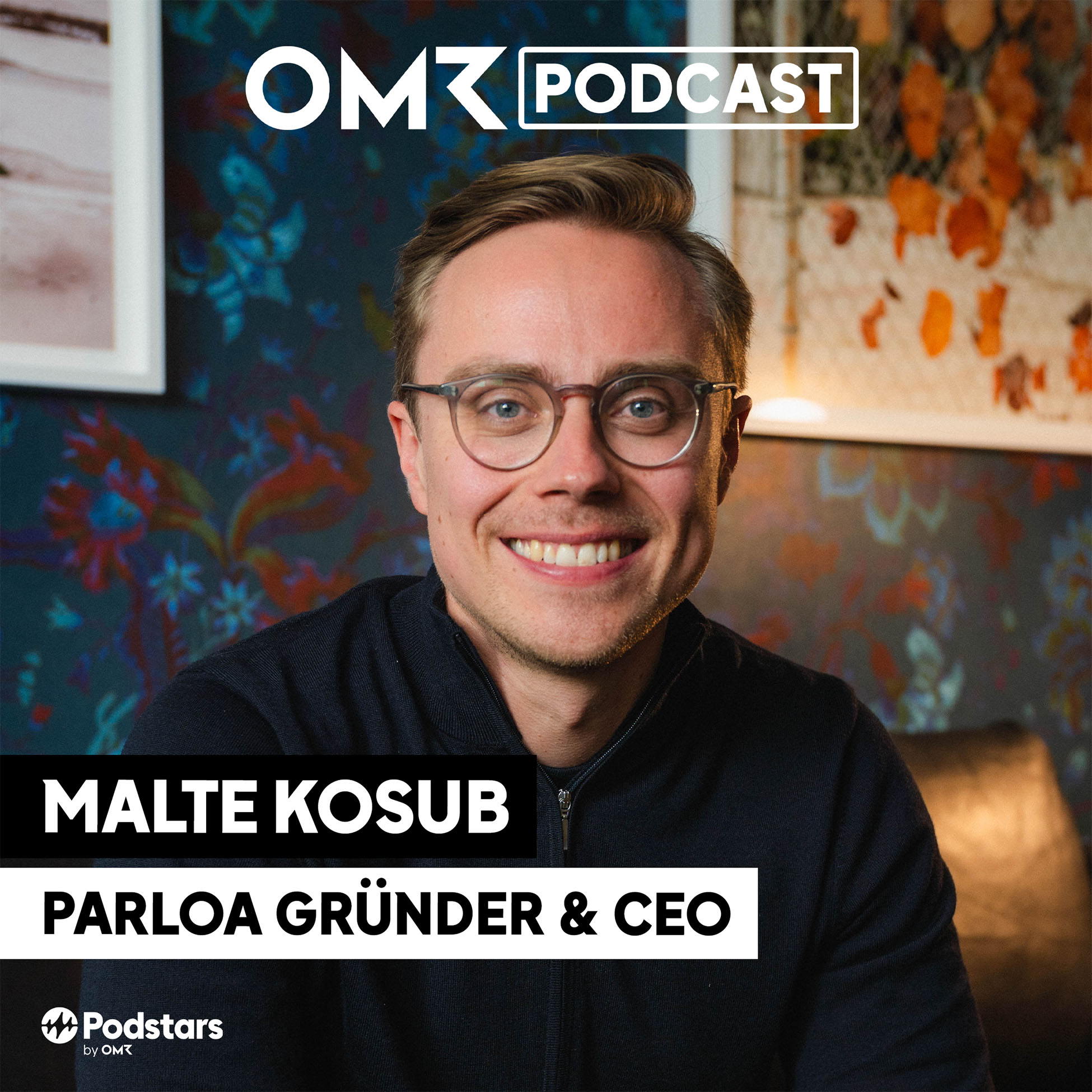
Mit KI zum Unicorn: Parloa-Gründer Malte Kosub (#846)
61m 6s
Malte Kozub, originally from Hamburg, relocated to New York to expand his European software or AI company, which is now valued as a unicorn. His company, Paloal, specializes in AI agents for customer communication, targeting large enterprises. They transitioned from traditional chatbots to AI agents due to advancements in language models. Paloal's early customers include HSE and Eon in Europe. The company made a significant decision to rebuild its product from scratch to adapt to evolving AI technologies. While big software companies like Oracle and SAP are entering the AI agent field, Paloal stands out for its focus and innovation in this domain.
Transcription
9651 Words, 52194 Characters
Today, the second podcast I brought from my late summer trip to New York,
I met Malte Kozub, the guy from Hamburg who lived here for a long time,
but has now moved to New York to grow his German or European software company or AI company.
He says, logically, if you build a software company in Europe and feel some traction,
then you have to go to the USA as soon as possible to be present at the biggest software market in the world.
And he wants to do that, because he believes in the largest order and value category of SAP or similar software companies,
possibly to be able to present.
So really, really big goals.
And if you hear that, then it is definitely very credible that he says so.
Many investors believe him too.
The company is now rated as unicorn.
And here it comes very, very painful for us, because we would have invested very early in this company.
We didn't do it and today it's worth billions.
I met Malte in New York, in the apartment of my friend Magnus at the Bowery.
And he told me how he started it and what the company Paloal has in mind now.
I can only say extremely entertaining, because really big thought.
And by the way, big thought.
My two editorial colleagues here at OMR, Roland Eisenbrandt and Martin Gard,
have researched how many people on social media are currently producing big thoughts and own series
and thus getting their accounts very, very crazy to grow.
I wasn't so sure, but there is a moving image, series boom in social media as a rich lever.
If you want to understand that, please read on OMR.com or click on the link in our show notes.
So read there what Roland and Martin have done there in the big hero piece of the week.
Hello, Malte.
Good morning, Philip. I'm happy to be here.
Amazing journey.
The first exchanges we had were a couple of years ago.
It shouldn't be a topic anymore, it hurts me because I missed it.
So thank you for the offer back then, but I didn't do it, so it was stupid of me.
Because you were very entrepreneurial in the early days and always been on it.
You made a music competition in the university.
Exactly.
I was never hired.
My first company was also founded in the school, when I was 15 or 16.
And then it started from one company to the next.
What was the first one?
The first was actually this music competition.
It was then a community again to help schools to organize professional music competitions
with more than 200 schools all over Germany.
And that was the first business start.
What can he do?
Then there were small projects.
I think the most relevant was Wandnotitz.
It was an e-commerce store for drug products.
We sold posters online.
We were the first ones who had the rights in Germany from Universal and Sony Lyrics to print posters.
We did that with Crow, we did that with the Fantastic Four.
And that was the breakthrough.
We wrote a love story in Hamburg.
It was a huge Facebook viral campaign.
Exactly.
It worked extremely well.
At the time, Facebook was the platform.
We had 42,000 shares.
Every second in Hamburg saw this video.
That was the start.
On December 6, we published it.
And until Christmas, we packed 12-hour packages every day.
Because so many people wanted to have this poster.
And was that a lucrative company for you?
It worked.
It escalated.
We did that with many cities.
With Crow, with Fantastic Four.
But it wasn't that big.
And then we sold it to a medium-sized printing chain.
And was that when you were in school?
That was when I was in school.
I got the story with me.
You didn't want to study at all.
In Hamburg, as a child, maybe you dream.
I wanted to study.
It was supposed to be a dual study.
I wanted to study in Hamburg.
I wanted to study at the same time.
That was the idea.
I wanted to develop a year between the university and the start of the study.
I wanted to develop talent so that it goes on.
But I wanted to join the university to get kids.
And then I was in the semester for a few months.
And in the end, I wrote down some emails and didn't do anything.
And then I thought, maybe I'll try to write the classes.
And then I learned three weeks in law.
And that worked pretty well.
Then I did the second semester again.
And then it worked too.
And then I thought, one third of the study went around.
And I invested seven weeks.
Maybe that's a good, efficient way to study.
Then I took three years.
And in the end, you were in Harvard.
MIT.
So I mean, with seven weeks of Germany, then to Harvard.
And MIT, I'm already crazy.
Yes, I said that at some point.
It was a dream of the people in class to go to Harvard.
And then I thought, I'll do that now.
Then try to go to Harvard again.
And then I needed to write a letter to the president of the university of Hamburg.
And it didn't work out that way.
That means it was already a bit bigger to catch up.
But it worked out.
And then you were there.
And MIT, that's the Institute of Technology.
So you were there for a while.
Exactly.
If you're in Harvard or at MIT, you can register cross-register.
That means you can then do courses at both universities.
And that's why I used it and made courses at both universities.
And then you made a German decision?
And then the next film.
Exactly, that was it.
I made the decision.
We were already in the sales process of Wandnoteds.
And then I wanted to do something more technical.
Because e-commerce is then a lot of marketing.
And somehow you have to build a real product for your cigarette.
But it's not really that deep, deep technical.
And then I met my co-founder in Berlin.
And that was in 2016.
Then AI research went through the coverage, realized that with Voice AI there is so much going on.
That the way and the way we talk to customers with companies will change.
And then we said, let's do something in that area.
And that was 2017 at the beginning.
But it was long before Open AI and Chatchapiti and so on.
And now, that's exactly what I think a lot of people might know.
They would like to do something.
How do you find such a topic?
And how do you find such a topic back then?
And how do you find a co-founder who can do something like that?
How did that come about?
Back then, that was of course the beginning.
And it wasn't the AI hype that we see today.
And we made 50 keynotes per year in 2017-2018.
And I told everyone, Voice Assistants will change everything.
And they will change how companies talk to customers.
It took six years longer than we thought.
But what you saw back then, when you look at the research,
that the quality of models is getting exponentially better.
So you saw that in the language recognition system,
that we reached the first human level in 2015-2016.
The translation of an audio file in text.
And you saw that back then.
And that was the first sign that something was happening there.
In the end, it took longer than we thought.
But it was lucky that we were on the right topic back then.
And how did you find Grünheim?
We are both in the foundation of the German economy.
That's a support for students.
And we met at an event back then.
But he's the tech guy.
Yes, exactly.
Okay.
And I mean, that was the time when I tried to reconstruct
where Amazon just came out with Alexa and all these things.
Right, we started to establish an agency.
Because we didn't know what the problem was.
So we started to establish an agency and see what we were building.
And then we helped big companies like them with Alexa,
with Google Assistant and generally with Voice AI.
And then we realized that the infrastructure was missing
to bring AI into production.
And that's how the idea for Paloa was born.
So Paloa is the company that deals with it today.
And what are you doing there?
So Paloa, you know it, it's based on evaluation and so on.
But what is exactly your solution?
We help big companies to introduce AI agents for customer communication.
So customer service or on the homepage in an app.
That means if you call somewhere, you probably have to hang in the waiting room for 10-20 minutes
and then talk to someone.
And that's maybe even the wrong person.
And we help companies to go to the AI agents and help them solve problems.
And the important thing is not old voice bots that never worked,
that don't understand you, but that are AI agents of the new generation
that actually solve the problem.
So tell me a reference customer where I could call now?
Booking.com for example, Alliance, IKEA.
Okay, so I have a problem with IKEA in the construction of a shelf.
And then I call Hotline and then I'm with you.
Exactly.
It's a great rollout, but that's the idea.
And then can your bots feed with IKEA information
and then tell me how I have to build the shelf?
Or how I can do my retours?
Or why I don't know, I'm disappointed.
Yes, exactly.
Let's get to the use cases.
First of all, we don't say bots anymore, we say AI agents,
because bots have a super negative connotation,
because bots haven't always worked that well.
And that can be in retail and e-commerce,
where is my order, I want to send back orders.
I have general questions in insurance,
I want to report a damage.
In energy supply, I want to report my cellar status.
There are very versatile topics there.
You can really complete the whole journey only with AI agents.
So you never have contact with people.
If that doesn't make sense.
In customer service you can ask level 1, level 2 and level 3.
And the higher the level, the more complex it is.
And especially in level 1, these are questions.
When will my order come?
I want to report my cellar status.
That can actually be automated at the end of the day.
And then you don't need people anymore.
And another question, where will a person come in?
Where does he hand over to a person?
It comes very strongly in the company.
And it comes very strongly when,
how many back-end systems are available per API at all.
How many companies can actually automate it.
That means there are companies where already relatively much,
30, 40, 50% can be automated.
And there are companies that can, it only works with 5%.
Because you have to take data into your heart to feed your agents.
Exactly, because in the end, if you want to change something with an e-commerce store,
but there is no point in the system,
then you have a nice conversation with the AI agent,
but the agent can't change anything.
So what kind of data systems do you usually need?
Let's say with a dealer,
then you go to the business system, right?
Exactly, to the ERP, to the CRM.
So all the systems where you have the relevant customer data,
from the order of the product.
Okay, and then at the end of the day,
do you also have a software fee for the software?
Yes, it's a bit different, because the exciting thing is,
we come from the classic software as a service model,
where you usually charge software per person.
And that changes everything now, because AI agents deliver a different kind of value.
And we basically calculate after consumption.
So the more minutes our agents interact with customers,
the more we calculate.
But the more our AI agents talk to customers,
the more we deliver more value.
So the more value, the more conversations we make,
the more we calculate.
Okay, so a conversation, if I now call Ikea,
and then there are 500 lines.
What do you do with it?
So size, or what do we have to prepare for it?
It depends on how complex an AI agent is.
There are then junior, mid-level and senior AI agents,
and seniority that uses larger models,
the more reasoning is basically used.
And then it comes from 15-30 cents per minute.
That's an arrangement.
Okay, so of course it's much cheaper than a call center agent.
If it was worth an hour, then it's just cheaper.
But in the end it's your competition.
So probably that's what we're talking about.
If you don't look at customer service at all,
the AI agents that help on the homepage and app,
but in customer service,
the big problem is that companies don't find
customer service employees, employees.
And that's why there are problems
that you have to wait 10, 15, 20 minutes.
For the first time, it's about improving customer experience.
Because it's incredibly difficult to find the people.
In the second line, if you don't have an AI agent,
you have to hire a call center or hire a client.
And then you probably won't have to pay for the same service anymore,
because each person costs more money.
Okay, understood.
So if you look at it like this, there's a call center company
at Börsen, and if you look at the distribution,
there are various Börsen call center companies.
They're all going down in the 18th course.
Is it because of the companies like you?
I think the trend is strongly influenced by AI
and companies like us, in any case.
And I think we work a lot with BPOs,
the call center providers.
We work with the two largest in the world together,
Teleperformance and Concentrics.
Our customers are in partnerships with them.
That's the second Börsen call center.
Exactly.
And what has to happen?
And that's what I'm talking about with others.
There are actually two ways.
The one way is to do these companies as far as we are now.
And then it's getting more and more difficult.
Or they transform significantly
and are actually going to AI companies,
which basically bring people and AI together.
That's a big transformation.
And some are doing it extremely well.
And some are not so successful.
And it's going to be difficult for them in five years.
Let's go back to the early phase of the company.
You started with this new topic back then.
How did you find it?
How long did it take until then?
We now have the idea of what we wanted to do,
from this marketing situation until we have a tech product
and until the first real customer live on the tech product.
We've been bootstrapped for a long time.
We founded the agency in 2017.
Then we started developing the software in 2018.
In 2020, we decided to build a product.
And the agency didn't want to do what we wanted to do long term.
And then we sold the agency to concentrate on the product.
And then it went on for two years.
We did a little Friends in Family round, but nothing big.
And at the end of 2021, it was a relatively important decision point.
We had a purchase offer, not a small one.
For Paloa, I think.
For Paloa, yes.
And we started a parallel financing round.
We had two ways that we would have sold now.
At that time, we had a large part of the company.
And in the end, for our age, it would have been great.
And we're talking about 10, 15 million or something.
Yes, it was 7 million.
Or we go on the venture path and build a big company.
And honestly, it wasn't a simple decision.
And then we went on the venture path.
And we started our first round in 2022.
Did you take in relatively name-based investors?
Say a few names of investors you invested in?
Ultimeter, they invested in OpenAI, in Snowflake, UiPath, MongoDB, General Catalyst.
They invested in Airbnb, Mistral, Durable,
Henry Ellenboog is one of the most successful US investors,
but also in equity ventures.
That's a great name.
Exactly.
And then of course you have to roll out this product.
For me, it sounds like today, if not the only value that would offer something like that,
it must be completely competitive in the market.
I imagine that.
Yes, it is.
But you also have to look at one of the biggest software markets
that will probably be available every time.
And if you notice that, you have a lot of competition.
It's quite normal.
I think it depends on the fact that you focus super strongly on a very specific customer segment.
And then hard work is to become the best.
What is the customer segment like?
We work very strongly with large companies,
large global enterprises that have a very high B2C volume on the phone.
And they are already ready to go the "agentic" way.
So "agentic" is actually in real-time customer interaction with AI.
But aren't you ready to do that?
Yes.
Okay.
What is their argumentation not to do that?
No, they have big compliance fears.
And say, we actually have to build a totally regular chatbots and voicebots.
And there is still a bit more fear ahead.
Okay.
And then who was the first big customer?
I mean, if you want to go into this market as a newcomer and say,
okay, we want to go to the big enterprises,
there are probably incredibly long cycles to win.
You don't even know a buddy who says, okay, come and test it.
That's probably a huge start.
Maybe you always have different milestones.
And they get bigger and bigger.
The first milestone was probably our victory at HSE,
the QVC.
Co-shopping Europe.
Exactly.
Oh, Taylor Shopping Europe.
Exactly.
That was our first very, very big deal.
The second big deal was probably Eon.
Oh wow, Stromreich, okay.
Exactly.
And of course it's getting bigger and bigger.
And of course they are...
But I mean, most of the companies are still not that great customers with you.
At least the last one I could see was 23.
It wasn't 100 million at the time.
I think it's pretty significant.
But now at least we don't have the unicorn traction.
And in general, the customer number is usually less than 1,000 customers.
Probably 10, 15, and then step by step, right?
Exactly.
At the beginning, especially with big companies,
you didn't have many customers.
Of course, we started with 10, 15.
Now there are more signifiers.
Of course, there are three positions.
Okay.
And of course, the turnover growth is also...
Usually, we grow absolutely faster.
But relatively slower.
We even grow relatively faster.
Because the revenue is there.
And we really made some decisions about what we should build.
Okay.
And then there probably was this moment for you when it came out.
And everyone started, okay, we have to look at it again.
What could it be for us?
To open the doors with the huge backwind in the transmission?
Exactly.
I think that everyone understood with Chatchivity,
okay, now AI is relevant and good enough
to build customer experience that doesn't only bring efficiency,
but simply make customer experience better.
And that was also in 2022.
That was still before Chatchivity.
And that was probably one of the biggest decisions
of the company history that was also very strongly discussed internally.
The old voiceboards and chatboards were very regularly based.
So you built decision trees.
But if we now talk about our conversation,
you can't map it into a decision tree.
Because a conversation can take infinite types of forms.
But voiceboards and chatboards used to be built like that.
And that's why they often simply didn't work.
Because it's impossible to anticipate a conversation like that.
And my co-founder said in 2019 and 2020,
"Malte, that's all total cheese."
We will never have conversations in life
that have a similar level to humans.
And with large language models, that was possible.
And in 2022, we said, "Okay, we just build
our entire product completely from scratch again."
And that was a lot of people in the product.
It makes a lot of money, it's super successful.
We just build everything from scratch.
And so far, we have built a phone system,
a cloud-first phone system.
But we just re-written the core product from the first line of code.
And who else is still doing something like that?
I mean, I feel that many big software companies,
the oracles of the world, the SAPs of the world,
are still trying to get into this field.
But they all try and talk a lot about AI agents.
If you look at a level deeper and look at what is there at all,
then it becomes relatively thin very quickly.
Okay, but aren't there really market leaders at all?
Yes, of course we already have relevant market leaders in USA.
Sierra, for example.
I think John is relevant for the market.
But if we look at the agentic AI for customer communication,
for big companies, we are the only ones in Europe.
Okay, and when did you do the last round?
No, that was this year in April.
That was our 120 million series.
And then there was the film rating over a billion.
Exactly, one billion.
And it was also important to have this unique moment.
In the end, I also say to the teams,
we always do this to become world market leaders.
And we do this to show that you can build a leading software provider
from Germany again.
And there are financial rounds and a part of the journey.
And of course the unicorn rating helps to increase the attention
when it comes to becoming a unicorn.
And before that, there are two starting points.
You have to build the system so that it really works.
And how long is it from one talking to customers until the solution is live.
Yes, so you had two deciding points.
Once, one says to a company, "I want to do this with you, Paloar."
That takes three months.
You notice that in the sales cycles,
the sales cycles are much faster.
We have a contract of over 10 million dollars in 40 days
from the first meeting to signing.
We sign what is incredibly fast.
You notice what is happening in this industry.
And when we sign it, until the goal is live,
it is within 10 weeks.
But then your technology is adapted to customers' logic again.
Exactly. If you were to onboard a human agent,
you have to train as well.
You have to train for the system.
And you have to do the same with a major agent.
Which systems are relevant?
How are the processes for the certain company?
All of that you have to do.
Okay. And there are currently several hundred customers live, right?
More than a hundred customers live.
And the target market is probably thousands of customers that you can get.
Exactly. It is a market that has several hundred billion potential.
And that is one of the biggest softwares there is.
So you are not still like UiPath or Celonis or something?
Signavio has always been a big European software company
that came out in the last few years.
But to become that on the jump.
And then when it has become that,
it is the next jump to become SAP.
Exactly. That is the ambition.
Okay. But of course it is also powerful.
I mean, they are already worth a hundred billion.
Yes, exactly. But of course you don't build that in three years.
But that takes time.
But I think that we need this ambition in Germany again.
I think one of the big problems is that we unfortunately often think too little.
Why can't we rebuild 500 billion companies from Germany?
So one of our values is that you ...
And I always try to say to all of us and people in the interview
that if others don't say that the ambitions are completely crazy,
then you probably don't think big enough.
And as I said, it doesn't happen overnight.
How many years have you been building that?
How many years?
I am 32 years old.
So who brings you something like that?
Is that your own opinion that you are living now or where did you look at it?
That is a very good question.
I think that probably went away during school time.
If I had set a big goal, I don't know why.
And I was lucky to be able to fulfill some of the goals through hard work.
And that strengthens you to continue doing that and to set bigger goals again and again.
And only if you set the big goals, you somehow get there.
And sometimes you don't get there.
I think the time in Harvard has really inspired me.
Because you are in a field where everyone thinks incredibly big.
And where you get in contact with people who have achieved great things.
And who are actually the only people who say, you just have to want it.
You have to work harder and then everything is possible.
And I think we have to put that much more into the heads in Germany.
And do you still have to give away a lot of money from the company?
I mean, when you look at the cap table, you can also see that it just wasn't possible to get the funding in.
I think you have about 10% left.
So you don't think, fuck, now I'm here with such a huge thing.
Or do I motivate you to say, OK, then I just need 100 billion then there are also 10% 10 billion.
Yes, exactly.
I have about 5% to 500 billion companies than 50% to 100 million companies.
I think it's part of the journey.
And especially if you have such a big ambition and have a market where you have a lot of competition,
then you have to go to foreign capital to grow quickly.
I don't know if you know the book by Reed Hoffman, Blitzgailing.
Reed Hoffman is one of our investors.
And in this book he says, there are situations in markets where growth is the very first priority of foreefficiency.
Because if you have won customers or markets for the first time, the efficiency will come or the profit will come later.
And we are in a similar moment right now.
Now it's about growth and so much of this market to win, how it works somehow.
It's not a burn, because you build up a global organization now, because you have to win the market or the customers.
Probably also relatively high customer acquisition costs in advance.
So to win such a large customer, you don't do that somehow.
How do you know that in the B2C?
For 50 euros you could win in the Netherlands.
So something like that for 30.
For you it costs probably 10.000 euros to win new customers.
Exactly, it's significantly more expensive than the e-commerce.
Of course you always have to look at the KPIs at the end and they are sustainable.
And they are incredibly sustainable, otherwise we wouldn't have raced these financial rounds.
But of course it's more expensive there.
So probably even 10.000, if I look at it later, it would be cheaper.
It would be very cheap.
I would say Philipp, okay, let's go.
Let's go, all customers.
10.000, I'll give you that.
Yes, it's more expensive.
Okay, okay, okay.
But if you look here now, you have to find out which size it is.
You said IKEA and such a huge monster.
But how many employees are there?
Or is the customer number relevant for you now?
We say that if you have half a million phone calls or half a million checks a year,
then it makes sense for us to start talking.
Okay.
And I know most of the companies how many people call a year.
You already have to have relevant B2C volume.
So then the turnover translates to 100 million euros plus?
That comes very strongly on it.
We look at the HSE, of course, they have incredibly many calls compared to their turnover.
If you look at B2B companies, then the calls are much less compared to the turnover.
That's why it is incredibly difficult to say what a turnover is.
There are companies that have 100 million turnover, that have so many calls.
There are companies with a billion turnover that don't have so many phones.
It comes very strongly just on the business case, on the business.
And how many people do you have in your company?
Over 300 people.
300 people?
Yes.
In Berlin?
We have a lot in Berlin.
So the whole engineering and product is in Berlin.
And most of them are in the US.
So you are now in a relatively early phase.
So the company is now so relevant with the new product, maybe only three or four years old, I would say.
Yes.
Have you already decided that we are going to the US now?
And you moved to New York yourself and you are now doing business here.
Do you have to finish Europe first or do you say no?
The topic is so huge and I have to conquer the market here before it is gone and others have their claims.
Yes, it is always the most difficult to keep focus, but at the same time to take the next steps.
And of course you are always in this challenge in a fast growing market.
Why did we take this step?
A. It is not easy as a European company in the US and you have to start and it takes time until you can celebrate the first success.
And the sooner you do that, the better.
Especially if you want to win American investors, it also helps to have traction in the US.
And secondly, of course, we looked at the right people in Germany who we trust that they can make German success in a few things in the US.
And we have answered that with a very clear answer.
And no one has disappointed us. Everyone has done a great job and that is why it was the right decision.
You told me that you were here for two years.
In a small rework you started in New York to start the US rollout.
And there was already a lot going on in Berlin.
There were a hundred people in Berlin and the boss is here.
At the end you have to start a bit from scratch. It was like when we were 2/17 in our new office with three people.
That's how it was here.
We got married to one person from Germany in the USA and sat in our re-work in a office.
And then you start and you have to prove yourself.
Did you call your own customers or what?
We made a cold calling.
At the end of the day you have to start a customer conversation at the beginning.
But is cold calling or texting people via LinkedIn?
We do outbound via LinkedIn, outbound via e-mail, via telephone, which still works best.
We get introductions from investors of different ways and ways we come to customers.
And then it was hard work.
You fly across the country and meet the companies and try to convince them.
Exactly.
The interesting thing is that there is also the difference between Germany or Europe and the USA.
The American companies tend to be very loud about their software.
Maybe they are a bit behind in the software and we tend not to be so loud about our software.
But we put in a lot of time. The software really works.
That means no one knew us and then you had to argue a lot about the product and show us the truth.
Have you ever seen a typical American reference customer who uses you?
Yes, we have very, very large American customers.
We can't talk about all of them.
But we just have a few past 200 customers.
Okay, okay.
How do you say the road?
Do you do it until the IPO?
Or do you click on the other films and say, okay, what are you doing?
That fits great to Oracle or something like that.
If you look at Larry Ellison, the richest man in the world, Oracle.
You can imagine what these companies all have for evaluation and balance sheets.
Then they come and get you.
Or do you say, okay, great, now I don't get 7 million, but I get 7 billion.
Or do you say, I'm going through until the IPO?
The goal is to become world leader.
And there can be an IPO a relevant step.
If you look at Stripe or Databricks, it also works if you are organized from a private market.
At some point they will certainly do an IPO.
But the goal is to show again how big software companies we can use.
And you are really an excellent product and not just a feature.
You can also say that the cool thing about you is that you are very deeply integrated in the customer.
If he works with you once, then you have the interface to the entire internal software solutions that are used there.
And then you have the standard.
If you have a customer, then you won't be able to start it so quickly.
Since the solution doesn't work at all.
That's a big value.
The question is, is that enough as a product?
You're talking about a real topic.
You don't have to call it a point solution, you just have to build a platform.
And that's what we started two years ago.
In fact, other companies can build on our platform, for example, or you call it a composable platform.
That means big enterprises can use parts of our platform, but not all of them.
That's what we started with.
And that also works extremely well.
But you have to build a platform to make this big story.
What do the others do?
What would someone do if someone was on your platform?
For example, Eon, they built their own utility solution on our platform.
They sell it to utilities.
Eon works with us, but Eon also works with us as a company that works on our platform.
They also build AI agent services for other energy providers.
And if you hear yourself in the unit, or if I or the hearing person call you somewhere in the unit,
is it really just faster to get an answer?
Obviously, I can imagine that.
But is it really better if there is a smarter person on the phone now?
It's very much about the company.
We assume that you can no longer distinguish between an AI agent or a human in the next six months.
The AI agent will always say that it is an AI, but if you only hear the voice and the natural experience,
you won't be able to distinguish it anymore.
And what we see in the numbers is that it becomes more efficient customer service and the net promoter score or the C-set actually increases.
So the people on the phone say that the phone helped me, that it helped me.
Yes, and it was actually better than what I had before.
And you had to think about it.
If you have the perfect human agent, then it's a great experience.
But that's unfortunately not the transparent experience that customers have.
The transparent experience is that they hang in the waiting room for a long time, then they are connected to the wrong person,
then they may be connected to an off-shoring or near-shoring agent.
The people are also just there for a few weeks, they are not really trained.
That means the transparent experience is simply not good.
And there the transparent AI agent is already better in most cases.
And is it possible that in the future AI agents, who are built on the customer side, will also be called by real people?
Or will there be a kind of assistance or co-pilots that are called by all kinds?
In the end, I just say to myself, please explain this to me.
And then my agent will call your customers.
Yes, I think both will actually happen.
At least 10 times more conversations will be held than today.
A. If the homepage is much more conversational in the apps.
That means you don't have to click on a complicated menu, you just talk to the app or the homepage.
And secondly, if the people don't just call, but a chat GBT, a Gemini, a Siri will call customers.
If you want to change your address, you really have to call your three insurance companies and e-commerce.
Or you just say to the chat GBT, hey, talk to these companies and then talk to the chat GBT about these companies.
And that's why conversations will increase significantly.
And that can't be started by people anymore.
You need an AI agent to catch all of that.
What I haven't understood yet is that everything is properly built by you.
Your own LLM, your own foundation models, I think.
And where do you still use something like OpenAI technology or Microsoft or something?
There are always the rappers who put themselves on something and say, I'm just good at sales and have a great idea.
And then I'm a small layer and at the end of the OpenAI, you take an image out of it.
I think that's very clever.
The question is if you can build a billion-dollar company out of this proposition.
Where do you see it?
We use OpenAI and external models, we don't build our own models.
I would say that we only talk about a small rapper.
A small rapper would mean that 90% of the value creation comes from the 80% model and the rest is basically just the rapper.
But the models are only 5 or 10% of the value creation.
You have to build a lot for big enterprise companies to build this model.
How can a business unit even brief the AI agent and do the right training?
How can this AI agent get better continually?
How do you simulate and evaluate this AI agent?
How do you integrate it into all the backend systems?
How do you deploy it into a home page, into an app, into a phone, into a chat?
How do you ensure that the guardrails and the compliance are kept?
How do you deploy it into different regions?
It's a lot that you have to build around this model.
In the end, the model is just a small part of the value creation.
There is a lot of discussion about OpenAI now.
What is the best model and feels like there is a new style of best scores every week?
Do you look at it and say, "No, we have decided for OpenAI and that's our partner."
We have a super strong partnership with OpenAI.
In the end, it is the decision of our customers, which model they use.
Exactly. We can also orchestrate the models.
We believe that AI agents in the future use different models for different use cases.
They can be models of different offers, but they can also be different sizes of models.
Because you use a small model for an easy topic.
I find it very difficult to use a large model.
So, in an openAI house, OpenAI can also be called entropic or parallel?
Exactly.
Is that your main cost position to pay these models?
Or is it a marketing cost and a personal cost price?
So, if you look at the software costs, which are on display for us for a month,
then it is actually the total cost for the large language models.
So, if you read OpenAI now, because you are not in the next 10 years or more than that,
then some of you will come.
Yes, that is correct.
A part of us.
And how is your general forecast on AI?
You are super bullish.
Where do the limits go in the future?
What do people do and what not?
That is a very good question.
I think that we can philosophize about it for 4 hours now.
Because I think that the working world will change significantly in companies,
because AI can take over more and more value.
I still believe that we are at the very beginning of this development.
But we will see day by day how much efficiency can be achieved through AI.
And of course, I am very bullish.
Yes, but see day by day what is actually in favor of it.
So, if you pitch for companies, tell them specifically,
"We can reduce your call center costs or communication costs
or personal costs to reduce factor 10 or something like that?"
There is also a lot of companies coming.
Is there a lack of customer service employees?
And in most cases it is the case.
That means the business case looks different in every company.
But what do you see?
You are already making people hot.
When I hear this, I would think, "Hmm, interesting.
Let's talk a little bit.
If they can save millions now, then they should always come."
Exactly.
They should all come.
In the end, of course, each company can make a certain amount of money and save a lot of money.
Okay.
And in the future, many people are unemployed.
Do you think AI takes over everything?
Or do you say, "No, it was always like that.
Everything came new technologies and there was still more to do than before."
I think when we look at customer service, we have to look at reality in the eye
so that it looks different.
And that the number of customer service employees,
who have done customer service at level 1 or level 2,
are no longer needed.
Other roles will be relevant for this.
There will be supervisors, who are basically AI agents.
Then you have a person who supervises 50 AI agents.
And we just said, "There are 10 times more conversations with companies."
That means you will need a lot of AI agents.
People will need to train AI agents and prompt them.
That means I think the working world will change.
But we have to look at reality in the eye so that the working world will change.
But I always had a quiet suspicion at the end when I heard this AI in the voice area.
That's why it's often been so disappointed.
So from the time of the bot generation and also from Alexa.
That was almost an disappointing experience.
When we thought that Amazon had pitched it so high,
then there were also Alexa agents, like my friend Andrei, who invested in it.
It was insanely difficult.
We thought there would be a new world with new applications.
Everything didn't come for it.
Nevertheless, there were experiences like, I don't know, you talk to someone and you think,
"Hey, there's no such thing now. I'm getting frustrated."
But you say, "It's not like that. It's really seamless."
And when you call your customers, then we think that's cool.
Yes, actually, I think it's just a new world.
In technology, sometimes there is a 20% evolution step.
That's a little better.
What happened in the last two years is 10x better.
That's why, yes, the experiences are at a completely different level.
And I think that's where we develop in customer communication.
In the end, you are also an example for the fact that it might have come out of Germany.
A large billion or the next one will only be more than a billion software companies to build.
Since Ceylon and Signavio, it hasn't been given, right?
Yes, there are a few companies, but not on the large scale of Ceylon.
There is still content from Berlin, for example.
There is Personio, but there is not a lot of examples, in any case.
And why does it sound like this when it starts rolling for you?
I think it's because of the ambition that we have to think bigger in Germany.
Of course, you have another possibility to collect capital, if you have the ambition and go to the USA quickly.
But it's also a success to get the capital.
I think you can do it.
You can do it, absolutely.
I think there is a lot coming together.
You need the ambition, you need a team that works super hard.
Especially when it comes to software, you have to put the step in the USA relatively quickly.
I also have to commit to the team.
And Ceylon, Alex and Basti are also super fast and super early in the USA.
These are all things you have to do.
And if you don't think so much, if you don't go to the USA, then it will be more difficult to collect money from American investors.
Then it will be more difficult.
But it's amazing, when you look at it, how it works with you.
You sit in there and know how difficult it was, how happy it was or not.
But we talk about such a software world for 10 or 20 years now.
And then we come to 3, 4, 5 companies.
Contentful, I didn't get the point, Personio.
Then there are no more that many in the billions.
No, and you also have a different network of other successful software companies that come out of these software companies and new reasons.
And then you get investment from the founders of other companies.
And of course you have a completely different ecosystem, if you're in the valley or in New York, when you have it in Europe.
And that helps, of course.
And then we have to do a lot more in Germany to build this ecosystem, to help young founders, to show where they can go, what is the right way there, how to get the right investors on board, what are the right steps in the USA.
Because in the end, most founders do it for the first time and there is not a perfect playbook.
And the ecosystem in Germany is certainly still much, much back in comparison to what you find in the USA.
Do you have to raise again after your business plan next year?
We have to raise, no, we could make the whole thing profitable.
Should we raise, if we really want to be market leaders in this market, then yes, because it is too competitive.
And for that, if your competitors collect money, then the probability is that you also have to collect money, because of course you want to grow quickly in other countries and so on.
And if you go to other countries, the countries are initially not profitable.
That means the probability that the further negotiations come is relatively high.
Okay, so you are probably already there.
No, of course I speak regularly with investors.
Yes, of course. We are trying to focus on that very, very much.
So the last financial crisis, they were, they had 15 workshops, actually three weeks from the first conversation to the term sheet.
And then there were over 100 million in there for three weeks.
Exactly, exactly.
Because we believe that in the end you need a focus.
And if I were to do the whole thing a bit fundraising, then I wouldn't do other things.
But also the people in the team who take care of fundraising.
That means right now we are not in fundraising, right now we are in the company to build up big.
Or your sales team here in the USA?
Or are you all Americans who have become you yourself from sales force, from other big companies?
Exactly, in the USA we have a lot of American people, great people from the USA.
So the experience is logical, because you already have the opportunity to bring a customer and a network with you and so on.
Exactly, that's also an exciting difference between Germany and the USA.
You have a lot of talent in the USA that comes from very successful software companies.
Of course, if you have fewer successful software companies in Germany, there are of course fewer people who have seen this path and have already done it.
And why New York and not West Coast?
Or is it Silicon Valley?
We have a lot of customers on the East Coast.
And the six hours of time shift is of course significant, just nine hours.
That's why we decided for New York.
And I think that's the way it is.
And do you plan to be here for the next two or three years until you come back here?
The goal is to spend a lot of time here in the next few years.
And of course that is always back and forth.
I am also in Berlin and that is always a back and forth.
But the focus is to continue to act globally and not only in Europe.
That means that we are now in the USA, in Europe and then in Europe there are other markets in Germany.
So it's kind of like France and so on and so on.
Yes, we have already united customers in Europe and we are now making it much more structured.
We will now open an office in London that makes London and the UK and Nordics open.
And that will be expanded step by step.
So it's interesting that in e-commerce you start in Germany and then maybe next time maybe in Poland and France.
In the software field, you don't do that.
You do that when you do a market in Germany.
Then you immediately go to the USA because you have to have the market in control.
And then you can still go back.
Exactly, America is the largest software market in the world.
And you can see the large amounts of contracts that you close here in the USA.
Your biggest customer doesn't have to say who, what kind of contract volume are we talking about?
Then it's already over several million per year.
Okay, okay.
Impressive, awesome.
So yes, I really think we have set up a thing with 32 now and are still in the middle of it.
Next financial round, what do you hope?
So can you create a jump to 5-6 billion rating?
We always try not to talk about rating that lie in the future.
If we try to work hard, then we will see where we land.
But a next financial round will surely come.
I mean, you have raced in time.
You have to make it clear again where the multiples were no longer like before.
Not yet during the pandemic, where you didn't have one million sales.
Then you had a factor of 100, sometimes.
Or there were also in many companies a factor of 50 on sales and so on.
That was the beginning of the year, not yet.
That means your multiples were already clearly down there.
And if you look in the future, then you probably have to think again with some low multiples.
Yes, it depends on it.
I think the multiples, the amount depends very much on what investors see in you.
And of course we are still in an environment, in a situation where we have such strong growth rates,
that you don't have the normal multiple that you grow at a growth stage software company,
but we grow by over 4.5x.
With such strong growth rates, it is much more about what companies can do in two or three years.
Okay, that's four to five times per year.
Exactly, yes, from August to August.
How did you get to read Hoffmann?
One of our restaurants made an intro and then I spoke to read and he was excited.
And then he said, "I'm here."
Do you have any other promises like this in the cap table?
We have Mario Götze and Bastian Schweinsteiger.
How did that come about?
Mario is known, he makes a lot, so to speak.
Yes, Mario makes a lot.
We got an intro and then Mario is cool and then he said, "What are you doing?"
What was your first start-up investment?
Really?
Yes.
He is totally confused and thinks, "How cool is that?"
Exactly.
But you don't have regular contact with him or something like that.
Do we have the money here or can you help?
Yes, Mario is very engaged.
He is very busy with what he does.
And he talks regularly with what he sees.
He thanks you for his money, for his investment.
I don't know how much it was, probably it would have been 500,000 euros.
He makes his return 10, 15, 20 times.
At the moment it looks pretty good for him.
At the moment it looks pretty good, right?
He was pretty early on, I think in the series A Mario was added.
And there is a good return on that.
So it means 10 already, right?
Yes, over 10.
Good.
He has to play for Pulsar two years.
If you really invest, then it works.
But of course you also look at the ones that worked.
There are certainly some that didn't work.
I mean, you have to take a shower.
And the first one from the USA is that all the textiles are very different from in Germany?
So the ecosystem is already bigger, of course.
I think the big difference in the USA is that my feeling is that the decision speed is much faster.
And because of that, faster things are decided and implemented.
It starts with hiring.
When you start hiring in the USA, then it goes very fast that the person starts in two to four weeks.
In Germany it takes three to four months.
And that's already a difference in the culture of how fast you make decisions.
And especially in the real world, the topic is also unregulated here.
It's more positive, more free and it helps you.
There is at least the reading and listening to big differences.
Yes.
So in day-to-day you don't see a big difference.
You already have faster decisions in the USA.
In our particular area there is still no restriction on what use cases are in comparison to the USA and Europe.
We assume that in the future there will be more regulation in Europe, where we can focus on it.
Where American companies that come to Europe first have to focus on it.
You can also see it as a chance for European companies.
But for day-to-day there is no big difference.
Have you already taken something on the table yourself and invested in game money?
I once did it in secondary to buy a house for my mother.
But I don't invest much because I focus on the company.
There is a whole new generation of people who build things there.
I remember a Christian Hecker or Eric who also does big things in the FinTech area.
With Trade or Scalable.
There are generations that do rock it.
Yes, there are.
I think there will be many more.
We all have to move on and think big.
In the end it is a journey to build the next SAP.
Or a company that is the largest in SAP.
You don't need that in 5 years, it takes 10, 15, 20 years.
Have you ever met the SAP Orbit?
No, I would have been able to meet them next week.
But we have our own conferences, so I don't feel that.
Do you have a conference at the workshop?
There is a small meeting of customers and partners.
As a big customer, you will understand.
We like to stay there.
I find it very interesting to see.
We just made a podcast about the SAP Journey.
It has been going for almost 50 years.
Today, not everyone in Germany knows exactly what they are doing.
But that they are very successful.
And that the founders of today's football are similar.
We are now at your journey, your journey.
A little earlier than at SAP.
Try to accompany it now.
When you start with a football club.
Or how far it goes.
America's Cup Seagulls like the SAP colleagues.
I would be happy, because you said that you really succeeded.
To build something great.
Thank you very much for being here in New York.
You are welcome, Philipp. Thank you for your insight.
All right. Bye-bye.
Podcast Summary
Key Points:
Malte Kozub moved from Hamburg to New York to grow his European software or AI company.
His company, Paloal, is now valued as a unicorn by investors.
Paloal specializes in AI agents for customer communication, focusing on large enterprises.
The company transitioned from traditional chatbots to AI agents due to advancements in language models.
Paloal's early customers include HSE and Eon in Europe.
Summary:
Malte Kozub, originally from Hamburg, relocated to New York to expand his European software or AI company, which is now valued as a unicorn. His company, Paloal, specializes in AI agents for customer communication, targeting large enterprises. They transitioned from traditional chatbots to AI agents due to advancements in language models.
Paloal's early customers include HSE and Eon in Europe. The company made a significant decision to rebuild its product from scratch to adapt to evolving AI technologies. While big software companies like Oracle and SAP are entering the AI agent field, Paloal stands out for its focus and innovation in this domain.
FAQs
He believes in the largest order and value category of SAP or similar software companies.
Malte Kozub's company focuses on introducing AI agents for customer communication in big companies.
Malte Kozub started his entrepreneurial journey by organizing a music competition in university and later founding an e-commerce store for drug products.
Paloa helps big companies introduce AI agents for customer communication to improve customer service and customer experience.
Paloa calculates based on consumption, where the more minutes the AI agents interact with customers, the more they charge.
Booking.com, Alliance, and IKEA are some companies that Paloa works with to introduce AI agents for customer communication.
Chat with AI
Loading...
Pro features
Go deeper with this episode
Unlock creator-grade tools that turn any transcript into show notes and subtitle files.
 PodcastTranscript AI