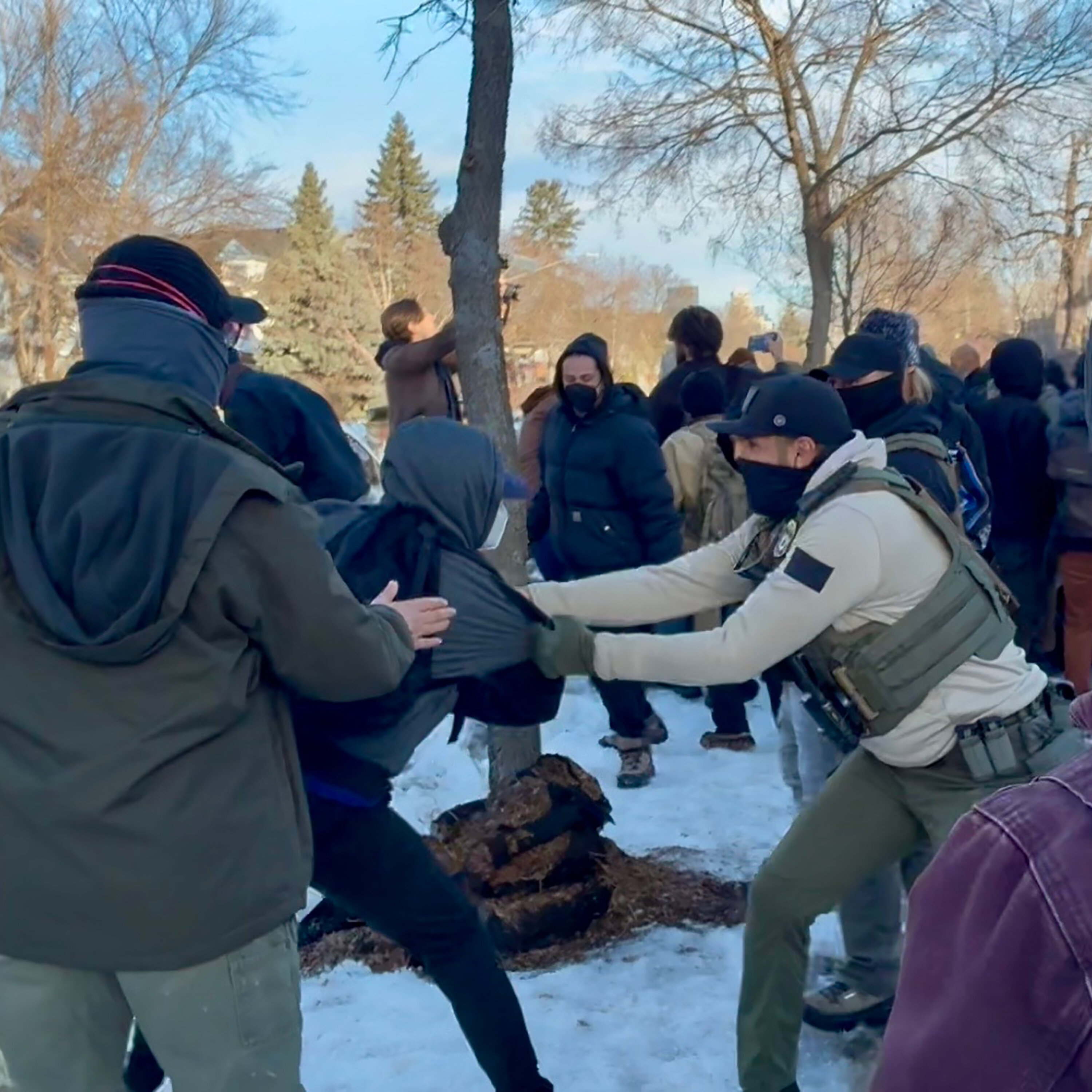
This transcript details personal and community experiences with ICE operations in Minneapolis, framed within a podcast narrative. The primary account comes from the narrator's wife, who describes witnessing an ICE raid characterized by unmarked vehicles, aggressive arrests, and the use of force, including pepper spray. She later learns a woman encountered during the raid, Renee Good, was fatally shot nearby. The violence traumatizes the community, leading to school closures and difficult conversations with children. The story then shifts to Julio Cesar Sosa-Celice, a Venezuelan man shot by ICE, and his family. Through an interpreter, his mother-in-law Yamileth recounts her family's harrowing migration to the U.S.—including a dangerous trek through the Darién Gap and a perilous ride atop a freight train—to reunite with her daughter. Now, following Julio's shooting and arrest, she lives in constant fear, keeping her children home from school and hiding in her house, illustrating the profound and lasting impact of immigration enforcement on families.
This is an I Heart Podcast. Guaranteed Human. I'm Drew Broussard, host of the LitHub Podcast. Every Friday, I take you behind the scenes at Literary Hub, chatting with staff, writers, and other literary figures about everything going on in the literary world. Find us now anywhere you get your podcasts. [Music] Pushkin. Hello. Hi. My wife. Hi. My husband. How are you? I'm getting through. Yeah, so you wanted to talk? Um, I did. I feel like we haven't had much of a chance to connect over the last couple of weeks because there's been a lot going on here. Here is Minneapolis, where I live, and the epicenter of what the Trump administration is calling, Operation Metro Surge. Since it all began, with the regular business of work, childcare, and running a household, Emily and I haven't really had a chance to sit down and actually talk. I knew she had a lot she wanted to tell me, so I asked her to start at the beginning. Um, on Wednesday, January 7th, I had dropped Aggie Fett school, and I was driving down 36th, which is a one-way. There were, I don't know if it was 6 or 8 vehicles coming directly toward me, going the wrong way down a one-way at full speed, and I really thought I was going to have a head-on collision. Then they just suddenly stopped, and then a bunch of men started running out of the cars, and they were all masked, and all the vehicles were unmarked. My brain just wasn't connecting what was happening, and then I saw two women running toward this scene with whistles. And then somewhere in my head it clicked, like, oh, this, this is an ice-raid. I didn't even know exactly what that meant, but I just felt so clearly like something wrong is happening, and so I parked and I jumped out. I ran up to the building, and they were all pulling away the woman who had a really little like five-pound dog, one of the ice agents just swerved right at the dog. And I was really emotional because I was still had a lot of adrenaline. I was coming on the women, almost hit me. One of the women there hugged me, and she just kept saying, "No, I know what." I said, "What do they think they are?" "Who do they think they are?" "Oh my gosh, it's just too much." I mean, that's when everything just like exploded. I got home, and you know, I had news on the background, and I saw that a woman had been shot dead, and that turned out later that this was really good, and she had just dropped her kid off from school, too. She was shot about 40 minutes after I had that encounter about four blocks away. Ice-oh, no! I went to the vigil that night. There were a lot of people there. I think everybody there really felt an obligation to be there. While I was there, I got a text from Katie, my sister, telling me that ice had showed up at Theo's school. Theo is our 14-year-old nephew, and that they had pepper sprayed a crowd of teachers and students. So she texted me that, and then wrote, "I have no idea how to process this with my child." When did I learn what ice was a thing? When did you learn that ice was a thing? I don't do you remember? No, you? Anoggy. You know, Auggie's nine. And so that's been one of the really hard things here is to know what do you tell your kid. I've been trying to talk to him about it just as honestly as possible with trying to emphasize that he's safe. But even if he is safe, there's a lot of kids right now around this city. His age, who aren't. And that's how do you explain that? Do you talk to Auggie about Renee Good? Yes. And what was that like? I first told him that a woman had been shot by ice. Then the next day, Julian came over and Eli Julian's dad said something to me about, "Oh, and you encountered them that morning in front of Auggie?" And so then Auggie was like, "Wait, what?" "We are ahead right now. Yeah, I'm okay. Um, number you wouldn't have stopped if I was in the car?" No. No, I don't need it. And we talked about it for a couple of minutes and then he said, "Okay, I think we need to stop talking about this now." And so I respected that. He stopped talking about it. So then the Thursday and Friday after Renee Good was killed, schools were canceled across the city because it just wasn't safe. I stayed home with Auggie and some of his friends came over. And throughout the day, we would be playing. The kids would be playing and they would just, they'd be fine. And then they would say, "It's so sad. Like this is so sad that ice murdered somebody." This is what Auggie's friends were saying. Yeah, yeah. And I actually have a really clear memory that day. We were working with the hot glue gun and Julian somehow cut his hand and the concern that they all just sort of rallied around him and were so worried about his hand. Julian. Yeah. He's like the Mr. Tough guy. And then there was this moment after I bandaged it up that we all, I've never had a moment with the boys like this where we all sort of like hugged each other. The boys went for this day allowed this. Yeah. And I do think it was just like this moment of vulnerability that we were all feeling such a weight. You know, that it just allowed us to have this moment of coming together. It was really beautiful. Wow. I mean, everything is completely overwhelming, but you still have to eat. You still have to walk the dog. And you know, kids are still kids. That next morning I was laying in bed and I didn't even get in wearing a captain's hat and a suit jacket and started rapping about yachts. I want to move from a birthday yachts. It was all about going on yachts and having cookie vacays. Gotta have a cookie vacay right now. We could all really use a cookie vacay. I wanted to keep baking yachts. I wanted to move my birthday yachts. You don't need to do the best yachts. Tuesday. This is Tuesday the 13th, less than a week since Renee Good had been killed. Once again, I had dropped Aguioff at school and I was driving home. And suddenly all these vehicles started squaring around my car. And I'm a little bit boxed in. And then I started hearing the whistles. And so I decided to get out. There's ICE agents all over. They're going up to an apartment building, yelling. You gotta open up the door. And you know, the crowd is slowly growing. But pretty quiet. And then they come out of the apartment building. And they have two guys who, to me, looked like children. They're like early 20s at the oldest. But I'd be surprised if it was even that. One of them is wearing a t-shirt in shorts, even though it's, you know, very cold outside. I mean, it's so cold, it's the kind of cold that, you know, you take your gloves off for a few seconds. And your fingers just really hurt. Like it is hard to be outside in this weather. Yeah. And when we see the kids, we just start screaming. Shame on you! Shame on you. I'm a mom.
You know, like, shame on you is the words that come to mind. And we're yelling, you know, "They're kids." And. Sorry, this is gonna be the hardest part for me. So everything I should just say first, like everything escalated very quickly. It just becomes chaos, where ice agents are just pushing people, shoving people, kicking them, you know, they have them down on the ground. I can't even describe the feeling where, like, literally three feet from me, I see a man, like, just a Minneapolis guy on the ground, and an agent just pepper-spring him straight in the face from three inches away. And I mean, every part of you just wants to run and just, like, tackle that guy, but you know you can't. And so you just yell, because what else do you do? But just to stay out there and see somebody brutalized like that, you just feel so powerless. (crying) So I'm standing on the corner, and they're trying to get this car to go. This woman in the car. And there's nowhere she can go. I mean, it was just chaos. And they're screaming at her. There was, like, 15 agents, you know, just surrounding her car screaming at her. (crying) All of a sudden, they break her passenger side window. Then they go around to her side, and forcibly pull her out of the car, and she's screaming. And then they've just got her by all fours, and start carrying her away. And then I see that they have a white-haired man that they are carrying by all fours. And they open the back door of a black SUV and literally like stuff him in. That's the only language I know how to use. Sorry. So they stuff him into the vehicle, and then. All right, this flash box is all over the place. And then the first. I got it back. I just hear a bunch of like, "Papa, papa, papa, papa." And I figure out that these are, I guess, what are flash bangs? And then smoke just starts to pour out. Smoke all over. And then it hits. Hits your throat first. And it starts to burn, and you're starting to cough, and you're like, "Ooh, that's strong." And then it hits your face, the skin on your face, and then your eyes. - Where do my eyes start to burn? - And for a second, you're like, "Oh, this hurts, but it's okay." And then each second that passes, you're just like, "Oh, it's not okay. Oh, it's really not okay." And then you're just like, "Fuck." And then I just can't really move. I'm doubled over. And I grabbed a fistful of snow to put on my eyes, and I can't see in any way. And then I just feel like a hand reach out for me, and grabs my hand, and they start to just guide me away out of the gas, and there's a guy there wearing a bandana. And he says, "This is my house. This is my house." It's the most minnesota thing of all time. We walk in the house, none of us can even see really. And he says, "I'm sorry, it's so messy." (laughs) - Oh. - Thank you, that's much better. - I had a bottle of water, and we're pouring it over my eyes. - Thank you very much for the hospitality. (soft music) (soft music) You know, there's that famous Mr. Rogers saying that when trouble strikes look for the helpers, and that's what I've always used with Aguil, look for the helpers. But you know, Renee Good was a helper, and Alex Freddie was a helper, like, they're murdering the helpers. (soft music) (soft music) Coming up, after being shot in the leg by an ICE agent, Julio Cesar Sosa-Celice became national news. Since then, his family has been forced into hiding. After the break, I pay them a visit. (soft music) (soft music) (soft music) - I'm Drew Broussard, host of The Lit Hub podcast. (soft music) Every Friday, I take you behind the scenes at Literary Hub, chatting with staff, writers, and other literary figures about everything going on in the literary world. Find us now, anywhere you get your podcasts. (soft music) One week after Renee Good, and a week in three days before Alex Freddie, another person in Minneapolis was shot by ICE agents. He was at his home when it happened. He was shot in the leg. It wasn't fatal, and the incident didn't get as much media attention. The man's name was Julio Cesar Sosa-Celice. He was Venezuelan, and he had no criminal record. There are different accounts of what happened that night. But in a nutshell, the federal government claims Julio had been targeted for arrest, that he fled during a car chase, and that when he was caught, he was shot by an ICE agent in self-defense. The FBI says otherwise. Their investigation determined that ICE wasn't looking for Julio at all, and that he was not a part of any chase. Julio's roommate was mistaken for someone else while driving, and he got into a car chase with ICE. The roommate led the agents back to the house he and Julio shared with their partners and their babies. Eyewitnesses say the shooting wasn't self-defense, that the men were fleeing into the house when shots were fired. At the end of the night, Julio and his partner, Indirelli, were arrested. But the story I want to tell isn't about the shooting itself. I want to tell the story of the family Julio and Indirelli left behind, with their life was like before that night, and what it's been like ever since. So far, Julio and Indirelli's family in Minnesota haven't spoken with any journalists, but it turns out I have a connection to Indirelli's mom, Yamili's. It was a very tenuous connection through friends and friends, but it was enough for me to be trusted. And so, one cold night, a week after the shooting, I text Yamili's my photo, so she could identify me through the front door's small window, and I go over to talk. Hi. Hello. Hello. Hi, why? Hi, why? Hello. Since Julio and Indirelli have been incarcerated, Yamili's has been taking care of their three-year-old son, her grandson. Yamili's has been in the US since 2023, but with the shooting, she fears that she and her family have become targets, even more so targets, of ice. So she doesn't leave the house, not to grocery shop, not to go to work. She keeps the blinds drawn, the lights outside, off. She says she prays that God will just make her house invisible. Yes, Yamili's. I've done it. I've done it. Yes, I've done it. Yes, yes. I'm with my interpreter, Eric, who's not really an interpreter, but my former officemate, who works as an immigration lawyer. This is Eric. Hola. Eric, como está? The house is full of life. Four kids of her own, ages nine through 14, and her three-year-old grandson, Julio and Indirelli son. Once inside, one of the kids locks the door behind us. Estamos más seguro. Since the shooting, even though her children have opened a silent case and social security numbers, Yamili says cat them all home from school. Her 14-year-old, Alejandra, attends class over video. I ask her for teachers know why she hasn't been in class. Yeah, but I like, I didn't tell all my teachers, so my grades are going down. Oh. So I'm scared about that too. I'm sorry. I really want to go to school again, but my mom's like, you need to stay here. Because the ice can't take you and things like that, but I really want to go to school again. Yamili says 10-year-old son, have you ever walked over? I haven't asked anything. He has a question he wants to ask me. Yes. I can't believe this. No, I want the ice things going down. Oh, I wish I knew. I'm so sorry. Yes. Okay. As a partner,
Senator Danielle makes himself dinner and the kids come and go from the living room. Yemelice tells me about her life before all of this, why she left Venezuela for the United States in the first place. We were living hidden. My fear of returning is really strong. When I ask why that is, Yemelice just says "political persecution" and leaves it at that. Her daughter, Indirelli, had already migrated to the U.S. and made a home for herself and her son in Minnesota. Yemelice really missed them. To see them again, she and her family embarked on a difficult journey, mostly done on foot. She and her partner Danielle, towed four little kids across South and Central America and through Mexico. We didn't have money. I had some coins in that. We walked for two months, sleeping in the street, eating what people would give us. We walked a lot. But I was always happy. In being able to once again see my daughter and my grandson. On the way from Colombia to Panama, they passed through the incredibly dangerous rainforest, known as the Darian Gap, where a lot of people died. The Darian Gap is a roughly 60-mile stretch of rainforest. It's the only gap in the Pan American highway. No road, not even a dirt trail. The area is filled with strong rivers, flash floods, and wild animals. There is no police. Many migrants are murdered and raped during passage. But of all the places they traveled through, Yemelice says the parts of Mexico controlled by the cartels were the scariest. He describes how while trying to avoid the immigration authorities, her family escaped into the forest. So three armed men came out of the trees and they said nothing's going to happen. They gave us your money. Give us your phones. You see, I said I don't have money or phone. Yemelice gestures towards her 12-year-old daughter who's sitting on the couch. She cried because she saw the guns. And they said she better be quiet or will kill her. My son. He was curious about the guns. And they said if he looks at me again, I'm going to kill him. Looking forward to see if we had hidden money. When they didn't find anything, they let them go. Yemelice and Danielle had heard about a train that carried migrants from Mexico City to the American border. The train was referred to as "le bestia, the beast". It's also been called "the train of death". Passengers ride on top of freight cars. Loss of limbs, maimings, even death occur as people try to board the moving train. The family was told by other migrant travelers where to wait for the train. They waited and waited. Bien el tren grandísimo. Then comes this big train. Y todo. Yemel. Everyone starts cheering the train. And I saw a lot of people running and running and running. But I said to God at that moment, "God, if it's you, we're going to stop." And I said to God at that moment, "God, if it's your will for us to get on this train, let it stop." Because I could get on and. My husband could get on, but the kids know. You have to jump on. Clearly. And I couldn't jump and grab onto the train with holding two of my children and him holding the other two. And if I fell, the train could kill me. When the train came to a full stop, Yemelis took it as a sign. The last car of the train. There were some calories. There was a ladder. Subimos muy rápido. And we climbed up very quick. Y se como amarrar los niños. Vamos a amarrarlo porque no se vayan a caer. And we passed five days on the train. On top of the train like that. Yeah, on top of the train. When we went through towns or villages, people would throw us food or cookies. Because we couldn't get down because if we got down the train, we could leave and we would be stuck. That train moved us through half of Mexico. And the kids, how were they? Sí, los amarré. Yeah, we tied them on. We tied the children down. Yo voy a seguir adelante. One just has to say, I'm going, I'm moving forward. Through the cold at night and the heat during the day, Yamili's and her partners stayed awake, holding on to the children. Falling asleep meant running the risk of being shoved from the train or simply falling, which could mean instant death. So for five days she hung on. No bathroom, just a pot, no proper food, just what they could catch, and no sleep. In this way, Yamili's spent her birthday. She was turning 34 years old. The train finally stopped in Juarez. The people had been killed. Children had been taken. People had had their stuff stolen. And I thank God that we were people that were very blessed. A man who saw the family get off the train, offered to buy them food. Other people gave them drinks. Another man even gave them money. They all ate, and finally, walking distance from the U.S. border, they slept. In the morning, U.S. immigration admitted Yamili's and the children into the U.S. They spent the night in a border patrol tent and were given paperwork to start the asylum process. Eventually, they were placed on a bus to Chicago. Yamili's daughter, Indirena, came to greet her. It was Yamili's first time seeing her daughter in a year and a half. "Oh, I'm so happy." Rand to each other and hugged and I grabbed my grandson. "It was a very small, very small day." Together, they traveled back to Indirena's new home in Minnesota, where the kids enrolled in school and eventually, Yamili's found work cleaning houses and offices. Over the years, they settled in and made a life for themselves. After the break, Yamili's tells me about her second separation from her daughter and grandson, the night of Julio shooting. Every Friday, I take you behind the scenes at Literary Hub, chatting with staff, writers and other literary figures about everything going on in the literary world. And as you can see, you can get your podcasts. Yamili's was at work when she got her daughter's frantic video call. Indirena was telling her that ICE was at the door. She was hidden with her baby in her arms crying. And she was saying to me, "Mama, if they come in, they're going to kill us." Tear gas had been thrown through the window and so Yamili's daughter and grandson got on the ground. They were phoning from under the bed. I can show you the video. Yamili's pulls out her phone. She had recorded the call and she shows me the video. They were going to kill us, Mom. I'm here in shots. I asked where Julio and his roommate were while she was on the phone with her daughter. Turns out they were also on the phone. They were there and they were talking to their mothers because at that moment they thought they were going to kill them. And they wanted to say goodbye to each of their mothers. Yamili says that her daughter, rightfully, didn't open the door, but ICE broke the door down. While she's telling this story, a toddler runs in. He's bright eyed and wearing a little football jersey.
¿Es este gran chau? Sí Hola ¿Hola? Hola Gracias La policía es que se sentía Y la policía se sentía Y la está diciendo que las bombas entraron por la ventana y les pararon al papa Julio He's talking about how the bomb came through the window and they shot his dad Julio ¿Pueden pas. grandes? grandes ¿Sigueles? He's talking about the "it smelled bad" The gas Where it failed It's "smell ugly" Smell bad Sí ¿Te hurt your eyes? No, he didn't like it No, he didn't like it ¿Todo? ¡Nuro! Sí, sí ¿Todo la tienda la puerta? Dio, dio, dio, dio, dio, dio, dio, dio, dio, dio, dio, dio, dio, dio, dio, dio, dio, dio. Y Millie says, "Her grandson keeps talking about that night. He's still has nightmares." Y yo escucho el dorme conmigo. Y yo escucho cuando él se despierta de noche. Cuando él se guarda el night. Yo era yo. Fierta la matequía. Más, más bien. La familia de la ciudad de la ciudad, la familia de la muerte, la desfina de la otra ciudad, sólo para ser percicute por ese nuevo gobierno. ¿Puedes haber imaginado que esto es tan mal que es como esto? No. Estados Unidos me parece un país. Es un país muy bonito. En sus cuatro estaciones. Y es por sus sesiones. Frio en el calor. Cold the heat. Me gusta más el calor. Me gusta el calor. El primer winter, Y Millie, por sus ojos y ojos en torres, donde ella fue, ella se encarga a un espacio que ha sido gifted a ella. Pero ver cómo la gente se ha desviado la snow, el winter ha sido creado en ella. Yo me siento bien aquí. Y. Vinimos a trabajar. Nos llegamos a trabajar. Vinimos por un bienestar para nuestros hijos. Nos llegamos a trabajar a nuestros hijos. Por cierto, están invitados a un verano. El próximo verano venía a comer a mi casa. Truly, ¿y a mi casa? Esto y aquí. Si todo está normal, vamos a comer muy rico. Vamos, vamos, vamos, vamos a comer muy rico. En la mañana, la casa era la última vez que la mañana era la casa que estaba sleepy. Cuando ella fue a su casa, no se lo recognizedó a la vez. Pero luego se ha agregado. Ahora no quiere ir a la casa. Es una fría que la gente se va a comer. Y a mi casa, siempre ha leído la casa y sus hijos han llegado a la casa. [Música] Este episodio fue producido por Emily Condon y mi Jonathan Goldstein, como el productor de supervisor Stevie Lane y el productor de Sr. Cleelaholt. En la descripción de Andrea Lopez Cruzado, mi interpretor de la casa de Yami Lysa, era el día de la casa. El editorial de Nadi Aramon, especial gracias a Melissa Redfield, Ben Nathafafri y Daphne Chen. Sarah Bruguerr, "Mix the Episode" con música de Emma Munger. Nos vemos en tu casa en un tiempo. [Música] Soy Drew Brusard, host de The Lit Hub Podcast. [Música] This is an I Heart Podcast. Guaranteed Human.
Podcast Summary
Key Points:
The narrator's wife witnesses an ICE raid in Minneapolis, describing aggressive tactics including unmarked vehicles, pepper spray, and the arrest of individuals, including one who was later revealed to have been shot and killed shortly after.
The community, including children, is deeply affected; schools close, and families struggle with how to discuss the violence and trauma with their kids while witnessing ongoing raids and brutality.
The story expands to focus on Julio Cesar Sosa-Celice, who was shot by ICE, and his family—particularly his mother-in-law Yamileth, who recounts her perilous migration journey to the U.S. and now lives in fear, hiding at home to avoid detection after the incident.
Summary:
This transcript details personal and community experiences with ICE operations in Minneapolis, framed within a podcast narrative. The primary account comes from the narrator's wife, who describes witnessing an ICE raid characterized by unmarked vehicles, aggressive arrests, and the use of force, including pepper spray. She later learns a woman encountered during the raid, Renee Good, was fatally shot nearby.
The violence traumatizes the community, leading to school closures and difficult conversations with children. The story then shifts to Julio Cesar Sosa-Celice, a Venezuelan man shot by ICE, and his family. —including a dangerous trek through the Darién Gap and a perilous ride atop a freight train—to reunite with her daughter.
Now, following Julio's shooting and arrest, she lives in constant fear, keeping her children home from school and hiding in her house, illustrating the profound and lasting impact of immigration enforcement on families.
FAQs
It's a weekly podcast hosted by Drew Broussard that goes behind the scenes at Literary Hub, featuring conversations with staff, writers, and literary figures about the literary world.
It's a term used by the Trump administration, referring to heightened ICE (Immigration and Customs Enforcement) activities in Minneapolis, including raids and arrests.
Renee Good was a woman shot and killed by ICE agents in Minneapolis shortly after dropping her child off at school, which sparked community outrage and vigils.
The narrator witnessed an ICE raid where agents in unmarked vehicles arrested individuals, used pepper spray and flash bangs, and forcibly detained people, leading to a chaotic and traumatic scene.
Yemelice and her family endured a dangerous journey on foot through Central America, including the Darién Gap, faced armed cartels in Mexico, and rode atop a freight train known as 'the beast' to reach the U.S. border.
ICE raids have caused fear, school cancellations, and emotional distress among children, who discuss the violence and loss, while parents struggle to explain the situation and ensure their safety.
Chat with AI
Loading...
Pro features
Go deeper with this episode
Unlock creator-grade tools that turn any transcript into show notes and subtitle files.
 PodcastTranscript AI