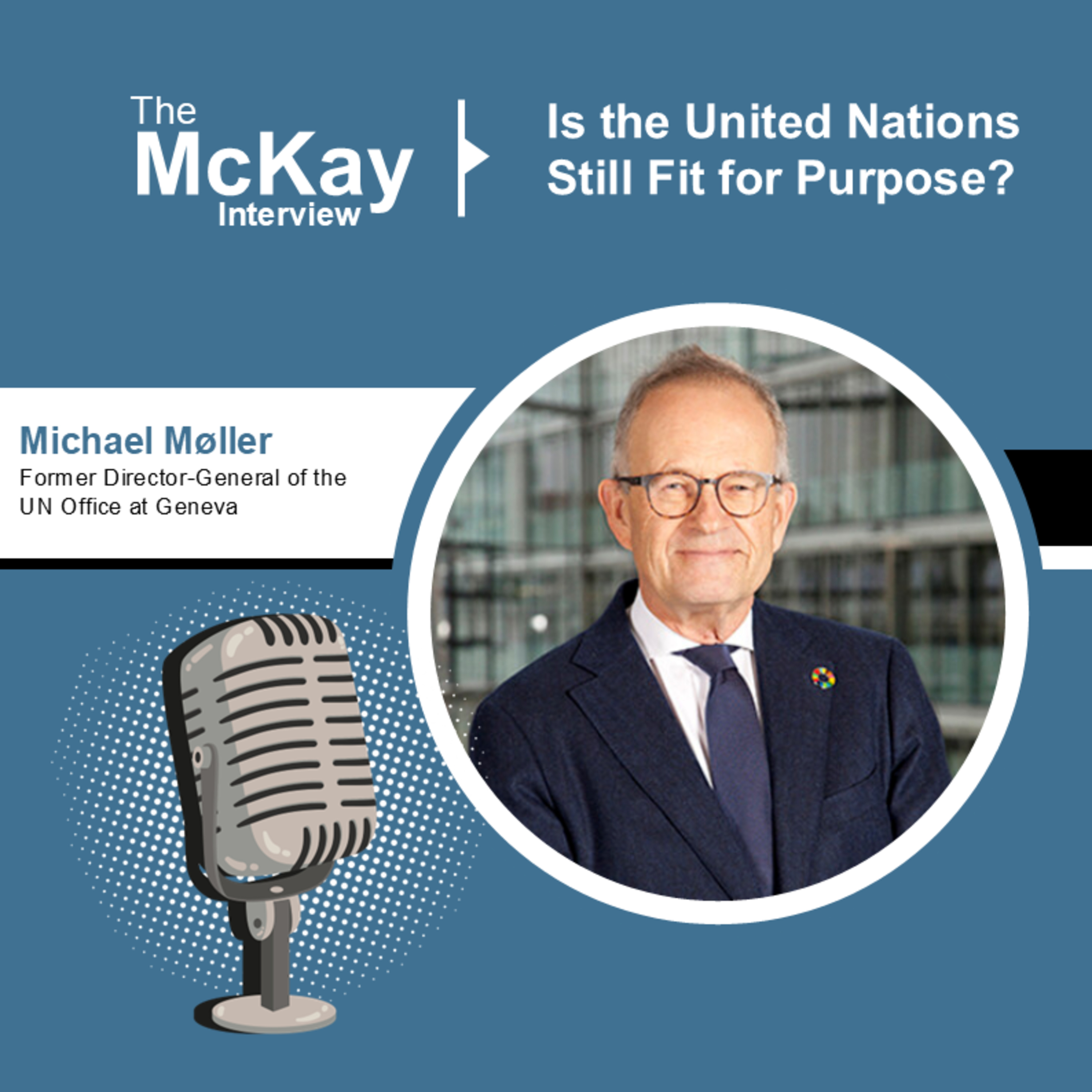
Michael Møller | Is the United Nations Still Fit for Purpose?
41m 23s
Michael Munoz critiques recent UN reforms, stating they are rushed and lack a comprehensive strategy for the future. He points out the challenges posed by funding cuts and member states' arrears, affecting operational activities and peacekeeping missions. The UN 80 reform proposal is deemed inadequate and causing discontent among staff, especially younger employees facing layoffs. Munoz stresses the importance of effective multilateralism and calls for a reevaluation of the Security Council to reflect current geopolitical realities. The discussion highlights the need for strategic funding decisions and a future-oriented approach to UN reforms to address global challenges effectively.
Transcription
7110 Words, 39624 Characters
I'm going to be very frank here, and I'm probably not going to be making some friends,
but I would say that the document itself is, first of all, not really a reform.
It's too little, too late. And it reminds me that when you take decisions based on panic,
you take bad decisions. And this is what we're looking at here.
Many of you listening today will know my newest guest already,
Michael Munoz, a Danish former Under Secretary General of the United Nations,
and the 12th Director General of the United Nations Office at Geneva from 2013 to 2019.
He was also the Secretary General of the Conference on Disarmament and the United
Nations Secretary General's personal representative to the conference.
Nowadays, he's a member of several boards and foundations, including the Kofi Nann Foundation,
of which he was once the Chief Executive. He's also an honorary citizen of Geneva.
He has over 40 years of experience as an international civil servant in the United
Nations system, serving in different roles in New York, Iran, Mexico, Haiti, and Geneva.
He's been a guest on my show before, more than once, and I'm delighted to invite him back again.
Michael, welcome back to the McKay interview. And thank you for inviting me to your home again
to record this interview. Thank you, Michael. Always good to talk to you.
It's good to see you again. Michael, back in the spring, you addressed a fascinating open forum
of the British Swiss Chamber of Commerce in Geneva on the new multilateral system.
I'd like to address some of those questions and answers again for a four and two and much larger
and more widespread audience. We last had an in-depth discussion about multilateralism
in September 2019, believe it or not, and you'd recently retired as Director General of the UN
Office at Geneva and talked to me about change in the UN system. Now you've put the word new
in the title of today's discussion, and much has changed in six years, but in your opinion,
what are the three, two or three most important new things that have changed?
I'll give you four, if you don't mind. Okay. The first is the fragmentation of our geopolitical
reality, very clear fragmentation. The second is something which I'm very sorry about, which is
the increasing acceptance of the use of force and violence in our differences and clearing our
differences. The disappearance of trust, a huge element of change in general, and also certainly
in the UN in particular. And finally, the really incredibly rapid advent of new technologies,
which is these technologies are going to change our lives in ways that we can't even begin to imagine.
So what I wanted to ask you next is about what happened
recently at the UN General Assembly, finished us a few weeks ago, in New York. What came out of it
that surprised you, if anything? What came out of it that may have disappointed you? And what came
out of it that reassured you, if anything? Well, I was somewhat surprised by the quite large number
of heads of state that showed up. I thought that might be less, given what we just spoke about,
about the lack of trust. So that was a good thing. And that leads me also to the positive
impression that in fact, in spite of the difficulties that we see the UN and the international system
going through, the structures are still there. And the understanding among our leaders that we
need a multilateral system of some sort, not necessarily the one we have now, but one that
hopefully will come out of the reform proposals that people are discussing, that those structures
still need to be there and that we need them. We cannot have a world without a multilateral system.
It simply won't work. And for those of us who don't understand UN procedures and processes,
you spent your professional life with them, can the General Assembly hold the dysfunctional
security council to account? Because the security council seems a failure in so many ways.
But how does it work in terms of making things change? Well, under the current rules and the
current habitual actions, the answer is no, not really. Although things are changing.
For example, recently, a couple of years ago, a new rule was put in place that demands that the
security council, when it passes a resolution, presents it to the General Assembly for discussion.
And the General Assembly, which in effect, also by the rules and by the charter, is the supreme
decision-making body of the UN system. It doesn't really take decisions that are binding. Only the
security council does that. So there's a disconnect there. So isn't that like closing the stable door
after the horse has bolted? Well, right now it is. But what we're looking at now is a rethinking
and a restructuring of that international system so that we can come up with a new kind of multilateral
system that actually is going to do the job. Because right now, the one we have, which has
served us incredibly well over the last 80 years, simply is not up to the task anymore. The problems
are too big. These huge existential problems we're facing, climate, health, corruption,
inequalities, et cetera, cannot be solved by any one government alone, has to be solved in a
collaborative effort. But in a collaborative effort that resides in a system that actually
works better than this one. And the debates and the votes that took place in New York. Did anything
happen that would give the UN in Geneva cause for comfort given the discomfort that's going on here
because of all the currents? Well, in a backhanded way, maybe, I would say. Because let's be clear
about one thing. At least I am clear about that thing. We are in this strange situation of having
two UNs right now. We have a political UN, which is the General Assembly, the Security Council,
the Secretary General, et cetera. That doesn't really work very well, if at all, in certain
instances. And then you have the operational UN. But that was always the case, wasn't it?
We have the operational UN that works. That works. That does its job asymmetrically well,
as always. But its job is to ensure that people's lives are better than it was yesterday.
And they're doing that. The link and the interaction between those two UNs is not as
strong as it should be. And it's not getting any stronger these days. And that is a problem.
So in that sense, the role of international Geneva as a repository of most of these
operational organizations is obviously a very positive thing. And just as I say that we cannot
do without multilateralism, it's very difficult to envisage us doing without international Geneva.
In one form or the other. It needs to be strengthened. It needs to be supported.
And cared for. I always compare it to a flower, international Geneva. I mean,
unless you water it every day, it's going to die. You've got to care for it.
Yeah, you've got to care for it. And this is happening. And we can come back to that in a moment.
But otherwise, not really. I mean, nothing much came out of this General Assembly,
as far as I could see. There's a lot of talk about there was not actually not that much talk
about the future. Were you there personally? No, no. One would have thought that given the
sector Jones proposals, you and AT and other proposals about the future shape of the international
system, you would have more discussion among the member states. But that was surprisingly,
not the case. Maybe because, you know, either they don't care, or it's too difficult a problem to
deal with at the top level. It has to be dealt with first at the working level. Whatever the
reason is that that was a little bit surprising. We're going to come on to you and AT in a moment.
But it's before we get onto that, I just wanted to ask you in this new multilateral order,
what new priorities would you make so that the reduced budgets, because it's not as much money
going around as there was before, this new environment that we're living in,
how would you ensure that the money is spent wisely, given that there's now less money going
around? Well, you're drawing the wrong conclusion, I'm afraid. You're saying that the money should
be spent more wisely. The fact is that there was no money to spend. So it's not that the UN system
is spending on wisely. It's simply because the member states are not paying that use. You know,
I mean, the arrears are huge. We're talking about $3 billion right now or something like that.
I mean, how can you run an organization or any organization like that? Sorry if I sound ignorant
about it. So there are many member states not paying up. It's not just the Americans. No.
There are different kinds of not paying up, if you want. There is, people, all member states
have dues that are calculated after certain rules, and there are a number of these countries are
behind in paying in time. The U.S. has a deficit, has arrears of over a billion and a half. China
hasn't paid up, although they're the second biggest, yet they used to pay at the end of the year,
which is not particularly helpful. So the two biggest economies in the world haven't
made their money? Yeah. And then, of course, copycats, you know, there's a lot of countries
that are looking at this and say, wait a minute, if they're not paying, why should I?
Sure. Perfectly normal, but not particularly helpful. That's one. The other thing is that
a lot of the activities, particularly in the operational field and in peacekeeping field,
are voluntary contributions outside the budget for the membership dues. And there,
there's a lot of cuts. From government. From governments. And a lot of cuts. In fact, the
cuts didn't start with the U.S. It started with a bunch of European countries that all decided
they needed to use their money to buy arms in order to rearm their armies, etc., in view of what
is happening in Ukraine. And the U.S. was just the death knell, if you want to, they came in and
just cut across the board from one day to the other hundreds of millions of dollars, which,
you know, impacts everybody. It's not just a UN system, it impacts, but more importantly,
impacts all these people that we've been helping for decades, get out of poverty,
be healthy, go to school, etc. So that's, you know, the different kinds of not paying kind of
that's important because I'd be surprised if a lot of people knew that already. I doubt it. I
didn't know that. Well, it's much more widespread. It's much more widespread, you know, including
Switzerland, by the way. Yeah. Although Switzerland has been generous now in terms of trying to help
many of these organizations that are in difficulty, both NGOs and and UN organizations,
international organizations, both at the federal level, the Cantona level and the city level,
they put aside some money to sustain them. But that doesn't detract from the fact that a lot
of countries, particularly rich European countries, France, England, Germany, etc. have cut down
considerably on their contributions to the UN. Good as me. Okay. Let's turn to UN 80. Just explain
very simply what that is, because I'm sure again, a lot of people will have heard it or read about
it, but I'm not particularly clear because I've heard it. First of all, there's a lot of disquiet
amongst the members of the staff, different levels. Not only staff. There's disquiet among
member states as well. But I'll get to that in a second. Yeah. Tell us a bit more about UN 80.
Well, UN 80 is a proposal by the sector general for so-called reform in the face of these massive
cuts. I'm going to be very frank here, and I'm probably not going to be making some friends,
but I would say that the document itself is, first of all, not really a reform. It's too little too
late. It reminds me that when you take decisions based on panic, you take bad decisions, and this
is what we're looking at here. It's not particularly future-oriented, and it's also premised on the
assumption that making cuts will actually increase efficiency. This is certainly not the case for
international Geneva. What is happening here, a combination of the cuts in funding plus the
response by the UN system, sector general and others, is basically the dismantling of the
international ecosystem that has been built over the past 80 years and that has served humanity
in extraordinary ways. A big part of which was here in Geneva, all the operational agencies are
not all, but a lot of them are here. A lot of that work, you have heard me say that
every single person on this planet is touched by something that emanates from Geneva.
Absolutely. Every single day of their lives. That is no longer going to be the case.
That's a big difference. What it does mean is that millions will die.
Millions of kids will not go to school. People will not get water and food, etc. We will see
wars reignite. We will see an increased number of migrants moving towards the north, because they
can't find help. For example, in Africa, in their own regions, which they did until now,
it means that many of the countries with help get out of poverty is going to be facing a situation
10, 20 years from now, when they have nobody to take over from those who are in charge right now,
because the kids didn't go to school and didn't learn.
So you're saying that there's a, or implying, if you're saying that there's a better way
to manage the cuts. Yes, of course. So the fact is not so drastic.
Well, it's not only that. It has to be strategic. It has to be with a very,
you know, I'm not sure that anybody sat down, you know, maybe somebody did, and really thought
through what kind of multilateral system do we need over the next 20 years and 30 years?
What kind of UN do we need, given the big changes that are happening in the world?
The world, the word future doesn't really show very clearly in those documents.
There was other documents that were presented by the ST a couple of years ago.
On the future, we want, so to speak. But the fact is that there is no strategy as from what I
can see. What there is, is a decision to cut 20% of all expenditures across the board without any
distinction of whether that's useful, not useful. If some areas needed to be strengthened and others
could be done away altogether, silos are being merged according to this. So unless this is part
of a longer-term future-oriented plan, then, you know, merging small silos into bigger ones is
not going to make things better. It's going to be making it worse. And this is where we are
right now. And of course, both member states are not particularly enthused by this. We'll see what
they do with this proposal, which it has to be approved by the General Assembly over the next
couple of weeks. Staff are not particularly happy because a lot of them are being fired
or relocated without any evident strategic plan. What we're seeing is, unfortunately,
as quite classical in the UN system over many, many decades, is that those who are being fired are
the youngest and the lowest on the totem pole. And those who are not being fired and not being moved
are the most senior. And that doesn't make any sense whatsoever. Because the youngest ones are the
future. The older ones, who in some cases are not particularly effective any longer, are, you know,
just taking up space. That's interesting because often in corporate life, it's the other way around,
the older ones are fired because they're the most expensive. And the younger ones come up through.
Well, one of the problems you have here, one of the problems is an endemic problem of all
bureaucracies. It's not just the UN. You'll find the same reflexes in governments and other
organizations, et cetera, where the bureaucrats are going to make sure that they defend themselves.
They defend themselves, yeah, exactly. And this is a little bit what we see here,
unfortunately. And it's really, you know, when you look at the numbers of the levels of staff
that have been fired or relocated, it's quite telling. The bottom is huge numbers, I mean,
comparatively, and the top is negligible. Yeah. Could it be that the Trump administration
has done the UN a perverse favor by forcing it to face a new economic reality in much the same way
that it's forced European NATO countries to wake up and pay up? Could it be? Yeah, we may say so,
up to a point. I think that the way they did it is certainly not the best way to put it very
mildly. But the fact is that, you know, we have known that the system needed to be reformed for
many, many years. We have known that there is better ways of spending the money that we get,
the little money that we get. But again, bureaucratic inertia was set in. And since there was no
pressure, really, from the member states to do much about it, and they themselves were not
particularly interested in engaging in the discussion about reform of the system,
then yes, this kick in the butt by Mr. Trump has been extremely useful.
Now, we'll see where that brings. I'm a little worried when I read some of the things that his
people are saying that they will do to the UN, and particularly what, for example, they're doing to
peacekeeping right now. For example, for those of us who don't follow it in detail. Well, I mean,
there's an incremental set of announcements about where they're going to cut and what they're going
to do. And the language is a little strange, because if you read the languages and you don't
know anything, the impression you get is that the U.S. is the only one who decides what happens
with and within the UN. That is not the case. That's not the case. There's 193 member states that
need to be part of the conversation. And of course, the U.S. is a big power. It is still
the biggest contributor to the budget with about 22%. And a little bigger. So the impact of them
withdrawing is massive. And now they are sort of looking at what they're going to be doing about
peacekeeping. And again, they're not the only ones who are deciding. And particularly peacekeeping,
where clearly peacekeeping operations can also be made more effective. It's a classic thing.
You go and look at any military of any member state, and you'll find the same kinds of problems.
Overpayment for staff, you know, not particularly well structured decision trees.
All of this can be fixed with the right approach. The right approach is not cutting all funds
from one day to the other, which is what we're seeing.
My guest today is Michael Munna, former United Nations Undersecretary General
and the Director General of the United Nations Office at Geneva from 2013 to 2019.
And we are in conversation in Geneva. Michael, you once defined multilateralism to me
as working together, as solidarity. That was the word that you use. I remember it very clearly.
At the very pinnacle of the UN, how can the member states get the UN Security Council to
act this important quality out, or to put another way, to walk the talk and can't the
President of the General Assembly, Germany, I believe in this case at present, bang heads
together to obtain a satisfactory outcome. Something's clearly gone wrong, or is that
just not the way things are done in the UN? Well, I mean, it's slightly wrong in the sense
that you're depicting the Security Council of the General Assembly as some sort of standalone
entities that are functioning outside the reality of what happens on our planet. That is not the
case. That's not the case. I mean, at the beginning and at the end of the day, this is all about the
will of member states. This is a club, the UN. And that's really the case. It's not semantics
to say. No, it's not semantics. It is the member state. It's not semantics. I mean, the Security
Council doesn't work because it reflects the reality of 80 years ago. And the one way of
changing that is by changing the Security Council. And they have been trying to change the Security
Council, talks, unending talks about reform for the past almost 40 years. And it's, you know,
all they're trying to come up with is adding member states and vetoes to an already dysfunctioning
Security Council. And it's just going to make it worse. It's not going to. We have to rethink
completely the structure of the Security Council. And we have to rethink completely the structure
of the system itself. You know, this system was built, as I said, over 80 years ago,
in the image of states at that time. And in silos. And silos that not necessarily
interacted in many cases never didn't even speak to each other. But that was a reality in member
states as well. Ministries that didn't talk to each other, that didn't overlap in their
activities, et cetera. All of this is changing, has to change rapidly even more if we are going to
come up with a system that can lick these massive problems we have in front of us.
So it's a matter of really sitting down and coming up with a very different kind of conversation
than we've had until now. And will it help just to spend a couple of minutes looking
obliquely at the problem on the role and influence of non-state actors like cities,
like mayors, like NGOs, like billionaires clubs, for example, on multilateral affairs? I mean,
of course, your experience mean to these people play a significant role crucial,
yeah, increasing crucial as important as that increasingly crucial, particularly cities.
Well, look, the population of the world is already by now, I would say that over 50,
close to 60 percent of every single person on the world lives in cities right now.
When you couple that with a couple of things, first of all, we are in the process of a transition
of governance and how we govern our planet and ourselves at all levels of society,
with many other people sitting around the decision making table. The fact that the quality of our
national leaders has been has been decreasing over many years, and where the real effective
politicians these days are mayors of big cities. These are the guys and girls who are closest to
the needs of their citizens. And that is an element that is playing into the conversations today.
Cities and regions are where the stuff is happening. This is where the rubber hits the road.
And when you were sitting in the chair of the DG in Geneva, did you interact with
these people? Do they express frustration to you? No, not to so much frustration. Everybody can
express frustration, but they express readiness to be part of the search for solutions. And this
is not just cities, it's also the business community, which for many, many years in my
early part of my career, I was told that you don't speak to the business community. It was
completely anathema. These people are the enemy, so quote unquote, complete nonsense. And that has
changed. So there are all of these actors, youth, women, which have to be part of the search for
solutions in ways that they have not been before. We are not going to solve the world's problems
without one half of the population of the world, to put it very bluntly. And all of this is absolutely
crucial that they're part of the conversation and not part of the search for solutions, not only
part of the search for solutions, but part of the action. We are now in a situation in the world
where every single person on this planet has to be part of the search for the solution in smaller,
big ways, depending on what our capacities are. But we cannot just sit on our hands and expect
our governments to solve these problems. It's not going to happen. So that's important. It's
very important element of it. You mentioned the word truth at the beginning of our conversation.
And I don't want this to sort of move into the area of philosophy. And I don't want to sound naive.
But has the UN got a role to play in the restoration of truth in public discourse?
Because it seems to be in short supply these days. Or was it ever thus? It's just we notice
it more because the kind of media that features discourse has changed in the last 15, 20 years
or so. How do you see that? Well, first of all, I think this is something that the UN has been
doing for many, many years, in many roles that they have both at the grassroots level. I mean,
the UN is in every single country of the world. UNDP and other agencies are there interacting
with the government, interacting with the people. Speaking truth to power, you mean? Yes, of course.
Yes, and helping out. So there's part. The fact that it's easy to accuse the UN and UN agencies
of doing or not doing things just is a fig leaf for the member states own in action. I mean,
frankly, we've been accused a lot of stuff. No, I'm not saying you are, but
we are the UN. I'm still saying we, although I'm no longer part of it. But that's a misperception.
But how should the UN or should the UN just continue what it's doing in that respect?
Well, one of the things that UN has been really bad at over the years, ever since it was created,
was to tell the story of what it actually does. And that has never really, you know,
I tried to change that when I was in office. I don't know if you remember, created something
called the Inperception Change Project to change the way we speak, by whom we speak,
and to whom we speak. And that was relatively successful with its small means and on a small
scale. But, you know, we are in a world where the means of communications are completely different
and incredibly powerful compared to, you know, writing a press release, frankly. That's the
difference. And they're doing their best. But again, you know, it's a matter of the kind of
funds they have, the kind of support they have. A lot of countries actually over the years
forced the UN to close its information offices in their capital simply because they didn't want
the UN to tell the truth or to have a different language or a different approach to things.
So, you know, again, here, we are looking at different realities that don't really often come
out in the open. But it is a reality that, again, here, the member states have a much greater
responsibility for what's happening and for what is not happening than people understand.
And picking up on what you said to me earlier about the UN, particularly in Geneva, touching the
lives of every single one of us on the planet every day. And Lesley, if we just look, for example,
at the inequity of wealth distribution, what role can the UN play in that? Particularly now,
particularly as budgets are being cut in making life fairer for people at the bottom
of the social pyramid without getting involved in anything like socialistic policies of economic
management. How does that work? But I mean, you're again saying you're describing a reality
that is not a reality because what you just described is at the very core of what the UN
is about, what it was created for, and what it has been doing over the past many, many decades
with, of course, different levels of success, depending on the social, economic, and political
realities of the countries in which they operate. But I can tell you one thing that I'm 100% sure of
that if the UN hadn't been here and helping out all these countries all of these decades,
they would be a hell of a lot worse off than they are today, even the poorest ones, simply because,
you know, both the money that is used, and it's not just the UN, it's the World Bank,
it's the IMF, it's a whole international, all of the organizations together that are,
that are helping, that are helping these countries to deal with. I mean, you just mentioned one like
UNICEF, that is helping the kids in all these countries to go to school, to have, to get food,
to get milk, to get, you know, to grow up healthy citizens of their countries. So the economic
inequality is, again, one of the issues that a lot of member states do address through aid,
but as we've seen now, one country just throwing the switch, it's incredible. You have to understand,
for example, that USAID paid for 43% of all humanitarian assistance on the planet.
Good heavens, that's a lot, that's half, you know.
Yeah, and they cut it off from one day to the other.
From one day to the other.
You can make the math on what that has meant on the ground for people. No food, no water,
no education, et cetera, no medicine. So again, I come back to pointing the finger at member states.
Well, you've made my next question slightly redundant, Michael, because I had written
down here, let's talk about leadership. And oftentimes, when I'm with people like you and
other people, senior people in the UN, they talk about strong leadership and never really define
what that means. And I'm just going to ask you about multilateralism and the qualities.
Would it not be better to talk about collaborative leadership? But we're now in the age of the art
of the deal, because that's the the trunk way of getting these done and banging heads together.
It seemed to have worked with Netanyahu recently. But what kind of leadership then is going to work?
And what I wanted to ask you, and this may, again, sound like an envidious question,
a naive question, but in your long experience, how did you deal with big, bombastic, me,
myself and I, egos, to getting that sort of ego to be effective?
I made a few of them over the years.
But it's not that difficult, actually. I'm interested to know.
Well, first of all, you have to be clearly empathetic. You have to show empathy. You have
to show understanding for the point of view of the person that you're speaking to. You have
to be able to listen and be seen as listening. And you have to be inclusive. And once you've done
all that. What do you mean by inclusive when you use it in that context?
Inclusive in the search for solutions. You have to, as I said, you hear the other point,
the person's point of view. And that person may have a very different one from yours. And you
take that into account up to a point. But if you're the final decision maker, then the last
element that you need to have is firmness. Once you've heard people out, and once you've
listened to all the points of view that you need to listen to, then you take a decision and you
make sure that it sticks. That's a way to do it. And that's...
And did that work? Did that work?
It worked very well. Yes. And that brings me back to your question, because strong leadership
is not antithetical to collaborative leadership. It's actually the same.
A really truly strong leader is collaborative.
Well, we live in a country with the diffuse leadership, and it works, even though this is a
very small country, it works very well. Yes, but it's also collaborative.
Very much so. That's the essence of the confederation.
Well, I would say that right now, the Swiss democratic system is probably the best in the
world. Let's take hundreds of years to perfect it.
Fine. No, actually, it hasn't. Well, less than that.
150 years. But the fact is that it works, and that people could be wise in taking some
inspiration for how they do it here.
Now, a bit of a geography lesson, Michael. Riyad and Qatar seem to have eclipsed Geneva
as the new international centres for special debate about difficult issues.
Do you have any advice for Geneva?
Well, in this conversation, I keep disagreeing with you because the word eclipsed is far too
strong to describe what's going on. What word would you use?
No, first of all, a lot of organisations are here. A lot of activities happen in Geneva,
and a lot of them will continue to do so. But Geneva cannot claim to have every single international
organisation based here, nor every single conversation about peace to happen here.
It has to happen elsewhere. I mean, this UN is a multi-geographic, if you want, geography
organisation. And so these countries seeing a momentary weakness in what's going on here
and walking away from the UN grasp the opportunity and are proposing themselves as venues for some
of these activities. Especially when they heard that UN 80 is proposing that staff, apart from
being fired, in some cases are being relocated to what is supposed to be cheaper locations.
So they grasp this immediately and say, "Okay, you want to relocate? Why don't you come here?"
So we had to see it in that context.
It's in that context primarily. But it was happening before. There's a lot of competition.
Bonn, Copenhagen, Paris, Santiago, Bangkok, all sorts of places in Nairobi,
where there are UN organisations and I have been there for years. And it's a healthy network.
And it's as it should be. We cannot claim, as I said, that everything should happen here.
We should not forget either that we have built an incredibly strong ecosystem in this town here.
There is no other place on the planet that has the amount of actors and the amount of
integrated approaches to problems that actually have an impact and give results as here.
And that's not just UN, forgive me, but that's not UN cliche speak.
No, that's me speaking.
That's you speaking.
Yeah. And it's not just UN I'm talking about. There's other,
there's plenty of international organisations out here. NGOs. There's almost 700 of them in
town here. Multilateral companies. There's 2,600 multilaterals that have offices in Geneva.
I used to work for one.
Well, there you go. It's huge. And all of this is a network. And it's a network that works
increasingly well. One of the things that the SDGs, the Sustainable Development Guilds,
goes brought to us was the understanding that we have to figure out ways of working together
and that it's a hell of a lot more effective to do so than not doing so. I mean, we see it
all the time. It's factual. You can just, you can count the numbers and look at the impact on
the ground of what happens when you do work together. It's a great feeling, actually.
Yeah. But it's also, you know, it's a very efficient way, a much more efficient way of
using the money because you share costs, you share staff, you strengthen each other's
initiatives, and you talk to the governments and the countries that you work with much more
weight if you're several of you instead of allowing them to sort of play one against the other.
There's plenty of advantages of working together. And that I think is, and I certainly see it here,
I've been seeing it for several years now, that the reflex for that is very much in the making.
I mean, I pushed it a lot when I was in office. I created the SDG lab, which whose objective was
precisely that to bring together people, to show them the opportunities of working together and
the impact that they would, and we had some incredible results. You introduced me to Nadia
Isola, and I actually had her on this program, talking about it. Yeah, she was terrific in that
group. Exactly. Yeah, sure. Michael, before we close, I've just got a couple more questions.
You mentioned the SDGs. You were very close to Kofi Anand. Yeah. If he called you today from his
heavenly repose, I'm sure that's where he's seated now, looking down on us, and asked for a progress
update on his SDGs, what would you say to him? And would he be disappointed?
Well, first of all, I think he already knows what's going on. But yes, he would be disappointed.
I'm disappointed. A lot of people are disappointed. But you have to remember,
he was also a pragmatist. He knew the system and the international system much better than
anybody else I knew, and knows the ups and downs and the cycles that we have to go through in
order to get to where we go. We had a first set of SDGs that achieved something, but then he came
up with a second set that ran until 2030. And we'll get there eventually because it makes sense.
Today's world, unless we find ways to work together like we've never, ever done before,
we are not going to make it. We, meaning humanity, will not make it. I'm convinced of that. And so
was he. Before we close, Michael, it'd be remiss of us not to address, even if only briefly,
the momentous events which happened yesterday in Jerusalem and Sharm el Sheikh. And here's
a good example, Michael, of a simple question which probably requires a complicated answer. And
that's the easy part of being an interviewer rather than an interviewee. However, as a very
experienced diplomat, you surely must agree that Donald Trump deserves praise for getting the release
of the hostages and stoppage of gunfire this far, wouldn't you? But what's your view on getting to
stage two and stage three over the line? Right. First of all, my answer to you is yes. Of course,
he deserves some praise and his perseverance and his push and the use of his, of the weight and the
power of his country and his office to push people into doing something they haven't done for 50 years.
And he deserves all the credit for that. As to the second part of your question,
I simply don't know. It's going to be very difficult. We're already seeing the so-called
21 points fraying at the edges. Hamas is fighting again in the streets. This morning Israel killed
five Hamas members. I'm not quite sure what they did, but I just heard it on the news.
They're fighting between themselves inside. So there's a lot of work that needs to be done
by a lot of people. And one of the big changes here that a lot of the neighbors, Turkey,
Saudi Arabia, Egypt, and other Arab countries, physically were part of the effort to make this
happen. And they need to continue to be part and make sure that other of the countries in the region
are part of the search for solutions. It's almost impossible to think or to hope that there will
be any kind of solution unless the region itself pushes both parties to do what they need to do.
Clearly, there has to be also down the road some legal repercussions, both on the side of Hamas,
on the side of Israel, for some of them. And security, surely. And security as well. Well,
that is a proposal for an international force to go in. But it's very iffy. And I'm crossing my
fingers like everybody else that this is actually going to happen, and that the momentum is going
to be kept, and that the push and the effort doesn't let up. That the kind of weight that America
and other countries have put on the two actors is something that should have been done years ago.
I'm happy that it's happening now. But just having the release of hostages and the release of
prisoners is just a very small first step. I mean, I'm happy for them, I'm happy for their families,
etc. But this is not going to this doesn't mean peace yet. I hope it does. Because if it doesn't,
and this explodes again, the whole Middle East is up for grabs. And it's really, it's really,
it's, it's a touch and go proposition here. Yeah, I think we'd all agree with you on that,
Michael. I thank you for fascinating, highly informative and emphatic way that you've put
your point of view on so many important matters. And thanks for being so forthright. My guest today
has been Michael Munna, former United Nations Secretary, Undersecretary General, and the
Director General of the United Nations Office at Geneva from 2013 to 2019. Thank you, Michael.
Good to talk to you. Thanks for listening to the McKay interview podcast.
You can find my show on most of the leading podcast platforms. Plus the complete playlist
dating back to 2012 can be found by writing the McKay interview into your browser. Thanks again for
Thanks for listening.
Podcast Summary
Key Points:
Michael Munoz, a former UN official, discusses the inadequacies of recent UN reforms.
Munoz highlights the fragmentation of geopolitical reality, acceptance of violence, and technological advancements as major changes.
The UN General Assembly's recent outcomes surprised with a significant number of attending heads of state.
The UN faces funding challenges due to member states' arrears, impacting operational activities and peacekeeping missions.
UN 80 reform proposal is criticized for being hasty and lacking a future-oriented strategy.
Staff layoffs and restructuring within the UN are causing discontent, especially among younger employees.
The impact of US funding cuts on UN operations and peacekeeping efforts is discussed.
The need for UN reform and effective multilateralism is emphasized, focusing on the Security Council's role.
Summary:
Michael Munoz critiques recent UN reforms, stating they are rushed and lack a comprehensive strategy for the future. He points out the challenges posed by funding cuts and member states' arrears, affecting operational activities and peacekeeping missions. The UN 80 reform proposal is deemed inadequate and causing discontent among staff, especially younger employees facing layoffs.
Munoz stresses the importance of effective multilateralism and calls for a reevaluation of the Security Council to reflect current geopolitical realities. The discussion highlights the need for strategic funding decisions and a future-oriented approach to UN reforms to address global challenges effectively.
FAQs
Fragmentation of geopolitical reality, increasing acceptance of force and violence, disappearance of trust, rapid advent of new technologies.
Surprised by the large number of heads of state, reassured by the presence of structures supporting multilateralism.
Under current rules, not effectively, but changes are being made to enhance accountability.
UN 80 is a reform proposal to address budget cuts, criticized for being inadequate, not future-oriented, and potentially detrimental to the UN system.
Several member states have significant arrears in payments, impacting the UN's operations and ability to fulfill its mission.
Chat with AI
Loading...
Pro features
Go deeper with this episode
Unlock creator-grade tools that turn any transcript into show notes and subtitle files.
 PodcastTranscript AI