Regulation at the MHRA is undergoing a transformative shift—from a purely restrictive, safety-focused model to one that actively enables innovation, prevention, and patient access. Lawrence Talon, MHRA chief executive, emphasizes that regulation must be proportional, patient-centered, and adaptive, balancing safety with speed, especially in high-impact areas like rare diseases, AI, and early disease detection. Key initiatives include a new rare disease framework allowing faster development through investigational marketing authorizations and biomarkers as surrogate endpoints for early intervention. The MHRA is also advancing parallel approval with NICE, reducing time between market access and NHS funding by three to six months, thus boosting R&D investment in the UK. International reciprocity—particularly with the US FDA—is vital for creating a predictable, globally competitive regulatory environment. The UK’s longitudinal health data and population-wide management provide a unique opportunity to lead in upstream prevention. A hybrid regulatory model of convergence (for standardization) and divergence (for innovation) is seen as optimal, allowing rapid adaptation without sacrificing sovereignty. Finally, real-world engagement—such as the NHS Spurs initiative—shows how sports communities can drive preventative health campaigns, proving that regulation and public health can be both innovative and deeply rooted in community action. Prevention is not just a goal but a central pillar of the future health system, driven by smarter regulation, data, and inclusive innovation.
This is the Health and Politics Podcast.
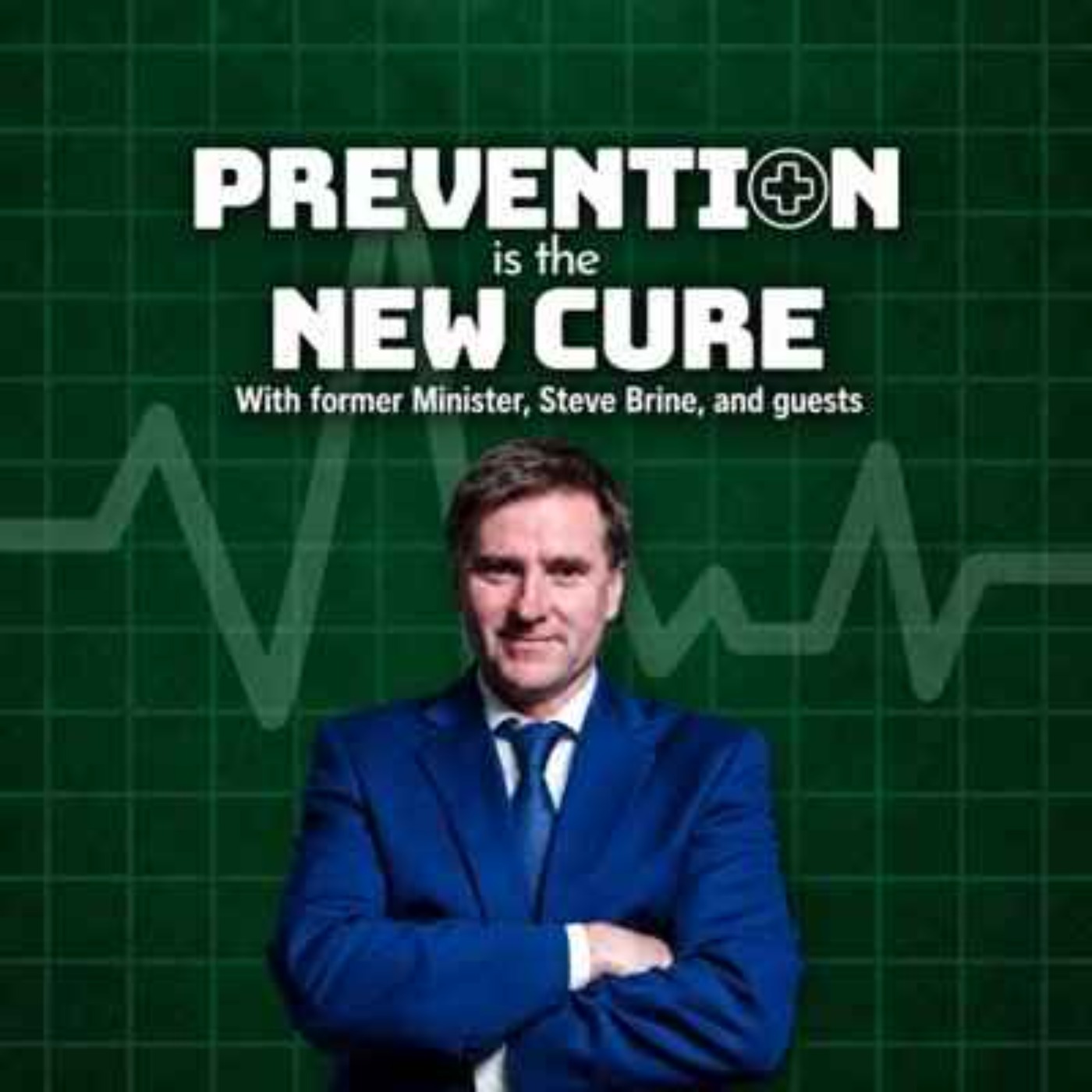
Prevention is the new cure with me,
former Minister Steve Brine and my guests.
Welcome along to episode 115.
You're listening to the third of our Autumn interview specials.
We've already talked with the longest-serving health secretary, Jeremy Hunt,
and last week, Sir Charlie Mayfield,
who's leading the government's Keep Britain Working Review.
Thanks so much for all the feedback on Charlie's interview last week.
Really appreciate that.
It's become one of our fastest downloads to date for what it's worth.
I think there's a huge interest in the work and health agenda
that Charlie champions, and as we record this episode on Wednesday,
he's all over the news again as they publish his September update,
titled Keep Britain Working, a National Growth Opportunity,
which he gave us some exclusive heads up to in the interview last week.
That episode is, of course, streaming now wherever you get your podcasts.
My guest this week sits at the heart of one of the most important,
but perhaps least understood, parts of our health system.
Lawrence Talon is chief executive of the Medicines and Healthcare Products Regulatory Agency,
better known as the MHRA.
The body responsible for ensuring that the medicines and medical devices
we use are safe and effective.
But regulation isn't simply about saying yes or no to a new medicine or technology done well.
It can help shape what gets developed,
how quickly innovation reaches patients, and increasingly,
whether we can detect disease earlier or prevent ill health in the first place.
Amen to that.
And of course, there's the wider economic question, too,
which links back to Mayfield last week.
If Britain wants to be one of the best places in the world
to research, develop, and launch the next generation of medicines,
diagnostics and health technologies,
what kind of regulator does that require?
Answer that one.
Welcome to the podcast, Lawrence Talon.
ISD, thanks very much for having me on.
Thanks so much for coming. It's really nice to see you.
Lawrence, when most people hear the word "regulator,"
not the most exciting word in the world, is it?
They probably think of an organisation whose job it is
is to stop unsafe things happening.
It's a stop things, as opposed to enable things, I suppose.
You seem to be arguing for something broader
that regulation can actually enable innovation.
Can you unpack that for me?
Certainly can, Steve.
So I think the first thing I probably need to start with,
a little bit about my background,
because although, as you said, I'm currently
the chief executive of the MHRA, the medicines regulator,
it's not really my background has not been in regulation.
Most of my career has actually been as a hospital executive
in the NHS and other systems,
trying to bring the latest therapies, medicines and technologies
to patients as expediently and safely as possible.
So my background really has been regulated,
rather than being the regulator.
I think it's deliberate on behalf of the government,
because not just in healthcare, it's in other sectors too,
that they're trying to do regulation differently,
and the emblematic part of that would be
the regulatory innovation office run by David Willits,
which is looking across sectors about how we can make
regulation more enabling of change in economic growth.
Now, regulation is really, really important,
sometimes, at stopping things,
because and guarding against failures.
So if we look at markets, markets are efficient,
but they can also have unintended effects or market failures.
And that's why we need regulation to stop for those,
that to stop those kinds of failures is particularly important,
where you have a high degree of information asymmetry
between the producer of a product and the purchaser,
or the user of a product.
So, for example, big farmer versus a patient,
the information asymmetry is incredibly high,
and then needs, therefore, to be an independent body,
making sure that the patients are kept safe
and have the right information.
And we have seen, of course, in this country and other countries,
some examples of egregious failures in medicines and medical devices.
Perhaps most infamously, in this country,
the Thalidomide scandal, which everyone will know about,
and more recently in medical devices,
the pelvic mesh scandal, which again has been very much
in headlines in recent years.
So safety and the protection of the public
is and will always be a foundational element
of what we at the immature do.
But regulation has to be proportional to risk,
not disproportionate, and it shouldn't come at the expense
of slowing up the benefits to patients
of new medicines and new technologies,
because the ultimate goal is to serve patients' needs,
which means, of course, we have to think about,
safety of course, we also have to think about
the effectiveness or efficacy of the product.
We are talking about the timing access
to those products for patients, particularly important,
where they may have cancer or severe disease
where time is of the essence.
And we have to think about personal choice and agency,
and to give you a couple of examples.
If we think about a prophylactic vaccine against a respiratory virus,
something that was, of course, very topical for us
only a few years ago, in a young person
for whom who may not have underlying conditions,
and the worst case scenario, you know,
if they cook COVID or something like that,
is they'd feel a bit under the weather for a week.
Well, we have to have a very, very high barrier
for safety for that young person,
because even the small risk of a side effect
is not worth it in that case.
But we think about a much older person
with underlying health conditions,
we will adjust that risk benefit calculation.
So my philosophy, really, is we need to put patient needs
at the center, which is safety, efficacy, access, and choice.
And we need to be able to, as a sophisticated organization,
operate in those multiple dimensions at the same time.
And I think if we get that right,
we're not only thinking about patient safety
and public health and prevention,
but we're also going to drive in with investment
because we will have the reputation as a great country,
a great place for innovators to invest,
to bring their clinical trials,
and ultimately to help grow the life sciences
part of the economy.
Yeah, the traditional trade-off, if you like,
is that there's an inherent tension
between being faster and being safer.
Does that drive you nuts?
Is that very much an outdated way of thinking about regulation?
I think there is a never-to-be-sun trade-off
between speed and safety.
But again, if I give you a couple of different examples
and some very real examples,
I won't sort of personalise with the patients,
but these are based on real things that we see day and day out.
I was at a facility in Scotland just yesterday
where we were talking about the potential
to bring personalized mRNA counts of therapies to patients
much more quickly than has historically been the case.
We were talking potentially weeks rather than several months.
Now, when you're talking about a stage 4 cancer patient
who will almost certainly be dead,
or very likely, let's say, be dead,
before that therapy becomes available under the current model.
And if we can really shorten those timescales
and give that patient a chance,
then we wouldn't take a egregious risk,
we wouldn't take dangerous risks.
But of course, you're going to calibrate that risk
benefit differently, to the example I gave previously about a much lower risk
in a younger person for respiratory virus.
So I think it's about, it's not as binary as speed versus safety.
There are multiple dimensions at place to do with the prognosis of the disease,
the benefit risk of the therapy or the technology,
and the choice in the circumstances of the patients.
Yeah. So where does then prevention fit into your world?
You know, to this regulation sort of move,
move us upstream, which is what we're interested in on this broadcast
towards prediction, earlier diagnosis, preventing disease,
that patient that you, you saw,
rather than regulating treatments once somebody is ill.
Okay, move us into that space.
That's what gets me excited on a Wednesday morning, Lawrence.
Yeah, yeah, no, well, I think that gets us all excited to see
that that's what we've, that's what we've got to do there,
health system, as of course, is the whole theme of this broadcast.
I mean, I sometimes think that there are three systemic failures of regulation,
or whether they, whether you call them failures is probably not the right one,
three systemic problems that need to be solved, let's say, by regulation,
might be a better way to, the first is around rare diseases,
which I think we might come back to later in the, in the episode.
The second is AI, and how do we, how do we build a system of regulation for AI?
But the third one that you've touched on is prevention,
because our systems, our health systems, including our regulatory systems, of course,
are built for established disease.
So it is comparatively easy for a medicine's regulator like mine or our peers and other countries
to say, okay, we have established disease.
We have a medicine that has an effective mechanism of action to treat that
established disease.
So we at the MHRA can decide the safety efficacy benefit is there,
and potentially nice our funding body can decide whether it's worth paying for on the public
purse, because it's, because it's established disease, it's much harder
for organizations like ours and nice to do that upstream of disease, or in very, very early
stage disease. And I think this is true, not just in healthcare, it's true in any sector,
that we find it conceptually difficult to make an investment today for a potential future problem,
which may or may not emerge, particularly challenging where that's to do with human biology.
But I think and I think this is one of the
is where the imagery will be making great strides in the months and years ahead. I think regulation
has a crucial role in unlocking that puzzle by the use of biomarkers as surrogate endpoints
for evidence. I can unpack a little bit more what I mean by that if that's helpful.
Yeah, so let's get into what we talk about enabling regulation. You mentioned rare diseases.
So I think that seems like a but I held that brief when I was one's government. So rare disease
seems a particularly good test of proportionate regulation is how I put it. If there's only
hundreds, perhaps dozens of patients with a particular condition, how do you maintain the
evidential bar without making development practically impossible? Yeah, so I mean, I think rare disease
is an interesting one because on the one hand, these diseases are rare at the individual disease
level. But when you aggregate them up, they're not rare at all. There's something like three and a
half million people in the UK who are affected by rare disease. But because individually they might
have small numbers of patients attached, it hasn't been seen as commercially viable for
pharma to develop products for these patients and regulators have not adapted their systems because
we have systems that are built for large population diseases. So the classic stage phase one, two,
three trial, we have large population works well for highly prevalent disease, but not for
less prevalent disease. So with the imagery published about a month ago, what is actually,
in regulatory science terms, quite a landmark publication, I read a new rare disease framework
where we've introduced a new concept called an investigational marketing authorization.
Now, that sounds quite technical, but let me just explain what it does. It concertinas,
the traditional phase one, two, three, and then marketing authorization,
process of drug development, it can take many, many years up to a decade from pre-clinical all
the way through clinical testing and then into into patients. It concertinas that to the point
we can bring that process down by several years, which in turn can make it much more affordable for
public reimbursement systems. Now, of course, we have to think differently about the evidential
threshold, but where we have compelling evidence, but that doesn't fit into that large population type
study, and we have very high on met need. So as an example of a kind of disease we might apply
this to, spinal muscular atrophy, where young people diagnosed with that disease, their muscles will
waste, they will gradually degenerate, and they were very unlikely to make it even to teenage years.
You will clearly apply a different benefit risk threshold, provided you have a plausible
reason to believe that that medicine is going to be effective in treating that child
and not have undue safety risks. If that child is very likely to progress to die before they're
even a teenager, then you'll calibrate your evidential requirements differently.
Yeah, and have you spoken to David Cameron about this? You and I saw David speak about his
work with the Oxford Harrington Red Disease Center, obviously following on from the loss of his
son, either many years ago, when he was leading with the opposition. I was a candidate for parliament
back then, and he's done really, really good work on this, and he speaks very coherently, and of
course with great credibility about red diseases. Presumably, you link in with people like that,
who carry a lot of public credibility and have a have a big name in this space.
Yes, absolutely. So the thing about David Cameron is his name registers at the global level.
Yes. So when we're talking about red disease therapies, we are talking about a lot of biotechs
in the US, some in China, some in Europe, and there are comparatively few places that really
set out best all to be the one that unlocks this puzzle. This is where we think I'm sure he can
take a big step forward. We have, of course, been working with Oxford Harrington,
with life arc and with the red disease community to produce the red disease framework that I've
described. I think David Cameron speaks, as you say, incredibly compellingly, because not
surprising as a former prime minister, he's a brilliant communicator of complex complexity
into a way that doesn't patronize, but explains for people who don't necessarily understand.
Yeah, here you go. Second part of enabling regulation, clinical trials. Obviously,
there's sure and see review looked into this in great detail. We used to hear repeatedly
that Britain was losing clinical trials overseas. So what have you actually changed,
when do you think patients at the life science industry, probably the other way around,
will notice the difference? Yeah. So we were losing ground. That is absolutely true,
and Lord, there's sure and see review set that out in graphical detail. We have absolutely
turned that corner, and we are now on the march again. I often think that if people say to me,
what's the single biggest thing we could do in the health system? I'm not just talking about
regulation, I'm talking about the entire health system. What's the single biggest thing we could do
that would improve patient outcomes, would improve clinical morale in the health service,
would not cost taxpayer money, but in fact drive in with investment, it would be to massively
increase our participation in clinical trials. That is a real challenge for us as a system.
Now we did lose a lot of ground, particularly after Brexit, and I have to say before my time,
but hands up, the MHRA was part of that because the separation of the MHRA from the European
Medicines Agency, which was co-ocated in London, was really, really disruptive. We also had COVID
around that time. So we became very slow at improving clinical trials. There were other factors too,
but that was a key factor. I'm happy to say now, we are absolutely back on top of that. We are
faster than most of our peer regulators around the world, including Europe, and we're seeing
clinical trials activity growing again at a pace. That's partly to do with the speed, it's also
to do with the pro-innovation policies we brought in. It's to do with the quality of academic
basin, the key opinion leaders we have in our health service now at university. There's more to do
though, because this is a fiercely, fiercely competitive global race with China, absolutely moving
at pace. Europe, of course, trying to mobilize countries like Australia doing incredibly well
around clinical trials. So we are moving in the right direction, but we need to put our
foot on the gas, I think. Yeah, let's move on. I saw you earlier this year in Leeds, the Tech UK
Health and Care Industry dinner, and you spoke about AI. You said AI is exponentially fast.
We must be in that conversation. You referred to something, the National Commission's report
on AI and healthcare, which you said was due out late this year. Now, of course, that is barely
a couple of weeks old. We talked about it on the podcast when it came out. I suppose the central
conclusion is quite significant, is that regulating AI can't simply be a one-off decision at the point
it enters the market. I would put it more crudely and say, look, innovation is always going to move
faster than regulation. The Commission sort of argues, I suppose, for a sort of life cycle-based
regulation and sort of continuing assurance in the regulatory space. So, look, we have now got
the National Commission's report on AI and healthcare. We'll put the link to it in the show notes.
What was the exam question that the Commission was trying to solve, Ron?
So, I think the exam question was, again, not just related to regulation, it was the wider
health system. I think we all know that if we want the health system that continues to provide
really high-quality care, that taxpayers think is worth their money and that keeps pace with
innovation and with what's going on in the best health system around the world, we need to be far
better at use of technology as well as, of course, prevention and the two things clearly into
relate. The pace of technological change is just extraordinary as we hear almost every day in the
news and so much so that I think AI inspires or fear in equal measure. And the big challenge was,
how do we adapt the regulatory framework and the related issues such as reimbursement and
health service adoption to make sure that we are giving the best opportunities and benefits
to clinicians in the NHS, patients in the NHS, but whilst guarding against the risks that
entail with that technology. We had a fantastic group of people come together,
chaired by a couple of really clinical academics, Professor Allison Denison from Birmingham and Professor
Henry, it's a huge deal. The patients say it's a commission for in the NHS. They brought together
big tech, small tech clinicians, patients, patient advocates, the public, there was huge amount of
polling from Ipsosmore and all those sorts of things. So it's incredibly wide and inclusive
crisis. And what we heard is patients, they recognise that AI should and will be used in the
health service, they're course doing it all over their own personal lives in other aspects like
banking and retail. But they want to know that it's to be done safely, that there are ultimately
humans accountable for consequential medical decisions. And so the analogy that I use for this
life cycle one is to think less about a high jump and more about hurdles race. So not a single
improbably high barrier to entry, which in the end just is like a damn holding back progress.
But a much more rapid iterative cycle of development that allows to have proportionate checkpoints
to make sure that the AI is doing what we thought and is learning and improving, not drifting
and degrading. And of course the beauty of these technologies is they have chips in them. They
give you real time data, real time signals. So you have the opportunity to do that. And I think
that is the central concept of the hearts of the AI. So is it that technology will help us
continuously regulate technology?
because of course an algorithm may be safe when you approve it, but it can evolve.
Literally, that is the whole point of a large language model.
You talk about something to do with L-plates in the report on regulation.
Can you explain that to us?
Yeah, so L-plates is the way we described it for the general public,
because I think everyone understands the concept of an L-plate.
The idea that you can start to deploy a technology,
but we're sort of someone sitting alongside the learner driver, let's say.
And then once they've passed, you might transition the L-plate into a green one,
so that the drivers around that car know that this is still a new person
and give it a bit of space.
So in AI, what that means is, for example, the concept of sandboxes,
where we would deploy, once we're content that a technology is basically safe
and effective at what it does, but we still know that there's more to learn,
we would deploy in a controlled environment, so if this is the L-plate concepts,
to check and test, it does what we think,
and gradually move out the parameters of the L-plate until it's in general use.
Yeah, I was at a lecture last week at the Royal Society of Arts
at Chris Whitty, the CMO gave.
It was titled Risk Uncertainty and Medical Decision-Making,
and he was talking about AI, and he said there's two sides to this,
because it's an audience of clinicians.
As clinicians, we should be honest, particularly with younger colleagues,
that AI in medicine is going to change the game,
and it is going to lead to different jobs,
and in some places less jobs, and we should be honest about that.
When it comes to AI Direct to Patient,
so, you know, it's all these stats about how people are using that as their first
port of call, Dr. Google has been replaced by Dr. Chad GVT, other versions are available.
He's saying that he feels that these AI models will give you a kind of
certainty in the response that it gives you.
Well, of course, medicine is not certain.
Medicine is an opinion based on diagnosis, based on observation,
but AI doesn't work like that.
AI is much more coxure, if you like.
It's much more certain, and he's saying that in a way,
what it should do is present itself as the probability
as to what it's diagnosing you with or the opinion that it's giving you.
I think that's quite an interesting view, as usual, thoughtful from the CMO.
What should a patient actually expect to know when AI is involved in their diagnosis or treatment norms?
Yeah, so, I mean, just firstly, on the issue about jobs,
our sort of far bigger problem at the moment,
not only in our country, but in all countries,
we don't have enough healthcare work.
So, you know, we've gone quickly to the idea that there's going to be jobs apocalypse.
I don't believe that is going to be the case.
None of us really know, but I think it will adapt and change jobs,
some more than others, but I think healthcare is fundamentally a human enterprise.
My analogy here is we can very plausibly see certainly in the near future,
if not now, that AI might be better at diagnosing a tumor on a scan than a human.
Yeah, and that's Christian. But anyway, we're going to want a situation
where you have your cancer diagnosis broken to you and your family,
and your options ahead explained to you by a robot rather than the human.
So, there is fundamentally a human quality to healthcare that I don't think will ever want to eliminate,
and I don't think that would be progress, actually, even if aspects of it would.
In terms of the, you know, the, the, the, the,
the cultural confident nature of AI, if you like, I think that is a real challenge that we're facing.
However, it's not one that we haven't, we haven't faced before in a fairly recent past.
So, let me give you two examples.
We know that there are a numerous number of searches on Google for health conditions.
I think there's something like a billion health searches a day or something like that.
But most people, I would say, pretty much know that when they ask a question
into Google about healthcare, they are, they are not asking a medical professional,
and they will use their common sense to sift and saw the extent to which they really believe
their information. And they also understand that they are taking advantage of a tool that's
available to them as a consumer, but they're also taking that advice somewhat at their own risk.
If I give you another example, most of us now will do almost all of our financial transactions
online, whether on our phone, online or whatever, very few of us will do much in cash anymore.
And we have become pretty adept and pretty sophisticated as consumers,
all up and down the sort of social gradient and, and, you know, different course of society.
At working out, when are you going to put your credit card details into something and when you
not? And we don't just, you know, we know how to, we broadly have learned how to use financial
service online whilst protecting us and being able to sift and sort reliable from unreliable.
So I think those are two analogies that just say that as we move into this new area of LLMs,
or more specifically LMMs, large medical models, which are specifically purpose designed for
medical diagnosis, and that that's a different order of precision and LLMs. I think that we need
both citizens, patients and particularly clinicians to use their management, but also to be helped
with sort of guidance that organizations like mine can, can put it out, to be able to sift and sort
reliable information from less reliable information. So I think the CMO's point is fundamentally
right. And I think we have the, we've been able to do that recently with other versions of
the technology, I think we'll be able to do the same thing again in the future. Okay, so just
finally then on this, when AI gets something wrong, so I should call it SI. President Trump says
it's super intelligence, not artificial intelligence. Right, I'm trying to believe that that's what he says,
then we must call it SI. When SI gets something wrong, where does responsibility sit? Is it with
the developer? Is it with the clinician? Is it with the hospital? Or is it with the regulator?
Yeah, so this is the really key challenge that we have in AI. And one of the key issues that the
National Commission dealt with, it didn't definitively deal with it, but it described it. So again,
let me try and unpack how that works now. And by the way, when we did this National Commission,
we didn't just look at healthcare, but we learned from other sectors that are essentially dealing
with exactly the same questions, such as law and financial services, where does liability sit?
And in a way, getting that right, I think, is that oil will make the cogs turn in how effective
we are at deploying AI. Well, again, it's in some ways it's not so different from what it is now.
So if a clinician now, a diagnosis is a medicine for a patient, we do not expect that clinician.
Sorry, let me, they diagnosed a medicine for patient. Now, as we know, with all medicines,
occasionally there are some side effects. So maybe some goes wrong, there's an adverse drug
reaction. So let's work back in the chain. We don't say something went wrong, the clinician is
liable. What we do is we say, did that clinician make a perfectly reasonable decision on the diagnosis
that they made, weighing up all the facts of the patient, their disease and the properties of the
medicine. And if they made a reasonable decision that would, their peers would, you know, have had
said is within the bounds of reasonable ability, they are, they are not liable for that decision.
We don't expect that clinician to understand the absolute detail chemical composition of the
medicine, necessarily, but we do expect them to understand the intended effects and to be able to
monitor whether that intended effect happened in the patient and to warn on the possible side effects.
And to warn on the possible side effects exactly. And the job of the regulators to make sure that
that medicine could only be available for referral, for prescription, if it had an essentially
reasonable safety and efficacy benefit profile. And that's how things work now. Now if we take
that, let's take the same example with an AI algorithm, we would expect the clinician to understand
what the algorithm is going to do or is intended to do, to be able to spot if it's significantly off
off doing that, to be in an organization that has a system of clinical governance to be able to
spot when things are going wrong. We would expect the regulators to make sure that that no algorithm
or no AI product was allowed to go into the market if it was fundamentally flawed or unsafe,
that's our job at the regulator. And if there was a something that went wrong, we would have to
have clear lines in the sand between the producer of that algorithm and the purchaser IED
organization on whose fault was it. So if the algorithm fundamentally didn't do what it's supposed
to do, that is the liability of the producer, the company that sells it, and that should be
in the contract. If it was used completely incorrectly and therefore had the wrong effect,
that will be the liability of the organization. But there is a lot of detail that needs to be
worked through. And we work with NHS resolution, clinical negligence body, who are going to really
unpack the similarity detail, because getting that right is fundamentally important to the adoption
of AI. But it's absolutely critical that we protect clinicians appropriately from unreasonable
complaints when it is essentially not their fault if something
We're going down downstream.
- Yeah, so often on this podcast,
I feel that we morph into the moral maze on Radio 4,
which is my favorite show.
And that says a lot about me.
Anyway, I digress.
Just on, companies, I think,
I talk to a lot of companies in this,
in the farmer space in my life outside parliament.
I think companies don't just want rigorous regulation.
I think they want predictable regulation.
I mean, companies want predictable regulation
in every space, whether that be taxation
or whether that be medicine regulation.
So, how important a speed and certainty
when a company's deciding whether, you know,
it's medicine diagnostic or device gets developed in Britain?
And could you link the answer to this
to international reliance and international co-reignition
for medicine for devices?
So, you know, you talked at this tech UK event
in leads about reciprocal regulation with the FDA.
And I think you also mentioned Japan,
maybe you mentioned Australia,
the work that we're doing there.
I'm really interested in how you think that
can help drive innovation and therefore grow
from being a competitive advantage for the UK
by working with reciprocal regulation with our partners.
Yeah.
Well, your first point is absolutely right.
Companies want predictability.
Of course, they want predictability and speed,
but generally speaking,
the most important thing for them is predictability
because they want to map out their product timescale
and they want to know that, you know,
they can launch a product at a particular given point
and they will start to be reimbursed.
So, predictability is crucial.
And that's why, as well as driving down speed at the MHRA,
we increasingly publishing what the Bank of England
would have called forward guidance to let companies know
what we're going to, you know,
how we're seeing things around red disease,
around mRNA, around AI so that people can really understand
how is a regulator going to look at their products.
And that does seem to be increasingly well recognized
in industry, all the different sectors we deal
with big pharma biotechs and health tech.
Now, international reciprocity is really,
really important in regulatory circles
for a number of reasons.
Firstly, because if a company has to design
a completely different application
for different regulatory jurisdictions,
then the UK is at risk of being deprioritized,
because they will go for the larger markets
for a simple, always designed for America first
because of the size of the market.
Europe, of course, is a larger market
than the UK, China increasingly as well.
So, we have to have systems of regulation
that are sovereign and where we are the decision maker,
but reduced regulatory friction
as much as possible between jurisdictions.
Now, the so-and-so, I often think that they're probably,
maybe only two countries in the world,
if even them, and clearly I'm talking about America and China,
that can expect to regulate every single product,
medicine, device, AI themselves as a sovereign regulator
without any reliance on other countries.
But countries in the size of the UK,
middle powers and small powers certainly can't.
So, where we're trying to get to
and now forthcoming strategy,
which we intend to publish in October of this year,
will set out, where can the amateur ABA thought leader
so this is things like rare disease,
prevention, which we might come back to,
AI, Emma and A, some of the underpinning technologies
such as non-animal methodologies and real world data.
That is where we can seek to be the thought leader
and have other regulated jurisdictions
recognize our decision making.
And the quick pro quo, of course,
is in some other areas, we'll say that we're fine
to recognize the decision from America,
maybe from Europe, Australia, Canada.
They have to be trusted here, regulators,
and we have a network of them.
But what I want to get to, and we're moving
very much in this direction,
is I want to be able to say to companies,
if you develop your product in the UK
and you get an amateur A authorization,
that will be recognized in all these other countries
and there are already many, many other countries
that fit into that category.
So that we can drive in with investment to the UK,
because the market size that we unlock
behind an amateur A authorization
is far larger than the UK alone.
And I'm particularly pleased with the deep work
we're doing with the US FDA, where we will be,
in a privileged position of having a liaison office
in the FDA, and they will have a liaison office
in the, in the, in the amateur A.
That puts us in a different category
to every other regulator around the world.
And of course, that is the overwhelmingly
the largest market for medicines and medical devices.
- Love it.
Approval isn't the same thing as access.
- No.
- So this little point in having the fastest regulator
in the world with, you know,
reciprocal arrangements with other regulators
in other parts of the globe, if innovation
then spends months, he says, years,
waiting somewhere else in the system.
Well, are we finally joining up approval with adoption?
And I mean, I guess this is where I want you to just
take me into the MHRA nice aligned pathway.
- Yeah.
- What's that all about?
- Yeah, so just for listeners who may not be
absolutely familiar, in brief,
the role of the MHRA's medicines regulator
is to decide if a medical product, medicine or technology
is safe and effective enough to be used in the UK,
go on the market in the UK.
And by the way, it is the whole of the UK for nations.
The role of nice is to decide whether a product
is cost effective enough to be funded
on the NHS in England.
And there are equivalent bodies in the other for nations.
- Yeah, and to give people an example.
So, in order to the breast cancer drug
was approved by a MHRA some time ago, years ago actually,
and is widely available in Scotland and in other parts
of the world, it was just last week approved finally by nice.
- Yeah, so there are some time legitimate reasons
why a product might be available on the UK market,
but not funded by nice,
because it's a safe and effective is very, very expensive.
And so there are some legitimate reasons,
but we try to minimise those
because we don't want to create frustration for patients
whereby a product is available,
but they can't have it funded on the NHS.
Now, the previous process was essentially a sequential one,
and we're moving that to be a parallel one.
So a company would get its marks in authorization,
it could go, it could sell its products
on the market in the UK from the MHRA,
and then it would seek its reimbursement approval
from nice.
So as an example you've just given,
there could be quite a long time lack
from a medicine becoming available
to being funded on the NHS.
Now I want to bring that down to be as close
to in parallel as possible.
So the MHRA has been working very closely with NICE
for a couple of years now,
both under its previous chief executive San Rob
that sends courage chief executive Jonathan Benga,
where we've really been driving close conversions
between the two organisations,
focused fundamentally on how do we get safe and effective patients,
safe and effective medicines,
two patients as quickly as possible.
We're starting now to see the first
of the joint approvals coming together.
And we think that that should mean that medicines
can get to patients something like three to six months earlier
than would otherwise have been the case.
And crucially, that also drives inward investment
to UK life sciences,
because it means the producers of these medicines
start to get reimbursed within their exclusive patent period,
significantly earlier than previously was the case.
So it's financially advantageous to those companies,
which means they're going to be more inward investment
R and D to the UK.
So it's a win, win, win.
Yeah, let's finish where we started prevention.
Obviously that's the title of this podcast.
If we're really moving towards a health system
built around prediction, prevention,
earlier intervention, rather than waiting for sickness,
so the shift sickness to prevention
is in the 10 year plan.
If we're having this conversation again
in five years time, Lawrence,
what does the regulator of the future
and regulators of the future need to become?
So I started to touch on this very briefly earlier
and I just unpacked it a little bit more.
So we as a regulator,
and by the way, there's no other regulator
around the world who has really owned this space.
There's a big opportunity for the UK
because of our whole population,
longitudinal data sets,
and the way we manage our population health.
There's a big opportunity for us to invest upstream
because we as the payer, the NHS as the payer,
or the taxpayer, will see the benefit.
That's different to America
because there's the main global market
because people chop and change their insurance plans
very regularly, so you don't have the same incentive
to invest upstream because by the time you get the benefit,
that person may have changed plan.
We don't have that problem in the UK,
we have the opportunity.
The challenge for regulation
is to build an evidential basis to say,
we are going to approve the use of this medicine
in a very, very early stage disease
or potentially pre-disease based on the genome
of that person and their individual risk profile
to have a medicine before disease has really presented.
Now, we sort of do this in areas where we use things
like statins which have an incredibly low safety risk
to intervene with patients early before disease
becomes established.
But we need to do that across a whole range
of other indications and particularly the GLP1s,
the weight loss medicines have really started to change
health systems thinking about how we can use those medicines
for multiple indications.
But we have to get comfortable as a regulator
by saying we're going to use a proxy measure.
So this is where we talk about biomarkers.
So it might be a marker in the blood
that tells us the disease is likely to develop
and we can prevent that disease developing.
So essentially biological proxy measures that we can get content with being adequate evidence
to use medicines upstream before disease has presented.
And that is how we can keep people healthy.
Of course, ideally, you want people to stay healthy because they look after themselves
that don't need medicines, but the reality is some of the medicines we have available
now will definitely help to delay or even prevent the onset of disease if we can find
the right biological proxies to make sure that we are confident in that evidence, enough
to license the medicine and reimburse the medicine on the taxpayer funding.
Just listening to that answer and the previous thing when we were talking about international
recognition.
If science and industry are increasingly global, or in which they are, how much sense does
it therefore make for regulations still to operate within national borders?
I mean, is there a case for a international regulator?
Yeah, so is there a discussion?
Yeah, I mean, sort of yes and no, I would say yes, so there are a lot of international
harmonization bodies in regulation.
There were so many acronyms that you wouldn't believe if I told you to look at how we tried
to bring regulators standards together.
There are also some continental wide regulators, so the African medicines agency does this
from all about Africa and the European medicines agency does it and there is an increasing
maturity about the Southeast Asian countries, the ASEAN countries as well.
I believe from a UK point of view, I talked very much about the principle of convergence
wherever possible, divergence only with a purpose, and I believe that we should converge
where it makes sense, particularly with our main PMR, PMR markets in America and in Europe.
But I do believe there is a distinct advantage, close Brexit, to having a sovereign regulator
that can move on its own.
So some of the things we've done in the innovation space, whether that be AI, rare disease or
in future in prevention, we would do much more slowly if we had to move at the pace of
a continent and we can move much faster on our own.
That in turn has the potential not only to make sure our patience benefit earlier, but
whether we drive in with investment in the UK because we've become seen as an excellent
place to do innovation.
What we then want to do is make sure that having proven the case in some of these innovations,
we then operate through those global bodies to harmonise across systems because otherwise
it's harder for product developers if they then have regulatory friction.
So I think there's a sweet spot between convergence in the main wherever possible, but divergence
as an opportunity for innovations as sovereign country and a sovereign regulator.
Thank you.
Just before we finish, what does Lawrence Talon do for fun?
Lawrence, if I was to say to you, don't look at the table for the next three weeks.
What would I be referring to?
You would be referring Steve to our mutual love and affliction of Tom Hotsworth Football
Club.
We have busy jobs, we have difficult lives, and we've unfortunately been saddled in this
affliction of being lifelong Tottenham fans.
So yeah, I mean, it's a tough gig at the moment for both of us.
But you chair NHS for Spurs, right?
Yeah, so I am the founding president of a thing called NHS Spurs, which is started out as
just a fun thing about Spurs supporters who are in or around the NHS.
But actually, I was being interviewed on the picture half time in one of the games.
And our Instagram account absolutely lit up.
And we suddenly had a light bulb moment, which is there is a teachable moment in sports
events up and down the country where you have thousands and thousands of thousands of people
for 15 minutes, sat in a stadium, they might go to the bar, they might go to the toilet,
or they might sit there scrolling on their phone or chatting.
There is a teachable moment for thousands of people up and down the country.
And so we turned this thing into a proper community interest company, registered with
companies' house.
And it campaigns on essentially preventative health measures.
And the motto or the strap line is Spurs in the head, the hearts and the blood.
And that can be templated for any other sports club.
It could be Harlem Queens, it could be Manchester United and the head of the heart, whatever
you want.
The head is an intervention mental health.
The heart is CPR and defibrillator use.
And blood is blood donation.
And we've actually been involved with legends like Aussie Adelis, Ledle King, for example,
the drive up blood donation.
And so we're doing actually proper health campaigning work.
And I think there's something about the convening power of top flight sports and health service
people.
And it's very, very rewarding to try and do something outside of work, but the contributes
to greater societal cost.
I love it.
Well, let's hope that that word top flight remains when you're helping a family of
adults.
But I heard a commentator during last weekend's game.
I use the word 'advisually' versus 'astambilla' where he said apparently Spurs fans heading
to the exits for the half-time drinks.
Apparently they've lined the shots up on the bar.
You can have as many as you like because apparently shots have no consequence here.
Boom.
Boom.
Yeah.
They're laughing.
They're laughing out of lines.
But they're not laughing at you as ahead of the MHRA.
There was a really interesting thank you for speaking so candidly with me on the Health
and Politics Podcast.
Prevention is the new cure.
That's with me.
The voice of it, Steve Bryan.
This episode is produced by Bryan Health and is part of the Acast Network.
See you next week when I will be live with guests at the head show.
That's the health care excellence through technology show in London.
Thank you, Lawrence.
Thanks for listening.
Thank you.
Podcast Summary
Key Points:
Regulation at the MHRA is evolving from a purely risk-averse, safety-focused role to one that actively enables innovation, access, and prevention by balancing speed, safety, and patient needs.
The regulator must adapt to new challenges like rare diseases, AI, and early disease detection, using tools such as investigational marketing authorizations and biomarkers as surrogate endpoints to support upstream prevention.
Regulatory innovation, including the new rare disease framework and L-plate-style sandboxes for AI, allows phased, proportionate, and iterative testing that maintains safety while accelerating patient access.
International reciprocal regulation—especially with the US FDA and in areas like AI and rare diseases—creates a predictable, attractive environment that drives global investment into UK life sciences.
The MHRA-NICE alignment pathway streamlines the path from approval to reimbursement, reducing delays by three to six months and incentivizing early R&D investment by allowing companies to receive funding sooner.
Prevention is central to the future of health regulation, with the UK uniquely positioned to leverage longitudinal population data to deploy early interventions using biomarkers before disease onset.
A hybrid model of regulatory convergence and divergence is optimal
Grassroots initiatives like NHS Spurs demonstrate how sports communities can be leveraged to deliver real-world preventative health campaigns, combining public engagement with measurable health outcomes.
Summary:
Regulation at the MHRA is undergoing a transformative shift—from a purely restrictive, safety-focused model to one that actively enables innovation, prevention, and patient access. Lawrence Talon, MHRA chief executive, emphasizes that regulation must be proportional, patient-centered, and adaptive, balancing safety with speed, especially in high-impact areas like rare diseases, AI, and early disease detection. Key initiatives include a new rare disease framework allowing faster development through investigational marketing authorizations and biomarkers as surrogate endpoints for early intervention.
The MHRA is also advancing parallel approval with NICE, reducing time between market access and NHS funding by three to six months, thus boosting R&D investment in the UK. International reciprocity—particularly with the US FDA—is vital for creating a predictable, globally competitive regulatory environment. The UK’s longitudinal health data and population-wide management provide a unique opportunity to lead in upstream prevention.
A hybrid regulatory model of convergence (for standardization) and divergence (for innovation) is seen as optimal, allowing rapid adaptation without sacrificing sovereignty. Finally, real-world engagement—such as the NHS Spurs initiative—shows how sports communities can drive preventative health campaigns, proving that regulation and public health can be both innovative and deeply rooted in community action. Prevention is not just a goal but a central pillar of the future health system, driven by smarter regulation, data, and inclusive innovation.
FAQs
Regulation can enable innovation by ensuring safety and efficacy while allowing faster access to new medicines and technologies. It balances risk and benefit, especially in high-stakes areas like cancer treatment, and supports patient choice and early disease prevention.
The MHRA works with NICE to streamline the approval process, allowing medicines to reach patients faster through parallel review. This can reduce the time between market approval and NHS funding by three to six months, improving patient access and encouraging R&D investment.
This new regulatory framework allows faster development of treatments for rare diseases by shortening traditional clinical trial timelines. It adjusts evidence requirements based on disease severity and patient need, making therapies more accessible to patients with rare conditions.
AI regulation focuses on a life-cycle approach with ongoing monitoring, using concepts like 'L-plates' to allow safe, controlled deployment and gradual scaling. It emphasizes human accountability and real-time data to ensure safety while enabling continuous improvement.
Biomarkers serve as biological proxies to detect disease before symptoms appear. Regulators can use them to approve medicines for early-stage or pre-disease intervention, shifting focus from treatment to prevention and improving long-term health outcomes.
The UK seeks to be a thought leader in areas like rare diseases, AI, and prevention by establishing predictable, fast, and internationally recognized regulatory pathways. Reciprocal agreements with the US FDA and other regulators help attract global investment and accelerate product availability.
Chat with AI
Loading...
Pro features
Go deeper with this episode
Unlock creator-grade tools that turn any transcript into show notes and subtitle files.
 PodcastTranscript AI