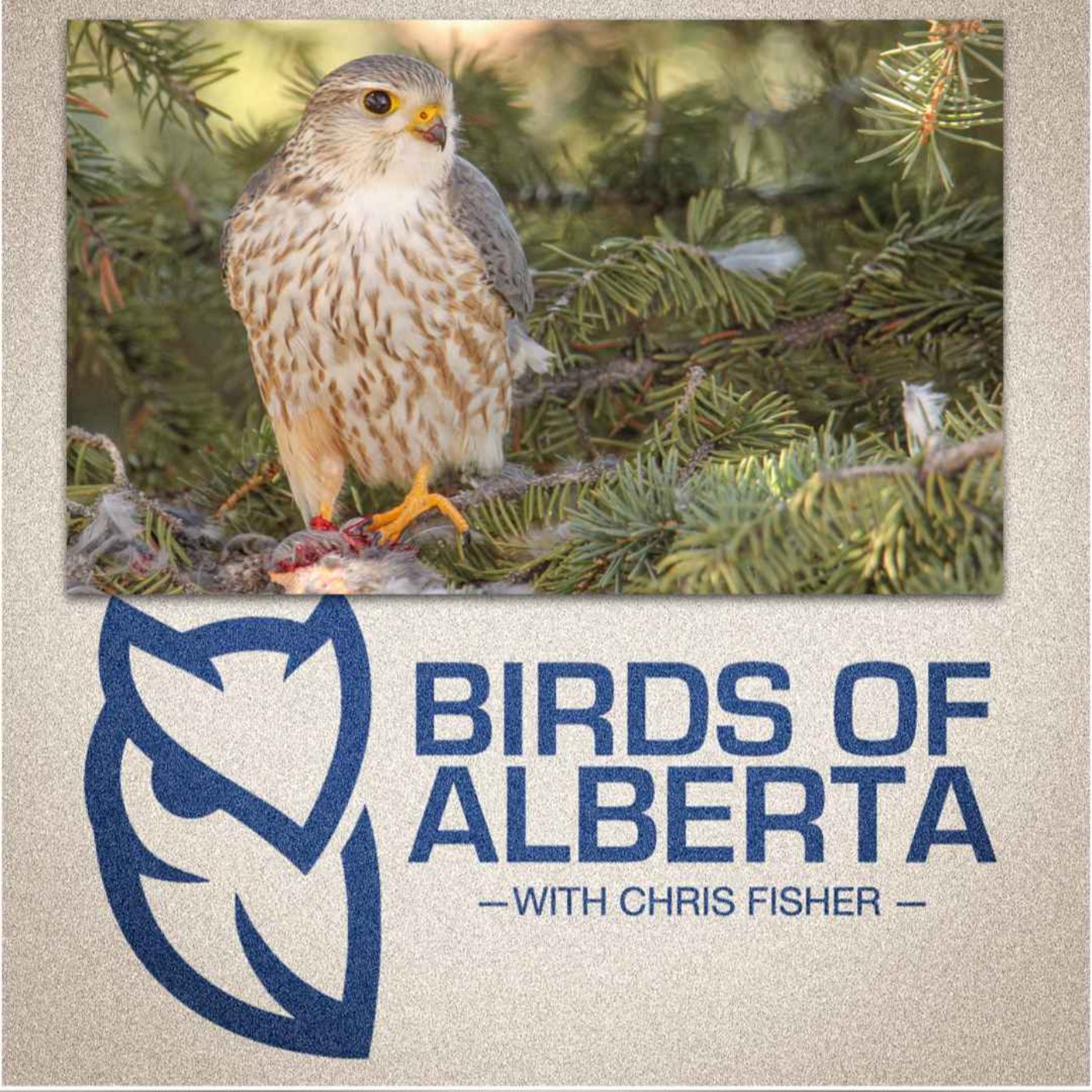
The podcast episode features Chris Fisher reflecting on a formative childhood encounter with a Merlin falcon in Lethbridge, which sparked his lifelong passion for birds. He describes the Merlin as a small, swift, and familiar falcon in Alberta, detailing its physical characteristics, hunting habits primarily on songbirds like house sparrows, and its loud, conspicuous courtship behavior in spring. The population, once impacted by DDT, has significantly rebounded since the 1970s, with Canada being a crucial breeding area. Merlins nest in mature urban neighborhoods and rural homesteads, often using old crow nests in tall spruce trees. A surprising taxonomic revelation is that falcons are genetically closer to parrots, sharing traits like flight style and vocalness. Fisher concludes by likening the Merlin to a comforting, unifying cultural staple, a common natural spectacle that connects Albertans across the province despite diverse backgrounds, celebrating its persistent presence in both urban and wild landscapes.
Welcome to the Birds of Alberta podcast. I'm Chris Fisher co-author of the best selling field guidebirds of Alberta. Now growing up in Leipbridge as I didn't late 1970s and early 1980s provided me with really exceptional childhood. I have great memories hanging out with my best friends and they yet to be developed lots along the railroad line and in the parklands in and around Henderson Lake. These areas were formative in my personal and professional course of life. Leading up and including I suppose me speaking at this very moment into this microphone. Now in this childhood we caught grasshoppers and diving beetles and water bulmin and kept many in buckets and tanks set up in a dedicated corner of my yard to house our catches. Nature was one of the big themes of being a kid those days but strangely birds over which I am now greatly associated with. Well they did not play a huge role in those days. But one of the very few birdie memories that has remained etched these many many decades later was of a very neighborhood type of bird. You see like many kids of that age most days I walked or biked or roller skated to and from my elementary school. I have since retraced that particular route as an adult and was surprised how much shorter the trek was in reality than in my school aged memories. But still over the years that ten block or so journey brought many adventures into the lives of me and my school made friends and on one morning in particular there was a very memorable bird. Perched on a powerline spanning over Diablo Vard that I remember meeting my very first good Alberta bird. It wasn't every day every day bird but it was one that was eye catching and a bit unusual. While it was not overly large or colorful or doing anything really spectacular quite frankly it was just perched there nervously looking around. The sighting stood out as being something a bit special so when I got home I looked it up really in the only thing that we had at home that was the Audibon Nature Encyclopedia. So good on my parents in investing in those twelve books way back then. And while I have since seen dozens and dozens of this particular species in the decade since most of those sightings have faded from my memory but not this first and foremost in counter because on that morning I had one of my most foundational encounters among the birds of Alberta and it was with of course a Merlin. Now to start a Merlin is a small falcon not our smallest falcon but a neat smallish falcon all together and falcons are little feathered rockets. The Merlin is perhaps our most familiar falcon and of course falcons are relatively mainstream in public lore because while we have falcon sports teams there's a 1960s car named after falcon which was not all that speedy and it's a relatively common corporate brand and as a bird a prey it really is one of the coolest birds and really one of the coolest birds that we can have in our neighborhoods because it really stands apart in a lot of ways in what neighborhoods actually mean. You see neighborhoods are not particularly speedy or quick places. Cars driving through neighborhoods are not speedy at all they're limited to 30 or 40 kilometers an hour and the spaces that we call Homer typically small yards. Cross a minute matter of seconds and well Merlin's do it in microseconds. Their view of the neighborhood is hundreds of yards which fall under their dome main and they really make no secret of this the sense of superiority real estate or otherwise they have over us they they dash overhead giving us only the briefest sights of them flying with their choppy choppy wingbeats but if you do happen two gaze upon one such as I did in my childhood you'll notice that they do have the distinctive look of falcons meaning that they are somewhat tear drop shape fairly long pointed wings and this is most visible in flight their wingtips come to a point unlike that fan out expression that one sees in our soaring hawks the males and females while they have a body form that looks fairly similar to one another they have different colorings the female tends to be brownish overall which helps her when she is to be camouflaged while incubating the eggs I suppose whereas the male has a little bit more color has a lightish powder blue back that's often tough to see as they tend to be seen above us leaving really only their undersides which on both male and female is fairly straight in brown with a little bit of white flicking Merlin are about the same size as a pigeon with a slightly longer tail but they can be confused with one another visually but when Merlin's open their tiny little hooked bill well nothing quite sounds like them and it is a special sound that resonates particularly in the spring across many of our neighborhoods and wild areas of the province now here in Alberta we are fairly lucky when it comes to falcons for there are five regular occurring species but there's no doubt that the diminutive Merlin is the most familiar one to many many Albertans all falcons for the most part feed on other birds hunting them with their blazing speed catching them in mid air occasionally some of the larger falcons and even Merlins will occasionally prey on ground dwelling things such as rodents or even insects for the smaller birds but they're really designed as a super sonic bird feeding predator in our cities and towns where they are relatively commonly seeing Merlins while they feed on some of the most common songbirds that we have including the ones that hang out in our backyards including house sparrows house finches and even in the winter time bohemian wax wings and the summertime cedar wax wings I suppose a study at the university in Saskatchewan in South Coutune which ecologically is very similar to cities such as Edmonton Reddeer, Lethbridge or Calgary in Alberta well that particular study of Merlins in Saskatchewan suggested that up to 70% of the diet of these urban birds comes from house sparrows and I suspect that is a little different here in Alberta but Merlins are also found in rural areas as well not in the same density but they will hang out in rural areas both as nesting residents but also a little bit more commonly as migratory birds coming from northern areas even as far as tundra areas passing through in migration when they do so well they'll be hitting up swarms of a buntings and red poles in the winter time for instance or horned larks or lapen mongspurs these sort of things as they migrate to and from their summer and wintering grounds passing through Alberta as a result of their taste for other birds having Merlins around is usually a pretty good indication that overall bird populations are relatively healthy Merlin populations a hundred years ago or so were much lower than they were now likely due to DTT that is famously associated with larger birds of prey but it would have knocked down Merlins as well for the same reasons and these birds are fairly wide ranging Merlins are found around the globe in northern part of the globe something we call circumpolar so that in North America means most of Canada in Alaska as breeding areas a little bit in the northern United States breeding also however in northern Europe the Scandinavian regions and throughout much of Russia and they winter leaving those areas particularly the northern most areas in which they breed and wintering a little bit further south south the places like Alberta but never as far south as say Mexico as a consequence of Merlins breeding in the area Canada is a particularly important area for the overall Merlin population about 44% of the global populations thought to nest in Canada that's you know from the gray plains all the way up to the Arctic with an increasing population over on the coast and in BC
and a good number of those would also nest in Alaska. So between Alaska and Canada, probably close to 50% of the entire global population is in this area. The Merlin population has increased from these previous lows. And since the 1970s, the population seems to have rebounded quite a bit. The breeding bird survey accounts are up nearly 300%. Over the last 55 or 60 years or so and so too, does the Christmas bird counts that we conduct throughout Alberta, will they show a fairly large increase in Merlin's over that time? They've really steadied out, however, over the last 20 or 30 years, if we look at the major Christmas bird count results from our biggest cities, like Edmonton and Calgary, which are probably the most consistent points of data. The largest numbers that either of those counts would have tallied. Remember, this is done in mid December or so, about 10 days before Christmas day. Both in Edmonton and Calgary, the top numbers of Merlin in those cities would be around 30 to 35. More typically nowadays, we're getting 10 to 15. In the large cities in Alberta, we may have as many as 50 pairs nesting, but of course, not all those would be represented in a Christmas bird count. In the urban areas where they tend to nest, we tend to find them in older, more mature neighborhoods. They will tend to nest in blue spruce trees, particularly older blue spruce trees that have abundant stick nests. Stick nests either made by magpies or more so American crows. Magpies will have a dome over the nest. Crows will have an open platform. And like all falcons, well, Merlin's don't put much effort into building a nest so if they can use super nests, a well-built nest from American crow, they'll do that. And their preferred area is a high up nest in a blue spruce tree. And blue spruce trees that are taller than the surrounding houses usually take about 40 years to grow. So that's the age of neighborhoods we tend to start seeing Merlin's hanging out with. And of course, those neighborhoods often have a lot of shrubs around and usually a pretty healthy populations of things like house marrows and house finches for which they pray. Merlin in rural areas occupy similar sort of nesting areas. And there are very, very many homesteads on the Alberta planes and in the parkland areas that have large spruce trees with crow's nest in them. Then those are the very same areas where the rural populations of Merlin's will occur. Now for most of us, well, much of the year can pass without us spotting. Merlin's, as they can be a little bit on the secret of side, but that all changes in April and early May with courtship time. Just as the last snows are melting away, well, these birds become very, very obvious. They have tremendously intriguing courtship flights where they just rocket over our homes, chasing other birds, whether they're other competitors or potential mates. And most conspicuously, they are very, very vocal. These birds are some of the loudest that we have in our neighborhoods, perhaps only rivaled by the incessant rattling of northern flickers that wake so many people up by rattling on the chimneys, particularly the metal chimneys, well, Merlin's don't go to those levels of creating noise, but they can screech as loud as anything high above our houses. Once Merlin's are done with their courtship, and have settled down on the nest to incubate their four or five little eggs, well, they become far less conspicuous for a couple of months incubation will be almost a month long. And then the young chicks will take a little bit longer than that a month or so of being fed by their parents before they leave the nest. The male will bring in most of the food. Male's a little bit smaller than the female. That's kind of the general rule in most birds of prey, whether you're looking at howls, hawks, or eagles, or falcons, a little bit more nimble in the air as a consequence, and probably a little bit better hunting in the tight confines of our neighborhood. And they will bring in bird remains, and the female will tear them apart and feed them to the quickly growing chicks. About a month after the chicks are hatched, they will begin to leave the nest, but they don't do it very, very effectively. You see, it's a pretty tough job as a young Merlin to go from no flying to some of the great fighter jet wings that the bird world has. So to become a top gun takes quite a bit of training. So in these times, it's not unusual to see young, scruffy, looking Merlin's standing around the spires of a blue spruce tree, or even, I've seen them, on road sides, over sidewalks, below the tree, kind of figuring out what it takes to be one of the best flyers that we have in our neighborhood. Now Merlin are very special for a bunch of reasons, but one reason that's a little bit unusual is there are really not many birds out there, particularly an Alberta that have one word names. Most birds are much more descriptive in their names, but we do have one word name in birds like Kildir Sora, Bob, Bob will link, they all come to mind, they kind of set these birds aside, kind of like a pop music superstar that separates themselves from the ilk of us common folk with these one word names. But a big question remains about the name. What came first, the falcon, or Merlin, the wizard? Well, see our feathered Merlin was first formally described by an Englishman, he's a naturalist, who came to North America and was collecting and recording birds in the south eastern part of the United States. His name was Mark Katzby and described it and named it the Pigeon Hawk in about the 1750s and then later on a few years after that Carl Linnaeus gave the Merlin, it's by no-mail name Falco Colomberius, which kind of also refers to Pigeons in his famous taxonomical work. So we think, well, clearly the wizard Merlin came way before that, so fast. We do know that the wizard was first introduced to the literary word around 1130 or so, so that's like six centuries before Linnaeus or Katzby were even around. And the wizard gets his name from like a Welsh word called Mirden. So our little falcon's name comes from the old world by French word, as Merlin or a Anglo-Norman as Merlin or German Smerlin. So there was kind of a Merlin-esque origin to the name at least in Europe and that dates back also to about the mid-8, 1150s or so. And of course, people long before that have been admiring the swift and agile birds of prey that were kind of small in size but big in character, not only that, these little falcons because they occur in the old world were also used probably for a couple thousand years in falconry. So it's not like that they came out of nowhere and they certainly would have been called something and it's likely that they were called something even in those times that were similar to the root that eventually led us to the name Merlin. Nowadays in the 21st century if anyone begins birding they're introduced to the name Merlin. Pretty quickly because it is actually the name of just an incredible birding app that's been put out by Cornell University. It's very popular so if anyone doesn't have Merlin and their beginner birders absolutely get it it's a free download. It uses AI technology to to identify photographs and they have to be reasonably good for
photographs of birds, but it also uses AI to identify the voice or the calls of birds. As such, it is exceedingly popular. Bird is young and old alike have it on their phones. So it's really kind of cool that Corn-Dale apparently named its app Merlin to kind of reflect the speed and the accuracy of the tool, much like the speed. And fierce of the little falcon. But the other cool thing is that it chose Merlin to evoke the magic of instantly identifying birds, kind of like the abilities of that legendary sorcerer himself, even if he was not associated at all with the original naming of the bird. At least, I guess, he got a piece of the app action. Now, one of the great things about writing a book and a book that has been out for over 25 years is that there are many changes and people are very, very eager to point out those changes, particularly when there's errors. But there's other surprises that happens over the years and one of the great surprises. When we wrote the book, we slid those falcons, including the Merlins, right alongside the other birds of prey, the hawks and eagles, for decades for centuries. Superficially, it looked like taxonomically. That's where those birds belong. Well, in the decades since, well, there has been a tremendous amount of DNA work going on to bird taxonomy. And wouldn't you know that it was determined that falcons don't belong anywhere close to those other birds of prey, but rather a rather surprising group of birds. That bird group would be the parrots. Now, here in Alberta, we don't have much experience with parrots aside from the caged variety. They are a tropical thing. So if anyone's ever gone to Costa Rica or Africa, you would have great experiences with parrots. But there's also introduced parrot populations. Ah, places like Chicago, even London and Amsterdam have introduced parrot populations. So you can see parrots flying around and wouldn't you know it? They're fast flyers. They're choppy wingbeats. They have long pointed wings. And they don't make tight turns. They make these long, slow arching turns very similar to falcons in particular, small falcons like the Merlin. And one other thing that's quite common to parrots and to things like Merlins are the fact that they're also quite chatty. Parrots never shut up. When there's a flock of them around, well you hear them blocks and blocks away. And so too, particularly in the springtime, you can hear the chatty Merlins from a long ways away as well. So perhaps while it was a bit of a surprise 10 or 15 years after the publication of our book that this research came out, in hindsight, it actually isn't quite a surprise at all. And it is fascinating and wonderful to have these little murder parrots as they're now known, flying around our cities and in our lives. Now Alberta as a province has, as we all know, like big energy themes. But Merlins as a bird, well they kind of also perfectly represent energy, both kinetic energy and potential energy. And yeah, I know, I know I'm taking Ornithology on a bit of a brief trip to the physics lab here, but do hear me out. You see, in flight, Merlin are these like meat-seeking missiles. And when they perch, they are these like composed, collected and contained beans. So they do represent both sides of the energy equation. They're both explosive and subtle. And they bring this dynamic dualism to our back decks like no other bird and in ways that we just can't ignore. Now I kind of think of Merlins a little bit as a bird like a can of tomato soup. Now sure, you can go to the grocery aisle and there are all sorts of fancy soup varieties. And many in even fancier soup packaging. And many of these were wonderfully intriguing and invigorating offerings that are extremely tasty. But do they last or persist months or even years? Or will they simply disappear off the shells when the latest trend falls flat? But not so with tomato soup. It is familiar, comforting and unifying. My kids enjoy it just as I did and just as their great grandparents did. It is an enjoyable staple of their lives. And so too is the Merlin. You see at some point in the year pretty much every neighborhood in every city and every rural section in the province is visited by Merlin with many of these in areas having full-throwed year round resident tiny little Balkans. Now there are fewer cultural things that unite all of us in the 20th century. Now previously we all listened to the same radio shows and watched the same movies, dance to the same songs on the radio. None of this holds true anymore. But natural show pieces still remain in common. And here in Alberta we have a common love of landscapes. And in some cases like the Merlin we can all share a common all in birds. And while these Merlin are found in all northern areas around the planet, there may be no better place than right here to experience the Merlin. It's our little feathered rocket speeding through to the very top of the birds of Alberta.
Podcast Summary
Key Points:
The speaker's childhood in Lethbridge fostered a love for nature, but birds, particularly a memorable Merlin sighting on his way to school, became a significant later influence.
The Merlin is a small, common falcon in Alberta, known for its speed, distinctive appearance, and loud vocalizations, especially during spring courtship.
Merlin populations have recovered since DDT-related declines, with Canada hosting a large portion of the global population; they nest in mature urban neighborhoods and rural areas, often in old crow nests in spruce trees.
Surprisingly, DNA taxonomy reveals falcons like the Merlin are more closely related to parrots than to other birds of prey, sharing traits like flight style and vocal chatter.
The Merlin is compared to a cultural staple, like tomato soup, for its familiar, unifying presence across Alberta's diverse communities and landscapes.
Summary:
The podcast episode features Chris Fisher reflecting on a formative childhood encounter with a Merlin falcon in Lethbridge, which sparked his lifelong passion for birds. He describes the Merlin as a small, swift, and familiar falcon in Alberta, detailing its physical characteristics, hunting habits primarily on songbirds like house sparrows, and its loud, conspicuous courtship behavior in spring. The population, once impacted by DDT, has significantly rebounded since the 1970s, with Canada being a crucial breeding area.
Merlins nest in mature urban neighborhoods and rural homesteads, often using old crow nests in tall spruce trees. A surprising taxonomic revelation is that falcons are genetically closer to parrots, sharing traits like flight style and vocalness. Fisher concludes by likening the Merlin to a comforting, unifying cultural staple, a common natural spectacle that connects Albertans across the province despite diverse backgrounds, celebrating its persistent presence in both urban and wild landscapes.
FAQs
A Merlin is a small falcon, about the size of a pigeon but with a longer tail and pointed wings. It has a teardrop-shaped body, and males have a light powder-blue back, while females are brownish for camouflage.
Merlins are often seen in older, mature urban neighborhoods with tall blue spruce trees, as well as in rural areas like homesteads on the plains and parklands. They nest in stick nests built by magpies or crows.
Merlins primarily feed on other birds, such as house sparrows and finches, hunting them with high-speed aerial pursuits. They are designed as supersonic bird predators, occasionally preying on rodents or insects.
Merlin populations declined due to DDT but have rebounded since the 1970s, with breeding bird survey counts up nearly 300% over 55-60 years. In Alberta, urban areas like Edmonton and Calgary may have 10-15 Merlins in winter counts.
Merlins become very conspicuous during courtship in April and early May, with loud vocalizations and dramatic flights. They are less visible during incubation and chick-rearing, which lasts about two months after courtship.
The bird's name comes from Old World roots like the French 'Merlin' or German 'Smerlin', dating back to around the 1150s. It is unrelated to the wizard Merlin, who appeared in literature earlier, around 1130.
Chat with AI
Loading...
Pro features
Go deeper with this episode
Unlock creator-grade tools that turn any transcript into show notes and subtitle files.
 PodcastTranscript AI