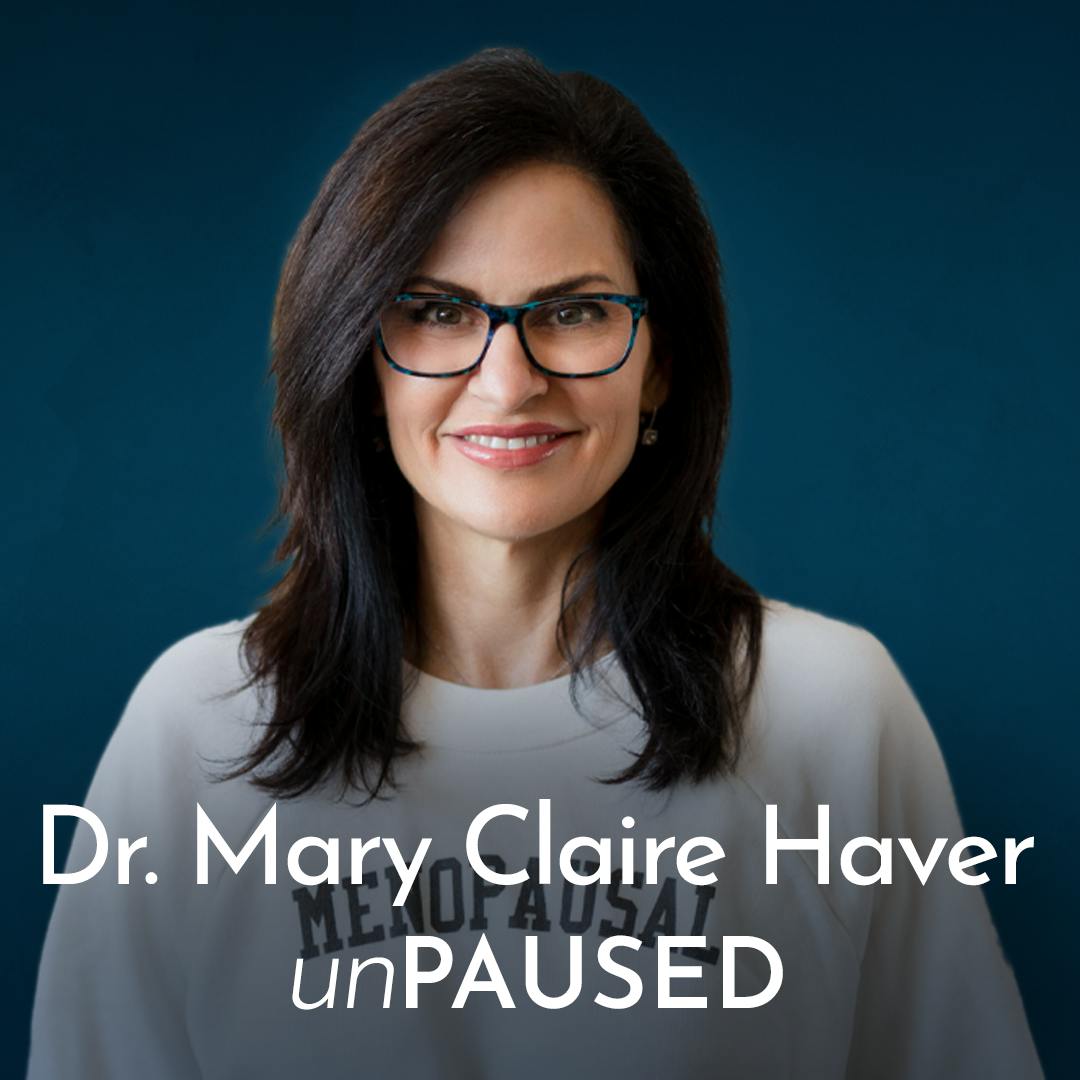
Menopause Masterclass: Hormones, Brain Fog, Weight & Mental Health with Dr. Mary Claire Haver
50m 49s
The transcription is an educational podcast segment where Dr. Mary Claire Haver explains menopause, perimenopause, and their systemic impacts. She defines menopause as beginning one day after the final menstrual period, with perimenopause starting 7-10 years prior as egg supply declines and ovaries become resistant to brain signals, causing hormonal fluctuations. Dr. Haver emphasizes that estrogen receptors are found throughout the body, so its decline affects nearly all organ systems, leading to diverse symptoms like brain fog, anxiety, heart palpitations, weight gain (specifically a tripling of visceral belly fat), and genital urinary issues. She advocates for menopausal hormone therapy as a first-line treatment for new mental health symptoms in perimenopause and stresses the importance of prophylactic vaginal estrogen to prevent GSM. The discussion highlights a critical gap in medical education, as most clinicians are not trained in contemporary menopause care, often leading to inadequate patient treatment.
Post Metapause represents the entire lifespan that we have, where we have to learn how to live without the hormones produced in our ovaries. So let's get into some questions. The views and opinions expressed on Unposed are those of the talent and guests alone, and are provided for informational and entertainment purposes only. No part of this podcast or any related materials are intended to be a substitute for professional medical advice, diagnosis, or treatment. I'm Dr. Mary Claire Haver, a board certified obstetrician, gynecologist, and certified menopause practitioner. I am also an adjunct professor of obstetrics and gynecology at the University of Texas Medical Branch. Welcome to Unpause, the podcast where we cut through the silence and talk about what it really takes for women to thrive in the second half of life. So welcome to my very first AMA or ask me anything. We got so many questions when I solicited on Instagram. What do you guys want to know about? But I think we first really need to start with basic definitions. So what is menopause and how do we define it? Unfortunately, in medicine, we define menopause as one year after the last menstrual period. Now, what happens if you don't have regular periods? If you've had hysterectomy or if you are having a marina, IUD, or some reason why you don't have a normal cycle, do you get left behind? And what if it's leap year? Do we go one extra day or 366 days? What menopause represents is the end of production of hormones from your ovaries. And why does this happen? Human females are born with their entire ex-supply. What I think every woman really, really needs to understand is why we go through menopause. So human females are different than human males on multiple levels. But from an endocrinological perspective, women are born with their entire ex-supply. Men get to make their stuff fresh every day in the testicles until they die. So when we are in our mother's womb, so in medicine we say in utero, when you're about five months along, your mother is pregnant, your five months along, and the DNA, the genetic material for your children is inside of your grandmother. If you think about that, it's kind of fascinating. So you have several million eggs there, and they start deteriorating immediately while you're still in the womb. So that by the time you're born, you are down to already one to two million eggs at birth. You continue to lose them on a pretty steady state basis, and that is from a process called atreja. Atreja, I like to think of it as kind of survival of the fittest. You slowly tick off the less healthy eggs so that the most healthy and viable eggs will survive. By the time you start ovulating, you are down to about 120,000, and then by the time you are 30, you're down to 10% of the original ex-supply, and then by the time you are 40, you are down to three percent of the original ex-supply. Now, where do we go from here? Menopause is basically you run out of eggs. Now, let's talk about ovulation and how that happens. Before puberty, when we're children, there is kind of breaks put on the ovulation system, and that is to give you your body a chance to grow and to get to some kind of an adult state. When that break comes off, we begin ovulating. So ovulation actually for us as women starts in the brain, not in the ovaries. The ovaries are sitting there just waiting for instructions to be told what to do. There's two glands in the brain that are important here. One is called the hypothalamus, and the other is called the pituitary gland. So the hypothalamus is the master regulator of our sex hormones as females. So the hypothalamus has like, imagine a little finger in the blood supply, a little probe, and it is checking for estrogen levels. And in our natural cycle, when the estrogen levels get low, at the end of the cycle, the brain says, hey, where's my estrogen? It sends a signal called GNRH to the pituitary gland that says pituitary. We need estrogen, send your signals down to the ovary, and that basically causes the ovulation. So we end up with this beautiful EKG-like ebb and flow of our hormones, FSH and LH from the pituitary gland, and then estrogen dial and progesterone from the ovaries. Mid cycle, we see the surge of estrogen, basically in preparation for pregnancy, and then we have progesterone that rises in the second half of the cycle. And that beautiful process in a healthy female goes like clockwork month after month after month after month until she reaches our next definition, perimenopause. Perimenopause is, you reach some critical egg threshold level, and it's different for every woman, where the signals coming from the brain don't work. The ovaries become resistant. We don't have enough eggs to respond in the same manner that we used to. So signals come, the brains like low estrogen, boom, start sending that FSH and LH down to the ovary and the ovary struggling to respond. The brain becomes agitated. The brain is, the hypothalamus is like, where's my estrogen? The pituitary is like, boss, I sent the signal. And the hypothalamus is like, send more, we've got to get this estrogen up. So what happens is the pituitary starts sending higher and higher levels of those stimulating hormones, the LH and the FSH to the ovaries to force the ovulation. That creates chaos in the brain and the brain hates chaos. So quite often the first sign that we see in perimenopause is not cycle dysregulation. That is late in perimenopause. It is brain fog, mental health changes. And sometimes just feeling, I don't feel like myself, something's not right. Clinically, when my patients come in, and I think about the 20-ish years, 15 years that I practiced before I truly understood perimenopause and menopause and the whole multi-organ system effects that it could have, I knew that people had vaginal dryness. I knew that people would have hot flashes. I knew that their cycles would become irregular and then stop. But what I didn't really understand was what was happening in their brain. And for most patients, when you really look at the things starting in the brain, the fatigue, the sleep disruption, the mental health changes that just not feeling something is wrong and you can't put your finger on it, that is perimenopause. So remember our definition of menopause, one day after your last menstrual period. Remember one day, just one. That is menopause. Everything after that. The next 30 to 40 to 50 years if we're lucky is postmenopause. So postmenopause represents the entire lifespan that we have or we have to learn how to live without the hormones produced in our ovaries. Which organ systems are affected by estrogen deprivation or menopause? Well that's a really good question. I talked earlier about what I was taught would happen. So I knew generally urinary changes, the bladder, the vagina mostly. I knew about the period disruptions and I knew that our bones would begin to crumble. But I did not understand. No one taught me until three or four years ago about what happens in the brain, what happens in the heart, what happens in the bones, what happens in the musculoskeletal system, what happens in the liver, what happens in our joints. So one of the papers that truly changed my life was researchers mapped out where the estrogen receptors were in the body. And that took my breath away. I had no idea that so many organ systems could be affected. That symptoms like palpitation, like frozen shoulder, like elevated cholesterol, like insulin resistance, prediabetes are all having to do with menopause. The natural estrogen in our systems while we're still ovulating and healthy is very protective of the human body. It protects our joints, it protects our liver function, it protects the way we process glucose, it determines where and how we store fat. And that was mind blowing to me. So let's talk about symptoms. When I was researching for the new menopause, I was trying to find as much medical evidence and papers that were written. And actually there was quite a few that demonstrated from organ system to organ system what symptoms might be experienced by a woman going through perimenopause from the estrogen deprivation. And are you ready for this? Breast tenderness, brain fog, arthritis, acid reflux, body composition changes, belly fat, brittle nails, arthralgia body odor, asthma, bloating, anxiety, depression, burning sensation in the mouth or tongue. Autoimmune disease, new or worsening, dry skin, sleep disruption, chronic fatigue, dizzy spells, dry eyes, decreased desire or libido issues, dry mouth, eczema, fatigue, headaches, fibromyalgia, frozen shoulder, hot flashes, health palpitations, incontinence, insulin resistance, bloating, gastrointestinal problems, electric shocks, sensations in the skin, a regular heartbeat, also known as palpitations, genital urinary syndrome, vaginal dryness, recurrent UTIs, difficulty concentrating, high cholesterol, high triglycerides, irritability, joint pain, itchy ears, itchy skin, kidney stones, memory issues, mental health disorder migraines, and the list goes on and on. And I need to add heightened hearing because my husband chewing is absolutely intolerable to me at this point. Parymentopause begins seven to ten years before your period stops, at least. So remember, the average age of menopause is 51. Normal, meaning under the normal curve, is 46 to 55. Let's do math and back that up seven to ten years. It is completely reasonable and expected and predictable for a woman as young as 35 to 36 to begin having any or all of the symptoms that I listed before. So Dr. Haver, talk to me about weight gain and menopause. So when I talk about weight gain and menopause, you will see, I see it on social media all the time, a lot of the wellness crowd saying menopause does not cause weight gain. What that means is that when we look at age-matched patients, regardless of their menopause status, they are all gaining weight. So it's hard to blame menopause on that. However, what we do see is body composition changes. Loss of muscle, so muscle weighs more than fat, as we all know. But fat takes up more space. So we are seeing expansion of the body fat compartment, especially in what we call the viscera and medicine, which you would call belly fat. This is a very specific type of fat that wraps around our internal organs. And it acts very differently than subcutaneous fat. Subcutaneous fat is the fat under our skin. It's heavily tied to our genetics of how and where we store fat when we are younger. And subcutaneous fat is not inherently dangerous unless you have a critical mass that is causing wear and tear on your joints. It's not really metabolically active, not nearly to the degree that visceral fat is. Visceral fat expands dramatically across the menopause transition and there is no denying this. So for example, a pre-menopausal woman on average, a fertile body fat about 8% is visceral. Take her through the menopause transition, put her into menopause. We now go from 8% to about 20% to 23%. So almost tripling the amount of fat with not one single change in diet and exercise. So why does this belly fat happen? That's a great question. So when we take estrogen away and out of the system, several things start happening. Estrogen is a powerful anti-inflammatory hormone. So we see systemic inflammatory markers rise, things like interleukin, things like sea reactive protein go up without estrogen there to kind of hold them back. When our body is more inflamed, we tend to drive fat to the visceral cavity to the abdomen. When we have fat there, the more fat we have, that fat itself pumps out more inflammatory cytokines, these chemical messengers that raise our blood levels of inflammation. So we end up in this really crazy negative feedback cycle, more inflammation driving more fat to the abdomen, causing more inflammation. Second thing we also see is effects in the liver. How our body processes cholesterol? We see a dramatic increase in our LDL levels and a slight decrease in our HDL levels. And if you haven't learned this, LDL is the bad cholesterol more likely to be related to cardiovascular disease and HDL is the good and protective cholesterol. One final thing to remember is how your body processes glucose changes dramatically across the menopause transition. We see elevations in insulin resistance, prediabetes and full diabetes. For example, a woman with prediabetes who is started on hormone therapy, not birth control pills, but menopausal hormone therapy in perimenopause, who is prediabetic, has a 50% decrease risk of developing full diabetes, the versus a woman not on HRT. In midlife, so many women struggle with fatigue, brain fog, weight changes, hot flashes, and they're still being told these symptoms are just a part of getting older. I hear about it every day from women who are searching for real answers and not getting the care they deserve. That gap in menopause care is exactly what Midi Health is here to close. Midi Health is a telehealth clinic serving women in midlife with expert evidence-based care. Their clinicians and medical leaders are professionals, I trust, committed to treating the whole person. And as the only national women's telehealth clinic covered by major insurance, they make high quality care accessible and affordable. When you work with Midi, you'll get a personalized plan built around your unique needs. This might include hormone therapy, nutrition, lifestyle guidance, or support for weight management. Everything is designed to help you feel better now and protect your long-term health. We're seeing the difference Midi is making with patients everywhere, and women are getting the answers, relief, and care that truly makes an impact on their daily lives. It's such an encouraging moment for women's health. We're finally seeing menopause care evolved into what it should be, thoughtful, informed, and centered on women's real experiences. I'm so thrilled by what Midi Health is doing to help women feel supported and empowered. You deserve care that supports you now and protect your long-term health. Visit joinmitty.com to meet with a midi clinician and start feeling your best for the years ahead. So Dr. Haver talked to me about mental health changes across parimenopause and menopause. Why am I having increasing anxiety? There's a few things going on. The zone of chaos, increasing levels of inflammation in the brain, also estrogen and progesterone and likely testosterone all have direct effects on our neurotransmitters. And neurotransmitters are things like dopamine and serotonin. These are the chemical messengers that go from neuron to neuron in the brain. And when we're, for example, when we're treating depression, we are giving you medication that changes the level of these neurotransmitters between those neurons. So imagine all of a sudden your brain is very used to having certain amounts of hormones come and go throughout the month and you're doing great. Or say you had a previous history of depression or anxiety that was well controlled on your medications. And all of a sudden, you get to parimenopause. The brain's going through its hormonal chaos. Your serotonin and norepinephrine and dopamine levels are starting to shift. And you are starting to have not only cognitive changes like brain fog, difficulty finding words, words, salad. But you are also having a new onset of depression or anxiety. Or previously well controlled medication is no longer giving you the symptom relief that you need. What we found when I was researching for the new parimenopause is that women who are treated with hormone therapy in parimenopause as a first line therapy or an adjunct. If they're already on antidepressants, this is really the gold standard now. Not to start someone who was doing great in life. All of a sudden has new depression and anxiety in parimenopause. We want to stabilize from hormones with menopause hormone therapy. And those patients are doing quite well. So first line therapy should be hormone therapy. And then if needed, secondarily adding an antidepressant, if needed, should not be first line therapy. It's also worth noting that we're doing a terrible job educating our clinicians about menopause and mental health. We're actually doing a terrible job educating them about menopause and anything. Recent survey done only about 8% of residents felt competent to treat menopause when they graduated from OB/GYN training programs. And only about 23% admitted that they got any training in menopause at all. And that's just OB/GYN. That's not including family medicine and internal medicine, all of the people who are seeing women on the front line. So you hearing me say giving hormone therapy as first line for mental health changes in the parimenopause transition may be the first time your clinician hears any of this. Because even with CME, the continuing medical medical education. So once we get out of our training and our resonances, we are required to keep our board certification up by recertifying on usually a yearly basis, which means keeping up with the latest changes. But the boards are not selecting menopause-related articles to put in front of their clinicians. And many of them are using guidelines that are very, very dated. So you may have to educate your clinician or seek out a menopause-educated clinician to get the care that you need. One of the most popular topics that we were asked to cover was concerning changes to the vagina, the bladder, the vulva, something we lumped together in my world called GSM or genital urinary syndrome of menopause. That name is probably not the best because you can have generally urinary changes from being postpartum, from being parimenopausal, from any time that your body is experiencing low estrogen. Our bodies remember, as we said earlier, have estrogen receptors everywhere, but really, really lots and lots and lots of them and are critical to the health of our bladder, our urethra, which is the tube that drains the bladder out into the world, the vulva. You should know what a vulva is by now. But if not, it is the labia majora, the labia menorah, all of the kind of outside skin in our pelvic area and the vagina. When we take estrogen away, or it begins to fluctuate and decline in parimenopause and then we take it away, the skin, the mucosa, the inside skin is called mucosa. The outside is just called skin. It becomes thinner. We lose about 30% of all of our skin's collagen in the first five years of menopause. And I do not have to tell a woman that she knows that. And we can talk about wrinkles on another podcast. We lose trans-epidoma water. So our ability to make mucous, the tissue thins, we lose elasticity. So the vagina becomes very easily damaged from regular intercourse things that never hurt you before. We have recurrent UTIs because estrogen protects the microbiome, which protects the poop bunks from making it up into the urethra. And let me tell you, the number one treatment for the prevention of recurrent urinary tract infections is not antibiotics. You should not be on antibiotics as a first line therapy. You should be on vaginal estrogen. Vaginal estrogen is local therapy. It is to quote Dr. Kelly Casperson. It is skin care for down there. It does not absorb systemically. So the warning labels and everything that applies to systemic estrogen does not count for vaginal estrogen. In my world, in the menopause, many of us believe that all women in perimenopause and beyond should be on prophylactic vaginal estrogen. Why would we wait until the vagina breaks before we decide to treat it? Why are we waiting for women to have a certain level of suffering before we offer them treatment? You actually should never suffer at all. prophylactic vaginal estrogen is safe. Even if you have active breast cancer, you can use it. You know, it is probably the most under-sung hero of the entire pelvic organ area. And I recommend it for everyone. So I did talk about this on a podcast with current men and you should go back and watch it. But in case you missed it. So here's my vaginal estrogen story. I had maybe six months between diagnosing menopause or figuring out it was menopausal and starting hormone therapy. Again, I started hormone therapy in the era where I was still afraid of it. I still believed the 2002 study, the American College of Obes家 had not updated their guidelines. It still says for severe symptoms only for the lowest dose for the shortest amount of time. Now, the menopause society has updated their guidelines in 2022. And I follow those guidelines. But at the time, I didn't even know the menopause society existed. It kind of started as a rogue organization of a bunch of concerned physicians that the American College of Obes家 was not addressing menopause adequately and they wanted to make their own society. But that's a whole political conversation we'll have later. However, I'm on reluctantly on hormone therapy and thought I don't need vaginal estrogen. I'm covered. I'm on systemic estrogen. Why would I need it? And I was having no symptoms. So fast for no symptoms that I could recognize. I about two years ago, I started noticing that I was struggling with orgasm. What used to take just a few minutes was taking longer and longer and longer. All that, you know, we were doing all the usual things to bring out this miraculous event. And it was just taken. It was so frustrating. I just remember being incredibly, incredibly frustrated. I wasn't having dryness. I was and we always use lubricant though. So I wouldn't really know if I was having dryness. You know, I wasn't having any of the classic symptoms and I myself as a menopause expert who talks about menopause all day on the internet did not realize that my delayed orgasms could be and were a sign of genital urinary syndrome of menopause. I was probably having literal atrophy from not enough estrogen making it through my bloodstream to get to the genital urinary tissues. And I was having poor blood flow to the area. So I'm on the phone with my bestie, my minobestie Karin men talking to her about this and how frustrating it is. And we were talking about vibrators at the time. And I was like, I don't know about this vibrator. It's not working. I'm taking forever. I don't know what's going on. And she's like, well, how much vaginal estrogen are you on? And I started laughing. And I was like calling myself out saying, none. And she said, what? Mary Claire. I mean, she laughs so hard. And let me tell you, within a month, of using it as prescribed, the situation had rectified itself. So if you are having this issue, and I know there's someone out there listening or watching who's going to be, oh my god, that is me right now. And then a note about lubricants, even on vaginal estrogen, I really recommend lubricants and maybe moisturizers, depending on the patient, definitely a lubricant for every intimate encounter. I cannot hype this up enough. We're never going to get back 100% our pre-menopausal vaginal health tissue strength elasticity, et cetera. That ship is kind of sealed. I mean, vaginal estrogen can go a long way. But it, of course, is traumatic to the tissues. And so I've just say lubricate, lubricate, lubricate hydrate. And so I like a vaginal moisturizer. So the big differences between the two, a vaginal moisturizer pulls water. It's usually made heavily with hyaluronic acid. Okay. Hyaluronic acid holds, I think, 100 or 1000 X some, some ridiculous amount of water. It clings. So it adds moisture to the area. There's a lot of skincare products with hyaluronic acid for hydration. I like that. I love to hike. If you follow me, you know, I'm always in the mountains, hiking, hiking, hiking. And when I'm not in yoga pants where everything's kind of tucked up and, you know, hell, definitely my anatomy has changed with age, gravity. And things are in places that they didn't, that they weren't when I was 25. I'll just let you use your imagination for that. So one I'm in yoga pants and everything's kind of there. I don't have much problem. But when I have shorts on the like Nike shorts with the built-in underwear, after a few hours of hiking, I start getting chafing in certain areas. So a moisturizer is miraculous for that. Adding some hydration in the area, I just love it. Lubricant is something you want to lubricate. It's adding slipperiness. Okay. And typically the products are something that is vitamin E-based, which is a really slippery, you know, an oil-based lubricant or a silicone-based lubricant. Now, if you're using toys like vibrators, you have to be careful with some of the silicone-based lubricants. It can mess with the skin on the apparatus. So always read the instructions on that. But every intimate encounter, I really recommend using a lubricant. Now, there's a separate prescription that is available. And it's called Prasterone when we're talking about vaginal hormones. This one is different because it is the prescription form of DHA. DHA is a precursor to both testosterone and estrogen. And when we put the Prasterone in the vagina, it converts naturally to both estrogen and testosterone. Not only do we have estrogen receptors in the vagina, we have testosterone receptors in the vagina. And my friends in the sexual medicine world are huge fans of this medication because they're not only getting that boost of estrogen there, they're also getting testosterone. I have a few of my patients who are on it and absolutely love it. I've never tried it personally myself. The problem is there's no generic available for it yet. And it can be on the pricier side. Vaginal estrogen, you can get for 10-15 bucks a tube that'll last you for a couple of months. So Prasterone would be used in place to vaginal estrogen, not along with your vaginal estrogen. It would be an alternative to it. One final medication is, I never can say this correctly, as osfamine. I've not prescribed it yet, but it is something called a SIRM. It's an oral medication that acts as an estrogen agonist, meaning it's proestrogen and vaginal tissues, but it isn't an antagonist in breast tissue. It is an oral formulation that allows estrogen to work its magic in the vagina, but blocks in the breast tissue. So for breast cancer survivors, this may be a great formulation for you to consider and talk to your doctor about. Now many women and many clinicians, sadly, haven't kept up with the latest guidelines. And are under the assumption that vaginal estrogen somehow is associated with breast cancer. Let me just stop that nonsense right here and right now. There has never, even in active breast cancer patients, even in post, even in survivors ever shown, and they've looked at the data extensively. There is no elevated risk of recurrence for a patient to use vaginal estrogen. And the greatest studies show that patients who had vaginal estrogen versus those who did not, who were survivors, lived longer. Vaginal estrogen saves lives. Why? Because it decreases the risk of recurrent UTIs, which can lead to sepsis, which will kill you. So big takeaway and general urinary symptoms is it's not just aging. It's not just dryness. If you are getting to the point where you are dry and hurting, your tissue is like at the 90th percentile. There is no amount that you need to suffer before you can earn hormone therapy in any form. At the start of the year, I always hit reset and ask myself, what am I actually wearing? I want my wardrobe to feel simple, elevated, and full of pieces I can actually rely on. No overthinking required. That's exactly why quince has become a staple for me. Everything from quince just works. Polished, effortless, and easy to wear day after day. These are the pieces you will reach for again and again. Their Mongolian cashmere sweaters, soft, cozy, and instantly feel like a treat. Their silk tops and skirts make getting dressed easy, and their denim and coats perfectly cut beautifully tailored, but built to last season after season. What I love most is how thoughtful everything is. From the fabric to the fit, it feels high quality without the crazy luxury price. And with ethical, trusted factories behind it all, you can feel good about what you wear. If you want your wardrobe to make getting dressed, feel effortless. Quince is it. Once you try it, these are the pieces you'll grab first every single day. Refresh your wardrobe with quince. Don't wait. Go to quince.com/unpause for free shipping on your order and 365 day returns. Now available in Canada too. That's q-u-i-n-c-e.com/unpause to get free shipping and 365 day returns. Quince.com/unpause. Hormones affect more than how you feel. They affect your skin too. As estrogen drops in midlife, your skin can lose collagen, hydration, and elasticity. That's where alloy health comes in. Alloy makes evidence-based menopause care accessible, connecting women with menopause experts. And now they're redefining skincare with M4. Their prescription line made with estriol, a form of estrogen that only works on the skin. It started with the M4 face cream Rx. And now, alloys added two game changers, the M4 face serum Rx and the M4 i cream Rx. Getting started is easy. Head to myalloy.com. That's m-y-a-l-l-o-y.com. Answer a few quick questions and a license position will review your info. Use code m-c-h-20. That's m-c-h-2-0 for 20 bucks off your first order. Your personalized skincare ships right to your door. No appointments, no pharmacy lines. Because your skin's changing and your routine should too, visit myalloy.com and use code m-c-h-20. That's m-c-h-2-0. Sometimes you don't need a whole new outfit. You just need the right finishing touch. And for me, that's Jenny Bird. You know that moment when you look in the mirror and you think, "Okay, this works." But then you add one piece of jewelry and suddenly it's like, "Yes, there it is." That's the Jenny Bird effect. It honestly feels like all my Jenny Bird pieces work together. So getting dressed is effortless. I can mix and match without thinking about it and still feel completely put together. The pieces are lightweight and easy to wear. Perfect for looking polished without spending forever accessorizing. Everything is designed to pull together instantly in a way that feels elevated but not overdone. And honestly, every time I wear it, someone asks where it's from. Every single time. From their iconic hoops to their bracelets and bangles, there's truly something for every style. And they just launched a new fine jewelry collection that feels modern, elevated, and really special. If you've been thinking about elevating your everyday look, this is your sign. You can get 20% off your first order with Jenny Bird by visiting jenny-bird.com and using the code unpawsed at checkout. So overwhelmingly, the vast majority of the questions that we got were about hormones and hormone therapy and all of the ridiculousness and misinformation that is floating around on the interweb. The person you should be getting your hormone therapy advice from is someone who is trained specifically in menopause therapy and in menopause care. That could be an internist. That could be a family medicine physician. That could be a nurse practitioner. What it probably isn't is a chiropractor. If someone is starting to steer you away from the gold standard of menopause treatment of hormone therapy and give you a bucket of supplements, saying that you don't need them, I would caution you to dig deeper and go to someone who actually has menopause education and experience. Second caveat, there are many, many, many, many, many types of hormone therapy and we will go through the basics. However, when you find your menopause educated clinician and you go in, locked and loaded and ready to discuss your options, your risk, the benefit profile specifically for you and they offer you one option, some cookie cutter option of therapy usually in the form of pellets. If they only offer pellets again, that's a little bit of a red flag. pellets are the most expensive, the highest risk and it's a 40 year plan basically and if you're willing to take the highest risk, most expensive option for 40 years and I'm quoting Kelly Cash Percent again here and that's your decision and that's what you want to do, that's fine but let me tell you, you can get bioidentical, FDA approved, tested, excellent hormone therapy that you can pick up from your Walgreens for $25 a month. There's no need to pay those exorbitant prices to get high quality, efficacious, tested, safe and affordable hormone therapy. So menopause hormone therapy or hormone therapy in this case is refers to replacing hormones that naturally decline as we age. Do you have to jump into hormone therapy to guarantee your best health for the rest of your life? No, not at all. I don't want anyone listening to this to feel like you are somehow missing out if you don't choose hormone therapy. You absolutely can be healthy without it, but it does get harder. Women on hormone therapy tend to live longer than their counterparts who were not offered hormone therapy. Two to three years longer, they have better bone density, they have lower rates of heart disease if they start early enough. The goal is not to make women younger, this is not a get your wife back moment. This is not, you know, this is medication that is meant to restore a balance that your body is missing and is struggling to perform at its highest capacity without. So when we discuss hormone therapy, we have to talk about categories. The ovary is the main source of production for estradiol, for all of our progesterone, and for about half of our testosterone production, we are able to make it through the adrenal pathway as well. Estradiol is the main estrogen in human body outside of pregnancy and outside of being postmenopausal. We have three main estrogens in our body. So estradiol produced by the ovaries estrone produced by the, what we call the peripheral tissue, so mostly in the fat cells, and then something called estriol, which is produced in the placenta. It's the main estrogen in pregnancy. All three of those can be formulated in their natural forms and given as some kind of a prescription. When I am talking about replacing hormones systemically, so I'm treating your brain, your bones, your heart, you know, potentially protecting your heart, etc. I am usually prescribing estradiol. I want it to be chemically identical or body identical or bioidentical so that I'm giving your body back what it can't make anymore. The second hormone we discuss is progesterone. Lots of questions about progesterone. Progesterone is produced in the second half of the cycle after ovulation, so we don't see it in the first half when you're still having regular periods, and it has a lot of functions in the body as well. It does prepare the lining of the uterus for a potential pregnancy. It rises after a pregnancy to help protect the fetus and the first 12 weeks of life, and then it declines again, but it's really, really helpful for sleep, and changes in progesterone levels is often the first thing we see in perimenopause. And for some patients, just treating with progesterone in the second half of the cycle, especially if you're only having symptoms in perimenopause, and your sleep is affected in the second half of the cycle, so you're tracking your cycles, you're like, I'm noticing worsening pre-ministral syndrome, sleep disruptions, a little bit of anxiety, some mental health changes. Sometimes just giving that patient progesterone in the second half of the cycle can be helpful. Now, when we are post-menopausal, or anytime in late perimenopause, and we're giving estrogen to try to stabilize these fluctuating estradiol levels, if you have a uterus progesterones or a progestin, which is the synthetic form and commercially available in other formulations, is required. Why to protect the lining of the uterus? If I pump unopposed estrogen meeting, estrogen without balancing progesterone into the uterine lining, it can cause something called hyperplasia and potentially malignancy. So to avoid that, we simply give a woman some form of a progesterone, and we can negate that risk. Now, if you don't have a uterus, this is a huge question that we got. Can I take progesterone? Yes, it's not mandatory, but it is optional. And it helps beautifully for a lot of women with sleep. How does it work? Progesterone gets converted to something called aloe pregnant alone in the metabolic process, which goes right to the brain and binds the GABA receptor. The GABA receptor causes us to relax. It's a calming mechanism, and it can be really, really, really helpful for women with sleep. I see it all the time. However, 10 to 15% of patients do not tolerate the best form of progesterone. The safest way to get into your body is in the form of oral micronized progesterone. For some women, it has the opposite effect. It can increase their anxiety, increase racing thoughts, and they don't tolerate it well. So thankfully, we have alternatives to that oral micronized progesterone. If you are one of the women who doesn't tolerate it, well, the third hormone is testosterone. I was never, ever, ever educated about testosterone when I was a resident. That was considered to be a male hormone. We never covered it. We only looked at women who were making excess amounts of testosterone through certain disease processes. It was never taught to me as a hormone of homeostasis. Homeostasis means everything is functioning at its highest capacity. Now, testosterone does not fall off a cliff, like estrogen and progesterone do through the men on post transition. Just like in a man, testosterone has an age-related, very steady state slow decline over time. To testosterone, we know is related to our libido. Libido is in mood. Libido is female desire, and it is the willingness, the acceptance, the excitement around having sexual relations with a partner. And as that testosterone level declines, we see women becoming less and less receptive to the suggestion of sexual activity being a good idea or sexual activity with someone else being a good idea. She still can masturbate, by the way, and she's fine with that. However, we know that women who are suffering, so the medical condition of hyperactive sexual desire disorder in my world, we call it HSDD. Meaning, I don't want to have sex with a person. I love and respect, and I feel supported by. When patients come into me and they're complaining of libido, I'm like, do you love your partner? She's like, no, he's disgusting. I hate him. I'm like, well, testosterone is not going to help with that. So you have to have had a prior, felt like you had a great libido. Nothing's changed in your relationship. You know, you're going through the same amount of stress, like everything's the same, and they're like, I love him. I used to want to do it all the time. And now there's just nothing there. There's just like a block. Okay. But they're not repulsed by him. So testosterone does not help with a partner who you would rather jump off a cliff. But if it's a partner who you love, feel supported by. It actually can be really, really helpful. Now testosterone can be given in multiple ways, like estrogen, like progesterone. We have oral options. We have non-oral options. We have injections. We have trokeys. We have pellets. We have all these ways to give testosterone to the body in the US. And they're working on it. We currently do not have a safe form of oral testosterone. It must be given in alternative ways through the skin, through the mucosa, either through a trokey or inserted into a pellet under the skin. I don't want to demonize pellets as there's something wrong with a pellet. Okay. A pellet is just a method of delivery to the system. The problem I have with pellets here in the US is certain pellet companies make false advertising claims. And it is a huge money maker for a lot of clinical offices. There's almost no discussion, like pellets will figure your pellet, your testosterone will fix everything. It's the most invasive. Okay. You're getting a cut in your skin and something inserted under your skin. And if that's your plan for the next 40 years, every three months for 40 years, getting a cut in your skin and some, all that scarring, you have better options. So in our clinic, we do transdermal options. And unfortunately right now, we don't have an FDA approved testosterone product for women in the United States. So in our clinic, we borrow the men's version and microdose it. So we take T-STAM or Andrew Gell and we give a tenth of the male dose, which tends to work very well for most patients. Of course, we follow her levels and then make sure she's having therapeutic response to it. I'll tell you my personal testosterone story. Again, I share with Dr. Men earlier so you need to go back and listen to that episode. I know that from studies, women who naturally had higher testosterone levels. Remember, it declines with age and it declines at different rates for different women. But by the time you're 50, you probably have about 50% of the level you had at 20. Okay, roughly. And I checked my testosterone level and it was on the expected low end for my age. And I thought, I've low muscle mass. Genetically, I'm a skinny girl and never had great muscle. Okay, and I am busting my ass, trying to eat the protein and lift the weights. Why not so that I can look like a bodybuilder? That's never going to happen for me genetically. But to keep me out of a nursing home when I get older because people with higher muscle mass have stronger bones and have less incidence of frailty and sarcopenia and that's a whole another conversation. Okay, so I thought I know some people, some doctors who really think that when a patient has low muscle mass and I am measuring muscle mass in my clinic with our in-body scanner, I am measuring body composition for my patients. Okay, I get on the thing and the machines yelling at me saying you have low muscle mass. I'm like, I know, thank you very much. What if I took some testosterone? Get me back up to my 25 year-old levels to help with me holding onto this muscle or maybe even building a little more. It's not going to hurt me. I didn't complain of libido issues. My husband and I never complain. When it happened, it happened. It was fine. And I have to say, I know it's the difference. I would not have qualified for HSDD. You know, we actually have a scoring system for HSDD where you check boxes and you score your symptoms and it's validated. So that's the scoring system I use in my clinic. I would have checked out fine. I get on this medication and within about a month, you know, and the vaginal estrogen had kicked in so orgasm wasn't an issue anymore. I get on the medication and within a month my husband got cuter. I was like, what is happening? And I was like, wow, he walked by the you know, walked by the shower and I was like, oh, look at him. Wow. Suddenly, there was an uptick of interest in the area. I don't love him anymore. I definitely think he's the same level of of attractiveness. I'm attracted to my husband. But there was an more interest in the area and I may have even started initiating, which had not happened in quite some time. So that is my testosterone story. I don't sell testosterone. I'm not trying to make any money off of testosterone. But I would not have gone and qualified to be treated for HSDD. But I tell you right now, if you took it away from me, I would miss that. And I think my husband would miss it too. We also had a lot of totally understandable questions about the age. How old is too old? When do I need to stop? What? You know, okay, so let's break it down for you. Estrogen will always protect your bones. And if you stop hormone therapy, the bone benefits that you enjoyed will stop with you and you will go right back on the treadmill of bone loss without estrogen. Okay. So forever for the rest of your life, regardless of when you stop and start, estrogen is protective of bones. And it is FDA approved for the prevention. Nothing else in the world is approved for the prevention of osteoporosis. And you are just as likely to die from an osteoporotic fracture as you are from breast cancer. Where the nuance is is around cardiovascular disease. Estrogen, remember, is protective. And it turns out it is protective of our endothelium, which is the lining of our blood vessels, of all blood vessels. But the one specifically I'm talking about are the ones around the heart muscle that feed the heart muscle. We talk about atherosclerosis, which is plaques form and then get calcified, which then cause blockages and heart attacks. Our natural estrogen gives us a sex-related advantage versus men. We have lower rates of heart disease until we cross the menopause threshold. Then we catch up with them and pass them up at year 10. We have higher levels of heart disease than our male counterparts after about the age of 60, 61 because the average age of menopause is 50 by giving a woman hormone therapy. And this is something that the Women's Health Initiative did show. If you start her close to her menopause within 10 years or before the age of 60, you will decrease her risk of a first heart attack or more than a statin will, then lowering her cholesterol with a statin. So that is where this can I start hormone therapy after the age of 60? Because once that heart disease starts, once you develop those plaques and once they get calcified, estrogen does nothing to decrease the rate of calcification. So it's protective against that disease process, but it does not stop it or reverse it once it gets started. So if you want the cardio vascular benefits, you've got to start as close to your menopause as possible. It does not mean that you cannot start after the age of 60. It does not mean that at all. I have patients all the time who were denied hormone therapy. Earlier, they missed the boat. The boomers are pissed, by the way, because they watch their mothers deteriorate. They watch their mothers die. These terrible, those last 10 years, that slog of end of life and they had to take care of their moms and they don't want to do that to their children. So they are what can I do, you know, and hormone therapy is not a magic bullet. Hormone therapy is a tool in your toolkit. If you are ignoring lifestyle, your diet, your exercise habits, your stress reduction, your sleep. If you're not putting up boundaries where you need to, hormone therapy is likely going to be a very little long-term health benefit just by itself. It is a tool in the toolkit of the pillars of health. Hormone health is a pillar of health. So if I have a patient over the age of 60, we talk about her cardiovascular risk factors. Sometimes I'll order a calcium coronary artery score. But guess what? Those studies were done in men, not women. And there was a great article that Peter Atia just put together and you should go and read it because it's very specific about female risk of heart disease versus male. And what they found is women tend to hang onto their plaques longer. Once the plaque is calcified, it's stable. But the plaques can become unstable and break off and cause strokes or heart attacks. So if the plaque breaks off in the carotids and goes into the brain, that is called a stroke. You're going to block blood flow to some area of the brain from that little plaque that broke off and became basically a clot. In the heart muscle, you know, in the coronary arteries feeding the heart muscle, if that plaque breaks off, now that's called a heart attack. And so calcium artery scores do not pick that up in women. So you may get a false sense of security that you're at low risk for heart disease or stroke with these coronary artery scores for women, but not so much for men. And if your doctor is telling you to stop, ask them why, what data are they using? If you are happily on hormone therapy, there is no end date. There is no date at which you have a shelf life and you must stop hormone therapy. That is a misnomer and it is fully supported by the menopause society. You can enjoy the health benefits of hormone therapy for as long as you want. As long as for you, the benefits outweigh the risk. So for me, my choice, my decision based on my knowledge is I will continue to enjoy the benefits of hormone therapy for as long as possible. And as long as I don't develop a contra indication, I may die with an extra dial patch on. So this was the first of hopefully many solo episodes that I'll be doing this season. I love educating. I love answering your questions. Please make sure to reach out with your questions because this, this is now my job. Thanks for showing up today and hopefully I'll see you again soon. I'd love to hear from you about this topic and anything else that's on your mind. You can find me on Instagram at Dr. Mary Claire and get honest and accurate information on health, fitness and navigating midlife at thepauselife.com. If you're loving this podcast, be sure to click follow on your favorite podcast app so you never miss an episode. While you're there, leave us a review and be sure to share the show with the women you love. We would be so grateful. You can also find full episodes on YouTube at Dr. Mary Claire. Unposed is presented by Odyssey in conjunction with pod people and I'm your host Dr. Mary Claire Haver. The views and opinions expressed on unposed are those of the talent and the guests alone and are provided for information and entertainment purposes only. No part of this podcast or any related materials are intended to be a substitute for professional medical advice diagnosis or treatment.
Podcast Summary
Key Points:
Menopause is defined as one year after the last menstrual period and marks the end of ovarian hormone production, while perimenopause is the preceding 7-10 year transition characterized by hormonal chaos and symptoms.
Estrogen deprivation affects nearly every organ system, leading to a wide range of symptoms including brain fog, mental health changes, heart palpitations, weight/body composition shifts, joint pain, and genital urinary issues.
First-line treatment for new-onset mental health symptoms in perimenopause should be menopausal hormone therapy, not antidepressants, according to emerging evidence.
Prophylactic vaginal estrogen is recommended as safe and effective local therapy for preventing genital urinary syndrome of menopause (GSM), including recurrent UTIs and vaginal atrophy.
There is a significant gap in clinician education on menopause, with most medical professionals receiving minimal training on its systemic effects and modern treatment guidelines.
Summary:
The transcription is an educational podcast segment where Dr. Mary Claire Haver explains menopause, perimenopause, and their systemic impacts. She defines menopause as beginning one day after the final menstrual period, with perimenopause starting 7-10 years prior as egg supply declines and ovaries become resistant to brain signals, causing hormonal fluctuations.
Dr. Haver emphasizes that estrogen receptors are found throughout the body, so its decline affects nearly all organ systems, leading to diverse symptoms like brain fog, anxiety, heart palpitations, weight gain (specifically a tripling of visceral belly fat), and genital urinary issues. She advocates for menopausal hormone therapy as a first-line treatment for new mental health symptoms in perimenopause and stresses the importance of prophylactic vaginal estrogen to prevent GSM.
The discussion highlights a critical gap in medical education, as most clinicians are not trained in contemporary menopause care, often leading to inadequate patient treatment.
FAQs
Menopause is medically defined as one year after the last menstrual period, marking the end of hormone production from the ovaries.
Perimenopause begins 7-10 years before menopause, often starting with brain fog, mental health changes, and fatigue, rather than irregular cycles.
Menopause leads to body composition changes, including loss of muscle and an increase in visceral belly fat, which can triple without changes in diet or exercise.
Hormonal fluctuations can cause new or worsening anxiety, depression, and brain fog, often due to effects on neurotransmitters like serotonin and dopamine.
GSM includes vaginal dryness, recurrent UTIs, and thinning tissues due to low estrogen; vaginal estrogen is a safe, effective local treatment.
Hormone therapy stabilizes hormonal chaos, addressing the root cause of mental health symptoms, and should be considered before antidepressants.
Chat with AI
Loading...
Pro features
Go deeper with this episode
Unlock creator-grade tools that turn any transcript into show notes and subtitle files.
 PodcastTranscript AI