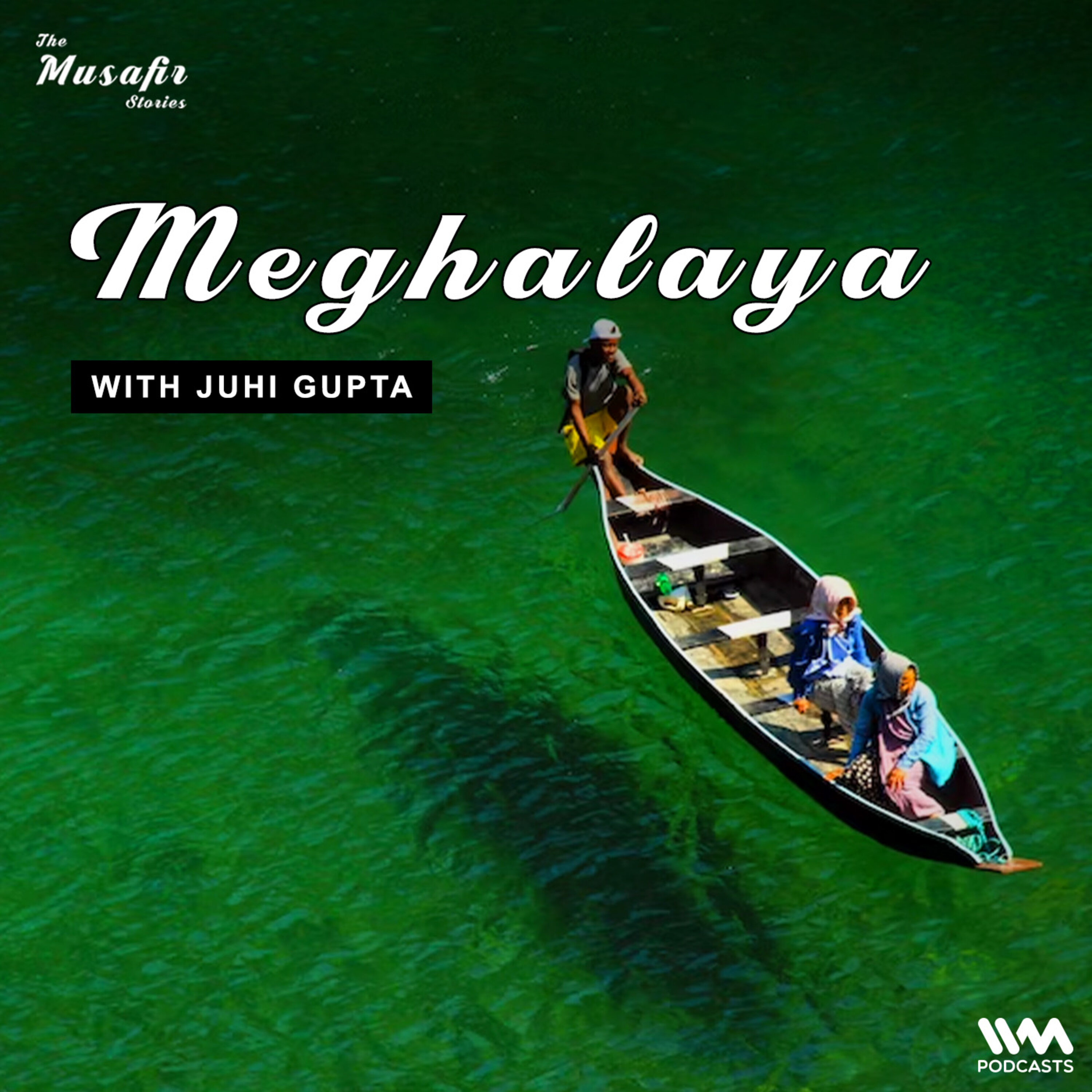
The text begins with promotional clips for several podcasts, including one hosted by athlete Sania Mirza combining pickleball and conversations, and others focused on travel stories and financial fraud prevention. The core content is an excerpt from "The Most Software Stories," a travel podcast. The host interviews Juhi Gupta, who shares her experience traveling through Meghalaya with the company Chalo Hoppo. Juhi provides context about Meghalaya, noting it is a northeastern Indian state known as the "Abode of Clouds," with a matrilineal society and being one of the wettest regions. She details her itinerary, starting with a flight to Guwahati, Assam, and a drive to Shillong. Highlights include visiting the picturesque Umiam Lake, exploring Shillong's music culture at Dylan's Cafe, and an adventurous day excursion involving a river trek, swimming, and rock climbing in Mawlyngbna. She emphasizes the state's stunning, unfiltered natural beauty and advises travelers to be prepared for rapidly changing weather conditions. The episode serves as a detailed travelogue promoting Meghalaya's landscapes and curated travel experiences.
It feels like everyone's talking about two things right now. Pickleball and podcasts. So what happens when someone who's lived her whole life on the court decides to bring those two worlds together? I'm Sanya Mirza and I'm bringing you a brand new podcast, serving it up with Sanya. I've had some incredible conversations with friends, fellow athletes, artists and entrepreneurs. Each episode starts with the Game of Pickleball and once the rallies are done, the real talk begins. Serving it up with Sanya, watch and listen on YouTube and wherever you get your favourite podcast. Hello and welcome to a brand new episode of The Most Software Stories, India's Very On Travel Podcast, where each week we share the journey of travellers in their own words and relive their experiences with you, alas, nerds. Hey guys, welcome to a brand new episode of The Most Software Stories. Hope you're all well and keeping safe. From the podcast today, we speak with Juhi Gupta from the blog forumoping.com, Juhi shares our experience travelling across the state of Meghalaya, also known as the Abode of Clouds. Let's hop on to the episode and find out more about our journey. Did you know Indian's report nearly 800 cases of online financial fraud every day, which has resulted in losses exceeding 1000 crores in the last 5 years? To keep you safe from such fraud, I am starting my newest podcast series, Conversation with Vigilante and initiative by HTFC Bank. In every episode, I will feature special guests who can share expert insights on the different types of fraud, their modest operandi and how you can protect your money. Stay safe, stay vigil and don't forget to tune into Conversation with Vigilante. Catch the episodes on all audio streaming platforms and we for Vigilante YouTube channel. Are you looking for finance, products and services that can enhance your personal finance experience? Are you looking for a space to talk about your financial product or service? And are you looking for a crisp talk show where the conversation is all about money? Well, your search ends here. Hi, my name is Anu Pabh Gupta and I am host of the Pesa Vesa podcast and I invite you for the conversation about your personal finance on each Monday, on the IVM podcast app or the website, or on any podcast streaming platforms. See you folks. Bye. Bye. I am really excited to be here because I have always wanted to be on a podcast. I am getting to do a travel podcast. This is the time I struggle because I always want to say something interesting. I don't want to elaborate more about that because it's frankly a bit boring. But the more exciting part of my personality is that like many of us I love traveling. And yeah, I do run with friends this travel blog called Forum Hopping. It's really as a hobby. But yeah, I mean, just a bit about the name. I mean, because we're lawyers, the bunch of us who run it. We couldn't think of anything to imagine it. So we came up with something which is actually a spin off of a legal term. So for any lawyers listening out here, they'll probably understand. But to put it very simply, there's a concept in law called Forum Shopping where you try and go to different courts to sort of pursue your case. So it's a spin on shopping to say forum hopping because forum basically being placed over here, not courts obviously. And the hope was that amongst the four of us, we would be traveling enough around the world to write about it. But like I said, it's a hobby. So say if you've seen the blog, it's not like we're regularly churning out content. But we would like to believe that when we write about something, it's with a lot of passion. And Julie, you know, conveying our experience with the mix of practical tips. So the travel part of my personality is something I really like. Which is why I also, I'm really enjoying coming on a travel podcast. That's pretty much about me. No, thank you. Thank you for sharing some light on the name and the word play with Forum Shopping and Forum Hopping. And yeah, you guys are definitely going places, right? Maybe not in the legal balance, but you are going places. So I'm glad that we have you on the podcast and very interesting blog as well. We'll link it in the show notes so that our listeners can check it out. And tell us about where you're taking us to today, Julie. Yeah, so today I want to take all of you to Meghalia, which we have blog about earlier this year. This is a trip I did actually last year in October, with this travel company called Chalo Hoppo. For though, I know, say, if they use you featured guests on your podcast before who have traveled with Chalo Hoppo, but just in case there are people who haven't heard about them. And I was one of them who until this Meghalia trip somehow had not come across Chalo Hoppo, but I'm very glad I did. They are basically a travel company that specializes in travel in Northeast. And they do group trips, they do customized trips. So I went with them on what they call their Kasi and Jentia Hills chapter, which is a group trip in the first week of October. And yeah, it was literally, I think it was one of the, I mean, it was by far my favorite vacation in 2022. But it's also, I think one of the best places I've traveled to. I was like, really, really amazed by Meghalia. Yeah, awesome. And thank you very much. We have had, even though we've not had Chalo Hoppo of the podcast. This is probably their hat-trick episode right? This is the third time somebody was traveling to Chalo Hoppo. Yeah, but Chalo Hoppo has been on the podcast and pretty much the OG travel company in the Northeast, I would say really help curate authentic experiences there. So definitely check them out and we'll make sure to link them as well in the show notes. But tell us a little bit more about your trip and about Meghalia. Before we get into the specifics of the trip itself, can you do some contact setting in terms of one mapping out Meghalia on the map for somebody who might not be aware of the place of the state? And also, you mentioned you traveled in October. How long of an itinerary was this? Yeah, sure. So Meghalia is one of the states of India in the Northeast. So it's also called one of India's Seven Sisters, the Seven Sisters being the states in the Northeast. It's also, I think since the colonial times called the Scotland of the East. So that's another name that's popularly associated with it. So just geographically speaking, you have, to the North and the East, you have Assam. And then, you know, to the South and the West, you have Bangladesh. So it shares borders with Assam and Bangladesh. Based on my experience with Charo Hoppa and from what I understand in general, you would typically land in Gohati in Assam. And then from there, you can, I mean, Shilong has an airport, but from what I understand, the commercial flights are very limited. So I think typically people land in Gohati and then you can drive to Shilong. And I think Meghalia, your journey usually starts from Shilong. And just before coming to the itinerary with Charo Hoppa, I think. So Meghalia, just to give a sense, it's, you have these three mountain ranges. So like I mentioned, the Charo Hoppa trip was called the Kasi and Jentia hills chapter. So the Kasi hills are the ones in the center. I think those are the ones which are the highest mountains. On the east, you have the Jentia hills and on the west, you have the Garo hills. So this, the Charo Hoppa itinerary, I went on, didn't cover the Garo hills. And yeah, I mean like Meghalia, I think, just some fun facts. You know, this, we also studied in school, I think, it's one of the few states in India. I don't know if it's the, no, it's one of the few in India, which has historically followed a matrilineal system. Which I found very fascinating. So basically the lineage, everything, the inheritance and the lineage are traced through the women. And it's the youngest daughter who inherits all the wealth and takes care of the parents. Another thing we all think we've all studied in school in India is that it's, Meghalia is the wettest region in India. So two of the world's wettest places. So Mohsindram and Chera Pungji are in Meghalia. And it's often compared to London, Meghalia, dobedo. Because you can, and I saw this for myself. Like you can literally experience all the seasons in a span of like 30 minutes. So it'll be sunny, it'll be raining, it'll be foggy, it'll be hot. So you have to be prepared for anything. You should carry an umbrella with you, you should carry your shades with you. And when I mean all the time, literally all the time, because you're just better off that way. So umbrella, shades, windshield, raincoat, just prepare for everything. And you know, like depending on when you go and we can talk about this further, like you'll be in the water a lot. So you know, just in terms of like being prepared for that. And yeah, coming to like the itinerary and like maybe when's a good time to go. So we like I said the childhood trip was planned in the first week of October, specifically first to 8th October. So it was just on the back of the monsoon's finishing. Although like I said, we got enough and plenty rain. So you would almost think the monsoon is still going on. But like what they had called officially the monsoon season was done. I think with Meghalia, though from what I understood while I was travelling there and speaking generally to people, you could really choose to go whenever. And I think you're the nature of your experience may change. So you may go in monsoons and yeah, it will be very wet. But I guess you get to see all the waterfalls in all their glory and Meghalia has a lot of waterfalls. You could go sort of literally post monsoon the way when the way I went. And because the monsoons have just finished, everything is just so green and like fresh. And you know, like all the all the waterfalls are full of water, the lakes, rivers. So that's also very interesting. And you could also go, I think, a very popular time is your November to February. And it's supposed to not be raining much, but it is very cold. But then you know things like caving and all happen in those months. Because it's not raining that much. And Meghalia has many caves. It seems to be one of those places where as long as you're prepared for what you could be getting into, you could go whenever. And also like just from some of the things you're mentioning, even in terms of diversity, you could do a bunch of things. Absolutely. Going at different times of the year, right, right from caving to even like above the ground, right? Right from the beautiful forest to the waterfalls to this water bodies. There's so much, so much beauty to see. And still I would say, I know in the last maybe a decade or a little bit over that, it has opened up and more and more people are traveling that. But I would still say this is still a bit unexplored overall looking at it from that perspective. But thanks so much for setting up some context here. And one interesting trivia I came across as well while looking up on the episode. While preparing for the episode was that Meghalia was actually formed in 1972, right? Yeah. Before that it used to be a part of Assam and then it was carved out of Assam to form the state of Meghalia. So just another fact to add there to the most of the wonderful things you mentioned. So cool, let's dive into the specifics of your itinerary and already from the things you've been saying, it has me exciting. I know we did one other episode on the caves in Meghalia and that turned out to be a very interesting and a very different type of episode. So this time I'm looking to explore a lot more of the natural beauty, especially when it's with Chalohapa and you. It's even more exciting. So yeah, why don't you take us with you and walk us through the overall itinerary where you started. And this maybe we could pick it up place by place and talk through your experience. Yeah, yeah, absolutely. And I think just one overall thing just picking up on what you said, I think for me really what stood out in Meghalia was the natural beauty. You know, like I had moments repeatedly where I was just like, wow, what am I seeing? And you know, it's just pure unfiltered natural beauty. Like it's almost seems like you know, those window, those desktop wallpapers and you're just seeing it in front of you. And I had so many moments where I would like get out of the, what do you call it, the traveler we were sort of using the whole time. And you're just like, you're like, wow, where am I like the color of the sky, the color of the water, the green of the vegetation. Yeah, like I really was spellbound so many times, but just yeah, sorry starting with the, I tend to digress in Meghalia because the beauty just started me. But yeah, starting with the itinerary, so like I said, we all landed in Goharati and from there sort of we were in Chalo Hoppo's hands. And just to give some context for those who want to just know more about Chalo Hoppo in this context, the group was just like seven of us. So it was a very good size. So we started from Goharati and the plan is to basically on day one make your way to Shilong, you stop for lunch or whatever. But on the way, you, we stopped at the first stop was this place called Umayam or Umayam Lake. It's this huge, really huge manmade reservoir. Actually they call it a lake, but it's a manmade reservoir. And it's like very, very picturesque like anything else in Meghalia. It's nestled between these hills and I think it's locally known as the dam state because there is a dam there. So you're damning the Umayam River basically. And it's nestled between the hills. And yeah, I mean you could do boating and stuff if you want to. Near the lake, they have this sort of for lack of weather, there's forest area where they have these bridges you can walk on. Quite high bridges like easy, not the route bridges like normal bridges. And you can walk on it and you really do see like you're walking in the trees because you're quite high. And it's this thick vegetation. And so yeah, it's it's fun. Like from there you can see the aerial use of the lake. So it was a good first stop in Meghalia. And then from there, people who don't know Shilong is notorious for traffic. So as you get closer to Shilong, you do hit that evening traffic. So it was a bit late by the time we reached Shilong. And that same night, we went to a very popular cafe in Shilong called Dylan's Cafe, which as the name suggests, it pays homage to Bob Dylan. Food was good, music was great. And like the vibe was very nice. And they have this very creative graffiti on the ceiling with all these music albums and stuff. So it's a nice, tasteful, de-done cafe. And actually, I think people would may know this. I mean, Shilong is known as the Rock Capital of India. So it sort of makes sense. And, I mean, I'm a big Bollywood fan. So for anyone else who's out there, they should know that Rock on tour was shot in parts of Meghalia, including Shilong. And I think they just, because it makes sense, right? I mean, Shilong is supposed to be the Rock Capital of India. And even while we were walking through the streets of Shilong, we could hear like, you know, jamming sessions and rock music playing from just different houses. And all it was, it was quite nice. So this was our first day. The second day was, I think, like, really the highlight of the trip, especially for me at least. We did, I mean, we did, we did this sort of thing called, I mean, I call it a river trek, because it really effectively was that. It's an excursion from Shilong, a day excursion. It's in this place called Mauling Buna. And really, like, I think, had I not, let's say, had I done Meghalia on my own, I may not have known about this place. Or even if I did, I would not have, it would not be something I would include in my itinerary because I'm someone who doesn't know how to swim. I'm scared of water. I've never even gone, I've never swam even with a life jacket on. And I had to do all of these things in Mauling Buna. So, but it was really, I mean, I can say this now in hindsight. It was amazing. So it's not your typical sightseeing thing, but I feel it's another different way of experiencing a place because a lot of Meghalia is about the water. So, basically, it's the excursion we did. It takes around a couple of hours. You have to leave from Shilong early to avoid traffic and to avoid the, so that you come back in time in the evening. On the way, you pass through the world's wetest region, which is more syndrome. So I was very excited about that. You also have these pitch stops on the way if you want to take them, but you're literally looking out into such, I mean, like, yeah, you're just in the hills looking out to, like, this beautiful valley. And in the distance, you can see Bangladesh, so it's all very like, you know, things you read about maybe and you're experiencing it. And yeah, the divert track is basically like literally that, right? So you have to cross from point A to point B. And it involves swimming, it involves, what do you call it, grappling, sliding down things, cliff jumping, luckily that was optional. I don't think I would have been able to do that if it was mandatory. But yeah, it's really like, I think Charlo Hoppo describes it as a natural playground. And you're just in the water for like two, three hours. And for me, very adventurous because for reasons like I mentioned, right? For someone who doesn't know swimming and is doing this for the first time, it can be a little daunting. But having said that, you know, of course, Charlo Hoppo's volunteers were there to help and they're really good. I felt really safe with them as someone who's doing it for the first time. But all of this was very fun. And so I think by this point of time, you know, say if I think I'd lost track of time, but I would like to believe it was at least one or two in the afternoon. Yeah, because you know, Meghalya and other things, days start early, right? Given the location. So you're a bit distorted having, I mean, whether you're coming from like Bangalore or Delhi, your conception of day evening is a little because there the sun sets by 530. And it's, you know, it could be sunny one time and literally in the next 30 minutes, it could become so dark. But I would like to believe it was around one or two. But even after this, even after kayaking in Umka Khoi Lake, the excursion part of it didn't end. So we were told, yeah, so the where we were supposed to go back from where we had parked the traveler on the way back. We stopped and did this detour to something called the split rock. It's basically like this huge rock which has a fissure in the middle and it's I think around 60 meters deep. And apparently it was split into two because of an earthquake in like all the way back in 1897. And so when you look down, it's like complete darkness. And then you're told that, oh, you can go down there. And I was just like, please don't tell us we have to like do some grappling or something down. But no, there's no grappling involved. But there's this, you know, you have to maneuver like a stick like these stones and golders and go down this bamboo ladder. And then you can go down to the fissure. It's a bit cool. And for those who are well versed in sort of rock climbing. So like our guide, which are low hopper guide, Nick, who's amazing. I mean, that could be a whole other episode. He's like almost like Spider-Man. So he was just doing his, you know, fancy rock climbing things. But for the rest of us, we were just glad we made it down alive. Actually, I'm making it sound a little scary. This was actually the more doable part of the whole day. But yeah, it's a fun. You're dead. You're down in the fissure, do whatever you can hang around and then make your way back up. So and then finally, we got back to the place where we had parked our traveler and where we sat down for what I want to say a very well-deserved lunch and we ate a lot. And then you make your way back to Shalom, which took, which took very long because as soon as you hit like Shalom, you get a lot of traffic. But yeah, so basically by the time you get back to Shalom, it's around like eight or nine at night. Okay, so it's a fun day trip pretty much, right? And you doing all of this, I'm sure I would have slept my way through the return journey. I think all of us got on a journal and so we didn't sleep. Yeah, by night, you're just like, okay, I'm ready to pass out. Yeah, and one other thing I found very interesting was the kayaking that you did on the Om Karkoi that you mentioned, right? Beside the lake as well, like there was almost these little craters, you could say, right, but they filled with water. I don't know if you came across those, but I found those also like geological formations, I think. And because of water staying there, or flowing down in a certain fashion, they've been formed. They almost look like the portals, I'm sure you would have seen in Bangalore. I was very curious looking at those, and apparently they're actually called as portals, like the feature of themself, the geological feature is called as portal. I was like, who would have guessed? So anyway, it was just a Bangalore in me, I guess, that got exactly looking at them. No, no, I'm actually very glad you mentioned this is something that's forgotten, but now that you mention it, I remember while doing the river trek. There were parts of the trek where we were told to be careful, where we're stepping, because of these portals. And if I'm not mistaken, I remember at that time being like, oh, you can, you know, making basically cracking a very similar Bangalore joke. So I had completely forgotten about that, but yeah, those were there, those were definitely there, yeah. I just found them interesting, right? And again, just goes back to the natural beauty of the place, also right? Do you have so many different things right from all of the things we mentioned from the water bodies and everything, and now we have these geological features as well on the surface. So cool. So that's pretty much the day to you would say, right? And a lot of the things that you did and returned back to Shalong, correct? And Shalong was pretty much like your base camp is that would that be right to say, or did you actually shift base after like a couple of days in Shalong? We shifted base. That's correct. So the first couple of nights for the Shalong homestay. And after this, we as part of the Chalo Hoppa Itinerary, you don't, you don't have to stay on it in Shalong. I stayed around on extra day beyond the Chalo Hoppa Itinerary, so I stayed, I stayed one more night in Shalong, but otherwise, no, otherwise, that's you're done with Shalong, yeah. Okay, cool. So where are we going from here? So date three, you get to sort of have a relaxed start because it's just been a very hectic for two days. We then were taken to the, so the homestay we were staying at Rockcliff, the owner's house. He's into vintage cars. So his own house is also another museum. And it's a very nice vintage car collection. And again, a lot of stuff done with the cycle materials. So we spent a couple of hours there. Then you make your way to this village called the Pinter Village. Now, but on the way, we stopped at the plan was actually to stop at and we did stop at this place called the Lytlum canyons. So, I mean, fun fact, Lytlum literally means the end of the hills or end of the world. And it's actually that, but whatever I'm describing to you, self is from pictures because our luck was that by the time we reached, I think it was noon. And it was very foggy. So it was a very clear morning in Shilong at least, but obviously you're going up a certain elevation to the Lytlum canyon because basically it's like you're literally at the end of the hills and you're looking down this sort of canyon and we didn't see anything. Literally, as soon as we parked our travel or in the car park, it started raining in true Meghalya style. The clouds came together, it became very dark and we didn't see anything. But the pictures, it looks gorgeous. I believe Rock on 2 was short here as well. So again, if anyone has seen the movie, I haven't. But if anyone has seen the movie, maybe they can spot the place. It had its own charm, you know, we ate some Maggie, which is a very typical thing to do in cold weather. So we ate some Maggie had some fun. But yeah, we unfortunately couldn't see the place. So I think the tip there is to go there early, better go there in the morning. I think we sort of overstayed our welcome at the owner's house in Shilong because we were so fascinated by the vintage cars. But yeah, I mean, that's fine. And then we continued to Pinter village, but the drive to Pinter was very, very scenic. Again, another thing I would never have done on my own simply because you would not know where to stop. But we had lunch, I remember, in one of the most literally pictures of settings I can imagine having lunch in. So it was just this, I mean, a log of wood in the middle of the lake. It's the lake is called. And I'm pretty sure I'm getting the pronunciation incorrect. So anyone who from Meghalya or Jalohop, if they listen to this, I'm really sorry. But it's the Pong are sneer Lake, I think. And it was amazing. Like Jalohop had the impact lunch on banana leaves. We were just sitting in the, I wish I could share a picture, but like we were just sitting in the middle, like the seven of us and our guide and driver sitting on this log of wood. And you're just like surrounded by these amazing hills, the water is beautiful. You're feeding the fish and you're so peaceful. I mean, really, it was one of my best meals ever. And even though it was dhal, travel, it was out of the world. So yeah, I just wanted to say this because you know, again, just going back to the point you made, right? Some of these things you may never do on your own, not because you may not run to. You just literally will not know that there is such a place, right? You'll continue driving. Our guide and Jalohop were new that there was this sort of place and it's the first time he asked us to get off. We were like, but where are we eating? And then literally five minutes later, we were like, wow, is this where we're having our lunch? So yeah, just going back to the, you know, sometimes the benefits of traveling in a group and you know discovering these new things. But yeah, so we did that and then we go to Pinta. So just one thing about Meghalya, I think people may have heard about the fact that Meghalya is just generally a clean state. Sure. And there's this village, they're called Molling Nong, which is chosen many years ago, I think in 2003 as Asia's cleanest village. And what happens since then is that of course Molling Nong became the more famous one. So a lot of tourists go there. So Jalohop tries to give us the same experience, but by taking you to hopefully sort of the lesser crowded places. So instead of taking us to Molling Nong, they took us to Pinta. And again, very clean, it's a very clean place, like I don't even know if it's cleaner than Molling Nong or not, but very, very clean. You see the village lives, they take you around, you meet the locals, you meet the kids, you talk to them, you can play football with them, whatever. By the time we reached it was I would say around six or maybe five. You have some chai with the locals and I think what was really nice is that they watch Jalohop planned is a local sort of musical performance. So you go to someone's house and there are a bunch of these musicians and they're playing on the local instruments. So it's very intimate and very nice. You can join in with them, you can dance, we all dance, we had a great time. Yeah, it was a lot of fun, especially when walking through the village, you know, fun fact about Pinta is that there's an average of six or seven kids per family, so there's a lot of kids. But it was very good to know about the schooling system and you know, there's a lot of emphasis on educating them, which was very satisfying to know. And in fact, actually, there is a Bangalore connection with Pinta Village, which blew my mind because I was like, what are the odds? But basically a lot of children have apparently gone to Bangalore to do their higher studies. You know, after the certain class, and they go on to work there also. So we instantly stopped at a chai stall, sort of tux shop with the lady who was running the shop. She had returned from Bangalore, she had studied in Bangalore work then she had returned from Bangalore so she was talking in Kannada. I was like, what are the odds? These are the sort of experiences when you travel. It's just amazing. Yeah, it's just not the potholes, yeah. Yeah, not just the potholes. So, you know, I was talking to her about Bangalore and I got very excited of course because I'm like, wow. So yeah, it was a lot of fun. The musical performance was a lot of fun and after spending some time there, we went to a accommodation for that night, which is a sort of this guest lodge. Yeah, I mean, again, a very different sort of a day, right, both in terms of experiences. And I think you also needed it to be a little relaxed given how hectic and higher than the previous day was, right. So I'm glad that you got to take this one a little bit slower and you actually got to do the. I would call this the real fine dining, right, with sitting on the. Yes. In the middle of a lake on a log, like, oh my god, what is that? Absolutely. So, I'm glad you got to enjoy that and also, I guess, in this village, you probably lived the actual or the real rock on experience with the local musicians giving a performance for you. Yeah. And I'm glad this way you also kind of got to enjoy and spend some time with the locals, right, because again, one of the risks of going with a very generic type of group trip is that you're probably a very cut off because you're just busy doing things or seeing places and not really having an opportunity to interact with the local there, which is also a very essential part of the overall experience of a place, right. Absolutely. So I'm really glad that you got to enjoy this better as well. And what is day four looking like? So, yeah, so day four is back to being hectic. So, Chalo Hoppo, they try to alternate. They try to give you one relaxed day or whatever their version of relax is. I'm just joking. It is relaxed. And then you have a very sort of adventure driven day. Day four is back to being adventurous. So, we go to this place called Shnom Padang. And actually, I think more people are familiar with Doki. And Shnom Padang is just close to Doki. But again, Doki is the more touristy one, right. But just to give some idea of where we are geographically, you are now basically heading to Umno River. And that's very close to the India Bangladesh border. In fact, my iPhone, we already picked up Bangladesh time even though we were still on India. So, I was getting everything wrong by half an hour. And then we finally figured out why. But yeah, you go to Shnom Padang. And I think a lot of people think of the river as Doki River. That's how it becomes famous. But actually, the river's name is Umno River. And you document other villages. We went to Shnom Padang. And yeah, actually, this is the river. I don't know whether your listeners would know. It went viral a couple of years ago. I think in November or something, there was this one picture of Doki River. I don't know whether you saw it because it's called the Crystal River. Now, essentially, if it doesn't rain, like if it's on clear days. So, typically, I think in November to February season. Or even any other season, if it's not rain, the water is so clean and transparent that you can see right to the bottom of the riverbed. So, it's called the Crystal River. Now, unfortunately, for us, it had poured the previous night. So, there was no chance we were going to see this. But I have a friend who went, I think, to Meghalya in November. I mean, like a few years ago. And he said, yeah, I could see right to the bottom. And there's a reason to call the Crystal River. So, I remember this image that had gone viral a couple of years ago. It was literally like you think the boats are floating on air because the water is so transparent, right? So, this is that river for people who just to give some context because people may have seen the image. But, you know, so this is that same river. And it's actually actually known as one of India's cleanest rivers. But basically, what you're doing there is you sort of have the day, like at least half a day to yourself. We did a boat ride around the river. Again, I mean, people want to check out the pictures. There are some pictures, of course, on the internet. And on our blog post on Meghalya, it's beautiful. I mean, you're just sort of coating through these hills and the water is clear and everything. And after a boat ride, you're sort of left your own devices. But again, a lot of adventure. So, cliff jumping, which I obviously didn't do. Actually, no, that's incorrect. I did inadvertently end up being cliff jumping. So, yeah, this day again ended up being very, I don't know, memorable for me. Yeah, actually, because, I mean, there was this one sort of not very high rock. And I went up there two, three times thinking that I can do it. I can do it. But each time I just got very scared. Obviously, you're wearing your life jackets and everything. But still, you know, and I think, finally, one of the chalo-hoppo supervisors who are there to, you know, around to help you or anything. I think he just got fed up of seeing me come there so many times and wasting other people's times, right? Because I'm, so he, I didn't know this. But he came from behind, picked me up and jumped with me into the river. I'm saying it very calmly right now. But in that moment, yeah, I remember being quite stunned. Because I was like, wow, what has just happened to me. But yeah, I mean, I guess that was the only way I would have done it. So, in theory, I have done cliff-jopping, but I can't take credit for it. Because I was not the one who jumped. But yeah, I think it's again one of those days, which I will say, "Joyly pushed me out of my comfort zone, and I knew I was safe." Because I have never, like I said before, forget the river check. We were swimming in a stream for whatever floating. Here I literally, you're literally swimming in a river if you want to. And I never thought I would do this ever. So, you know, like I don't even know swimming, but whatever I was doing, flapping around, I was still doing it. I never, really thought I would do it. You know, so that's why the Minghalia trips for me. Of course, the natural beauty of course was one thing. But I think when I look back, it was also one of those trips where you discover new aspects about yourself. I mean, will I voluntarily go swimming in a river now? Maybe not. But the fact that I did it once at least in life, you know. So days like day four and snorppening, I will always remember for even those aspects. But basically that's the thing with snorppening. You do boating, you can do all of this, you can do kayaking. So yeah, I did a bit of kayaking on the way back. Like on the way back to when I say way back, I mean like the starting spot where you leave your bags and everything. So yeah, after all this adventure, you have some good food. Again, a lot of our food was daal chaval and some meat. So typically chicken or pork. But everything tastes very good and we can talk about the food later. But everything tastes amazing. And then you have the option of being ziplining because you're quite high. And I didn't do that. I was done with my adventure for the day. But yeah, you can do, you can do some ziplining. And there's this very long and rickety, if I may add suspension bridge, which you can walk across. We all did that. I will not lie. I found the walk a bit scary because it does shake. And there are a lot of people on it and one go. But it's really worth it for the views. And again, you get that sort of adrenaline going when you're walking across it. But yeah, it was largely manageable and jolly, the views are amazing. So after doing all of this, yeah, it's almost early evening and nothing much after this. We did a detour to go to the India Bangladesh border, which was fun. So the border crossing, I mean, so we just enjoyed some Bangladeshi snacks, got your customary photos. And yeah, then you're heading back. I think one thing to flag. And I checked this at the time of writing my blog post. I don't know if the situation has improved now. The roads, two shnappening and docky in this whole area from where we were staying at least relatively in a bad condition because they were doing some road works. And with the rain, it becomes worse. And you know, evening traffic when you're heading back, it becomes even worse. So that was a bit of a bummer. But in the largest scheme of things, probably not. But you know, for some travelers, of course, that's a priority. And it's not the most comfortable ride. I don't know what the situation is literally as on day to day. But yeah. One important dynamic of this group trip or group trips like this is also the group itself. In terms of the company you're traveling with because that could. Yeah, I want to say make a break, but it could. It could, right? Yeah. So how was your experience like just with the other folks on the trip and how you folks bonded together? Yeah, no, I'm glad you asked this. And my friends from that trip will be very happy. You've asked this question. No, so it was amazing. I think this was one of those trips where everything came together. This is the first time I was traveling in a group like this. I was going with a friend. So I had that for lack of better work come for that at least one person I know on this group I get along with. You know, so what channel hopper does is that they connect the travelers or whatever the group on WhatsApp a few days before your travels. You broadly know where people are from. But you know, general apprehension most average travelers will have, right? But it was amazing. I think on day one itself. I think by the time we did the, you know, what I'm calling the forest walk in Pumayam Lake. I think we were just already bonding the bunch of us. So we were seven. Six girls and one boy. Yeah. So I felt it was a perfect group size not too big. Not too small. Yeah. You know, so five of us were traveling from Delhi, one from Bangalore, one from Bombay. But really, I think we gelled so well by end of day one. I felt I had known these people for a very long time. So no, these, it was great. And in fact, they'll be very happy if I take their names because I didn't mention their names on the blog post and they were very upset with me. So I was like, okay, sorry. I'll fix this on the podcast. So yeah, basically, so the friend I was traveling with, who I've known from law school. He was Soveini. The others from Delhi are Vishakha, Kriti, Yashika. And the girl from Bombay is Mohini. And the sole boy on the trip was Anirud from Bangalore. So yeah, we've become very, very good friends. And I think that's a nice, if anyone ever asks me, do you recommend a group trip? I would 100% say yes. It is a hit and a miss, like you said. But yeah, I mean, like at least my, this one experience has made me more open-minded to it. I think it's also set the bar very high. So I don't know if it's a good thing or a bad thing, but I had a lot of fun with the group. A lot of fun. And I think in the same vein, I would want to mention about the guide. Because he was a big part of the group dynamics. His name is Nick, the shallow hopper person. In fact, if you Google, or whatever, if you see triple visor reviews of shallow hopper, a lot of people have talked about Nick. Especially in things like, you know, this whole cliff jumping and all. He would really push me and be like, look, I'm there. I just do the jump. Do it, do it, do it. He was great, great taste in music. And all around, I think we all just got along so well that it was a big part of why I enjoyed my khalya. Yeah, yeah, shout out to the gang. Yeah, shout out to Nick for pushing you literally also, I think, right? From the cliff. It's really great to hear. But this is what, now day four, end of day four. Yeah, time really flies even though the podcast has free videos. So you did all of this fun stuff at Shnoptheng, and did you halt for the night at the same place? Or what is the plan then? Same place. So we halted at the same guest lodge that night as well. Yeah. Okay. And what was in store for the next day? So the next day was what we all read about about Minkhalya, right? The Root Bridges. The Living Root Bridges, which I think a lot has been written about. I think you can keep writing about them because they're amazing. So just for some context for people who may not know, these are these, I mean, this is, it's a very ancient thing. These living Root Bridges. I think effectively they came up because Minkhalya, you're looking at like a lot of places which are high altitude and so much vegetation that from crossing from one place to another and in the middle you throw in waterfalls, streams, etc. How do you do that, right? And you know, a lot of rain and everything. So it's literally like an architectural sort of invention. They came up with where you are effectively, I don't want to get into technicalities and I don't want to get something wrong. But you're basically building a bridge of the roots of like this, this Fikers Elastica tree because they're very, they're very strong and they're these rubber trees with bamboo. And you're building and it's not, it's obviously not an overnight job. It's years and years of like strengthening the bridge. And I think it takes around a minimum of 30 years. So that's why it's a very ancient thing. And that's a few years before the first stage of a bridge can become functional. And even that from what we were told, only around five or ten people can cross it in a day. So it takes a lot of time for that, for a lot of people to cross in a given day. And they're actually on, I think they're currently on UNESCO's world heritage tentative list. The world heritage sites tentative list. Because there's a lot of history to it also and I think it's really become a part of Meghalya's culture. Now the famous one, which people may have seen or been to also, is Nongriyat, which is the double-decker bridge. So you can even, if you know if you Google it, it's not double-decker bridge. You know, people will get the picture. And you know, it's one of those stock photos of Meghalya. But you're too shallow hopper style. They didn't want to take us to Nongriyat because it's very touristy. And they took us to Mokirnot. Where actually, again, we had such a local, let no authentic experience. Sorry, maybe I didn't mention this earlier. Chalo Hopper tries to tie up with local guides in each of the places they're taking you to. Or locals, in the sense that for example, the people in Shnopadang, who were helping us. And you know, like that. Here, they tied up with this guy called Morningstar. He's actually a living, he's called, I mean, he calls himself a living bridge's activist. So he's the founder of the Living Bridge Foundation that's dedicated to spreading awareness, you know, about the bridges and preserving them. He's done documentaries on them. I think he's doing or has done something with BBC about them. So the fact that we were being taken by him just really added to the experience because he knows so much. I think even Nongriyat has a huge trek to actually get down to the bridge. But so does this one where we were going. It's an easy, when I say check, it's like their proper steps. Just in terms of like couple of very maybe obvious tips is that you are really in a very high vegetation area. So just be careful about what you wear. It's very tempting to wear shorts because it's very hot and humid. But yeah, then you're going to be bitten by a lot of insects and mosquitoes. So just keep those things in mind and definitely have a good breakfast on the day of this. Because it's just sort of walking. But yeah, I mean coming back to the area. So yeah, we basically go down like these steps and on the way we walked across a couple of bridges. So we actually got to walk on the longest route bridge in the world, like in mid-Halia and in the world. So that's around 53 meters. And I think it was around 90 years old. We also walked on a bridge that's around 200 years old. So yeah, it's a bit like sort of disconcerting in the beginning because you're walking on like tree roots. It's very sturdy and someone is walking with you. But then you get the heck of it. And then of course the views are amazing. It's just one of those aspects of Meghalia. You have to just experience it. You can read up a lot about it, but unless you experience it, it's really not the same. I mean, this is definitely one of those things where you can say only in Meghalia. And I smiled a little bit at the beginning when you mentioned, I think it was at the Omi Amleic or wherever you said. Not the root bridge, just the regular bridge to that. I was like, yeah, in Meghalia you have to clarify. This is really almost like an architectural slash natural. It's such a marvelous feat, right? Imagine having thought about this and having the, I mean, just the locals also being kind of surprising enough to actually think about this and build this and also preserve this, right? That's another thing that they haven't really just done it as the one time thing and then left it and either overused or whatever, like just destroyed it. That's not the thing. But what is this like, how do you think or how much time does it take? I remember leaving at a reasonable hour from that guest lodge. And yeah, half day thing, like I think we were done by early afternoon and then we were rewarded by an amazing lunch at a local's house. And that's again, thanks to Morningstar. He had some connection, some relative of his. I hope we didn't intrude, but they were very welcoming and we had lunch with them. So some very local, you know, local vegetables and pork chicken tongue or something. Some part of the chicken which I had never eaten before. Very tasty, some nice tea. And again, just, you know, mingling with the locals, experiencing that sort of very local way of living and see how they make their food and all of that. I think around, I think this would be around by three years, you're sort of done and then we made our way onwards to our next stop which was basically Chara Punji, which locally is actually known as Sohara. Okay, yeah, very interesting. I think we had a guest previously as well. They mentioned that the name change or whatever, the corruption, let's say corruption of the name, right? Sohara was the original name and I think during the time of the British had went from Sohara to Chara to Chara Punji, whatever it's known as today. So that was an interesting story as well. And is it far enough for you to actually reach there by evening and then explore the next day or was it the same day thing? No, typically next day because by that again, essentially because the sun has sent right by the time you've reached. So no, I think for the rest of the evening we just checked in to our accommodation which was like, which was like, you could call it a, not a homestay but like a large. And we basically, you know, have dinner and yeah, you're just left to yourselves then. Okay, cool. So next day we're pretty much looking at exploring Chara Punji then, right? Yes. What Chalo Hopu did is that it's quite a bit to do in Sohara because there's a lot of waterfalls and all. So we sort of amongst us as a group landed on what we and I don't because we had effectively one day, it's not possible to see everything. So we landed on what all we would want to do what we did is that we went to a waterfall called way so down, which is this three-tier waterfall. Again, one of those stock photos of Nikhalya, you definitely have seen it, but it's like basically this three-tier waterfall with like this amazingly colored pool at the bottom. And there's an easy way to get to it. Again, lot of steps involved because of, it's not a very high waterfall. The beauty I think, okay, so long is just the three-tier and that that blue, the color of that blue is just something else. If in case you don't want to do the trek at all, whether it's a difficult or the easy way, they do have these viewpoints. Several viewpoints from where, you know, you can see the waterfall quite clearly. So it's not like you have to do the tracks to get to see the waterfall. After we spent some time there, we went to this other gelatively hidden waterfall. I don't even know the name. Chalo Hopper just took us there, very secluded. Of course, there were some other people. And I guess, you know, thanks to Instagram and stuff, some of these secluded places also become less secluded. But still, relatively less secluded. And again, for those who swim and stuff, so I think all of this is such a treat. We spent quite a bit of time there. There also, there's this really high, nice, tiered waterfall. And after spending some time there, we halted at a restaurant for lunch. And then we went to the Arva caves. So you mentioned you've had a guest before who's talked about their cave experience. So cave is a big thing in Hinghalia. And I think it's hope like Hinghalia, I mean, this is some stuff I looked up by writing the blog. I think it's home to like nine of India's 10 longest caves. So the Arva caves, the one in Sohra, they are very famous for their limestone formations and for the fossils. So it was quite cool. It was also very different from the rest of the trip so far, because you're not outdoor, right? You're like indoor somewhere. I mean, indoor, I say, like, loosely, but you're like, you know, but it was a lot of fun. You have to be ready for the crowds. Again, it's one of those. Most of the things in Sohra will be fairly touristy and crowded except for, for example, maybe that secluded waterfall that they took us to. There are accessible parts of the cave, which are taken on half in a 45 minutes to explore, you know, depending on the crowd. There is a fair bit of bending and crouching to do. And by the time we got out of the cave, the sun had set. So even though it was just like maybe six, you know. But yeah, so I think we mainly did these three places, but I think like another famous thing about Sohra and again, another stock picture is the Naka Alekai Falls, which is India's tallest plunge waterfall. We really wanted to go there. We knew it's touristy, but yeah, I guess time didn't permit us to go and by evening, because the sun has set and it's foggy, this and that, you have to go there in the morning, generally. But yeah, that's another very popular place in Sohra to go to. Yeah, wonderful. Really. I think the cave experience also kind of adds to the diversity of all of the different things you got to do, right? Yeah, being like a lot of adventures also, even though you're saying you're not, you're not too keen on doing a bunch of things, but you have clearly done a lot of them. We left a link to the other episode we did on the giving experience to this was very different experience and that the guest we had, he and his friend, they wanted to do something off beat and they went into a cave that is not very commercial and common and touristy. And it was just the two of them basically and they end up getting lost there. And yeah, pretty much spending the whole day within the caves until they could make it out by themselves. It was an interesting experience. We'll link it for those of you who are interested. But overall, it's been like a very, very exciting journey and you've beautifully shared a lot of these wonderful places and we're probably just scratching on the surface. Johi, there's so many different things to do and I mean, beyond the known places like the ones that are lesser explored and probably known just to locals, those are different story in themselves, right? So we probably will never be able to do justice on Meghali, though we've done like two or three episodes now. But anything beyond or besides these places that you already touched upon, you want to give a quick shout out on even if not in detail or the ones that you couldn't cover. This was the end of the Chalo Hopper trip. So next day was flying back to your respective home locations. But my friend and I, we stayed an extra day and like I mentioned, and so what we did is that we got dropped off at a certain place from where we went to the Moff Lang sacred forest, which is another very well-known place in Meghali. We are very close to Shilong, around like whatever, 30-40 kilometers from Shilong. So Moff Lang is basically again, it's a very like a religious sort of forest for them. And Moff Lang means moss-covered stone in the Kasi language. So there are a lot of monoliths here for different purposes and basically it's a forest protected by the locals and I think the specific tribe is the Lindo tribe or the Lindo clan. And the idea is that in like in ancient times there were a lot of rituals that were performed here to protect the forest and the local deities. And you know there's a certain part of the forest that's accessible where you can walk around with a guide who you know give you an overview of the vegetation, the rituals that would be performed and all of that. And it has a lot of like plants and flowers and mushrooms and that sort of stuff and all of it's considered holy. And the whole idea is that the big thing about Moff Lang is that the beliefs that if you you're not supposed to take anything from the forest. So if you pluck a flower, a petal or anything, you know, I mean for lack of that a world you will be cursed. So they share those folklore with you and it's a very interesting experience, very beautiful. And even though the tree, the Rudraks tree which is considered holy by the Hindus, that can also be found in a lot of like you know great numbers here. So that was a very interesting experience and another thing I would mention which we didn't do which I may want to do someday is the David Scott trail. I don't know if you heard of it but it's this trail from the colonial times or David Scott I think he was a British administrator. So it's a trailer actually starts from I think very close to Moff Lang and it stretches between I think Moff Lang and another place called Lad Moff Lang. So it's part of a larger tree root like a hundred kilometer tree root that was constructed during the colonial times but this what they call the David Scott trail is around 16 kilometers. So I mean I apparently if you can do it on foot and it will take around four or five hours to do and it's supposed to be very scenic. I've seen some pictures and what the Chalo Hoko people and the locals are describing it really does seem beautiful. You can apparently also cycle. So maybe that's another thing and a part of that like what I mentioned later on canyons which we didn't do maybe something like Nandria. If you just want to get the complete root bridge experience. Yeah, yeah, 100% and like you rightly pointed it even for people who are interested in the culture of part of it. There's a lot of different tribes in Meghalaya right. Yeah. The Kasi, Jairati Agarro people are just like some of them they're obviously probably in the majority but there's a lot of different tribes as well. And even I know we didn't touch upon it a lot but from the local cuisine perspective also there's a lot of things you can try out. I mean obviously like poke and bamboo shoots and all of that is the more common and popular type of dish that most people try out besides the momos I guess. Yeah great move. But yeah and things like the local root beers right. Yes, every region every tribe probably has their own version of that. I believe the one here, the popular one here at least is called the Kiat K by 80. So that's something as well. Yeah, even from a local food perspective there were so many different ones. Very interesting like Pumalau, Pumaloi, probably between a lot of the names but rice based dish, Jado. Yes. Another popular street food. Yeah, probably something you might have come across or heard. Yeah. And then Puklein which is a sweet dish made of rice and jaggery. So yeah a lot of different things like even if you're a foodie or person who appreciates culture there's stuff for you. And I don't know I don't even want to start listing out the waterfalls that one can or I cannot do because so many of them will just be nameless and still be as beautiful as the popular. The ones that make it to the stock photos right. So yeah, lot, a lot of interesting things definitely to do. I'm glad that you had a wonderful experience doing this with Shalohapo. And for somebody who wants to reach out to you to chat more about this or your other travels. What's the best way to do so. So he please share your blog as well as your socials. The blog is forum hopping.wordpress.com like you mentioned I personally am not on social media so but the blog for sure is so the handle on Instagram is accurate forum hopping. You know if you just DM us there, I'll be more than happy to then connect offline and whether it's about Minkhalya any of the other travels and share any details or anything else that I can. Yeah, no problem. For hopping definitely is I'm so like you said and we'll make sure to add the socials in the show notes of the description of the episode. Again, thank you so much and my apologies for having you making you wait for such a long time to get on the podcast. It was just different things happening. So glad that they're up. And hopefully have you back on the podcast too. Now that you made your debut you already sound like a pro so maybe we'll also have you back wherever you're ready for another episode. But thank you so much Joey. It was such a pleasure talking with you and thank you again for sharing all the beautiful stories and experiences about this. Thank you so much. Like I said, this pleasure is all mine. I think it was worth the well worth the wait. I'm happy the first time I've spoken on a podcast is about Minkhalya which is a very dear to me. Needless to say, I love your podcast as well. So all in all, I think I couldn't have asked for a better debut and more than happy to be a girl to be on your show again and really thanks a lot. Thank you Joey. We'll definitely keep in touch and we'll make that happen. Thank you. That was just a little bit great episode on the Massoffer Stories. Make sure to show us some love by sharing the podcast with your friends and family. You're on Instagram and Twitter at Massoffer Stories. If you like this podcast, don't forget to check out other interesting podcasts on the IBM Network. Listen to us on the IBM Podcast app or the website. Follow us on our social media. We are at IBM Podcasts on Twitter and Instagram. Hey there. Love sports, bold stories and big personalities. Then you'll love serving it up with Sanya. Hosted by it and a select Sanya Mirza, IBM Podcasts latest show brings you Candid, no filter conversations with the biggest names in spot and entertainment. Check out this moment from her episode with the one and only Karan Johar. You had both of us actually have been raised by two parents and there was usually one bad cop and good cop. And in my case as well, my father was the good cop. He's the good cop and my mom was the bad cop and she was the one who was disciplining. And we both are at a stage in our lives where we are single parenting. Me to a large extent and you almost fully write and you do have your mom who helps you but tell us a little bit about that because yours was actually by choice. I think it was something I've always wanted. I feel like I'm inherently a parent even when I wasn't. I've always had feelings of paternal instincts towards the kids I worked with in the movies or the kids I've mentored as a director. Alia and Varun and all of them and like I just felt I always wanted but I somehow knew that it was a decision I had to take along with my mom. And when I said it to her when I felt I was fully emotionally equipped to be a parent I asked her and to my sure and utter joy she was like I can't wait. And I feel like it's daunting for me because I'm in only child and a single parent and it's a double whammy because my mom's not been keeping really good health in the last year. She had a stroke last December and from then on she's not being able to do what she was doing as a cop and she's also 83 years old. So it is not easy you know that you know and I have twins so I have double the issues I'm the only dad on two WhatsApp mom's group. I'm the one who has to schedule their lives give the time and balance it by running a company and be there for my mom. It's all it's overall overwhelming but that joy of just having that love they have the proud recipient of the love when they come and give you that heart. And it doesn't matter to them. And I'm sad to say this but it's I never want them to be on well I always have to be happy but the moment they hug you when they have a tear in that eye and you feel like you that because now kids have stopped hugging the way they used to and they were three and four. Now you have to beg for that love because I want and I am there's nothing doing because I am like my dad. My dad was tactile wanted the hugs and kisses and I desire I want to be hugged and they meet me but when they need you and they are feeling wonderful and they give you that hug. That's to be heaven. That moment of that child in your arms and you hold them tight and just hug them with your core. I feel like I don't know what heaven feels like but that to me is my heaven. You know same and for me as well I think the whole single parenting yes it is hard but also because we are working and we do so many different things. Have you seen the flip sides? It's actually liberating because you are not at crossroads with anybody else like everybody else has. But you are not. I know well. That's why I don't have that flip side. Cross border is well. So I mean you have a situation which is even more daunting and overwhelming but in my end I feel actually I am blessed. Of course. Because I feel when my twins were being born and when they were born I had a hundred people give me pieces of advice. On parenting twins or reading books, hearing podcasts I did nothing. I was like we are blessed with what we call a superpower. It's called instinct. Your instinct is different from every other situation and there is no right or wrong way. It is your way. And there is something called over parenting. Yeah I am not an over parenting but I do find it challenging to leave him. Like now when I am here you know because I live in Dubai and he is there. You know and I feel the same way when I have to travel. That's the biggest challenge for me. Like to stay away right. Like for a period of one week then I have to like obviously just like your mom comes in my mom and what a blessing. Like right now she is with him because I am you know working for this one week and I am here and I won't see him and that for me is the hardest part. Anything else I am fine with. But you know sometimes that we will also make him more independent. Yeah. I always see the plus in everything. Instead of worrying about the minuses I feel there are big pluses in every extreme such situation. Like the big plus here is that your son and my twins will be very very independent and they will be strong and they will be resilient. Yeah. And that is something that I would wish for all of them. Like we say in Shalala we really really hope for that to happen. Last couple of questions both of us have been in the public eye or spotlight if you say for many years now. And I was very young I was like 15, 16 you were as well. It is hard I mean single parenting all of this stuff but also having romantic relationships is hard. How do you feel that how have you made peace with the fact that you are today your single or we think you are single. My status is single okay. Your official status public status is single. No my real status. Your real status single. So have you made a peace with that that you know you are okay with it. There is a line in another song which I didn't get in every single one in my life. Pushnasee is the one who got this in my life. I am okay now. There was a point of time I really wanted the love. Yeah. I wanted the relationship. I remember talking about this. I wanted a relationship. And I went through all kinds of dynamics. A broken heart. One sided love. I even made a film on it. That was cathartic but beautiful for me. I would help me heal. I waited. I realized that it's somebody going to love me for who I am or what I bring to the table. Then you come on with doubt. Everyone says, "Oh put yourself out there." I'm still looking for that there. I don't know where that is. There is a somewhere. Oh go abroad. They say like you know abroad. I don't know. You know what I mean. I'm abroad. I'm abroad. I live here. I have a mom and two kids. I have to live here. So I've gone through those beats. And I don't get lonely. It's not. It's a reality. When you get the loneliest is in your highs. Not in your lows. Actually. Because in your lows you have your mom. You have your close friends. Family. Yeah. I have two cousin sisters. I'm very close to her. My best friends. I have my family. My friends. My kids just to hug. In your highs, what do you do? You celebrate a victory. I remember I got a call saying you won the national award and I put the phone down and for one I kept thinking, "What should I do tonight? Who's house do I go to? Who do I sit with?" Who's hand do I hold? Who do I feel? I feel a little bit. I should pat my back today and feel a little happy. It's those moments. You know, when I went to receive the national award they asked me, "Who's your plus one?" And I had no one. I had no one. Like, Apura was winning it. Who's my partner at work and my best friend and he was bringing his wife. Everybody was discussing this house of young men. You know, or whoever. My mom is not physically capable of coming. And my kids are too young. And I was like, how? It just felt that reality with it. At night, you sit at home and you're eating alone. Eating alone is the other thing that makes you feel a bit lonely. I'm saying, yeah, because I'm relating to a lot of what you're saying. And at any time, I don't even go to the dining table, Sanya, because that makes me feel worse. So I eat in my room. Like, I know they say you shouldn't lie down and eat and you should sit and eat. But I sit up like this. They have a table. They put my food on it. And I eat and I always bought something. So I can actually dilute the emptiness of the moment of the loneliness of that being. Because I've come to realize that I'm okay today. I've dealt with it. But yes, the love of a partner, the sharing the nothings of your day or the highs of your life with is very different from what you get from a parent, a sibling or a child. That love. And it's not the intimacy or the sex. It's just the partnership that you form. It's almost a friendship and the companionship, right? That's what you're talking about. I meant actually to be a unit of two. Yeah. You know, real true love comes from a partner that you have. You know, whether it was the beginning and origin of man and woman or man and man or woman and woman. And whatever the dynamic today is. But if we are meant to be a unit of two and then we go and create a family. Yeah. But this real unit is of two. We were never meant to fly solo. No matter what we were created in pairs. Yes, yes. Yes, we are. And we are. But now we're not made to be a unit of two. But maybe, maybe not yet. And they say never say never. Yeah. Which that happens. My arms are wide open like Shah Rukh Khan. Yeah. You know, I'm willing to welcome, you know, I've told the best love stories. I sold love, but unfortunately I didn't buy it myself. Love what you just heard. That's only the beginning. Catch the full episode of Serving It Up with Sanya. Now streaming on YouTube. All major audio platforms. And on Mintra, glam stream. Don't forget to follow the show and hit subscribe. So you'll never miss an episode.
Podcast Summary
Key Points:
The transcription features promotional introductions for multiple Indian podcasts covering topics like sports, travel, and financial safety.
The main content is an interview from a travel podcast where guest Juhi Gupta discusses her trip to Meghalaya, organized by the travel company Chalo Hoppo.
Juhi describes Meghalaya's geography, climate, cultural facts (like its matrilineal system), and highlights of her itinerary, including a river trek and visiting Umiam Lake and Shillong.
The conversation emphasizes Meghalaya's natural beauty, the variability of its weather, and practical travel tips for visitors.
Summary:
The text begins with promotional clips for several podcasts, including one hosted by athlete Sania Mirza combining pickleball and conversations, and others focused on travel stories and financial fraud prevention. The core content is an excerpt from "The Most Software Stories," a travel podcast. The host interviews Juhi Gupta, who shares her experience traveling through Meghalaya with the company Chalo Hoppo.
Juhi provides context about Meghalaya, noting it is a northeastern Indian state known as the "Abode of Clouds," with a matrilineal society and being one of the wettest regions. She details her itinerary, starting with a flight to Guwahati, Assam, and a drive to Shillong. Highlights include visiting the picturesque Umiam Lake, exploring Shillong's music culture at Dylan's Cafe, and an adventurous day excursion involving a river trek, swimming, and rock climbing in Mawlyngbna.
She emphasizes the state's stunning, unfiltered natural beauty and advises travelers to be prepared for rapidly changing weather conditions. The episode serves as a detailed travelogue promoting Meghalaya's landscapes and curated travel experiences.
FAQs
It's a podcast hosted by Sanya Mirza featuring conversations with athletes, artists, and entrepreneurs, starting with pickleball games followed by deeper discussions.
You can watch and listen on YouTube and on all major podcast streaming platforms.
It's a podcast series by HDFC Bank focusing on online financial fraud, featuring experts who discuss types of fraud and how to protect your money.
Episodes are available on all audio streaming platforms and the Vigilante YouTube channel.
It's a personal finance talk show hosted by Anu Pabh Gupta, released every Monday on the IVM podcast app, website, and other podcast platforms.
Meghalaya is known as the 'Abode of Clouds' and is one of India's wettest regions, featuring lush landscapes, waterfalls, caves, and a matrilineal society.
Chat with AI
Loading...
Pro features
Go deeper with this episode
Unlock creator-grade tools that turn any transcript into show notes and subtitle files.
 PodcastTranscript AI