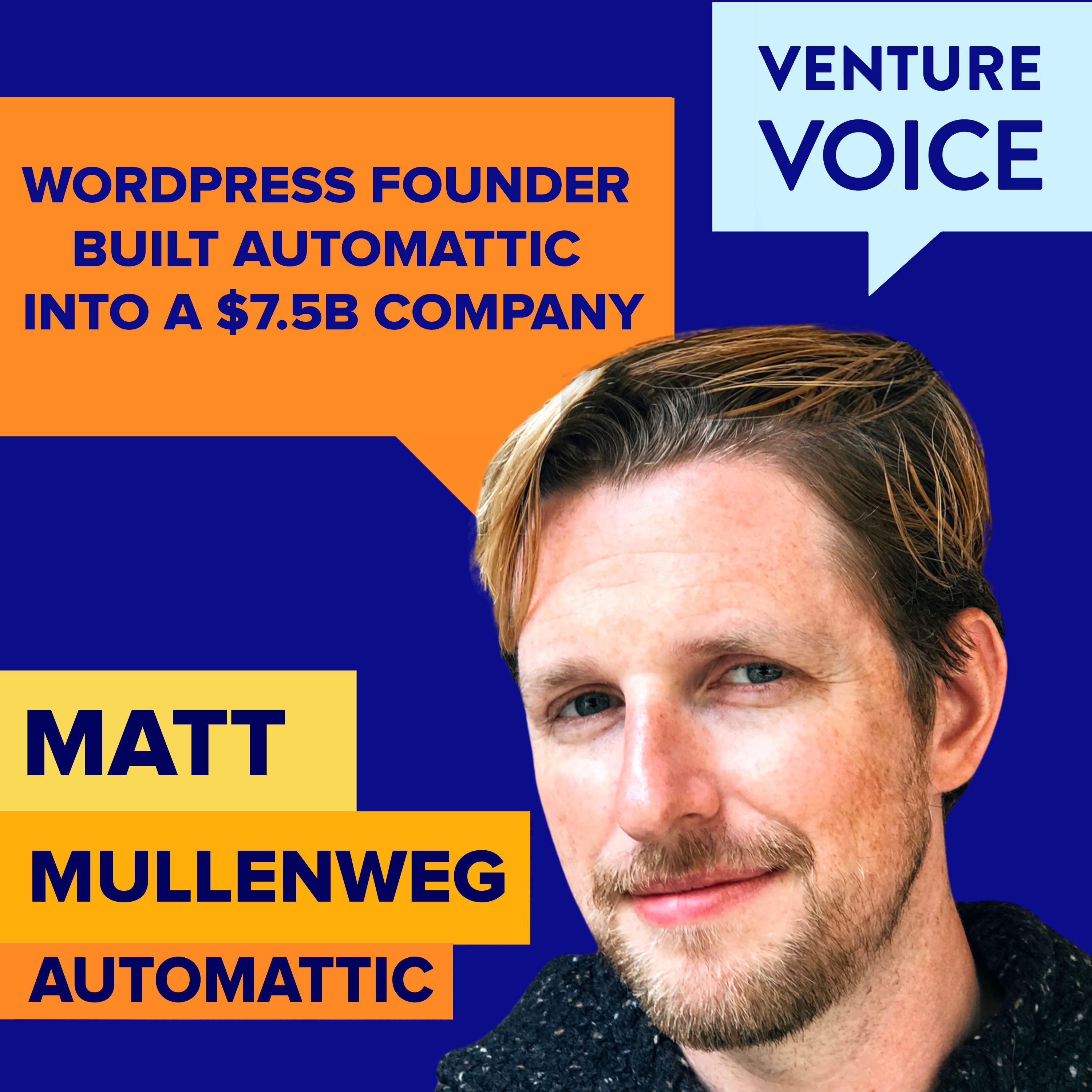
Matt Mullenweg built Automattic into a $7.5B company
from Venture Voice – interviews with entrepreneurs
69m 0s
The interview with Matt Mullenweg, founder of WordPress and CEO of Automattic, traces the origins of WordPress from a personal blogging tool to a platform powering a significant portion of the internet. Beginning as a high school student passionate about blogging and open-source software, Matt developed WordPress based on the B2 platform, prioritizing customization and a user-friendly installation process. Initially, WordPress served as a resume booster, leading to a job at CNET, but soon evolved into a business through bootstrapping and early revenue from web hosting partnerships. A pivotal moment was hiring Tony Schneider as CEO, whose experience helped scale the company while preserving its core values. Notably, Automattic pioneered remote work from its inception, building a globally distributed team—a model that later inspired many other companies. Matt emphasizes a philosophy of slow, sustainable growth without excessive venture funding, allowing WordPress to remain independent and influential over 16 years, breaking traditional molds in both business structure and workplace culture.
coming up on Bencher voice. So we got that bill and by the way that was a substantial part of all the money we had at the time. I thought it was like a light bill. Oh my god, you just pay it. And then Tony came and he was like, no, like this, this is actually a lot. They should give us a break because we're like brand new and they know that we're going to be a customer for a really long time. So I'm going to go negotiate this down. I was like, what? You can negotiate a bill. Never even occurred to me that was something you do. And uh, and sure enough, he went there and he was like, okay, we're starting out. We're five people now. We're going to be a lot more in the future. So can I give us a break on this? We'll have more money in the future too. And the company that just out, they reduced the bill quite a bit. Welcome to Bencher voice. This is Greg Gallant. I am so excited to bring you this interview with Matt Mullingwig, the CEO of Automatic and pretty much founder of WordPress. WordPress now powers a good chunk of the internet. He employs over 1700 people across 91 countries. And even more interesting than all of Matt's business accomplishments. And I should say Automatic is company now also owns Tumblr, simple note, partially a bunch of other products that I personally love using. But the really interesting thing about Matt is that he's pioneered remote work. His company's pretty much enabled remote work for the 16 years that they've been around. Matt has been an inspiration for me in my own company called Muck Rack, which is a PR software platform. We have over 100 employees. We used to be half remote, half in person. And during the pandemic, we decided to commit to being fully remote. We actually launched the work remotely forever pledge. You can check out workremotelyforever.com to see it. And Matt was the first person to sign on having him sign on gave us such confidence to go out and get dozens of more companies representing thousands and thousands of jobs to agree to let their employees work remotely forever. I've done my business for 10 years. It's hard to keep motivated and to stay fresh. Matt has pretty much ran WordPress for 16 years, eight as president working with the CEO, but still the founder and largest shareholder. And then eight as CEO, he took it over and put in a lot of really forward thinking strategies made a super interesting capital structure. And for someone like me who loves running his business and hopes to run it for many years to come, there are very few entrepreneurs to point to have done it in this way without taking lots of venture money and going public or committing to doing things the traditional way in a physical office. So Matt has broke the molds in many ways. I was really excited to talk to him for this interview. I hope you enjoy it as much as I did. Matt, welcome to venture voice. Hello. Thanks. Have a good morning. Usually I love to start by asking people when they start their first business. Sometimes it's from childhood, but in your case, it all started with the blog. So I'd love to hear what how old you were and just where you were in life and what inspired you to want to start blogging. How old was I? I was probably still in high school. So put the later part, maybe 17 or 18. It would have been probably around 2000, 2001. And I was just reading blogs, loving them. Some that are still going today like Tyler Cohen's marginal revolutions, which is blogging on WordPress today and I think almost daily. So I was just reading these blogs and was so impressed by how they were doing what I was doing, which was reading the internet, but then they would curate the best for their friends and they share about it and share their opinions and use it like a personal journal. So those early bloggers really influenced me to start blogging myself made it very accessible. Cool. And how do you go from actually just writing a blog, actually thinking about the blogging software? I think every blogger, like tinkering with the blog is as much time as writing itself. At least for the ones that like me. And so I was always tweaking the software, trying to make it just represent myself more personally because I didn't want my site to look like every other site out there on the internet. And so I wanted to be really accustomed to what I felt like represented me. And so that customization led me to switch software. My first first blog was probably on live journal that I switched to a movable type or blogger that moveable type. And then finally I found this software called B2, which was an open source blogging software written in PHP. So it was very easy to modify and also to community. So that was really the one I took to the long story short is that was what was the base for what became WordPress later. Cool. And it's so funny to think back when I started this podcast in 2005. I also started on a movable type. And at the time, it just seemed like they were the dominant force and they were. It seemed hard to imagine unseating it. When you switched off a movable type, how much it was just a personal desire? How much of it? I know people can get very passionate about what open source platform they're on. But to a degree that you foresee like, hey, maybe movable type won't be it forever or was it just really kind of, you know, you think you were going off to the fringe? For me, it was a philosophical decision as much as anything. Moveable type was not open source. And so I was really beginning to understand the importance of, you know, if you're using software, if it's open source, it increases your freedom. If it's not open source, it decreases your freedom. And so I was trying to increase my freedom as much as possible. And so opting into open source wherever I could was great. So that was part of what drew me to be too. And then also the customization, you know, movable type was written in pearl. It would generate these static pages. Not unlike some static static state generators today, but that to me felt very clunky. I loved with PHP. I could just change one file and instantly my entire site. Thousands or even millions of pages would be up to date. So that was very, very compelling to me about the PHP fully dynamic approach to blogging. But did I expect others to care about that stuff as much as me? No, probably not. And what we focused on though that I think ended up being a big strategic advantage was the installation process. At the time, the company behind movable type, which we called six apart, you could pay them 50 bucks or something to install the blog for you because it was kind of difficult to set up. But that also created the incentive for them to not make the setup that much easier. I don't think consciously. No one sat down in a meeting said we're going to make it hard to install. But just subconsciously, it just wasn't their first priority when they were working on things. We had no users. So getting people to install it was really, really important. So it focused a lot on making that installation process as clear as possible. It actually wasn't easy, but we tried to make it clear. And then I think I had gone to some diner. They had some milkshake. It was like, this is the famous milkshake. The famous mels milkshake or something. And I thought to myself, like, is it really famous? I've never heard of this before. This milkshake doesn't have like an encyclopedia entry or anything like that. It's just called famous. And then you're more likely to order it because they order it called famous. So for WordPress, I called it the famous five minute install. Even though it was certainly not famous at the time, I just branded it as famous. And you know what? It became a self-fulfilling prophecy. People really would talk about that five minute install. That's something that was a huge contrast to others. So a prophetic fame. Or the fame came first before the notoriety. When WordPress, you were starting it as an open-source movement. Did you have any idea back then that there could be a business around it? It was a purely kind of that feeling of hobby and just wanting to build it on my community. It was much more just wanting the software to exist. There were some open-source businesses, but the models weren't as well developed yet. And hadn't had the idea for things like a kiss mitz or other SaaS services that could plug into WordPress. So it was just early days of internet too. At least to me. It had been around, but to me it was still pretty new. And so tell me then, what was going on in your life at the time? Like, where were you? How are you thinking about, you know, you need to make money where you wanted your career to go as you were building WordPress as an open-source community? I would have been finishing up my high school, which was, I went to a special performing arts high school, where we had no sports, no gym, no anything. But we would do three plus hours of our art area per week, which for me was jazz saxophone. I ended up deciding to stay in Houston to go to the University of Houston, where my father went actually. I was making money at the time. I moved out as soon as I could when I was 18. And I would make money two ways by playing gigs for the saxophone. Often union gigs, which was great because we could check in the mail later. Or building computers, like buying parts and putting computers together, mostly for other musicians. And I guess the third way, which is making these really terrible websites, you just like dream reverb and front page. And like I didn't really understand what it was to make the web then. But I liked figuring out software. So that was my income screams. The computers were honestly a lot better than the websites. But over the time, the websites became to be more and more focused. It was more fun to me because it was about community. There were other people on the websites. What was the moment where you realized that WordPress, the open-source project that there could also be a business to build alongside it? I don't think I would notice that or realize that for many years to come. A year, a year and a half in the WordPress, I gained some notoriety for writing it. And then that caused me a job offer at a media company called CNET Networks. Which ran news.com and download.com and a bunch of big media properties at the time. But getting the job was kind of my business model. That's like, oh great, I got a job.
I'm a 20 year old kid from Houston without a college degree. So that was cool. And that also allowed me to move out to San Francisco, which was really where I felt like I found my tribe. In Houston, I had a handful of people, part of the open source, the nonprofits there, the tech support groups, or others that felt like they were passionate about the same things I was. But San Francisco, it was just in the water. - So WordPress was a resume more than a business. It was your calling card to get noticed by employers. - Yeah, and in fact, my co-founder of WordPress, I had a co-founder. He chose not to focus on it full time. - Yeah, the job and the life and kids and things, so he kind of went a different direction. - We were all just volunteers and all, I think, not, didn't have a strong sense of any commercial possibilities. - Yeah, and I remember right at the time, there was this feeling kind of open sources, almost anti-dissnister that it was not compatible with the idea of making money. - And literally we were giving this software away, so what all of our competitors were charging for, we were doing for free. So it just seemed like we would need to figure something else out if we wanted to have a business. Oh, it's our grand aspirations. Where I was getting paid 20% of my time for working on WordPress. It's like if I could never get that to 50 or 100%, that would be golden. So our business wants are also really modest. We just wanted to gather people working on it to be able to work on a full time. - Well, was that moment that it's seen at that, that let you leave there and be able to focus full time on WordPress? - Well, I started to figure out some business models for WordPress and running some advertising, partnering with some web host on sort of sending people to them and then they share back the revenue from the people who signed up for the hosting was just starting to kick off. And so that started to be a lot of money, a couple hundred bucks a month, a couple thousand bucks a month, to where we were able to bootstrap the company through the first three or four hires full time, including myself. Were you even your first own hire? Did you start hiring people before you left, Cena? - No, I actually started paying people just out of my CNET salary. And in fact, I overlavered myself. I got a little over my skis there, maxed up all my credit cards and everything. But I was just, yeah, I think I ended up being the third person the full joint full time, even though it was the founder. Or that as well was, even though I told Cena I was gonna leave, they asked if I could finish up some projects. So I stayed on some, a couple of months actually, additional to wrap up some things I've been working on. I had so much appreciation to them for removing me out, taking a chance on a kid from Houston. I really wanted to make sure that all the things I had set out there to do, I'd finished. And actually I was really proud. I ended up doing some software that saved them, it made them millions of dollars more than they would have, 'cause they were paying a lot of licensing fees and things out. So I was proud of my tenure there, even though it was short, just a little under a year. - So you do the year there now, you're credit cards are maxed out. You actually have a payroll, was that scary at that moment? I mean, I know a lot of people, I got freaked out when I first had a payroll to support much less all the credit card debt. - Totally, and to me, it was just a responsibility of these other early folks who would put their trust in me. They left the job that was, for a real company, and joined me. And I'd already kind of over-extended myself once. I wanted to make sure that, you know, even if everything went to zero, I could still give all these folks like some time to find another job and not miss a paycheck and everything like that. So it was really what led me to raising our first round, even though we were break even at the time. I thought, well, let's have some money in the bank. It was like a rainy day. So if anything happens, I can make sure these folks who have entrusted me, I'm repaying that trust. - Two things I find really fascinating about your story. It's one, obviously, the early adoption of remote work, and you were very gracious in joining us and signing the Work Remote Lead Pledge, and it's been a big inspiration for how we grew Muck Rack and being a remote first company. And the other is how you've done your financing with it all to let you be flexible enough to still be an independent private company. I guess there were a couple of pivotal things happening back then, but just to go back to the start, those first two or three people, my understanding was they were our remote, they weren't in San Francisco. - Yeah, so first couple of people, or people I was already working with on the Volunteer Open Source Project. I think the Open Source Projects attract people from all over the globe. It's not just people in one city using WordPress. It was very much a global phenomenon. And so first person was in Blarney, Ireland. Second was I think in maybe Vermont, from remembering correctly, maybe Seattle. I was probably third in San Francisco, we had someone join in Texas. So it was from the very beginning really, really spread out, including time zones. - So you've got this totally spread out company. And now, it's so funny to look back at it now. And that'd be totally normal since it's a pandemic. And everyone's just accepted their remote work works. But at the time, and I before, easy video chat and all that, what was it like going out to investors? 'Cause I just remember being in Silicon Valley around then, and they're just being this idea that like, hey, if you're a startup, there's some office I can go to, and I'm gonna see a bunch of people sitting around coding and a startup was an office of a bunch of people or garage or whatever the cliche was, or somewhere in so much, just like a bunch of people working. And here you are, probably just meeting with people all over your apartment during a coffee shop and saying, we have no office. I don't have anyone else here in San Francisco for you to meet. - A little weird. And definitely turned a lot of investors off. I found investors basically fell in two camps. There was one camp, which often who had operated a company before, who were very concerned about how you were building the company. Which would be fair, I was 20 year old kid, so they should be, it wasn't like I knew what I was doing. But then there was a second class that was just concerned with what you were accomplishing. And so the ones that were seeing what we were accomplishing were the ones that were, ended up investing. And the ones who would sort of say how we were doing it, and saw that we were doing it different from every other company they had done or invested in that business as well. I think pattern matched to say like, okay, maybe this is not a good fit. Or maybe this is a little too weird. - And at the time where you just kind of like everyone else in Silicon Valley where you're like, hey, I've got something working. And of course the next step is to raise venture. Or was there any part of you that was thinking like, you know, going more of the 37 signals based camp route and unsure if you wanted to take on outside investors? - I was very much not sure to take on outside investors. In fact, didn't want to for the first part. And I don't think we necessarily needed to because at the time the model was not founder led companies but bringing an adult supervision. So the model that most people would look at was Larry and Sergey on themselves, geniuses, without a Google, they brought an Eric Schmidt as like the adult supervision to run the company. So I knew if we raised money, they would want to bring an adult supervision. And that didn't sound like fun to me. Until I met this gentleman, Tony Schneider. Tony had been CEO of a company that just sold Yahoo, he was introduced to me by someone who's still one of my best friends, the journalist, O'Mollock, who had written a business cover story on him for a magazine. And when Tony and I met, it was like, we were two sides of the same brain. And he was someone who was a really amazing guy, a great person, understood open source and everything I was doing and that we wanted to accomplish got the vision immediately, but also was an experienced executive. And someone I was like, I would love to work for this guy. I was like, well, if I can choose the adult supervision isn't that bad. And so that's how Tony and I ended up partnering in the beginning. I can send myself so incredibly lucky that I met him and that he was that we were able to hire him as CEO to join the company. And he was CEO for the first eight years of the company. So I choose you're a babysitter. Yeah. And this Tony and I are still so close to this day. So it's one of those things where it's not often that you meet someone and you click so much on that first meeting. And it's still going strong 16 years later. But that's definitely Tony and I. And so I just can say again, I met thousands of people. Tony's kind of wanted a million for me and how well we mesh then and now. And how do you dynamic work? And like you were saying, I'm sure it's probably somewhat similar to the Google Dynamics where you have you is the founder who imagined, "Oh, and more of the company." And what is thought of is synonymous with WordPress. But then you had Tony come in, whose title was CEO and in a corporation, the CEO is the top dog. Well, a lot of things I'd rather than time made it clear that when reporting lines were uncertain or if executives were having a two parent effect where people go to one and then get one answer and another get the other answer, that wouldn't work well. And so I always was very clear in my mind that Tony had the final call on things. That was why I was hiring 'cause I wanted him that at the final call on things. And that we'd want to really communicate and always be in agreement or consensus within the company. Even when we were small, five or six people. So we would talk and debate endlessly, including with the rest of the folks in the company. But we'd always make sure that we ended up agreeing on a path. Even if it was sort of what is now called like disagreeing commit. Maybe we disagreed, but we can bet on what we were gonna do. And then whatever that was, we would go fully into it with no hesitation, just like really try to make that as successful as possible. So that is very basic advice, but I probably got it from some book, but it ended up being very, very helpful. I think in Tony's mind as well.
He might be better asked about this as well as he was thinking well, you know, Matt's writing the code He's you know working with the engineer so he really tried to set up clear areas of responsibility So I was the president But he ended up giving me a ton of responsibility for a lot of things within the company and that really grew over time to when we did Actually do the handoff where I took over a CEO. It was very very natural It was really like a very smooth baton pass because he had done such a good job grooming me and teaching me and passing more and more Responsibilities on so by the time we did that handover it was you know very friction-free within the company Cool So it wasn't one of these situations where you were just chairman and had no direct reports and was floating around like did you actually have Reports and divisions rolling up to you and kind of a span of control. Yeah more than latter So I think my title is president and the engineering and the product all Rewarded into me which is it being a big part of the company as a real and now for Tony is he was already successful CEO I didn't actually get to research just by imagining his prior company. It was in a non-remote company and an office company Is that true and it and if so you know was it hard to get him on board with the remote work? Train they did have an office they might have had people remote. I don't remember it was called all posts and they were very forward It's progressive company in so many ways, but Tony also fully got the remote thing So there was never any hesitation or issues there. He also though knew they're important of getting people together So at the time I think those first a first year we flew everyone in twice To where we all got together brainstorm hang out share meal and that was really key to the culture then and now You know pre pandemic we would tell people who joined automatic to expect three or four weeks of travel per year And that means probably three or four maybe five times you're meeting your colleagues Maybe it's at a conference. Maybe it's at a whole company meet up But like you're seeing people pretty regularly Where the biggest things that you learn from Tony that you didn't kind of learn on your radar prior to hiring him Like you knew this concept of like oh experience CEO adult supervision But like what did you see him do where you were like I would have never never thought to do that or never never even expected that next move from him It's countless but I'll share one antidote from the very very beginning which I thought was funny It's done. I'm totally joined at the perfect time because we hadn't had to like pay taxes or do a lot of things it and I first incorporate the company on legal zoom But then we hired some lawyers to like redo it and make it clean and everything like that to be ventured back And that costs gosh who knows $20,000 or whatever it was that they build to incorporate the company because it wasn't like a template thing It is still like they would do everything from scratch or at least bill you like your subscribe and so we got that bill And by the way that was a substantial part of all the money we had at the time I thought it was like a light bill You just pay it and then Tony came in and he was like no like this this is actually a lot They should give us a break because we're like brand new and they know that we're gonna be a customer for a really long time So I'm gonna go negotiate this down. I was like what you can negotiate a bill Never even occurred to me that was something you do and And sure enough he went there and he was like hey, we're starting out We're five people now. We're gonna be a lot more in the future So can I give us a break on this? Well, how more money in the future too? And the company did just that they reduced the bill quite a bit So you're getting to kind of watch someone in action like getting to kind of skip maybe but it would normally take an entrepreneur Two three four years to learn you're just getting to watch all this Pro and yeah, there was no blog that I had ever read that said that no book and certainly the lawyers weren't gonna tell me that I couldn't negotiate the bill down Good couch on the lures for everything and so long that way of working with Working with Tony how do you learn yourself to be you know kind of go from that? You obviously knew how to collaborate really really well, which is what open source is all about How do you become a manager yourself and know how to deal with performance issues of people on your team and Structure your teams and just everything that goes along with the the business of management for better or worse I would say that was largely trial and error over the past 16 years The good news is as you said we were really great at collaborating around the product So the team I think because we were coming from open source we worked together before and we were so in touch with the users and we were users Ourself for word for us. We never had any issue making Products that really resonated with people and that every iteration it would appeal to a wider and wider audience But everything else in management, you know, I really had to learn Larger through reading books a lot of seeing the example of Tony the example of other more experienced people who joined which is by definition Pretty much everyone joining the company and more experience than me and And like I said some trial and error including you know being not the best manager for some people or Reacting from a place of fear or ego when something was happening but then seeing you know that doesn't work as well So and you can do the opposite Do you remember any specific examples where you just had a management tissue and just had no idea what to do or Wanted to run away from it is you know, I think all of us did as you were learning to be managers I think some of it because we were we were pretty frugal and we were getting started and we were really tight-knit team that was High performance some of the stuff that we ended up doing which ended up with being innovative Was kind of just working from first principles of what was working so hiring engineers We did the interviews and we did the thing that we had seen other companies do or we brought them in for a panel on they would Write on a whiteboard and like they were talked to seven different people I think we over indexed for people who had like masters or PhDs and computer science and like really tried to go for that And then some of those early hours really didn't work out and so we just kind of looked around the table and we're like well We're all really good and we don't have some of our backgrounds like I did political science and I didn't finish I was a dropout so maybe like indexing on college degrees is not the best thing because obviously we don't all have these fancy college degrees from Stanford and my team stuff and so we're like well what did allow us to work well together? Well, we actually did the work so we worked well together and so we knew we would work well together There was a little bit of a truism, but it was true as well like people who were referred someone's like oh I worked with this person on a previous company They usually end up working really well, but I was like well We're tapping out the people we've worked with before and we can't afford some of those people either So how do we make it so for anyone who shows up to the door in the world we can see whether they would be someone we work well Like well, let's just figure out a trial project. Let's figure out like a small project that could take a couple days That you know could be even like a bug on the open source like just send them a bug and say hey This is a bug and WordPress do something to it. So that evolved to become our trial project Which I think was and actually still to the same huge competitive advantage for us in hiring because we almost Don't look at the resume at all. I'll be looking further in the resume as typos Like is there attention to the detail? But other than that go to college anywhere have any previous work experience be a barista be a team master Doesn't matter to me have a 10-year gap in your resume who cares? I'm looking at the quality of your application the quality of writing in your cover letter. So are you a clear writer and That's true. You know, let's chat and then if the chat's good Let's do some little project together over time. We've gotten better at making those projects really good at predicting someone's future success But that a lot is to really tap into talent that was came from non-traditional backgrounds or had to have a non-traditional work experience How do you manage that tension like you'd mentioned you kind of first did it the Silicon Valley conventional way Then you did the more kind of first principles such as figure this out way and I've heard kind of two schools have thought There are a lot of people who are like hey what we do is the product that's unique You know WordPress is going to be unique and everything else has been figured out before so we can just hire people from Google or Now Facebook or whatever and implement the the playbook way of doing things Versus the idea of like hey, we could do everything from first principle But of course, you know if you do that it could be so much work to get going that it'll take forever What's your learning bit on like what went and went to go for the playbook and went to figure it out first principle? I guess it's a playbooks working keep doing it right But for us the playbook wasn't working and maybe it's because I hadn't worked at a Google or Microsoft or Yahoo Or the big companies at the time so I didn't know who were the right people in those companies or we were all coming from like outside I said look in the valley so yeah the playbook just wasn't working for us. We tried it You know we had investors and friends of other companies were like here's what you do so we tried that first But then we're like okay, let's try something else and that ended up being a real competitive advantage for us because almost everyone else was working out in the playbook So by using your own book I think we were able to build something with a lot more staying power and a lot stronger foundation another thing is like the people were hiring stayed, you know we had so much still to this day have a much much lower attrition rate and almost every other technology company I'm aware of the numbers for and so that allows you to build a stronger culture allows you to build more expertise and sort of pass along knowledge from more tendered people to newer people which I think is again a really huge competitive advantage for our company. So let's fast forward now eight years to when Tony's There's a transition and the adult supervision is no longer needed and you get the the keys to the company. What was there?
specific event that precipitated it, you know, not why it was in seven years in or nine years in. What was it about eighth year that kind of triggered that discussion? There was kind of an arbitrary milestone, which was my 30th birthday. I was exiting my 20s. I was into my 30s. Your 20s was in his 30s when he was the CEO of the company. So that was kind of the arbitrary one. That was also kind of fun. I think we officially did the handoff, did a fun party down in Mexico. Tony was there and then like the Monday after that, we did the official handover. But I'll say the conversation that started a few years before. And it was just, you know, Tony is very aware and conscious person. And he was like, yeah, I really enjoy working with small teams. So a lot of max getting bigger. And over time, I had become really passionate about what it would take to scale. I got really into that idea of like, how would you go from 15 to 50 to 500 to 5,000 and became kind of obsessed with learning about that. And so that was a very, very natural thing. And the fun thing about it was Tony just took a different job within the company. He was like, I'm going to take off the CEO hat. But now I want to run some teams. I want to work with some of these small teams again, which also created this amazing legacy of kind of how the best thing that George Washington did when he was the first president of the United States was I stepped down and sort of made it so there was this orderly transition of power. It's actually very, very key and automatic that when people become leads of a team or division or something like that, if ever they feel they're not getting energy from it or passionate about it or the best person in the world for it, they can step down. Yet still stay at the company and still have a great job or find something that they are really passionate about within the company. So it doesn't mean they have to leave their colleagues and this great kind of aim that we've created together. So Tony was an amazing example of that. So some of the things he just did being himself have become really key parts of the culture. Another thing that he did was he took, I remember exactly how long it was, but I think it was at least a month or two in there and did a road trip around the country with his family. So he's European, he's Swiss, he's used to longer vacations. At one point he was just like, yeah, I wanted this road trip with my family with the kids of the right age. You know, we're young, we're healthy and so we're going to take a few months off. So Matt, run things while I'm out. So that was also kind of a practice run. But two, like, you know, this is a really valuable thing. That ended up turning into a benefit that now we offer to every automation, which is we call it sabbaticals. So every five years at automatic, you get two to three months of pay time off, minimum to maximum three, and it's fully baked. So you get your full salary for that time and you can do whatever you like. It's being a really amazing benefit for people. Often people do life experiences that they remember and cherish the rest of their life. Whether it's with family or doing a backpacking trip or something like that. So the inspirations were Tony and also this nonprofit I joined the board of called Grist. And they circulated this bike paper that was like nonprofits become too dependent on the journal managers, their founders. They become a bottleneck for everything in the organization. So if you're a nonprofit board, with good governance, you should force that person to take a few months off. Because then the rest of the organization can figure out how to operate without them. And otherwise, which is always be dependent and you'll get all these like inefficiencies. And so the other thing about sabbaticals is it forces the organization to figure out how to operate without that person. It maybe gives a someone their their grooming to be a successor to their role like a chance to try it out. Like it creates actually so many great things for the organization. And so I do incentivize people to do that. Well, you just pay them. You say, okay, make your full salary and then do your own thing. And that's an addition to the normal vacation. There are other benefits that we have. So again, I consider myself lucky that some of these early things. Sort of some serendipity combined with some research ended up being things that are key to our culture. How big was automatic when you did this transition at your third year of birthday? I'd have to look up to see the its act number. Recall it on the order of magnitude like 150 200. So you take over at that scale. What what you observed kind of before and after like what were the kind of biggest moments in scale where you had to change your job as CEO and running the company? Yeah, the first thing was actually around fundraising, which is pretty interesting. The first, because there was eight or nine years of the company, we did the whole thing on just $11 million of outside capital. So like a million dollar around the beginning and then like a $10 million on later. So that wasn't very much. It was largely bootstrapped. So the company was kind of growing as a revenue screw. And Tony had advocated to raise more money so we could grow faster in the past. But I had never got comfortable with that because to me bigger companies were less innovative, less fun, less good. But then once I became CEO, even though it was in some ways just a title change, even more the responsibility change, it became clear to me how right Tony was. We were capital constrained. And so we went out to to raise around our C.R.C. And that was I think 2014 when we closed it. And we became a unicorn in that round and we've raised $160 million. Both of which now seem like not a huge deal. It like happens five pounds a week. But we were one of the very first ones. And I think when the first to do it around that large because that was kind of what people were raising in IPOs. So it was like we did an IPO, yet we stayed public, maintained control of the company and gave ourselves a lot of room to really put the gas pedal on an accelerate growth, do acquisitions, accelerate hiring. And so that was very much a turning point for the company because it had an as clear to me, but we were capital constrained and our opportunity was much bigger than our revenue growth was able to support at that time. How do you think you missed that? I mean, you were working with Tony, you were on the board, you had this remote company like what was it that getting the CEO titled, let you see something that you couldn't see as president and as founder? Yeah, I wish I knew. Because I could tell folks to avoid it, but it was just probably my hardhead in this. Let me see. Yeah, at that time WordPress was 21% of the web. Wow. So about half as large as it was now. Yeah, but we figured it out eventually. Cool. Yeah. And you know, it's funny going back to that. Okay. So I remember there was this big idea at the time that you could do so much with few employees, which it sounds like is the idea you had. I remember looking at, I forget who it was, it did a presentation on this, but they showed the top 10 websites and you know, you had Yahoo, which was like the old dinosaur with thousands of employees, but then you had Craigslist, which then had about 100 employees or maybe less. Yeah. And you had Wikipedia, which had a couple dozen employees. So I remember this kind of feeling of optimism back then that like, Hey, you could have this huge company. We had the internet and technology leverage. You could have this huge company with very few employees and maybe we're trending towards a day when it's just, you know, one person and a server plugged in and that'll be a billion dollar company. What's happened with like Instagram and what's happened? Like some really amazing examples. That's a great point. Yeah. Yeah. So we saw that. But then even with those ones right eventually, they get acquired and now there's God knows how many thousands of people, you know, within Facebook working on Instagram and what's happened. And then you were kind of at that pivotal point, right? Like you could have decided back then just to make lots of profits, have 150 people and maybe do it. But what do you think it is that, you know, like what or what led you anyhow to just decide like, Hey, we need more humans here. I'm not satisfied just having a small relatively small team running this business that could scale and make lots of profit. I think still in an automatic, the best work is done by small teams to this day. But just we're doing work on more things. So that's where I don't think the depth of what you do necessarily can expand, but the breadth can really go. And so our whole structure and how we try to run things is balancing out how can we create like a sort of forest of small teams that are fast and iterating quickly and have a lot of autonomy, but then just do more stuff. And we're 2000 people now in our current roadmap. There's enough work for 10,000 people easily. And so it's just about how do we grow the business to be able to support that in the meantime. I want to learn about the kind of endurance that let automatic and you keep going probably years. But first, I'd love to just hear what the investors because I think there's this idea that, hey, if you take VC, the VC is going to be on a whatever, you know, five to seven year time span. And they're timetable for sure. Yeah, they need an exit. And I guess the conventional wisdom was always like, hey, if you take VC in five years, you're going to IPO or you're going to get fully acquired by some bigger company. How have you managed to go 16 years without either IPOing or getting acquired? Again, we were fairly lucky. There's a name which is very well known now, which is Tiger Global, which is a hedge fund out of New York, which is some of the smartest investors of the past few decades. No one knew who they were. They reached out to my name, Leifick-Sell. And I think 2013 is like, hey, I've seen your business. He actually came to extorted Ninovo. Here was on vacation in Mexico and thinking about like, what is the future of the web? He's like, well, there's going to be something powering like the operating system. And then he came back and was like, let me figure that out. Then he came across WordPress. He was like, and then he just reached out cold. And we didn't know what an incredible investors they were. But they came in and they said, well, we want to be a long-term holder of this company. We think you can run it. so we're not trying to take a board seat.
anything like that. And we're happy to buy stock from your existing investors if they're done. So that's the thing. Sometimes funds might need an exit, but you can have new investors exit them without selling the whole company. And Tiger really helped us with that. And they really helped us with that. One thing I always say to every shareholder, whether they're new or existing, is if for whatever reason you need liquidity, I'll find it for you. That's my commitment to you as the CEO. I consider that part of my fiduciary responsibility. I can't promise you it's the right thing for the rest of the company, the whole company to sell or the IPO. That's driven by a lot of factors. And in fact, I'm never going to do it for an external pressure. It will only be driven by what's right for the business. But if you, your shares, you know, you want to sell, I'll help you with that. And I'll call investors and I'll like pound the streets, even though it's not my first choice of things to do. It's kind of like actually at the very bottom of my list of things I love to do. But that's my commitment to anyone joining. And that gives people a lot of confidence to hold as well. We definitely have had many early investors that have sold along the way, which they needed to or early employees or things. But we have others that knowing that they, they can sell at any time, criticism the confidence to hold. And then they just kind of look at the metrics of the business. They say, well, this is growing faster than other things I could put my money in. I'll let it roll. I would say also in this time period in 2005 to now, it's much more normal for limited partners to give extensions to the funds, sometimes indefinitely, you know, what a stock is doing well, because they've seen how many returns they've missed out on by selling early in the best companies. This is how you probably saw a query to switch where they can now have public holdings. And definitely, I think the old model of venture had some amazing returns. The returns could be an order of magnitude higher if they were allowed to hold longer. So now it's, now it's a little bit of common wisdom that if you've got, you know, if you've got a tiger, don't let go. No pun intended. Yeah. If you're on a rocket ship, don't jump off. Stay on it as long as you can. And now we know, I mean, we have companies like Google and Apple at tens of billions, hundreds of billions of dollars, still growing 30 and 40%. So the growth of a worldwide technology company appears to have no ceiling yet. We haven't yet found it. The most valuable company in the world, trillions of dollars in market cap is possible. So or before I think people assumed that an exit of a billion dollars was like a once in a lifetime event. Now we know you can actually build tons and tons of value. That's right. And so interesting to think that the kind of the investors and the mechanisms you're using now to stay private, didn't exist or would have never invested in technology back when you started the company. Yeah. You know, one of our largest new investors of the past years is actually Bernard Arno, who's the chairman of Elviemh, Louis Vuitton, what a Tennessee. One of the largest luxury governments in the world. He's obviously a super smart guy and understands the impact of technology on his businesses, understands quality, understands creativity, understands building businesses and governments over decades. So he's an amazing fit for us doing what we're trying to do, which is create essentially a holding company, which is automatic, which is not unlike a Berkshire Hathaway or an Elviemh or an IEC or an alphabet that has products like WordPress, Tumblr, WooCommerce, Jetpack that can grow to be companies on their own, which are really substantial. And if that could be public, if they wanted to. And I saw you just did a new raise of 288 million back in February. Congrats on that. Thank you. I was reading it as part of it. You provided a buyout for your employees, which I imagine is another big vector of this challenge of staying private and not having that typical like, hey IPO, everyone's stock options are worth money and you can look at the market. How do you structure that? And then it sounds like you did it differently than the kind of standard model of saying like, hey, employees, you can just sell your shares to this third party we found. It sounded like you were actually from the company buying back the employee's shares from what I read. It's very similar to selling to a third party, except the reason you do a Tinder offers because you can aggregate supply and demand. So, if you own shares in a company you can sell at any time you want. There might be like a writer for a refusal for the company or something like that, but ultimately they belong to you. When these transactions happen kind of one-offs, it's not usually advantageous for the seller. They don't have the CEO, the CFO, the company out there like sharing financials and information. They might not have access to the best investors in the world or they might not just have enough stock where it's worth writing a check and doing the work for the best investors in the world. They might need to put in a minimum of 50 or $100 million. So, it had been a few years since we had done any employee liquidity. So, that was just something that we thought, well, it's been a while, the company's grown a lot. Let's do this Tinder offer. I would say they're pretty standard and I'm actually very excited by platforms like CARDAX or NASDAQ private markets which make this almost like an ongoing thing. Great essentially like a stock exchange for a private stock. That's probably the future where this goes to. But for the next few years at least we're just doing kind of like as a big event. Where we like say, hey, we're going to buy 200 million of employee stock. We're going to sell it to investors and we'll figure that out as a middle person. And you've been big enough now to IPO. Why haven't you IPOed? I mean, so many entrepreneurs dream of bringing that opening bell and you can raise what you've raised like capital anyhow, but not only do you get capital, but you get a lot more fame and press. Why not just IPO? Yeah, I think it's just looking at what are the constraints for the business. We're not constrained by how famous we are, how much press we get. Certainly that's not something I want more of in my personal life. We're not capital constraints. We have lots of money in the bank and even if we need a lot more, we have a lot of credibility with investors to be intelligent allocators of capital. So that means there's a lot more available if we asked for it. And liquidity. We just talked about how we're providing liquidity shareholders. That's another big reason to go public as the largest shareholder and with the other largest shareholders and investors in the company. I think we're all pretty happy with the trajectory of where we are on the private track. So the advantages of being public are advantages we largely already have. And I think there's another advantage to not having the scrutiny of quarterly results, the public markets. And also other people in the world not knowing your numbers whether that's competitors or new startups or other things like that. So by keeping that pretty close to our chest, by having a very, very small set of shareholders, you can kind of you can fit our whole cap table on a single page. It gives us a lot of flexibility to work hand in hand with some of the best brightest investors in the world, build a team which really thinks long term and just have a ton of flexibility for when we need to make a very, very long term investment, which occasionally we do. It's not that public companies are precluded from doing that. And there's some examples like Amazon where they can build something like the Kindle or Echo over. Have it lose money for five or ten years before it really starts to have the impact AWS being another good example. Amazon actually has a lot of them, but you know, we have that same flexibility and it's just, it's nice. We're not subject to the vagaries of, of the downs of public markets right now. And have you optimized your own endurance to be able to keep running the company after this long without getting bored or restless or burnt out? Board is never a risk because what the company does changes so much here to year. And that's just a function of scaling, evolving, growing. We have more products now. Wordpress is totally different than it was a decade ago or 15 years ago. So everything changes in technology all the time. So I think if you're staying relevant, you are also changing both yourself and the product you work on and so the work changes. Burnout is a factor. And I would say the good news is I am very passionate about what we do. I would do it even if I wasn't getting paid. So that's nice. I get a lot of energy from the WordPress community. So again, we haven't talked about it too much, but there's still an open source community of thousands of volunteers and hundreds of thousands of millions of people who make a living from WordPress. And so, you know, usually once twice a week, I'll get an email from those people or meet someone in person. They say, "Hey, my first job out of college was building WordPress sites." And sometimes it's CEOs of like deck of corn companies. They're like, "Yeah, that's how I bootstrapped to myself." And so that is very compelling. You know, I get a lot of reward from that. I find more than any change in monetary stuff at this point. But I will also admit that like post-COVID, I got hit pretty hard. I think because I was working harder than ever and then just life was really tough. And so it has been something I've been thinking about a lot more over the past year and a half, just how to keep up my own personal energy because I felt it flagging for the first time in my career. And it's given me so much empathy as well for other people who hit a wall or had troubles in their personal life, which then led to like work being a bit tougher. So that's, I think for me, applying the things that I knew were helpful on a daily basis, really doubling down on that. Meditation, diet, exercise, spending time with loved ones, maybe like an easy forward list that we all know, but like it's sometimes hard to prioritize. Doubling down on that. Also just, you know, building at a time. I hadn't taken any vacation or time off. And actually I have an upcoming trip where I'll be offline for like really offline, like in the middle of nowhere, satellite phones only for 13 days. So I've been really looking forward to that trip. And it'll just be nice to be out of nature and be disconnected for a little while. I'm hoping that that will also be very restorative. Nice. And if I read right on your blog, you, I think you wrote that you,
went down the Van Life Rabbit Hall and have been kind of exploring with alternatives. But love to see us here because I think so many people think working from home is remote work and it sounds like you've done more than just work from home. I would say I definitely, you know, from Texas, so people think I'm a country pumpkin, but I really grew up in the cities. And Houston is a huge thriving metropolitan. It really has a ton of energy. I think it's the third after New York and LA. But the pandemic definitely, you know, made turn cities from my asset to a liability. And so I really got out in nature a lot more, which I'd done occasionally before. I've been a boy scout and stuff, but Van Life was fantastic. And I figured out like really good connectivity and everything and just being in RV parks or national parks. So it's kind of that Venn diagram overlap where you still have really great cell phone connectivity or Wi-Fi. Yet you were in some place beautiful and you could, you know, step outside and be on a lake or hike to a waterfall or something like that. It was funny because at the beginning of 2020, I do a thing every year where I reach out to someone like closest friends and loved ones and ask them to assign me a New Year's resolutions. So I make my own, but then I'm like, okay, make one for me. And I'm always just fast-named with people too. And sometimes I do and sometimes I don't. But that year my mom, the one my mom had made for me was like, get out of nature more. And this was pre-paying ever get everything. And it ended up being incredibly prescient of vice for not what I would actually do. Certainly that sort of like that first march to September. But what I sort of realized through that first lockdown, like, oh gosh, I really need to do this. I need to get out in nature. And it's naturally distanced and everything. So that was kind of my personal journey. I could say myself, I was lucky in that like my work, I was able to continue. My impact on the world was able to continue. And in fact, in some ways increased during the pandemic because I had no medical expertise, but like I knew a lot about remote working. So I was able to share that with a lot of companies. I spoke to literally everyone who reached out to try to help them get better at remote work and distribute work. And so that felt like very small, but something that was meaningful to me to get back to the world. I think I saw the stat that we went from 5% of hours being remote in the United States to 60%. And the course of about a month. So a lot of people were doing it for the first time. So some of the things we'd learned at Automatic in 15, 16 years of doing it, we hadn't really necessarily written down or shared or even really thought about. And so it gave us, you know, I think a big opportunity to get back in that regard. So that felt good. And you know, that was I think just lucky. And then also just the health of myself and loved ones was largely safe during that time. Now if I can just ask something really practical on that. Well, obviously, because I'd love to do it too, but you pick a lake to go to or a mountain to work from how do you connect to the internet there and how do you even know what the connectivity is going to be? Good question. So there's a ton of sites, particularly for boondocking. So that's often what I would do is I would have my van RV would be like totally self-contained. So I wouldn't have to like plug into electricity or grid or anything. I could do that for a few days. So some of these sites will actually show here's the number of bars for Verizon, here's the number of AT&T, et cetera. At these campsites, it's sometimes you have to go on like a logging road to get to. So you can be quite remote physically where there's not another soul there, but still have pretty good coverage. So that's just again, that's that Vindyagram overlap. What are some of the sites? Boondockers, welcome, harvest host. It's just Google for like boondocking apps and websites. There's like five or ten of them. And I would just use them all, like logging on, see what was around and see what was there. And then into the van I built, end up using this system called Pepplink, which is a multi-way and router. It's a little expensive. It's a couple thousand dollars, but it can essentially you can plug in multiple SIM cards and then put an antenna on the roof. It will actually create multiple network connections simultaneously and it can even combine them. And so if one's not working like if AT&T is really weak, it'll use the Verizon. So I think I set up a Verizon and AT&T and a Google file, which is basically like T-Mobile SIM cards and was able to do that antenna and everything that worked actually really, really well, even more reliable than a Wi-Fi in many situations. And also kind of networking and like literally networking is kind of my hobby, like Wi-Fi and routers and all that sort of stuff. So it was also just a fun kind of cathartic activity for me to hack around on this stuff. I said, were you concerned at all like when you were doing, I mean, you have obviously an amazing reputation and remote work and your company speaks for itself, but still when you're talking to billionaires about fundraising, you're talking to BlackRock and Tiger Global and these kind of older school finance people who are probably in their mansion's God knows where. Did it feel weird at all? Did you feel so conscious jumping on and having your background be somewhere deep in nature or do you think that added to the, or did you feel great about it and that it added to the charm of your pitch? Usually my background is pretty nondescript. So I try not to have it be a distraction to wherever I am or you can always do the virtual Zoom background. That's just me. So and usually I talk to this folks we talk about the business. So they have no idea you're in the middle of nowhere. They might, I mean, if they asked, I tell them, but you know, we usually had lots of other things to talk about. So it wasn't usually the first or reason, fifth thing to come up. That's right. Yeah, it's funny how some people are at home and they put up the virtual background of nature and you might have been doing the opposite. You're in nature and you're putting up the virtual background of an office or of a wall in your home. Yeah, there was a video broadcast. It was actually a panel I did with a Mitchell Baker from Mozilla and Dries, Makria, which would be why I admire a lot. But just the way it worked out is I ended up, sometimes very, I wasn't able to make it to the place where I planned to do the broadcast by the time we had to do it. So I ended up just stopping on the side of a road and setting up a little mini studio outside. And on the camera it looked really nice because like I had this kind of like nice nature looking background and I have a real camera. So like usually it's a nice bouquet effect and everything. But then I did it behind the scenes picture. It's actually a weblog. I looked up I think streaming setup or something and I was literally like on like a folding chair with like a folding table. Some yoga blocks holding up my laptop. The camera kind of on a tripod with a blanket over me because it's actually pretty cold. So like I had to suit on top. Then like a blanket on bottom. It turned out that this particular road was right next to a logging station. So every couple minutes this giant logging trucks with like 40 feet of logs would go by. And one of the pictures you see kind of like the van and then like a logging truck going by. But luckily over time and tech is so good I was able to use things like Chris Bay. I had a good headset to essentially make it so that there was no perceptible background audio noise. I use that as an example. Like you could literally be on the side of a road with a truck going by and have like a professional quality broadcast. So what a time to be alive. Going to the new normal. Are you do you see yourself going back to your old life which is I understand it from checking out your blog was going to lots of conferences and traveling traveling the world saying at hotels meeting with your employees, your partners or do you see you know embracing van life or you know getting out into nature and living this more solitary you know nature connected life. That's a good question. It's to be totally honest since I've been able to fly safely. I haven't been driving around as much. I mean the driving just takes a ton of time even if you're sharing it with a friend like you can really only I can only drive two or three hours at a time before like my back starts hurting or get just get tired and so to get around sometimes you might need to cover a thousand miles. So you can really really add up and there's a lot of uncertainty to being fully nomadic where you don't know how the cell phone signal will be or what the internet connection will be and I don't like that. But I like to control variables and minimize risk on things that don't need to be risky. So a lot of the second half of this year really 2021 I've been back to either being at a home base like I have some home bases in different cities or staying at every beast or hotels I know will have a great internet connection and it's funny my number one thing you want a friend invites me like come stay have a guest room. I don't ask about the bed or anything like that or anything about where I'll be staying and like how's the internet that's my first question because I find with great internet I can be really productive and we're out of company of almost two thousand people now. But when the internet's slow or bad or dropping it can be really really frustrating. You or I experience this a little bit earlier. I think it was the software we're using not the internet but like it's so frustrating when you're trying to connect with someone and it's like can you hear me now can you hear me now. So that's really what I'm when I'm looking at Airbnb's I'm looking at the reviews if anyone mentions the wifi. That's great the only thing that matters like and then by the way does that for Bruce and a working toilet. But yeah actually a fun hack is this there's a thing you buy in Amazon it's a 50 foot retractable ethernet cord that kind of goes into like a little thing and a lot of times if I know I'm going to need to do a professional broadcast I'll actually travel with that because you can run the cable from wherever the router is up to 50 feet and I've actually daisy chained to them so I did a hundred feet into where I was broadcasting. And once the funny thing that happened was I got an Airbnb and it turned out the internet connection was like DSL so I couldn't broadcast and I had to do a company town hall which we do once a month and I take them really seriously like no matter what I'm doing in the world once a month we get the whole company together we do a very big broadcast people can do a Q&A you can ask whatever they want.
It's not filtered, it's not moderated. And it's really important to our culture. So what I ended up having to do was I set up the sort of camera station in the house, but the internet was so bad, it turned out the internet through my modem and the RV was better. So I ended up running daisy chaining a couple hundred feet of ethernet from the van through the garage, through the kitchen, into this living room, through the broadcast. So it ended up the cell phone connection was much more reliable than the house one was at that point. And life saved you even when you're getting RV and bees. I really like being resilient to whatever happens. So I think of anti-fragility for business, I think of a personal life, I think of everything. And so there is something to know, like your whole life can fit in this car and that you have, you're prepared for many eventualities. Now, you've got access, I've got things to get the tires out of mud. It's just a really good lesson in kind of reminding us all the things we take for granted to, like running water and flushing toilets. So I think it really makes your appreciate modernity and the luxuries of modern life as well. When the pandemic started, I think everybody looked to you as the remote expert and as you said, lots of people called you up and you really made the playbook, a lot of other companies have followed. But I'm curious though, you know, in that shift of just being a pandemic where it's forced remote and you can't get on a plane during it and you can't bring your company together as you used to put a lot of resources to, well, would you say that you personally have learned in the sense that pandemic started about remote work and running a business? You know, I think what we did so well and what we've shared is what we figured out in work 12, which is how to work together. And part of that was us getting together a few times a year with those meetups. And so when that was taken away and then you also had the stress of a global pandemic, I think what we are still figuring out alongside the rest of the world is exactly what I talked about earlier, like one, you can't go out and see friends every day when you can't necessarily have the part of your life, which allows you to be better at work and which I think when you work remotely can actually be really great because you have total autonomy and control over going for hikes or walking your dog or going to a matinee movie and spending time with your friends and loved ones. All those things that when you have normal flexibility weren't available, how to navigate that pandemic life. And the good news is at least in America it's getting better. Cities are open, restaurants are full, people are vaccinated, feel safe, concerts are happening. So a lot of things feel back to normal, but you know, we have, I've colleagues in 90 countries. Some of them don't have widely available vaccines yet. So it's really what can we figure out and what can we do to give people the space to navigate this, you know, hopefully once in a lifetime stress. And if you're in a country where you don't have vaccines, that also means like your friends and loved ones might be getting sick more or you might be getting sick or other things could be really, really stressful. So we've been just trial and error. One new thing we introduced was actually the ability to move to part time, work and pay and move back at any time. So we allow people to go to either 80% or 60% expectations and pay. So the equivalent of being three or four days a week, even though it doesn't necessarily add up to that, just sort of like expectations. A lot of people have often answered that because they're like, I need an extra day over a week because I need to share child carrying responsibilities with my spouse who's also working at home. You know, there's any number of reasons why people might need that extra time and allows them to do it without the guilt of feeling like I'm not pulling their full weight at work. And also for the business also allows us to titrate some of our costs as well, which is of course a concern when so much economic uncertainty, many parts of the world and some parts of our business. So that's something that we've launched new that's been successful, but that was kind of trial and error and also just for people asking for it. We found a lot and some teams did the experiments with it and it seemed to work. And how do you manage it all like in the kind of Berkshire Hathaway model you described where you have all these kind of different companies operating within automatic now. And I believe with Berkshire Hathaway, they don't kind of prescribe how those companies should work at all and each one has their own HR departments and their own policies. How are you thinking about that in terms of like to what degree are you kind of like a Google and like, hey, this is how we do things that doesn't matter if you're in the YouTube division or the search division. How much of it is, hey, you know, Tumblr can run this way. WordPress.com can run that way. And you can run this way and just show me your PNL at the end of the year and don't do anything illegal. It's definitely more towards a lot of ways more towards the alpha better Google model, where we have some things that work really, really well like our ability to hire or some of our shared infrastructure. And in fact, WordPress itself, all of our businesses are basically built on top of WordPress. The good news is because WordPress is open source, the coordination overhead of completely disparate businesses working together is totally possible because the code's open source. I don't need like someone in a different division to enable me to do something. In fact, any company in the world can build on WordPress and you know, many tens of thousands do. So the open source, I think, is our hack for allowing lower coordination costs among very disparate businesses and getting kind of the best of both worlds where we have the best of being part under the same roof, but not as much of the overhead of a large company. So that's just what we've been able to figure out so far. We of course look to some of these four bears, Google's and others have done this for much longer and too much larger scale. But we also look a lot to things like military organization or city and federal governments. LVMH, Berkshire, like other conglomerates, coke industries, like others that have done this in other industries and sometimes we find more learnings from the non-tech examples, necessarily the tech examples. Because sometimes for like a Google, they did all that innovative stuff, but they had also stumbled on what appears to be the world's greatest business model in Adelworth's and search that's ever been discovered before a sense. So that can also forgive a lot of mistakes and provide a lot of the legroom where other industries like manufacturing, which might be have much tighter margins, would be much more competitive. They've had much tighter margin of error for what works or what doesn't. And some of the places we compete in are much more like that than they are like a cash machine. We have some of the best competitors in the world with companies like Shopify, Squarespace, Google Adobe, Salesforce. So we really have to be at the top of our game to stay relevant. Yeah, it's about to think if the Google guys had worn suits and ties and not giving out pre-lunch, they're business could have worked just as well and we'd all be wearing suits and ties, maybe. Carging for lunch now. Yeah, I really appreciate the section that's had a question. Yeah, my pleasure. Thanks so much for coming on. I know, I'm sorry, a little over, but this is really great. So I appreciate you taking the time. No, thank you so much. I hope this is valuable for your audience. And if people want to see more or see more of these stories, my blog is at ma.tt. I'm @photomat.co.matt on Tumblr, Instagram, Twitter, so follow me there. And yeah, tweet at me or something. If you have another question, let's get the conversation going. Wonderful. And I'll make sure to link to that 50th, but Ethernet cord in the show now, it's having people well. We'll need that for for their next adventure. Thanks again, Matt, and enjoy your time off the grid too. Thanks. Have a good one. That's all from my interview with Matt. Man, I could have gone on for hours and hours more. There was so much dig into just the way they do remote work, the way that he's been able to keep his company private and independent, the open source movement that he has high and the eared and continues to be such a powerful force in our economy. So really hope you enjoyed this. Go out there and check out all of automatics products. Make sure you follow Matt on social media, automatic, he is just really kind of continually a source of inspiration for a lot of entrepreneurs. And I hope you tune in for the next venture voice. Your help spreading the word would really mean a lot. Head over to iTunes, leave a good review, tell your friends the more people that listen, the more great guests like Matt will be able to have on this podcast. And let me know what you think.
Podcast Summary
Key Points:
Matt Mullenweg founded WordPress as an open-source blogging platform from a personal need for customizable software, emphasizing user freedom and ease of installation.
WordPress evolved from a hobby project into a business through bootstrapping, early remote work adoption, and strategic partnerships, without relying heavily on venture capital.
The company's remote-first culture and unique capital structure have allowed it to remain independent and influential, inspiring other companies to adopt similar models.
A key turning point was partnering with CEO Tony Schneider, whose experience complemented Matt's vision, enabling sustainable growth and a long-term leadership dynamic.
Summary:
The interview with Matt Mullenweg, founder of WordPress and CEO of Automattic, traces the origins of WordPress from a personal blogging tool to a platform powering a significant portion of the internet. Beginning as a high school student passionate about blogging and open-source software, Matt developed WordPress based on the B2 platform, prioritizing customization and a user-friendly installation process. Initially, WordPress served as a resume booster, leading to a job at CNET, but soon evolved into a business through bootstrapping and early revenue from web hosting partnerships.
A pivotal moment was hiring Tony Schneider as CEO, whose experience helped scale the company while preserving its core values. Notably, Automattic pioneered remote work from its inception, building a globally distributed team—a model that later inspired many other companies. Matt emphasizes a philosophy of slow, sustainable growth without excessive venture funding, allowing WordPress to remain independent and influential over 16 years, breaking traditional molds in both business structure and workplace culture.
FAQs
Matt started blogging around age 17-18 in 2000-2001, inspired by early bloggers. He later customized open-source blogging software, which led to the creation of WordPress.
Initially, WordPress was not a business but a hobby and open-source project. It served as a resume for Matt to get a job at CNET, and later revenue came from advertising and web hosting partnerships.
Matt started paying early WordPress contributors from his CNET salary, eventually maxing out credit cards. He later raised a funding round to ensure financial stability for his team before leaving CNET.
Matt raised venture capital primarily to create a financial safety net for his early team. He was cautious but partnered with Tony Schneider, an experienced executive he trusted, to lead the company.
WordPress started as a globally distributed open-source project, so its first hires were remote, spanning locations like Ireland, Vermont, and Texas, long before remote work became mainstream.
WordPress focused on making installation easy, branding it as the 'famous five-minute install.' This simplicity contrasted with competitors and became a key selling point.
Chat with AI
Loading...
Pro features
Go deeper with this episode
Unlock creator-grade tools that turn any transcript into show notes and subtitle files.
 PodcastTranscript AI