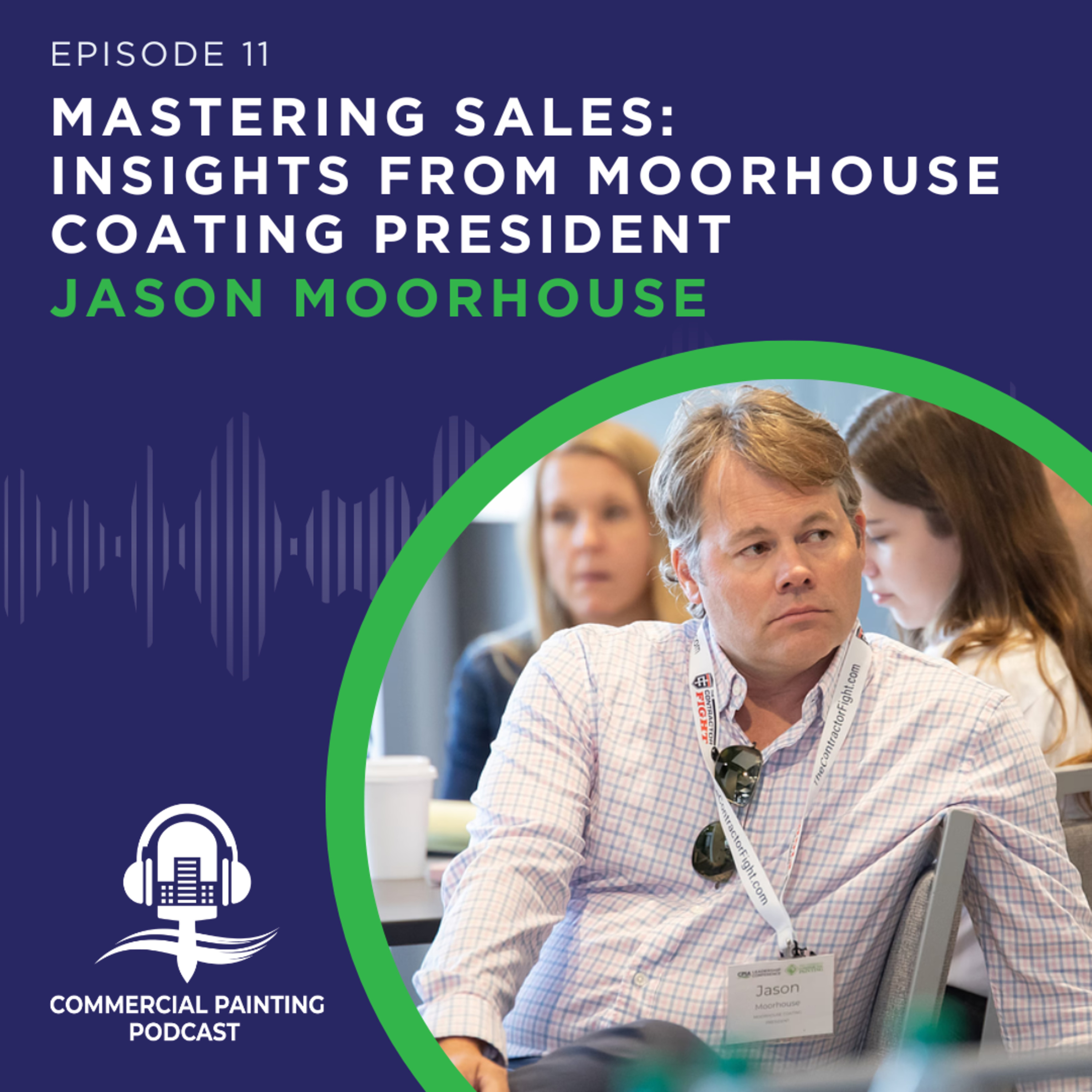
Mastering Sales: Insights from Moorhouse Coating President Jason Moorhouse
from The Commercial Painting Podcast
21m 31s
The discussion centers on sales strategies and business operations in the commercial painting industry, particularly in seasonal markets like Park City. Key themes include the importance of defining product-market fit to guide pricing and sales efforts, with an emphasis on preparation and targeting specific customer segments such as new construction, hospitality, and residential clients. Hiring salespeople should involve performance-based compensation, like commissions, to reward delayed gratification and align incentives with business goals. Daily KPIs, such as outbound activities and customer engagement, are critical for tracking sales effectiveness. The conversation also explores balancing internal training with hiring external sales talent, advocating for a customer-focused approach that builds long-term relationships. Additionally, the challenges of labor and market dynamics in high-cost, seasonal areas are addressed, highlighting the need for proactive planning and tailored marketing to sustain growth.
Yeah, when you hire a salesperson, the first thing that they panic over is what price am I going to charge? Yeah. How am I going to get to this price? And so whether it's a salesperson or an estimator, you have to say, how am I going to get this thing priced out? Yeah. So it's your job as an owner to evaluate what's your product market fit. What are you offering and what is this, you know, vertical, this product figure you're bringing to market? Welcome to the Commercial Painting Podcast. Whether you're a seasoned leader or just getting started with your business, we're here to help you take your organization to the next level. Today's show is brought to you by the Commercial Painting Industry Association, or as you often refer to it on the show, the CPIA, and a David creation. You can find more information about these sponsors and the show notes for this episode. Thank you for joining us for today's show. Our guest today, we got Jason Morehouse from Morehouse Codings. Morehouse Codings, sorry. Yeah. At a park city, Utah. So welcome, Jason. Thank you. Thanks for having me. So I just give us a quick background on a your company where you're out of, you're kind of all over the place sometimes, right? So some of the times, yeah. I'll just give this real quick. So I met Jason at least 12 years ago in Los Angeles visiting a customer out there. And it was, you were really unique. I'm really happy to have you on the show today because you're one of the few painters in the world, probably, that you live in California, but you're right now. Currently, your work is in the state. So yeah, just go ahead. Yeah, I can reflect on that because the marketing that you helped me set up, you know, 12 plus years ago, we're still essentially using it. The thought process, you had really a comprehensive solution and you stepping away from a business and being engaged in it and then, you know, identifying what was considered marketing, what, 2010, 2009, 10, we haven't done much to change that. So, you know, I don't know if you've ever said thank you, but that, that helped. Thank you. And our marketing strategy has changed a little bit. Now, we, you know, we don't wait for the phone to ring. We're going after customers. So park cities is a great market and we'll all get there next year, right? We're all going. Yeah, yeah. So that'll be exciting. We'll be leaning on you. You're going to have to beat Riggly Field though. So I don't know. I mean, what you got something up here, sleep, I hope that's, you have to take deep it. I don't think we can, I don't think we can beat this experience. We'll try. No, we'll do, we'll make it good. I got some ideas. We'll talk soon. So it'll be good. So you talk about high elevation, high energy. I'm sure we'll bring it. Yeah. So I think park cities is one of the greatest places. I think one of the things that always, you know, you said you're, you're not waiting for the phone ring and, you know, it's a built a pretty impressive business and of, you know, relatively small town. I mean, you know, park city, do your value? Yes. It's had a lot of development in the last couple decades, but it still is. I mean, what's the population of park cities? Yeah. So you could debate with tourism, whether there's 30,000 people there, maybe there's 60,000, the numbers have changed so much in the last year. I'm not really sure. Yeah. It's an ideal market to focus on. And when I've looked at painting companies, the most successful companies have been in northern regions. So, you know, like painters in Minnesota, there's like a lot of them. Yeah. But it focuses you the farther north you are in Chicago, how many, how many months out of the year do you have to paint? Outside. Yeah. Yeah. Yeah. Not many. So if you're not on point, like for that six months, you're probably not making money. Yeah. Yeah. And we have the same kind of thing. You know, I live in Montana. You know, I do the similar thing. So it's like big skies, a similar market or Jackson or, you know, there's just, yeah, there's a lot of work there. But I think one of the things that, you know, right off the top of the first thing everybody thinks of when you think of a market like Park City, I mean, it's expensive, right? Aspen, Vale, Big Sky, Jackson. I mean, either places where there is literally no affordable housing. So how do you deal with, I mean, I guess Park City is a little closer to Salt Lake, but where are you getting, you know, if you need 50 man or 100 man to keep your business running, where are you getting that kind of labor? Yeah. And I think the answer to that is just one word prepared. Be prepared. What are we going to do next season? So we focus a lot of business on maintenance. What are we going to do next year? Because by the time you react to somebody calling, you're already too late. Yeah. Well, yeah. Because I mean, again, when we met, you had the Park City division and for a time, you were in multiple markets like, yeah. And then we kind of lost track for, you know, you and I reconnected, but you were back in Park City. In Park City, you're doing at least 10, nine plus a year in a small, very small market, yeah, because of the maintenance. Yeah, I hate to say that out loud, but yeah, that's true. And the reason, the reason you get it all locked up, you won't have anybody come into it. Like I won't find much more in Park City. Absolutely. But I think the word prepared there is, it's really what your marketing is. Are you taking the time to, you know, inform your customers today? And if you could meet that customer ahead of time, by the time they become aware of you, you know, you already have a solution for them. So I think that's probably the best marketing advice that I can give. And tailoring your sales approach to that is really important. Like, you know, if we only have a short window of time, five or six months, you know, even in this market, how prepared are you for 2024? How prepared are you for 2025? Yeah. And if labor's tight, you better be prepared and you better have those things negotiated up front. So where are the people living though? Yes, that's my question. Like, do the people live in the surrounding areas of Park City? Within 45 minutes to an hour. Yeah. Yeah. So Park City is really a ski mountain. That's right. Right. It's a ski destination. So, and we've had this movement of people living at their home, working from their home. And it's just an incredible drive to say, I want to be at house big enough that I can work and play from and I want to enjoy living. And I think that's really what the last two years have been about. It's been people moving into spaces that they can really enjoy and thrive in. So adjusting your marketing, right? Adjusting where's that customer? Who is that customer? Right. Well, I mean, I want to take this conversation. But there's, I mean, we'll probably not be back multiple times because there's so many topics that you can answer. I want to switch gears for a minute because you have a lot to share. But I want to kind of focus this discussion around sales, your sales process. But specifically, I want you to talk to us about your sales. Yes. You and I have talked about that because you're obviously involved now in Chisholm Brothers, which is real life experience and really how do you hire, hire salespeople, which I enjoy the firing maybe more. I know. He's such a nice guy. He doesn't like the firing side. No, I think sales should be pay for performance. I think people should work for a commission. There's a lot of effort that goes into sales. So you want to find people that are rewarded for their delayed gratification. So if we're talking about a main Instagram in 2024, obviously you have to pay well because you've got to have the energy level. You got to bring the drive that says, hey, I'm willing to get paid for some sense of delayed gratification. And in society today, we want it right now. We want, you know, we want to get paid immediately. So we're rewarding the behavior that says, hey, I'm looking for the future and I'm willing to go out and do something. There's really ownership. And so if somebody can bring to the table that they're willing to contribute, then you should pay well. And that should be rewarded. So when, you know, I think that obviously with you know, you being remote and doing, I mean, what are the statistics like what? Okay. So we talk about like pay them commissions fine. Okay. But like if you don't mind me getting a little bit more granular with it in the fact of like, what does is it do, do you do basing in plus commission? Do you draw us against commission? And then, and then is the commission based on just solely dollars brought in? Do you do it off with gross profits? So like they're selling the jobs correctly. I don't know how much whatever you're willing to share. Yeah, no, absolutely. And I would say that we're not a terrific model for how to do that. I think we've a lot of times in business we're doing things that seem to work at the time and then we evolve, right? That's right. And that's where the entertainment comes because if you hire somebody they may not work out and the faster that you say this is not going to work out, the better off you are. But I think straight commission has been around for a long time because it really is the definitive factor. And so whether it's straight or a sliding scale or a base plus, it's all the same thing to me at the end of the day. You are selling an agreement or you're creating some contractual agreement in the future and you should get rewarded for that. The real issue becomes how you train someone to become a salesperson and they understand your systems, your values. And so as soon as you start with that, you need some kind of base commission. You need some, you write some some training level or some, background. And I think just being part of this event, you can talk to other people about what system works for them. We had entertainment yesterday listening to how a new business development person was being paid and everybody said, we're coming to work for you. So the structure has to work and it has to work for your particular market. And I think the product market fit is where people are wrong in hiring a salesperson. They really don't know what product that that company is selling. So if you can identify that, then you can create that vision of what is it that we're trying to have you sell, then you have success. And I have to say when we started, that was really hard. Now we have.
what I call the three by three, we have three different customers, we're selling three different products, so it's really specific to what we're doing. And I think that helps. So, I'll say three. Well, really, I think if somebody was to evaluate their market, it would be three different pools of money. So, we're still really enjoying new construction, which is crazy, but new construction has been on fire from Park City. Yeah. So, that's one pot of money, but do you really want to be working for GCs all the time? Right. Probably not. But that's a third of our business. Another third is the hotel and hospitality industry. We had 600 plus inches of snow. They did pretty well last year. That's a third. Another third is really the business owner similar to ourselves that is interested in living in Park City. They have a single family home or they have a combination of a business. As long as we're selling to those three, then what are the three services to those three products? And so, if any business anywhere in the country can do that and get that product market fit, they're going to be successful and they're going to also be somewhat recession proof coming up soon. Yeah. To a station tune. So, would it be, you know, and like the three services would be like inter-exter maintenance or something like that or depending on, you know, what you're, you know, obviously new construction GC is probably as a little different. Yeah. When you hire a salesperson, the first thing that they panic over is what price am I going to charge? Yeah. And so, whether it's a salesperson or an estimator, you have to say, how am I going to get this thing priced out? Yeah. So, it's your job as an owner to evaluate what's your product market fit? What are you offering and what is this, you know, vertical product that you're bringing to market? Today's episode is brought to you by the Commercial Painting Industry Association, the CPIA, and a David creation, find information about our sponsors and the show notes for this episode. And now, back to our show. I mean, I'm just curious about the KPIs inside. So like, obviously, in order to be able to say like, you're not producing, right? You have to track something, right? Yeah. Because you have to have a benchmark or a bar that they're either above or below. Yeah. So, I mean, is it just, you know, sales dollars, but what other KPIs? So, I'm really looking at daily activity. And we all like this part. Yeah. We all know that it takes work to sell. It's just not answering a Google ad or a Facebook ad or waiting for the phone to ring. But when those things aren't happening, what are the outbound activities you're doing every day? Because we only control today, right? I mean, just watching you live for the last five days is exhausting and I haven't been anything. So you're obviously working. You're an impact member in your community. You're in your business. You're an agent of change, right? Yeah. And so if I was to look at your day, I don't know if I could keep up with you, but it's filled with activity. So, it's really getting those salespeople to think about what are the activities that I'm doing every day and I'm passionate about for that window of time. So, if you put in four or five hours of work doing these things in our company, you're going to be successful. And those are the KPIs. That's just the daylies of, hey, how do I go out and be aggressive in sales today? And nobody's working more than five hours today. I've studied a lot. I may be awake and be operating for 16 hours out of the day and feel like I'm working, but there's only maybe four or five hours that you're engaged. So I'm interested in those five hours where you're in front of people and you're taking daily action. And so for anybody in their business, that's what they should be looking for. Yeah. That's what outside sales is. This is difficult. If not more difficult than putting on paint, right? If there's things that you need to be doing. And then do you assist with, like are you using like a CRM or HubSpot or one of those types of things that tracks like input of the amount of opportunities that they're mining and give you action to track? Yeah. We're not geographically based. We're more customer based. So we want the customer to connect with, you know, who they're doing business with. And for that to be a lifetime value, a long-term relationship. So to me, that's what every sales system should have. It should be customer focus. I think we're a customer focused or customer centered business. You know. So you had an example. You share with me about one of your guys that you'd hired who didn't have a painting background and you'd tell me about how you found him, how you motivated him to sell and how he's doing and he's still with you, I believe. Yeah. And this is the experimental to us because we've basically brought people from the industry. And that's another topic that we could discuss. You know, you find companies, should you really grow your sales staff from within your company as you're growing or should you go outside and find somebody who is a background in sales that you teach something about paint, right? And I think we could debate that. I firmly believe that we would be better off to bring people through our organization and teach them how to sell. Because I think sales is just another skill. But I also think there are sales people that have this natural gift that you probably sell anything. And paint is, it is very difficult to explain, but it can be broken down into simple terms. So I think that's a debate we could have. Yeah, I know. I was going to say I probably don't agree with that. Yeah. I don't think inherent sales people become painters. I think sales is something that is in your name is kind of, it can be trained. But the greats are kind of born that way. You know, like you know, the sales guy, you think back to high school or grade school, like the kids sling in the football pool was probably going to be a sales guy. Yeah. Yeah. And that's what we talked about. Those guys are doing two to three X. Yeah. What's somebody from within? However, when there's a technical challenge where there's something that's specific, they are by defect passing that off to somebody who has a technical background. So that's, you know, and then to then you can have the argument that you go sales estimator, right? So you can promote up to an estimator. And then if you have someone discovering these activities, getting mining everything and then you bring in an estimator or support them, that may be a way that works too. I don't. You're right. It is a blended approach and you should have all of those members on your team. Yeah. You know, yeah. So I think some people listen to this. They have in some traditional painting businesses, the salesperson might prospect estimate and sell a job. Some might go further and run the job. Yeah. Right. So what does it look like in your organization? And this is just new to us where I've really firm believer that sales and production should be separated, right? Because we want people to be able to focus on completing the work and not jumping off the job. You know, and there's this eternal debate between should I have a subcontractor and should I have a W2 employee doing the work? And the answer is at the end of the day, we're building a product, right? We have a service. So the quality that service should be the most important thing in how you get to the quality of that product and what that product looks like should be your priority. In terms of a sales approach, I think we could debate for hours. Sure. Yeah. Yeah. No, and I mean, look, you know what is the answer? Whatever works for you. Yeah. Whatever, but you know, kids have done, you know, so, and I mean, you know, I've, I've obviously like anybody we've had successes and failures along the way. So, well, you've obviously had some success here, right? There's some things you're doing well and there's a product and a market fit that you have. Yeah. And, you know, the more you can share that with your team members and how you do that, I mean, I think there's a, there's a value from internal growth and a value from outside growth. Yeah. Yeah. And we're going to have you back on because we can do some deeper dives on some of your, as you learn too, because you're, did you get a lot of things going on? You got the inside sales, you got outside sales, you got estimator. So we'll do deep dive on that next time. But it's great. Appreciate you being on this call today and or this podcast today. Yeah. And I guess, you know, the only other thing that we're, you know, shamelessly, I just always kind of want to understand like your experience. I think Colorado was your first event with us and, you know, like, from the CPIA. Yeah. And I think you're in David's peer group. So just kind of a general, you know, from the association in general to the events, what your thought is this is likely the best pain event I've ever attended. And I've been a painter for maybe 30 years now in business for 25. I go back to early 2000 for PDCA, thinking about the energy of this event, the conversations, the information, you know, somebody said fire, you know, the younger person's generation say this event's incredible. The peer group, to me, I was only explained two weeks before Colorado Springs on David's recommendation. So a lot of my success there for joining CPIA comes specifically from you. You got us plugged in. I couldn't highly, you know, I couldn't recommend more highly this the peer experience. Yeah. That's new, you know, really new to me, but that is the key to this organization, right? The engagement of the peer group. That's new to me. Thanks. Yeah. And Steve and I would recommend anybody that's interested in a commercial painting experience to get involved in this group. Yeah. If you're up to improvement. Yeah. Thank you. Yeah. No, I believe in that model. And that's why we went the way we went with it from the Gico. And it's, you know, it's a little hard to convince people once, you know, up front. Like I had to twist the arm of a bunch of friends to get it going.
that it's going. People are like, damn it. I wish I would have been doing the sooner. So, well, you're hanging by the IV and, right, I don't know if the secret's out. Yeah. I don't think it's going to be easy to keep it contained. But I just, I can't stress how important a peer group is. If you're not connected to another professional in your market, you know, experiment with thinking about that peer group. Yeah. Yeah. Great. Well, I don't know if you have anything else. David, I think that I mean, we could probably do a four hour part. That's what I mean. I'm so sorry. How do you keep this under 30 minutes? Jason, we just tapped the surface here. So it took all of this long to get you on. We'd be talking about it for a month. So hey, we're going to do this. Yeah. Glad you got to be on today. Thanks, David. Thank you. Yeah. Thank you very much. Thanks for being on. It was great. Lab brings us to the end of another episode of the Commercial Painting Podcast. Thanks for tuning in and creating a part of this conversation. If you enjoyed today's episode, don't forget to hit that subscribe button and consider sharing this episode with somebody who might also enjoy it. We want to hear from you. If you have thoughts, questions, or even suggestions for future topics and guests, please reach out. Let us know. You can find us at commercialpaintingpodcast.com or find our contact information in the show notes for this episode. Well, that's a wrap on this episode. Take care and be sure to tune in next time to the Commercial Painting Podcast.
Podcast Summary
Key Points:
Effective sales and pricing strategies require clear product-market fit and preparation, especially in seasonal markets like painting.
Hiring salespeople should focus on performance-based compensation (e.g., commission) and aligning their activities with daily KPIs and customer engagement.
Business success in niche markets (e.g., Park City) relies on targeting specific customer segments (new construction, hospitality, residential) and proactive maintenance planning.
Sales training and structure should balance internal development with external hiring, emphasizing customer-centric systems and long-term relationships.
Summary:
The discussion centers on sales strategies and business operations in the commercial painting industry, particularly in seasonal markets like Park City. Key themes include the importance of defining product-market fit to guide pricing and sales efforts, with an emphasis on preparation and targeting specific customer segments such as new construction, hospitality, and residential clients. Hiring salespeople should involve performance-based compensation, like commissions, to reward delayed gratification and align incentives with business goals.
Daily KPIs, such as outbound activities and customer engagement, are critical for tracking sales effectiveness. The conversation also explores balancing internal training with hiring external sales talent, advocating for a customer-focused approach that builds long-term relationships. Additionally, the challenges of labor and market dynamics in high-cost, seasonal areas are addressed, highlighting the need for proactive planning and tailored marketing to sustain growth.
FAQs
It's the owner's job to evaluate product-market fit by understanding what they are offering and the specific vertical or product they are bringing to market. This clarity helps in determining appropriate pricing strategies.
Focus on being prepared by planning ahead for the next season, especially through maintenance contracts. This proactive approach helps secure work and labor before demand peaks.
Straight commission or a base-plus-commission model is effective, as it rewards delayed gratification and performance. The structure should align with the market and the specific product being sold.
Evaluate three different customer segments and the corresponding services or products for each. This segmentation helps create a focused sales strategy and can make the business more recession-resistant.
Focus on daily outbound activities and engagement, such as prospecting and customer interactions. Tracking these actions ensures consistent effort and helps measure productivity beyond revenue alone.
There are benefits to both: internal hires understand the technical aspects, while external sales hires often have innate selling skills. A blended approach, with support from estimators, can be effective.
Chat with AI
Loading...
Pro features
Go deeper with this episode
Unlock creator-grade tools that turn any transcript into show notes and subtitle files.
 PodcastTranscript AI