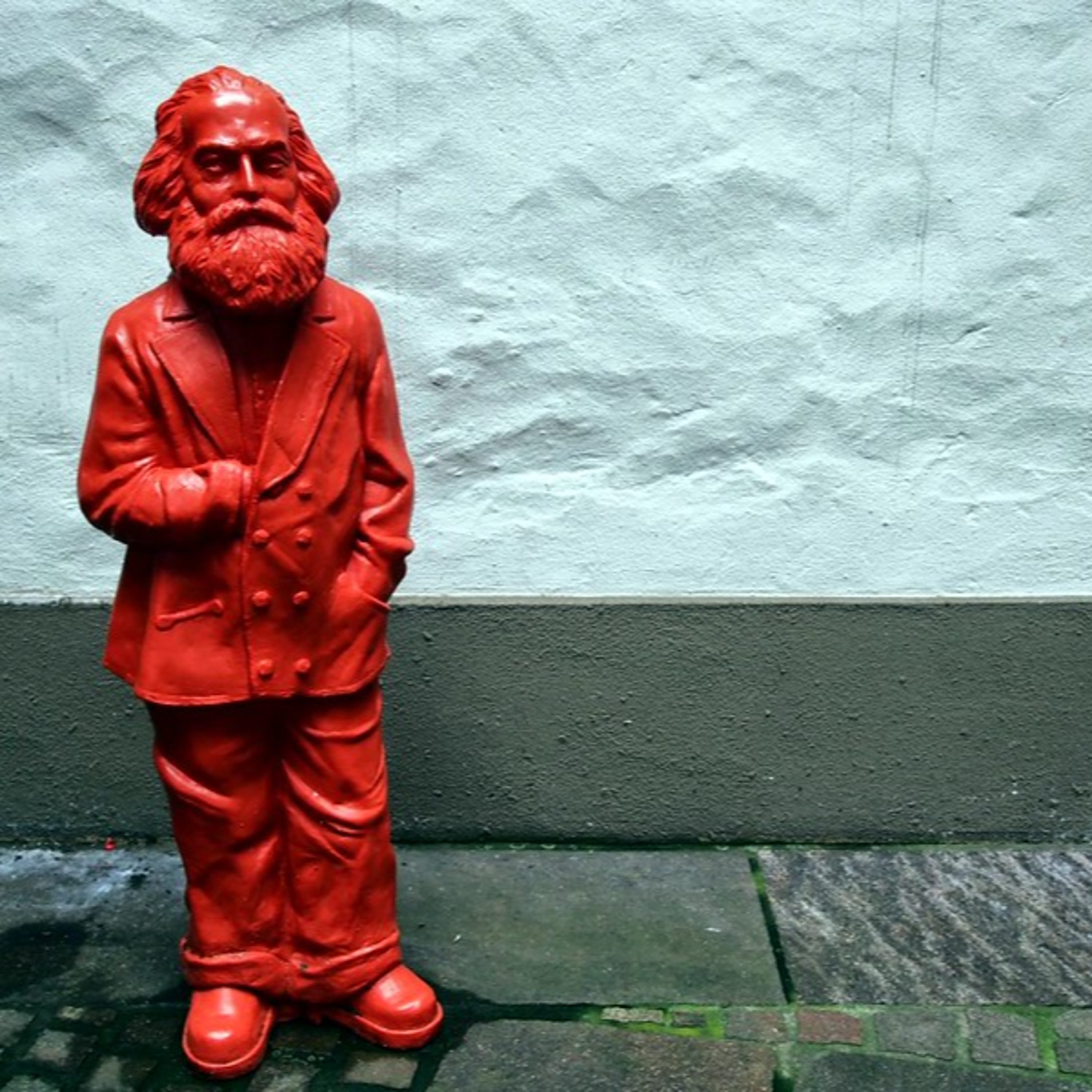
Marx, piece wages & the gig economy: Interview w/ Dr Matthew Cole
44m 46s
Mae'r trafodaeth yn archwilio cysylltiadau rhwng damcaniaeth cyflogau darn Karl Marx ac economi gig fodern. Dywed Marx bod cyflogau darn, er eu bod yn ymddangos yn fanteisiol i weithwyr, yn fodd i ecsbloetio llafur drwy greu cystadleuaeth a gostwng cyflogau cyfartalog. Yn economi gig heddiw, mae platfformau digidol yn gweithredu fel canolwyr tebyg, gan hyrwyddo model 'tâl wrth y dasg' sy'n golygu diffyg diogelwch, amseroedd aros di-dâl, a chyflogau ansefydlog. Mae hyn yn effeithio'n arbennig ar weithwyr mewnfudol sy'n wynebu ecsbloetio ychwanegol. Er bod gweithwyr yn aml yn gwerthfawrogi'r rhith o annibyniaeth a hyblygrwydd, nodir y gallai strwythurau gwaith sefydlog gyfuno hyblygrwydd â diogelwch, ond mae modelau busnes economi gig yn anwybyddu hyn oherwydd pwysau elw. Felly, mae dadansoddiad Marx yn dal yn berthnasol i ddeall dyfnder ecsbloetio a phryderon cyfiawnder mewn economi gig.
Dwi'n gweithio'n gweithio'n gweithio'r gweithio'r gweithio'r gweithio'r gweithio'r gweithio'r gweithio'r gweithio'r gweithio' o eichonomic tachs of all time, capital. For Marks, piece wages are lifetime wages a form of capitalist exploitation of the workers' labour. The difference is that piece wages create a greater sense of individuality and competitiveness among workers. And therefore it was a useful tool to motivate workers to work longer hours, more intensely and to lower the average wage of the workers. Can Marks' critique of piece wages give us insight into the gig economy today? My name's Ben Ray, I'm the coordinator of the gig economy project. And to discuss this, I'm joined by Dr Matthew Cole, who's a lecturer in technology, work and employment at the University of Sussex in the UK. Matt is an associate fellow of the Fair Work project, which examines platform work and the digital futures at Work Research Centre. He's also committed socialist and trade unionists. Matt, welcome to the gig economy project podcast. Thanks for having me. So let me just start by setting the scene for listeners. I published a short piece on Marks and the gig economy a few weeks ago in the gig economy project newsletter. Looking at Marks' chapter in volume one of capital on piece wages. And Matt responded to that on Twitter or X, as we're supposed to call it now, saying that you're working on a book and you've been reading this chapter in the context of that book or that book chapter, I think it was, that you're working on. So I thought it would be a good idea to discuss it since there's someone else in the world who's also reading about Marks and piece wages. So Matt, what is it about what Marks had to say about this of interest to you? I think so for, to take Marks's kind of wage theory, you kind of have to put him in context. And so he's writing in the classical political economy tradition, right? So, you know, this most famously begins with Smith in Ricardo, but there are, you know, many other people that were sort of forgotten in history, like William Petty. And he's sort of writing in response to a lot of these classical political economists. And the classical political economists theory of the wage is basically organized around the cost of reproducing the working class. It's a sort of dignified way of allocating resources, right? And this stands in pretty stark contrast to the contemporary wage theory, or which is largely based around sort of organizing markets, sort of very markets clear. And then there's a sort of equilibrium between supply and demand. And it just doesn't take into account needs at all, right? So he's writing in this in this tradition. And when in capital, when he gets to the chapters on wages, like the chapter on peace wages is quite short, and his basic thesis is basically, like, peace wages aren't all that different from time wages, right? And so just to sort of explain for listeners, you know, the time wage and peace wage are pretty self-explanatory. Time wages are, you get paid X amount according to a specific amount of time. That can be a day, that can be an hour, it can be a week. It varies, it has varied a lot over the past few centuries. But ultimately, you're getting paid a specific amount for the time that you put in. Now, in most of these time wages, there's also a sort of output requirement. And so if you're, you know, if you're kind of lazy about, or you're going slow, or you're soldering, which is a sort of old term to kind of talk about how workers would limit their effort at certain points, depending, you know, to basically just preserve their capacity to work, but also sometimes as a former resistance. If you didn't finish the output, you'd often still only get paid for that day rate or that hourly rate. And then this continues in a lot of contemporary wage jobs, like particularly hospitality work, like hotel workers. If they don't meet their room quota for their hourly shift, they have to work until they finish it. And that, you know, there's a huge source of unpaid labor there. So time wages are, you know, they seem quite straightforward, but actually there's an output component. And so then when we move on to peace wages, he's essentially saying, you know, you get paid per output here, right? And so it sort of appears that this is a better deal for workers initially, but actually it cuts out any possibility of downtime, rest time, breaks, any kind of like prep work to produce the good is often not counted. And you have an ongoing, you know, this kind of contestation between what the boundary is between paid work and unpaid work, whether that's paid time, or whether that's paid for the production of a particular good or a particular service, that contestation continues today. And Marx's basic point in that chapter is that peace wages are actually the sort of optimum for, you know, optimum wage for exploitation. And he kind of gives a lot of different examples of why that is. Yeah, so I think that's a good kind of overview of what Marx has to say about it. I think the reason why I became kind of interested in this is because whenever you listen to, like, platforms, CEOs, they talk about the gig economy as if it's a slight, incredible new invention, you know, it's only been about since the digital age. And, you know, what Marx talks about, not just Marx, I mean, Adam Smith talked about peace wages as well. You know, this form of payment pair, you know, pair out, pair of peace, as it used to be, and now his pair task has been about since before capitalism, but actually really really started to emerge, Marx said at the start of industrial revolution. And he argued there was a lever for reducing wages. Do you think there's any sort of comparison to be had with the emergence of peace wages at the start of the dawn of capitalism and the dawn of the industrial revolution, specifically, and the emergence of peace, of this modern form of peace wages, the gig economy at the start of the digital age, is a comparison to that coincidence. Yeah, I mean, absolutely, like, I mean, there's an article by Stanford, actually that sort of talks about, like, gig work wages and gig work is nothing new, is sort of the re-emergence of gig work is actually more consistent with how wage, the wage system, remuneration, et cetera, was organized in the early days of industrialization. But, like, what's important for Marx, and just understanding the evolution of the wage, is that capitalism, particularly industrial capitalism, is this, and the sort of institutional forms that reinforce it, disrupted custom, right? So, a lot of the commodification of labor, or the fabrication of labor as a commodity, came out of basically trying to change and disrupt what workers took as customary to produce commodities. So, workers, particularly in guilds, they would have essentially prices that were fixed by experience, right? So, that means prices were paid in a standard way, often relating to socially necessary labor time, the labor time that it requires, in all senses, to produce that commodity and nothing more, right? So, like, Marx actually has some examples in capital where he talks about London Taylor's workshops. They would call a waste coat an hour, and the hour was valued at, like, six pennies and one half a shilling, or whatever that means, and, like, you would have this sort of contestation between time wages and peace wages, but employers would sort of put time wages and peace wages next to one another, and pay different groups of workers, different amounts of money, to kind of height and exploitation. And he kind of talks about this, and, like, those, you know, factory reports, you know, because capital is a work of social science, essentially, right? And he talks, specifically, like, in this chapter, he notes that peace wages are the most truthful source of reductions in wages and frauds committed by a capitalist, right? Because they enable the proliferation of middlemen, or what he calls parasites, who, I'm quoting here, interpose themselves between the capitalist and the wage labor. So, the profits from this subletting or sweating of labor, they come exclusively from middlemen, and buying cheap and selling deer, right? And if you think about how platforms work, I mean, platforms sell themselves, essentially, as middlemen, right? They're these sort of, like, inter, you know, they're sort of merchant capitalists in a lot of ways, depending on the model, right? I mean, you have platforms that are just straightforwardly employers, even though they, you know, don't have that legal status. So, the parallels, I think, are pretty obvious when you look at the peace wage and the organization, and it opens up the sort of employment relation to all these little middlemen, and you, when you look at the way the platforms are working, you know, that's their explicit strategy, and a lot of ways is to insert themselves in, and even in, um, gig work, gig workers themselves, like, particularly the, like, delivery, or any, any model that maintains a sort of independent contractor, if you're in the US, or self-employed contractor, if you're in this country, you, you have the ability to, um, sort of give away your work, or like, if you get a job, you can sort of sublet that substitute, right? That principle of substitution is really crucial there, but what you have is a lot of, like, people who essentially rent their account to migrant laborers, and migrant laborers have to earn a wage, because within a market-based society, where you can't produce the things that you need, but they're not legally allowed to, whether they're, you know, here as asylum seekers legally, or they're in some sort of other kind of limbo, and you have a lot of, you know, there's, there's many other kind of examples where, um, migrants are sort of open up to exploitation because of this model, right? Um, another thing I sort of, I want to touch on as well, which is part of, part of a paper I've been kind of writing off and on, uh, over the past year or so, and as feeding into the book, um, there is a kind of, a difference to between the way that Marx talks about peace wages, uh, and the way that they're sort of applied today, because in Marx's time, you didn't have the, like, capitalist subsumption of services, right? You didn't have, like, services were largely interpersonal. They were formal, formalized into these sort of, um, uh, very, uh, large-scale production, um, facilities, and you didn't have, it was essentially, um, domestic labor, like, I have some, some money and I pay out of my money, which is out of revenue for Marx, someone directly to come to my house and clean it or fix my plumbing in their, their independent business, right? This is sort of capitalist relation is a sort of, like, market base or sort of, like, maybe sometimes petty commodity production, right? But the point is that in, when Marx is talking about peace wages and capital, he's very much talking about a physical peace, uh, in the way that, you know, the history of, uh, industrial relations and the evolution of capitalism in the 20th century, it was still mainly, like, manufacturing, goods production and so on, where things have shifted over the past three decades, right? We've had a big, massive deindustrialization, which is a little bit of a misnomer, because it's not, like, industry went away. It's just purport, the proportion of manufacturing and goods and industry in relation to services has decreased because we've had the formal and real subsumption of services and employments mostly driven by services. A lot of economies are also still, you know, service driven as a proportion of GDP, right? So, so there's a lot to take in, but I'm getting to the point, right? So I hope your listeners look to stay with me, right? So we have the platform economy, most platforms are providing services, right? And there's sort of commodified services, you know, X as a service model, right, is the sort of driving force. But the issue with services and a peace rate system is a bit of a problem, uh, even more so than Marx could have anticipated, because especially with on-demand services, you can't control the rate of your peace production, right? So if I'm in a factory and I'm, you know, making, say, car grease and I have to put, you know, a certain amount of grease in the can and put the cat lid on the can and then push it down the line or, um, or if it was more intensive production, you know, something like a, you know, wooden chair or, you know, like if I was paid by the, the finished product, the paid by the finish, I kind of adjust my rate because, um, no one is essentially, I don't have to wait for anyone to order it. It's part of the production process, right? The orders are handled by the, you know, managed according to the needs of the company, right? That's not the case in platform, in most, uh, digital labor platforms, because it's a service and it's an on-demand consumer driven service. So essentially you're, you're tasked in your time and therefore your wage is dictated by the immediate demand of customers. And particularly when like platforms like Deliveroo have a model where they don't limit the number of potential careers and they don't put any controls on because then they would turn into employer. You have, it creates a situation where workers can't control the number of pieces they produce and therefore they can't rely on a steady wage and it's highly precarious and exploitative in addition to all of the other issues like not being paid for wait time and all of different kinds of wage theft. And I want to get to the point about the, the kind of what Mark says about the independence of the worker and the extent to which they are independent. Because I think it's quite interesting to compare what Mark says to how, when I, certainly when I speak to a lot of egg workers, they talk about, they want to be their own boss, they want flexibility, but their actual experience of work isn't always, isn't always that. But the, the, the peace worker compared to the time wage worker has this feeling that, or illusion that they have more independence. So he says, the wider the scope that peace wage gives to individuality tends to develop on the one hand that individuality and whether the sense of liberty, independence and self control of the labourers and another, the competition with one another. Peace work has therefore a tendency where we're raising individual wages above the average to lower this average itself. So, so there's this competitive dynamic of peace workers more than time wage workers are, they're kind of pushed against each other, they believe that if they're the most efficient, they'll earn more money. Even though Mark's argues, as you've already mentioned, in reality their pay is determined by what the capitalist is willing to, to give them a pair of peace, it's not determined by their output. How do you think that that's relevant to the debates about flexibility in the gay economy, you know, the extent to which independence is something that is an illusion and the psychology that peace workers have about being independent or not? Yeah, I think it's, I mean, this is, the psychological trick is, is performed in many different contexts. I mean, speaking of someone who used to live in the United States, the idea of freedom of individual choice is sort of paramount to the point of driving people into kind of sociopathic, like orientations towards one another and like a kind of rejection of structures that actually can ensure that everybody can have dignified and stable life. And so when, you know, when I talk to a lot of gig workers as well, I mean, they're, what they, what they want are sort of sometimes contradictory things, like they do what they, they all, they all say they love the flexibility, right? And they all say they like having being their own boss and all of these sort of things. But they don't sort of consider that you could have flexibility and you can have stability as well. If the platform adopted an organizational managerial strategy that prioritized those two things, you have, you have some platforms like just eat that tried to do this sort of model. And most of the workers that I spoke to with that, some, you know, the stability and the, the wage was, was very like beneficial to them. But the way, I think the way that the industry is set up because of this demand to pull kind of service provision, it makes it difficult in, in terms of profitability. And because of how leveraged a lot of these companies are, where you have, you know, a huge amount of venture capital, you have a huge amount of other kinds of investors that want a very, very high return. They've sort of created a situation where it's almost impossible for them to sustain themselves and pay their workers and provide, you know, a kind of decent living. I don't, I think there are plenty of solutions. And when you have situations like with Uber in the UK, where they're forced to guarantee a kind of wage floor, even though they don't pay for wait time in between jobs, you know, Uber is still doing find in London, you know, I mean, I've not looked at the recent accounts, but, you know, the, the strategy of expand as rapid as possible at all costs is, is a distinct, you know, is a particular choice to these companies, right? And so they want to sell this idea of freedom to workers so that they're not accountable to them so that, you know, oh, we, we, the workers just sells the labor in an open market as if they're an independent business. But they're obviously not because they can't, you know, start their own network and they, you know, start their own platform and all this sort of thing. So the platform has, platform successfully sort of sell this lie to workers without, who aren't given the, the tools to consider that they can have freedom and stability together. These are not contradictory things. In fact, in most industries, having a stable job and an, and an income in limited hours and is the sort of condition of possibility of freedom because then you're not precarious and you're not, you know, you can actually start to play on your life, right? Yeah, I mean, I'll stop there. Just the final point on this. You already touched on it briefly about the, the migrant aspect. So, so in that chapter, Mark says in the same salary shops of London, often for the same work, peace wages are paid to the French, time wages to the English. Now, as you and I both know well, the, the gig economy is primarily made up of migrants. What is it about peace wages, about gig work, which has this kind of visualized aspect to it, which seems like it's, it's usually work for that migrants end up doing? I mean, I think the, the racialized element has a long history in terms of like vertical and horizontal segregation of the labor market. So even before the gig economy, migrants and, you know, largely like people of color were doing jobs typically that white workers didn't want to do or white workers would, and residents and, you know, people, middle class or, or otherwise would have access to upward mobility and, you know, education, and, you know, social and actual economic capital so that they didn't have to do these jobs, and, you know, collective bargaining, right? So there's a kind of long tail to this, but then when you have the introduction of, you know, digital revolution and ICT technologies and the pervasive myth of mobile phones, the transaction costs, or in other words, the costs of businesses to find people and hire them as well as the costs of onboarding people and getting them to do the jobs are drastically reduced, especially when you can institute this sort of self-employed model pay by the piece, because then you have very little, there's no mutual obligation there at all. It's, you know, agreed to terms and conditions, fire up the app and go. So the low barriers to entry and, is particularly appealing if you're a migrant and you don't have any networks and you need money because, you know, if you're new to a city or new to places, you often don't have the networks to help you get things in non-market ways. And so you're actually, you're having to work sometimes a lot harder. You're in precarious jobs and you're working all the time for a little wage, so that reduces the time outside of work that you could spend on, you know, improving your human capital. I hate that word, but, you know, doing training and so on. You know, add to the fact that in Britain, you've essentially lost that there's the free education that, and further educate, and low costs for the education and qualifications that used to be available are now out of reach for a lot of migrants and anyone on a low wage. So you get stuck in this cycle of, you know, working 10 different kinds of gig jobs, just to sort of scrape by, and now we're in the cost of living crisis. So it's just getting much worse. Okay, let's move on to some of your work. You've written a lot about wage 5th, including in the context of the platform economy. How do you define wage 5th, first of all? And is it more prevalent in the platform economy, wage 5th and then in the economy as a whole? Well, I think, well, to define wage theft, I just, I define wage theft kind of in a continuum. So the formal definition of wage theft is unlawful deductions of wages, and that, you know, that hinges on different national contexts. So an unlawful deduction in the US might be slightly different than an unlawful deduction here. And also the, what counts as a lawful deduction is sort of oriented or enclosed within the category of employee, which is a legal status, or dependent contractor or limby worker, which is another status. It's like halfway between employee and self-employed contractor. And so you have these three different statuses. If an employee, you have many more rights, and you can raise a dispute with your employer, grievance, if there is, you know, if they're paying you below the minimum wage, or if they're not paying for you for all your wages, or if they're, like, time-shaving, or they're not paying you over time, all of these can fall, you know, these are sort of legal definitions of wage theft. And you also have that right, I believe, if you're in that sort of middle status, but with the, with the gig economy, most platforms use self-employed contractor status for their workers. So you have, essentially, no right to make wage theft claims. You don't even have the right to a minimum wage. So yes, I mean, in the kind of broadest sense, the gig economy is essentially designed for wage theft. But in a legal sense, it's not wage theft at all. So, but yeah, I mean, I consider wage theft in the long, the continuum of unpaid labor. So part of the, what I'm doing with the book is theorizing the relation between the concept of unpaid labor and wage theft, and essentially, the struggle between capital and labor is about where the boundary is between the paid and unpaid part of the working day. And wait, I consider workers that essentially have the right to collective property of anything that they mix their labor with. Right. So in the sort of Marxist, like very broadest Marxist sense, you know, all unpaid labor is sort of is wage theft. I guess if I was a platform CEO, right, what I may respond to what you're saying is, with platforms, everything goes for a digital transaction, right. So if I'm a fiddle of a career, I get a specific task when I complete that task, I get paid digitally. Whereas if you work in hospitality, I guess it'll all of its cash in hand, or if you work in the black market, it's definitely cash in hand. So platforms CEOs may argue that we are actually, especially if you take something like domestic care or domestic cleaning, there we're formalizing these sectors and actually reducing the chances for wage theft and that sort of thing. What would be your response to that argument? So that's actually, I would actually agree with that in low middle income countries or like developing world countries. That's true. In a lot of cases, there's been positive developments where they you can actually bring, like, it has benefited informal workers in a lot of ways because once you have that sort of formal payment structure and that formalization and that record that also helps with like credit agencies or like, you know, there's whole, there's a whole other economy of payment platforms that you can sign up to if you're a gig worker to show your income. And so I think there are benefits to that formalization because cash in hand, you know, there it can work if you're trying to avoid the tax man. It can work if you're there's a relationship of trust, but there's very little record of that. And it does particularly if you're a migrant, put you at a lot of risk of non-payment and exploitation. So I would actually, I would agree with that. But my, the main issue I think in the geification of work or platformization of more traditional work tends to be in Europe or in like rich countries where you have established, like, sectoral collective bargaining or established, like wage, worker protections that are being undermined by the sort of peace rate and the sort of contractual status of gig workers. Yeah, and I think one of what I think that is, if you are a domestic cleaner, you know, a home care worker on a platform, often if you want to get that five-star rating, you end up doing things that you weren't officially, you weren't supposed to do or work an extra hour and that sort of things. There's, there's subtle forms of pressure to force people to do work beyond the, you know, what they can contractually obliged to do. Let's move on to your, I'm really interested in paper you published in a journal called Antipode last year. And it's about how we should fear a technological change. Now in this, the paper is not just about digital labour platforms, right? It's not just about Uber, it's also about Google and Apple and Facebook and so forth. And somebody who has said that these platforms are actually not very distinct to the corporations that are dominated in the industrial year, but you argue in the paper that this platformisation represents infrastructure discontinuity because it has a distinct government logic which contrasts with the previous year of capitalism. Can you explain the kind of technological and economic context from which platform capitalism has emerged? And what's distinctive about platforms to older forms of infrastructure and capitalistic elements? Yeah, thanks. So in this paper I was, I was trying to work through this sort of debate where you have on one side people saying everything has changed, nothing will be the same, we're in a completely different era. There are some people that take this so far as they say that we're in like a techno futileist era. And then on the other side those people that say, well, actually nothing much has changed, platforms don't really represent much of the labour market because they're only talking about digital labour platforms rather than the broader platform context. And I found both of these positions inadequate because if you look around us and if you're my age and you remember before we had, you know, mobile data, certification of virtually everything, the world looked different and so did the organisation of labour and the organisation of business and capacity, particularly with relation to like services and how much data could be collected and used. So I was trying to think through this and I sort of started by looking at like where and when the particular technologies that form the platform economy sort of came into the mainstream and like we're essentially invented or disseminated in their modern form and most of them came like cloud computing and another things and services, blockchain, data, big data, machine learning AI which depends on big data and all these other sorts of technologies. And also the sort of IPv6 network infrastructure which now which like essentially expands the capacity of the internet to virtually anything. All these sort of emerged from about 2005 to 2015, 2017. And then when you look at the investment in ICT technologies, you have this sort of massive increase and then you look at patent production, you have massive increase, all the same era and all this and then you look at like speed and intensity and dissemination of all these technologies. It also sort of all happened in this 10 10 year era. So what I try to do then is think about like, you know, how we've thought about ICT tech in the late 70s, 80s and 90s is I think different than the way the platforms are operating now in this sort of capacity. You know, like we have like, you know, Manuel Castellas rise in the network society which is like, you know, one of the key techs for, you know, pre 2000 theories of the network. And the network kind of emerged in this sort of post-fortist era like globalized production enabled the sort of production networks to expand in all kinds of different sort of supplier relationships. But it wasn't organized in a way that you could have one sort of central node dictate the rules for anyone that connected into that node. So I sort of differentiate the network from the platform. The network is that sort of more dispersed kind of internet 1.0 like Wild West or like kind of situation. And then the platform is the sort of kind of real subsumption of the internet, right, where you get control and collection of data by this AI and delegates the rules of engagement. So it's kind of like you're plugging in to an electricity network. And the platform is this sort of electricity company, but they control everything, right, rather than, you know, different suppliers, right. You use this sort of autocratic design enables like huge networks of effects and the siloing of data and so on. And so platforms this sort of difference between the network and the platform can be reflected in this sort of platformization of infrastructures and then the becoming sort of infrastructural platforms. So you kind of have another element of discontinuity between this sort of traditional infrastructure and platform infrastructure because you have platforms as essentially and in non-democratic privatized form of service provision, right. I mean, like in this country, unfortunately, you have water companies, you know, you have a natural monopoly and you have a private corporation like organizing that. There's no accountability to the public and as we have shit in all the rivers and in the sea, right. You have in the US, Elon Musk's like SpaceX satellite network essentially being able to bargain with the US government to access capacity in the Ukraine, because he's created a platform with no public accountability that has all the capacity in the data. Right. And so I'm trying to essentially mark a break between when we had at least the ruse of a sort of social democratic public governance and, you know, even capitalist competition. And contrast that with the sort of platform era where you have platform infrastructure, you have these sort of AI data-driven, like international companies that provide this sort of, you know, everything for like, like Google's like, transport mapping and business directory, infrastructure, meta, you know, Instagram is like an advertising infrastructure, and you even have supernatural BC infrastructures with these meta platforms like soft bank or, you know, and you have, like, international financial infrastructures, even the European investment fund like mimicking these platform forms. Right. So I think it's sort of really important that we recognize that there are differences in, you know, the platform and platforms, digital platforms, they're not just delivery and gig economy companies, right. These are quite a small proportion of what platforms are and how platforms are reshaping, you know, the political economy of everyday life and the governance of our society. Okay, let's finish up on UK politics. I know you're quite engaged with what's going on in UK. A couple of weeks ago, the times revealed that Labour's abandoning is new policy, only to cut this policy a couple of years ago of creating a single worker status. Now, you've already explained in this podcast, the three different statuses, limbie being the position between employee and self-employed. Why is Labour doing this and what does it mean for workers in the gig economy? So I don't know if I can galaxy brain my way up to why Labour is doing this. For that, I would have to be in Keir Starmer's head and I don't know if I want to do that. But I mean, if I were to speculate, he's essentially just trying to get the Tory vote and to not be tied down to any particular policy that would expose him to accusations from the Murdoch press of, you know, anything related to Corbyn, any kind of social transformation, anything that you know, could make him look like he's not, you know, Tory with a red tie. That's sort of standard blarist, politicking and strategy. Maybe it'll work because the Tory party is so unpopular and has absolutely decimated the country that I think, you know, literally anyone leading a Labour party could win. I think it's an obvious mistake for all workers because the new deal for working people document was, you know, that was essentially part of Lord Hendey's Staffs of Workersville, John Hendey, right? And that passed House of Lords and it probably would have passed Parliament if it wasn't, you know, for a rogue or whatever. This had widespread support. Yeah, like I've talked to Damian Collins who's a Tory MP. He supports the sort of simplification of worker status or employee status, right, to get rid of the precarious, you know, fake self-employment contracts, right? But there's only like, I think two other countries in Europe that have a third status. I don't see a strong argument for it. Like, you can have flexibility and still be an employer, employment, unemployment contract. You know, there's other options of, you know, offering genuine self-employment, you know, like taxi black cab drivers are genuinely self-employed, but they have absolute autonomy over their time and they have, you know, it's very strictly regulated. You have to pass, you know, the knowledge, you have to, you know, there's collective bargaining and representation with TFL. Uber drivers don't have any of that. So they would have like TFL and well, at least in London, right? There needs to be a national sort of collective reorganization of taxi and private higher cabs at a policy level. I don't think retaining worker status benefits anyone really. And if you just look at other European countries that don't have this third status that get long just fine, Uber is in those countries. Okay, Matt, thanks very much for joining the podcast. Yeah, thanks, sir. If you enjoyed listening to this podcast, you can subscribe for all of the gig economy projects podcast on anchor. You can also access all of our content on the Brave New Europe website and you can subscribe to our weekly newsletter. BraveNewEurope.com/GIGEEcorimateProject. Thanks for listening.
Podcast Summary
Key Points:
Mae cyflogau darn yn cael eu hystyried gan Marx fel ffordd o ecsbloetio gweithwyr, gan greu ymdeimlad o unigoledd a chystadleuaeth er mwyn hyrwyddo oriau gwaith hirach a llai o gyflogau.
Mae economi gig fodern yn adlewyrchu cyflogau darn hanesyddol, gyda llafur platfformau yn gweithredu fel canolwyr sy'n dyfnhau ecsbloetio, yn enwedig i weithwyr mewnfudol.
Mae'r rhith o annibyniaeth a hyblygrwydd yn economi'r gig yn guddio diffyg diogelwch a rheolaeth, gan amharu ar allu gweithwyr i gael cyflog sefydlog a gwaith teg.
Summary:
Mae'r trafodaeth yn archwilio cysylltiadau rhwng damcaniaeth cyflogau darn Karl Marx ac economi gig fodern. Dywed Marx bod cyflogau darn, er eu bod yn ymddangos yn fanteisiol i weithwyr, yn fodd i ecsbloetio llafur drwy greu cystadleuaeth a gostwng cyflogau cyfartalog. Yn economi gig heddiw, mae platfformau digidol yn gweithredu fel canolwyr tebyg, gan hyrwyddo model 'tâl wrth y dasg' sy'n golygu diffyg diogelwch, amseroedd aros di-dâl, a chyflogau ansefydlog.
Mae hyn yn effeithio'n arbennig ar weithwyr mewnfudol sy'n wynebu ecsbloetio ychwanegol. Er bod gweithwyr yn aml yn gwerthfawrogi'r rhith o annibyniaeth a hyblygrwydd, nodir y gallai strwythurau gwaith sefydlog gyfuno hyblygrwydd â diogelwch, ond mae modelau busnes economi gig yn anwybyddu hyn oherwydd pwysau elw. Felly, mae dadansoddiad Marx yn dal yn berthnasol i ddeall dyfnder ecsbloetio a phryderon cyfiawnder mewn economi gig.
Chat with AI
Loading...
Pro features
Go deeper with this episode
Unlock creator-grade tools that turn any transcript into show notes and subtitle files.
 PodcastTranscript AI