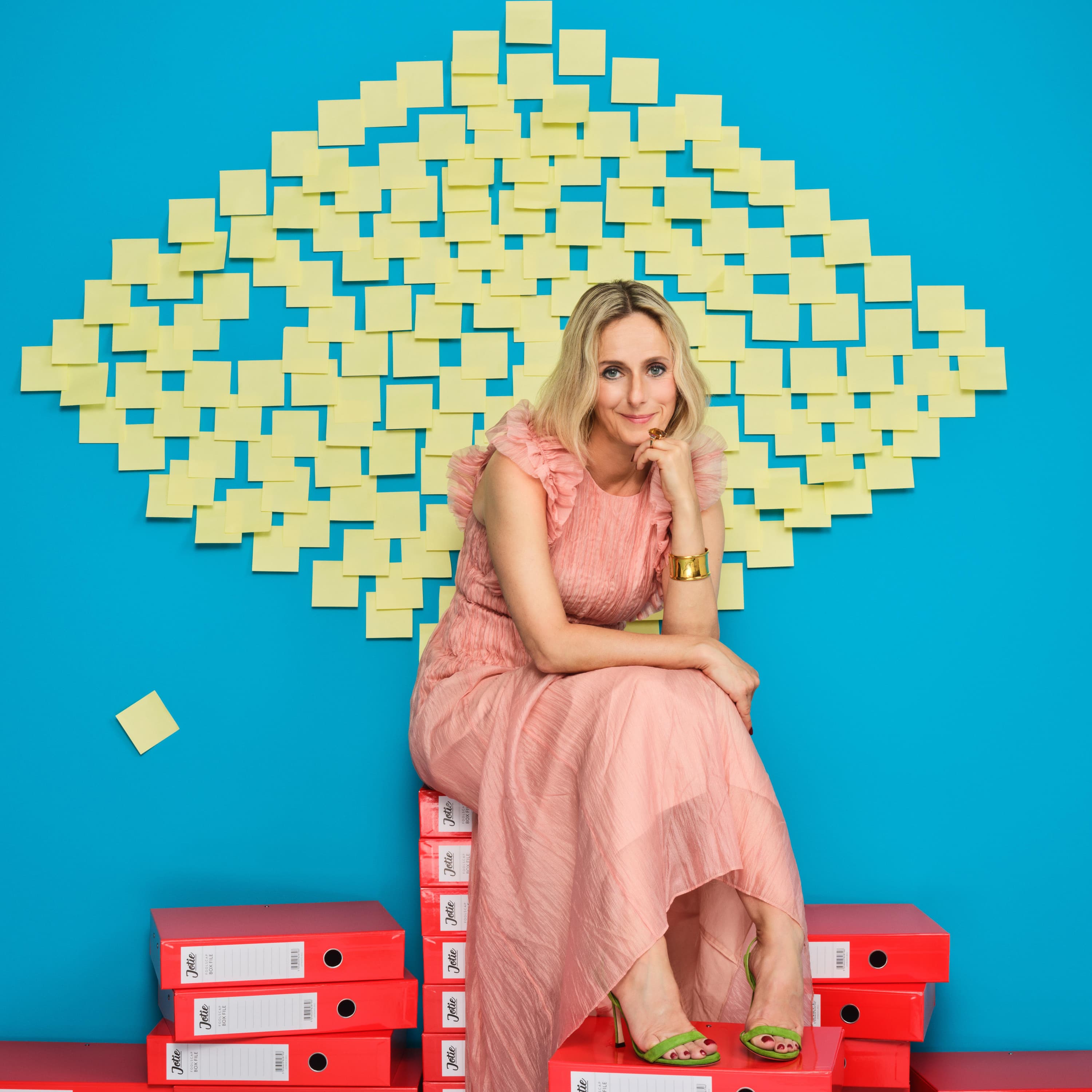
This is the Guardian.
Today, a wild ride through the mind of Rina Hyde.
I won't make a song and dance about it, so let's just get straight to the conversation.
We're talking to Rina Hyde, a staff for the Guardian and winner of many, many awards for her columns,
which are more original, much smarter, and far funnier than political writing deserves to be.
How do you stay sane writing about a world that isn't?
From the Guardian, I'm Noshinik Baal, to Dane Focus,
Rina Hyde, on what a time to be alive.
Rina Hyde, welcome to Dane Focus. Now, I don't think anyone really needs an introduction,
but you have been, guess, documenting the life in times we live in.
Three times a week for the Guardian for 25 plus years.
Oh my god, it's almost half my life. It's a long time.
I don't want to bury the lead, but you are leaving us, and so we'll come onto that,
but you've had an incredible run, and you've got this new book,
which is a collection of your columns over the last three years.
It's the last four years.
Yeah, four prime ministers.
In four years? Well, yeah, naturally.
It's the UK.
It's just a content mill. We live in a content mill.
Well, let's talk about that then a bit. I'm going to start not at home.
Let's start abroad with the year in Trump, the traffic generator in chief.
What have you most enjoyed or been most appalled by Trump term two?
Well, I mean, there's a lot to be appalled by, isn't that?
In terms of what have I most enjoyed, the least malevolent things,
although they are quite malevolent, I have enjoyed the series of kind of home
improvements to Washington, DC. I am obsessed with the ballroom.
The New York Times got some pictures of the ballroom,
and it's like you'd given an AI prompt of something,
the ballroom designs, but they hadn't ever been to a ballroom.
So they've got all these steps, but then there's no door.
I don't know if they've changed those plans, but all the
lose, I think, were down the side of the inside of the ballroom.
I'm obsessed with the poor guy, needless to say, is a Trump donor,
who Trump got to do the Lincoln reflecting pool.
He's found the one pool guy that no one's wife would want to fuck.
I'm obsessed. And then when all the water went wrong, and the guy was saying,
the people who'd done it had never done a pool before,
or they were saying, "But this is the same kind of water that would be in like a lake,
or in a river, or. " I was like, you know, I believe it's H2O.
You're just, you're naming a compound now.
I've enjoyed that. I mean, it was quite a thing having a UFC fight
on the White House lawn. It's the fripperies of Trump, then, really.
Well, you know, I prefer it when he does that than, like,
annexes a country, or, you know, allegedly behaves in corrupt fashion.
When it comes to Trump's base, one of the issues that really
has turned them against him is his wars. You know, Trump on the international
international stage, promising no more forever wars.
And yet, here we are. I mean, can you even count how many?
Any interventions? Yeah, it's really odd that
it is strange, but then I always felt that his relationship with the base is so odd,
because even during the last presidency, during COVID, you know,
there was a bit where, you know, they're conspiracists about everything.
And they believe that, you know, the state and the man is lying to them
and all of these things. And it's like, "No, but this guy, your guy,
really is lying to you." And he is involved with all these things.
And yet, they just, the one conspiracy in some ways.
And, you know, he is, as we can see,
personally enriching himself in completely unprecedented ways
from the office of the presidency. And yet, for so long,
it just wasn't sort of acknowledged or seen. I mean,
some people will just remain die-hard,
Trump is no matter what he does. And I find that sort of fascinating
from a human behaviour point of view.
I think, increasing the way to survive the news is to say things like,
"I find it fascinating from a human behaviour point of view."
Like a firewall against actually thinking, "My God, I mean, what are we living through?"
How do you think Mago and Morphe without him then?
And, you know, do you think JD Vance is a credible follow-up?
Oh my God, he's like the worst replace.
It's not like getting Nigella into Bake-Off, is it?
No, it is not like he, there's nobody like him.
There's something absolutely extraordinary about Trump.
And, you know, you have to take your hat off to it
in a sort of, you know, wearing your hazmat gloves
because there's no, he totally sort of understands
something intrinsic about showbeers and spectacle.
And, he is a kind of extraordinary figure.
You can't feel that way about JD Vance, not at all.
Not all, like Hegseth, I mean, come on.
But these are just complete third-level henchmen.
You write about the villains a lot in terms of Vic Tech, you know,
you're very good on mask, Mark Zuckerberg, Jeff Bezos, Sam Altman.
What is it about those characters that fascinates you so much?
Well, it's interesting, the tech guys for so long
were written about and interviewed for so many years
as though they were these kind of adorable inventors.
Or there was something eccentric about them.
They were weird, they were sort of amazing.
And, you know, it's inheriting the earth.
Yeah, there were points where, you know, I think some of the stuff
that Elon Musk has done is maybe a net gain.
Well, you're thinking, oh, he obviously has a lot of drawbacks,
but he's like a net gain for humanity.
I've passed that point now.
Right. But there were times back there.
And there were, can you remind us of a few of those net gains for humanity?
It's very hard. I think, you know, I think sort of trying to make electric vehicles
a whole, you forget how advanced he was on all those sorts of things.
I don't care about the Mars commune.
I know, I desperately want him to go and live on it.
And feel free not to come back.
But, yeah, all of those guys for a long time
were written about like they were not as though they were politicians.
And actually, what's become clear over the last few years
is that they're far superior to politicians.
Politicians are sort of like junior personnel to these guys.
They're sort of front of house type people.
And actually, these people are so,
they're as powerful as nation states.
These huge firms and they're sort of completely unregulated.
And so, yeah, it's much better to write about them, I think,
as villains than to do what, for a long time,
they were just treated as kind of slightly fascinating kind of creators.
One thing I always wanted to do, although I can't drive,
so I realised it would be complete points.
I always wanted to go and write about Silicon Valley.
And I read this really interesting article
with a long time ago now, but saying how all the tech groups
sent their children to this Steiner School in the valley.
And there's one, and they all like knit their own textbooks.
And obviously nobody sees a screen forever,
because crack dealers don't use their own product, right?
I really thought it would be so fun to cover them
as a sort of social class and to almost write about them
as a society columnist about them.
But I can't drive, and I think it's kind of crucial out there.
Driverless cars out there, big things.
Well now they've finally invented them.
They just want to keep you on their platforms longer.
Marina, we've just had another wave of AI workers
binning their own industry.
She kind of wondered, like, could have maybe
thought about this a bit earlier before you joined in.
They claim it could end humanity
if the industry doesn't slow down.
How do you feel about the imminent AI of popularly humanity?
I'm very relaxed about it, Nishin.
I am very relaxed about it.
I've seen it, see, you take it.
I try to take it seriously,
but I mean obviously there are masses of benefits
for this technology, and I'm excited for the diagnostic stuff.
And it seems that actually I read something yesterday saying
that actually lots of, it's creating more jobs at the moment.
I feel that will, that will, yeah, no, I know.
Just because it hasn't happened in the last two months,
doesn't mean that long time.
It has come down.
Yeah, well, I mean, I feel like everyone does about it.
You know, there's nothing they can do about it
that it's possibly coming for them.
But they just do want to spend quite a lot of time on it
saying why won't this guy text me back?
That's why it's so hot this summer.
It's just people saying why won't you call me?
What do you want to do?
Yeah, you can just call me a response.
We need to take things slightly closer to home,
although obviously the apocalypse comes for us all.
How many Prime Ministers were you able to capture this time around in the book
and which has been your favourite party leader to watch?
Oh my God, there were three Prime Ministers.
I could tell you the second I sent off, you know,
the introduction to the book that it was absolutely guaranteed
that I'd be rewriting it because there would be four.
So there's four Prime Ministers in the book.
The best one, what was the best one of those to cover?
I mean, Liz trust brands so briefly, but what a comment!
So that was fun. I mean, they all had sort of hilarious points at different times.
And I've. I mean, the soon after collection in the rain, the announcement of the election in the rain,
all of them had their highs and lows. I mean, did they have any highs? We'll see.
But I don't know, the constant change of personnel has been, you know, I always say very good for business.
I don't mean by that for business, but I do mean for my business.
And I think that's the worst.
I think historians will judge that to have been the main thing.
I mean, I was going to ask you a question about Starmer.
And yet, I can't believe it feels almost irrelevant to do so, but I feel we should. Something happened. God, can I say this? I went to a restaurant on Monday.
And God, I don't know if I should say this. I'm not going to say which restaurant.
I went to a restaurant on Monday and I got this amazing corner table, me and my husband, it was his birthday.
And I was like, wow, we're in the absolutely apex table here.
And then this guy comes in and there's a table that is genuinely, the kitchen door is flapping this way.
And I was like, they've not actually put a star in that seat.
Yeah. He's not only at the table that's the worst table, but the seat was like, the door is flapping like this.
And I just thought, Jesus, and I was like a mess at all.
Was he sit for a minute or so? It's weeks ago. It was brutal.
It was like watching something brutal happen in kind of 1980s Hollywood.
And I just thought, oh my God, I mean, that is showbiz.
That's deeply, deeply unrelaxing.
Yeah. I had a clear eye line to this. The whole night was mesmerising.
You don't seem, correct me if I'm wrong.
You don't seem particularly energised by Berna Mania.
It's like he can't futter his eyelashes enough for you to be convinced by the energy that he's bought.
I have to deal in realities. And I think you just, you know, you can't fight the fundamentals.
So it's, you know, people, this is the problem is that no one has really worked out how to be a good prime minister in a time of no money.
And, you know, if they could just do that, then lots of these guys, and maybe some ladies, could be excellent too.
But I fundamentally think he faces too many difficulties to overcome it with the sort of things he's suggesting.
I think you just need to do enormous things.
But three years quite hard to do enormous, enormous things.
Yeah. So yeah, that's why I failed to sort of, but listen, all the best, all the best to all prime ministers of all parties.
You were asked by Guardian readers about who you'd pick as prime minister and tongue maybe somewhat in cheek.
But you did pick JK Rowling, can I ask on?
Well, you know, I originally put corner story from heated rivalry because he's so amazing in the sex scenes in that.
And then I just thought like, come on, can you be, you know, so I thought I would, in fact, choose somebody who I think is strategic and principle and brave.
But I do think kind of would make an incredible deputy.
No more further elaboration on.
Yeah, no, I don't, I don't feel like I need to like just get into a whole thing.
But yeah, so, but I had, I've, yeah, I mean, kind of would be good, but anyway, I've done I've chosen now.
I mean, you went for a drink with Nigel Fryer in 2013 and wrote it up for the Guardian, which is a highly recommended treat.
If you went for a drink with him now, what would you ask him?
I couldn't do it now. I mean, they made me do that.
I can't remember why I can't, I remember writing a column of that like, you know, he's the sort of person that people want to go for a drink with.
And that's his hindsight selling.
Yeah, he's going to have a long time, you know, it's kind of a crass and boring thing that people say about politicians.
And then I think the features desk said, will you go for a drink with him?
And I was like, really? I don't know.
I don't know.
I was on the thesis all the day at the time.
Okay.
It wasn't me. It wasn't me.
I can't remember who it was.
And I said, okay, fine. I will go for a drink with him.
So then I actually ended up doing it.
Yeah. No, I don't think.
Even for the journalistic exercise.
I should always go for and do all these things with people.
People are very odd about, you know, you shouldn't speak to any of these people.
The great thing about being a journalist is that you should speak to absolutely everybody.
And that there should be, you know, but actually one of the questions that I don't think I had time to answer from the readers was, you know,
like, who would you invite to your dinner party?
And it would have to be for me.
Like, why would I not have like Trump and Putin?
Because you want the market leaders, right?
You know, just saying, oh, you know, I'd like to have Mary and Margly, although I don't think anyone wants her now after recent events.
But, you know, saying all that is like, no, I kind of feel like you want to have the kind of monsters of the age in some way.
And you want to kind of get close to them and how would you get word in edgeways?
Yeah. Well, I mean, I would just hopefully be writing it all down in my notebook, like normal.
Yeah, I don't, that sort of thing.
You don't want to meet these people.
You don't want to interact with them. And you don't, I'm afraid you just can't do journalism like that.
And lots of people, you just have to kind of go and see people and find out what they're like.
You know, you don't have to love them.
But when it comes to forage and the particular impact that he's had on this country.
Well, it does say something about the countries and it's such a sort of small person.
And I think sort of morally small has been such a large figure in our politics.
I really do think he's completely psychologically not up to the job.
I think he's mentally weak. I think it's very significant.
I always think go on about this, but you know, I remember the night of the referendum and he conceded.
Then he unconceded, then he reconceded, and then he unconceded.
I think he would go to pieces in the top job.
I think genuinely, look at him now, like sort of shout out.
He's, he's got his big two big donations.
And maybe he thinks that puts a fair wind in his sales.
I think that will unravel in a very different way given where they've come from.
But I genuinely think he is a mentally not up to it person who cannot turn up.
And he doesn't turn up for the big events. He'll pick one murder to talk about.
You know, the murder of Henry Novak.
And then there are other things he's got nothing to say about Joe Cox.
He's got nothing to say about Sarah Everard apart from its one bad apple.
Well, I'm so sorry. You don't get to show up to just the ones that you think count.
If you want to be a leader of people, then you should find the words for all of these moments.
And all of those were moments of incredible national kind of horror and soul searching.
And he turned up for one of them because it suited him.
And I really do think he is a kind of weak person.
And I don't think he has the kind of moral heft or most particularly the psychiatric strength to be in the top job.
I think he would absolutely go to pieces. I think it would be extraordinary.
Coming up. What did you get wrong?
Marina Hyde and the things she's changed her mind about.
Marina, what's your favourite celebrity plot line of the year being?
Some of the fun things that I thought happened. I found it hilarious. The more I heard from people who'd actually gone to Taylor Swift's wedding,
that they had things like they had like a raffle and a giveaway.
Like we're giving away cars and stuff. It was so basic in hilarious.
I loved that.
And then someone had to stand in a queue for a pasta salad next to Steven Spielberg.
That kind of remarkably weird stuff.
Genuinely hilarious. Everything about that.
But I think the back-ums has to be, "God, it's such a sort of cautionary tale."
And it's so Shakespearean and it's so, you know, Windsor aligned.
And for so long, when they kind of exploded in the '90s and everyone said they were our alternative royal family,
it's so weird to watch the kind of errant sun plot lines kind of converge.
I mean, really so extraordinary. And desperately sad, you know, I feel incredibly sad for them.
They epitomize so much about how people live and how people put their children all over social media.
You know, and how they, it's impossible, I think, for them to think of living in any other way.
Well, they are human. They're brands. They're themselves. They're humans. They're the business.
Yeah. And that's also a reflection of that.
And yeah, they do obviously completely love their children.
It's like, I mean, it's like sort of successful or anything, isn't it?
I mean, it's like all of these things. It's just a sort of horrible, tragic thing.
And you can see it condemned to repeat itself.
So I think it was a sort of really shocking moment, the Brooklyn Beckham kind of diatribe.
And awful for them, but a cautionary tale for the way lots of people live.
Was there any moment when you were looking back at the collection of columns that have been collected for this book
that either made you wince or laugh at yourself, or perhaps even like you might have changed your mind on this book?
Oh, my God, I'll be wrong about a load of stuff in this book for sure.
I mean, I just, sometimes you want to keep them in to keep the story because you want to sort of have,
you want the book to come here in a way so that people work out what happened within the politics.
And you're like, oh, I've got to put this instance of me being very wrong in here.
In general, I try not to make predictions.
Because I think so much of journalism has come about saying what might happen rather than analyzing what just has happened.
Because it's very compelling that to say, you know, tomorrow we're going to be doing this.
We're going to be living this kind of, as I say, high up team, way with lots of news cycles a day.
So I try not to make predictions, but I don't always succeed.
Yeah, I like to put all my mistakes in.
And I didn't keep anything.
I'm sure there's loads in every column.
I mean, when I was reading out the audiobook, and that's evidently how to carve out from the Geneva Convention,
reading the stuff in the kitchen.
Oh my god. I mean, this is a formal torture, like being in a room on your own for five
or six days with your own thoughts from four years ago. Like, well, this is going to be
a pleasure for a lot of people. Your first torture. I actually had to go back and redo
the first 35 pages because I finally understood the assignment. Let's do them at the end.
But then that was more jolly. But yeah, yeah, there's, I'm wrong about millions of things.
I'm all the, but you know, and I might think something different to what I write in a column.
Honestly, the next morning, I might just, you know, it's kind of like a moment in time.
But it feels like you're right with such conviction and such persuasion and, you know,
it's only good jokes, like, no, no, just like, but I can, yeah, no, I might change my mind
even later that week. But that was the thing about journalism. It always used to just be a moment
in time. And then, you know, famously, it was chip paper or buggy cage liner. And now it's like,
you know, it's forever preserved on the internet. And I have put it into a book.
So, well, if you were to, please come and buy this book of my mistakes. Brilliant,
I think, just get a highlighter and put a line through every mistake and you'll, you'll be run
out by page 35, I'm sure. I don't think so. I wonder if there's, and this is kind of a ridiculous
question to ask. I know you've had your head completely in it. But if there was a word to describe
what this book reveals of the age that we live in, word, sentence, how, how would you describe it
when you looked back at it all? Well, it has been, you know, it's important to keep going
back to chaos, doesn't it? But I suppose it has been chaotic. And there's never been a throughline
that can last for, that can hold for much longer than two years or something. I mean, and that's,
so we've got, we've cycled through so many kind of leaders and so many different plotlines.
There's never a point where you think, I suppose what we've let go of completely is the idea
of an even keel and that there's something that, the reality corrects to, which was now seems
like an idea almost from the last century, millennium. We just, I suppose we've let go of the idea
of that. Everyone thinks that anything can happen all the time and you get up in the morning
and you see that, you know, Trump threaten to annex a country and it's just like, okay,
and I mean, these things just didn't happen before and now they happen all the time.
I mean, you have been writing a column pretty much three times a week on politics, sports,
celebrity for 20 plus years. Eventitained us is an absolute joy to read your coffee.
What's next and why stop now? God, you know what? It's, it's difficult. It's,
it's 24, yeah, 25 years. It's nearly half my life.
And it's a, it's a big thing. I have, the thing I would like, the people I'd like to thank
by a million miles, I mean, I want to thank the people in the Guardian who have got my articles out,
who've sent me to World Cups and Olympics and like 900 general elections. I'm thanking you a bit.
I, but what I, the people I really have to thank are the readers. I was thinking the other day,
you know, I've only had this one email address. I didn't have a Gmail or at least I didn't.
Oh, my God. And so for all of this time, I've only had, you know,
[email protected]. So people have been able to write to me for good and for real.
You know, and often not threatened to kill me. I'm joking. There's only a few.
And to have that relationship with readers and to have such an engaged audience has meant
absolutely everything and you get so many ideas from them and they make you reflect and they inspire
you. And to have had that audience, you know, ultimately, as I say, you know, we're in the audience
business for sure. And to have been able to kind of serve that one has been such a privilege and
an education for me. So it's a big thing to go. It's a very politicians way of not answering the
question, though, why stop now? I guess this, I just need to try something new. I need to do more
of my own thing, maybe. And the thing I said to you before we started this interview was that
all the way through the Guardian, I've changed all the time and done different things. And then I've
added things outside, screenwriting or podcasting or whatever it might be. And the reason I've done
those things is to feel scared again and to feel that I'm not in a comfort zone and to be challenged.
And although, because kind of often it means I'm doing too much, I'm tired. There is something
energising about that fear and about the challenge and to just not know what you're doing.
And I just think it's time for that. But of course, it's a very emotional thing as well for me.
We know it's such a joy to have you. Thank you so much for the years and years of writing.
Look forward to seeing what you're doing now. We're going to thank you so much. Thank you, Noshi.
That was the inimitable marina hide. I know, I know we're going to miss her as well.
You can of course buy her book What A Time To Be Alive, which condenses many of her very brilliant
guarding columns over the last four years. That's out in bookshops now. And that is it.
This episode was presented by me, Noshi Nickbarl. It was produced by Ruth Abraham's and Lawrence
Topham. Sound design is by Brienne McNamara. The executive producer was Sami Kent. And we'll be back
this afternoon with the latest.
This is The Guardian.
 PodcastTranscript AI