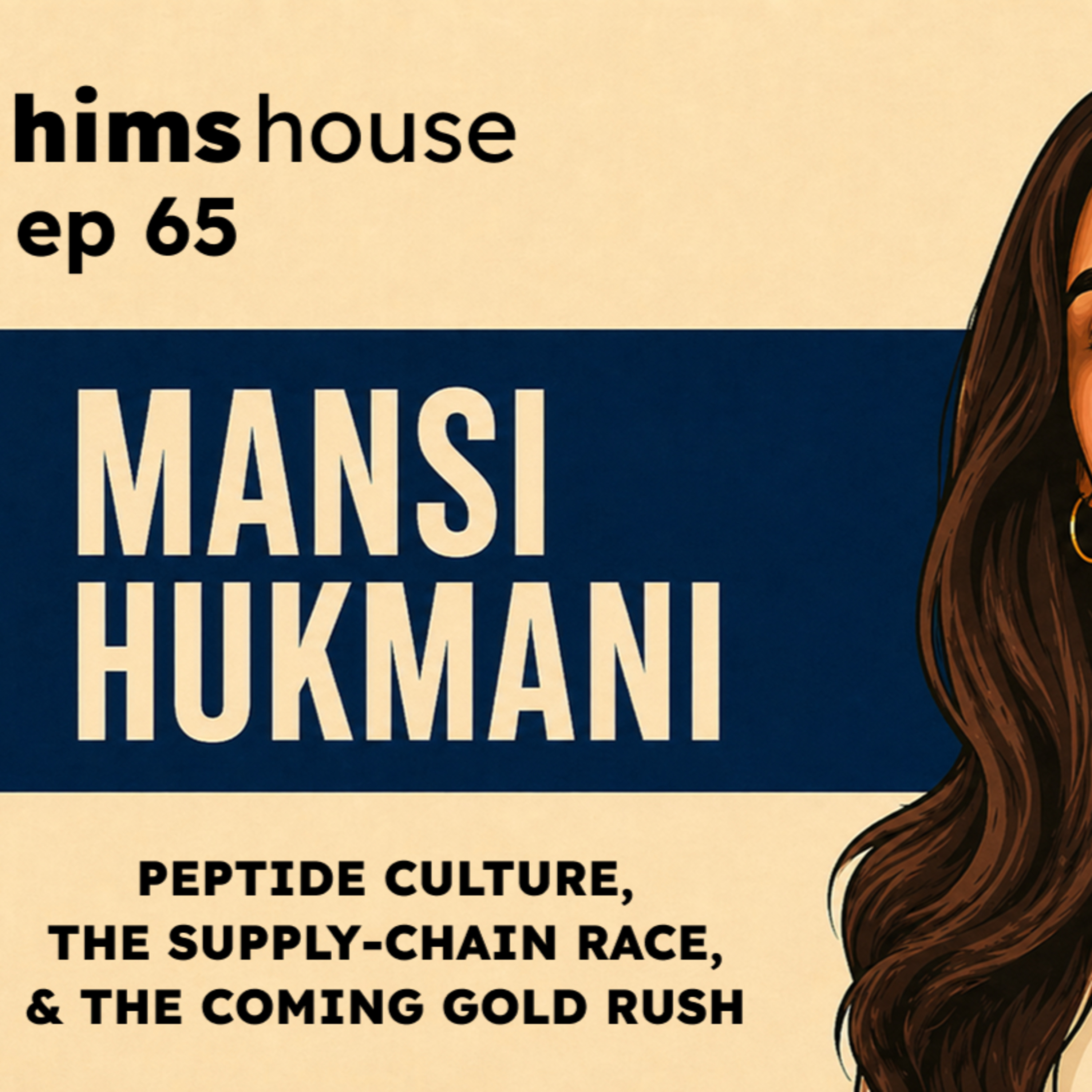
Mansi Hukmani - The #1 peptide Substacker on peptide culture, supply-chain race & coming gold rush
50m 11s
Monzi Hukmani discusses her Substack "Chief Lawn Jevite Officer," started after a spending audit revealed 80% of her income went to wellness. She describes the New York peptide scene, where nurse practitioners inject NAD+ at private events, driven by a hyper-optimization culture among founders and investors. Peptide trends vary: New York and San Francisco are early adopters due to productivity focus, London is slower due to NHS trust, and Dubai/UAE attracts high-net-worth individuals with lax regulations and health tourism. Monzi compares peptides to crypto, both emerging from distrust in institutions like healthcare and finance, as people seek control through self-experimentation. She tried Retatrutide, noting initial side effects like reduced heart rate variability and poor sleep, but improved focus and reduced food noise. Regulatory updates involve a PCAC meeting on July 23-24, 2027, to reclassify seven peptides (e.g., BPC 157, TB 500). While reclassification may take 6-12 months due to rule-making, compounding pharmacies are already preparing by sourcing APIs from China. Monzi emphasizes that the peptide movement reflects broader cultural shifts toward agency and distrust of traditional systems.
Welcome to Hymns House, I'm excited to share with you my conversation with Monzi Hukmani. But first let me tell you about superpower. I recently used superpower to get a blood draw of over a hundred biomarkers, but the product did a lot more than that. I was able to upload my past lab results from a test I had last year, had multiple very, very long conversations with their in-house AI to explore my results and figure out what they actually mean for me. And then I've compared it side by side with Chatchee BT and Claude and I have to say, superpower really is sharper and more precise. Superpowers also launching peptides soon and has acquired some interesting IP in the space. Join their wait list at superpower.com/peptides. And second let me tell you about Mochi Health. In 2026 you can get literally anything delivered to your door in an hour. But if you want to see a specialist, you're booking three weeks out and waiting for hours in a waiting room only to stand in another line at the pharmacy. They've already helped more than 400,000 members lose more than 5 million pounds and they've expanded well beyond weight loss, now covering over 120 conditions including dermatology, hair loss, sleep apnea and mental health. Go to joinmochi.com that's J-O-I-N-M-O-C-H-I.com. Mochi, your health can't wait. And now here is my conversation with Monzi Hukmani. James House episode 65, my name is Jonathan Stern. Today I'm joined by Monzi Hukmani, founder of Chief Lawn Jevite Officer, a substack in community that's become one of the go to sources for anyone trying to make sense of the peptide and lawn Jevite space. She's been embedded in the biohacking scene in New York for years, has visited underground peptide clinics in Panama for her research. She's finally published maybe the most comprehensive breakdown of the peptide supply chain I've ever seen. And she's here today to talk about it all. Monzi Hukmani, welcome to him's house. Thank you Jonathan for having me. Before we get into peptides, tell us about Chief Lawn Jevite Officer, what is it, why did you start it, and what are you building beyond just the substack? Yeah, 100 percent. So Chief Lawn Jevite Officer started off as a substack a year and a half ago. I was pretty burned out from being a founder and I just wanted a way to channel my creativity. So I did a spending audit a year ago to see where I was spending all of my money and realized 80 percent of my paycheck was flowing directly into the wellness industrial complex. So spending a bunch of money on equinox membership, sono, colplum sessions, supplement stacks, things of that nature. So obviously my passions magically pointed to wellness, so I started writing about it on substack. And through that, I started building a pretty robust online community, which then I translated into IRL and started hosting events around the world. So that's been going pretty well. I recently came back from Dubai, which is pretty sick. And yeah, the community goes on. Okay, so you host events around the world now, where all have you been to host these events? Yeah, so it started off in New York, which is where I was living for the past four years, a couple in SF, some in Austin. The most recent one was in Dubai and now I'm based in London. So I have a couple of exciting events coming up here as well. Awesome. So let's go back to that substack. There was an essay you wrote last year about getting free, May D plus shots at cold condo events, being invited to private lofts in Tribeca, where founders were injecting themselves with BPC 157. I'll say I was not invited to these lofts. You mentioned. I got you. You mentioned tea parties that's not T E A capital T parties, where guys were getting their blood drawn and comparing testosterone levels. Once again, was not invited to these parties either. And you I only I only mentioned this because there's this there's this world that previously I was not a part of that you have full access to an hour, a big part of. Can you paint the picture for people like me and others who are not in this world and going to these parties. What is the peptide scene actually look like right now in New York and elsewhere? Yeah, great question. So it's a my most visceral memory of peptides was around a year and a half ago when I visited a friends cool punch event. That time around he had hired a nurse practitioner to inject us with any D shots right after we exited a cool punch and any of you isn't a peptide to coenzyme, but it's like grouped, you know, with the peptides for some reason. And that was like my most visceral memory of coming in contact with this. So I ended up writing an FA on substack about it, just like my experience, you know, like what's going on in the space and it ended up going pretty viral and it got into the hands of a couple of biohacker communities in New York. So I started getting invites to their events. But these weren't events that were public. There were more so like, you know, signal group chats or what's up group chats. People were meeting up at different lofts around the city, you know, chatting about their peptide stocks. I've been to a couple of parties where they hired nurse practitioners to, you know, inject us with certain things and it was pretty interesting. I mean, it was a lot of folks within like the founder investor community. Yeah, a lot of like hedge fund bros. I would say people wore very into like the hyper optimization culture. And then following that, I think, I started noticing a proliferation of like longevity clinics in New York starting to pop up. So like the extension health and the next health of the world. So since then, I've been pretty embedded in this consumer trend of peptides and, you know, biohacking as a whole. I'm happy to hear that there are nurse practitioners there who are making something is supervised. Is this the first time with NAD plus and what does that do for those who don't know much about it? Yeah, it was my first time getting injected with NAD plus and it's a co-enzyme that helps with salvage reubination. You have to do it for like, you know, a long period of time to actually feel effects and I only did it like once at that point in time. So I didn't exactly feel anything. It was more so like the endorphin rush after getting injected, uh, just what I felt. Interesting. There's a company called Roe, R-H-O, not him's main competitor, Roe.co. It's been running these ads on, uh, TV on, and I see him on CNBC in the morning. So I'm watching a squat box. Sometimes R-H-O will be talking about their NAD plus, but it's not an injection. It's a, I think it's like a drink. Is that? Can you have an AD drink? Can you have NAD plus in that form or is it like, have you all? I'll look that up. Maybe I'm misremembering. Yeah. I don't know. I don't know if NAD is bioavailable orally, but again, I'm not a scientist. I don't, don't quote me on that. Yeah, I'm just interested in how I look and do I have. They have Roe nutrition, liposomal, NAD plus liposomal. Right. Yeah. And his hymns used on their compounded semiglutide pill, which they eventually call premium lemon flavored liquid, just designed to boost cellular energy metabolism, which is what you said. So I, I know how that works, and I'm not recommending it, but, uh, yeah, interesting to see the innovation on form factor. Yeah, yeah, to get a certain delivery system that, I guess, protects the compound from breaking down in your gut, but yeah, I don't know. Good to know. You've, you've been all over how, how does the peptide scene differ city to city? You're based in London now. What's, how does that compare to New York? You said you've been to San Francisco. I mean, I'll just say, at least from my perspective, maybe it's all of the time that I spend on Twitter. San Francisco means like ground zero seems like the place where people are craziest seem, like that is the place where the peptide raves are happening. That's the place where Jasmine's son is writing about that culture. But what is, what is your perspective? Yeah, I mean, honestly, no, like peptide culture has been pretty embedded in the US for a very long time with them like the bodybuilding community, even the military, right? Like I have some friends who are ex-teno gone who are friends with like special forces folks and they've been taking DPC what's the seven forever. So it didn't start in a staff know, but you know, the tax scene in a staff does run a big portion of Twitter. So I think, you know, where the ones like, drumming up interest. But I would say every city tends to deal with these macro trends in their own very specific cultural way. So when it comes to New York and Jonathan, you can like back me up here since you live there. I would say that New York is a very extreme city. It tends to reward those trends that help people to, I guess, increase their productive output, right? It tends to attract like the super neurotic, extreme hyper optimizer crowd. So whenever there's a trend that you know promises that people will look better, feel better, be able to do that.
their work better. I would say that New York tends to jump onto that trend pretty quickly. And I think San Francisco is pretty similar in that sense. I mean, like the tech crowd has usually always been an early adopter of technology, even trends. I was in S.F. Rissali hosting a biohacker meetup and I was in same, like every party that I went to, peptides were like the main topics. And then London, I would say, is a bit slower to adopt. Trends like this, I think number one, it's because that NHS is a beast and then off itself and people tend to trust that NHS. I think in the US people have lost trust when it comes to child health care. So people aren't as jump either, try the newest hottest thing because they're fine. Yeah, so-- What about-- --that are fenced out? What's going on in Dubai and Abu Dhabi? Yeah, yeah. Dubai is a very interesting use case. I mean, Dubai, Abu Dhabi, like the UAE in general is bent. I think the last decade. Incentivizing, you know, founder is an investor, is a high net worth expats to move to Dubai. They've incentivized these folks through, you know, low-income tax, no capital gains tax, golden visas. So the result of that, the population in Dubai specifically is high net worth individuals who have the disposable income to spend in the name of their health. So I think that has attracted a lot of innovation when it comes to health and longevity. I mean, I met with a lot of longevity clinics there by all hacking centers. And then I would say like regulations is another part of that. The UAE is a bit more lax when it comes to, you know, their health infrastructure as compared to the US. So for example, clinical trials, right? Like the approval times in Abu Dhabi run around 200 days, whereas in the US it's like 520 days. And that's like embedded in their growth trajectory. I think like the vision for the GCC by 2030 is to make health tourism a very big growth sector. So obviously they're going to be, you know, a bit more lax when it comes to regulations. I have heard peptides compared to crypto, which is, which is interesting as someone who's sort of on the outside of both communities. I was early to crypto and own some like, well, gosh, maybe 13 years, 13 or 14 years ago. Yeah, that is a long time. 13 or 14 years ago now. But I was not, I was not interested in crypto in 2010, 2011. I wasn't that early. Yeah. I think both sort of have this countercultural feel to it, at least in the case of peptides, people are self-experimenting because it's like literally not allowed. Sharing protocols on telegram and signal buying from gray market or black market sources, your visiting clinics that are underground. I think you meant you called them underground at one point. Is that the right way to think about sort of what it's been, not maybe where it's going, because I do think we're sort of in the process of bringing all of this above the table and above ground. But is that what it's, do you, does the comparison to crypto resonate with you? Yeah, that's honestly a great point that you make because I don't think this trend with peptides isolated, right? Whenever people lose trust in a dogmatic institution, they tend to build parallel systems around it. So I guess when people started to lose trust and try to finance, they built a blockchain and now prediction markets is a thing. So when it comes to health specifically, I think people are losing trust and traditional health care. And obviously this didn't happen overnight, right? Whether it was big pharma or big insurance, I mean, the Paris example with big pharma that I can remember is like the opioid crisis, which now costs the US around $8 billion to deal with. And then you have a big insurance company, right? Like if you've ever tried to get money back from your insurance provider, you, I'm sure you can tell that it's a very difficult process. And I mean, I think, I think the most of this real moment, I remember around people losing trust in their insurance industry was when Lungi Mangione shot the United Health Health Care CEO. And it was really interesting to see how people responded to that. I mean, there were more people backing up Lungi G than they were demanding him. So I would say that was a pretty big cultural signal. And I think I'm starting to realize that the broader like peptide movement or just the fact that consumers want to take agency back into their own hands is because we're living in a very, very volatile system, I would say, where people don't feel like they have the semblance of control. And at the end of the day, it's like agency on control is what drives people. So they're turning to one thing that they feel that they can control, which is their bodies. And they're trying to regain, I guess, some sort of like leverage in that sense. Yeah. So we have two trends that are sort of in parallel pushing the peptide mania into the mainstream. One, as you've said, is sort of more prominent than maybe San Francisco or New York, where we have these hyper optimizers who are doing everything they can to get ahead. And then on the other hand, we have a bunch of people who are totally disenchanted with traditional health care in the system that they've had for many decades. Is that right? Yeah, 100%. I mean, like the stat that I discussed in the substack was that physician trust, specifically has dropped from 70% to 40%. And then generally, I think it's around 75% of Americans distrust institutions broadly. Yeah. It's not like a friend who's not anymore. Faith and institutions has been declining for a while. I just haven't seen what Pew has said on that in the last two years. But certainly for years and years and years, trust and institutions was in decline. Yeah, 100% and that's why you see movements like the Maha movement, right, which is really taking off, because I mean, they've responded to this like six decade long trend of distrust with child health care. And they're messaging really reposence life. And that's why they have a pretty large following, I'd say. If you are open to talking about it, I know you've experimented with some peptides on your own. Would that help? Are you talking a little bit about this, Monzy? Just curious, like what you've tried. What the current stack looks like. So like what you've thrown away. What's work for you versus what is either over hyped? They're just a little bit less effective for whatever reason. Yeah. I mean, so obviously call gym, right? Call gym with peptides. So I drink my bone broth every morning. But when it comes to these like sexy tub-doo peptides, I've experimented with better true tide. The small microdose, 1MG, and I've stopped since then, but I did it consistently for three weeks. And it was pretty interesting. I would say my HRB 10. I mean, like the first two days I felt like super jet-logged. But after coming out of that experience-- You were a bee. You said it tanked. Yeah, my heart rate durability. Okay. Generally-- yeah, yeah, yeah. And my sleep was pretty compromised, I'd say. My run sleep wasn't doing that well. Neither was my deep sleep. But after the two days of feeling those jet-lad-like symptoms, the food noise went away. I've felt like I was able to concentrate a bit better on my work. I mean, I'm a very ADHD person. Even right now, like my stream of conscious masses trying to come out at a very fast rate. But I'm trying to filter it so I can articulate my thoughts as well as possible. But I did notice that with Rutter, I was able to concentrate a bit more. So that was pretty interesting. I mean, this is just like anecdotal data based on my experience. But I think there's room to test these GLP1s and 2s and 3s. And now 4s and 5s, I mean, I'm sure you saw the viral tweet yesterday that Lili is putting out data on some GLP5s. But I think there is-- Is that serious? Well, I saw the GLP4 that Dave-- I saw the GLP5. Oh, OK. I don't know what that means. I don't know when that's coming, but that's crazy. I did see a GLP4, which is-- I think we're just going to send our human bodies at that point. Like, what weight will we have left for this? But it is fascinating that Reta not only is it the best, according to most people's experiences and I think the data so far, in terms of both weight loss and muscle retention. But it also seems to have the mental effects of focus, past guess, Max Markeoni's CEO of Superpower said that many people experienced increased focus while on Reddit Trutide, which-- Mm-hmm. Yeah, I don't know if the other GLP1s confer that benefit as well. But certainly with Reta, I've heard that. Yeah, 100%. I've heard it helps reduce neuroinflammation. But yeah, I mean, I think there's more research to be done on this indication specifically, so I can't speak to it. OK, let's move to the regulatory situation, which last Wednesday we got some clarity on. So I guess backing up to--
two months ago, RFK, as you know, said on Rogan that several peptide, 14 peptides would be removed from category two. Last Wednesday, we got confirmation that in July, July 23rd, we will have a PCAC meeting to reclassify seven peptides. Among them, BPC 157, TB 500, I think those are on the list, MOTC. I think that's also on the list. GHKCU is not on the list until next February, there's going to be another meeting a little under a year from now in February, 2027. Let's assume, I think it's fair to assume that at least some of the peptides are reclassified in this July meeting. Let's say that happens and we get reclassification of three or five or maybe even all seven, what happens next? Yeah, I mean, I think it's still going to take time. I know there, you know, they've been moved from category two, but then placing them on the 503B box list is going to be a different process. I think the PCAC meeting is scheduled for July 23rd and 24th, correct? Yep, that's right. The committee votes in favor in July to move, you know, these peptides, two category one, the notice and comment rule, make, period, I believe will take around six to 12 months. So I think we have ways to go, but I do know a couple of compounding pharmacies who started compounding these peptides already after that seven-day rule. So what's fear? Like 503A pharmacies are already. Yeah, yeah, I don't know. Knowing the purpose. Yeah, interesting. Yeah. Is your sense that there will, there are dozens of pharmacies and telehealth that will be ready to go the next day? So I don't know if that's July 25th or not, because you said there's a rule-making period that has to come and happen, but like are there companies that are preparing to be ready in July? Yeah, I mean the compounding pharmacies, like once they have access to the API, they're ready. And I know a ton of compounding pharmacies who have been exporting or importing APM, sorry, from China, whether it's like BPC 157 API or like GHKC or so the access is there. But I think and then when it comes like the telehealth companies, like they rely on patient specific scripts, which the compounding pharmacies full cell. So once they already have like that relationship going, like, you know, they'll be able to start selling them. But I think in this case, you know, first to market, maybe matters a bit less than first to supply chain, because when the category one door does open up, yeah, like the telehealth companies will be able to prescribe the peptides through the compounding pharmacies. So the barrier to entries not very high. But I think the really strong mode is who is able to move upstream in the supply chain. So players like him, they're doing that right with their acquisition spray where they bought a 503A and then they bought CSFIO, which is a peptide manufacturing company. I also got off a call within RUO peptide manufacturer who's also investing in a peptide manufacturing facility. Just for just for those who are you owe that research use only? It's only yeah, yeah. Yeah. And there, I think players to bring over cheap labor from China, which is an interesting player. So I think like whoever is able to consolidate the fastest and move upstream in the supply chain is going to essentially win. Sorry, there's a research use only company here in the United States that is planning to import people from China to that's what I'm hearing. Yeah. To help in the American factory. Yeah. Because they're a little fascinating. Yeah, the labor is really cheap. I mean, that's why China wins, right? Like it's the government subsidy is and the regulation or like the regulatory environment is really lax is compared to the US, but the labor is also super cheap. I just don't know what the process is for importing people and getting them. Yeah. Yeah. Right. Yeah. I've worked scary stories where people hold passports and stuff. So we'll see. Okay. Moving to the supply chain story, which your sub stack covered again, it is great depth as I've seen. You have this peptide power laws while the peptide power laws and it maps out really the entire supply chain. One of the mean stats, I think from the piece, is that just five companies in China control almost 90% of global supply of protected amino acids. Yeah. And you break that down for us. Like what does that mean? How does a peptide get made? And then how did China come to be so dominant? You said costs are the worried, but yeah, walk us through some of that. Yeah, 100%. So before any GLP one drug or peptide is produced, you need its API, which stands for active pharmaceutical ingredients. And right now China supplies, you know, most of the world's API, but the process of manufacturing APIs is super complex. And as you mentioned, the five companies in China control, roughly around 90% of their protected amino acids, which is essentially the raw building block of a peptide. Right. So that is the portion that China has a pretty strong chokehold on. Because you can't essentially attach raw amino acids to each other. Like that's a very volatile and chaotic process. So to able, to be able to synthesize these peptides, you need to protect them. So you need to add certain caps on the nitrogen and amino acid and then attach them. So that process is very time intensive, event expensive, and China has done a pretty good job of controlling that industry. And after, building out protected amino acids, the next step is synthesis, which basically means attaching these amino acids together in really large scale industrial machines, which China right now also controls. And this is the step that these US companies are now starting to get a leg up in. So hence, buying CS bio, it's a peptide manufacturing facility. And they host some capacity of the these reactor farms, which are these, you know, large industrial scale machines that you attach amino acids in. And that's like the same step that this are your manufacturer that I mentioned, is trying to get a leg up in. But the main thing is that there's an efficiency component when it comes to synthesizing peptides, the error rate tends to compound every time you attach one amino acid to the other. So for example, BTC 157, right? It sits at around 15 amino acids, I believe, and tends to come out correct around 75% of the time. And some are glutide-ozampic sits at 31 amino acids. So that comes out correct around 50% of the time. So the longer the peptide are the worse the yield. And I think this is why China wins because they have this massive scale. Like to compensate for these efficiency issues, they have built the reactor form capacity at scale. And that's where the US is now trying to come in and essentially get a leg up. Okay, got it. So China owns the amino acids themselves. China also own synthesis, which takes the amino acids and pushes them together so that you have these names that help that we can inject into people. CS bio and there's a company I had not heard of in your essay called Horton Pharma. Horton Pharma, which is in Colorado. Is in Colorado, it's the largest in the US. Do they do synthesis as well? Yeah, they have around 10,000 liters of SPPS reactor capacity. But when it comes to China, right? And that's like the gold standard for the US. This is like one of the most massive peptide and capturing companies in the US. But in China, there's a company called Wuxi AppTech, which has 100,000 liters of capacity. And that's just like one of them. Like there are multiple Wuxi there on China. So you can imagine the scale is massive. Got it. So the I mean, Wuxi is a bigger is one of the larger synthesis companies in China, right? Yeah, exactly. This company in China called Wuxi is more than 10 times larger than the largest synthesis plant here in the United States. Okay. Yeah, exactly. And then after that, there are a bunch of other stops, certainly, purification. And then there's a surly testing, liaflization. So those steps, the US does pretty well. But if they're able to bring synthesis to the US, I think that will really help our bottom line. So yeah, him's owns CS bio now, which is a step in the right direction. But
I imagine even small, like must be smaller than cordon pharma if it's the, if cordon is the largest. Yeah. I believe in him. I believe it's a thousand. Oh, sorry. No, no, no, no, no. You go on. CS bio is a thousand. Yeah, it's a thousand liters capacity, I believe. And I got off the phone at the compound in pharmacy the other day and they've used CS bio in the past actually to manufacture some vaccines. So they've been running for quite a while. But what can him's the largest telehealth in the world that his message explicitly that it wants to move into peptides hope to achieve with a manufacturing facility like CS bio? Is it R&D? Are they actually going to be supporting peptide manufacturing for the entire country or for the entire world at CS bio? It seems like it's not big enough from what you've said. No, not the entire world, but I mean, they are already pretty strong in certain modes. Like they're pretty great with the branding. They already have a pretty strong customer base. They have all these partnerships now with like NOVO. They're just trying to control the supply chain and the sense that they can, you know, produce their own API, manufacture their own peptides, solve them through their channels. I don't know if they're going to be like the winner and the entire game of thrones if, you know, gets to control the peptide supply chain, but I think they will be a pretty meaningful player. So you also mentioned in your essay that a friend of yours bought a compounding pharmacy in Texas and then set up a separate lab entity next to it. Basically using one for standard prescriptions and the other for research use only peptides that would be off limits through the pharmacy. What other creative or crazy moves are you seeing people make right now to position themselves before the floodgates open in July or August, whenever the rule change actually hits? Yeah. Definitely. There are a lot of interesting statewide plays going on right. So for example, Texas action just past our compassionate moves at, which basically means that you have a chronic disease you have the right to try. So you have the right to try stem cells peptides marijuana. So even if the FDA has a different stance on it, the state essentially controls what happens. So Utah also signed on, I think Florida passed this and right now I believe the way is to well founder is testifying in our zone for this as well. So states tend to move faster than the FDA on that's a pretty interesting play that I'm seeing. Ways to well. Yeah, that's bringing me. Yeah. Okay. We love to bring him on the pod because he's been on roguen. He's been on roguen like two times I think talking about peptides. Yeah. What is he doing founder of ways to well? So waste rule is a longevity clinic, but they also own compounding pharmacies and they're building a very robust diagnostics arm too. I think their goal is also to collect structure outcomes that I see that into the government. So the government can essentially use this data to see if they want to test certain peptides for any patients and he's pretty involved with the maha guys right now. So yeah, he's question that. He certainly seems close with the maha guys. I think that's a nice way to put it. Yeah, yeah, I met his partner Denise a few years ago in New York and she's she's really great. The final topic for the pod, I think is going to be market dynamics. I just want to understand like again, who's going to be ready to go in July or August or shortly thereafter once reclassification happens. James has CS bio and his message that they want to launch peptides at some point CEO Andrew Dutam says they will not be first to market, but they want to be best. Noom just bought tailor made compounding and noted in the press release that it was because of the because peptides are coming. Superpowers definitely launching peptides wait list is up. I don't know if row has said anything row dot co. But I would imagine they're going to enter at some point if this is a big business. Who do you think is ready on day one. Other than the compound. One of these and. I guess how big of an edge. Is it to be first to market. If this really is about to be a gold rush or something like it. Yeah, and my opinion, it might not be the right opinion, but I think first to market matters a bit less than first supply chain, especially after all of the rumblings in the government over like tariffs on key starting materials and API. Because when the category one doors you open, you know, every telehealth platform in America will be able to prescribe these peptides through any licensed 503 a compounder. So I think the barrier to entry will basically be zero. So I think the stronger mode right is who moves upstream in the supply chain. So like with him acquiring CS bio. I think that's a really great play. And then I think over time you'll see customers spending patterns and then the market will eventually identify the peptides that are doing really well. And then more spend will pour into marketing these specific peptides. So I think GHKCU for example, will be really big with the girlies because it's, you know, known to promote collagen synthesis and reduce acne squaring. I'm here and great things about since, you know, sleep is a very large lover in the longevity economy right now, especially after, you know, Eli. I've not heard that one. How do you spell that? Decept DSIP. Okay, DSIP. Okay, go on. Yeah, sleep. Yeah. Yeah, sleep is, you know, a pretty big trend in the lead, the longevity economy right now. So I mean, I'm sure you saw Eli Lilly acquired Contessa. Yes. And then I think that is producing these sleep drugs for a lack of better word, but I think like DSIP is going to be pretty interesting. So we'll see. I mean, once we're able to co-lay data on like what peptides are doing well, the push will go into that and then the market will consolidate. So, so most important thing is securing the materials. What happens to price? Is this going to be, I mean, with GLP ones prices were driven down for most of the comp for most of the telehealth that popped up pretty much overnight like MedV and were just drop shipping GLP ones to their customers with hymns and row. They were never the low cost, they were never the low cost providers of GLP ones. They were lower than Eli Lilly and Novo, but they were, they were never as low as again, like MedV or Fridays or some other companies. And so just curious like what happens to peptide pricing? Is it a race to the bottom? Is there some pricing stability or a price floor? Anyway, what do you think happens? Yeah. I mean, what I just want to comes to telehealth players specifically. I think right now the barrier to launching that telehealth is basically zero, right? Like not sure if you saw this tweak floating around where this dude literally wrote like the entire process of starting a peptide to see brand from end to end. So I don't think pricing will be a mode there because I think it is a race to the bottom. Eventually, I think for telehealth specifically like branding or like premium branding will be really big. And then I think there will be a pretty strong consolidation at the top. So you know, like the three to five players, as you mentioned, like the rows and the noons and the hens and I'm hearing a lot of rumblings are on life and D2. So I think they will capture most of the volume and then the rest will probably be acquired. But when it comes to pricing, that's a very complex topic. I mean, I'm sure you saw Trump's recent executive order around 100% tariffs on patented materials and even like he's starting materials unless these former companies signed MFN deal, which he's getting them to sign this because for a very long time, Americans have been subsidizing the pricing of drugs for other countries because other countries are very strict when it comes to their population's health. So they've been able to negotiate with format and you know, drop down the pricing for a lot of these drugs. So for one drug, where like America is paying maybe a thousand dollars, like a German is probably paying like 200 dollars. So I think pricing will definitely start to creep down just generally across the board. I think the compounding pharmacies might have a bit of trouble since they're not able to sign this MFN deal with Trump essentially and these APIs are going to be patented and I'm hearing the key starting materials which are the protected amino acids will probably be patented as well. So I don't have a full fledged answer for you at this point in time because I'm also absorbing what's going to happen in the market. But
I'll be pre-opted. - Not realized players were pushing to patent some of the starting materials and stuff like, and the amino acid stuff like. I thought since it was naturally occurring, that would be difficult to do. But I don't understand patent law well enough to have really any more thoughts than that. - Yeah, sorry. - I guess. - The main thing that will be interesting to observe is whether companies like Hymns and Row have pricing power, relative to the telehealth that pop up overnight because the barriers to entry are so low and are able to undercut the competition. Does brand matter does trust in where Hymns, Row, Nume, and others are sourcing their materials matter? And does it allow those companies to charge a slightly higher price so that their margins are a little bit inferior than, you know, the telehealth that just popped up? Or is it really a race to the bottom and will the consumers not care? Will they just want the lowest price at all costs? - Yeah. I think brand definitely matters and partnerships as well. I mean, Hymns partnering with Noville was a pretty big deal. I think Superpower will do pretty well since they've really claimed a stake and the pop tide ecosystem. But for the price sensitive consumers, I don't think so. Which is why I also think the gray market is not gonna disappear because it retains a very specific customer segment. So it just depends on who your ICP is at the end of the day. And then with players like Trump, RX2, right? Like I'm hearing they're also going to release peptides down the road. So we'll see how that goes and how low they are able to go when it comes to pricing as well. - And on the gray market, you said something very interesting, which is that they expect it to exist post July and be the target customers very different. Say more about that. - Yeah, I mean, I don't think it will disappear because it retains again a very specific customer segment. When it comes to like the biohackers, right? Like I know biohackers who are doing like the craziest shit that will never be approved. So the gray market will still exist for peptides like that. And then there's obviously the price of the crowd, right? The actual hot trouble moving over. So I don't know, like I'm hearing people getting an entire vial of BPC 157 for like 20 bucks from China. So I don't know. - Yeah, that's right. Jonah Lutton, who was on an episode of HMS House a couple of weeks ago, said that if you were able to message the Chinese factories directly over WhatsApp or signal or wherever they are holding these communications, and if you're able to communicate with them, I guess many talk, many speak English. The prices of these peptides fall to $20, $25, $30. - Yeah, exactly. But then also, a lot of these folks are probably not taking the peptides through the sterility testing, the endotoxin testing, which are pretty expensive, I would say. - It sounds terrifying to see something directly from the manufacturer that's not also going through all of the quality control. - Yeah, exactly. - That we usually demand for our Medicaid. - Yeah. - But I guess you can get the $20 BPC if you really want that. - Yeah, if you don't mind injecting yourself with like random shut then yeah, sure. But the reason. - What does BPC run? What does BPC usually run? If you're getting it from a more upstanding supplier? - From a longevity chronic. I've seen twice and around, you know, four to $600 of a vial, it's like 10MG. - Wow. - But is that a monthly price? - Yeah, from like these like premium longevity clinics because you're also getting physician oversight. So like, you know, advice on protocols and dosing. Sorry, it really depends. But I've seen all the way from like $20 of a vial up to like $600 of a vial. - Okay. - BPC is not, is from what I've heard not one that you'd want to be on like every month. It's usually to treat an injury and then you would stop taking it. I'm sure some people are on it nonstop. But I've heard it might be answer risk. This is not medical advice, but like we don't, yeah. Anyway, yeah. - Yeah, cool. - There could be like, I just think that that one would lend itself to higher churn. Like I would not expect it. I would not expect every customer who's on BPC 157 to stay for years and years and years. Probably they take that and may not be on it the next month. But they're probably, would you say there are some peptides that customers would want to take day after day, month after month and they have a-- - The gelp ones. - Would they really highlight time value? Which ones? - The gelp ones. - Other than gelp ones. I think the sleep peptides are going to be really big. Penalene, epithelon, desept. Also, if you've heard of C-Lank and C-Max, there's a lot of data on these peptides, specifically from Russia, and I've heard wonders when it comes to people's cognitive health and depression and so that nature. So I think like those peptides will definitely be pretty embedded in culture. Once we start to see more clinical data around it, GHKC, who I'm really excited about, I think this one peptide can really crush the skin care industry. So I'm really sad that they're looking at it and fab versus July. - Right, yeah, that's exactly right. We have to wait till February for GHKCU. - Yeah. - The topical though is legal now, right? - Yeah, but why am I hearing rum wings that they might move it to category two? Have you heard that? - Well, the topical? - Yeah. I could be wrong, I could be wrong, but that's why I reached out to a compounding pharmacy for I'm to hold some for me, because I want to try them. - Have you tried GHKCU? - I've, so yeah, for like two weeks, I did experiment with the glow stack, which is GHKCU, TB500 and BPC 157, but I was just really lazy to inject myself every single day. So I fell off and I didn't really see any benefits. - Oh, that's a daily, okay. - Yeah, that's a daily. The half life is like super short. Whereas like, Jill, who wants last form. - And that's where, where do you inject that? - On my stomach. - Oh my, okay. 'Cause Jonah was talking about how he injects the BPC into his, I think it was BPC into his shoulder. - Oh God, I'm, no, I wouldn't do that. That's where he has his injury, right? - I believe it was important that it get injected near the site that he wants help. - I don't think it's important, but I don't know. - So on Twitter, someone on Twitter then replied that there is no evidence to suggest that insight matters. And I think Jonah replied, I don't wanna misrepresent what Jonah said. I think Jonah replied, for this one in particular, there may be some evidence that suggests the location of injection is important, but in any case, okay. Stomach is just fine. - Stomach or your bite or your thigh. - But I mean, there's not much data on BPC 150 something anyway. So I mean, like the most, most of the data is anecdotal and sub-radets, right? So. - Absolutely, yeah. I think one of the most interesting things that's about to happen is that we are, we are about to actually have real clinical medical data on tens of thousands, maybe hundreds of thousands of patients. Once these are moved above ground, we'll have some, in a scientific way of what they're doing, whether they're working, whether it's placebo, whether they're dangerous. - Yeah. - Like, well, it'd be nice to know some of that before we unleash them on tens of thousands of people. But I think this is the order in which we're going to get the data in which this is gonna happen. - Yeah. I mean, I'm hearing a lot of rumbling the structure data collection aspect of peptides as well. I'm friends with a couple of longevity clinics who are now running IRB cell trials on their patients. And they're gonna collect all of this structured outcomes data and feed it into format. I mean, I think there's a world where someone builds a flat iron health for peptides and GOP1 specifically. So I'm giving out a startup idea if anyone's interested. But what flat iron health did was they realized that the oncology data exists in silos across clinics and hospital systems and EMRs. So they essentially built their own EMR and supplied with EMR across all of these clinics and collected very robust structured outcomes data and then sold that as data sets into format. And then format looked at the data and decided whether they'd pursue certain indications or not. I think there's room for something like this to be built as well. - Wow. Thank you for the startup idea. - Yeah. It was actually my startup idea that I was like, I'm, there's no founder market fit for this. I can't do B2B SaaS again. I've built a startup in the past, sock to compliance, funny enough and I hated it. So. - Any final words or a note that you'd like to leave us with?
Just stay safe out there, man, living in our crazy world. Monzy, thank you very much for being a part of him's house. Yeah, thank you so much, Sean. I appreciate it.
Podcast Summary
Key Points:
Monzi Hukmani founded "Chief Lawn Jevite Officer," a Substack and community focused on peptides and wellness, born from her burnout and spending on the wellness industry.
The peptide scene in New York involves underground events with nurse practitioners administering injections like NAD+, driven by a hyper-optimization culture among founders and investors.
Peptide culture varies by city
Peptides are compared to crypto as parallel systems built from distrust in traditional institutions (e.g., healthcare, finance), with people seeking control through self-experimentation.
Monzi experimented with Retatrutide (GLP1), noting initial side effects like reduced heart rate variability and sleep issues, but improved focus and reduced food noise.
Regulatory updates
Summary:
Monzi Hukmani discusses her Substack "Chief Lawn Jevite Officer," started after a spending audit revealed 80% of her income went to wellness. She describes the New York peptide scene, where nurse practitioners inject NAD+ at private events, driven by a hyper-optimization culture among founders and investors. Peptide trends vary: New York and San Francisco are early adopters due to productivity focus, London is slower due to NHS trust, and Dubai/UAE attracts high-net-worth individuals with lax regulations and health tourism.
Monzi compares peptides to crypto, both emerging from distrust in institutions like healthcare and finance, as people seek control through self-experimentation. She tried Retatrutide, noting initial side effects like reduced heart rate variability and poor sleep, but improved focus and reduced food noise. , BPC 157, TB 500).
While reclassification may take 6-12 months due to rule-making, compounding pharmacies are already preparing by sourcing APIs from China. Monzi emphasizes that the peptide movement reflects broader cultural shifts toward agency and distrust of traditional systems.
FAQs
It is a Substack and community started by Monzi Hukmani a year and a half ago, focusing on wellness and peptide trends. She began writing about her spending on wellness and built an online community that expanded into hosting events globally.
The peptide scene in New York involves private events in lofts with nurse practitioners injecting peptides like NAD+. It attracts hyper-optimizers, founders, and investors focused on productivity and biohacking.
New York and San Francisco are early adopters due to their hyper-optimizer cultures. London is slower due to trust in the NHS. Dubai attracts high-net-worth individuals with lax regulations and a focus on health tourism.
Both involve countercultural self-experimentation due to distrust in traditional institutions. People use gray markets, share protocols on encrypted apps, and build parallel systems for health, similar to crypto's alternative financial system.
She tried retatrutide (Reta) at a 1mg microdose for three weeks. She experienced initial jet-lag symptoms, reduced sleep quality, but later improved focus and reduced food noise.
In July 2025, a PCAC meeting will reclassify seven peptides from category two. After a 6-12 month rule-making period, they may be placed on the 503B bulks list. Some compounding pharmacies are already preparing.
Chat with AI
Loading...
Pro features
Go deeper with this episode
Unlock creator-grade tools that turn any transcript into show notes and subtitle files.
 PodcastTranscript AI