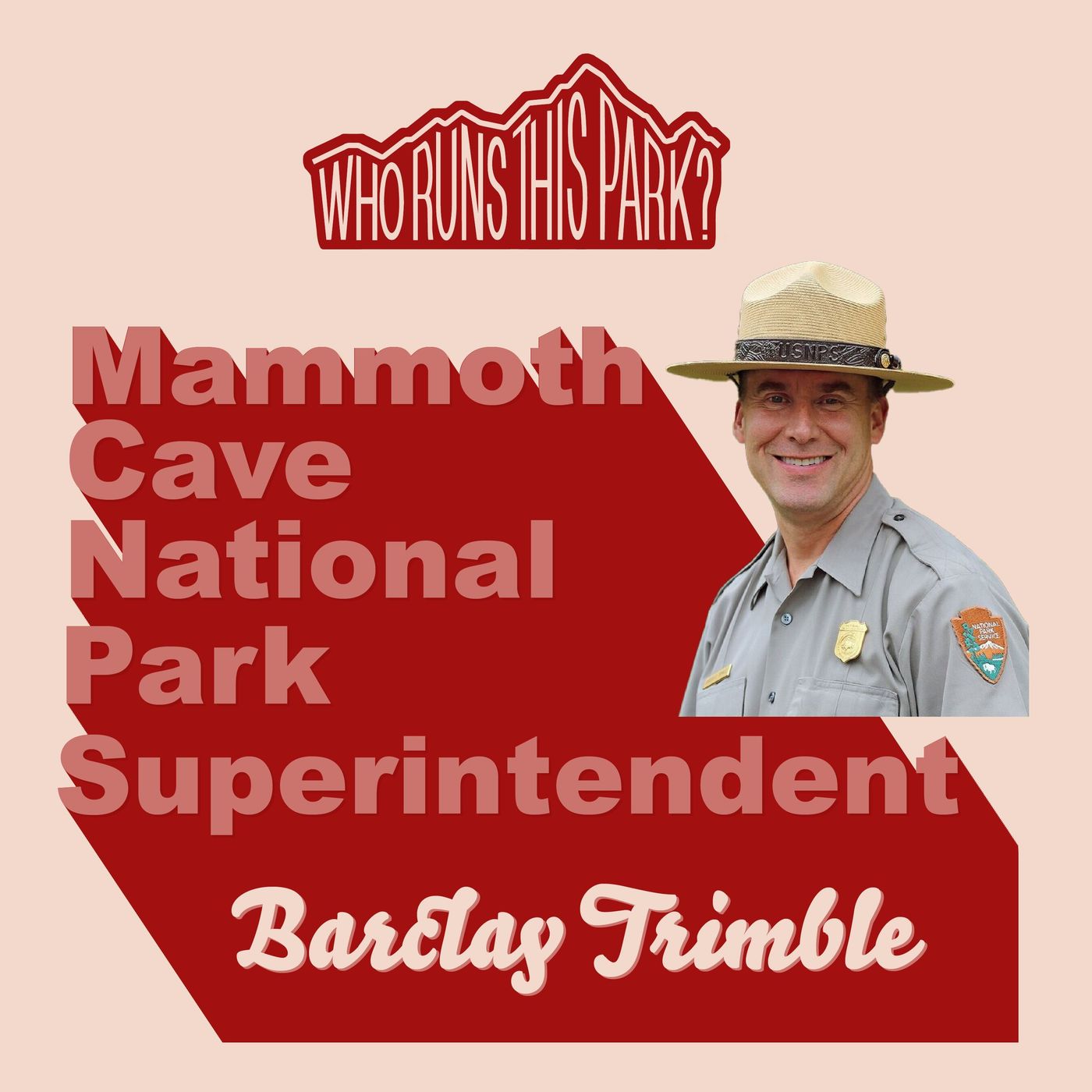
Mammoth Cave National Park Superintendent: Barclay Trimble
61m 40s
Barclay Trimble, superintendent of Mammoth Cave National Park, shares his unconventional path to leadership, rooted in business and finance rather than traditional park management. Growing up, family trips to national parks sparked his love for the outdoors, and summer jobs in Yellowstone solidified it. After college, he worked in accounting before joining the National Park Service in the early 1990s, when the agency sought professionals to manage concessions. His career included roles as a recreation fee manager, chief of finance, and acting chief of business management, where he oversaw financial operations, fee programs, and concession contracts.
Trimble emphasizes the value of taking temporary details and continuous learning, which allowed him to gain experience in park operations and eventually become a superintendent. He recounts memorable moments, including managing the park during COVID-19 and organizing a concert with Yo-Yo Ma and the Louisville Orchestra inside the cave, a logistical feat that attracted global interest. He also explains the complexities of concession services, which range from food and lodging to river rafting and transportation, and discusses the fee structures that support park operations. His story highlights how diverse skills and a willingness to explore new opportunities can lead to a fulfilling career in national park management.
I've been playing outdoors since I was a kid. Standing by the front door around two years old, hollering, side, side. Trying to get my mom to let me go play outside. Now, after 30 plus years working in the outdoor business, I'm dropping insider conversations every week with brand leaders, guides, marketers, CEOs, and others to make the outdoor business a trillion dollar juggernaut that tries product innovation, revenue, and public policy for everything outdoors. I'm Rick Says. Welcome to the outdoor biz podcast. Available wherever you get your podcasts. Hey, guys, it's me, Mattie, your host. I'm popping in to let you know about the Who Runs This Park newsletter that you've got to sign up for. With the newsletter, you get to see highlights of each episode, fun pictures, typically of me and the superintendent cheesing, stay up to date with all that's going on in the Who Runs This Park world, and get to read Mattie's Outdoor Obsessions. The part of the newsletter where I pick three things from the outdoor world to highlight, whether that's a favorite product or brand, or podcasts and publication that I came across. Sign up at link tree slash Who Runs This Park. That's l-i-n-k-t-r-dot-e-e slash Who Runs This Park. Check the show notes for more information. I had way too much beginners like I was definitely at the right place at the right time, yeah. So-- [MUSIC PLAYING] Welcome to Who Runs This Park, a podcast where you are invited into the hearts and stories of those who have committed their careers to the protection and preservation of our great national parks. Who Runs This Park aims to be a catalyst for inspiration, highlighting all that goes into managing our national parks and building a sense of appreciation for the invaluable beauty, diversity, and history of our protected lands. [MUSIC PLAYING] Today, we're joined by Barclay Trimble, mammoth cave national park superintendent. Before Barclay's time at mammoth cave, his extensive experience spans the whole US from being deputy regional director in Atlanta to placements at parks like Grand Canyon, working with Denali and the Outer Banks Group. He has experienced both in management and in many business finance positions and is a fellow Texan. So we love that. For those who aren't aware, mammoth cave is located in Kentucky and is one of the earliest tourist attractions in the US. Has the world's largest cave system with over 400 miles. But the caves aren't the only way folks can recreate with over 85 miles of surface trails for hiking, biking, horseback riding, camping, et cetera. Barclay, welcome to Who Runs This Park. No, thank you for having me. Yeah, pleasure to have you. A way that I like to start off the interviews is by diving into your time at mammoth cave and then we'll take a step back into some historical experience. But what's one of the more unique or crazy situations you've had to deal with as mammoth cave superintendent? Well, I'd say probably have two of them. And I'll start with the one that was a little more challenging first and that was probably just managing a park during COVID and getting through and the world shutting down and getting through that and then trying to figure out how to make sure my staff felt safe as we were introducing visitors back into the environment. And so just working through that whole process was an interesting challenge. It was unique. I hope we never face again. You and me both. But probably though, it's a fun one that comes to mind. We just recently completed about a year ago. And that was actually having the Louisville Orchestra and Grammy award-winning conductor Teddy Abrams and Yo-Yo Ma have a concert in the cave. And so that was several years in the planning. But last April, almost a year ago today, we had that couple of concerts down in the cave with the small contingent of the Louisville Orchestra and Yo-Yo Ma and acquired group out of Louisville that was really a unique experience. Yeah. Did you bring down speakers and stuff or were the acoustics of the cave good enough that you didn't need any ample? The conductor Teddy was very happy with the cave environment. So it worked out really well. Yeah, that's cool. So the bath, the only thing they brought down was a little lighting. And so it wasn't in the complete dark. But other than that, the cave took care of itself. Was it like a lottery system or how did folks get to-- It was. We figured it was going to be something that people would be very interested in. So we worked with recreation.gov, the group that does all our ticketing. And so we put a lottery system in place and just a random draw to come back in. And so we only issued about 500 tickets. And we had-- if I remember right, close to 28 or 30,000 requests. So it was-- Wow. It was-- That's a time. It was overwhelming the amount of people. We had international people in the lottery system. We had people from all over the United States, from Hawaii everywhere, wanted to fly in and just be a part of it. So it was a great experience. It's making me think of so the eclipse passed through Texas. And I got to go up to Waco and spend some time with the current Sequoia and King's Canyon Superintendent and like a ton of old Smokies, like the X Super Intendent and a lot of folks who used to work there and have retired. And they were talking about-- Because Clay, the current Sequoia Superintendent, was deputy superintendent at the Smokies when the eclipse went through the Smokie Mountains. And they were talking about how they had a similar thing where they did a lottery system and reserved, I think the Klingman's dome. I don't know if it's like the peak at-- great Smokie Mountains, but a similar thing. I've took a lot of planning and coordinating and lottery tickets. And even you putting into perspective, it's like a harder acceptance rate than getting into college. Yeah, it was-- yeah, the acceptance rate was tough. It would likely we were able to do it. But it was overwhelming in the fact that the conductor Teddy Abrams wrote a brand new piece of music just for this incident that included YoYo Ma. So it really was a brand new piece. So there was a lot that went into it. Was there a recording of it? Or is it-- they're working on some aspects right now that will hopefully have a recording, but actually a preview and a documentary that talks about all of it. So they're still trying to put the final touches on that. And they hope to get that released here in the future. OK, I'll keep my eyes out and let the people know of-- in the future, you can check this out if you didn't get the chance to-- Yeah, that'd be good. See it in person, that's cool. Taking a step back, what led you to work in the park service in the first place? I know for folks who aren't aware, you got your degree at UTSA in business. And so how did you make that jump into the park service? It was sheer dumb luck and an aspect for jobs that I never showed up on a resume. So I would just say growing up, we had the family outings for the older audience, hell understand, but getting in the station wagon with your family and just driving to the national parks. And that's exactly what we did growing up. So my parents were very influential in just kind of making sure that we got out and we saw different parts of the country. And we got to the different national parks. So we grew up doing that. And then three of my summers during college, I worked in Yellowstone National Park for a concessioner. If it was on my resume, as it would say, I was a petroleum transfer engineer. So I pumped gas. OK. So that, yeah, that was it. It was really just to be up there. You'd work five days, but they would start early and let you off early your last day. So we had about two and a half days to go out and hike. And so we were just up there for the experience of Yellowstone and spent those three summers just hiking all over the park and the tea tons and other areas. So it doesn't always have to love for it. And then that even kind of dwelled it even a little deeper into it. And that's actually kind of the job that got me into the park service. The one that I never thought was going to show up on anything. It was really just for fun. Did you go from being like a seasonal worker to a full-time worker? How did-- No, I didn't. I didn't know. I didn't know. As soon as I graduated college, I actually went to work for a small accounting firm for a little bit and kind of decided that that wasn't going to be my calling. And the park service at the time back in the early '90s went through a professionalization aspect where they wanted to either accountants or lawyers to come in and help with the concessions program. And all the concessions come in and provide all the food and beverage and lodging and gifts. And so there's some fees that come back to the government for that opportunity. And so they were trying to professionalize that rank. So because I had that business at accounting degree, that's what got me in. But then I also had experience on the concessions. I had worked for a concessioner. So I knew what they were all about, why they were there, and a little bit about that. So I think that's what really inevitably got me in the door. That's-- and what was that first role in the park service? My first role was just as an accountant in the concessions program in Washington, D.C. So I left Texas. I became the fellow Texan. I actually had to get up and move and get to Washington, D.C. So that was a tough part of the move, but that was good. It's been great. Yeah. Yeah. Yeah, that's a big move. I just moved back from-- I was in New York for four years, and then just moved back to Texas. So it's funny to see-- You understand the big city move. I do. Yeah, I really do. Yeah, I think that's something that was unique about when I was researching for this interview was your experience on the business side of things. And one of my favorite things of-- well, there's many favorite things-- of these conversations in this podcast. But one thing I really like is learning everyone's different path and kind of seeing the unique different ways that people become superintendent. And I was excited because I haven't seen a ton of-- or I haven't gotten to talk about a lot of the business side of things. And then that transferring into being a superintendent. So I know some of the roles-- and I'll just list some of them out that I found-- but I'd love to hear some of your favorite moments from those different experiences. But I know you were a recreation fee manager for the Intermountain region, the chief of finance for the Concessions Division. So it's kind of got more experience and management experience in the concessions realm outside of being an accountant. And then the acting chief of business management of Glen Canyon recreation area. So those are kind of the big ones that I found. But I'd love to hear what sticks out to you from some of those more proper business roles. I think all of them just had great learning opportunities, I think, as you talked about. So as I started with the part services and account, then obviously was able to take that opportunity.
to take that next step up and start some management level aspects becoming the chief of the finance branch. And so that particular group was there to to look and oversee the financial side of all the concession operations, which are multi million dollar operations in some of those bigger parts. So getting into looking into the financial statements, looking into the payments they were receiving help to solidify and determine what the payments were when a new contract would go out. And the prospect is that people would be bidding on so that obviously got me fit well with what my education was and then really then started taking other opportunities to many details and other up to like the one that you talked about at Glen Canyon was able to go in and help oversee, you know, they have a large concession operations there with houseboats and lodging and food and beverage and Greek. So there's a lot going on on the lake, but then was also overseeing the entrance fees and, you know, that aspect of the business side of that particular park. So got to look at those particular different areas and then at least with the intermountain region fee manager that was one of the federal land recreation enhancement act was recently created. So it was a brand new program on how these parks were going to start collecting fees at entrance fees and expanded amenity fees for, you know, other tour operations, you know, that are that are outside of just the entrance fee. And so I was able to help, you know, kind of stand that up and figure out how that was going to work for a whole region. So they worked well with where my background was, but also gave me plenty of opportunities to look at other park operational aspects getting out and talking to the different parks. So I'm just going to be successful. What's going to help? How can the region help? And so those conversations were great to have. So I haven't heard of that. Actually the federal lands recreation enhancement is that the ability to collect additional fees. You said outside of just the entrance fee to the park. So it's actually the authorizes both. So it's a temporary act that has never been put in permanently. So it's one that's in the green book that gets reauthorized at the time that then allows the parks service opportunity to come and charge what are called the entrance fees and expanded amenity fees, which are the fees outside of entrance fees like campground fees to like all that so we don't charge an entrance fee at mammoth cave. So the park proper is accessible to everyone. So if you want to go into the cave, those are all under guided tours to keep down the vandalism in the cave. And so those are part of a fee structure that we have to come in and look at. Oh, interesting. And are all of the fees associated with recreation.gov. Do those kind of fall under this act. I would probably say majority of them might have to look at them to be sure, but I was sure that vast majority and probably fall under that act. That's cool. I didn't know that. I did. I was curious about the concessionary concessions division. So how does that work? Is it you have a spot within a park, a building or something where you could provide food and you lease out that space to a different concession operator. So they do the buildings, you know, are inherently, I mean, they get a lot of technicalities of what are, but for the, for the gist of a list to say all the buildings are owned by the park service. And then you would put a solicitation out that for multiple bidders to hopefully come bid on. And you're providing that opportunity for a concessionary to come in and provide those services to the visiting public. And it can range from a bunch of different type services. There are climbing services in the dolly and there's when I was at the Grand Canyon, all the whitewater river rafting is done by concessionary. I don't know how many contracts are there now. I think there were 11 at the time that I was there. So there was 11 different companies that would provide that service through the through the inner canyon. And, you know, like what we have here at the end of cave, we just have food and beverage and lodging and we also have transportation. They provide our services to and from our cave entrances that are not associated right there by the visitors center. So we've got a transport visitors to and from those caves. So, so it can really be a whole cadre of services that each individual part might have. That's I actually just assumed it was like food and beverage. So that's interesting that it expands to the activities. Obviously that I mean, I'm even thinking like Mount Rainier hiking to the summit. Yeah, somebody's a bit of a concessioner going into the bottom of the Grand Canyon. We have a, you know, part of a concession operations was taking the mules and writing those down to the bottom of the Grand Canyon to stay in the lodging at the bottom of the Grand Canyon. So there's a lot of services that are provided by great companies. I joke that the more I do these interviews, the bigger my like bucket list grows. It's almost it's almost dangerous because I remember interviewing the voyagers super antenna and just parks that I'm also as I'm interviewing learning a lot about in preparation and in the discussions. And it's just the list is getting too long at this point. It's getting too expensive. I'm like we're getting out of hand here. It's a good list. Yes, it is. How did you transition from the more business side to I don't know if you would call it the park management side. I think it's just taking opportunities and that's the beauty of the park service, taking details and, you know, just continual learning is a big proponent of where I am. I you never know everything. So some of those things you should talk about was at Glen Canyon. That was a detail I took there and getting up to Denali and our details like different assignments. They are there like usually they can be give or take but normally like 120 days. So four months where you go in and you take a short term assignment to go and learn something else and did some super cool. Some stuff at Denali is a management assistant. I did a stent in Yellowstone in the concessions program. That time as a business manager at Glen Canyon. I also took a opportunity one time and actually went out and did a short term detail with the NTSB. And so I went outside the park service, but I really wanted to learn how an organization like that acts when we have a horrific accident how they spin up how they get there. How they analyze the data so it was just great learning experience for me to see how an outside organization, you know, just takes a horrific admit kind of like incident command structure we use in the park service. And so I had a different lens so had an opportunity to do that. I just had several opportunities. I've applied for and was successful enough to get into and that really helped me, you know, learn more about park operations on the day to day stuff outside of being in the national or regional office. Yeah, no, that's I mean, it sounds fun because it's like internships and a sense which is this idea that you get the opportunity to learn of super new skill set and it's cool to hear that you can do that in a professional capacity and don't you know don't have to be a college student. Right. Yeah. Do it. I mean, obviously you're a full time employee, but it has the things that I like about internships are getting thrown into something over a short period of time and figuring it out and it's new and all that. And so it's cool to hear the different experiences of that. Been very rewarding. Your details and just different things have been at so many different parks. What natural elements do you find yourself drawn to most of the time? Good question. I don't know that I really have any natural elements. I mean, obviously, you know, you start up north in Denali and the cold and the high mountains and that was a great experience. I like to experience different parts of the country and just see what I don't know. And so it's not really necessarily elements. I mean, we enjoyed out west on the outer banks. We were at the eastern most part in the continental United States. And so that was a great experience less dealing with the hurricanes that come up that. Oh my gosh. That coastline and deal with a couple of those. Yeah, you're making me think of a conversation I had with clay because I think he was at the Gulf shores national sea shore for a bit. And he was also saying every hurricane season. It's like just it was tough. It's pretty much a hurricane's hitting something on that shore. I don't miss those days. I mean, every day starting June 1st, I was up at 6 a.m. with the weather channel and figuring out what was coming up the tropics. So we're going to be all right. Where are we going to be? Where are we going to be lined up for the next six months? It's the hurricane season starts in June. I didn't really. June 1st. Yeah, usually from June 1st about the end of October. So wow. How far out do the predictions go? We normally have plenty of notice. It'll depend on the speed, but you know, normally you got seven to 10 days where you're out. But we had a shutdown plan that we would have in place. So we had a lot of work secured, but then get the employees enough time to get their own personal residences and everything else secured. So it's a. Yes, not an easy process to shut it all down and secured as best you can, but Mother Nature is with all parks and not just hurricanes. So rain events, wind events, everything else. I mean, she'll come in and your best late plans don't always work out. Yeah, and just the like stress and pressure of making those decisions of are we evacuating? Are we not? Right. Maybe some of those are determined by other governmental agencies, but yeah, I don't I don't envy you in those times for sure. It was all good. I had I had a little bit of experience growing up in Texas and Corpus Christi. So we got a couple actually from the personal side. I knew what I was stepping into what I got in there, but just back to your question. I mean, it's just we've really, you know, the time in our region, Lofts, we just really enjoyed Denver, really enjoyed Atlanta. I enjoyed my time in DC. So I really don't have a specific attribute I'm looking for. It's more of the for me. It's more of the challenges that come with the particular parks. I like coming into areas that, you know, that maybe aren't running as smoothly as they could be. I'm trying to figure out how we can make a better experience. So I like the challenges of that. That's a great segue because I love to hear each park. I've learned and I joke about this all the time. But every time I talk to a superintendent, I'm like, my gosh, there's a lot going on. Y'all are busy. There's a lot of things to manage and deal with and all of that. But what unique challenges does me amethcave present itself compared to the other places you've been stationed. I'd say probably the one that's probably most unique to here is one that's
Well, not unique specifically here, but there's only a handful of subterranean caves in the park service. So that comes with its own uniqueness right there and in managing both surface and a subterranean environment. But probably for me what's most unique about here is the size of the cave and the carstopography that surrounds mammoth cave leads to a lot of aspects that right outside the park boundary that can have a real detrimental effect to the subterranean environment. So if we have an 18-wheelers spill over interstate 65 and we start having gas or whatever could be a liquid load that something is occurring which has occurred all that material can get leach into the ground system very quickly. It's the carst environment is very porous limestone holes you're fully aware of being in Texas and all the limestone that's around there. But all that gets into the aquifer and the water streams that are all feeding into the underground rivers that are in mammoth cave. And we have an endangered species, the Kentucky cave shrimp that is only indigenous to MFK. So if we ever had an oil spill or it could decimate a population. So obviously paying attention to what's going on outside our boundaries is more of the more unique challenges, you know, working with the farmers trying to come up with the pesticides using best management practices where they'll leave some swaths in there where the grasses and stuff can absorb some of that before it gets into the water system. So it really is kind of the activities that are occurring outside the park that we're continually watching to see what is doing to the environment in the park. Well, it's interesting because I think you always have to be aware of that to some extent as a superintendent and stuff like that does affect ground water quality or stuff, but it's maybe not as prevalent because a part of your park isn't like you said subterranean and I mean the fact I did not know that mammoth cave had underground rivers. So that is cool. What is that? I feel like Austin has aquifers. You do remember mine. I'm remembering field trips from elementary school. We went to Edwards aquifer for anyone who's from Austin and knows that. And you got to see the swimming pig. If it's still there, I don't know that that's still there. That was in my time. That's a long time ago probably before it might have might have passed, but no, so please I mean we do have multiple rivers that are still down there and with a with a carstopography what's interesting about the cave is that what everybody may or may not really realize that the cave is still growing, you know, we have we have really we have those underground rivers are still carving out cave passages as we speak so it's you can get down in there and and that's where we have a lot of little critters that are down in their eyeless cave fish and crawfish that are solid white and no eyes. And so there's a whole adaptive species that have come into the to the cave environment. And so continuing to see where that and then where it follows. Matt is the green river the main river that cuts through the park. Right. That river is with every river in the United States to continually carve down with the Grand Canyon we were losing a with of a paper every year. So the size of a thickness was being carved out. They're all different on where they are. But the underground rivers that come in from those above ground sinkholes and sumps that all falls underground and chases the river. So is the river sinks. So does the cave so man of cave really is five layers of different cave passage that over time with the oldest layers being the upper levels. And as the river has continued to carve new passages over many many many years, but when now we have five different layers stacked on top of each other. I would imagine you are always having to evaluate safety and the structure of the caves on top of the cage. Luckily they're pretty stables. Yeah, I guess. Well, you get in there and it's you know, it's not like up on the surface the environment in the cave really never changes other than the entrances where we'll get a little inflow and outflow and some colder temperatures may come in a couple hundred feet. The ambient temperature in the cave is always 54 degrees. The humidity level in the certain areas is pretty much always the same. So there's no freeze thought there's nothing that really occurs down there that helps break down stuff on the surface. That was in one section of the cave one time and there was a newspaper that was out there that was talking about Nixon running for president. And it was still pristine. I could sit there and read the whole article just laying down on a rock that was down a couple hundred feet underground. So really how it preserves everything that's down in there. It is. Yes. I'm even thinking how you're saying these adaptive species that live there. It's making me think of the species that are at the bottom of the ocean that live without sunlight essentially. And are really unique what type of and for folks I had mentioned in the intro that it's over 400 miles long my understanding is it's now 426 miles long because a few years ago an extra six miles was discovered. So I'd love to hear about that experience and how one discovers more trails like who are these people that were discovering you know 400 miles of trails underground or the additional six. Right. No, so we work with two different groups the cave research foundation and the national theological society in SS and CRF and but CRF is mostly the group that does a lot of that exploration. And so volunteers come in on their own personal time. There's a lot of weekend a lot of weekend the events that they plan and come in and then they have bigger you know camps that will come in and spend a week in the cave doing this. So they come in and there can be 40 or 50 of them that'll come in for some of these events and then they segment out the different sections of the cave where they've seen possible leads that nobody's been down yet. And so that's exactly what they do. Matty they get in there and they start crawling on areas that have not been mapped and they're not sure where it's going to go. They're not sure they're going to be crawling on their belly for a couple hundred yards and then that leads. And then that leads just going to stop and then you've got to be maybe able to turn around or you may have to back crawl that same part so it's not for the folks like if you're claustrophobic that's not something to do. It's not I don't think it's an organization I would volunteer. But then in assesses also here and they come in and they help us and they do a lot of restoration work. So areas that over time where we've had dirt trails as people walk on that that puts a fine layer of dust up on the formations up on the walls that affect the cave environment. So they come in and clean and remove old infrastructure that's that's trying to get the caves as pristine as possible. So we couldn't do without the two organizations and the work that they do to come in and help us. Are they a national group like do they work at Carl's back? Yes, they're about national groups. And I mean, I'm just shook that people are just going out. Do people camp overnight in the caves if they're far away or do they kind of. No, we don't have any camping overnight. They return back. So it's yeah, it's a well, I'll just say one of the unique experiences I've had is one of my philosophies is how the getting out and seeing what everybody does and just participating. So the first month I was here in this job, I went in with CRF into salts cave, which is a. It's a cave that nobody can get into. It's got a big cave gate. There's a ton of archaeological aspect down in that particular section of a cave. But I went in early in the morning. So it was dark and this is where I'm talking about that newspaper when I found that when I was down there. But we were in there for 12 hours. when I was participating with that and looking for new passages and redocumenting existing routes and using all their specialized tools and equipment that they do to get all of this, but we basically came out you know 12 hours later. It was dark again and it felt like it would have been in there for a couple hours, but we had to we had to shame me through some holes and I barely fit through and we had to climb some areas that, you know, you're just climbing up some cliffs and so it was a great experience. But I have so much respect for for all those volunteers that come in and do this and just yeah, we couldn't do without. So was that I saw you discovered a to a shark tooth. I did. Was that the same expedition? No, that was a different one. I tried to get in as often as I can, which isn't often enough, but no, we had on that shark. I think it was one of our park staff, I remember right or could have been an old member. Anyways, we found some documentation of some aspects of what we didn't know what was sticking out of the wall in a passage that's that's off the main trail. And it's one that you have to get on your hands and knees and crawl and you got to shimmy around a little. And so it's not a place we can get the public. But so they had that and they took a picture of it. And so they sent that to an individual JP Hog met up in Washington, DC that specializes in sharks. And he was like, Oh, that is, I need to come see that. I think that's actually cartilage from a shark, which is almost never preserved. So he flew in and we took him in there. I had never seen it personally. So when he came in, I'm like, well, I'm just going to I haven't seen it yet myself. So I'll go in with that group. It's a very small passage. And obviously he was there to do it. So I let he and my cave specialist go up and you know they got first view of it. So I just happened to be kind of looking around and looking at the sea of lanes. Hey, this is a unique tooth. You know, I could I grew up collecting teeth on the on the Gulf Coast purpose in that area. So I was like, man, this one's serrated. I've never seen a tooth like this and just pointed it out to JP and he came and he's like, Oh, that is something I need to collect. So he took it and it yet happened to be a new species that had never been. Yeah, new to science. As they say. Yeah. But you know, again, we couldn't do that without, you know, my park staff just.
was a great job trying to get in there. We've had a couple different species that have been found in the cave now. I think we're up to three or four new species that have been found. Wow. Of sharks or just a big one. Well, because it was, I think I read it with that part of the country was underwater. Yeah. Yeah. Yeah. That's why the fossil is there. It was a shallow sea bed at that particular time, a warm sea bed. And so that particular area is really rich with a lot of stuff that haven't seen. Yeah. A particular time of like three hundred twenty five million years ago. Yeah. Exactly. So it's kind of unique to have these the shark fossils. You know, people like that to begin with, but then also have that in a cave environment, I think just has to the excitement, which you come and see it versus seeing all that. Yeah. You know, you see plenty of fossils on the limestone there and in Austin and some of those areas out there and seeing one on the surface as one thing, but seeing these sticking out like just the other day, I was just on another area and there's a piece of a shark fin that we found in a sea life. So yeah, it's unique. Wow. Yeah. Super unique. I mean, again, similar with the shark teeth. I spent some time in Charleston and like would collect shark teeth on the coast and stuff. And I'd never really done that before. And it's cool. But there's definitely a different experience of like looking up and being like, is that a shark tooth in the right? Yeah. Interesting. So now I'm constantly looking. I'm tripping all over myself because I'm not looking where I need to be anymore. I'm always looking at the ceiling of let's go on around me now. So yeah, you had a little bit too much beginner's luck of like I had way too easy to do. I was definitely at the right place at the right time. Yeah, but it was sheer double. Now it's every time you're like, well, I kind of expected to stop and see she's so. I think all I've said for even looking even more now because we've had another one that the tallest in shark was the first one that that our guide found Kelly Tolson found and so that one was named after her. And then so so I think a lot of our guides are in there now look at it. It's like, all right, what do we do? They need a namesake shark to. You had mentioned that folks usually need a guide to go into the caves. What type of like expeditions is a visitor can folks experience explore like how long are the hikes typically? They range. And so we have some we start to let's say one, we have an accessible tour that you know, we think is important. We have an elevator here in the in the cave. So we're able to get people to some challenges into the cave so they can see that. But inside of that, you know, we just have a whole cadre of tours both in length and timing. And so some are probably about an hour's our shortest one. And that can go anywhere up to six to eight hours on our wild cave tour where you're in coveralls and you've got to have the right footwear and you're in some areas that your head this way from from top to bottom with your helmet will not fit through some of the stuff that you have to crawl through. So you've got to turn your head sideways. Oh my gosh. To get through. But so it's a great experience. I've had the pleasure to do that. It was fun. But it is one that you know, we find a lot of times that people sometimes cannot be prepared or they're not getting to what they're get to. So one of the things we recently just did was created a video that I think is on recreation.gov now or there will be shortly that gives some experiences of what the wild cave tour is and the footwear that you have to have and just trying to make sure that people are prepared and ready for the experience for what they're going to get because because as you said early on with your claustrophobic, even people get in and we have some pretty large passages. Some people get in and you know, just that's not for them and we have to walk them out and get them to take them off the tour and come back out the entrance because they they felt they wanted to do it. But this the body and the mind just didn't allow it. Yeah, but it's making me think of I have scuba dive or scuba dove scuba dive once and it's really interesting because I wouldn't say I'm necessarily claustrophobic, but it's an anxiety provoking situation the first time you do it and I would imagine being in the cave in a really narrow space could be that same. But with scuba diving, it's you know, you have your oxygen tank and it is a lifeline to breathe slowly and calmly. And so it was such an interesting practice because I was feeling so nervous, but it would like actually was really good because I was forcing myself to breathe calmly because I mean, I can't even it's scary to think of like you like starting to like hyperventilate or something underwater like that. But I feel like it'd be similar in the cave of you're like you're there, you're kind of stuck. You just have to to the best of your ability really practice those deep breathing skills. Yeah. Okay, they're not closing in on me. It's not moving. That is true. Yeah, that's true. Was your first experience in the cave once you were super intonate or had you come as a visitor or I had come into as a visitor before I brought my kids up here in summer spring break, but we had we stayed at the campground and we got them on some cave tours when they were young. Yeah, that's cool. I had read about so the Great American Outdoors Act. It's been cool to see all the different areas that this act has played a part in the park service. My understanding is that they helped or that act helped fund the cave trail rehabilitation project. So I'd love to hear kind of the current status. My understanding is that the cave trails hadn't really been fully updated since the 1930s. So it sounds like it's a big effort and initiative. Yeah, that's exactly right. So the civilian country, the CCC was the last group that was in here when the park was created in the early 40s. And so they were right before the park was created and right during after we're in there laying some of those cave trails that were just surface dirt that they would take from borrow pits from elsewhere in the cave and create cover that rock to create somewhat of a level walking surface. And so yeah, over almost a hundred years that dirt picks up on your feet gets transferred to different areas of the cave. It was no longer a consistent flat surface. It was dimply almost like a golf ball just the way the dirt had moved and certain things. So a lot of tripping hazards and a lot of things. So the parks really been busy trying to do that. But yeah, we got that goa project to take a section from of our what's called our new entrance out to frozen Niagara. And so we hardened that whole section and made some other improvements. There was a lot of slopes that were in there that you know, you would take two steps up, slide one step back, two steps up, one step back. And so we were able to put stairs in those locations. So it's so it's easier. We were able to put some elevated boardwalks in so you get some different perspectives in some bigger rooms to come and look at the lovers leap function. We also had a lake in there. Crystal Lake that was at the previous time was just a cement pathway that went through. But then all the electrical conduit and all the other stuff was in front of that in a railing. And so you really couldn't even look over and see the lake. So we were able to take that and make that a see through walkway now. And so you've got much better visuals of Crystal Lake and took some lead-based paint stairs out. So we get rid of all that. What was in the cave environment needed to be removed and replaced it all with stainless steel. And so we really did had a great opportunity to to make that improvement. And it also helps a little bit with just trying to thinking about possible rescue operations. We hope that they'd never happen, but trying to make those stairs and some of the walkways wider now helps with our with our rescue teams if they have to go in. So we're just kind of trying to take every little bit of what we can think about for improvements and incorporate it all in that design. But it's completed and that trail's open. Oh really? Yeah. I have two thoughts on that. The first is I know we've talked about the caves being 423 miles of trails, but you're talking about all the different things. I'm like this is massive. It's like a whole little world under there. So that piece is sticking out to me. And then the second is I actually did want to that's a good segue because I did want to ask about the search and rescue team because it my guess is that it's a little bit different than kind of the setup for a lot of other parks just in the nature of the type of recreation, the fact that people typically shouldn't really be in the cave without an experience, professional or a tour guide. So what is that? How is that search and rescue team set up at mammoth cave? Well, I'd say it's an interdisciplinary team. I mean, it's kind of all hands on deck when something comes in. Luckily we haven't had any in my tenure and we haven't had any in a while. We really try to do an aspect that's done really well here and it's more preventative. I guess search and rescue is probably what we would call it best. I mean, as people come in for every tour that comes in, they're given a talk before we even go in and we talk about low ceilings, we talk about tripping hazards, we talk about what you what you shouldn't shouldn't do just to try to get everybody in the right frame of mind of what they're getting into. And then what we really talk about is to the point we were talking about with claustrophobia and everything else there is that if you think this is going to be difficult and even if you're not claustrophobic knowing that if anything did did happen, it could be hours before we could get in there and do that. If something was to ever happen, finding any wood I could knock on, but on the well, cave tour, I mean, that's off the beaten path. You're on rock and trying to get a litter or cave stair chair in there to help transport somebody out would be a challenge in itself. Yeah. Some of those areas are unforgiving, but for most of it is not. I mean, most of it is designed just as we were just talking about with those trails that we're putting in. We've put in trails from the from the historic entrance through the whole historic route now, which is the vast majority of our visitation takes that. So that trail now is did. And then before we did this one with goa, we had gotten money to do another section that tied in from our elevator to an area right there at the new entrance. And that we just talked about what we did there. So we're slowly tying all the pieces together. Most of the toured main trail will all be that hardened surface, which makes it much easier to get there, but we're continuing to try to do more preventative information than search and rescue. And like we said, that yeah, of course, crawling tour video, we just created and we're in the process of doing it. And getting up gives people a really good visual of what you're going to be encountering. I think it's different, but you get into an area and the first thing you do
unfortunately, the cave is not for using. So the size of the individual is an aspect that you have to take into consideration. So one of the things we do on the wild cave tours first thing you go through is called the mole hole. And so I fit through it, but I've got a picture of it. Basically my boots are sticking out the mole hole and that's about this. Oh my god. And that's about the size of the hole. So it's 12 inches maybe. And so depending on your circumference and your shoulders, like a big football player, he is not going to get through there. So it's just unfortunate that so just trying to put all that on video and just trying to make people fully aware before they get here. So they're not disappointed when they think they're going to do this and they can. So again, trying to be preventive as best we can. Yeah, I think that's one of the beautiful things about the park is the variety of activities that people can have. And it's kind of different ranges of risk tolerance. And like there's inherent risk with a wild tour, you know, going into the backcountry and Yellowstone or something like that. And it's been cool to see how a lot of the parks. And I think it was a grand canyon that started the preventive search and rescue. Yeah, I was there when we started that. So we've got the rangers that are just yeah, trying to gauge people. I mean, we put them out on the trails and they're nailed to kind of gauge people's there going down. We never tell people they can't do it, but just question them before they get there. It's amazing how many people would start hiking down into the canyon that didn't even have any water. And so you're about to head somewhere where it's 115 degrees in the middle of the summer. And you don't have any water. Like how does that make you feel? And some people would turn around and say hey, thanks for the advice. I'm going to turn around and some people would still say, yeah, I know what I'm doing. I go, it's like, all right, you go. It's a little bit different, but it's making me think of a couple years ago I ran the New York City marathon. And when you finish, they have all these med tents. And I'd never run a marathon before. And it's like the most extreme athletic endeavor I've done. So I hadn't really experienced this before, but I remember sitting down because I was tired and people are on it and you they tell you to stand up. The med people are looking every single runner in the eye walking by to make sure that they're okay and not delusional or all that. And it was really interesting. And I was mad at the time. I was like, I'm so tired. I want to sit down. But it was the hardest. It's ever been to get up. It's just such a crazy thing because you're running straight for 26 miles. And then I like stopped. I got like they give you like a little snack pack and I like sit down to drink the chocolate milk or something. And my legs stopped working. They gave out right there. Okay, we're done. Yeah. And I was like, I literally was running about three minutes ago and I can't get up. Yeah. What? But I could all imagine I haven't done that. Yeah, it's an experience. I mean, it was like one of the coolest things I've done. But I did not get the bug. Some people do it once and they're like, Oh, I can't wait to do another one. And I was like, No, I'm good. Thousand. This was off my bucket list. I'm not doing it again. Yeah. Yeah, exactly. So I know there's some history with how people use the caves in American history. Was it used as like a storage place or hiding place? It's been used for a lot of different aspects. I mean, it's some point. You know, the first Native American first users of it were probably up to 4,000 years ago. And so that's when we see first documented aspects of them coming in and mining minerals and different aspects of the wall. I mean, this is the part of the preservation we were talking about. The cane reaches that they would walk in there with are still there. And the stoke marks that they would do on the side of a cave to get some of the ash off are still there. So it's just amazing when you look at how self preservation, you know, the cave environment really is. But you've got that group that started way back then. And then it's been toured for tourism for over 200 years with different way before the way before the park was even a stab. Yeah, private owners were running tourism. But even before that, the war of 1812, a lot of the gunpowder, the salt Peter that is needed to make gunpowder was mined out of a cave. So there's still mining operation that are still transparent in the cave and some of the structures, some of the vats that they would separate the dirt from the salt Peter are still there and in existence for people to see. So it so it runs a whole gamut from 4,000 years ago all the way to here. And then and then on top of the surface, there's that same history when the park was created. There was about 500 families that were inhabiting the land and farming the land up above. And then that was all during the 30s, most of the 30s, early 40s, you know, that was all acquired by an outside entity. And then all of that was transferred into the park service when the park was created. So there is a lot of history that comes with this particular part. Yeah, what outside entity was originally acquiring. The Lameth Cave National Park Association was established in the 30s when the bill was created that yes, Mammoth Cave could be a part, but the National Park Service and or, you know, US Congress wasn't going to go through and condemn these lands. So they said they gave a minimum amount that had to be purchased. And when that was there, that it could be transferred into the park service and the park to be created. So the Mammoth Cave National Park Association was created and still existence today, we still work with them today on different aspects where they helped the park out. And so still in existence. Is that the like current Mammoth Cave Friends Group or is there another nonprofit partner that does that to the Friends of Mammoth Cave is the other nonprofit that we have? That's also a quick tangent, something I've learned in this endeavor is how supported the parks are by their friends groups and how crucial they are. I didn't really know about them honestly before pursuing this. So what projects has the Friends of Mammoth Cave recently enabled? They really work with us. I mean, environmental education and kids are obviously important. And so they do a lot of time and effort helping us with that. And so last year we probably saw, and now this is not all on site. This is on site. We send Rangers to school. And the one plus of COVID is the fact that we learned the green screen. So we now do a lot of virtual stuff too. But we probably saw over 63,000 kids last year. And this is where the Friends of Mammoth Cave is probably the main fundraiser that comes in to do that. But we also do get a little bit of funding from the Mammoth Cave National Park Association from the National Park Foundation and the National Park Trust. So they all have these grants that we apply for. But we're able to pay for the buses and the transportation fees to get all the kids to come into the park and a small fee for the cave tour to come in. And we also utilize that funding, which I think is really good as we do. And so they're over usually overnight workshops that come in for a weekend or possibly a school day and the teachers just take a day or two off and bring in a substitute. But they come in and learn from our educators to what they could do and they learn about the different aspects we would train the kids with on site. Something about how limestone, how the caves are created, how limestone you use the carbonic acid and watch the limestone kind of start eating away and pollinators and all the different aspects that come with the National Park. We teach them what we teach the kids so they can take it back to the classrooms and teach their own kids that aspect as well. So those teacher-ranger teacher workshops are always a really good thing to do as well. Where do the teachers usually stay? Are they on campgrounds? Most of the time the CRF that Cave Research Foundation we talked about earlier, they have a site just off the park boundary where they have what's called Hamilton Valley and so they have a couple little dormitory kind of rooms and they work with the park and let the teachers stay over there. So they're close but have a place to stay because sometimes they come from all over the state of Kentucky and thick last time I think we had somebody from Ohio. They still come from from around mostly in Kentucky but they're starting to get outside of that too. Very cool. How this is a good segue kind of when we were talking about Indigenous groups also but how has Mammoth Cave historically engaged with both local communities and Indigenous groups in the area. It sounds like a lot of it is through education. But are there any other partnerships or how have you engaged with them in the past? Well I would just say let's start with the communities and just you know for me it's inherent in my style is to have those conversations early often and all the time. So when I get to it in each individual park meeting with the partners outside the park is one of the first things I end up doing but you have to do it. You can't you can't some people may see the parks these little islands that are you know protected because we're this is federal land this is protected and it really comes down to what we talked about earlier with the cars. I mean what happens outside the park has big effects on the park and your partners have a big effect and you know we're really an economic driver for South Central Kentucky for this little rural area of Kentucky. So it's important for me to be able to get have those conversations. I mean I'm not all the time meeting with all the different partners and as far as the indigenous you know that's a little more difficult in that none of the affiliated tribes are within the area you know like at Grand Canyon we used to meet those tribes all the time here most of them are not here but it's like in a couple of weeks the first week of May I think I'm going to Oklahoma to go meet with some of the tribes and so you know it can continue to build those relationships you know not we're not going with anything that has to be discussed it really is let's go out and just build that relationship so you have it so if something you know adversarial does happen in the past you hopefully you've built that relationship she can have those discussions with somebody you know and not just a name on a wall so it's so we'll be doing that and I'll be doing that in you know here in a couple of weeks. That's cool yeah I didn't I haven't thought about that. It's interesting to think of the scenarios where they are closer to the park still or yeah aren't near and near and near more and then that creates different scenarios with the local communities who are the partners that you typically work
I know it sounds like there's the friends group and but I guess who are other people that you initially connect with? Well, well, obviously, you know, Mammoth Cave has three counties that are within authorized boundary. And so, you know, for you, you might know him as a county commissioners here. They're known as judge executives. So get out and make with the county executives right away. I mean, with all the tourism boards for all three counties because tourism is a key development for all of them. So we're obviously getting their input the convention bureaus. So it really is just kind of, you know, a little bit of everybody that's out there. I mean, with a lot of the state people within the governor's office, the state park. Yeah, that's cool. Continue to work with them as well. The state historic preservation office is another one that we meet with often. In fact, I'll be going up there to about two weeks to go have a two day meeting with them on just all the upcoming projects. So they're fully aware of what's coming and get some of their feedback. Right now on things we should be considering that maybe we haven't looked at yet. What is that organization? The state historic preservation office. They're known as the ship owes. The ship owes got it. Now I remember. And that's the same way that to your point, another one with the tribes, you know, the tribes have their own, which are called the tip owes the tribe historic preservation offices. So at the same time, we're meeting with those anytime we work with cultural resources or historic buildings or cultural landscapes. I mean, we always involve all those entities and then there's a discussion of what's going to be best. So we hopefully get consensus. We don't always get consensus, but we strive for that early. Right. A fun question I have to ask is say you're going for like a tour in the caves for a long day. What is your favorite snack to bring? You'll probably laugh, but so it's probably either it's a combination of either almonds or cashews just to get some salt in there and then usually like a fruit roll up or gushers. Oh, heck yeah. That's awesome. It's so funny because I've started asking superintendents. This question just as a fun little thing. And I was talking to Ed Keeble, the Grand Canyon superintendent and he was like, I just like bringing candy, I bring paydays into the park. And I was like, you're going straight to the source. You know, gosh, it's that's how I feel of I never really eat cliff bars. I really like cliff bars, but I only eat them when I'm skiing. Yeah, it's like a weird like I always just get them at the grocery and kind of nibble on it all day. And it's just my skiing. Yeah, no, we all have them. I'm saying with you, I don't need them outside of going on a hike, but it's like, hey, that sounds good. I might add, I might start adding gushers and fruit roll ups to my hiking repertoire. That's I haven't had those in a long time. So I'll think of you when I do that next time. Yeah, that's a little sweeter because you need the salt. You need to keep that going with you. You need both. You need the energy from the sugar. Maybe. Yeah, kind of a different question. We mentioned briefly the green river. But I'd love to hear a little bit more about both the green and the Nolan Rivers blueway and their connection with mammoth cave. Yeah, no, that was something where we got here. And it's just I'll say when I got here and I think you hit on it well, this park really is two parks and one. We have the surface and we have the sub train. And so the surface, I thought was being a little overlooked. And so it's getting in and trying to get a national designation for the blueway was something that was going to be challenging. And so at the same time to your previous question to me, it's important to have community buy in on this. I mean, it just doesn't do isn't it good to start at our boundary here and then end at the boundary here when the river is several hundred miles long and everybody can benefit from it. So that was one of the things and another partner that we met with was cave country trails. And so they're big at promoting all the different tourism and trail activities outside of the park proper. And we met with them and we kind of pitched this idea. It's like, look, we really want to do this, but we don't want it to be mammoth cave specific, you know, would you be willing to take this endeavor on and will obviously help and do all this and they said they can see it said heck yeah. So actually the permit isn't written by mammoth cave national park the application was written by cave country trails and the blueway extends outside of our northern boundary and also outside of our southern boundary. So we know is as more opportunities arise, you know, where we can get the put ins in the takeouts within the predetermined mileage. We hope to extend that blueway further up in both, you know, north hand south of the park, but we get we daily with some private property dealing with other entities where you may not be able to get that they typically want those put in takeouts about every eight miles. What's a put into free way and get the can do to put in your can use and take out so you don't want to put in that like there's a town of north of us. You don't want to put it at a month or bill and you may have to raft 20 miles before you can get to the next takeout. Yeah, that may be a little too long. Yeah, exactly. So that's why there's some parameter. So we're still trying to work through that, but you know, that really was a joint partnership that was done with the community to get that done. And what's really fun about it is the green is probably one of the most biologically diverse rivers on the eastern seaboard. And so with all the different freshwater mussels. Yeah, look that one up because it is it is an ugly like that people can eat the fresh water must. Well, though, you can't collect them in the park, but they're there to see. So you could I guess, but not not in the park, but no, we have several threatening endangered species that we that we're working to continue to improve their habit. We've luckily had an area and not luckily, but had a the green river has a system of locking dams that were established over 100 years ago for transportation. And right before I got here, lock and down number six, which was just outside the park boundary failed on Thanksgiving night. And so the river at certain areas dropped anywhere from, you know, just a couple inches to over 10 feet overnight with that failure of that dam. So what used to be impounded water basically lake water where you know you just had no current no flow, you're paddling, you know, you're sure you've paddled on a lake. It's not near as much fun as a river where the current takes you. Yeah, no. And so the sailing overnight almost all of the park now became free flowing water, which is also increased the habitat for the muscles. So it's really been ecologically it's been a good aspect for the river and that's when we were able to get the designation as the blue way because, you know, most of the water at that particular time was now free flowing. And so the blue way a common term for like a preserved river or is that just the name of the area. No, it's a common term or for the amount of mileage that's used for it. It's basically a blue or a river hiking trail. If you want to look at a different term, it would be the name of the hiking trail on the surface would go from here to here. So it's a very important term for the water trail along a navigatable waterway such as a river lake now are also signed for recreational use. Yeah, and it's the first and only national blue way you know in the state. Yeah, that's a big deal. And that was done while you came in a super intended correct. Yeah, that's cool. How do people typically recreate? Are they like canoeing and kayaking and camping along the shores and stuff. Yes, all of the above. So we have three put in and take out points one at the north end, Dineson ferry, which is the one that's most heavily used. And then we've got green river and then how to this very location. And then the Brownsville and the Edmonds and County have done a good job with the old lock and damn six site and they've got another take out even further than that. So that's where it's flowing going outside the park into the local communities, which is exactly what we wanted. Do you have to reserve the campsites or is it you can just pull up on shore or wherever? Right now there's there's some parameters of where you have to be, but all the islands and some floodplain areas. It's all first come first serve. We're in the process of doing a backcountry management plan right now. And one of the things that we're doing with that is trying to incorporate some reserveable campsites that would be on the river. Because as you know, there's always two types of people. There's the type of people like, you know, me that are just like, Hey, I'll find it where I find it and it'll be good. There's the other group that really likes a plan that, you know, wants to know where they're going to be staying. They have a place to stay, make some. That's fair. It's fair to see ball. Yeah, no, I think it is. So we're trying to get some here in the future that will have reserveable campsites. On the river as well. Okay. And do people do the shuttle car system? Is there a shuttle to get people between the drop off in the end point? Most of what's utilized right now is we have some commercial use authorization permit holders, three permit holders that shuttle people in and pick them up. So you can leave your car at some other place. The private activity is obviously picking up. And so that is yeah, they're shuttling their own vehicles. But there is no shuttle service that takes you from point A to point B. I know again, as I say, the list, the bucket list just gets longer. I'm like, well, to a canoeing trip in a wild cave tour. It's a great way to come to experience the park. Yeah. Well, I want to thank you for our time. I feel like I learned a ton about mammoth cave, even in my research and I'm prepping. It's just fun to hear from your experience. And a way I like to wrap up the interviews is with the question of what do you wish everyone knew about mammoth cave national park regardless of if they have or haven't been. I'd say a lot of you hit on a lot of it right now. And I think as we just talked about, but I think it's, you know, as I talked to visitors as I'm out and about, it's amazing to kind of hear about how surprised they are that they like mammoth cave. I think you hit on it well that it's I think everybody kind of thinks of us as the longest cave in the world. And that's the different aspects of what they're. And so it really is from the visitors perspective. What I hear they call it. I love the term the hidden gym. You know, it's something that they weren't there because I think it's important. Most people don't realize that you know the park is actually it's a world heritage site. It's the core component of an international biosphere. And then we're also an international dark sky. Three aspects where you can come in and as you were just talking about you can go.
spend the day on the wild cave tour, then you can spend the afternoon on the river, seeing we have bald eagles, so you can have the opportunity to see that. We have the topography and the ruggedness and the cliffs and the gorges that are forming the green and the Nolan rivers is pretty fantastic to look at. And then the night sky is obviously something that's pretty spectacular for the East Coast, doesn't, you know, that's take it where it is. But obviously the cave geology and the history is fascinating that's there. So it really is kind of two or three-parts in one, with the surface and the subterranean. And I just think it's more than an underground attraction that we have. And I think we really do have something for everybody. And so that's what I just hope everybody will get out of it. Come and enjoy it. And I think you hit on it well with all the kayaking, the equestrian use, the mountain bike, we have a mountain biking trail and hiking trails. And so there's a little something to do for everybody. Yeah, yeah, that's awesome. I mean, I'm intrigued. So-- Well, come on. [LAUGHTER] Well, thank you, Barclay. I appreciate it. It's been great chatting. That was good. Well, thank you. [MUSIC PLAYING] Thanks so much for listening today. Our music was composed by Danielle Bees. If you liked this podcast, rate, review, download, and tell your friends about it. This ensures the stories of our national parks and how they are run are shared. Listen to the other episodes wherever you listen to your podcasts or visit us at whorunsthispark.com to learn more. I'm Maddie Palment, and you've been listening to Who Runs This Park. [MUSIC PLAYING] [MUSIC PLAYING]
Podcast Summary
Key Points:
Barclay Trimble is the superintendent of Mammoth Cave National Park, with a background in business and finance rather than traditional park management.
He managed the park through COVID-19 and organized a unique concert featuring the Louisville Orchestra and Yo-Yo Ma inside the cave, which drew nearly 30,000 lottery requests for only 500 tickets.
Trimble’s career began with summer jobs in Yellowstone, followed by roles in accounting and concessions management, including positions in Washington, D.C., Glen Canyon, and the Intermountain Region.
He highlights the importance of taking temporary details and learning opportunities to transition from business roles to broader park management.
Mammoth Cave features over 400 miles of cave system and 85 miles of surface trails, with all cave access requiring guided tours due to vandalism concerns.
Summary:
Barclay Trimble, superintendent of Mammoth Cave National Park, shares his unconventional path to leadership, rooted in business and finance rather than traditional park management. Growing up, family trips to national parks sparked his love for the outdoors, and summer jobs in Yellowstone solidified it. After college, he worked in accounting before joining the National Park Service in the early 1990s, when the agency sought professionals to manage concessions. His career included roles as a recreation fee manager, chief of finance, and acting chief of business management, where he oversaw financial operations, fee programs, and concession contracts.
Trimble emphasizes the value of taking temporary details and continuous learning, which allowed him to gain experience in park operations and eventually become a superintendent. He recounts memorable moments, including managing the park during COVID-19 and organizing a concert with Yo-Yo Ma and the Louisville Orchestra inside the cave, a logistical feat that attracted global interest. He also explains the complexities of concession services, which range from food and lodging to river rafting and transportation, and discusses the fee structures that support park operations. His story highlights how diverse skills and a willingness to explore new opportunities can lead to a fulfilling career in national park management.
FAQs
It's a podcast that explores the hearts and stories of people dedicated to protecting and preserving U.S. national parks, aiming to inspire appreciation for these lands.
Barclay Trimble is the superintendent of Mammoth Cave National Park in Kentucky, with extensive experience across the U.S. in various parks and management positions.
The park hosted a concert in the cave featuring the Louisville Orchestra, conductor Teddy Abrams, and Yo-Yo Ma, with a lottery system for 500 tickets and 28,000-30,000 requests.
He started as an accountant in the concessions program in Washington, D.C., leveraging his business degree and summer work experience in Yellowstone.
He served as a recreation fee manager, chief of finance for the Concessions Division, and acting chief of business management at Glen Canyon, among others.
It's a temporary act that authorizes the park service to charge entrance fees and expanded amenity fees, like campground or tour fees, to support park operations.
Chat with AI
Loading...
Pro features
Go deeper with this episode
Unlock creator-grade tools that turn any transcript into show notes and subtitle files.
 PodcastTranscript AI