Hello folks, you are tuned into Finchats daily.
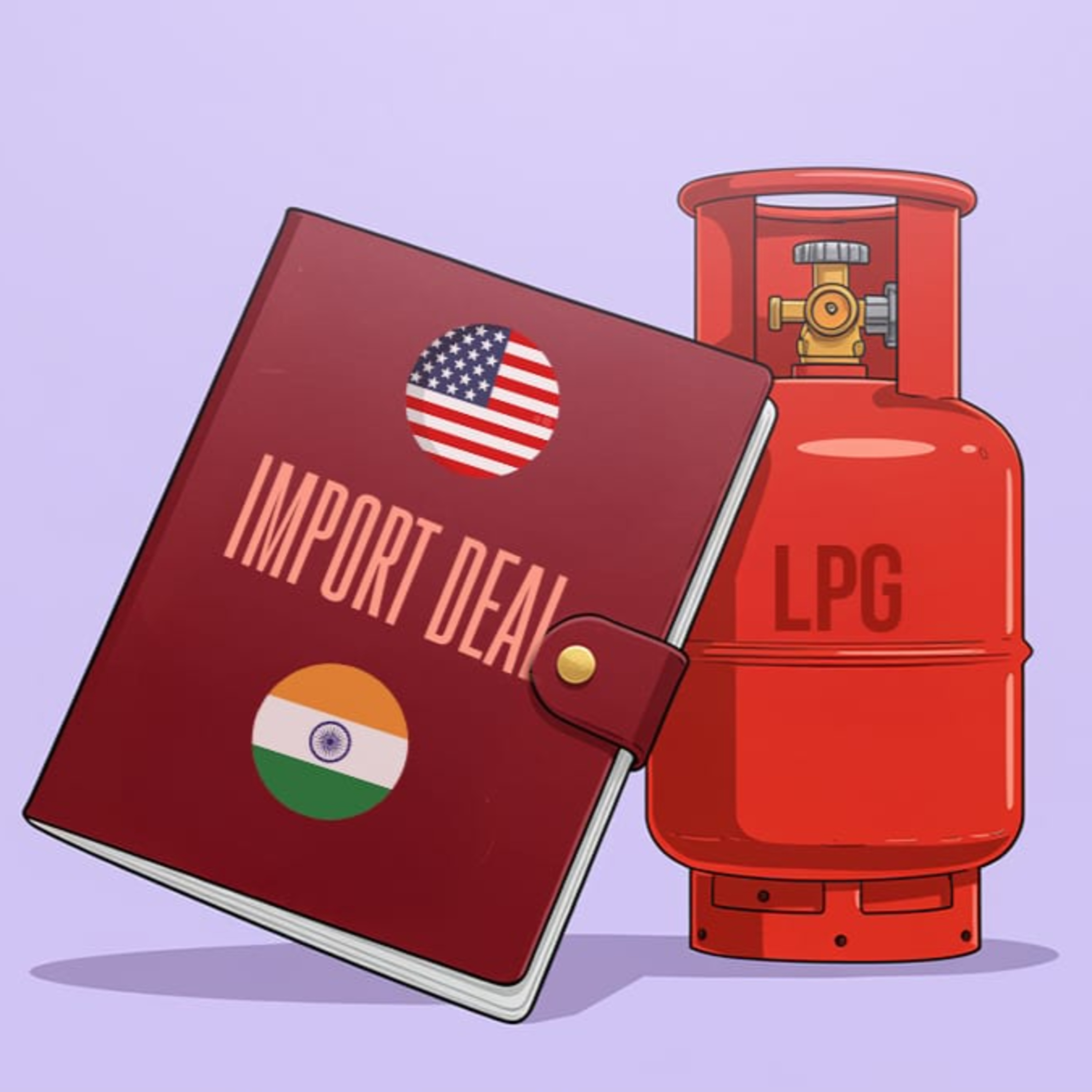
In today's episode, we break down India's first-ever structured long-term contract to
source 10% of its LPG from the US and what it means for you.
But here's a quick side note before we begin from Team Ditto.
Insurance actually matters only in one moment, when your family needs to make a claim.
Most people never hear real-claim stories until it's too late.
But choosing the right plan is just as important.
Many people buy policies that don't fit their needs, miski features or Oluq small details
that cost up later.
So this weekend, Ditto is hosting a free two-day insurance masterclass built around real cases
that we've handled and simple rules for shortlisting the right plan.
If you want clarity, real-world insights and simple steps, you can apply immediately.
This free masterclass series will surely help.
Click the link in the register while the seats last.
Now on to today's story.
When you wake up in the morning, the first thing you probably do is make yourself a cup
of chai (sorry coffee lovers) and that chai is probably made on a stove that lit up because
of an LPG cylinder or liquefied petroleum gas cylinder.
We're assuming that because most of India or about 62% of all households use LPG as
a primary cooking fuel.
Now, LPG is composed mainly of two flammable hydrocarbons - propane and butane.
And LPG used for cooking in India specifically needs to be more butane heavy.
That's because propane vaporizes at very low temperatures, meaning it reduces high
pressure even in cold climates.
That's great if you live in a country like Canada but not so much in a tropical country
like India, where most regions are warm or hot.
A propane dominant cylinder would build too much pressure in India's heat.
And on the other hand, vaporizes at higher temperatures, gives a steady flame and packs
more energy per unit of volume, which is perfect for cooking in a country like ours.
But why are we telling you all this?
Because this butane heavy preference is exactly why India is so heavily dependent on the Middle
East for LPG.
The source about 90% of our imports from there, despite the US being the world's largest
LPG producer.
Now the reason is simple.
Middle Eastern LPG mostly comes from oil refineries and refinery grade LPG naturally ends up
with more butane because of how crude oil breaks down during refining.
So Middle Eastern LPG is butane rich by default.
Basically a byproduct of turning crude into petrol, diesel and jet fuel.
On the flipside, the US produces most of its LPG from natural gas processing and not refining.
Natural gas teams contain far more propane than butane which is why US LPG's propane
dominant.
Naturally, this doesn't suit India's domestic cooking needs and of course, freight costs
from the Middle East to India have always been much lower simply because it's closer.
So the Middle East enjoyed a natural cost and product fit advantage.
But just yesterday, the Union Minister for Petroleum and Natural Gas, Hardeep Sengpuri
announced India's first structured long term contract to source LPG from the US.
Now think of it as a formal predictable supply deal.
Specifically, India's three OMCs iOCL, BPCL and HPCL will purchase 2.2 million tonnes
per annum from the US.
That's roughly 10% of India's annual LPG imports.
Before this, India mostly relied on spot market purchases or one-off cargoes negotiated depending
on price and availability.
Sure, we had recurring Middle Eastern suppliers but those were in fixed long term structured
contracts.
But now, India has gone ahead and decided to source a significant chunk of its LPG from
the US.
And you're probably thinking, wait, didn't finchots just tell me that US LPG's propane
heavy and way further away?
So why on earth are we buying from them?
Well, you can partly blame or maybe even thank the US-China trade war.
You see, China was normally the single largest buyer of US LPG.
But when Trump administration imposed huge tariffs on Chinese goods a few months ago,
like you know, China retaliated by slowing down LPG imports from the US.
Suddenly, US producers were sitting on extra propane heavy LPG they needed to send somewhere.
And the price is softened.
At the same time, the Iran-Israel conflict and tensions around the state of Hormuz pushed
Middle Eastern freight costs higher due to war premiums and risk insurance.
Since 20% of the world's oil and LPG passes through Hormuz, any threat of disruption makes
shipping more expensive.
And for the first time ever, the price of the US LPG to India became more competitive
with Middle Eastern supplies.
So India stepped in, bought some discounted US LPG shipments, and then decided to lock
in that advantage through a one-year structured contract beginning 2026.
The deal comes with some other benefits too.
For starters, by reducing Middle Eastern dependence by 10%, India gains some insulation from geopolitical
shocks around the state of Hormuz.
For context, a few months ago, India had backup LPG storage for only about 16 days of consumption.
Now that's not ideal if you're trying to keep Indian kitchens running.
So in a situation like this, diversifying supply sources strengthens energy security.
This diversification also means India now gets to work with two different pricing benchmarks.
Think of them as two separate reference prices that the world uses to trade LPG.
Middle Eastern suppliers follow the Saudi Aramco contract price, which is basically the global
benchmark for LPG coming out of that region.
For years, India has been tied almost entirely to this number.
If Aramco's prices went up, India simply had to follow it.
But with US imports in the mix, Indian OMCs can also buy using the bond bill of view benchmark,
the pricing standard on the US Gulf Coast.
And here's why that matters.
When you have two benchmarks instead of one, you suddenly have options and this gives
Indian OMCs some leverage.
If Aramco's prices spike, bond bill view might still be cheaper.
And if the US gets too expensive, the Middle East could be the better deal.
This competition between suppliers could eventually lead to more favorable pricing across the board.
And in fact, Middle Eastern suppliers know this and don't want to lose India, their biggest
LPG customer.
So they've already started lowering prices to stay competitive.
And finally, there's also a diplomatic angle.
As you know, the US recently slapped a 50% tariff on some Indian goods because it feels
that India sells more to America than it buys and keeps import duties on US goods high.
So by picking up more US energy, India is basically trying to balance the trade relationship
a little and make future negotiations a bit easier.
Now folks, there are some downsides too.
US LPG still propane heavy, which is an ideal for India's cooking mix.
This means OMCs will need to blend incoming US LPG with butane or adjust infrastructure
in some parts of the supply chain.
And yes, the US is much farther than Middle East, so freight will always be costlier.
The only reason US supplies became competitive this time is because China reduced imports,
temporarily depressing US prices.
But if China resumes normal buying, that price advantage may vanish.
But the biggest thing is that this cheaper sourcing may not automatically mean cheaper
cylinder prices for consumers like us.
That's because the price you pay for a cylinder today isn't the real price, even if you
have given up your LPG subsidy.
OMCs buy LPG at global benchmark prices after adding freight, insurance, port charges and
everything in between, and then still sell it to you at a standard rate of around ₹853,
which is a price for an LPG cylinder in Delhi for a 14.2kg cylinder.
Now in many cases, their buying price is actually higher than what you pay, and that gap widens
even more under the Pradhan Mantri Ujwala Yojana, where OMCs supply subsidized cylinders to
women from low-income households at prices that can be roughly ₹300 lower.
Now put all of this together and OMCs end up with something called under-recovery - basically
the laws between what it causes them to buy LPG and what they're allowed to charge you.
Now in FY25, this worked out to be around ₹220 per cylinder, adding up to a massive ₹41,270
crore in total under-recoveries for the 3 PSU OMCs.
Now this did improve by around 35% in Q1 FY26, that's between April to June 2025, partly
after a small ₹50 price hike that the government allowed.
But with cheaper US LPG coming in, and Middle Eastern suppliers lowering prices thanks to
competition, OMCs could trim these losses by another 37%.
Now sure, the government does compensate OMCs for these under-recoveries, but lower under-recoveries
simply mean that the government has to set aside less from its budget for the support.
And that budget is ultimately funded by, well you guessed it right, taxpayers like you and
me.
So yes, if you were hoping this new US deal would directly bring down your LPG Cylinder
price, that's not how this plays out.
And that's a long and short of it.
Alright folks, I will see you in the next one, until then have a tremendous Tuesday.
And if you want to share your feedback or suggestions, do drop us an email to
[email protected].
Until next time.
 PodcastTranscript AI