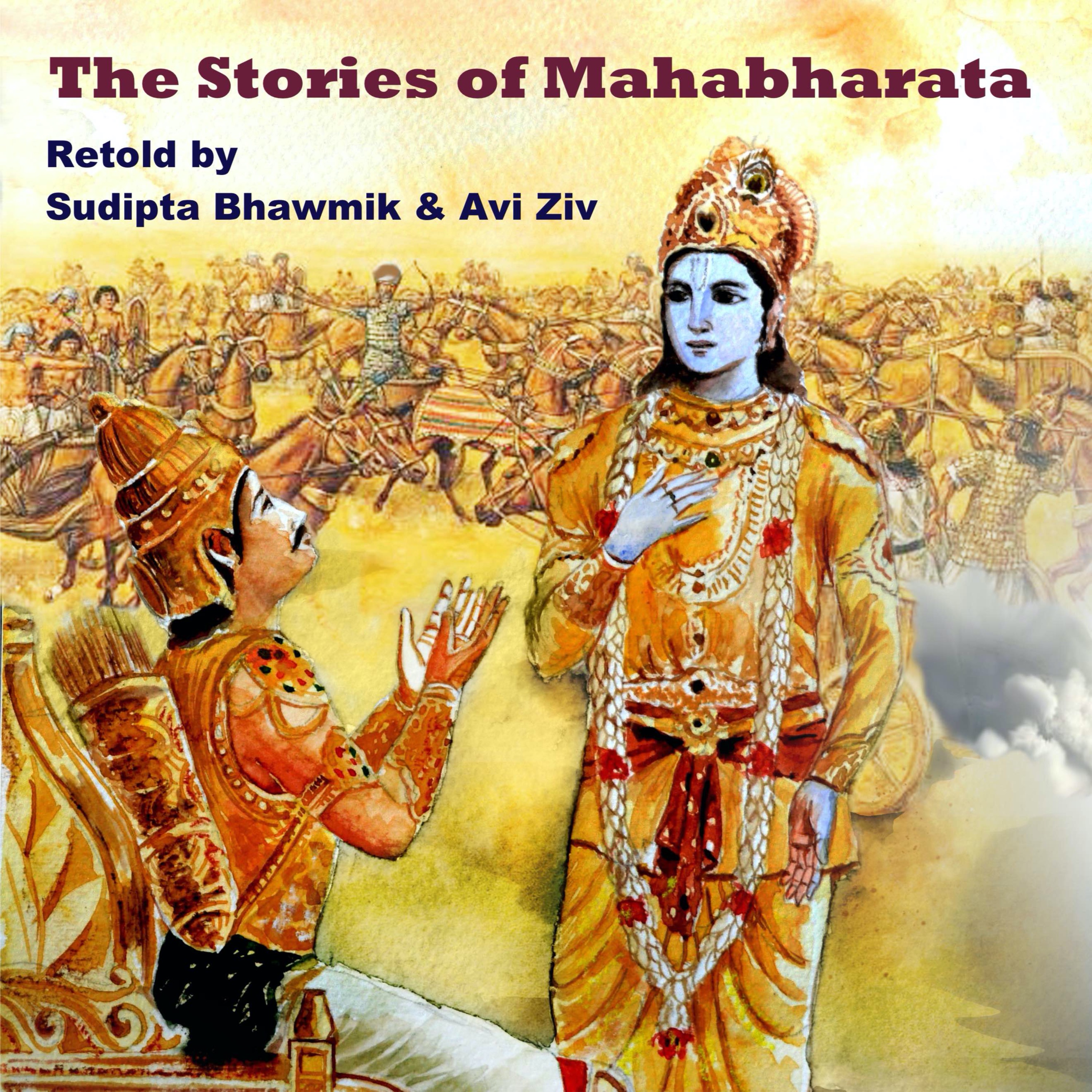
The transcription narrates the beginning of the Mahabharata epic, starting with Rishi Vyasa seeking Ganesha's help to write it down. It then delves into the tragic love story of King Shantanu and Ganga, leading to the birth and fate of their sons. Ganga revealed her identity as the river goddess and the reason for drowning their sons. Devabrata, later named Bhishma, made immense sacrifices to fulfill his father's wish to marry Satyavati, eventually renouncing kingship and taking a vow of celibacy. The summary highlights the intricate relationships and sacrifices within the Mahabharata narrative, showcasing themes of love, duty, and destiny.
Transcription
2836 Words, 15973 Characters
The Stories of Mahabharata, Retold by Shuddhipta Bhomik
It was the time of the Dwapar Yuga, the great Rishi or sage Vyasa, composed an epic poem
which he called 'The Mahabharata'.
Rishi Vyasa was the son of Satyavati and Rishi Parashara.
Since he was of dark complexion and was born in an island,
he was also called Krishna Dwipayan Vyasa.
Vyasa composed the poem but couldn't write it down because his thoughts ran faster than his pen.
So he was looking for a scribe who could write the verses at the same speed with which he recited them.
But he could find none.
Vyasa invoked Lord Brahma.
Brahma appeared before Vyasa and asked, 'Why did you call me Vyasa? What do you want?'
Vyasa said, 'O Lord, I have composed this wonderful poem, an epic.
It is the story of mankind, the story of our humanity.
But I need someone who can write it while I recite the verses.
Can you recommend someone?'
Brahma said, 'I think Ganesha would be the best person for this job.
Why don't you ask him?'
Vyasa called Ganesha, the elephant-headed god.
Ganesha appeared and asked, 'I understand you are looking for a scribe for your poem.
Yes, I am.' said Vyasa.
'I can write your poem for you,' said Ganesha.
'But I have a condition. My pen should never stop.
If you ever hesitate while reciting your poem and my pen stops,
it will not start again and I will leave right away.'
Vyasa thought for a while and then said, 'I agree.
But I also have a condition. You cannot write a single word or verse
without understanding it.'
Ganesha thought, 'That should be easy.
After all, Ganesha is a god and Vyasa a mere human being.
How could Vyasa write something that you wouldn't understand?'
Ganesha agreed to Vyasa's condition and sat down to write.
Vyasa started dictating the poem.
But whenever Vyasa ran out of material and needed some time,
he would compose a verse with difficult words and complicated phrases.
Even the god Ganesha had to stop and think to decipher those phrases
while Vyasa composed few more in his mind.
Thus, the great story of Mahabharata began to take shape
with this wonderful collaboration between Vyasa and Ganesha.
Long, long ago, they lived a king named Shantanu,
who ruled over a vast kingdom in the northern India.
Hastinapur was the capital of this kingdom.
One day, Shantanu was strolling along the river bank,
enjoying the cool breeze and listening to the soothing sounds of the flowing water.
Suddenly, he saw a beautiful maiden rise from the water
and walk towards the river bank.
Shantanu was awestruck by her exquisite beauty
and he understood what love at first sight meant.
He felt an invisible force pull him towards the lady
as he lost all control over himself.
He stood in front of the gorgeous lady and asked,
"Whoever you are, my lady, I am in love with you
and I cannot live a single moment without you.
Please, please marry me and save my life.
I, King Shantanu of Hastinapur, beg for your mercy."
The lady smiled and said, "I am flattered, O King,
but I have a couple of conditions for any suitor who wants to marry me.
If you can agree to my conditions, I will marry you.
But I must warn you, these conditions are not easy to keep,
especially for a husband."
Shantanu said, "For you, I can agree to any condition."
The lady smiled again and said, "Listen to them before you agree.
First, you can never ask or inquire about who I am
or where I come from.
Second, you can never stop me or ask me for any explanations
for any of my actions, whatever they may be.
If you ever break your promise, I'll leave you at once.
Do you think you can agree to these conditions?"
The infatuated King didn't have the patience to think through.
He said, "I agree. I will never ask you who you are
and I will never stop you from doing anything.
Now will you please marry me?"
The lady agreed.
Shantanu took her to his palace in Hastinapur
and married her in a grand wedding ceremony.
The happy couple spent a great year together
until their first child, a boy, was born.
When Shantanu heard the news that his wife has given birth to a beautiful little boy,
he left his coat and ran to the birthing chamber.
But as he entered the room, he saw his queen
pick up the newborn baby, wrap him in a shawl and walk out of the room.
Shantanu was about to ask where she was going.
But he remembered his promise and kept quiet.
He followed her as she left the palace
and went to the bank of the river where they had first met.
And there, he saw his queen drop the baby into the river
and within moments the boy sunk into the teapotters.
Shantanu was horrified.
How could a mother do such a thing to her own child?
He wanted to scream at his wife.
But again, he remembered his promise
not to ask any questions or demand any explanations.
He was hurtbroken, but he kept his mouth shut.
After about a year, when Shantanu had almost forgotten the trauma of losing his first son,
the queen gave birth to another child.
And this time too, the shocked king saw his queen
drown the baby in the river right after his birth.
Shantanu could neither protest nor demand any explanation for a horrific behavior.
One after another, the queen gave birth to seven sons
and each time she took the baby and drowned him in the river.
The king, bound by his promise, stood silent and watched the tragic events.
When the eighth son was born and the queen was
about to drown the baby in the river, Shantanu couldn't take it anymore.
He shouted, "Stop! Stop this! I won't tolerate this anymore."
The queen stopped and said, "But you have promised."
The angry king said, "I don't care for my promise anymore.
How could you be so cruel? How could you kill your own child?
I have kept my mouth shut all these years, but I won't let you kill my child anymore."
The queen smiled and said, "You have broken your promise.
Hence, I must leave you. But before I leave,
I'll tell you the reasons for my action.
I am Ganga, the river goddess. These eight sons,
seven of whom I have drowned in the river, are the eight Vasus of the heavens.
Once, the Vasus visited Rishi Vashista's ashram.
Provoked by their wives, they stole Vashista's cow, Nandini.
Vashista was furious and cursed them that they would be born as humans
and go through the sufferings as any human does.
The Vasus were scared. They cried and prayed for his mercy.
Only Prabhash, the eighth Vasu, the one who stole the cow, stood defiant.
Finally, Vashista calmed down, but he couldn't take back his curse.
He said the Vasus would have to be born as humans.
But the seven of them who begged for his mercy would be short-lived.
I was assigned to be their mother, and I had to relieve them of their curse
by drowning them right after their birth.
But the eighth Vasu, Prabhash, would live a long life on this earth
and endure the sufferings of human life.
The eighth son of yours is the eighth Vasu, Prabhash.
Shantanu was amazed to hear this story.
He pleaded to Ganga, "Please, please don't leave.
It would be hard for a boy to grow up without a mother."
Ganga said, "I'm sorry. My job is over, and I must go now.
I'll take this child with me and train him to be your worthy son.
Then one day I will return your son to you."
Saying so, she disappeared into the river with the newborn baby.
Shantanu was hurt-broken. He was sad and depressed.
Every day, Shantanu would go back to the river bank with the faint hope
to see Ganga come back with her son.
Days passed, months passed, years passed, but Ganga didn't come back.
Finally, one day, while he was taking his usual stroll on the river bank,
he saw a handsome young boy playing on the banks of the river.
Shantanu felt a strange attraction towards the boy.
As he walked towards the boy to ask him who he was,
Ganga appeared from the river. She came to Shantanu and said,
"Oh, King, here is your son, the eighth child whom I took away with me.
He has grown up and mastered the arts of warfare
from the great Rishi Parashurama, and he is as skilled and powerful as his guru.
He has learned all the scriptures and holy texts
from the great sage Vashishta and has become the wisest of the wise.
His name is Devabrata. And as I had promised, I have come to return
your son to you. Please accept him." Shantanu was ecstatic with joy.
He embraced Devabrata and took him to his palace in Hastinapur.
Soon, Devabrata became the most popular prince of Hastinapur.
His gentle and kind behavior, his courage and strength,
his wisdom and knowledge made him the obvious choice
as the rightful heir to the throne of Hastinapur.
One day, Devabrata was riding his horse in a
meadow nearby when he saw a huge army approaching.
It was King Shalya's army marching in to attack Hastinapur.
The 18-year-old Devabrata alone fought the entire army.
He defeated them, captured King Shalya and brought him as a captive to his father's feet.
Devabrata's courage and heroic prowess impressed King Shantanu.
The next day, in front of his ministers and subjects,
he proclaimed Devabrata as the crown prince of Hastinapur.
Shantanu, although happy to have his son Devabrata by his side,
felt lonely at times. He missed Ganga and often he would come to the river bank
and walk alone, thinking of her.
One spring afternoon, while walking along the river bank,
Shantanu smelled an intoxicating fragrance.
The fragrance mesmerized him and drew him towards the river
where he saw a beautiful woman on a boat.
The fragrance was emanating from her body.
Once again, the king was struck by the cupid's arrow.
The thoughts of Ganga vanished from his mind
and he felt that this woman was his destiny.
Shantanu walked up to the maiden and asked her,
"Were you my pretty lady?" The woman smiled and said,
"I am Satyavati, daughter of Dasaraj, the king of the fishermen tribe."
Shantanu picked up her hand as one would pick up a delicate flower
and said, "Satyavati, I am King Shantanu of Hastinapur,
but your beauty has cast a spell on me and has made me your slave.
Now on, I cannot live without you. Will you please marry me and be my queen?"
Satyavati smiled and said, "O king, I am honored by your proposal,
but you will have to ask my father for my hand.
If he agrees, I would have no objection to marry you."
Shantanu thought he was the great king of Hastinapur.
How could someone not agree to give his daughter in marriage to a
king like him? The confident king went to the fisherman's village
and met Satyavati's father, Dasaraj.
"O king of the fishermen, I am King Shantanu of Hastinapur.
I am in love with your beautiful daughter, Satyavati.
I would like to marry her and make her my queen.
Would you please give me your permission and your blessings?"
Satyavati's father, Dasaraj, welcomed King Shantanu with folded palms
and said, "King Shantanu, I am honored to hear your proposal.
Satyavati is fortunate that a great king like you is a suitor.
But as a father, I have my obligations to my daughter.
And that's what's keeping me from accepting your proposal.
I hope you'll pardon my insolence." Shantanu was taken aback a little.
He said, "What's bothering you? Tell me and I will try to quell your fears
to the best of my ability." Satyavati's father kept quiet for a while
and then with all humility he said, "O king, we all know that you have proclaimed
Prince Devabrata as the crown prince of Hastinapur.
No doubt Prince Devabrata deserves to be the king of Hastinapur.
But then if you marry my daughter, what would happen to her son?
The strong and powerful Devabrata would overshadow him
and he would have no role to play in the palace.
I cannot let that happen to my grandson.
If you can promise that after you Satyavati's son would be the king,
then I'd have no objection to give my daughter's hand in marriage to you.
Can you promise me that?" Shantanu was shocked to hear this.
But this time he did not lose his head.
He said, "That's impossible. I can never promise such a thing.
Devabrata will be the king of Hastinapur after me."
With folded palms, Dasaraj said, "Then please forgive me, O king.
I cannot agree to give you my daughter Satyavati."
King Shantanu came back to the palace with a heavy heart.
Devabrata noticed the change in his father.
He had never seen him so depressed. He asked,
"Father, what's the matter? Why are you so unhappy these days?
Please tell me and I will try my best to resolve the issue."
Shantanu looked at his son and said, "I am not worried about myself.
I am worried about our kingdom. Our enemies keep on attacking us
from all directions and you have been fighting them all.
I know, I know you are invincible. No mortal can defeat you in war."
But accidents happen.
If something ever happens to you, what will happen to this kingdom?
Who will protect the people of Hastinapur? What will happen to our Kuru dynasty?
Wise men say, "Having only one son is same as having none."
Devabrata sensed that something more must have been bothering his father.
He inquired with the ministers and other well-wishers of the king.
Finally, the king's charioteer gave Devabrata the real cause of his father's
depression. The charioteer told Devabrata
about Satyavati and how her father Dasaraj had rejected Shantanu's
proposal to marry her. Devabrata mounted his chariot and dashed to
Satyavati's father.
"Oh, King Dasaraj, I hear you have rejected my father's proposal to marry
your daughter Satyavati. Tell me, what can I do to make you agree?"
Dasaraj said, "I have already told your father my condition.
I am concerned that if your father marries my daughter Satyavati,
my grandchildren would be deprived. You are the crown prince of Hastinapur
and after your father you'd be the king and my grandchildren will have no
chance." Devabrata said, "Is that all?"
Then I, Devabrata, son of Ganga,
promise that I will never claim the throne of Hastinapur.
I will never become the king. Satyavati's son,
your grandson will be the king. Will that satisfy you?
But Satyavati's father was still not satisfied.
He said, "That's very kind of you, Prince Devabrata.
But even if you renounce the throne, what about your children?
When they grow up, they would stake their claim to the throne
for sure and this can result in a dangerous feud in the family.
I cannot allow this to happen." Devabrata thought for a while.
Then he spoke, "O king, I stand before you, before the gods
and I promise that I will never marry and I will stay celibate forever."
Hearing this profound vow, the gods showered flowers on Devabrata.
They all chanted Bhishma, Bhishma, henceforth for this Bhisham or
profound vow, he was named Bhishma.
The fisherman king was pleased with Bhishma's promise
and agreed to give Satyavati in marriage to King Shantanu.
Bhishma took Satyavati on his chariot and brought her to the palace
in front of his father, Shantanu. Satyavati's arrival washed away
Shantanu's depression. The happy king embraced his son in
gratitude. Soon the marriage ceremony was held
and Satyavati became the queen of Hastinapura.
But when Shantanu came to know of his son's terrible promise,
he was hurt broken. Bhishma consoled him, "Father,
father, your happiness is more than anything I can ask for.
I can give up my life to see a smile on your face.
This vow is nothing in comparison."
Shantanu blessed his son and said, "My dear son,
I give you this boon that you will have the power
to decide your time of death. No one would be able to kill you
unless you want to die. This boon, just short of immortality,
made Bhishma invincible to anybody, except himself."
On Twitter, we are @mahabharataudio. The podcast is distributed under the Creative Commons
non-commercial license.
And now for some late-breaking news. The podcast is also available as a book
to aparkata, the stories of Mahabharata,
published by Harper Collins India.
Podcast Summary
Key Points:
The epic poem Mahabharata was composed by Rishi Vyasa during the Dwapar Yuga.
Vyasa sought Ganesha's help to write down the verses of the Mahabharata at his recitation speed.
King Shantanu fell in love with Ganga, who had conditions for their marriage leading to tragic events.
Ganga revealed her identity as the river goddess and the reason behind her actions with their sons.
Devabrata, later known as Bhishma, made significant sacrifices to fulfill his father's wish to marry Satyavati.
Summary:
The transcription narrates the beginning of the Mahabharata epic, starting with Rishi Vyasa seeking Ganesha's help to write it down. It then delves into the tragic love story of King Shantanu and Ganga, leading to the birth and fate of their sons. Ganga revealed her identity as the river goddess and the reason for drowning their sons.
Devabrata, later named Bhishma, made immense sacrifices to fulfill his father's wish to marry Satyavati, eventually renouncing kingship and taking a vow of celibacy. The summary highlights the intricate relationships and sacrifices within the Mahabharata narrative, showcasing themes of love, duty, and destiny.
FAQs
Rishi Vyasa composed 'The Mahabharata'.
His thoughts ran faster than his pen.
Lord Ganesha helped by writing as Vyasa recited.
Ganga revealed that the sons were the eight Vasus cursed by Rishi Vashista.
Devabrata made a profound vow of celibacy, earning the name Bhishma, to secure Satyavati's marriage to his father.
Chat with AI
Loading...
Pro features
Go deeper with this episode
Unlock creator-grade tools that turn any transcript into show notes and subtitle files.
 PodcastTranscript AI