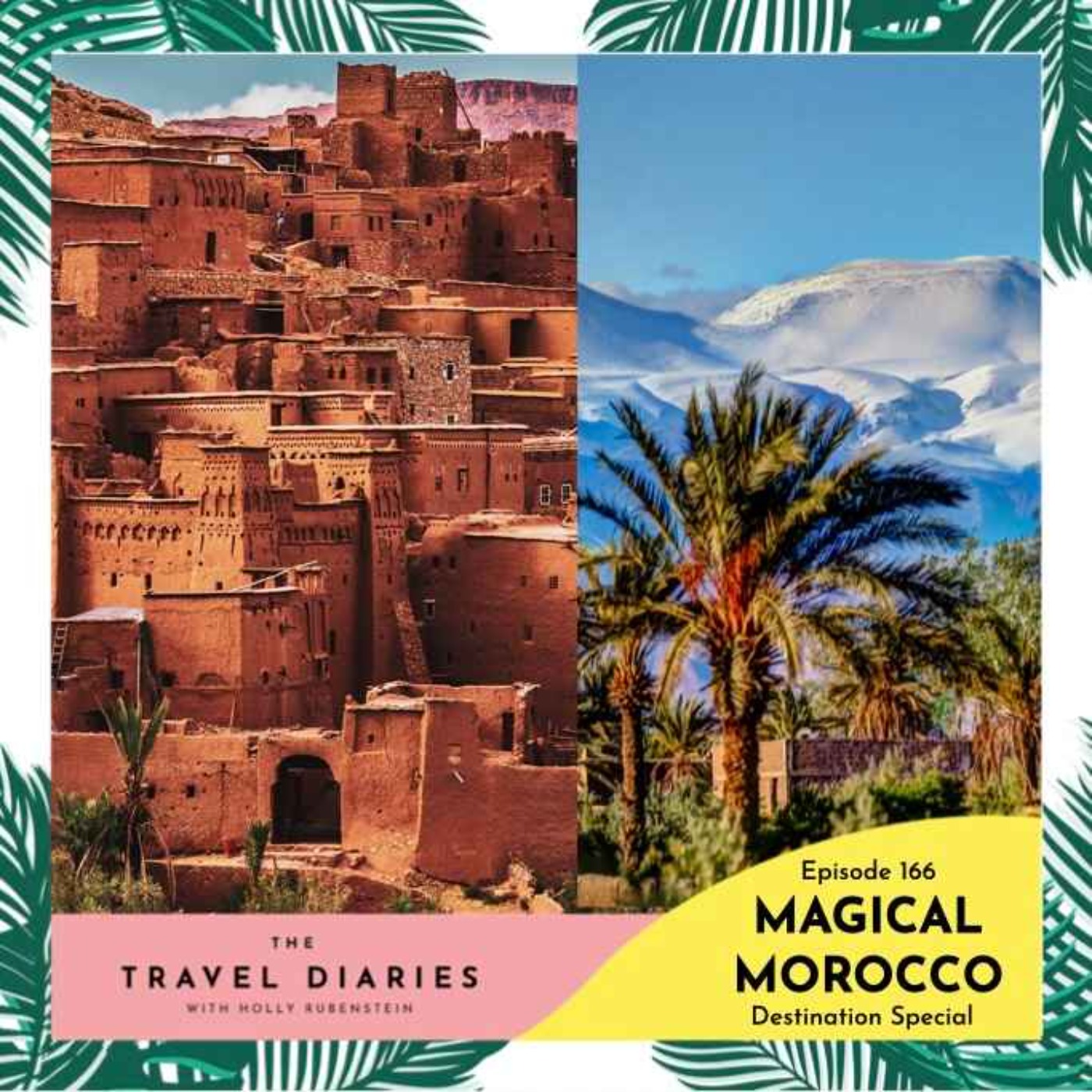
This special edition of the Travel Diaries podcast celebrates Morocco through vivid recollections from past guests and insights from travel expert Paula Hardy. Listeners hear personal stories highlighting Morocco's sensory richness, from Marrakesh's bustling souks and artisan trades to the serene Sahara and Atlas Mountains' tagine-scented villages. The episode notes a significant rise in UK visitors, driven by Morocco's accessibility, cultural depth, and diverse landscapes—ranging from Tangier's Mediterranean greenery to remote desert oases. Paula Hardy recommends exploring beyond Marrakesh, suggesting northern destinations like Tangier for its lush gardens and Tetouan for authentic crafts, while also touching on modern advancements like high-speed rail and the 2030 World Cup. Throughout, Morocco is portrayed as a place of timeless tradition and evolving experiences, captivating travelers with its blend of adventure, connection, and unforgettable moments.
Hello and welcome to a very special edition of the Travel Diaries podcast. Today we are traveling to a place that's so many of my guests have spoken about with real passion. A country that seems to cast a long lasting spell. It is of course Morocco. Today's destination special is a love letter to a country through the voices of those who've experienced it at its most magical. In the first half I'll be sharing a series of reflections and memories from some of the brilliant guests who've joined me on the podcast over the years, all describing the moments that made Morocco unforgettable for them, whether it was the colours of Marrakesh, the silence of the Sahara, or the scent of a Tagine cooking in the Atlus Mountains. Each person captured something personal and unique and it felt only right to bring them together like a tapestry to celebrate just how rich and varied Morocco can be. And it's clear they're not the only ones feeling this way, UK visitors to Morocco are up by more than 40% in the past year alone with adventure and touring holidays, seeing an almost 100% surge. And it's no surprise, Morocco offers that rare combination, a short flight from home, but a total shift of pace, immersive, sensory and unforgettable. And then in the second half of the episode, I'm really pleased to be joined by Paula Hardy. Paula is a brilliant travel writer and a Morocco expert who splits her time living between the UK and Morocco. She takes us beyond the usual hotspots with insider tips that span the entire country, from the Mediterranean feel of Tangier and Tertuan in the North to remote desert oasis near Scoura, coastal towns like Asila and hidden mountain villages. We explore Morocco's deep traditions, its craft, cuisine and culture, as well as its exciting evolution with new high speed trains, striking new architecture and preparations underway to co-host the 2030 World Cup. So whether you've been once, many times or it's been on your bucket list for years, this episode will hopefully show you and Morocco you may not yet know. I remind you why so many travellers return again and again. But you people have travelled the world like actor and presenter Sir Michael Palin and yet when asked about his all-time favourite journey, he chose Morocco. The desert is such a spectacular background to everything. The desert conditions everything. You know when you, you, I mean, travelling through Morocco was one of those wonderful journeys I've done right from Tangier which is very sort of a bit European and then to Fez a beautiful old city but very sort of closed people are behind doors and life goes on behind, behind closed doors. Then to Marrakesh becoming rather more commercial and then people don't normally go on south of that but to go south of that then you really are in the desert. I remember just realising that we know more hotels, your intense and the wind blows at night, you're going to wake up in the morning with sand about an inch in your tent. Even the bread you buy will have, will have been baked outside and will have bits of grit in it. So there's a feeling immediately you are possessed by the desert and everything is sort of the context is this great big, very vulnerable expanse. There's no way really to hide there when the wind blows. Let's head now to Marrakesh, a city of artisans of colour and contrast. First we'll hear it from designer Ania Haymash, followed by Lynne Hughes, the editor in chief of One Last Magazine. Well the oldest memory I have of travel was actually being in Marrakesh with my parents. I was probably about, I would be five or six. I remember how intoxicating it was and just the sound of the birds and there's incredible blue skies and the bright orange fruits and all these oranges were in baskets. You'd wear a basket of oranges, I think clothes contain a bit of basket. These are things that just felt very foreign, all the oranges had leaners on them, I remember well. It just felt different and exciting and scary at the same time. That's a memory that goes deep and I think my parents travelled a lot and I always took this with them so it was a nice early memory. I love the fact in Marrakesh that you can, there's so many trades, you can find people who can work metal or can work ceramics or you can actually do amazing embroidery or you can do a lot of printing and they can weave baskets. I mean there's so much you can do so it's quite exciting the sense you can have an idea and put it into action literally within the dinner. That's really exciting. For me I think it's more about the place that I go way to have a break to clear my head really and I think there's something about that intoxicating mix of the cool to prayer and as we say those blue skies and the sound of birds is breathtaking and it's really it's definitely actually. So it's just a place that I just, it gives me, I suppose the closest place to the UK that feels properly foreign and that's very exciting. When you go there, do you stay is there a particular spot that you like to visit? In Marrakesh itself I almost stay in Elfen and then we tend to head out quite quickly to sort of footsies of the Atlus mountains as it was called the Caspar Belldi which is just very very simple. It's really like lots of little farm buildings actually and it's on the edge of the Lallit of the Hoos, the Dharaj, the dam there. So there's a damned lake. So there's a sort of sense of seaside in the funny way. I think a lot of the Marrakeshs go out there for the weekend. It's some really fun restaurants that feel almost a bit like sort of St. Ponceig and incredibly chic and quite on the sort of slightly drying out the Dharaj lake. But it's really cool, actually cool and dusty and fun and very simple to everything that appeals to me. But I love it. We always ask them to put on the hammam so the night they arrive and have a wonderful hammam sort of scrubbed within a inch of our lives. And then sort of hot, hot, and tagine by the fire where we read our books. It's really relaxing and then you're on big heights the next day. It's just a really lovely place. It's a marigold. I love the city that seems to have, I don't know, been pulled back to a lot again and again. Or I seem to perhaps almost end up back in somehow by accident. It's Marrakesh. I think it's one of those places you'd find hard to get tired of. It's actually where I met my partner as well. And I'm pretty good with a wanderlust trip. It's always exciting to be back in Marrakesh and perhaps walk through the suits to the main square, General Fennar. And as you get closer, the anticipation rising and you can hear the drums as you get closer where you get all the strict performers in the square. You get that ride and energy and to go and perhaps go to the rooftop of one of the cafes around the square or something. As the sun goes down and you get the food vendors with all the smoke comes up from their fires where they cook with food and you've got the street performers and you've got this hubbub of life below you. And that still always gives me a thrill. Yeah, absolutely. Many use Marrakesh as a launch pad to nature. In less than an hour you're in the cool dusty foothills of the Atlas Mountains. The Atlas Mountains are one of Marrakesh's most majestic features, a land of burba villages and snow top peaks. And it's a place beloved by some of the most intrepid of our guests, Richard Branson, TV chefs, the hairy bikers and presenter and blind eventual Amalette. I mean, up in the Atlas Mountains outside Morocco, outside Marrakesh, it's just so beautiful up there. Mount Tupacall is a lovely mountain to climb which we did last year and second Africa. And we just happened to have a little place called the Casper Tamadot which is run by the Burber community. The Burber community are just gentle, wonderful people. And I'd been there six times in the last 12 months, so I really love it. One of the favourite properties I've ever been to. You've been there? Yes, I was there in November and I had the most magical time and as you say the staff there are just so wonderful. If there was one that you would say that you really should do in your lifetime, is there a particularly iconic route that you would suggest to add to someone's biking bucket list? You can get up the ferry in Tangier and two days later you've got your front wheel in the Sahara desert. You've been up through the snow and then you end up in the Sahara of an acol beer. So that contrast in kind of one journey? Yeah, you work your way up and I was about out of my out of Tangiers Marrakesh and you can see it smell all the tigines, you know, cooking on people's walls and then so you eat, then you're in the snow, so you're cold. But then when you start to drop down to Azazet towards the Sahara, the whole world just opens up before you. It's like coming down from an aeroplane. For example, in Morocco, in the Atlas Mountains where the burbars live, time has stood still. They're going to the local markets on donkeys, you know, and you're walking through these mountainous villages and the local people, they're so lovely, they don't have much, but when they're breaking their bread and their stoves outside, they see me with my groups walking past and they're like, you know, they communicate to us and they give us bread and we're having this amazing moment with them and it's so peaceful and it's so wonderful. Time stood still. You're seeing people making clay pots like they have been doing for centuries. These are the kind of places that are so special. You're cool to pray. Oh God, the call to prayer. You know, you've got lots of little mosques and different places and you know, it's kind of got that haunting sound. It's just so amazing and I absolutely love it. Finally, let's descend from the mountains to the Golden Gateway of Azazet. This cinematic frontier town is known as the door to the desert. Let's hear from Travel and Leisure magazine editor Jackie Gifford about her experience staying there. As an editor, has there been a particular feature written by one of your contributors that made you fall in love with a destination that you hadn't been to and then made you decide to book a trip to go there? Oh, good question. Yeah, I mean, that happens pretty regularly for me. I find that I'll read a story and just go, oh my gosh, like I need to go. I would say this happened years ago, but a long time contributor to Travel and Leisure Maria Shalumbarger had written a story about Morocco and some of the desert camps there and I then promptly booked a trip to go to to go to Morocco within the next, I'd say, like, you know, nine to ten months a year. I just started a travel measure and I remember reading Reis Peace and just being like, you know, Morocco has always been on my list. I need to see it and I went with my husband. We stayed in Marrakesh. We went to a beautiful hotel outside that, you know, in your wars is that called Dar Ahwan, which is a Relays Chateau property where the owner who's now, you know, quite, he's created some really interesting concepts including a roving hotel around the world. Oh, yeah. His name is Terry. Yeah. So Terry had created this other, I believe it's called 700,000 hours, but it, this roving hotel, but he's one of his first projects with Dar Ahwan and they'll create these dinner setups for you in the middle of, you know, in the middle of the desert, in the middle of nowhere. And every night when you stay there, breakfast, lunch, and dinner is always in a different location and it's just like a, it's like theater. And it was so interesting because the hotel is just in the middle of nowhere, frankly, and we drove to get there and through a snow storm and it was through a pass in the Atlas Mountains. And when we got, when we got to the hotel, it was just, it was just so special. And I think that was a good example of just dreaming about a place and saving up for it, you know, saving up for the trip because it wasn't inexpensive and deciding to go and I was completely, and I wasn't, you know, at that time I wasn't the editor in Super Travel Major, but I read a story and felt like I had to go and take action on it. The power of great travel jamb, isn't it? Yeah! And that brings us to part two of this special episode. Coming up next, I'm joined by Travel writer Emoroko Expert Paula Hardy, who's spent over 15 years unraveling the stories of Morocco. And she's here to share her ultimate Moroccan travel diaries. Now don't forget that all the recommendations made by Paula and our previous guests are all included in the episode show notes as you're going to want to remember a lot of these gems. Paula, welcome to the Travel Diaries. It is so lovely to see you. How are you? I'm great. Thanks for having me. Oh, my pleasure. I'm really looking forward to talking all things. I'm really looking forward to talking about Morocco with you. I can think of a better guest to fill us in on everything that the country has to offer. And it really is having a moment right now, isn't it, Morocco? I mean, the UK arrivals are massively eventualities of booming. What do you think is really behind this renewed fascination with Morocco? Morocco seems to me to naturally meet the moment in the current world we're living in. Not just as a travel destination, but also in life in a way. And by that, I mean that it's, Morocco is a place that feels unfiltered. It feels very real. And I think it is a place where people really connect with other people. And I think that's very natural in Morocco that happens very naturally. People nowadays, they are looking for kind of connection. They're looking for adventure, but I really feel like it's this kind of connection with other people when they travel that really sort of makes Morocco quite special. And I guess also there are easy flight rates, certainly from the UK. The flight is pretty short about three and a half hours or so, isn't it? Typically. I mean, I'm not really. Absolutely. I mean, if you fly to Tanger, it's barely three hours. And if you go further south, yes, to Marrakesh, it's three and a half hours. So yeah, it's really close. But it's one of those destinations where you can fly three hours, but you really do feel like you're experiencing a different culture. It's not like, you know, Britain on sea. You're getting a really different immersive cultural experience. And I guess that must be another reason why I'm absolutely falling in love with Morocco because they can just really feel like they're being transported somewhere very different. Absolutely. I mean, I think you're really right. And also, like if you let's say you fly to Tanger or you fly to Marrakesh or you fly to Agadir, even in themselves, those places are very different from each other. Yeah. So climatically, sort of what they look like, even the sort of vibe of the cities or the regions. So yeah, I think absolutely. It's somewhere you can go sort of, you know, dozens of times and be completely transported to another world that's very different from Europe and the UK. Yeah. A lot of travelers, I think, will have been to Marrakesh. A lot of people listening to my podcast will have been there. But what would you recommend as the first destination in Morocco for a traveler to visit beyond Marrakesh on their like second trip? Oh, that's a tough one. I mean, I would probably say go north because for the contrast, I think that would help people understand the scale of diversity in the country. So Marrakesh is very kind of earthen and red colors. It is that kind of desert heat, you know, it feels like a desert place. Whereas let's say if you flew to Tangier or even Rabat is a bit further south, the capital city, it feels more Mediterranean. It's very green around there. The Medinas are whitewashed. They're not earthen. The sea is a huge influence on the food and the kind of literally the air. You know, you have this kind of balmy Mediterranean climate. So I think that would be a great second place, Tangier, because it does give this kind of real contrast. But again, it's still very Moroccan. I mean, it feels closer to Europe and it has a Mediterranean feel. But it's still very Moroccan in terms of the markets you go to, the things that you're buying, the suks with all the stuff and the shops, the jewelry, the textiles, everything. And I just think that would be a nice kind of balance to see that compared with Marrakesh. It's great to hear you talk about Tangier because I've not been, but I'm really dying to go because of a hotel that I'm desperate to review there. I'm sure I knew you were going to say that. Oh my gosh, I've seen it on Instagram. I've read about it. It looks like a complete oasis. Have you been? Yes, yes. And I mean, it's stunning. I mean, you know, it is one of the most beautiful sort of villas and gardens. I mean, the garden is such a huge part of it as well. And of course, it's extremely kind of elegant and beautiful, Jasper Conran, the owner, you know, he has a very sort of elegant touch. And it's in a fantastic location. It's right at the top of town in the Casbah. So you know, you just have kind of 180 degree sea views. And then sort of below you when you're on the roof terrace is just this magnificent garden, like full of Bougainvillea and a canthus and palm trees. And I mean, yeah, it's completely dreamy. So definitely go. I think it defies the perhaps preconception of a vision of Morocco as a whole because it's so lush and verdant. Yeah, I think this is really, it would be a huge surprise because I mean, you know, one of the misconceptions I think about Morocco is that it is a desert country that it is, you know, North Africa. And when people think North Africa, they think the Sahara, they think desert, you know, and that kind of vision. And then I think it's really kind of quite a dramatic surprise when you kind of fly into Tangier. I mean, you can see from the plane how green everything is. And then you land. And yeah, it's a completely sort of, you know, bosky Mediterranean climate with pine, Aleppo pine trees and rosemary and like, you know, even the smells and of the sort of macchia and things like that are completely different to the south. If you went to Tangiers, there's certainly enough in Tangier to just base yourself in Tangier and spend four days there sort of exploring Medina doing like a minute. Maybe one or two museums and then maybe going to the city catch and beach, which is about a half hour drive west of sorry, Tangier. So that would fill four days very easily. But if you did want to explore further a field, you can easily go to there's a small sort of Medina sort of fortified coastal town called Aseela, which is about an hour's drive away. And I don't know if you're familiar with Esawira, which is close to Marrakesh. It's a similar sort of place and it's a kind of totally enclosed coastal fortified town. But there's like, there's almost no one there. I mean, and you know, there are, there are some tourists there, but it's really very quiet and peaceful. And I mean, so that's a fantastic day trip. Before you could go east of Tangier to Tatuan, which is a, it's one of the best preserved Medinas in Morocco. And it's very, it's a kind of intellectual city that has a well-renowned university there. It also has the equivalent of a kind of arts academy there. A lot of Morocco's kind of master craftsmen train there. And it's very authentic. Again, it's not particularly on the tourist radar at the moment. And so that is a very kind of, it's completely real that Medina, like I mean, if you want to get anything made, it can, people can make it for you in an instant. I mean, the Medina there is fantastic and you can spend hours there. No one really pays much mind to you. The food has a slight Spanish flavour because of the kind of Spanish influence there in the past. I'm quite addicted to, they have these Bocadillo sandwiches that are just like, oh my god, they're so delicious. So yeah, so I think that's a, that's a different sort of, that's also a different experience. Yeah, those are brilliant recommendations. Like hidden gem destinations, like you say in the sense that they're not on the typical tourist trail. No, no, and I don't know if you know, but the Royal Mansor, which is Morocco's flagship hotel brand, and that has opened their most recent property is 20 minutes from Ted to one on the, on the sea on its big side property. And honestly, it's one of the most beautiful properties, hotels I've ever seen in my life. It's fantastic, yes. And it's a wellness focus there, right? Yes, I mean, they, it's a sort of, you know, beach resort, but their wellness centre is spectacular. I mean, you could spend a whole week just in the wellness centre, you know, where they've kind of, it's a modern wellness centre, but they really sort of brought to bear. That kind of Moroccan tradition of the hamam and the kind of bathhouse culture that Morocco has. And they've sort of set it within this modern context with a lot of also contemporary wellness treatments. But I feel that it really also engenders that Moroccan wellness tradition that is centred in the hamam. Oh, it's somewhere I'd love to visit on my hotel wish list as well. I mean, we've talked about two very high end, high price point properties there. Are there any places in the north that are at a more accessible, a kind of rate that you have really liked to visit in the past? Yes, I've, I mean, in a sealer is a beautiful place called Dara and Brozier. It's a house. It's very well priced for a, you can sleep 12 people there, but or less. I mean, you rent the whole house, but that's 400 euros a night, but for, you can sleep 12 to 12 people. Wow. Tanger has a huge range of property. And it's not necessarily that, you know, quality or atmosphere is dependent on price point. There's a very beautiful property in Tanger called Mimi Calpe. It's a little bit like a sort of country house hotel, strangely. It's not in the Medina. It's just beside the Medina. So like 10 minutes sort of walk, but you know, it's in a garden that, I mean, that's super quaint and that's probably around, you know, 160 euros a night for a room or maybe 120, depending on season, you know, there are dozens of kind of very quaint bejou reads in the Medina. So I think actually Morocco has, that's the real strength of Morocco that there is really a good range of price points as well. And the standards are really very good. Yeah. Yeah, absolutely. You mentioned the season. And obviously, you know, when you think about Marrakesh, you think it's pretty hot like nearly all the time. But if you're going slightly in the, if you're going further north, are there, is there, what would you say is the kind of optimal time to visit? Well, I think actually May, May, June is very nice month, particularly, I mean, if you want to swim in the sea early in the year, the sea can be, I mean, the weather is lovely in April onwards, but the sea might still be a bit fresh. So let's say if you wanted to go and you're interested in hiking in the Riff Mountains or along the coast, April would be a fantastic time to go. That's also when the gardens are very beautiful. Then I think if you also want to do a bit of swimming and enjoy the sea a bit more, then going sort of mid-May to June is a beautiful time because the sea is warmed up then. And again, you know, September October would be very nice months as well. But then having said that, I mean, I've just come back from Tangur and it's mid-July and the weather was sort of fantastic there. It was like 25 degrees. It was quite breezy. It was very comfortable. Like, we didn't use aircon at night or anything. We didn't need it. So I also, it's not necessarily that it's so hot in summer. Again, it really depends where you are in the country. Yeah. I guess then, contrasting to that, if you wanted to go to Morocco to have a desert experience, where would you recommend for that? Well, there are different desert experiences. So if you wanted to, Morocco is quite famous for these two long river valleys. They're essentially dry river valleys. One is called the dry and one is called the dadez. And so you kind of can journey down them and it's kind of palm trees, away seas, whatever. And then you get to the desert proper. At a small town, there a small town, one is called a Mohammed, another one is called a food. And from there, you can launch off into the desert proper. And that would be sort of camps beside, you know, those kind of picture book, June's. You'd be staying in a bedo in sort of tent. So a large tent, not a little camping tent. You know, it would be laid with carpets and you'd have a mattress. So it's a fairly comfortable camping experience. Those are the sort of points where you would launch off into the desert. And you can do things like a camel trek or you could do a four-wheel drive trek. And it could be a multi-day trip across the desert and across this place called Iriki, which is a dry lake. And then you could come back round to a town called Taradant. It's similar to Marrakesh, but it's sort of a more desert town. But it is the sort of mud-break town. So you can do a nice sort of journey across the desert to Taradant and end up in another kind of earth and Medina where you can sort of end your trip in quite a nice hotel. Oh, that sounds like a great recommendation. Did that correlate to where Jackie Gifford mentioned in terms? Is that anywhere near was was is art? Yes, Jackie Gifford mentioned Daraahlam where I was just at Daraahlam last week. And yeah, yeah. And it is one of the most amazing places in the country, no doubt about it. It's this incredible mud-break caspo, which is basically a castle, a Moroccan castle, with sort of four towers. And it's in a no-aces called Skurra, which is about 30 minutes north of Wasazart, which is the main sort of juncture to go to the desert. So for example, there are Ryanair flights to Wasazart once a week, I think, so you can fly directly there. And so, yes. So Skurra is like about 30 minutes north of Wasazart. And Skurra is this magical kind of date palm oasis. Strangely it's at quite a high altitude, 1,200 meters. So it has a good, it has lots of water. So that makes it very lush and green. So when you're in Skurra, it's, you know, the top canopy is the palms. Then underneath you have almond trees, fig trees, apricot trees, pomegranates, you know. And you sort of all the paths in the oasis are sort of just mud tracks. So you can sort of cycle around the oasis, you know, in early summer it's sort of ridiculous, like sort of fruit dropping off the trees that you could literally pick up and eat. Like sometimes you just think, am I dreaming? And then Darahlam is sort of sits in the middle of this incredible palm grove. And yes, I think, you know, Jackie Gifford may have explained it's this sort of extraordinary hotel run by a man called Cherry Thessia, who has a very interesting idea of tourism. He is much more focused on regenerative tourism, on how tourism, how Darahlam can work with and benefit the local community, but in a really meaningful and integrated way. And is that a good kind of launch pad also to then have your kind of typical touristy kind of desert experiences as well? Yeah, so I think what you would do is you, if you might fly into Ozzazar or drive to Ozzazar from Marrakech, then you might spend like three days in Skurra and then you would launch off down, the River Valley and heading to the desert. And even around Skurra, there are sort of more desert areas because the the oasis are tend to be in valleys. And then all around you is this incredible sort of like moon. It's like the surface of the moon landscape. So, you know, you can have sort of various desert experiences around Skurra, but if you really want the June fields, you have to go further south because, you know, not all the desert is the nice pointy June's. Yeah, yeah. So, so what was it that made you first fall in love with Morocco? How much time do you spend there each year now? And what was, yeah, what was the first kind of place that captured your heart? I probably spend half my time in Morocco and have done for quite a while now. I first came to Morocco as a child. One of my best friends is Moroccan from when we were 11 years old. She's now a filmmaker in Morocco. So, this was the, you know, the first connection. And I used to go there for holidays at her house, you know, near it's a place called Cabo Negro near Tatuan. And that continued, that love of it. And I suppose, I mean, really the impactful memory that I have of of Morocco is when I was probably around 20. She was making a film there. She was at film school. So, we were filming there in the Medina of Tatuan. We're sitting in this cafe. Just a local cafe. I remember the wall was sort of painted half blue, half white. So, the kind of light in the room had this strange sort of bluesy aura. It was quite cold and there was a elderly gentleman sitting there in a Bernouce, which is a heavy woolen coat with a pointy hood, which he had up. And, you know, we had mint teas, which you could smell. And I was sort of looking out the window, this quite ornate grill. And you could see the local Amazigh ladies in the marketplace selling kind of piles of herbs and vegetables. And they wear these sort of amazing straw hats with these colorful pom-poms on them. And it was just so, I don't know, it's like that scene is imprinted on my memory. It's so, it was so cinematic. And it was just so sensory, the whole thing. And, you know, I just thought, you know, Morocco is an extraordinary place and it's full of scenes and moments like that. And I just think that it kind of makes life an adventure every day because you just see these extraordinary things all the time. And I think that's quite rare in the modern world. Totally. And obviously that was a little while ago. Would you say that you would still see those kind of similar scenes now? I mean, has things changed that much? Things have changed, but I think not that much. There has been over the last 10 to 20 years, there has been a long process of, I'd say, fairly well managed development in terms of, for example, in Marrakech Medina, many of the shops didn't have electricity before. And, you know, there were issues. And about, I think, five years ago, the Marrakech Medina was restored. But it wasn't like, I mean, I think what's interesting about Morocco's development is that it's not this kind of tearing down of the old and replacing it with something big and shiny and new. I feel like there is a real sense of a real understanding of the value of that past and that heritage. And they desire to preserve it in conjunction with building sort of new things. For example, the new amazing theatre in Rabat that was built by Zahar Hadid. So that was built in a new place by the river and there's going to be a big park around it. So, and I am quite impressed with how Morocco has been undertaking the kind of development and restoration and you do. So you still, if you go anywhere outside the cities and even in the cities, you still have these moments that are very extraordinary. Like the Amazigh ladies still come to the market in Tangent, they come from the Riff Mountains. They live a very rural life there. They make this delicious jibbon cheese, which is a kind of soft goat's cheese. They bring it to the market along with all their herbs and vegetables and they sell them in the market. They wear these amazing clothes, like they still wear the hats with the pom-poms on them and very colorful skirts and things like that. And yes, that's who they are and that's what the community is and so that's still there. And then like you mentioned, kind of the Shaks of position then with modernity as well. I mean, the country's going to be hosting the World Cup coming up, which is exciting and I imagine there's a lot of development involved in relation to that. And I also remind me about there's a train route, like a high speed train route that I remember reading about. That was also a massive kind of a huge deal. Yes, yes. So the high speed train, it goes, it currently goes from Tangir. The high speed train is called Al-Berach and it goes from Tangir to Casablanca, currently. So it also serves Rabat, the capital and then it goes on to Casablanca. And in the next couple of years, extensions will be made to Fez, which is the sort of intellectual and cultural capital of Morocco. It was a historic capital and then it will also go south to Esuera and Marrakesh. So before the World Cup. So high speed train, I will go all the way through basically. Yes. That's amazing. It has made an extraordinary difference. So for example, in the past, if you went from Casablanca to Tangir, it might be five hour train journey. Now it's a two hour train journey. That's incredible. So that's so exciting because it really means that people who are visiting for the World Cup or around that time are going to also be able to see so much of the country in one go, which is just so liberating for a traveler to actually feel that they'd have to do internal flights. Where actually is the World Cup being held? It's being hosted jointly with Spain and Portugal. But there will be matches in multiple Moroccan cities. So there will be matches in Marrakesh, Tangir, Fez, Rabat and Casablanca. And they're building the most extraordinary stadiums. I just like a couple of weeks ago, I received a video from the Moroccan tourist board about the stadiums. And they're amazing pieces of architecture. So they've been designed to sort of again fit with the character of the different cities. So for example, the one in Marrakesh is like a Moroccan palace. Wow. I mean, it's yeah, the one in the one in Casablanca, which will be the biggest football stadium in the world, I believe, is looks like a tent. So it's got this incredible mesh sort of roof. It's going to have kind of suspended gardens. I mean, looks incredible. That says out of this world. I mean, you'd never think that that kind of effort would go into the design of football stadiums typically. How exciting. See how they'll transpire. Yeah. Yeah. So I mean, I think it will be very exciting. And it is really interesting. I think this use of kind of architecture to express cultural values for people who, you know, come to Morocco and maybe they don't know very much about the country, but, you know, then immediately even in the football stadium, you will be just aware or absorbing connected to sort of something about Morocco. Yeah. That's actually fantastic. How brilliant. I can't wait to see what they, what they look like when they're done. Or maybe I'll go. Who does it? I know. I mean, I'm thinking the same myself, even though I'm not necessarily a huge football fan. But that's a great. Yeah. You say it being a basic cultural experience. Yeah. Yeah. So what would you say is your all-time favourite destination in Morocco, having seen so much of the country? Obviously, I've spent a huge amount of time in Marrakesh and I have done over the years just because Marrakesh is Marrakesh. And I think, you know, Lynn was right, you know, the editor of Wanderlos about this magnetic quality of Marrakesh and it really does, it really is magnetic Marrakesh. So I think it is a city that you go back to time and again, you never get bored of it. It can be, you know, annoying or whatever, but I feel like it's just part of its energy, you know, and you've got a role with it. And that's sort of what's fun. I mean, I think even, and your Hinmarj said that there's kind of like, you know, sort of exciting edgy quality of it. So of course, you know, I have a very soft spot for Marrakesh. Where else? I mean, I have to say that Scoura is an absolute hidden gem and is a lovely, it's such a beautiful place. I mean, I do love that. Oh, you've really told me on it. I have to say. And there's one other place that I do love that's really kind of, I don't know why it's not really sort of better known. It's called Oalidia, Oalidia. And it is a lagoon. It's about an hour or maybe hour and a half drive from Marrakesh, north of Esawira. And it's a lagoon environment. So full of migrating birds, you know, flamingos also come to nest there. And it's just like a magical little world because it has a microclimate. It's very cool and breezy there. Obviously, the lagoon is protected by the barrier light on a sand, you know, it's a natural lagoon. So the water is very placid. And, you know, it has this quite vintage feel to it, Oalidia. It's just a place with lots of little fishing boats. People go and do their fishing. There are light birds everywhere. There aren't really many hotels there. There's a little sort of, I think, a surf camp for children, surf land because people go there to learn surf. But it's just got this really strange. It's, to me, it sort of almost feels like it's sort of from the 1950s. And there's a lovely hotel called Las Ultana. They have a sister property there. And even the hotel has this kind of slightly cool vintage vibe to it. So, you know, but there's so much, you know, you ask me, you ask me this question. And then I think, oh, but I just went to a music festival in FES. And that was fantastic. So it is really, really hard to choose. Well, there's some great picks. What a lovely sounding place. Do you have an all-time favourite hotel in the country? What do you say? Well, one that you recommend to people time in again. I mean, as sort of one of my favourite places in Marrakesh is Riedmina. It's in the south of the Medina. It's a sort of archetypal Ried. In the Riedm means an internal garden in a house. So, and it has this beautiful big garden. And it's just has a very kind of tranquil atmosphere. All the people there are lovely. You really get the contrast when you come from the craziness of the Medina into the house where it's just like relaxation, bird song. It's so cool in there. So I do love Riedmina. Where else? Berber Lodge, another one just outside Marrakesh. It's kind of very sweet country retreat. Lots of nice, vegetable meals. And Royal Man's Sword Tamudabay, I just have to say that's one of the most spectacular places I've ever been. I mean, even if you just go for lunch, it's worth it because of the craftsmanship. So for example, the the foyer is sort of designed with all these seashells that they collected from the property when they were doing the building work. So it's decorated and I think it's like 90,000 seashells. Oh my goodness. So I mean, that is just a work of art. And I think the people who designed a company called Musa Lab, but they seem to really kind of understand like integrate it with Morocco's Roman history. There's lots of Mosaic there. There's the there's the Moroccan elements there. And so that is spectacular. But do you see what I mean? Then I'm like, yeah, and then you just go down the rabbit hole and then there are lots of kind of cute little rieads like there's another small place called Latelier in Marrakesh that's that's a very reasonably priced riead. It's beautiful. It's run by young couple, but that's also the fun of it is that you can go and you stay somewhere and it's a completely different, you know, experience. Yes. Like different design, different house. Like there's a designer called l-r-n-c-e, Lawrence. And she's a she opened a riead, a called riead rosemary. And that is kind of all her designs. Like the entire riead is, I mean, she's a in sort of designer of carpet ceramics this that's it. But the whole riead is almost like a creation of her. So that's an interesting place. Oh wow, that sounds incredible. Yeah. So I yeah, it's so very good recommendation. So cool. I mean, we're going to say. I obviously include all of these recommendations everyone in the destination recap in the episode. She relates for today. Yeah. As you talk about Lawrence and the kind of craftsman, chicken things, you know, a lot of people go to Morocco to buy things. Yeah. To bring things back to their homes because that's so beautiful. Obviously you can kind of get taken down a bit of a rabbit hole and perhaps, you know, like you can in all kind of Medinism markets get ripped off in some places. What would you say are the kind of items that if you're at traveling to Morocco that are really worth, you know, worth purchasing there as opposed to kind of getting swept up in it or interesting question. I mean, Moroccan crafts are great. All of them, but you're right in the in the suits. There's difference in quality. I think the first thing to understand if you are buying things is that, you know, these are crafts. And if you're looking for the top end of crafts, they are going to cost more than then sort of cheaper models, let's say. So I think some of that is, you know, I think maybe there might be an expectation that people think oh, because it's Morocco that everything should be really cheap. So I think you, you know, the awareness of the work that goes into that craftsmanship is important. I mean, certainly like Morocco has it, I mean, carpets are great, but obviously, you know, a carpet is an expensive item in that, you know, particularly if it's hand woven, someone's spent maybe a year or three years making this carpet. So I think that I think the important thing is to if you're buying a big ticket item like a carpet, there are many cooperatives that represent the women who make the carpets. I mean, obviously the further you get away from the maker, the more expensive the item is going to be. So I think the the key is to try and find a sort of shops or organizations where you are as close to the makers as possible because then you're you're paying a good value price for it, but you're not paying for a lot of add-ons of middlemen who brought it to a shop in the Medina, if you see what I mean. So there's a there's an interesting cooperative in Fez called Anu and they are they are basically a female carpet weaving cooperative, you know, buying a carpet from Anu is a is a great thing to do. They make them, they sell them, there's there's a very short distance between maker and market there. In Marrakesh, there are also companies like there's a shop called Tribalista where you can actually have a carpet made entirely to your specifications and they will work with you and again they are very closely connected with the makers. So I think that's the key to understand that yes, if you're shopping in the main street of the Marrakesh Medina, like which is the most expensive real estate in the Medina, that's a bit like shopping on Sloan Street in London. So you're going to be paying top dollar for everything you see in every shop on that street. If you explore a little further into the further north in the Medina, into those funducks which are these little sort of workshop areas, you'll probably find similar items much less expensive. Yeah. Well thank you so much, Paul, for sharing so many fantastic gems and insider tips with us. It's been fascinating to chatting to you. I always like to ask my guess, like the final question is, you know, the destination that's at the top of their travel bucket list. I know you've seen actually every quarter of Morocco, but is there somewhere that you've yet to tick off or that you're dying to return to? Yes, I do have something on my, there's always something. Morocco is endlessly interesting. There's a company I sort of know called Inclusive Morocco and they told me about this and it's a journey, it's called the memory road and you start in Scora, but you travel south into the far south, but to very unique places that are quite remote and one of them is a village called Tisk Medina, which is sort of built on a rocky outcrop and the village was the old village was abandoned for a long time because you know difficulties with water and living there. Anyway, there's been a sort of regeneration sort of project there. Cherry from Dara-Hlam has supported them and kind of given them support to make this project go. They've restored sort of three or four houses in Tisk Medina and they're sort of simply furnished and decorated, you know, but with everything you need for a comfortable night seat, there's no electricity in the village, it's all candlelight. And so you go there and then you go to another village in another little valley with some arm and trees and so it's an eight day journey, but it's really down in the far south of the country to these very small, really unknown sort of places and that is absolutely top of my bucket list, I would love to do that. That sounds incredible. I hope that you get there, see that we can all follow along. Thank you so much Paulair for your time. It's been so lovely to chat to you. Thanks so much, Holly. Oh well, huge thank you to Paulair for taking us deeper into the magic of Morocco and to all the guests whose memories brought the country to life so beautifully throughout this episode. If today's episode has sparked some wanderlust, I'd love to hear where you're dreaming of going to next. Just tag me on Instagram or send me a message. I'm @TollyRubanStine, I'd of course love to hear from you. If you enjoyed today's episode, remember you've got over 160 others in the back catalog to discover wherever you get your podcasts. All the destinations that are mentioned by my guests are always included in the episode show notes here on your podcast app and on my website the traveldareespodcast.com. Right? That's it for today, wishing you all safe travels. Until next time, thanks guys. [Music]
Podcast Summary
Key Points:
The podcast is a special episode celebrating Morocco, featuring reflections from past guests on memorable experiences like Marrakesh's colors, the Sahara's silence, and Atlas Mountains cuisine.
Morocco's popularity among UK travelers has surged, attributed to its short flight time, cultural immersion, and diverse offerings from Mediterranean north to desert south.
Insights from travel expert Paula Hardy highlight lesser-known destinations beyond Marrakesh, such as Tangier's Mediterranean vibe, Tetouan's crafts, and coastal towns like Asila.
Personal stories emphasize Morocco's sensory appeal—artisan markets, mountain villages, desert camps, and traditions like hammams—alongside modern developments like high-speed trains and World Cup preparations.
The episode underscores Morocco's ability to blend ancient culture with evolving experiences, making it a repeat destination for travelers seeking authenticity and adventure.
Summary:
This special edition of the Travel Diaries podcast celebrates Morocco through vivid recollections from past guests and insights from travel expert Paula Hardy. Listeners hear personal stories highlighting Morocco's sensory richness, from Marrakesh's bustling souks and artisan trades to the serene Sahara and Atlas Mountains' tagine-scented villages. The episode notes a significant rise in UK visitors, driven by Morocco's accessibility, cultural depth, and diverse landscapes—ranging from Tangier's Mediterranean greenery to remote desert oases.
Paula Hardy recommends exploring beyond Marrakesh, suggesting northern destinations like Tangier for its lush gardens and Tetouan for authentic crafts, while also touching on modern advancements like high-speed rail and the 2030 World Cup. Throughout, Morocco is portrayed as a place of timeless tradition and evolving experiences, captivating travelers with its blend of adventure, connection, and unforgettable moments.
FAQs
Morocco offers a short flight from the UK (around 3-4 hours) but provides a total shift in pace with immersive, sensory experiences. Visitor numbers have surged, with UK arrivals up over 40% in the past year, driven by its rich culture and diverse landscapes.
Marrakesh is celebrated for its vibrant colors, bustling souks, and the main square Jemaa el-Fnaa with street performers and food vendors. It's also a hub for artisans in trades like metalwork, ceramics, and embroidery, offering a deeply foreign yet accessible experience close to Europe.
The Atlas Mountains, just an hour from Marrakesh, feature Berber villages, snow-capped peaks, and serene landscapes. Visitors can enjoy hiking, traditional hospitality, and timeless cultural experiences, such as local markets and handmade crafts, providing a peaceful contrast to city life.
The Sahara desert provides a spectacular, immersive backdrop with activities like desert camps, camel rides, and stargazing. Travelers describe feeling 'possessed by the desert,' where conditions like wind and sand create a raw, unforgettable adventure, often accessed via towns like Ouarzazate.
Tangier offers a Mediterranean contrast to Marrakesh, with whitewashed medinas, lush greenery, and coastal influences. It's ideal for experiencing Morocco's diversity, featuring historic sites, gardens like Villa Mabrouka, and nearby day trips to towns like Asilah and Tetouan.
Paula Hardy suggests exploring northern Morocco for its Mediterranean vibe, visiting Tangier for its gardens and sea views, and taking day trips to authentic spots like Asilah and Tetouan. She emphasizes Morocco's unfiltered, real experiences that foster connections with local people and culture.
Chat with AI
Loading...
Pro features
Go deeper with this episode
Unlock creator-grade tools that turn any transcript into show notes and subtitle files.
 PodcastTranscript AI