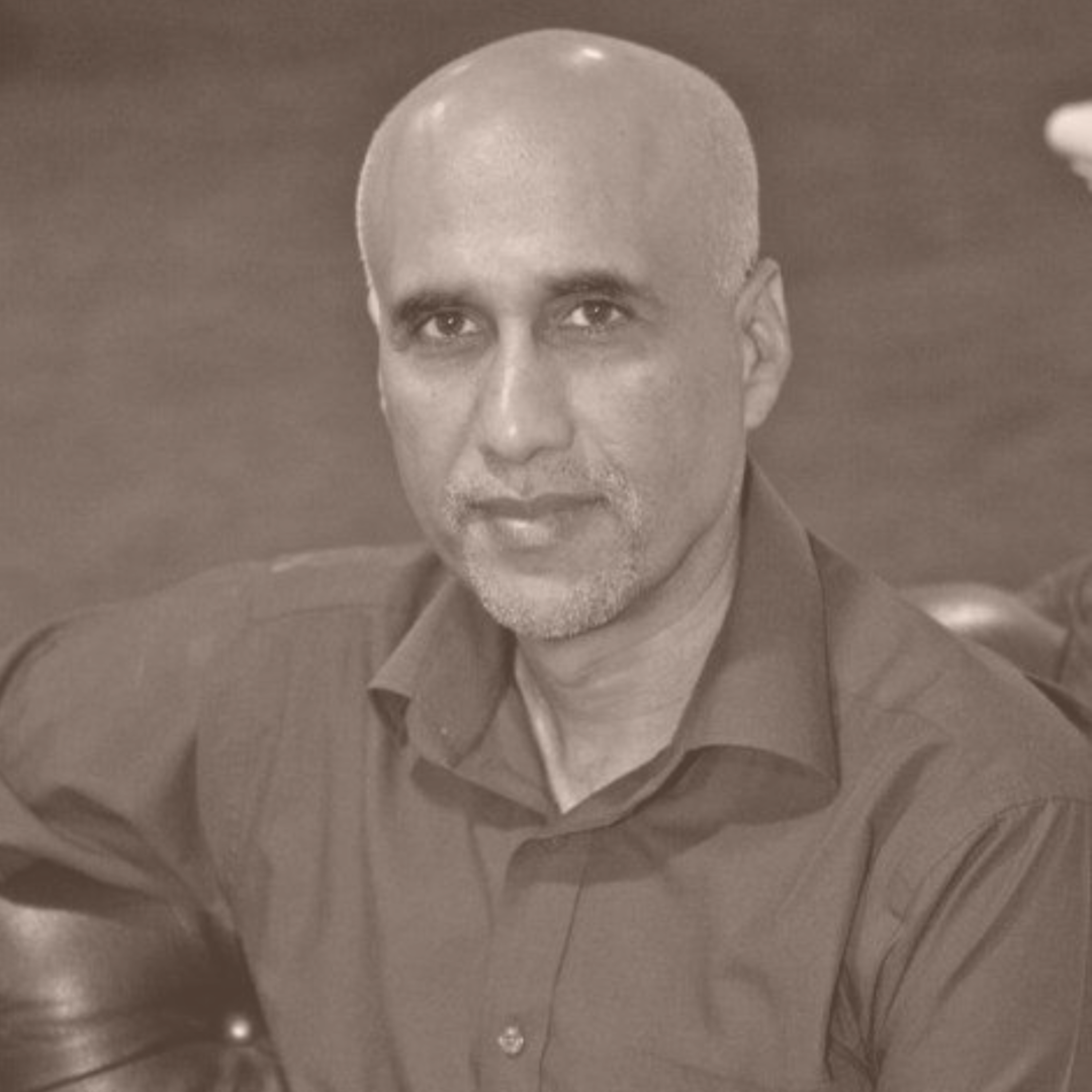
Macrofutures, Myths, and Metaphors w/ Sohail Inayatullah
from FARSIGHT
44m 55s
In this podcast episode, host Casper interviews futurist Sohail Inayatullah, who shares his journey from a 1975 course with Jim Dator at the University of Hawaii to becoming a leading figure in future studies. Inayatullah emphasizes that the future is not merely a technical problem but is deeply shaped by worldviews, narratives, and metaphors. He introduces Causal Layered Analysis (CLA), a method that goes beyond surface-level trends to examine deeper systemic, worldview, and metaphorical layers. Drawing from his multicultural background, he illustrates how cultural contexts influence futures thinking. For instance, in Cambodia, ICT development was metaphorically framed as moving from a “room of arguing monks” to a seamless “Ibuuta” (digital Buddha), while in Thailand, AI was envisioned as a personalized spiritual guide. Inayatullah notes that effective foresight requires adapting to local narratives, such as using farming metaphors for agricultural societies or risk analysis for MBAs. He also discusses the power of metaphors in personal transformation, recounting how a senior leader reframed his burdens from being a “donkey with bricks” to “investing in a new home.” The conversation touches on macro-history and Jim Dator’s four future archetypes—collapse, continuation/growth, stability/restraint, and transformation—highlighting how deep narratives shape both historical understanding and future possibilities.
Hey everyone, Casper here. And it's just me for this one. August is moving from Copenhagen to Utrecht, but he will be back for the next one. We have so many interesting guests lined up for you. My guest today is futurist Sohail Inaya Tula. He's a professor and UNESCO chair in future studies. And he's kind of a grand wizard of future studies. I think it's fair to say. He's developed quite a few of the methods that futurist use, including one that Sohail brings up a few times in our conversation, the CLA or causal layered analysis. I won't go into too much detail. And I think the conversation is, will be fun to listen to for those of you who might not be that interested in the nuts and bolts of futurist methodology. But since Sohail brings it up a few times, I want to just briefly explain what it is. So it's a way of looking at the future that takes beneath the surface. So instead of stopping at the headlines and the familiar images of what's ahead, it works through different layers. There's the immediate problems that we see. There are the systems that produce them, the world used to justify those systems. And finally, the deeper myths and metaphors that shape how we make sense of it all. So the point is to uncover the hidden assumptions about the future and also to imagine alternative versions of the future. That is the short version. And I do hope you enjoy this conversation with my guest Sohail Inaya Tula. Now looking for alternative features of utopian and distant. You are listening to Farsight from the Copenhagen Institute for Future Studies. Okay. It is not easy being a futurist. There are some tough barriers facing anyone who wants to make an honest attempt at either studying the future or preparing other people to have a sense of agency about it. Some of these challenges have to do with the worldviews, the narratives, the myths we carry around about the future. And so you are the right person to talk about this with Sohail because not only are you one of the world's foremost futurist academics, you are also an expert in what we might call the humanistic and the cultural side of Farsight in future studies, meaning that rather than treating the future as a technical problem, you want to drill down into how our worldviews, our narratives, our metaphors shape what we imagine and the kind of futures that we create. So a warm welcome to you Sohail and thank you for coming on. Great for being here, Kasper. Thanks so much. And just to get us started, perhaps you could tell our listeners a bit more about yourself in your own words and also why you decided to pursue not only future studies but also this particular approach to the discipline. I remember when I was a student in Hawaii in 1975, I went to do my undergraduate and I read this magazine called Renaissance Universal and it was all challenging articles. Someone said the future is not the west but the third world. How could that be? On other piece was how the image of the future creates the future by Oliver Markley. And this was all fascinating in the sense that we grew up, I was born in Pakistan, moved from Lahore to Peshawar, then to Indiana, then to New York, then to Geneva, then Pakistan, then Malaysian Hawaii. So I grew up in diverse areas and my insight from all those areas, one is that politics is often about finding the enemy and the best politicians are good at identifying enemies so they stay in power. And this was essentially a Machiavellian reading of geopolitics. And so I could see this was interesting but having traveled so much, I didn't see this novel or in fact in any way insightful. And so in suddenly I'm in Hawaii, I read this magazine and someone says you should take a course with Jim Dator. And so I took this course in future studies and he approached it dramatically different. He goes yes, that's one way of seeing the world that geopolitical but imagine a different world. So we saw through the lens of new technologies and suddenly he was teaching us about genomics and gene revolution, about robotics and artificial intelligence, about demographic shifts in the US. And suddenly he took change as the way we should see the future. And this for a 17 year old was really exciting because I could start to see not just a different world is possible but through the variables we were introduced to a different world is inevitable. And so that got me on the journey of foresight in future studies. And so this was back in the day, Jim Dator, University of Hawaii. He's one of the greats and we'll get back to him and his archetypes a bit later in the conversation. So you've been in the game for a while. Well my first course was in 76 February and I took every course Jim offered and then one of my other professors came up to me and said you do know you're wasting your life. What do you mean professor? He goes future studies is a can of worms. Get out now. And he also knew I had a spiritual interest in meditation and alternative futures and inner work, humanistic work. He said also that's also a waste of your life. And I looked at him and I said that. What are things to tell a 17 year old? What? He was really what he was saying is you're entering worlds that are unknown, that are higher risk and most likely will lead to disaster. As it turns out, they didn't. In fact, futures orientation was a weird thing 50 years ago and now it's the norm. Spiritual ideals were considered weird then as well and now most people want to move beyond GDP and towards well being. Bhutan even says they want to develop the mindful city. So an outlier before can start to move towards the center, it becomes the way we define reality. So I feel I was lucky and stuck with it. I could have said yeah right, it's a can of worms. Let me get out now and only do statistics or law, but I've decided to shift. Based on again the core notion, the belief that the world can be different and it should be different and the way we're constructing reality now doesn't work. And you say the future of future monitors has become the norm today, but how have you seen the field of foresight and future studies change over the years? Yeah, I mean, I think that's how so it was started as being the weird kids and then who were talking about these changes and the 80s people say what? What? I remember Johan Galtung's speech at the Eastwood Center I think 1981. He talked about structure and fluidity. He said the more structured a country is in the sense that it can't change, the more likely it's going to fall apart. So then he says he said, it was 19 years when he said yeah, he said, I and I would like to assert by 1990 the Soviet Union will collapse. And the entire audience cracked up into laughter and rolled up their eyes. And he said the reason why I make that assertion is again, it's highly structured and the metaphor Hazel Henderson used was the state pretends to pay people pretend to work. So it was based on the great lie. And so we've seen traditional structures fall apart and we've seen dramatic crisis emerge throughout the world system. And I think most of us are the position that the crisis that have emerged, one can't be solved in the framework of the crisis. And to what Galtung again argued, he says don't see crisis as outside of the deep narrative. And I said, what do you mean? He goes people keep on saying there's a meta crisis, a public crisis. He goes, no, Western civilization indeed now modern civilization is defined by crisis. So crisis is not an external variable. It's built into the system. So that became a fascinating way to see the future. So I mean he got it right in terms of the Soviet Union. We, his a fun fact for you. We published meaning we the Copenhagen Institute for Future Studies before my time. I have to point this out. Published a report on the future of trade relations between the Soviet Union and the European the EF as it was called in days at the time. This was published in 1991 I believe, right months before the collapse. So it goes to show few people saw it coming right. So I mean for us, then there's the issue, well, is it about getting it right? But I think most of us want to go further and say not just where the risk or the new technologies but how they'll change. I remember Majid Toranian when I met him in Brisbane, he gave a talk to us. And he said, don't see this as the changing nature of technology. That's not interesting. He said, it's the changing meanings we give to technology. That's interesting. In this sense, it's not the future of AI, but our relationship, what meanings we give. And so I think much of the foresight literature has been about dystopia because fear is easier to be embedded and embodied. And our work as futurists now is, well, how do we create other visions of the future? So futures become easier because of the change we had the last 40, 50 years. They're not weird anymore. They become normalized. that they're normalized are always foresight.
practitioners is seen as far more acceptable. Let's talk about these visions because I've started out the intro to our conversation with introducing some keywords that I think will be recurring during our talk. Excuse me. World views, narratives, metaphors, things that are both deeply subjective but also are rooted in collectives of people, meaning that they come in through our culture, through our social upbringing, basically the world we grow up in. I'm interested in your take on this question of the future as a concept. When you go across the world, you're a good person to ask about this, not only because of your academic expertise, but also your own background. As you bring up, you've been, you were born in Pakistan, you've been growing up in numerous countries, Malaysia, the US, Switzerland, and so on. You've had a very international career, you've taught and worked across the world, both in places where what we could call the progrès narrative reign supreme and in other places of the world where you have a more holistic, perhaps a more cyclical understanding of past, present, and future. So I was hoping that you could spell it out for a list of a bit more. And when you go to the US, when you go to Switzerland, Malaysia or Denmark for that matter, and you ask people, what does the future mean to you? How are the replies you get from people different in each place? As a foresight practitioner, I always understand what's going on. So I remember when I was working in Geneva, I sensed this competitive nature. And I won't give the incident, but there was some incident at a building and I thought, what had just happened here? And I said, how do I make sense of this? And actually, I understood there's too many international organizations fighting for one kawasal. So there was a sense of limited money, limited funds, and how do they get it for their development work. So every place has a guiding narrative. And if you're doing futures wherever you're doing it, you have to find a way to make a work. And working in Cambodia once, looking at their 2050 ICT strategy, natural strategy. As we did the CLA, which is called an analysis, level one is litany, level two is system, level three, worldview, level four metaphor, they came up with this amazing metaphor. Is it right now? ICT development is like being in a room of monks. And I thought, what does that mean? They said, well, we're not on the same page. They're arguing. It's inefficient. And I thought, this is interesting. I said, well, how do we want to see it in the future? This is the guiding metaphor should be the Ibuuta. The Ibuuta. The Ibuuta. Yeah. And I said, what does that mean? It means seamless. So a digital Buddha. Yeah. Okay. Easy to access. So the guiding metaphor for natural ICT strategy should be like the Ibuuta. Now, of course, this is cultural. That wouldn't come out in a meeting in Denmark. Right. Or in Rio. Yeah. So I found it fascinating that everyone understood straight away. No one had to explain what Ibuuta was. Now, then we did another workshop in Thailand two years ago. And perhaps for a listener who wouldn't be privy to that understanding, how would you explain this? The Buddha is mindful, present, wise, wholesome in the sense that, and so systemically, that means things work really well. It's on the cloud. Anyone can get everything done very quickly seamlessly. There's no bureaucracy stopping you. The other model bureaucracy is red tape here. It's green tape. The Buddha helps you find your true wisdom, your true self. So now, a national narrative of the Buddha as central to national ICT strategy, that was intriguing to me. And so that's the joy of working in different places. And Thailand just recently, we had a workshop with the Thailand Institute of Justice and Professor Aura from Chiang Mai University. And we were looking at emerging issues. And the one that hit me most is that, imagine by 2035, everyone has a personalized Buddha as a hologram available to them. So you wake up the morning and you access that. And the Buddha will say, "It's time for meditation. It's time for good diet." You feel angry. No, don't be angry. Find compassion. You see someone as evil. It's no. That's delusion. So the notion was AI as a spiritual friend who guides you in your life. So that's in a way unique. You won't get the other places. So places, developed narratives that are most useful for transformation based on their own history. So a role with Futures is to understand that. I remember in one country 25 years ago, they had been through a coup. Things were very difficult. They felt suppressed. And I said, "So what's your core metaphor of your country?" They said, "We're a passenger in a car being driven by a blind person." Now, one, if it's a part of the metaphor, but in that one second, you totally understand, you can write 100 books on colonization by not having agency, but that one metaphor did it straight away. We're not in charge of our future. Someone else is in charge of our future. We have to regain control of means and production of our own narrative. What about when you're in a teaching capacity, do you find that some communities, some people of certain professional backgrounds have an easier time than others, getting into a Futures mindset? So if we go past metaphors for a minute, just the act of thinking ahead, say 10, 20, 30 years, do you find that some communities or some types of professionals have an easier time doing that than others? I think for us as Futures is to find how do I think of thinking ahead in the language that the other understands. So I remember one foresight workshop we were running in a Southeast Asian country. And it wasn't going well. We were focused on quantitative methods, cross-impact analysis, etc. And we sensed in the room, not resistance, but boredom. And these were very smart people, but they were like, "Why are you teaching us this?" And then suddenly we went to metaphor, and we went to their youth. They were recently agricultural country, now they're highly developed. And when we went to farming metaphors, they understood Futures straight away. Within their local historical culture, they had many metaphors about. You can tell changes coming when thunder clouds approach based on the monsoons. So they had local language metaphors and immediately able to understood foresight. Before that, it felt to them like an external engineered view of the future. So thinking ahead paradoxically came from thinking in the past. When they were young children, what were the stories given to them by their mother and father that had them understand prevention and had them understand creation? So I won't say there's a fixed view. This is the role that Futures to inquire, to be alert, to understand what stories are people telling me. I know when I work with MBAs, if I'm doing a, I've run a Melbourne Business School course for 20 years, they really understood emerging issues analysis because it's risk assessment, weak signals, looking for changes. They got snare straight away. The Celia part for some groups took a while and I merely figured out why. Metaphors for them were to be segmented and bracketed as methods that were not helpful in strategy. And so I would have a CEO stand up and say, "I don't believe in metaphors. It feels like we're on the wrong ship." And I said, "So you just need to metaphor to our against metaphors." I'm the look in the room, the room would stop. And I said, "Can you now talk more?" He goes, "Oh my God, I've been living in narrative, but unaware of it." So I said, "Now let's talk about the inner Celia, define your life narrative where you're conscious about your story." So I had one person in one country, I won't say, "Oh, I understand now. I'm like a donkey." And people looked at him like a donkey. He was like a senior leader. He goes, "No, I feel like a donkey. I have burden from family. I have burden from stakeholders, from the board, from other corporations. I'm burdened." And now I'm just starting his PhD. Now I'm adding to the burden. I'm a donkey with many bricks. And really there was a look of shock in the room because we all thought he was this guy who knew everything. And so then I asked the group, "What would be a better story from him?" And so I said, "Don't put on your MBA hat. Your MBA hat will be straight away, jets in that business. Fire those employees." He put on a creative hat. And so someone said, "Ah-ha. You're not a donkey. You're investing in a new home. You're creating your new home. These bricks were creating the foundations for your new future." And he just breathed the sigh of relief. His shoulder stopped slumping. A weight left him. He said, "I understand now. I'm investing in the foundation for my new home, my new life, my new career. Everything made sense then." So to get them there, I just say, "You've been trained to avoid story. and you're welcome to do that. But cheer here.
to do more powerful strategy and more powerful foresight. Yes, empirical data is critical. Yes, trends are critical. Yes, scenarios are important. But unless you go this deeper route, you'll have scenarios where no possibility of change, because you won't know how you're an agent. One of your other areas of interest, which I share with you, and I'm excited for this question to get into this topic, is the connection between macro history and future studies. So meta-narrative, some macro narrates, if you will. And I think macro history is enticing to many futures, I think, because it has a grain of speculation in it about the future. Whether you're talking about the Marxist view of history driven by a class conflict towards the inevitable socialist future, or you're talking about cyclical histories from Eben Keldun or Oswald Spengler, you have this idea that history is on track for something. There are some powerful dynamics pushing us forward. It's also what makes macro history and these macro narratives open to criticism of being on scientific or leaning into metaphysics. But I think this pursuit of an underlying logic is, you know, something that some historians and some futurists sort of have in common. It's not to say that futurists are deterministic. Some definitely are, but not all. But it's to say that futurists are also sort of in the business of uncovering which narratives we sort of view the future through. So you mentioned Jim Dator in the beginning. Jim Dator has these four archetypes that he did some studies. He found that these archetypes are really quite present in our conceptions of the future. He even did some empirical studies, I think, to back it up. So for the listeners who are not aware, we have, you know, we have the classic collapsed decline scenario. You see it in all the Hollywood movies. We have the continuation regrowth scenario. That's sort of the the the yin to the yang of collapse. Then we have stability and restraint. And then finally we have transformation. And I'm wondering, what is your take on this? Are these types of narratives, these archetypes? Not necessarily only the Jim Dator ones, but archetypes in general. Are they useful? Are they inevitable? Or should the role of the futurist be to somehow dislodge our conception of the future from these very fixed conceptions? So for me, I remember I did an lecture on macro history in the future. And the great psychologist, transhumanist psychologist, Gene Houston was in the room. And she loved it. And she then said, the main insight for all of you change agents is use macro history. Don't be used by it. Meaning don't get lost on is it empirically true or not? Because we do know the future is emergent. So that's one clear lesson. Second, futures can move overly towards novelty. Macro history says, no, there's some deep structures. And those deep structures have to be honored. So Dator's structures work because there's only four possibilities. Either things stay the same, they collapse, they're in limits or they transform. That's it. You can't argue else-wise. So there's some structures. Either it's linear, cyclical, pendulum, spiral. Now of course, there's other ways of knowing. The indigenous, for example, with the infinite challenges that, but fair enough, the point is there are structures and patterns to change. They're not inevitable. The future is to use them wisely. So I just finished a piece for the new journal, New Mystic Review on a comparison between suma-chen, Sema-kwan, as I'm saying it wrong. I've been Haldun and PR Sarkar. And the issue I looked for all three of them was what's the nature of virtue? If more and more were moving towards an economy of lies, the great lie being told all over the world in every country now, which has become a way to talk about reality, to just lie about it. What do they tell us? And all the macro historians all come to the same conclusion. Civilization decline is prefaced by the great lie. As when we move from virtue to telling lies which everyone knows don't represent empirical reality, the dow is lost. For Ibn Haldun, Ashabia is lost. There's no unity. For Sarkar, we move towards a situation where one group controls the other groups and pretending there's equity. And everyone knows that. So that, to me, is the utility there. Looking at macro historians and say, how do they comment on today? And they all come to the same conclusion. A good society is based on virtue. And if you move away from that, the early warning indicator leads to civilizational societal collapse. Now, you can have Pomp and Pomp and circumstance. So Ibn Haldun has that great quote. It may appear that the light is burning brighter. It may appear that the candle is lit up even greater. But that's actually the final light before everything dims. So it's a poetic, structural way of seeing change, which I think is quite useful. Sorkin reminds us as well, the body is pendulum. We think the world we have now is eternal. So if in a sense, state, phase, it's materialistic. And then suddenly we switch to an idealistic spiritual phase. And we think that's eternal. And Sorkin always said, no, the pendulum shifts back and forth. And the markets go up. The market will go up forever. Sorkin says, no, markets will shift again. So you see that in countries. One type of thinking emerges dominant. And it gets reinforced. And the domination becomes total. But Sorkin says, wait a second. If a domination is total, that's not the nature of reality, which is diverse. So if the materialistic takes over all possibilities, it reinforces itself until the spiritual, the elastic is so far pushed away, it comes back with a bank, what we've seen in many countries. So the macro history is a tool for futurists, not to be captured by the seduction of novelty. And to understand there are deep structures, which doesn't mean the end of agency. It does mean we have to understand the way of the past so we can make wiser strategy. [Music] When future studies came to Europe in the 60s, it was a technocratic project. It had an ideological goal of stemming the tide of Marxist thought in Europe. That was one of its objectives. What you're describing today is the role of the futurist pointing out the big lie. Yes. Do you see that as sort of, I suppose that view of the role of the futurist has sort of gone out of fashion? Would you agree with that? Yes, because it's a movie strategic foresight, how do I have better strategy based on changing futures, which is part of the role. But the more uncomfortable part is really the emperor has no clothes, or you're focused on one product, is that the right product? I don't know, again, one of my favorite stories with one large car company we were working with. Their scenario one was sell more SUVs. The scenario two they merged in the-- The continuation. The scenario two was marginal change. How about personalized SUVs? You can get it more electric or hybrid or a different color. That's a bit better. They might call that transformation, right? Yes. Now, scenario three and four adapted and radical are more interesting. So this is where the questioning process sums it up. So really, instead of selling more cars, we want to create throughout the Asia Pacific or world of driverless green AI pods. Meaning no one owns the car. We have full fluidity and mobility throughout the system, so the role of the car company is to create a greener Asia. Now, of course, that's challenging because how are you going to make money off that? So that became the debate. How do we invest in that future? And it became very clear we may have one product called the personalized SUV, but our larger mission is to create a new Asia Pacific region that's cleaner, greener, safer. And then the promise there was, if we do that well, haven't we just created a new trillion-dollar industry? And so this is where the futurist role is to come in and ask questions. What are different scenarios? Are we there just to ask what is working or not working? Or are we there to say what are some solutions outside the norm? And that, I think you're right. That's a prodding. That's a questioning. And we know most strategy fails because questions about the future were not challenged. What about the role and sort of you're touching on the technocratic aspect of the futurist again? And contrasting that with the participatory futures that we see in growth today. So an example for our listeners would be, if the EU do a foresight initiative today, they might do it in the context of a participatory workshop involving EU citizens and so on. So there's sort of a change on the way where you want to democratize futures thinking you want to anchor it in the will of the population. Do you see a potential tension there in the sense that futurist may consider one future more desirable than others? The population might disagree. So how do we reconcile those two things? My favorite foresight projects are when there is a great
So if you look at it a triangle, if you will, the futures, on one side you have the citizens. You're asking them about their preferred future, but you're also very clear they have to be skilled. So there's future literacy first before you ask them questions, otherwise they just talk about the latest movie they saw. So I think democracy, there's a skill to it, so that's one. The next thing is the academics with the data, with the deconstruction, the reconstruction, and third is with all the community groups, be their business, the council, the boards. So you really have to have all three working together on the vision of the future. So that's what I've seen that has worked really well. Now there's always tensions. I remember for one city, the mayor had said, we've done the scenario work, the academics have done it, here's what you've said, now we're going to do voting. And so they developed four scenarios. And then before the voting, the CEO ran up to me and said, what if they vote wrong? And I looked at him, I said, that train has left. We made, you made a collective decision that citizens have wisdom. You've trained them in this is not just random people off the street. They've learned future skills. You've done endless workshops. You've had a reference group of academics and counselors. And now it seems quite appropriate to vote. So this is as we move quicker, you want some deliberate foresight democracy along with the fast thinking. And so you want to mix those two. So I think the technocratic has its use in bringing data to the table, but there's nothing more exciting than our participatory workshop. We've learned over and over that the technocratic can provide some solutions, but it doesn't lead to real change. I'm reminded of some of the work we're doing here at the Institute. To give you an example, we recently put out a, we conducted a survey of the attitudes of Danish peoples, well, the hopes and fears of Danish people for the future. So we asked a thousand Danes, how do you feel about the future 10, 20 years from now? Dan Margus in Europe, there's a war going on in Europe. There is, you know, Russia is considered the great geopolitical threat. It has been for a while, but especially since the invasion of Ukraine in 2022, there's now even a latent threat of conflict with the United States. So the Greenland something that used to be thought of as a totally implausible scenario is now in the realm of possibility. And what we saw from the replies was the threat of war and in opposition, the hope for peace completely dominated expectations for the next 10, 20 years. Climate change was not absent, but it was pretty far down the list. And, you know, one of the things I took away from this was not only how the future, you know, how the future looks depends on where in the world you are. Are you in Europe? Are you somewhere further removed from a conflict zone? But also how difficult it can be for us to sort of disentangle from present realities. Now I would expect climate to have a more prominent place on that list, 20 years into the future. War might be an imminent threat at the time. It might not be. But we know that the climate crisis will become more severe, not less severe. So there's, for me, there was kind of a logical disconnect, but it made me think maybe this actually tells a different story. It tells a story about how difficult it is for us to disconnect from our present reality, whether that's the reality we are exposed to via the media, via our politicians, whatever it may be. I suppose the role of the future is to help guide us through that, through via future's literacy, other means, but I mean, this is not a clear question here, but as someone who has studied these things for decades, how do you see this? How do you do three examples? And they're tough ones, right? You've gone to a tough area. So example one I was working in Canada, and we wanted to, of course, do the impossible, of course, imagine alternatives, but we had to start with a compelling issue, compelling issue with the possibility of invasion, the 51st state. And Eva Lomé is written a nice article for journal fidgetities about that. And so our role there was giving this emerging issue or no compelling threat. And so we did see a lay on it, and we went straight to the metaphor. CLA just for us to. So there's an else. CLA is a layer analysis. What's the actual core issue here and a deep unconscious body level you might say? Yeah. People say, aha, we're in a playground and we're being bullied. And so then the strategy emerges from that metaphor. So strategy one is confront the bully. Strategy two is no just be nice and hug the bully and bullies don't respond well to that. The Canadian response. Hugging be nice. And then we went to other strategies. Well, if it's a bully, what's the first thing you do in a playground? You make new friends. And so that means making better friends with PRC with EU with UK. That becomes a new strategy. Strategy number four is you find out you don't attack the bully head on. You find out what's the core weakness that became the bond market. And so quickly by going to the narrative, they came with four strategies that could work and one or two that won't. But this is where CLA helps create transformative strategies. Recently from UNDP, they asked, can I please run a workshop in Kiev on after the war, what are possible peace futures? Now, that's been postponed for obvious reasons. But and the obvious reasons were with your about to have the workshop them was another bombing. It's too soon almost. But someone in parliament was already thinking through eventually, if you're a futurist, you know the war will end. This will not go a thousand years. When it ends, how do we go from a war threat trauma situation to creating peace and alternatives? So they're already thinking about that and UNDP is on top of that. So I'm hoping that happens. So the response is difficult. I've tried to get a project up called the Futures of Palestinian. And my colleagues there who've left who are there, they said, we can't even entertain that idea. The panic and fear and collective death is so strong. We know this is the end. We can't go towards what we might look like in 50 years. So each group, you can use futures. It's work sometimes and sometimes it's timing and sometimes really you can't do it because the imminent personal threat is too high. So in terms of climate change, clearly now is the time to do it because the threat is there. It's increasing, but there's still some sense of agency. But I think I mean, data is argued that when you ask students, citizens, what's the issue, you always choose the issue that's today. And thus the data is not reliable. So that his conclusion was, use emerging issues analysis, which is not biased towards present challenges, which is biased towards the unknown, the uncertain, the weak signals. So I think our role is futures is to acknowledge the present, use methods that can help us out of the present and novel strategies and always have us thinking what are the alternatives moving towards vision. So I think that's our gifts, our benefits, our superpowers, if you will. Because there's enough people doing strategy about the present. We don't need to be doing that. There's enough people doing management consulting. There's enough people doing technocratic foresight. That can't be our core who we are. It has to be something else. You brought up the example of Gaza. I mean, these are people who have had their future foreclosed. That's their material reality. The future does not exist, you know. And this question of how do you think about the future when your house is burning? Conceptually, of course, we go towards what's the real issue? Why is Gaza burning? Why is your Korean being attacked? Because we have a UN world political system that's a nation state based with the Security Council, which has vetoed power for five powerful nations who have nooks. So then quickly we see, okay, we can solve it at the local level. But this is part of a grand transition to a new guy in politics. That nothing is solvable into the UN transforms whether it's a global governance, war government. So having that bigger lens reminds people that the problem is not X. It's a deeper, what worked in 1945, no longer works in 2025. The role of the future is to help design the new world government system. Do you think we need to sort of get back to that world systems thinking the guy theory stuff? The stuff that was really big in the 70s, but that futurists have kind of lost touch with. I definitely, I mean, Wallachstein is one of my teachers, William Thompson is one of my teachers, PR, Sarkar. They all didn't shy away from what is litany problems, but they always, you know, you solve problems by going deep and changing the entire system. So that's, I would say yes, that's macro history, that's world systems thinking we have to do that. The other part of that is, is not like we'll ever be out of crisis. If golden is right, that the definition of majority is crisis, they're always going to be there. So we need some group of people, some research always saying not just what's next, but what's a better system? How do we transform? So clearly, I mean, I love the work. I think that I'm much for Nanda. There's quite a few people who've done work on after capitalism. Andy Heinsen is in a few pieces. They're saying yes, it looked like this will last forever, but all of us know it won't. And when it does collapse or evolve into something else, what might that something else be? And I think that that's again the role of the future. What are some third way possibilities? The one workshop I did in Vig and Denmark was about Proud, a political system is more cool.
cooperative, more collaborative, what would a global cooperative platform look like? What would a system look like? Whether it's a world economy that's localized, where the money keeps on flowing and you have wealth caps. So you start to ask yourself, okay, if we're futurists, what's the third way out of the current stalemate? We have a nation-centric system with large corporations. What's the third way there? Now for many, there's that's too idealistic. Then the role the futurists becomes, okay, that's too far for you. What are some changes we can start for the next 5, 10, 15 years that move us in that direction? So I know with CLA, we often say we had one group of energy providers. I said, what are you doing today? They said, well, it's keep the lights on. That's all we're doing. I said, well, what about the long-term? Long-term is we have a global decentralized, integrated solar grid. It will be choose your energy adventure. And so now those become the two extremes. Then I asked, what's the mid-range? How do we integrate the long-term with the short-term? And that becomes yet another narrative. So you want a mid-range story. And so, so, hey, this has been a fascinating conversation so far. I have one last question. I started off asking you how you've seen the field of futures and foresight developed since the 70s when you first became involved. The obvious follow-up is how would you like to see it evolve into the future? So I know one colleague I spoke to, he asked, well, we have multiple tents. We need to create one new tent above it all. And I suggested maybe we need to link the tents. So that's a debate. How do we have integration but localized? So in that sense, if I look at all the people who are doing online courses, do we need a shared platform like a food court? So people have local agency but we have some agreement on the field, some agreement where we're going. So that would be one way forward. So this is more global local. The second shift of course would be AI. I already, my colleague Carla Kongson developed an AI twin of me. She developed an AI. Do you have an AI twin? Yeah, she just developed it. Do you use it? Just started to use it. Especially when people want long meetings. And you know, I love it. Oh, you send it to the meeting. Yeah, I said go, talk to the twin. Oh, no. And then if, you know, sometimes they said that was enough. We don't need anymore. Okay. And one group said, well, can we do both? So they interviewed me and they interviewed the twin. Okay. And Carla did the research. It was 95% correlation. Yeah. So I said, well, so it was you essentially. It worked well. Okay. So the third thing, the next thing we, how will futures use AI will be replaced. I don't think so if we were wise, we use it as a friend that does some of the things we may not love doing. So we can do the things we really love doing. Now that means using AI, but also all of us need to be aware of the meetings we give to AI. This whole algorithm versus oppression versus algorithms of emancipation. So we want to be on that side using AI wisely and deconstructing the assumptions. So the AI evolves that futures literate. Do you think AI will be, can it create compelling stories, scenarios of the future? Will it be able to? I want to see humans with AI. So like everything, the factory produces but humans design. So it will be able to, but I can see in the publication field, I someone sent me some notes and I said, wow, these are brilliant. I love it. Can you develop that into an article? And his insights from his mind were stunning. I really learned a lot from his three insights that I saw. He just did a quick chat on it and developed it further, but the magic was lost. So there's an asynchronous. I felt it straight away. You spend 30 minutes thinking about something. It took him two minutes to prompt, right? And once you know it's the machine, I felt something. I could sell it. It wasn't his original genius, which it was. I thought, okay, so this is now. So then it was like, well, maybe you should just stay with the original genius and not develop it further. But I think the development further needs this dance. If it's a Gaia, it's a dance. It's an ecology. And each one is working together. We don't know what an ecology AI will look like now. We do know all technology when it comes in changes us and amplifies what we are. So we need to make sure it amplifies the best of us, not the worst of us. And the worst of us is cutting corners. The best of us is genius insights, which I thought this person had. All right. Thank you so much for joining us in coming on the show. Thanks, Casper. This was fantastic.
Podcast Summary
Key Points:
The podcast introduces futurist Sohail Inayatullah, a professor and UNESCO chair, who emphasizes a humanistic, cultural approach to future studies.
A key method discussed is Causal Layered Analysis (CLA), which examines futures through layers: litany, system, worldview, and deep metaphor.
Inayatullah’s diverse background (Pakistan, Malaysia, US, Switzerland) shaped his view that narratives and metaphors vary by culture, affecting how futures are imagined.
Examples include Cambodia’s ICT strategy using the “Ibuuta” (digital Buddha) metaphor and Thailand’s vision of AI as a spiritual guide.
Effective foresight requires adapting methods to local contexts, such as using farming metaphors for agricultural societies or risk analysis for MBAs.
The conversation explores macro-history and Jim Dator’s four future archetypes
Summary:
In this podcast episode, host Casper interviews futurist Sohail Inayatullah, who shares his journey from a 1975 course with Jim Dator at the University of Hawaii to becoming a leading figure in future studies. Inayatullah emphasizes that the future is not merely a technical problem but is deeply shaped by worldviews, narratives, and metaphors. He introduces Causal Layered Analysis (CLA), a method that goes beyond surface-level trends to examine deeper systemic, worldview, and metaphorical layers.
Drawing from his multicultural background, he illustrates how cultural contexts influence futures thinking. For instance, in Cambodia, ICT development was metaphorically framed as moving from a “room of arguing monks” to a seamless “Ibuuta” (digital Buddha), while in Thailand, AI was envisioned as a personalized spiritual guide. Inayatullah notes that effective foresight requires adapting to local narratives, such as using farming metaphors for agricultural societies or risk analysis for MBAs.
” The conversation touches on macro-history and Jim Dator’s four future archetypes—collapse, continuation/growth, stability/restraint, and transformation—highlighting how deep narratives shape both historical understanding and future possibilities.
FAQs
CLA is a futurist method that examines the future through layers: immediate problems, systems that produce them, worldviews justifying those systems, and deeper myths and metaphors. It aims to uncover hidden assumptions and imagine alternative futures.
In 1975, he read a magazine suggesting the future lies in the third world and that images of the future create the future. Taking a course with Jim Dator at the University of Hawaii showed him how change, through technologies like genomics and AI, makes a different world inevitable.
It started as a niche field considered weird, but now it's normalized. Early predictions, like the Soviet Union's collapse, showed how structured systems fail. The focus has shifted from dystopia to creating alternative visions and understanding the meanings we give to technology.
Each place has a guiding narrative. For example, in Cambodia, ICT development was metaphorically compared to a room of monks, while in Thailand, the ideal future involves a seamless, mindful Buddha-like system. Local metaphors help communities understand foresight in their own context.
Futurists should use language and metaphors familiar to the audience. For instance, farming metaphors worked for an agricultural community, while MBAs grasped emerging issues analysis quickly. Inquiring about personal stories and local narratives makes foresight more accessible.
Macro history offers narratives like Marxist class conflict or cyclical histories that speculate about the future. Futurists uncover these underlying narratives to understand how they shape our view of the future, moving beyond determinism to explore alternative possibilities.
Chat with AI
Loading...
Pro features
Go deeper with this episode
Unlock creator-grade tools that turn any transcript into show notes and subtitle files.
 PodcastTranscript AI