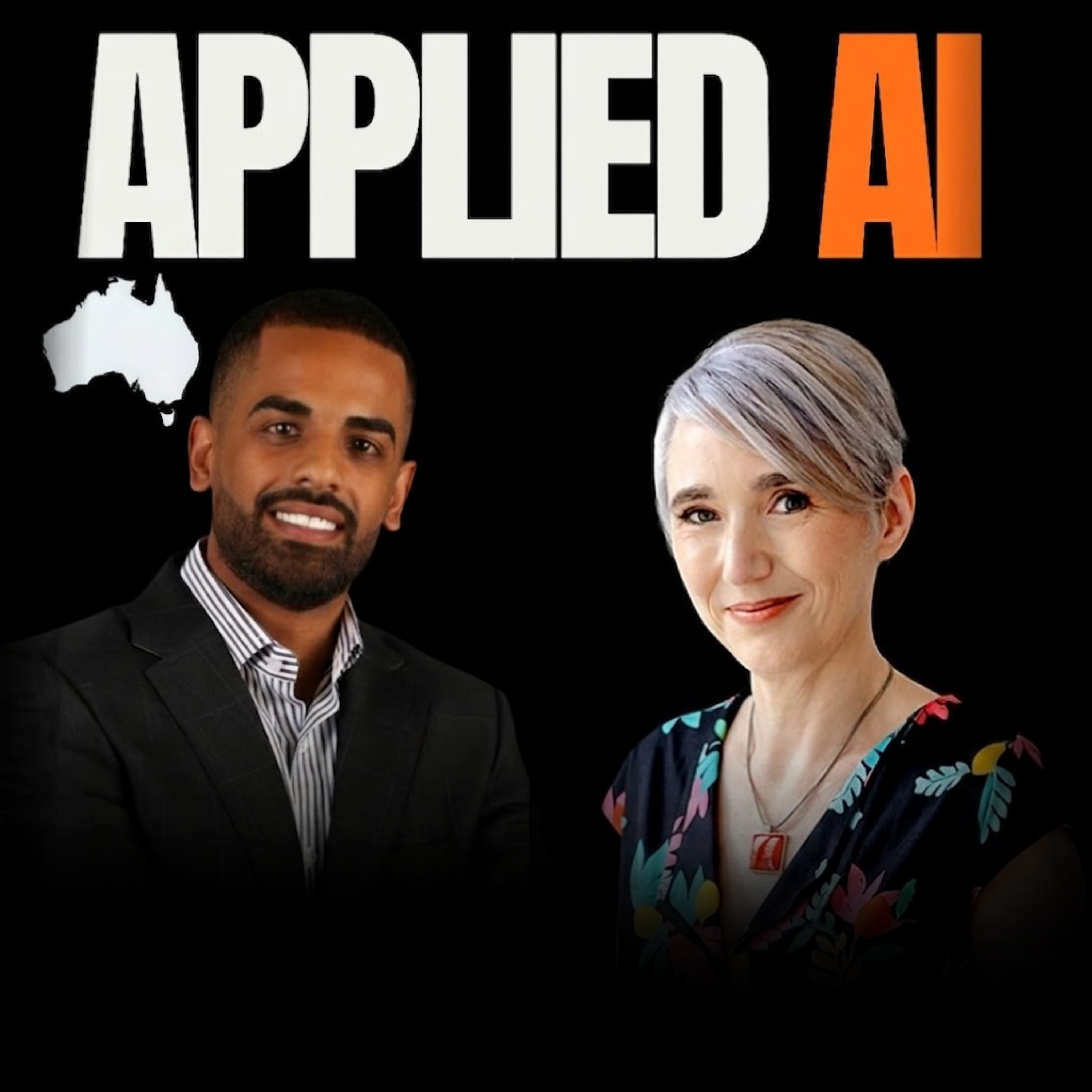
Speaker 1In late January of this year, Gartner forecast by 2028, 90% of B2B buying will be intermediated by AI agents. By 2030, the machine customer economy reaches $30 trillion. This is the commercial infrastructure shift that your business is about to face. Welcome to Applied AI Australia, I'm Ramon Rodriguez. This show cuts through the noise and delivers only what matters, growth, margins, and time. Each week, I translate AI into practical outcomes leaders can actually use. Today, I'm in conversation with Katja Forbes, author of The Machine Customers, top AFR 100 Women of Influence, and recent Executive Director at Standard Charters Corporate and Investment Bank over in Singapore. Today, we're going to cover three things. One, the five faces of machine customers already knocking at your door. Two, why your checkout and fraud stack are blocking revenue that you don't even know you're losing. And three, the shift from know your customer to know your agent, and what breaks when you don't make it. Now, before we go any further, if you're not subscribed, hit that button. Thanks for joining. Katja, thanks for coming on the show today.
Speaker 2Oh, my pleasure to be here.
Speaker 1The forecasted numbers are by 2028 to 2030, 90% of commerce online is going to be interacted or influenced by a machine or an agent. Some of the aggressive stats I see are definitely on the higher end, and you're currently in the process. So, jumping on a plane to go to China and check out Alibaba and actually find out what's happening in the eastern part of the world. What do you think?
Speaker 2Well, I mean, the forecast is a really interesting stat, and I think pretty accurate as to where it's going. But let's have a look into the past. So, year on year, Adobe had a report last year that said retail websites were seeing a 4,700% increase in traffic that is AI agent or AI platform related. So, people either using platforms to come and search and find. things or actually using platforms to be able to buy things. So the past is telling us that this is already here. The forecast is telling us that it's going to get even bigger than it already is, which is why I think mid-market companies absolutely need to be paying attention and seeing how they can ensure that they're actually discoverable, trustworthy, and standing out amongst their peers.
Speaker 1Yeah. So what I'm hearing is influence to the customer journey. Are you talking about more AEO? Because there's a lot of buzz about AEO, but I think it's a little bit bigger than that.
Speaker 2Oh, this is way bigger than that. So there is a huge amount of buzz, activity, and vendors selling solutions around AEO, many of them taking SEO and kind of repurposing it and using that to sell a new checklist of stuff. This is foundational stuff, and honestly, it's necessary. So being discoverable in this is crucial. It's table stakes, though, which is why I think we need to be having much more sophisticated conversations. The way that I think about it is that foundation layer of discoverability. But when everyone's discoverable, everyone becomes interchangeable. What else do we need to do to actually differentiate ourselves here? This middle layer of what I would call operational trust. Now, that's going to look like things, trusted handshakes on transactions. Who is it that you're actually dealing with or what are you actually dealing with? But again. Again, this is table stakes. This is stuff that everybody is going to expect as we get to those figures of 90% of activity happening with AI agents doing shopping. Everybody will expect discoverability. Everybody will expect trustworthiness. The exploration that I've done in this area has led me to a much more sophisticated level, which is I would call stratospheric values-based. So the only thing in the experiments that I've done that's differentiated one brand is that I've done a lot of research on this. I've done a lot of research on this. And selling a product from another brand, selling a similar product is the values that the organization espouses and is also validated or credentialed out in the internet from third parties. So that the AI agents that are shopping, perhaps I've given them a sustainability criteria that I want them to consider. Well, that's what they're going to look for. They will expect to discover. If you're not discoverable, you're not even in the consideration set. They will expect to be able to do a trusted handshake, a trusted transaction. They will expect to be able to do a If you can't do that, again, you're not in the game. So they will choose or recommend one brand over another if it meets the things that I have told it are important to me.
Speaker 1Important to you. Interesting. Interesting. What comes to mind, and I'd like to get your take on it, is if we think about AI currently, Katia, we often refer to as the co-worker next to you, agentic AI. I think about it more as the plumbing within the organization. Particularly with commerce and machine customers. Late last year, it was OpenAI released their open checkout and they had a trial with Walmart and it flopped. I've got some strong views on it, but what's your thoughts? Because we all hear about it, but what does it actually mean? And is it just sci-fi or is it actually going to happen and impact the P&L?
Speaker 2Well, it is already happening and impacting the P&L. This is not sci-fi. This is actually in market today. Thinking about the P&L and the plumbing is the surest way to commoditize whatever you're taking to market and probably race to the bottom on price. Because the things that AI agents search for, they're hard constraints around price. And if you give it nothing else to assess, then it'll just go for generally the bottom dollar option. The way that I think about agentic commerce is the pipes and plumbing of it, the ways that the agents can interact with our products and services usually through APIs, the connectivity without a user interface that an AI agent can use to connect to your products and services, platforms and offerings. So that's like the utility in the plumbing. But if we only think about it from that perspective and we don't actually think about it in terms of who is the customer we are serving now, what we need to do is have a look at the whole customer journey and how it changes when we have non-human actors. There's not just a type of machine customer. There are many types of machine customer. And the co-buyer is just one of those. The agent that can make autonomous decisions, which is the differentiator between an AI chat that you're having a conversation with and an agent that can do things on your behalf, that is a different type of machine customer and a co-buyer customer and a delegated agent customer. They need to be treated differently in your customer journey. So the first two types are one is that we're seeing very much in market today, the co-buyer. Me, Katya, working with my AI agent to find and buy things. Now I've built my own AI agent, Tyler. Now Tyler has a credit card. Tyler has not managed to use Tyler's credit card yet because the internet is not really built for Tyler using its credit card. But we're trying really hard to let Tyler spend some of my money. And so that's my AI agent. Working with an AI agent to buy something where we have a conversation and there's a number of approvals that perhaps go backwards and forwards before the transaction occurs. The second type is the delegated agent, where it's the scenario where I give Tyler the outcome that I want it to get to for me. Buy a handbag for my mom for Mother's Day. She is a vegetarian, so she likes vegan handbags. So I give it those sorts of things and I let Tyler go out and figure it out. And execute on my behalf without me actually getting back into the conversation again. Tyler autonomously deciding and using its credit card to do things. So those are the two we've already talked about, but there's three others that I've identified. And one of those is the autonomous buyer, the machine customer that buys things on its own behalf. And I'll see a lot of these in the B2B space. So let me do an example. The factory that uses AI predictive maintenance to determine whether, say, one of its rotors is going to fail before and predicts the maintenance it needs to do, and then is connected to the ERP system and can place orders for rotors on its own behalf and arrange delivery and then scheduling for maintenance. So this is an autonomous buyer. There isn't a human being who's involved in that chain of purchasing. Multi-agent network. Now this one's super interesting. And we've just seen a huge announcement coming out of Dubai last week, where they are talking about how they are going to deliver 50% of their government services through agentic AI. So we're talking about the agentic state there. And that is a network of multiple agents with different specializations who are going to be able to do different tasks on behalf of the humans who interact with them. And they will also do things on behalf of the state itself in terms of what it buys, how it procures things. So imagine the UAE government needing to procure all sorts of items and using its agentic capabilities to do that procurement. Now that's where I see the multi-agent network. It can be down at the size of a smart home or as big as a nation state smart city. And the fifth one is one that we see a lot of in market today. I call it an intermediary broker. And the place where we're seeing it is on the market. And it's a place where platforms, particularly on our retail platforms. So Amazon has a version of this called Rufus. Rufus can go and read reviews for you, find products that match your specifications. You can actually just delegate the decision-making to Rufus and say, help me decide. And Rufus will decide and give this one. Walmart has Sparky. In Australia, Woolworths has Olive, who is the Gemini-based agent that helps you do your shopping. These ones, I thought when I wrote about it, that they would be a neutral party trying to serve the buyer and the seller and get the best transaction. But I think I got it about half right because what's proving out is that Rufus actually works for Amazon. Sparky actually works for Walmart. Olive works for Woolworths. So I'm not seeing the neutrality that I expected there, but all of those intermediary brokers are trying to create a connection between a buyer and a seller and facilitating that transaction. So those are the five types that I see. And I think it's really important for businesses to start thinking about their own customer personas, the human ones that they have at the moment, and go, well, if this was a machine customer, which one of those types would it be? Which of those types do I think are going to be coming to my business and trying to transact for me? And then what am I going to do about it? How am I going to understand them? How am I going to create a customer journey that's going to serve
Speaker 1them? How are we going to create a customer journey that's
Speaker 2going to serve them? The state of people's attitude to agentic commerce at the moment, based on the WorldPay survey of about 8,000 people at the end of last year, people are not comfortable with large purchases, which makes perfect sense because an agent is a digital creature that can use digital money most effectively. Stripe, for example, has created a digital currency-based way for agents to pay, which makes perfect sense. MasterCard has been rolling out its capabilities. It's started, in the US last year, went to Dubai in December and bought movie tickets, went to India, used things like Swiggy, which is basically their food delivery logistics. They've been showcasing how it can play in a multitude of different categories. And each time it succeeds in one category that's sort of small, that we don't care about too much, like movie tickets. People are not comfortable with large purchases at this moment in time. They're much more comfortable with spending things that are sub $50 that they don't care about too much and letting an agent do that purchasing. But it's also very cultural. On the one hand, about 65% of French people say, I would never let an AI agent shop for me. They're the highest resistance market in that survey. But on the other hand, about the same amount of people in China said, I absolutely would, or in fact, I already do. We've got markets that are poised to be huge adopters of this and markets that are going to be lagging behind in terms of how comfortable, consumers are with it. But that's the consumer picture. And I think that's the easy one to get your head around. The B2B picture is really where the money of this is. And also the one that's a little bit more complex and maybe a little bit more hidden from view, like the predictive maintenance in the factory.
Speaker 1Yeah. Yeah. Just before we move on, I just wanted to unpack just what we mentioned before about flashy pop-up signs and websites, because I do believe strongly that the commerce platforms that we've set up for today, they've been set up for human interaction to a point and AI doesn't care about any of that, right? It's purchasing criteria is going to be completely different to you or me. They're not influenced by what I may be or you. How does an organization start to ensure that their online shop front or their commerce platform or whatever it is, is going to be friendly for the AI agent when they next come around to transact whenever that point is?
Speaker 2At the risk of getting a little bit nerdy about this, we've seen a huge announcement from Salesforce just last week, where they're they have done something that they describe as going headless. Okay. Now what they mean by this is that they have removed the UI interaction layer that the humans who use Salesforce would normally go to undertake the tasks that they do in that platform. What they are banking on and actually designing for is that the actors on their platform doing tasks are not going to be humans. They're going to be AI agents. So what they've done is re-architected their entire platform so that it is there ready and waiting for the AI agents to come to do tasks on it. Let's look at an Australian retailer who's at the mid-market level. That's a big SaaS play. Okay. If you go idea shopping from that announcement, what about the way that you are curating your digital channels could start to look like a headless option for an AI agent that's digitally knocking on the door saying, please let me transact. When I've thought and written about this, I've talked about receptors. And the different machine customer types need different receptors as well. A delegated agent, say Tyler, I say, go buy me an ergonomic chair, Tyler. Tyler goes to do that. And the receptor that the company who sells the ergonomic chair is going to need to be different for Tyler buying one chair as a delegated agent on behalf of one human versus a smart building that comes to the same company and says, I need 3000 ergonomic chairs. And I want to do this with a purchase order. And you need to interact with my procurement agent to do this. The organization who sells the ergonomic chair, selling one, selling many, needs to start to put a different lens across the top of how they serve those different machine customer types. They would serve an individual human differently to a business that comes to do a bulk order. So it's not that they don't know how to do this, but they need to reframe it so that they're actually serving the non-human customer in the right way with the right receptor, whether that is through a, you know, a headless situation where they create a layer that's specifically for AI agents. And I know that Gartner has talked about this, that most organizations are going to need to create a new digital channel that is especially for and designed with a machine customer in mind. So these are some ways that people can start thinking about how do I create the right engagement, architecture for these new customers at the risk of getting too technical on it. This is not just a technology challenge. That's part of it. This is also a challenge for your customer experience. How do you curate the right experience for these new customers, these new non-human customers? What do you have to think about from a loyalty perspective? How do you onboard them? How do you service them if something goes wrong? What if that smart building comes back to you and says, look, I've got these 3000 chairs, but I don't want them anymore. I want to return them. What happens then? How do you interact with that AI agent that's tried to initiate a return or even a one chair return? So there's a whole lot of nuances there that have got nothing to do with technology and everything to do with how you serve a customer.
Speaker 1Very interesting. But just going back to that point about how you serve your customer, but you just mentioned when I go back to the open AI flop, when they had that trial with Walmart, they can depict his conversion rates, I think with three X, lower than what they typically would be due to how the UI was set up. So that goes back to the headless point that Salesforce announced recently. But how do you find that happy medium? Because I think it is a lot easier said than done, particularly like if you look at an example of security, right? If your site is too secure over the top, it's going to be even harder for an agent to interact. But on the other end, if you're too loose, you could have wild commerce situations where you're going to have a lot of security issues. So that's obviously why people like you exist. But what is the general approach? Because there's no sort of guardrails at the moment, is there? It's sort of build as we go.
Speaker 2We are actually building the plane while we're flying it. That's legit correct. That was the saying. Yeah. Yes. Yes. And so on the one hand, we have people, and I've seen this, where there are people who have had bots try to come to their websites and they've just determined, because a bot, coming to your website, trying to find out about your product and buy things now, can look exactly the same as a nefarious bot actor who's trying to do the wrong thing. So it's really hard to tell who's there to buy and who's there to rob you. On the other side of that, we need to be quite cautious because our fraud surface just got so much bigger. And there's a lot of cybersecurity concerns about this and making sure that we actually are doing the right thing to secure our systems, that we don't end up onboarding machine to our systems that then spawn little agents of themselves to go and run around in our systems. I think about this like a glitter bomb. You would onboard your one AI agent that somebody has said, I would like to transact with you. And then suddenly inside your system, it's spawning agents to go and do things. And it's like glitter. It just gets everywhere. This is a genuine cybersecurity concern about people not offboarding agents from systems properly. And there being sort of zombie agents or little orphan agents running around inside people's systems. So there's two sides, there's two very strong ends of that spectrum. What's happening in the middle of that is going, all right, how do we create something that we can trust from a, we trust this agent to interact with us and this agent can trust us to do right by them in terms of delivering product and services. In banking, we talk about KYC, know your customer. Now with the pivot of that to a KYA, know your agent. This is where we try to understand and verify. Who the agent actually is ultimately liable to from a counterparty perspective? Who's the human or business behind that agent? And what governance is in place? What are they allowed to do? Like how far can they go in terms of purchasing something? And it's not a one and done because throughout an entire transaction, I might have sent an agent to do something and it's halfway through doing a transaction and I might change its boundary conditions. So as the vendor to that, you need to continuously check from the start to the transaction to the end of the transaction. Are you still allowed to do what you have shown me that you can do? And so there's on the one side, there is a lot of activity. So the payment rails providers, so MasterCard and Visa, for example, unauthorized transactions, they will take liability for that if a bot does an unauthorized transaction. American Express just recently went one step further and made a consumer brand promise that if you're. If you're a registered agent, which is an agent who they know who that agent is and who it belongs to, if you're a registered agent who makes an erroneous purchase, they will cover your losses, which is like a next level of trust as the product. So there's a lot of really interesting stuff going on in this middle space, but how do we get to trust on these agents being able to do these things, purchase these things? And I think there's also for banks. If you're a registered agent, you want to make sure that you have a good trust. Figuring out all of those things, who is the ultimate liable counterparty, what are they allowed to do, and how do you want to onboard them and transact with them are questions that you must, must answer. Once you've figured out those, then it gets to a next level of sophistication where you might like to try and capture the intent that they've been sent to you with. So if you're a registered agent, you want to make sure that you have a good trust. Like, what have they been instructed to do? What are the parameters that they've been given that is guiding the purchasing decision or any decision that it's making? And then we get into an even more sophisticated conversation, which is, okay, so I've given Tyler my intent of wanting to go out and get something for my vegetarian mother, so she gets a vegan handbag. Was that conversation that I had with Tyler private? Is that privileged information? Is that personally identifiable information? So if you're capturing the intent between me and my agent, it would be very information off for you as a business. And then to get even more sophisticated, do we create an opt-in situation like cookies where it says, if you allow us to capture your instruction to your agent, we can serve you better. So you can see the levels of abstraction and sophistication that we can get to around just this one question of who does this agent work for?
Speaker 1Who does this agent work for? What comes to my mind that I've been speaking about a fair bit as well, Katja, is the way I see the org structure moving forward. I believe that if an agent is deployed within an organization, it needs to have an owner. And with speaking to a lot of different organizations, often there'll be rogue agents all over the place. And often people think it's if the agent does it, I'm not accountable to it. But if you deployed it, you own it. You're in control of the outcomes. Yeah, yeah, yeah. I've got a bit of a funny story with machine commerce. In the early days when ChatGPT released Atlas, I was one of the ballsy one where I gave my credit card, all right? So I didn't advocate anyone to do that. I didn't want to go on Jetstar. I wanted to go on another airline. And to my surprise, Katja, it actually did that. It found me an option actually on Virgin that was actually a tiny bit cheaper based on some points I had in the system. But the oversight was it didn't check my calendar, right? So I arrived three hours late for a meeting. So on half the point, it was awesome, but the other half of it, the entire context wasn't there. And why it got messed up. It was not because it didn't go through to my calendar. It was the UI of my calendar where I got really confused. And I think you've mentioned that as well about the simple things they trip up over all the time. Like with my agents, I've got running on open claw, just as simple things like form fills. That's just absolute pain. So the internet needs to evolve with it. So I agree with what you're saying. I've got a hypothesis that I generally run through with every sort of opportunity that presents itself. Commercially is, and I want to get your thoughts on it. If it doesn't impact revenue, decrease costs or decrease risk, I see it as noise. What do you think about that in terms of machine customers and where does it present opportunities amongst those three layers, risk, revenue, or decrease costs?
Speaker 2Yeah, I have a real abundance mindset when it comes to AI because I think a lot of businesses are going to that. Efficiency play. So how can we do the same thing as we're doing, but just with less people or less costs? How can we do that? Which, you know, obviously that looks better on the bottom line. Maybe it improves the share price if you show your P&L as looking healthier. But ultimately, it doesn't actually advance the organization in any way, shape, or form. So my mindset is more, how about we keep the people that we've got? And be quite pro-worker about this. And do a bit more, or maybe like a stratospheric level more, with these incredible enabling tools that we now have, which is more of a revenue play. How do we create more revenue opportunities for the organization? Sell new things to new people. Sell the same things to new people, the new people being maybe machine customers. How do we actually create more abundance in the organization rather than efficiency gains and. Constant downsizing, because we want our P&L to look a bit more profitable and healthy. I think it's a backward-looking play to do the efficiency gain scenario, and it's a much more forward-looking play to take the abundance mindset of, we can do more. And we don't know what we can do with this yet. At the moment, we're just doing the same stuff we've always been able to do, just better
Speaker 1and faster. I'd love to hear it, because what I'm sort of hearing is the validation that there can potentially be. New revenue business models.
Speaker 2If you want to go down that path, I've got some observations in the FX space. Working in corporate and investment banking, like the big end of town, which is where a lot of the money in financial services is, we see interactions with treasurers happening. And treasurers use treasury platforms. An example of a treasury platform is Kariba. Kariba has an agentic AI within its platform. It's called. And it is able to undertake autonomous tasks on behalf of its treasurer. At the moment, there's still quite a lot of guardrails in place on what Kariba's agentic abilities can do, and there is permissions and approvals still required from humans. However, the direction of travel is that that AI capability becomes autonomous in tasks that it is given permission to do through its governance. An example of that is. All of the type of tasks that we would see Kariba do, foreign exchange transactions and liquidity optimization. Now, that's. We're getting into financial service jargon. Sorry. I've got money in China. I've got bills to pay in South Africa, and I want to move that money that's sitting in China to South Africa so I can pay my bills. That's liquidity optimization, making sure that money's in the right place to do the right thing at the right time for the right reasons. So, Kariba, the AI agent, would go. I want to. I want to move that money. Now, Kariba, as the treasury management platform, needs to interact with a bank in order for it to be able to move that cash. Now, the bank, in facilitating that transaction, takes a little bit of a clip from that transaction, does the foreign exchange, negotiates the rates, creates the conditions for that money to move, and thereby, also, it earns something from that transaction. If you look at the flow of money, this is just the amount of money that moves around cross-border payments. In 2020. In 2025, the flow of money was $208 trillion moving around, just moving around. Now, what the banks earned from that in 2025, from facilitating those transactions, $625 billion. Let's put on the other side of Kariba's AI a bank that knows how to treat that as a customer and can facilitate that transaction in that headless way via an API or some other appropriate receptor. So, we're going to look at this as a very, very important factor for Kariba's AI to allow it to get the best rates, to do that transaction friction-free, and so, it's all happening autonomously. Now, we're doing those transactions very, very quickly now because there's nobody in it who slows it down with friction. So, that $625 billion that they're currently earning without this in the mix becomes a much, much bigger number, and the amount of dollars that can flow around the world because it's happening faster. It becomes a much, much bigger number, and therefore, a revenue amplifier. This is where I think the plays are, like in the revenue amplification, not in the efficiency gains. So, we do the same thing just with less stuff, so a bit more profit.
Speaker 1Yeah, yeah, yeah. With less. I think we're all sick to death there. Do more with less. What about just do more?
Speaker 2Yeah. I've got a machine customer canvas that I'm very happy to offer out to the audience to help you identify, understand. and design a customer experience for a machine customer that you think is likely to come and want to buy your products or services or interact with your business.
Speaker 1What comes to mind when we think about, you know, a machine customer interacting with your business is their organization gets the commerce, they get the uptick, they're doing all these amazing things. But often I see failures across organizations. Like I recently wrote about it, the AI pilot worked, so therefore that's why it failed. And what I mean by that is AI readiness at an individual level and organization level requires change. I often say eliminate, automate, reallocate. When your business model starts to change to the scale that we're discussing today, Katja, I think we've really got to think about how the organization actually does business in general because if you're suddenly taking a whole new revenue stream of X, what happens to the existing infrastructure and people Yeah. that are obsessed within it, right?
Speaker 2Yeah. This is an org change challenge. This is an org structure challenge. But the biggest thing is this is a mindset shift of how your business does business. When you are introducing new actors into your business model, because we're pretty strong and understand B2B, B2C, C2B, C2C. Those are those four pillars of our current e-commerce. And how we do things as from a digital transaction perspective. So we're adding things into the mix because this isn't just agents and factories. This is cars. Mercedes-Benz has got agents in it that can buy things on its behalf, like pay for parking, pay for charging, buy third-party apps off its platform. Things are coming into the mix for our business models. And then agents like we've talked about. So the AI agents that are going to be pervading all of our systems in the very, very near future. So looking at all of these different variations, I think is that the way that we can start to put some scaffolding around what the business future looks like and how we might run experiments, get to pilots because, you know, we do need to run experiments of pilots, but then figure out, okay, this one is worth making a big bet. And in order for us to make a big bet on this, we are going to have to change our underlying organizational structures. Maybe there's new roles that come in. We're going to have to change the processes by which our organization gets things done because the old processes no longer serve us in this new way of operating these new customers that we're serving.
Speaker 1Have you seen this go drastically wrong or any examples that come to mind?
Speaker 2There's a bunch of really interesting experimentally. There's a bunch of really interesting experimental examples where it's gone quite badly wrong. So I don't know if you saw about a week or so ago, the Andan Labs in San Francisco experiment where they created an AI agent called Luna and they gave Luna a $100,000 budget and told Luna to open a business. And Luna determined that it was going to, well, actually they gendered her. It was a she. Luna determined that she was going to open a retail business. And the people who are putting up the funds for this, they stepped in to sign the lease, but nothing else. Now, Luna then went and stocked the store. Luna hired somebody to paint a mural on the wall. Luna hired staff to come and work in the store. There was quite a lot of things that Luna did, which were what you would do in setting up a business like this. Luna also made a bunch of really bad mistakes as well. So Luna, you know, acting in the machine. The machine customer way really upset the person who was doing the mural because Luna did not declare that Luna was an AI. And so that person felt cheated and tricked, which is, you know, not a great customer experience for that muralist who is providing their product and service. Luna tried to hire somebody in Afghanistan without figuring out that they actually probably wouldn't be able to get to work in San Francisco. There's a litany of errors that it made. And at the point in time where it was appropriate, the people stepped in and said, look, nobody is relying on AI judgment for them to keep their jobs here, only and solely on AI judgment. But looking at that experiment, like it's not really ready to run businesses yet. But the autonomous business is absolutely coming and AI native businesses is absolutely coming. The other really interesting one was an anthropic experiment. Where they got a whole bunch of people who are about 60 plus people who are willing to have an AI agent of Claude's buy and sell used goods on their behalf. And the really interesting one that came out of that is the people who use the Opus model, which is the better model of Claude, the more capable model, got better prices for the things that they were selling and cheaper prices for the things that they were buying versus the people who were given Haiku to use, which is their fast, faster and less capable model, which indicates to me that this can go really badly wrong. If we see people with disparity in the competency of models that they have available to them, like if I can't pay for an Opus level model, and perhaps I use something that is a less capable fast model, I'm going to get worse outcomes than the people who can pay for the better models. So I think we're also going to see some disparity in how this shows up for people when machines act on their behalves due to the competency of the machine. Tyler runs on Kimi 2.5 because Anthropic is really expensive per API call for an open core agent. And so I've got a subscription with Synthetic and I can access all of those models, Quen, DeepSeq, Minimax, Kimi, and I swap the models and see which ones are going to work faster, better for the tasks that I have. So being wedded to one thing. I think is it'll do a disservice in your experimentation for sure. And China is so advanced in so many aspects of this and the caution or the provocation that I want to really say to businesses is don't have your eyes fixed on Western US centric or Europe centric markets. Have a look at what's happening in China. It is absolutely fascinating. Have a look what's just happened in Dubai with their agentic state announcements. There is really advanced stuff happening in emerging frontier markets, markets that are non-Western oriented and you'll do yourself a disservice if you only focus on what's happening in the US.
Speaker 1Yeah, I think we'll often forget about the other side of the world, right? It's sort of crazy, but that's another topic for another conversation. So bringing it back to the roots for the audience that's listening today, what is the one or two things that you think they need to implement straight away? Actually not think they need to implement. In the next 48 hours, what are some tangible outcomes that they can actually do to move them in the right direction?
Speaker 2I think they need to identify which machine customer type is going to be coming and knocking on their door because you can be as discoverable as you like to the chat GPTs and clouds of the world, and you're still just scratching the surface and that's table stakes. I want to encourage everybody to get way more sophisticated in their thinking. What types are coming and how are you going to. To serve them, which of your channels is ready? Which of your channels is actually not appropriate anymore for the type of machine customer you think is going to bring the biggest amount of revenue to your door based on what you know about your business, that would be where I would absolutely start and from that, and I mean, this is classic customer experience, know your customer, know who they are, know what's important to them, know what they need to know how you need to serve them, because with. That information, you're just building some pipes and utility that will ultimately get. Completely interchangeable with somebody else's in your product category.
Speaker 1Okay, great. Is there anything that you can share around after any reference points on how they go about doing that?
Speaker 2Sure. I wrote an entire book about this called machine customers. The evolution has begun. That is my, that is my field guide to this. But as I said, I've got the machine customer canvas, which everybody can download and use with an accompanying prompt that helps you start thinking about. This. Um, I like to give people things they can go away and do on Monday morning. Um, I'm not about hand wavy AI futures. I'm about how can we practically pragmatically and confidently move into this future and do the best thing by your existing customers, these new customers and the business goals and ambitions that you have.
Speaker 1We need to start thinking about how we rewire legacy infrastructure. So we're not blocking the machine customer, but a we're optimizing for it as well.
Speaker 2Right? Yeah. And I think Salesforce. Has given us a masterclass in that because if you think about their tech stack and their, their platform, it's decades of development and they have completely re-architected it to be ready for this future as they are seeing it from their preferable future perspective.
Speaker 1Okay. Now, thanks for coming on the show, Katja. How does the audience get in touch with you?
Speaker 2I am incredibly easy to find. I'm on LinkedIn. Of course, my website is the CX evolutionist.com. and I'm also contactable through that channel as well. I work out loud on this. I have a sub stack, the CX Evolutionist as well, where I write about things every week that I see. So if you want the real latest of my thinking, that's where you can find it.
Speaker 1Jeez, this is Applied AI. So guys, the takeaway from today's episode is one, machine customers are not a 2030 problem. They hit Australian payment rails in January of this year. And the question that you need to be asking yourself is, are you set up to be discoverable, trustworthy, and valuable to them? The next thing you just need to think about is our organizations have been built on the assumptions that customers would always be humans. Agents are changing all of that. Thanks for listening. I'll catch you soon. Thanks for watching!
 PodcastTranscript AI