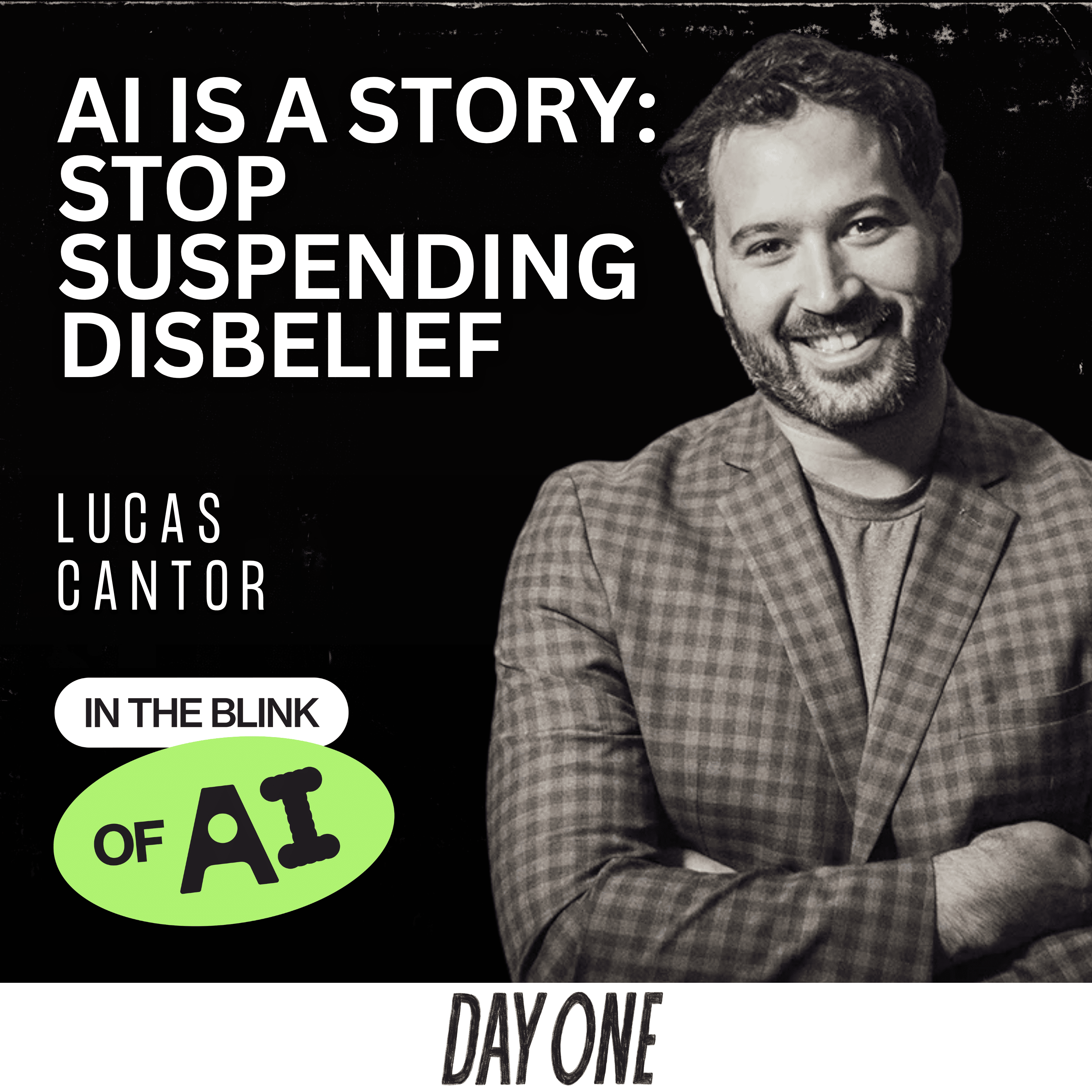
Speaker 1You're listening to a Day One.fm show. You know, Georgie, I want to push back on that. I don't think anybody knows what AI is. Huawei asked me to finish Schubert's Unfinished Symphony using artificial intelligence, and I would have thought this would be a competitive gig, but I think I was the only qualified person who said yes. And they all have some version of the same answer, which is that I'm sure artificial intelligence can do, fill in something that they're not an expert in, but I doubt that it could do a thing that they know all the details of. The biggest problem with AI and people's reaction to it is that the idea of artificial intelligence engages a part of your brain that does not require you to think critically. It engages the part of your brain that wants to suspend disbelief, because AI, it's a story. What it does is it helps creative people do things better, which is useful if you are a creative person, but it is not useful if you are not a creative person. Music is cooler and more intricate and more interesting today than it's ever been. So I think there's nothing to be afraid of.
Speaker 2Hello and welcome to In the Blink of AI. I'm Georgie Healy, and this week my guest has two Emmys. He's scored for Fox, NBC, Disney, Netflix. He's produced with Lorde. That Lorde. Huawei approached him to leverage AI to finish Schubert's unfinished 8th symphony. The dude was long gone. How can we finish this beautiful symphony? And that experience was so incredible, and the final product was so incredible that it ended up touring orchestras with orchestras worldwide. Lucas? Luis Cantor Santiago is a composer, producer, and music tech VC. He's freaking incredible. This episode was so nuanced with how technology can be leveraged for someone that's ultimately a very creative person. He recently published a book talking about this experience and asking the key question, what is left for the artist when machines can literally finish your work for you? I just loved this chat. Side note, 70% of you that regularly listen to this show are not subscribed. Which is wild, because last week we reached number 10 in the Spotify business charts. Thank you, because that is due to people pressing follow, rating the show. And if you're not doing that, now you know how much of a difference it really makes. Please follow, please subscribe wherever you are. If you can rate it, that's huge. And it helps me get these kinds of incredible guests and improve the show every single week. Let's dive in. You're listening to a day one.fm.
Speaker 3Show. Found a scale faster on deal. Set up payroll for any country in minutes. Hire anyone, anywhere. Get visas handled fast and get back to building. Visit deal.com slash day one. That's D-E-E-L dot com slash day one.
Speaker 2Lucas, congratulations. You've had a new and recent book come out. It's called. Unfinished the Role of the Artist in the Age of Artificial Intelligence. I am so genuinely excited to unpack this book. I haven't heard this take before, and it's something that I can't wait for our listeners to learn about. But before we do that, what's an AI hack that you are using that you think listeners should try?
Speaker 1You know, there's so much stuff that just isn't useful and it's clever and it's a, you know, like a cool math problem and a cool capability. But but it's really not. It's not that useful to most people, but one that I do find myself using all the time is stem separation. So for listeners who aren't musicians, like one of the things that I do in my music career is like a label or something will say, hey, we want a version of this song that, you know, like, say, Bonnie Tyler's holding out for a hero, but we want it to be like new and we want it to fit with this trailer or this piece of advertising. And so that's great to do, except for the multi tracks of Bonnie Tyler's holding out for a hero. And so I think that's a great way to do that. And I think that's a great way to do that. THEIR FAMILY. The road to Puritanism goes further than most people would like.
Speaker 2Oh, my gosh. Okay. So, on this, like, let's paint a picture for our listeners. You're a composer. Lucas, you're a producer. You're an author. You're a multi-instrumentalist. You've already brought out a piano. If you were forced to give one of your many, like, titles to AI, could you? And what would it be?
Speaker 1Yeah, this is the irony of being a, you know, AI person, I guess. Evangelist. Yeah. I don't know if I'm, I'm certainly not an evangelist. I'm just, I think partly because I'm an investor in music technology broadly, which is not just AI. Oh, we should have added investor into that. Yes. Yeah. That's part of my, it's my sort of side hustle, I guess. But, so I end up talking about this a lot and about, you know, the role of technology in the arts. And I don't find AI specifically, other than a few narrow use cases, one of which, stem separation I just gave you, I don't find it, to me, particularly useful. I, I do understand why someone who's not like a trained, who's not a trained musician would find something like Suno useful. And I always pick on Suno because they're the biggest ones, but there's a bunch of companies that do what they do.
Speaker 2And explain Suno for people that aren't familiar.
Speaker 1You go to the website, you type in a prompt and it will make you a song. Yeah. And so it's, it's just like, you know.
Speaker 2Hardcore metal and a theme. A theme of corn, but make it these lyrics.
Speaker 1Yeah. You could get that from literally what you just said. You could probably get something. And, you know, there are a lot of ethical problems with the way Suno trained their model. And that is the, that is what, you know, that's their biggest PR hurdle at the moment. I mean, they basically just stole all of the music in the world and trained on it. And it is unclear. This is still, you know, this lawsuit's pending. It is unclear whether what they did is illegal or not. It's certainly unethical. Whether, you know, whether, whether they broke the law or not, it's certainly unethical. It's going to leave a bad taste in the mouths of musicians, no matter what they do subsequently. That said, the product is really quite amazing. Yeah. It sounds, it sounds great. But I don't really, you know, people accuse me of being an elitist because I'm a professional composer. And like, I don't really understand the point of Suno beyond entertainment. And that is, you know, I, I stand by that. Like I, I enjoy. Making sounds and making them cool and getting into the details of that is like what I like to do. That's what I view as my job, but everybody making music is complicated and different people like different parts of it. So like, for me, the part that, um, I would be happy to have AI take over is like, I don't love mixing and, you know, like just turning the knobs, getting the sounds exactly right. I, you know, I'm, I'm, I'm okay at it. I'm serviceable at it. I don't love it. Other people do love it. So like, you know, for me, maybe. That's the one that I would be okay with AI helping me with. And I have used tools like, uh, like row X to help me with that. And like Lander that, that can help you with that. And the result of all these tools that I'm naming for, uh, for the purists in the audience who would not want to use AI or don't want any AI involved in their music is like, because of row X and Lander and Suno and all these musical tools that make amateurs able to bring professional grade stuff to market all music sounds better. So like all music. No matter who you are, like you can record with your guitar into your iPhone and it sounds better today than it did five years ago. So, so it's a, it's a, it's a pretty profound leap. Um, and the baseline for what like Sonic quality is in music is, I mean, it's sort of like a frog in hot water. Like it's so much better than it was just 10 years ago. And we don't notice it because it's kind of inching up slowly, but like what you would accept. I mean, I think about demo tapes I made when I was a kid, like on tape in a room in an untreated room. With just a microphone and no, you know, digital enhancement and they, you know, you could make an, you could make an argument that they sound, they have a certain vibe that maybe you like, and maybe you don't, but as far as fidelity and, you know, how much of the music was actually captured and how much noise was accepted and rejected, it's just, it's light years ahead of what, where it was even just a few years ago, let alone a few decades ago.
Speaker 3On deal set up payroll for any country in minutes, hire anyone, anywhere and get visas handled fast. So you stay focused on scaling deal takes care of onboarding HR, IT, EOR benefits and compliance. So your team can grow without borders. It's why more than 40,000 fast-growing companies trust deal to move fast. That's D double E L dot com slash day one.
Speaker 2So you can see the magic in AI in the way that it makes sound quality so beautiful to listen to. And I, and I really admire that because for someone like me, I don't see the nuance necessarily, unless you were to fully point it out to me.
Speaker 1Another thing I hear it like you would hear it just back to back. You'd be like, oh yeah, that's so obviously better. Yeah. The same way if you listen to a recording from the twenties, you can hear that like recording technology.
Speaker 2Yeah, for sure. For sure. And I'll use. Terms that musicians probably don't use. One thing I'd love you to unpack a little bit for me too. It's probably so obvious to you how Suno has stolen music, but to, to, to me, I'm like, when you say so, like how much work goes into it end to end, how many hours and what does it really mean for a musician or a composer or a producer to have music stolen? Oh, you could just record something else though. Like no big deal. Like, like make it clear to us how big a deal this is to musicians and the like.
Speaker 1Yeah. I mean, your audience, if I'm not mistaken, is like business savvy people for the most part, right? So, okay. It's very simple that music is a commodity, much like commercial real estate. So when you make a song, it is very difficult to make a song that people know. It is easy to make a song that nobody knows. It is very difficult to make a song that people know and songs that people know are incredibly valuable. They are valuable. Not just. Because you get paid to perform them, but they are valuable because there are entire royalty streams and industries that are attached to them. So, um, a song like everybody wants to rule the world. I'll take as an example, because I have some involvement in it was a very popular song in the eighties and it was probably worth the most amount of money that it had ever been worth in, you know, 1980, whatever, when it came out, it kept decaying after that, but it hits sort of a flat line. It's a song that everybody kind of knows of, right? You know, maybe you can't sing the lyrics, but you've. Listened to it and you sort of, oh yeah, I know that song. I heard that. I love it. And that is, that's the, that's true of every hit. So that familiarity has value, um, because people gravitate towards what's familiar in the world of entertainment and, you know, in the world generally. So that familiarity has value. So when I did, um, a cover of that song with the artist Lord, it wasn't just her stardom that, that brought that to life. I mean, it was her stardom that made the version that we did amazing, but the fact that the song was recognized gave it this other, um, dimension. That made it into a hit and that dimension is what's valuable in a song. And to like, take the composition and ingest it and just sort of strip it and use it as training data is stealing something that is valuable, right? Yeah. I don't know if that makes sense. It's a, I guess that, so use the analogy of commercial real estate. Again, it's sort of like coming into your building, laser measuring everything, and then using that to design a new building. All right. So it's like, did you steal it? I don't know. But you entered without my permission. And what you did is definitely unethical.
Speaker 2I love that analogy because, yeah, we've, we've all heard covers before. We love a cover. Covers can be beautiful. Sometimes covers are better than the original. Um, I listened to Lord's, um, like your involvement in that song. I listened to the song. It's such a different take and it's so beautiful in its own right. I, I love the band Deftones. They've covered a lot of the Smith songs. Very different vibe coming from a new metal band, you know? And like, they both have their place in my opinion, uh, that that's just adding something very special. Like, I have to ask you while you're on the show, the listeners would be begging me to, how was that process come like creating something special in you and, and, and tell me about it.
Speaker 1So I unfortunately have a kind of disappointing answer to this question. Um, but my, uh, I, I do detail it in my book quite a bit about like, you know, how it came about and how, and how we, how we went about it. Once, once it, once we had gotten the job, but, um, it was done entirely remote. I've never met Lord still. Um, so it was done entirely remotely. You're going to be closer than ever. Yeah, yeah, I know. When you visit. I'll be, I'll be as close as I've ever been. I, I went to a, I mean, I, I met her like in passing at a concert, you know, but I've never like, you know, talked to her. And, uh, you know, I joke in the book that like it was done remotely and the vocals could have been recorded in any studio in the world except for mine. Um, I literally have no idea where she did it. Um, wow. So, uh, yeah, it was done, um, you know, entirely on, you know, we didn't quite have the technology we have today, but we did have, um, you know, like what we're using right now. Riverside is, I don't know if it's a derivation or just a sort of similar family to technologies that musicians have been using for decades. So, um, we used to use like a thing called, um, source connect where I was able to like listen to the board of a studio halfway across the world in my own studio. And this used to be incredibly expensive. by the hour. Now there's a company called Audio Movers are good friends of mine it's a wonderful company but like i can literally with a 20 a month subscription listen to any studio in the world it's how i do all my work now is i'll like just i can literally just log in to someone else's rig and listen to them manipulate stuff as in real time um but this capability we've had for a long time so um it's just it's just gotten like cheaper and uh cheaper and better in the last in the last 15 or 20 years and for the people that are in the
Speaker 2social media comments saying i hate ai i hate ai in the creative space in the creative industry are they missing something about well in the past you needed so much capital so much money connections is this a democratization of being people that have talent being able to bring a beautiful finished product like am i simplifying it or is that true yes you are simplifying it
Speaker 1it is it no i mean it's not like your your impulse wrong it is a democratization as i said of sound quality is a democratization of like um of being able to get something that is ready for market faster uh the same way that you know you can vibe code an app to a standard that was impossible even five years ago that doesn't mean that you can design a good app and almost everybody can't and it's the same thing with music so like the fact that you have all my tools like so georgie i could take you or any of my listeners you can come to california and sit down at my rig and try like good luck yeah i mean unless you're a musician you're not going to be able to do it and like and and even if you are a musician i have like every musician every composer has their own instrument so um it's you know that they made that is specific to them so even someone who knows logic which is the the software that i use would take a few minutes to get comfortable on my rig or even a few hours um so it's so it is a democratization of it and it's a like it's a it's a fallacy it's a fallacy promoted by um ai companies that ai democratizes creativity what it does is it helps creative people do things better which is useful if you are a creative person but it is not useful if you are not a creative person so um you know love yeah well the way the way i think of it is that like you know if you accept the you know talking point that ai can make it can help you realize anything you can imagine then the obvious bottleneck is your imagination and you know that's that's what artists work on and that's what artists cultivate they cultivate their ability to generate good ideas that are fully formed um and that can uh that can um communicate things and that's that's a skill
Speaker 2that i think is underrated outside of the arts it reminds me of um and this is such a silly comparable but it reminds me of when black swan came out and everyone said oh natalie portman learned how to be a professional ballet dancer for the film and as someone who's done even like like i did i think 15 years of ballet and was never even close to the standard of a professional ballet dancer i was like how dare you like you can't just like um give someone all the tools and even the training and all the rest of it to be at that level just you know
Speaker 1georgie i'm the same way with um movies where our actors conduct uh-huh like if you know what conducting is they look absolutely ridiculous if you tell me why yeah kind of tell me why well i mean it's it's uh it's for the same reason that um natalie portman you know being a ballet dancer it's for the same reason you just wave your arms around like i don't know what you mean yeah yeah i mean the reason it's it's actually very it's actually kind of profound um that i mean the reason is because you know what you're looking at um and you know and you're and you're like you know for most people the idea that a conductor stands in front of an orchestra and waves his arms around is perfectly fine like your life will be robust and beautiful and filled with joy if that's what you think a conductor does it really doesn't matter if you are trying to be a conductor it's much different um so and and i think that this is one of the things that social media and just the sheer fire hose of information that has proliferated in the last 200 years has done for our society is that it has made us believe that expertise is not valuable and that anybody can know anything and like the evidence for this is that there's a lot of things that we don't know and like the evidence for this is uh and i i do believe that anyone can know everything or anything but that doesn't mean that everyone does know anything everything all right i think that made sense no i get you no you nailed it yes but my um and and my uh my evidence for this was like very early in the research for my book i you know i'm not an academic i had no idea how to go about writing this book and so i was like i thought well let me just ask someone who's smart and knows stuff that i don't know and so i asked my doctor like my actual primary care physician and if i could take him out to coffee yeah yeah just like you know the guy who tells me i got a cold right he seems not yeah well i mean i i knew that he was very learned in a way that i wasn't right and so like i don't know anything really about medicine and i assumed he didn't know much about music and that was confirmed by you know asking him and uh so i took him to coffee and i said like you know tell me what you think about artificial intelligence and he said well i'm sure that artificial intelligence could do something like write a pop song but there's no way it could ever diagnose a disease
Speaker 2right so and i was like this get him on the show come on yeah yeah we'll see if we can well so
Speaker 1but but his reasoning was very reasonable and this is the thing like i've asked this question to many people and they all have some version of the same answer which is that i'm sure artificial intelligence can do fill in something that they're not an expert in but i doubt that it could do a thing that they know all the details of right so for us who are not doctors i assume that a disease is like collecting and collecting and collecting and collecting and collecting and collecting and x amount of data points and running them through a database but that is not at all apparently what diagnosing a disease is like um i've never done it right i've never been more out of my depth with
Speaker 2diseases and music lucas but like i'll believe both of you yes yeah and with music i mean like
Speaker 1you know the idea like you know it's it takes a lot of work to get to something that sounds really simple um and uh it takes a lot of effort and uh and and a lot of genius to get to something that you listen to and just think oh right that's music um the greatest example of this you know is i mean there's so many good examples but if you think of like an alan menken song you know any of the disney songs from the 90s you don't even think of someone having written them they just seem to exist with these characters um or you know anything by john williams you know like try to imagine star wars without the score without the score or indiana jones these don't seem like created pieces of work they just seem like part of your life um and uh you know i think it was said that the best technology becomes invisible and you know the evidence for that is like there is just i don't even know how many servers are like burning uh electricity for us to just have this conversation from australia to los angeles completely seamlessly but you know this technology
Speaker 2is invisible to us that's such a great way of putting it it kind of reminds me of ai and people being like i don't exactly understand how it works under the hood and it's like every time i pick up it how it does what it does it just does yeah i don't know what my car does under the hood frankly agree and and somehow we we we use it every day i want to ask you you know obviously you were passionate about writing this book obviously um to me who knows a little bit about you i can see why this was so important but cast me back to the point where you know i read that you called yourself a luddite for most of your career and you were like i don't know what to do with this career basically you know um the purists that we were talking about before when did you when did
Speaker 1you first start to be like i need to reassess my thinking here yeah i've i've always been just a little bit more curious than cautious and i think that's that and and just in i mean just like an inch more right um or about three centimeters more um and so i think that the uh the impetus for me had i not sort of stumbled into technology i would have been one of those people you know bitterly bemoaning the demise of civilization and music because ai is ruining everything which it's not and like you know uh it is also like for um those of you who might be nobody who believes this has listened to this far but for those of you who might have uh have had an open mind um you know the idea that technology is destroying music is you know it's as old as the sea it's what every generation says about every other generation and it is um you know the one constant in human history and certainly the one constant in music history is change and so saying that the old stuff is not as good as the new stuff is like saying that yesterday's weather was not as good as today's play your old stuff um yeah yeah i mean it's an observation and it and it's true but it doesn't matter and it doesn't really mean anything so um uh and it's and and better in music is is a relative term it just means that it like what people are saying when they say that today's music doesn't is is not as good it's just what they mean is they they don't understand it it doesn't speak to them and and nor should it you know musicians musicians um like pop music for example the music that most people are familiar with is made by young people for young people and when you are no longer a young person you continue to listen to the music that was made for you when you were a young person that is what almost everybody's experience is again
Speaker 2guilty guilty yeah and and you know uh for you like i found this story incredibly interesting right so most people that are in the music industry or any industry might not have this experience where you were approached to go into a partnership with a very big tech company, right? One of the largest tech companies on the planet. Tell us that story and tell us your thinking before that happened and then did that evolve as you continued the partnership?
Speaker 1I'll tell you one of the things that really helped me in that project was that I live in the United States and at that time I hadn't traveled like a lot and I had never heard of Huawei. So they do no business in the US. I mean, I think they sell switches, like something that you would know if you were an executive at AT&T, but I had never heard of them, right? And so like for me, when my manager brought this to me, I was like, okay, whatever. Like I took it seriously, but like I wasn't intimidated by it as if Apple had asked me. So that really helped, I think. But I'll just sort of take you to the beginning. So I was a Luddite in like a musical Luddite in that I made music. I learned to make music. Like I learned to just play guitar. I didn't care about recording at all. I just learned to be a good guitar player. And then I started recording in a studio that was totally analog. It had a computer, but the computer was basically used as a tape machine, right? And so the sound came from the instruments and from the board. And then I moved to Los Angeles and I got a job at Hans Zimmer's studio, which is a hub of music technology. And I realized that as a composer, what Hans had built, was the ability for me to use any sound I could possibly imagine at any time. And that's what a composer's job is, is to combine sounds together in a cool way. And, you know, the limitation, like I said before, is your imagination now. You know, it was different in the 1990s even. If you wanted to like demo something, you had to get people in a room to do it. And at Hans's, you could just demo it immediately. So you could fail faster. You could innovate. You could do all kinds of interesting things. And so I sort of begrudgingly began to see the value of using technology and music at that time. And then when I was connected with the technologists who wanted to do the Unfinished Symphony, I was in this unique position of having done a lot of orchestral work because I did this song with Lorde. I was doing a lot of recording at Abbey Road and just working with big orchestras and also not being afraid of technology. So like I was like, you know, it seems like, like, so, so Huawei asked me to finish Schubert's Unfinished Symphony using artificial intelligence. And I would have thought this would be a competitive gig, but I think I was the only qualified person who said yes.
Speaker 2So much to unpack there. I'm going to start with Schubert's Unfinished Symphony. Tell us about that. And I don't like things that are unfinished. I'd be like, please, someone give it a go. But why did why did you use AI for it? Tell me a little bit about the symphony. The symphony itself, and then and then what happened next?
Speaker 1Sure. Well, Georgia, your proclivity to finish things, you know, does set you apart from syphilitic composers. So, yeah, the Schubert was well, I'll tell you one funny thing about the Unfinished Symphony. So the Unfinished Symphony is Schubert's eighth. He wrote two movements of it, and then he sort of sketched out. A symphony typically has four movements. He wrote two movements. He sketched out a third and scholars who know more about Schubert than me think that the fourth movement was actually another piece that he used in some other context. So so maybe he did finish it, but not really. He never, you know, bound it together.
Speaker 2And so he's very type B Schubert. OK, got it.
Speaker 1No Schubert was Schubert was fucking crazy, right? Like Schubert was a genius, but he was out of his goddamn mind. I love that about him. Yeah, I know. He's he's like, I think of all the of all the composers of that era, he's the one you would least likely you would least like to know personally. But the one you would have most wanted to have known, if that makes sense.
Speaker 2I can think of some present day music musician equivalents that I will not drop on the show. But yes, I think everyone has.
Speaker 1I think everyone has that friend. So so Schubert's eighth symphony is called The Unfinished, and it immediately just conjures this. And Schubert died very young in his in his early thirties. And it conjures this image of like Schubert with a quill and the candle is burning and he's about to die and he's just trying to pick up. Trying to pen these notes. It's so romantic, but that's not what happened. He just stopped working on it. So and we know this. This is not my, you know, a controversial opinion. We know this because there is a complete Ninth Symphony. So, yeah. So he just was working on this and he was famous for like he would. Schubert would write music. He wrote as if music was something he was trying to, like, expel from his body. Like he would just write on scraps of paper and just sort of throw them around to the point where his friends, his friend once, collected paper from around his piano, brought it to a copyist, had it, you know, beautifully laid out. And then a few weeks later gave it to him and said, Hey, what do you think of these? And he played them. He goes, Oh, these are fantastic. Who wrote these? That literally had no idea of the music that he had just written. So so I think he just I think he just kind of, you know, there are technical reasons why it would have been difficult for him to finish the symphony unfinished symphony that have to do with, you know, styles and constraints of the time that were different 20 years after he died. So I the the critique I've gotten about the unfinished symphony was that, you know, it sounds a little bit modern, you know, it sounds a little bit modern. A because I was the one who finished it and B because I thought that Schubert would have come back to it years later and used different techniques that were available to that would have been available to him then that weren't available to him when he died. So that was my thinking, you know, right or wrong. That's what I that's what I thought. But the the idea initially to finish Schubert's unfinished symphony came from a technologist named Mick Grierson in the UK. And while I wanted to do this to to announce the Mate 20 Pro, which was their flagship phone of 2019. So they had the idea that Mick had this technology that was it was an LSTM. So, you know, basically Stone Age technology by standards and it generated melodies for us. We prompted it with all of Schubert or sorry, we trained it on like monophonic. So just just the melody, not any harmony. Just the melodies of as much Schubert as we could get our hands on. And then we prompted it with the melodies of the unfinished symphony. And it gave us back some, you know, somewhat reasonable melodic ideas back. And then I orchestrated them and made them into a symphony.
Speaker 22019 is before anyone had AI even on their radars. I think people still spoke about AI like it was, you know, NFTs or crypto or James Cameron. Like you were going to bring the Titanic up and like it was just like, OK, now it's just, you know, standard. You know, it's it's just part of the lexicon now. Whether you like it or you hate it, everyone knows what AI is. You still think they don't know?
Speaker 1No, I know it's it's I mean, I don't know what it is either. It's a marketing term and like it's different. You know what? Like what is considered AI today is I mean, what is considered AI today? It's like I mean, I think we all sort of understand that, like, if you're using a large language model, that's artificial intelligence. Yes. If you're using a recommendation algorithm on the back end of, you know, TikTok, are you using AI? Is AI using you? I mean, is that even AI or is that just a piece of technology?
Speaker 2It's a fair pushback because the term is used interchangeably for like a general intelligence, like a human could do this, but then it can't count the number of eyes in the letter Heidi. And it's like, well, like, most human adults can count how many eyes there are. So so what do you mean when you say general intelligence? The other day I got really cranky and had this huge rant about AI agents because everyone just says, oh, I've got an AI agent. Well, an AI agent is AI that works on its own with no human intervention. And I'm like, well, no, no agents exist. Then like you're just using that word for email triage. So it's a fair pushback. But in 2019, people really didn't know what AI was is like this feels very early.
Speaker 1The field, as we know, it did not exist. Yeah, or it was it was like I guess it was starting to exist. It was really kind of a marketing term. I mean, GPT, like like Google was experimenting with GPT at the time and they were like pretty good. They weren't amazing. And and there so it was a yeah, it was a different time. And I mean, just to just to talk about agents for a second, like I just so I'm just like less sanguine about. Artificial intelligence than most people just from having, you know, sort of lived in it for a long time. One of the things that, you know, I noticed there's a commercial that I see in the States for like an open claw derivative. It's open claw, but like for dummies or something, right?
Speaker 2But so it's like, oh, that's just what we need, Greg.
Speaker 1Yeah, well, it's open on the back end, but like you just prompt it like natural and like the use cases they they show in the commercial are email triage and the AI can call a restaurant and make a reservation for you, which is also like open clause use case like it always talks about. We can call and make a reservation, a thing that no human being does or needs to do. Like, you don't need to call a person to make a reservation at any restaurant in the world, pretty much literally ever. So this is and you know, the the other stuff that they show I doing in commercials is like all things that it doesn't actually do right. It's pie in the sky vaporware stuff that we wish it did. And like, I wish that my I could like organize my schedule for me. Remind me that I should pick up flowers for my wife. Tell me to not. Forget, you know, X, Y and Z. But it doesn't actually do that, right? Like maybe it will in. the future and maybe if we just pour a few more trillion dollars into it it will but at the moment
Speaker 2it doesn't so i yes this is such a good pushback and for the listeners that feel like a year ago ai agents were being promoted um you know book flights for you is another one that they all they all book our flights for us no one has an agent autonomously booking their flights imagine that happened before you got to big sound lucas like don't worry an agent will do it would you trust that i wouldn't i would be like hell no would it check the yeah i just even i mean trust is like
Speaker 1you know yeah i guess the the argument and the sort of emotional what what makes it seem emotionally possible is that you know i don't actually know the person that did book my flights to big sound right it was just a person who sent me an email like had it been an agent i would not have known however had i gotten to the airport and realized that it hallucinated a flight that didn't exist i would have at that point figured it out um so yeah there there is like you know i i don't believe that there is no future for this technology i believe that there is a robust future for this technology if we can get it to be a lot less expensive than it currently is um and by by expensive i mean the actual cost of it not the cost to the consumer at the moment which is heavily subsidized but you know i think there is a use case for it but the way that i think about you know say uh claude or open ai is that to me they're about as useful as microsoft excel and you know for my business i wouldn't want to run my business without microsoft office but if it cost like five thousand dollars a year i would just find an alternative like it's not that useful to me so um you know at the current price point you have the ability to
Speaker 2use your brain like i think for some people that have never used microsoft office don't know how to use excel don't know how to use google sheets or all these tools like graduates that are coming out of university i worry for them without them because they're not going to be able to do it without a foundation layer like how they would survive without ai if not saying it's a good thing but but to you and i like if you removed ai i think we'd function perfectly well in society without it i have one hot take two for you for your opinion if that's okay of course as many as you like here's a hot take that people are saying b2b sass is dead the the platforms like the hub spots like the crms like the sales force like these big big companies and enterprises use is dead because ai exists we could vibe code that but do people want a person to yell at at the end of the day when it fails and if that agent books your flight and you get to the airport and you have no flight and you got no seat and you can't come to big sound surely you want to yell at someone i want to yell at someone what are your
Speaker 1thoughts um i do want to yell at someone georgia yes um and uh there is i think it's deeper than that i mean it's it's um you know being in the sort of world of capital markets um as i as i find myself sometimes it is the idea that b2b sass is dead is like a very convenient reason for open ai's ipo to work out you know um and it's a very it's very good news for um people who have the biggest microphones in the world um that doesn't make it true and um it's you know industries also take a long time to die uh the music industry is often touted as an example of an industry that was murdered by technology but the music industry is bigger today than it was before now much much bigger not like okay healthy much bigger so you know it was disrupted but it did not cease to exist and um you know trillions of dollars do not vanish um you know brilliant people who have robust companies do not go away just because their valuations go a little bit lower um so i don't uh the the sasspocalypse is i mean it's a hilarious word first of all great word no argument yeah so so kudos to whatever journalists came up with that um but but it but it is um it is likely i mean and this is you know for anyone who's ever worked at a big company i mean there are fortune 500 companies that are still running a version of windows from 10 years ago probably it is like not a obvious or easy thing to change any software in beautifully said i worked in
Speaker 2automotive uh top automotive companies in the world they were using systems from the 80s because to rip that out would ruin their whole supply chain like they just couldn't do it
Speaker 1like yeah this is this is a well-known in the states maybe not elsewhere but our like the important parts of our military are like run on computers from 60 years ago because you can't just like upgrade a nuclear facility right you just if it's working you just leave it it's straight up yeah it's not broke and i think that the the problem here and this is really like one of the things um you know this is this is one of my dc's as an investor but uh but the the biggest problem with ai and um people's reaction to it is that the idea of artificial intelligence engages a part of your brain that does not require you to think critically it engages the part of your brain that wants to suspend disbelief because ai is a isn't it's a story and the the what these companies are doing is they're telling you the story of what this technology might be and so you engage with it the same way that you might engage with a movie or a television show if you think that about these claims critically and apply them to your own life they do not hold up and i mean we've already like we've already given some examples of this but for anyone who is uh you know afraid of ai anyone who thinks that ai music is going to ruin the world or that ai is going to rule the ruin the world stop thinking about it as a story as something that is inevitably going to happen and just start thinking about what are you actually seeing today and what does it look like right now and it doesn't look much different than it did when i finished hubert's unfinished symphony in 2019
Speaker 2okay so you're a music tech vc lucas if there is a company that you see being a unicorn in future based on what you're seeing now to your point what is it
Speaker 1um well interesting question um one of the uh one of the cornerstones of our of our fund is that we're not really in the unicorn business um we think that we think that tech companies are severely undervalued and that we can do good multiples like within the realm of reason um and um the other thing is that in entertainment shit happens so like you know we're in the we're in show business which means that like sometimes something happens that makes your thing incredibly valuable and you can't predict what that's going to be so um you know the like labels and publishers um are in and vcs to some degree are in the business of failure you fail most of the time and your successes are really big um and so we're so we're you know our fund is smaller and we're trying to get a good multiple on a amount of capital that is a rounding error in like an ai you know fintech right but you know but money is money so um yeah so uh as far but as far as like the things that i think that are going to to answer the spirit of your question which is what do i think is going to end up winning and be the uh you know the the musical tools of the future i think that that it's already sort of happening there are these big like a company called uh moises which i already mentioned which we're invested in is it's like a b2b it's like a tools platform for musicians i mean it has all kinds of different tools uh you know charlie pooth is an ambassador it's all the stuff is ethically trained it's all super cool and like and they've got um millions of users like they're doing great they're providing a service they don't have a tremendous debt load they don't have a tremendous uh ai spend and they're making money so if you're making money in the music business you are killing it hell yeah hell yeah and um and companies like uh um suno like i you know they have a 500 million dollar valuation already or is that right now it's five billion dollars and like i don't know what they're going to do to realize that valuation i i i i can tell you what what they are doing is like making every mistake that i've seen various companies make over the last three years like they're trying every avenue that i've seen already fail i maybe the next thing they're going to do is try tokenizing you know i don't know um but you know uh the but but maybe they'll figure something out and like the the i think the you know when you get a bunch of smart people together trying to accomplish something generally yeah i don't know if that's true do they generally do it
Speaker 2i don't know um it's well said too because we do see these like vibe coded projects being created and it reminds me of suno a bit because it's like oh that's kind of neat like taking the ethics away from it oh kind of cool do i need this every single day to vibe coat my own like music in the style of corn like not really everything that has been everything that ai everything that has been
Speaker 1um almost everything that has come out in the last five years has fallen into the category of amusing but not amazing so yes you know it's great it's cool yeah oh wow that was fun and then you move on with your life like an article in the newspaper you read it it gives you something and then you throw it in the trash and the um the uh so the companies that i see winning are the ones that provide like real tools for people to tell stories. Um, you know, in entertainment, that is what we sell. It doesn't matter what part of the business you were in, you were in the storytelling business. And so if you have a really good idea, um, for a story and a really good idea of how to tell that story and the way that you tell it and the content of the story resonates with your audience,
Speaker 2it doesn't really matter what tools you use. This brings me to this headline question. I'm dying to get your take on actually. Ben Affleck had an AI company called Interpositive he sold to Netflix. Scorsese's using AI for storyboards. Their, their take is that these are laborious tasks that AI could do and will streamline our process. It's not a flash in the pan vibe coding project that you never use again. What is your take on these kinds of technologies and systems
Speaker 1in the creative industry? Yeah, I, my understanding of what the storyboarding one, for example, is that it's very much like the DAW that I use to create music, that it's like a way of abstracting visual information in a way that can be more easily manipulated. So you can have more creatives comment meaningfully on it at earlier stages. So, um, to, to only use, I can only really speak to the example of music, but it used to be that like, so like the first time George Lucas heard the score to star Wars was in a recording session when they were recording it in London. Well, the first time that, um, uh, and I I'll just pull this out. Uh, but the first time that Christopher Nolan heard the score to, um, uh, let's say, um, uh, Oppenheimer was probably pretty early in the process because Ludwig Goranson is able to generate beautiful sounding demos, right? The first time you heard it, you know, it's always sounds better when you actually record it. But today we are absolutely required. Composers are absolutely required to provide realistic sounding demo material. And when you can do that and when you can make it, um, in a manipulative manipulatable, um, format, you can have a director right next to you and say like, Hey, what if that note went up instead of down? And you can have that happen. What if that pause was a little bit longer? What if that section came a little bit later? And so you can actually have the director making meaningful contributions and any other creative on the film, making meaningful contributions to the music in a way that makes it more collaborative. And so in a case like storyboarding, where like, just for, for listeners who might not know for at a, every shot in a film is they basically make a comic book first, right? That's the easiest way to think of it. It's like, it's literally every shot in the film. And there's all these conventions of like, you show the actor and then there's an arrow, which indicates that there's a pan and you can imagine what the pan would look like. Right. But it's, it's basically like a comic book of the film. And this is, these are things that were done by hand typically, I think until kind of recently, and then probably done digitally and like Photoshop or something like that. And so to have a, um, technology where you can make them and manipulate them in real time means that a director can kind of have one extra cut of his movie. So, or maybe multiple extra cuts of their movie. Um, will this make movies better? I don't know, but it will certainly make them different and it will, uh, and it, and it gives creative people more opportunities to do creative things. So I think that's probably why Ben Affleck and Martin Scorsese were behind these things initially. Um, and then my other, uh, my other thing to say on this hot take is that like, just because a company sold to Netflix doesn't mean that it's worth anything. So I mean, I wish them well and I'm sure it's great, but like, you know, there are all sorts of reasons that companies buy other companies.
Speaker 2Things get sold. Doesn't really mean much. Okay. Great. Great. Uh, reminder there. Okay. I keep seeing these two Emmys you've got behind you, Lucas, is that a fake green screen you've got? Yeah. Wow.
Speaker 1I know this is my, well, I mean the most important award is this is my coach of the year award from Chatsworth junior baseball, which I got. Shut up. Shut up. Coaching my kids' tee ball team. Yup. Hell yeah.
Speaker 2So that's in my.
Speaker 1We love all three.
Speaker 2Yup. Yeah. They're all good. Two of the three were Olympics related and it's not the sport one though, right?
Speaker 1It is the sports one. Yeah. So the, so yeah. Um, so yeah, when you, when you work on the Olympics, um, the, uh, if the Olympics, if the show gets an Emmy, you get an Emmy. So this is like a, it's like a producer Emmy. Um, so, but I'll take it. Emmys are Emmys.
Speaker 2Where, like I'm proud of you and I'm sure a lot of people are. Thank you. A lot of other people are. That's incredible. Does this mean you're joining us to the Brisbane 2032 Olympic games as well?
Speaker 1Come on. Well, you know, I'm really focused on the Los Angeles 2028 games, which are coming right up. That one first. And, uh, yeah, I have worked, um, in some capacity on every Olympics, on every Olympics since 2002. And, uh, if I'm, you know, if I continue in that job, I will certainly be involved. I don't know if I'll be there, but, um, but if I'm, if I can be there, I will be, I, because of technology, I'm able to do my job remotely.
Speaker 2Yeah, exactly. But, but after big set, I'm sure you'll have a few couches.
Speaker 1I hope so.
Speaker 2Lucas, I, I could easily speak to you for another three hours. Um, I know it's nighttime over there, so I won't put you through it. I do want people to check out your book because I think this has given a little taste of some misconceptions that we all have about the music industry and technology and, and, uh, history and, and, like, you know, the, the, and, and things that we thought might be the case that, you know, you can very clearly articulate aren't. What's one thing though, before I let you go, that you hope people take away from reading your book at, as the role of the artist in this time of AI?
Speaker 1Music and technology are almost the same thing. Um, they are inextricably linked. We have always used technology to make music and disseminate music and understand music. And, um, and AI is no different. And this will just, it might change the way that music sounds, but everything that we've ever invented has changed the way that music sounds from the, uh, phonograph to the printing press. It's, it's, it's all changed. And I think, you know, music is cooler and more intricate and more interesting today than it's ever been.
Speaker 2I adore that. Thank you so much, Lucas. Anything else you'd like to shout out before
Speaker 1you go? Uh, no, I'm excited to go to big sound. Um, I'm, I have a, uh, little, um, sub stack that I started called tech proof, which is about how to, you know, do stuff that will survive, um, you know, basically any technical, uh, technical, uh, upheaval. And, uh, it's pretty simple. I mean, look, I can, I can sum it up in one word, which is like, be good at something, you know? Uh, and this is to, and I, I think like the last thing for, you know, any musicians and especially young musicians who might have, uh, you know, um, been listening and I know a lot of them, uh, follow me, like get good at music. And I think that is still a really viable career path. Um, or, or it's as viable as it's ever been, right? Like if you're a music student, you probably will fail because that is the nature of the business. That is the nature of, uh, an elite profession, but you don't have, you have a greater chance to succeed today than you did when I was a kid. Um, because there's more opportunities to make money off of music and that's not going to go away.
Speaker 2Beautifully ending a fantastic episode, Lucas. Thank you so much. I have a sub stack, so I am going to recommend yours. If you follow me guys, you'll see Lucas's, uh, pop up now. Thank you so much. I will see you at big sound. My friend, I am so looking forward to it. I can't wait. Bye. Thank you so much for listening to in the blink of AI. If you want to go deeper on anything we've spoken about today, I write a weekly sub stack called attention is all I need. Yes. It's hilarious. It's a pun. And essentially I go into AI rants. Tech news events. I'm going to, and more it's bite-sized and I hear it's awesome. Uh, the link is in the show notes below.
 PodcastTranscript AI