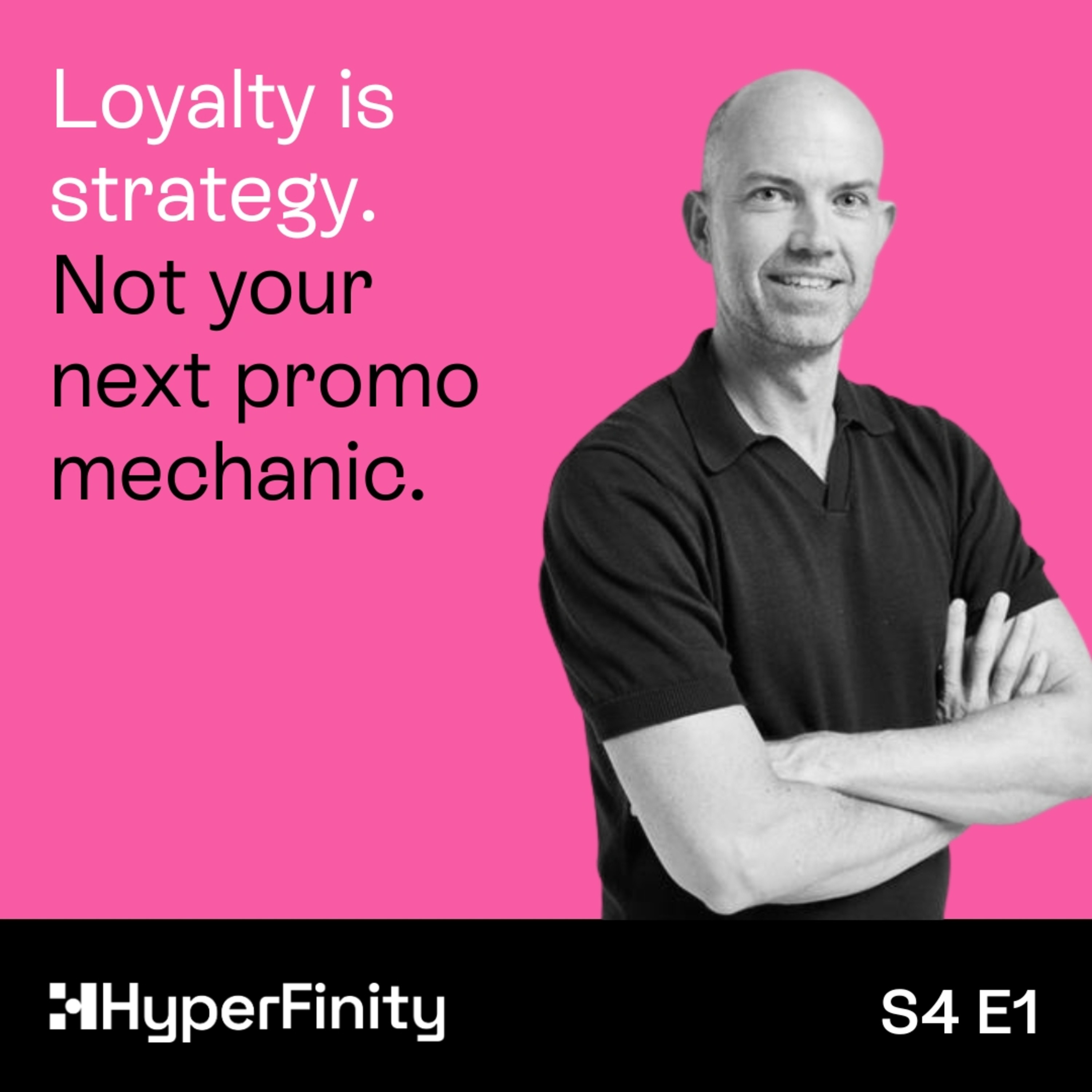
This podcast episode features a discussion between Tom Rigdon and Chris Charmers, Global Customer Director at JD Sports, focusing on loyalty programs and data strategy in retail. Charmers explains that JD's "Status" loyalty program was launched to extend customer relationships beyond physical retail, reward shopping behaviors, and gather valuable data. He emphasizes that data is foundational for modern retail, driving personalized marketing, advertising efficiency, and potential data partnerships. However, quantifying the full impact of loyalty on brand affinity, beyond direct sales incrementality, is difficult. JD tracks brand sentiment and customer engagement but lacks definitive correlation to broader brand health metrics. The conversation highlights that loyalty strategies must be tailored to specific business contexts and customer demographics, with JD prioritizing simplicity and digital integration for its young, tech-savvy audience. Charmers notes that programs should evolve continuously, cautioning against automatic rewards that may undermine profitability, and stresses that loyalty's strategic value—whether as a growth engine or defensive tool—varies across different markets and stages of a brand's maturity.
Hello and welcome to the fourth series of To Affinity and Beyond, Hyperfinity's Decision Intelligence for Retail Podcast. I'm Tom Rigdon, Growth Director at Hyperfinity and Your Host. Our podcast explores how data science and AI can drive more profitable outcomes for retailers. Season 4 will see us talk to senior leaders from across retail. We'll talk through real-life examples of how retailers are using customer loyalty as a growth engine and how data is critical to their success. This week I'm joined by JD Sports Global Customer Director Chris Charmers. In the session we talk JD status, the data and tech strategy behind successful loyalty programs, as well as how loyalty programs can help inform wider customer and commercial strategy. Hi Chris, great to see you. Hi Tom. For those uninitiated in your career so far, will you tell us a little bit about yourself and your journey so far? Yes, of course. I guess my career has been defined by operating in retail, real passion for retail, but also leisure travel as well, quite a different sector, but both equally interesting. Essentially a career I guess always driven through commercial marketing, with a bias towards digital and laterally as the landscapes changed, so how that commerciality is then being applied more broadly in marketing and organisations. And your current role is an interesting one, your global customer director. Yeah, new role for JD. I think off the back of what has essentially been a journey to really drive the omnichannel agenda in JD, where we bring our digital and our stores business together and make strategic decisions across the chain with that global footprint. I think there's been a recognition to really drive the customer's interest now, as we have various varying levels of maturity in each of our markets that we operate. So actually how we show up for customers and what we do to serve our customers in the best way and provide them with a great experience that we are so passionate about. Actually, it has different priorities by each of our markets based on our position. So some markets are just entered, some have a degree of maturity, some have a degree of maturity such as the UK market. I guess where you are now and the sort of challenges that come to your door and the ambitions that you've got as a brand, I guess the landscape will have changed quite a lot across your career from when you started to where you are now. You're great to get your perspective on some of the more, I guess the biggest points of difference that you think, from when you started out and the challenges you faced in the roles and then you had to where you are now and the things that show up day to day. Yeah, I think there's kind of a rod of steel that runs through all of the businesses I've worked in terms of the importance of data. I think which has really been the backbone of the change. And I think the infrastructure and the technology that enables you to drive more value out of the data rasser is the, is the inflection point. And then I think, you know, I think it's always been that recognition. I started my career early by my career with Tesco, clearly defined by the, the role of Don Hongbin, how that drove power, but also a risk into an organisation. And I think that sort of stayed with me. All the businesses I've worked with since have had a different level of maturity based on their proposition and not always having loyalty. Loyalty is a massive unlock to the data asset, right? But not all retailers and businesses choose to have a loyalty program because they choose to make their investments in other strategic areas. But I think there seems to be a real sort of pursuit of that. I hate the term sort of data is the new oil. In fact, someone said to me, it should be defined as soil because actually it creates the shoots of growth. Yeah, I thought it was quite interesting. I think, so this kind of been this, this moment in time, I think where the recognition of the value of the data beyond just those commercial sort of top line sales gains. And how that can play out in the media landscape, but also into your proposition development as a business, how you better serve your customers based on the insight that you get. So I think that broader sort of knowledge that's unlocked by the data, that's historical or typically driven by loyalty propositions outside of a pure play in commerce business. Is it seems to be the direction of trouble where most businesses are seeing some value? I mean, it's a good that you raise loyalty at that because obviously that's the cornerstone of what we talk about on this podcast series a lot. The topics that we covered in the last series that is always really front of mine to me into our business based on the conversations that we typically have with senior stakeholders in the cease week. Everyone's got different motivations, right? But growth is a common one. That concept of loyalty and what it means to a business and having the conversation around loyalty turned from cost to investment to growth engine. It's kind of challenge and I'm really I've never set client side, so I don't know how that is. I can sort of infer how it might be from conversations I have with clients. But what's your point of view on that about sort of various businesses that you've been in or you're privy to and the challenging conversations around loyalty and whether that is a viable investment or whether it's even seen as an investment, whether it's seen as a cost in a business that would be really interesting to get point of view on. Yes, I've been up and around businesses that have a very different point of view on the role of loyalty and actually whether or not it's a strategic priority. So sometime a growth so they were very deliberately not having a lot of scheme because they chose to invest essentially what they would reward customers with through through investment in price because they wanted to hold a really strong price position. So I think that's anchors to more of the commercial value, the commercial role of loyalty. But I think as I've sort of moved through my career in different businesses, it's often tabled as we should do loyalty and there isn't much rational as to why. And I think what's been really fascinating in the JD business is the global, the global element of the business where there's a different level of maturity for the brand in each of the markets and therefore loyalty is right for some markets but not necessarily right for all interest. You see that through the customer life cycle, through high levels of acquisition, through a degree of maturity, through a degree of challenge. So when you're challenged as a retailer, you've got to find a defensible position. Loyalty can be the solve to that and in fact in some ways JD's our investment in status is to defend our position to drive true customer connection. It's been fascinating from a JD perspective, I talk more to JD because it's the very live experience. The role of loyalty was far beyond just the commercial gain of ultimate sales growth. It was really about the brand enhancing element of the loyalty scheme and how we can add a richer experience for our customers. We're basically 16 to 24 year olds with lots of very distinct cultural interests where loyalty and its broader proposition can play a genuine part in the day to day lives with a secondary benefit of driving reward for maintaining their shopping behaviors with us. So I think the element of the data value probably came later in terms of what that really presents from the top line commerciality where you can start to see more of the profit gains as opposed to just the sort of core growth or defense defensible position. So that's been quite interesting and I think that's what a lot of businesses wrestle with. Yeah, and I personally have had to try and size the commercial value of the data asset not only through the typical reading me during monetization elements, but through the genuine, you know, how you extract value from that data. You drink by loyalty through as a retailer. Yeah, and I always frame it in three ways, which is, first and foremost, you're a retailer. So how do you drive your top line sales growth in great give customers and keep your customers loyal, but actually you're an advertiser. So how do you invest? How do you better leverage your data and your knowledge of customers to drive efficiencies through your advertising? So we know the underpin to media is now on data. And the third is, you know, and more of a recent thing is see yourselves as a publisher, a media owner or a data owner. And therefore what's the value of the data to other brands that you partner with? That's huge. Yeah, there's a couple of points that you've mentioned there. I'm packing and diving into a little bit deeper. There's one that I have a lot of theories about all the time. Greater your point of view on it. So you talked about loyalty, not always purely just being the driver of incrementality of revenue, although obviously that's super important, but that brand impact of loyalty. I'm probably going to hatch it because I'm doing it for memory, but I think there's a McKinsey stat that says that anybody who's a part of an active loyalty program is likely to spend 15 to 25% more on non loyalty based purchases, which means that's probably driven by a greater degree of brand affinity by being part of something. I'm reading that in textbooks and doing my research, but from your point of view in the businesses that you work with, and I guess from JD as well in terms of, is that right for your experience. And how do you go about tracking that in terms of how loyalty impacts that that brand salience amongst your customers and that ripple effect of, you know, normal purchase patterns being increased by. There's a really interesting point, probably one I don't have the full answer to, I think what we're trying to do. So how do you measure it really, really tricky. What we've established within JD is brand tracking. So, and actually what we're looking is verbatim comments that talk to status states in our law's proposition and where they're proactively talked about through the surveys that we put out into the market across our core target customers. And then we have some very intended deliberate questioning around the role of loyalty and status and a lot of what comes back is clearly the digital value of status. We can't correlate any any true impact yet to brand health metrics off the back of the status program, but we can clearly see a high level of incrementality from our status cohort of customers. And we see them as being a high level of engagement, clearly more frequent in their shopping behaviors with a higher basket value. So the core is there and you've got to believe that, you know, we have a fully digitized loyalty proposition. So the status apps it's locally on all the customer's devices who have chosen to download the status app and are willing to let it still persist on their device when spaces are precedent and people, you know, customers can make choices. So, you know, and then we give it to the comments channel as well so that we can start to talk directly through the likes of push notifications where we have the rights to. And that then sort of means that you're generally more visible as a consequence. But we can't we've not got any definitive correlation yet in terms of the true what to validate that begins to start. Yeah, interesting point of point of thought dig at because I'm just personally particularly interested in that, but we're quite fortunate in terms of we've got a core sort of target audience of 16 to 24 year olds. Yeah, very digitally savvy, very digitally engaged. We have a digitized proposition through our law to proposition. And we're really clear on their cultural interests and we haven't fully tapped into that in our extended proposition about how we sort of form part of their everyday lives through the wider role of status. Let's touch on status. Let's go into that a little bit. So the every loyalty program is different. I think when we when we talk to clients, every loyalty needs to start with sounds obvious, but every loyalty need program needs to start with a strategy specific to the business because everyone different trading patterns. What was the mission for JD status when it set out and how has that evolved as you've sort of developed it and built it? Yeah, so I think it was it sort of predates me. So status was a great initiative undertaken by the business really for three reasons. One is that it was sort of extending the relationships outside of just physical retail. And that's everything I've just sort of talked about in terms of how it can be more brand enhancing. So that was probably the first thing. Second thing was sort of retaining our customers and rewarding their behaviors in a way that was commercially viable. And then the third thing, but probably less of a priority, but a secondary benefit that is quickly coming over priority, which is the value in the data set. So being able to really identify our customers in store and their transaction behaviors so we can drive that true intelligence to show up in a more person on targeted way. Through our digital communications and or our on-site experience that we give our customers or our in store experience that we give our customers. Great. And I guess that's a real that's a real win and an unlock isn't it? If you understand the relationship between customers and how they're interacting with digital channels, so app website and then what happens in store. Yeah, the sports fashion sector is equitable between stores and online. So it's a way that in sectors that has that true sort of 50/50 split. So therefore our customers are normally channel customer and they will typically shop between an online and an in store and they don't differentiate, you know, it's just JD. Yeah, I've been able to understand those behaviors and how our customers like to shop with us. And whether they choose to browse in store and then transact online or whether they choose to browse online and transact in store. Yeah, it's really important for us to understand that so that we can then again show up in the right way with the right proposition. Yeah, yeah, great. And your view on the loyalty programs, there's a myriad of different ways that people can be rewarded. What's your view on your approach to status and how you reward customers? And sort of zoom out to a general view of the market and perhaps other loyalty programs that you see in comparison that might do it a little bit differently. Yeah, there's a lot more that's filled clearly and member pricing seems to be the key one across the grossest, but I think our proposition is really simple and I think that's really important. Keep the service, the proposition as simple as you can say there's an acquisition offer which is pretty rich and drives the uptake of the status program across our customer base. We've measured significant incrementality of the back of that initial first transaction and then we dropped to a quite modest base currency. But the total across the 12th century delivers reasonable incrementality, but we know the base currency isn't sufficient to maintain the same level of incrementality over time. Okay, so therefore we have a two-pronged attack or approach to then compensating for what the commentality that initial quite rich offer was. And that's across the experiential technology, additional features, benefits that we offer and then targeted emotional activity and not auto rewarding outside of a base, a base level of currency because it could get quickly quite expensive. So that's the status, but clearly in the market there's a whole host of different different approaches to loyalty. I'm not a particular personal fan of the tiering where you go through a gold silver bronze or move from a bronze silver gold. I'm not a particular fan, I think it's right for some sectors maybe airline where frequency is potentially lower. So you take a longer period to move through those, but you retain quite sticky to the airline. The grossest clearly are all into member pricing, which is a really interesting one. You can't really do that until you've got a sizable penetration of your little scheme across your customer base, so it takes a while to do that with impact. And then you've got those that look for, you know, where you can extend your rewards outside of just the core retail environment that you're operating within. Yeah, so yeah, I can't comment on the problems of all those schemes, but I think we're really, really mindful of keeping our opposition within our loyalty scheme as simple as possible. Yeah, I think when it comes to customers, it's got to be accessible to them. They've got limited bandwidth, even if you're type of customer that wants to keep up today with all the latest colorways and make sure you get a limited edition one when it pops out. Yeah, even the new ones of presenting an offer as in our world, we talk about 10X, yet in terms of the cash back proposition that we have, whereas we know actually 10% back is easier for some customers to kind of equate what that actually means. Has that been a challenge at all in terms of what's really important to a loyalty program is customers understanding of how they use it. And it can often be really clear to a business, but not necessarily super clear to the customer in the end after it's been rolled out. Have you seen any of that? Have you evolved anything in status as you rolled it out based on customer feedback? And is there a lot of kind of constant tweaking of it to make sure that it's landing really well with the customers to get it? Yeah, I mean, it's a never, ever never ending process, you know, we've productized our loyalty proposition. So we have a clear road map in terms of the tech that supports it and a rollout plan in terms of the global rollout of the program, but it has to have real strategic merit on why you would do that. I think we still operate with a loyalty app, which is native and distinct to the transactional app, and we know that's something to review and solve for in the way that ClubCard did and Tesco many years ago. But we've tried to create a clearer connection between our digital estate and our digital store and our status app so that we can make that that shopping experience as frictional as possible when our customers are armed with the cash to spend. And I think, inevitably, the cash balance is almost, you know, is a ability to spend and I think being able to maintain that dialogue with customers is really important. So the importance of all those comments channels that we have access to and reminding our customers, certainly as they move close to an any expiry is a really important part of the journeys that we that we've invested in over time as we've learned more about their behaviors. So yeah, I think it never stops. I think there's a there's a number of different strategic plays within that, but our primary priority at the moment is really better understanding to drive much more targeted relevant offers to customers outside of that auto reward of the 1% cash back proposition. Yeah, auto reward is something that comes up an awful lot and it's I think I have a slide on it sort of like, you know, one of the most commonplace challenges within loyalty is the auto reward and the margin erosion of auto reward. So if you don't know that you're doing it, you get the dopamine hit of the result. You keep on doing it without really realizing the true impact to margin across the country. That's that's been you know measurement is critical. Yeah, it's one of the topics you want to talk about and I've been on the journey, right, which is what really come up to nearly two years of maturity in our UK proposition and questions get asked over whether is it really driving incremental value. And will like to measure that's quite difficult because you can't preclude anyone from joining the scheme. You can't have an actual control discipline in the way that you can at a campaign level. So then the measurement of that is pretty challenging and that's why you have to be very thoughtful and very rigorous in the approach to win the confidence of the business that is delivering the value. That's further challenged when when you know retail stuff right so some businesses, you know, may be challenged in quite tough retail environment. And therefore any incrementality that you can demonstrate as consequence of what you believe to be loyalty might actually mask some of the overall downturn in performance, which is hard for us becomes quite. So I think there's a good health potential in JD's business a good health attention and a constant challenge about the incrementality of the scheme because we make a significant investment and we want to see the returns. And I welcome that because I think it keeps us really on point to make sure that we're all constantly delivering the incrementality that the investment would warrant. The point there is that there's in something so complex as a loyalty program when you deal with, I know in some business you can have hundreds to thousands of micro segments of customers each with their own depends to towards different categories and ranges and brands and buying patterns and things like that. It's not always easy to have this sort of catch all silver bullet metric that is. We've done this in this delivered X but I guess that's constant test and control isn't it. It is yeah, but the way we approach it is we have an annual measurement cycle so we will we will re-measure every year the base the core program and the performance of that program. And then we will plan you know our forward looking KPIs as a result of that, but that's commitment that we make and it's really important that has a high level of integrity through the measurement methodology that you deploy, which we've worked really hard with. Hard to do with the support of the high team and then outside of that you've got your date, you know much easier campaign level test and control which we've done over the period of time to truly understand. I'm now we're fortunate enough to have a level of maturity because I'll point your cash back expires after six months. So actually we've got that maturity and that like to resolve for and we've got given the scheme length how long it's been alive we've been able to now get some certainty in the value back over along the time horizon which has been good. So we manage the total program on an annual cycle and then we manage campaign level by campaign and then we manage all campaigns on a six month roll and basis. And it's I guess it goes to the longer you do it the more you do the more significant the data set the more you can trust it exactly as long as you measure in all the time. And that's a really good point because I think that trust is really really really important certainly with the lights of the CFO who who often is the the biggest challenger in a in a good and healthy way. So the more confident you can be in the in the data that underpins the numbers that you're you're landing on then the better is for producer. Yes, when you put yourself in the shoes of a business that hasn't done this before hasn't yet been committed to go through loyalty or the data science or rigorous measurement methodology if you're doing it for the first time. It's quite scary thing to think about investing in because it's to be undertaken isn't it. I think and we operate pretty quickly to get something live it's a start of the launch of status and I think there's a whole you know infrastructure that needs to be stable and secure and well going to manage I think just to make sure that the data is accurate and accessible to therefore then the confidence in the measurement and the performance. Yeah, that's a big watch out for any business that's thinking about launching loyalty is the tech of the data of structure to sport at neat blue piece of risk. So thank you for that. I was going to ask you about the tech side of things. So what's that what's that it's that it's the my tech map that gets produced every year that just becomes a giant swarm of bees of brown. Every year and this gets bigger which I can talk about it like a restaurant menu where you get decision paralysis you don't know what's good or bad anymore so you just pick staked chips. So we're being in your position though I think I talked a lot of retailers all the time where they're looking for a tech solution and maybe a point solution to solve loyalty is a problem in a singular fashion and that's quite a challenging. In conversation to go against and talk about the breadth of what you need to look at strategically in the loyalty program. It just be great to get your point of view on your experiences with that and the implementation of point solutions and different methodologies to find the whole thing together and what you think it takes to build a successful loyalty program with a combination of tech and smart strategy. Yeah I think essential is I would the most important thing is to get your data architecture on so clearly the vendors that will provide the solutions to manage offers allocate offers is critical and there's many of those available in the market. But being able to make sure a mandate that the data flows in the right way is essential because the accuracy is so important to prove the value back and at any point that's challenged or not trusted. Then you'll lose a lack of faith in the numbers that are ultimately standing behind in terms of their real performance so so my biggest piece of advice or the things that people that the position recognizes is being really clear on the data architecture and the data flows and the solutions that support that spot on related to that is another topic of keen interest to me. My previous background was around sort of the marketing world and pre-loyalty acquisition really that was what my world was focused before. I'm really interested you talked at the start of the conversation around the rich kind of attribute rich data that you get from running a loyalty program and the deeper understanding of your customers and then how that impacts how you do everything else and how you spend your money on acquisition and above the line and all those sorts of things. It should be great to hear your point of view on that and how that's evolved as you've got rich data set of status. Yeah, I mean, there's a few things I guess within that which is the data and the segments that we can identify because the data segments we can identify within that clearly helps us do downstream activation in a more compelling way for our customers. So we can be more targeted relevant in in certain media environments showing the right products that we believe to be the next best action for customers to to buy or consider. So there's a real real power there. I think there's also through the scheme and the mechanics the ability to capture additional data that you would never have been able to allow us that richness. So this concept of zero zero part of data is fascinating but actually through a gamified experience which is the sort of path that we've tried to capture that more data from our customers and gamified the collection has been really perform and what that's allowed us to do is really distinguish the preferences. And rich set attributes at customer level to inform some of the programs that we do downstream. So that's been fascinating and actually customers are really engaged with providing us with the favorite brands or if they're if they're what missions are undertaking certain parts of the year and as we understand that we can be much more relevant to those customers in a way that never existed historically. Yeah, marketing world, you know, you can execute data across a multitude of different media environments now in a way that you can never do that before so therefore it's less important. It's still not widespread in common places, though. No, no, it's matured and truth. Yeah, but it says it's hard. It's hard to get your data into good shape to then be able to leverage it to benefit ultimately the customer experience. We play with that and call it customer relationship media here because it's kind of like CRM. That's it. I agree. I think the typical the term CRM is far more wide ranging than it ever was in the way that you know all the touch points that customers have where you can drive a degree of relevancy through the attachment of the data. Yeah, yeah, I think it's probably going to become a lot more prevalent because it's over competitive in the market still it costs a lot to win new customers. And I think if you well, you will have seen this, I guess the quarterly focus on pro acquisition or OS, the media spend that you put now there. The very minute that you can lay every lifetime value metric and loyalty metric alongside that sort of gives you a different sense of power as a decision maker. Yeah, good point. And I think yes, that balance between short and long term impact and clearly all businesses chase the short term because it's the revenue derived then here and now. And it takes a slightly bigger nerve, I guess, to hold out for that longer term impact. But as you better understand the profile of your customers and you can see that you get that lifetime value over a longer period of time, then you more compelled to invest a level you probably wouldn't have been before. So actually it's dead interest to get into over optimizing on a short term basis, which just gives constraint to long term growth. But striking that balance is tricky. And I think one thing we're trying to do and I'm trying to champion is that we see loyalty in the same way we see media in its value that it drives back. And we may consider investments in both our media is equitable to our loyalty investments and then make choices about where we spend. Yeah, and you need to win in both. I don't think anyone's got enough customers at any one point, I know we could always do more always do more. But I guess when imprudently is the and that comes back to measurement, I suppose you got to start to be able to measure it, but measuring over long enough timeline helps you inform all of that. A little bit more efficient in the acquisition side of things, but ultimately if you move in towards lifetime. Yeah, 100% yeah, especially the CFO. Where do you think with the can't really call it the emergence of AI because it's been around for a long time, but the more public emergence of strategic. Where do you think that's going to take the direct to travel for loyalty programs also businesses like yours as a whole. How you approach it strategically next year? Yeah, I mean, it's a fascinating area, and I think a lot of businesses are wrestling with what does it mean for their business and where's the opportunity within their business. I think from a JD perspective, we've actually recruited a director of AI to help shape what that looks like for the group. And I think some of the interesting areas that are exploring at the moment is around content generation, which is fascinating itself. Now what that does do and what does it does enable from a lot of perspective is the scale up because actually to your point you loyalty and the better understanding that you have allows you to create. Multitudes and micro segments that you can't scale when you've got man, you said dependent on manual processes or even some of the core tech foundations. So the scale up of loyalty to be hyper personalized demands that content engine that can present the content in the right way to the, you know, to almost one to one. So that's a big focus area for us within the business in terms of how we tackle that and get the scale up. Yeah, outside about that, there can be any different to any of the businesses in terms of how you can make meetings more effective by using things tools like co-pilot. And the light and how then how accurate they are and playing about what the discussion has been. And I think then some of the decision logic from a law perspective is clear to something that we're exploring with yourselves in terms of how you can scale up the decision around what which offers the most compelling for customers based on the segments that they resided. Yeah, that's quite I mean, it's sort of play on that for a moment. Yes, when you're trying to execute loyalty without ability embedded, it's a lot of work. It's a lot of consideration and it's probably a lot of spreadsheets as well as trying to work it out manually. It's almost impossible. It can be a big manual process to scale up in the way that I guess all businesses would want to want to say you have to have eyes on that. I think as you develop your annual sort of strategic approach. And then, you know, the balance between some of the basics can deliver value and power and then how that scales over time as you build your infrastructure around it. Yeah, but yeah, AI fascinating one. We've just created the school of AI actually for other colleagues to form part of and champion champion our agenda in that space. Well, it's something that we can't ignore on the big fan of looking for how it helps create efficiency in what you do. Or it's like it's like having your own sort of PhD assistant, isn't it? I guess when we're talking about decision intelligence and we're talking about creating 100 microsegments or 1000 microsegments apart from away from personas, for example. I mean, those worlds have been so close to each other. It feels like 10 years ago everyone was talking about personas and you come up with almost like your sort of Janet and John personas that were drawing out. And that was sort of your strategic foundation, but a lot of it was built on what people thought in a room and with research and a bit of anecdotal stuff, whereas now. Has it made it easier for you to get into that level of having sort of attribute rich microsegments and a decision engine helping you orchestrate the office? Does it speed up decision making internally amongst teams? Because obviously you're working in an environment where you've got multiple teams working together with the same end goal. Does it make it easier? I don't think we know yet. So I think we're at the early stages of our exploration of that. So we don't truly understand or have the understanding so I haven't done enough volume yet to know you intuitively would say yes. There's going to be significant efficiencies. There's going to be significant scale up and that should make us highly much more efficient and still maintain a level of mentality. We believe that hypothesis to be true. I can't say if that is true. Yes, yeah, until we're further down our discovery. We touched on brand earlier, as a recent term to the ripple effect of loyalty and people spending more. I'm always interested in how it impacts sort of a creative love in this attribute rich view of the data and a deeper understanding of customers' behaviors. You're above the line campaigns and how you approach those sorts of things. Have you come up with any nuggets of insight that made you think? I think the thing we've been able to do is probably reassure what the business already knew, but with some more facts data that underpins those decisions or those thoughts. So I think that's where really the confidence has been deemed or landed in the organisation is still, I can still really well just got a wider set of data. I was just to call a further that is right. And it is right. It's reinforcement. It's not really changed. It's just helped them reinforce and made internally colleagues more confident in the way that they do and the approach that they take. So it's always an interesting one that because if the data had told you something completely different, I would have been a little bit worried. Well, to the all important question, I guess working for JD and working on the status loyalty program, how has that affected your own trainer game? Well, you just lost my wife. Yes, I like trainers. I know I buy quite a lot of trainers. The problem, isn't it? It's become a problem. I've aloft with Perspects boxes that like up when I walk out there and display trainers that I know. I mean, we're fortunate that we sell amazing products, amazing brands. And I think you know, being able to access those is fantastic for all our customers and I'm certainly one of them. Yeah, well, trainers of the gift that keep on giving on there. Unfortunately with the modern workplace now. I don't always have to wear brooks anymore, but I know I should have picked today where I wore all the high tops, but you know. That's been a really great discussion today, Chris. I think we touched on a lot of really interesting, interesting points. I guess the final question that I'll ask is on a topic that I think is evolving quite a lot amongst retailers, where at the start of the conversation you talked about, you're three points, your last point, be and think of yourselves as a publisher. And a retail media is kind of like it's become more of a buzzword thing that everyone's talking about these days, but as a retailer thinking of yourself almost as that publisher, not all retailers would be in the mindset of thinking about that as a revenue stream or as a means to fund their loyalty program in part or in whole. The greats get your point of view on how you've seen that develop over the last couple of years as this has become more possible. Yeah, and I think my reflection on that because I've been around this sort of space for a good while now is you can kind of completely see the value and opportunity within the gross away your supply basis significant. And therefore your opportunity to drive true incremental revenue or new revenue is great go greater. I think we're still reflecting in JD on the true opportunity we have a distinct core set of brands that we partner with to drive sales in partnership. And I think it's a really you've got to be really considered on what your proposition would be and if it adds value to the brands that that you partner with until you can really qualify that opportunities isn't there in the way that everybody just seems to quickly move towards. So I think we're still exploring what we believe the opportunity to be you know we're not as high a frequency as grocery we don't get that weekly shop some customers. So you're about the same as buying. So you know when you haven't got as frequent a shopper base in the same way so clearly the biggest attraction to brands to spend or move their spend out of core media into retail. What you tell me is to get a proximity to the purchase and you've got to do that incisable volume to make it be a compelling a substantial or a spend out of other channels and you can clearly see that in some sectors and not so much in others. You get that and is there an ethics point in there as well in terms of without naming brands because probably we wouldn't want to do that here but obviously we know what you stop JD and what you sell. Obviously the concept of retail media is giving brands access to audiences that they might want to get in front of clearly that could be quite challenging because you don't want to be seen as biased when you've got a lot of suppliers and big brands that you work with. So I guess that's a consideration when you're not a grocer where there's thousands if not hundreds of thousands of brands where it's a little bit more saturated and easy to do. Absolutely and I think any of these propositions have to be developed and in hand with your partners to make sure that they land in the way that you want them to and that there's a market there for whatever the propositions manifest to be. So we say very much it would be needing to understand and work with our partners to get to the right proposition and not do that in isolation. Yeah I guess you've got to think about the customer at all points and yeah I believe that all of this is with the intent to drive more relevancy for customers so that's got to be a good thing. So I stand by I think the proposition that stands behind or sits behind retail media as a concept is a great one for customers it's got we've got believe it is. It's just making sense of it commercially for retailers, the brands that we partner with. So it's fascinating and I do think we tell me that probably isn't probably right terminology now because it's sort of moved beyond a whole multitude of things that aren't just so pigeonholed as media. Yeah so yeah I think once you once you understand but I guess as well that there's the tooling so you have to be a significant enough size to be able to have the tooling to have the data to warrant the. Absolutely yeah yeah tech investment data investment you know typically to have self teams you know so there's a big investment to stand up these initiatives and it would be right for some some businesses and not for us. So what would you to put you on this part because I haven't primed you for this but if you were to give two or three key takeaways for people in your shoes and similar roles or people in retail businesses that are looking to export loyalty or pseudo loyalty programs. What would be your two or three biggest bits of advice interesting I think well we've probably touched on it through the discussion but making sure that you go eyes open with the tech and data infrastructure that you need to enable these. That's in part to deliver the best proposition but also to enable the measurement because that measurement is critical and I think that would probably lead to the second point which is be clear on the commercial goals and how you will measure. And when the confidence hearts and minds of the business based on the investments that been unlocked. And the third thing probably would be you know see see beyond just the commercial sort of corporate sales growth driving aspect into that brand you know what the roles it can play in terms of brand. And that brand enhancing element of the proposition brilliant perfect. Thanks again brilliant conversation great to see you again I do just. Thanks for listening and thank you to this week's guest JD sports global customer director Chris charmers. If you enjoyed today's episode please subscribe and your favorite platform and send your feedback to contact at eyepuffinity.ai we'd love to hear from you. See you next time for episode two where we'll discuss the power of customer micro segments with Victoria pick up tool station senior customer insight manager.
Podcast Summary
Key Points:
Loyalty programs like JD Sports' "Status" serve multiple strategic purposes beyond sales growth, including brand enhancement, customer retention, and data collection.
Data is a critical asset for retailers, enabling personalized customer experiences, efficient advertising, and potential partnerships, though measuring its full value, especially brand impact, remains challenging.
Successful loyalty strategies require simplicity, alignment with customer lifestyles (e.g., digital engagement for younger demographics), and continuous evolution based on feedback, avoiding over-reliance on automatic rewards that can erode margins.
The role and maturity of loyalty programs vary globally within a brand like JD Sports, depending on market-specific factors such as customer acquisition stages and competitive positioning.
Summary:
This podcast episode features a discussion between Tom Rigdon and Chris Charmers, Global Customer Director at JD Sports, focusing on loyalty programs and data strategy in retail. Charmers explains that JD's "Status" loyalty program was launched to extend customer relationships beyond physical retail, reward shopping behaviors, and gather valuable data. He emphasizes that data is foundational for modern retail, driving personalized marketing, advertising efficiency, and potential data partnerships.
However, quantifying the full impact of loyalty on brand affinity, beyond direct sales incrementality, is difficult. JD tracks brand sentiment and customer engagement but lacks definitive correlation to broader brand health metrics. The conversation highlights that loyalty strategies must be tailored to specific business contexts and customer demographics, with JD prioritizing simplicity and digital integration for its young, tech-savvy audience.
Charmers notes that programs should evolve continuously, cautioning against automatic rewards that may undermine profitability, and stresses that loyalty's strategic value—whether as a growth engine or defensive tool—varies across different markets and stages of a brand's maturity.
FAQs
The podcast explores how data science and AI can drive more profitable outcomes for retailers, with a focus on customer loyalty as a growth engine.
JD Sports sees loyalty programs as brand-enhancing tools that add richer experiences for customers, particularly targeting 16-24 year olds, with data value becoming a later priority for profit gains.
First, as a retailer to drive sales and customer retention; second, as an advertiser to leverage data for media efficiency; third, as a publisher or data owner to create value through brand partnerships.
JD uses brand tracking surveys and verbatim comments to gauge customer perception, though it hasn't yet established definitive correlation between the loyalty program and brand health metrics.
Status aimed to extend customer relationships beyond physical retail, retain and reward customers commercially, and later leverage the data asset for personalized targeting across channels.
JD keeps its loyalty proposition simple, starting with a rich acquisition offer, then using a modest base currency supplemented by experiential benefits and targeted emotional rewards to maintain incrementality.
Chat with AI
Loading...
Pro features
Go deeper with this episode
Unlock creator-grade tools that turn any transcript into show notes and subtitle files.
 PodcastTranscript AI