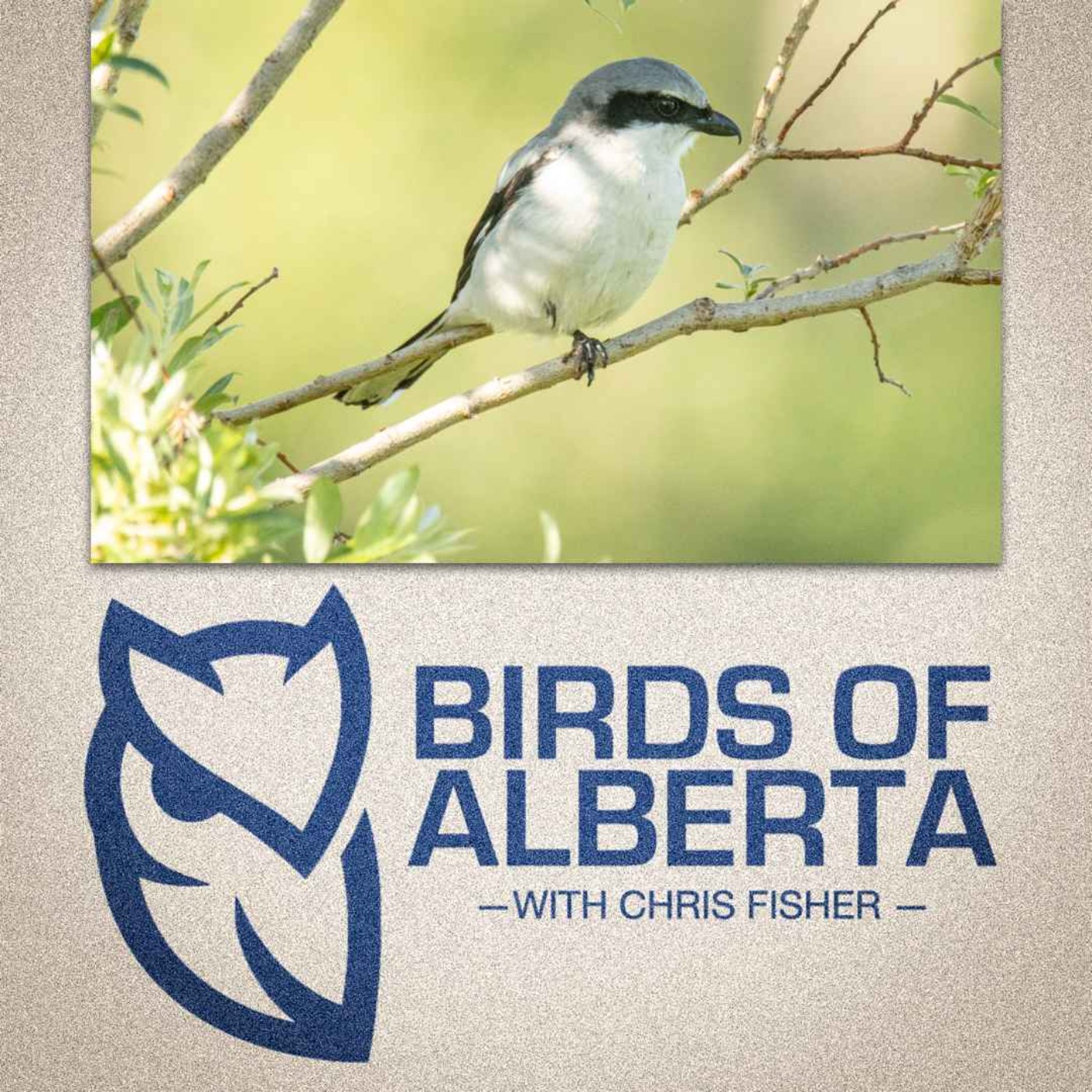
The podcast discusses the two species of shrikes found in Alberta: the Loggerhead Shrike and the Northern Shrike. These small predatory birds, often overlooked due to their size, are characterized by black masks, hooked bills, and a habit of impaling prey on thorns or barbed wire, which serves as a food storage method and may aid in courtship. The Loggerhead Shrike breeds in Alberta's southern grasslands during summer, while the Northern Shrike is a winter visitor, migrating from Arctic regions. Loggerhead Shrikes have declined historically due to agricultural conversion but are recovering in Alberta thanks to conservation initiatives like planting native shrubs. Both species are challenging to spot, often seen perched in open areas, and provide rewarding birding experiences, with the Northern Shrike adding interest to winter landscapes. The host emphasizes their unique predatory behaviors and ecological significance, highlighting Alberta as a prime location for observing these fascinating birds.
Welcome to the Birds of Alberta podcast. I'm Chris Fisher, co-author of the best selling field guide, Birds of Albert. Now Alberta sores and tyrannosaurs may be long gone from this part of the world, but their predatory legacy lives on strong. Now I'm betting that following that opening sentence, many of you will have flashes of our most iconic meat eaters. We are very well represented here in the provinces we have grizzlies, cougars, wolves, and rattle snakes, even gossocks. And Alberta predators, well they are some of the most seductive wildlife we have. This wonder of Alberta predators has actually been well studied. None other than legendary Harvard biology professor E. O. Wilson wrote about it in a book called Consilience, the unity of knowledge from 1998. He wrote, "We are not afraid of predators. We're transfixed by them, prone to weave stories and fables, and chatter endlessly about them because fascination creates preparedness and preparedness survival. In a deeply tribal way, we love our monsters." Now, I think this is one of the main reasons why so many people really dig birds of prey, like hawks and eagles and falcons. They're really some of the most sought after birds to track down in the field and photograph. I was, of course, share this same predatory vibe, but they have also something else going for them. With their forward facing eyes, they look like little mini human beings. We are all programmed to have compassion and nurturing instinct with big-eyed, round-headed many humans, aren't we? Now, there is also another group of smaller predatory birds that are not so well-known, but they're also very appealing. While smaller numbers are really only two of them in the province, they stand out in their own special way and fly off the pages of field guides and checklists, whether they're viewed by a first-time bird or an e-birder in the Millennium Club. But to the uninitiated, they hide their predatory predelitions behind a teddy bear facade. But once you get to know them, or better yet, spend time with them in the field, you realize the truth that these two species of birds are dressed as Mexican wrestlers and bear the brutality of an M-M-A fighter. They are our most repacious of the birds of Alberta, the Northern, and Longerhead Shrikes. Longerhead and Northern Shrikes share many similarities, but they also have many differences as well. Really the only predatory thing that jumps off their bodies is an oversized hook, ginsued like Bill and, of course, an oversized appetite, but all this is really massed by a pint-like size that has a bird exhibiting these characteristics that's only slightly larger than the very common American Robin. Maybe the most distinctive thing about both those species of Shrikes is that they have black and white feathers in both their wings and their tails. So when they fly away from us, their wings seem to pulse like a police strobe light. They've got a fairly large head to them, and their back is a really nice soft grayish color. But perhaps the most distinctive thing about them is a dark black mask that runs pretty much through their eyes over top of their bills. Now Longerhead Shrikes are a little bit more compact and shorter build than the slightly larger Northern Shrike, and the Longerhead Shrike has a black mask that really runs over the top of the bill, and their bill is slightly small. These distinctive masks probably evolved as it has in many Shrikes throughout the world, probably to reduce the glare from sun when they are out hunting. They do tend to spend a lot of time in wide open sunny areas, and this is fairly similar to how baseball and football players tend to use a little bit of black under their eyes in order to make that big catch. And so while it is possible to tell the Shrikes apart when you meet them in the field, there is quite frankly a better way of telling the two birds apart when you do come across them. Now if I'm investigating a Shrikes sighting, my first question would always be, so tell me Mrs. Jones, where and when did you see your Shrikes? In almost every case of seeing a Shrikes in Alberta where and when are the two important things to consider. You see the Northern Shrikes is migratory. It nests way up in the tree line areas of Arta Kanda and Alaska, and around the crown of the entire planet over in Asia as well. Whereas the Loggerhead Shrikes breeds in the province of Alberta, but breeds down in the grasslands and southern parkland regions of the province also in open areas. So if you are seeing a Shrikes in the summer months, say from May through to September, it is likely a Loggerhead Shrikes, and you're likely seeing that in the southern half of the province. In northern Shrikes, well boy, they can be seen anywhere, but not anytime. They start arriving in October and will be leaving in April and maybe early May, and you can see them absolutely anywhere but unpredictably in the winter months in Alberta. As anyone would rightfully assume, these two species of Alberta Shrikes are fairly closely related. The Northern Shrikes, the fact that it occurs also in Europe and Boral regions throughout the world, is probably the most ancient, the more ancient species of the two with the Loggerhead Shrikes, maybe an evolutionary offshoot of Northern Shrikes when they arrived to the North American continent perhaps after a leciation or other such periods in the Loggerhead Shrikes evolved in open areas that were located in North America, such as the Great Plains, where they are found to this very day. Alberta is lucky to have both of these species of Shrikes, and it does also hold a distinction of having perhaps the Northern most Loggerhead Shrikes breeding in the summertime and the northern most Northern Shrikes overwintering during our winter months. Now there are only two species of North American Shrikes, so we in Alberta really are on the top shelf for Shrike viewing in the entire continent, but we really can't hold again soon knife to other places in the world like Africa and Asia. Now when I guide tours down in the Serengeti in Tanzania, there are about a dozen of these Shrikes to sifter. There's big ones and small ones, and brown ones and black and white ones. There's magpie Shrikes and bush Shrikes and Fiskles. Yes, Fiskles, that's the name that Shrikes have in most parts of Africa and wouldn't be a shame if some future taxonomists imposes that name change on us here in North America. I certainly do like the name Shrike. In my view, there is really not another name for a bird that so fits a group perfectly. Shrike. It starts off soft and ends hard and cutting just like this little predatory bird. As a bonus, the word Shrike often and fittingly I must have had get spell checked to Shrike. Now you've got to pick your season when you go Shrike looking in the wintertime. Go searching for Northerons in the summertime. You go looking for loggerheads, but they do have characteristics in common. They are tree topper birds, so you see them often at a great distance. Merched on the top of a tree, that's more typical in a northern Shrike situation as they tend to hang out in open fields that border on mature trees or shorter bushes. That is the case with loggerhead Shrikes for their grassland habitat does not have a whole bunch of trees, so they tend to hang out in the bushes that dot our prairie landscapes. But no matter when you go out looking for them, good luck to sneak up on them because they are great scouts and they see you long before you ever spot them. So the most common observation type of a Shrike in Alberta is a view of them flapping their wings and flying off to a distant perch. Now loggerheads, loggerhead Shrikes can be seen increasingly through the grasslands in southern Alberta, places around bind-loss and one-four. Even up as far north as Castor in the Hayes area or even in Cessar.
Well, these are all good places to look for them. Seek out grasslands, particularly pastures that are dotted with some of the native shrub vegetation, and you have good chances of finding a loggerhead strike. Now, northern trikes, while they can turn up just about anywhere including in our larger cities. Here, in the larger cities, they tend to hang around city parks, particularly areas that have songbird feeders, as the loggerhead trikes are not necessarily attracted to the seeds, but for the songbirds that hang around in those areas. But for the most part, shrikes are rural, semi-open country types of birds, and you can see them perched up high, wherever you go in semi-open country, usually farm country is pretty good. Oftentimes, places where there is an abundant food source in winter, such as places where snowbuntings flock, it's not a surprise to see large flocks of snowbuntings migrating north and south, seasonally, and have in a northern trike rather, accompany them on their journey. Now, when you go out looking for northern trikes from October through May, there is an irony in discovering one because they do something that is sometimes very surprising, but also very welcoming as well. They sing. It's a surprise to hear them sing particularly in January or February, but the quality of a shrikes voice is also quite a surprise. Now, due to their predatory and nasty nature, you kind of expect a husky and raspy voice coming out of these birds, appealing only to the darkest of souls in the bird world, but the truth is not that at all. A northern trike song is peppy light and actually kind of musical. And it's so wonderfully suited to the soft acoustics of our snowy winter landscapes. Now, the loggerhead trike also sings a fairly similar tweetering song as its northern cousin, but I honestly don't really remember often paying much attention to them. You see, springtime's on the prairies is really an overwhelming orchestration of pipettes and longspurs, and metal larks and sparrows, and the sputtery song of the loggerhead trike doesn't really rise above the principal prairie instruments. That being said, it is pleasant enough of a listen. Now, as someone who has written about shrikes and posted about shrikes and spoken about shrikes for many decades now, I can firmly attest that there is no easier bird to play a game of word association with than our shrikes. So I'll just sit on this for a moment so that you will be able to come up with a word that I'm thinking about. And if you know anything about shrikes, well, I know you will find it. But before we get to shrikes, let's try a few other word associations with certain of our other bird species. So are you ready? Let's try wavy butter, recurved robber, condominium, feigning, honker, epilot, fissile. You got some birds in mind? Well, let's go through them. Wavy, well, that refers to the snoguse butter, well, the butter but of the yellow rumped warbler, recurved. Well, that's right in the scientific name of the American avisette, robber. Well, that's the cap robber or our Canada J condominiums. Well, who else lives in a condominium aside from purple martens? Faining. Well, while some ducks feign wing injuries, there's no greater feigning actor on land or in the water than the kill deer. Honker, that's the can de goose. Epilot, those distinctive red wings of the red wing blackbird fissile. Those are our gold finches. Now, I am sure that you have probably figured out the perfect word association for our two species of strike, Aventure. It is, of course, impale. So let's get to the key predatory behavior that strikes are so well known and for which they get perhaps the most common nickname butcher bird, which honestly is not. It's not a nickname that I like all that much, but you see it all over the place with lazy writers. I don't like it because, well, a butcher implies surgical precision and sharpness and clean cuts. And I can assure you, when a loggerhead or a northern strike captures a prey, whether it be in a songbird or a volumous or even an insect, there is nothing clinical or surgical about the disembley of their prey. It is ravenous and it is brutal and it is messy. And now this brings us to the macabre habit of impaling. And they do, indeed, impale it on the thorn of a thorny buffalo berry shrub or, or also quite commonly, a piece of barbed wire. And this is no doubt a legacy behavior from the evolutionary past of all strikes, for they likely evolved in places like Africa, where Akisha trees and their thorns adorn pretty much every plant that grows over a certain height. There are probably several reasons why strikes have the habit of impaling their prey, because they don't have really, really strong feet, their feet look pretty much like a robin's feet, not much use for a fierce predator. So they may need their prey to be held onto something so that they can rip it apart into shreds. So a thorn is a very handy meat hook, which they can use to hold onto their prey, where their feet are not all that useful. And because they do tend to take fairly large play, they don't tend to finish the entirety of their kill in one session. So as they leave it hanging on the thorn or the barbed wire, it can serve as a pantry for future meals. This may also serve as a courtship sign, a sign that the male or the female are in good stead and good hunters and good providers and wouldn't you be lucky to be breeding with me. Now the other thing that's fairly well known about strikes is that the loggerhead strike in particular has had big declines in Canada and the United States. The northern strike is holding on much better, primarily because it nests in relatively undisturbed habitats in the far north along the tree line and Arctic areas where there is very little development. But loggerhead strikes, well, they have traditionally and habitually nested right in the heart of the great plains, which over the past 200 years have been intensely converted to agricultural purposes. And when you remove native grass, lands are removed a lot of potential prey items and certainly as you clear lands for agricultural purposes, a lot of the structure be it thorny buffalo berries or other prominent shrubs in these areas are removed and it just makes it very hard going for loggerhead strikes throughout the great plains. But in Alberta, over the last number of years, the population of loggerhead strikes seems to be doing pretty good. They are holding on and in fact, probably becoming a little bit more common in certain areas of the province and we've got good-hearted Albertans to thank for that. Organizations like the Alberta Conservation Association and Multissar, well, they work with land owners throughout the range of loggerhead strikes in the province of Alberta and they do basic things. But insightful things and very helpful things. Stuff like planting shrubs that the loggerhead strikes really want to nest in. They go around planting torner and buffalo berry all throughout southern Alberta and since they've been doing this for decades now, well these plants have matured and are hosting loggerhead strikes where none existed when I first started birding many, many years ago. We also have to thank many of the appandoned homesteads that got rural landscapes in Alberta while the human residents no longer live in these little oasis of carriganas and poplars, well the loggerhead strikes. And other wildlife have taken to these places where there is very little disturbance but nice cozy branches and a mixed tangle of bushes in order to nest in peace.
(gentle music) - Shrikes really provide a great birding experience here in the province over there. They're really one of the birds when you're out for a drive that cause you to hit the brakes. And that's usually a pretty good thing because they do tend to occur in rural areas where it's safe to get out of the car and have a good look. The logger could stretch, of course, a huge thrill to meet in this province because, well, they hang out not only in some of the most pristine prairie landscapes that we have, but they are a sensitive species, both federally and provincially, and it's always neat to see things that are quite unusual and hard to come by. But their numbers seem to be increasing here in the province and it's not unusual to find them in good habitat and even spending the day driving around these prime areas of southern Alberta you can encounter several nesting pair of loggerhead shrikes and certainly the ranchers that live in loggerhead shrite country probably see them daily as they commute back and forth to town. As much as I love seeing every single loggerhead strike that I come across, I also really dig northern shrikes and it's not just the predatory thing, it's because they add a certain sunshine to those January days when daylight is preciously short and the cold has got you worried about your ride and your bird list sits at 19 with 16 of those being magpies and this is the perfect time for the northern strike to appear, but they rarely do. But on some of those drives, as you go down a snow-covered road, the tree emerges in the fore and a dried leaf appears to be at the top. It doesn't quite fit into other dried leaves that you've been trying to turn into birds all day long and as you approach, it is a bird, but is it a magpie? It finally reveals itself a northern strike, the tree top boss that we all know and love that makes these distant lonely winter drives all the more rewarding. And so here in Alberta, our strike spottings always seem to pack a good wallet, either through the falling snows of a February drive or through the choking dust of a back road in June. Northern and longer-head shrikes, they give us moments to remember through the adventure needed to meet our most macabre and provocative birds of Alberta.
Podcast Summary
Key Points:
Shrikes are predatory birds in Alberta, with two species
They are small, masked birds with hooked bills, known for impaling prey on thorns or barbed wire, earning them the nickname "butcher bird."
Loggerhead Shrikes have faced declines due to habitat loss but are recovering in Alberta thanks to conservation efforts like shrub planting.
Northern Shrikes are migratory, nesting in the Arctic, and can be identified by their seasonal presence and slightly larger size.
Both species are elusive, often seen perched high in open areas, and add significant value to birding experiences in Alberta.
Summary:
The podcast discusses the two species of shrikes found in Alberta: the Loggerhead Shrike and the Northern Shrike. These small predatory birds, often overlooked due to their size, are characterized by black masks, hooked bills, and a habit of impaling prey on thorns or barbed wire, which serves as a food storage method and may aid in courtship. The Loggerhead Shrike breeds in Alberta's southern grasslands during summer, while the Northern Shrike is a winter visitor, migrating from Arctic regions.
Loggerhead Shrikes have declined historically due to agricultural conversion but are recovering in Alberta thanks to conservation initiatives like planting native shrubs. Both species are challenging to spot, often seen perched in open areas, and provide rewarding birding experiences, with the Northern Shrike adding interest to winter landscapes. The host emphasizes their unique predatory behaviors and ecological significance, highlighting Alberta as a prime location for observing these fascinating birds.
FAQs
The two species are the Northern Shrike and the Loggerhead Shrike, both known for their predatory behavior and distinctive appearance.
You can distinguish them by season and location: Loggerhead Shrikes are seen in southern Alberta during summer (May-September), while Northern Shrikes are migratory and appear anywhere in Alberta from October to April.
Shrikes are nicknamed 'butcher birds' due to their habit of impaling prey on thorns or barbed wire to store or tear it apart, as their feet are not strong enough for holding large prey.
Loggerhead Shrikes prefer grasslands and southern parklands with native shrubs, such as pastures dotted with thorny buffalo berry bushes, particularly in areas like Bindloss and Castor.
Northern Shrikes sing a light, musical song during winter months, which is surprising given their predatory nature, and they often perch high in trees in semi-open or rural areas.
Loggerhead Shrikes have faced declines due to habitat loss from agricultural conversion, but conservation efforts like shrub planting in southern Alberta are helping their populations recover.
Chat with AI
Loading...
Pro features
Go deeper with this episode
Unlock creator-grade tools that turn any transcript into show notes and subtitle files.
 PodcastTranscript AI