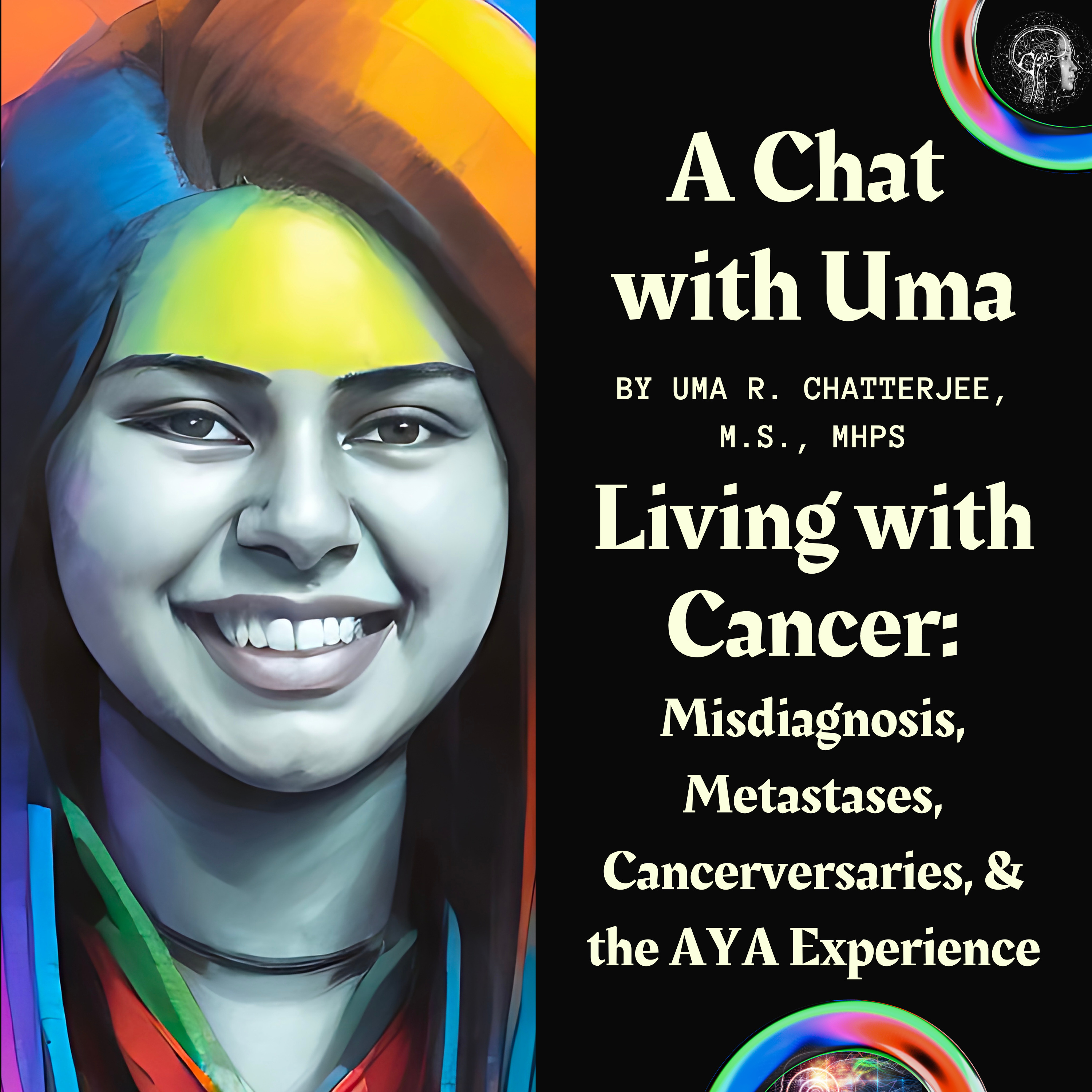
11. Living with Cancer: Misdiagnosis, Metastases, Cancerversaries, & the AYA Experience
84m 42s
In this episode of "A Chat with Uma," host Uma R. Chatterjee opens with gratitude for her listeners, emphasizing the podcast's role as a safe, authentic space for exploring human experiences through neuroscience, psychology, mental health, and advocacy. She shares that while she typically plans episodes, she feels compelled to discuss her current reality: living with cancer. April is a significant month for her, as it includes her birthday (April 25th) and the anniversary of her cancer diagnosis, which occurred the day after she turned 23, four years ago. She also notes that April is a key month for adolescent and young adult (AYA) cancer advocacy, a cause she champions.
Uma announces three upcoming events: a free presentation for the Aspiring Scientist Coalition on her non-traditional path into research, a talk at Europe's largest psychedelic conference (Breaking Convention) on psychedelic-assisted therapy for PTSD with comorbid OCD, and a presentation at Digital Cancer Con on psychedelics and cancer. She then recounts her diagnosis journey, explaining that after years of poor health and avoiding doctors, she visited a primary care physician in November 2018. The doctor discovered a bulge in her neck during a physical exam, which an ultrasound later identified as a one-centimeter nodule over a lymph node. This discovery set her on the path to a cancer diagnosis, a story she continues to share to honor others with similar experiences and to validate their struggles. The episode serves as a permission slip for those living with cancer to embrace their truth alongside the rest of their lives.
(upbeat music) - Hello and welcome to a chat with Uma, with me, your host, Uma R. Chatterjee. On this podcast, I bring together all of my roles as a neuroscientist, researcher, board certified mental health peer specialist, mental health advocate, community builder, and a survivor with lived experience to bring you honest and unfiltered conversations exploring our true human experiences in their fullest form. Every week, I'm bringing you conversations bridging the gap on all things neuroscience, psychology, mental health, lived experience, advocacy, psychedelics, and more. This is a space for raw unfiltered truth to truly explore ourselves for who we are and how we are. I cannot wait to connect with you, answer all of your questions and co-create this with you. Welcome to a chat with Uma. Hello, everyone. Welcome back to another episode and week of a chat with Uma. I just love being able to spend time with y'all here every single week and just know that there is a safe space for you and me to just be and to just show up as we are in whatever form and whatever's coming up and just have a safe landing space. That's what this show feels like to me. And of course, it's because I get on the mic and I talk, right? But it's so much beyond that because the show is nothing if it's just me talking. It's all of you who makes a show for me, the people who listen to you, the people who reach out to me and you talk to me about what you heard and tell me how you related or how you learned something or how it just changed your day or you're a moment for you or even your life. It's just, it's a relationship and it's a really safe one. And so I just wanted to start off the episode with just the gratitude and the joy and just the peace really that comes with doing this every single week and co-creating this with you. It's just truly the greatest gift and just thank you for being here and showing up and engaging and being the community. I'm quickly learning from starting the show and really getting into actually doing it as compared to everything I thought or expected or was told by others who are seasoned podcasters like how things go. I am realizing from actually doing it that so much of what is a value to me is to be authentic and true to what's going on right now if it feels resonant with sharing. And you know, I, there's so much time in space for my plan and schedules and scheduled episodes and all of the things that are coming. But in this season right now, I just feel the most resonant with just talking about and having conversations about like what's really on the forefront of my mind and my experience because that's what the space is for for showing up truly rather than what we think we should do, shutting all over ourselves or what we think others want and expect from us. And I really, if nothing else pride myself in or I guess like just my values are honesty and authenticity and so that means being flexible with my plans and just taking a risk, taking a gamble on the strategy and plans I have and just being me. And right now today, this season, this month, that's going to get it into, being me, a large part of it is contending with being someone who lives with cancer. And that's why this episode is about living with cancer. And there's so many reasons for that and we're gonna get into it. But I just wanna start off by saying that this month April of 2023, well April in general is a very salient month for me and is definitely a trauma anniversary and also just like paradoxical and dual and has a lot in it because my birthday, the day representing my birth and coming onto this earth is April 25th and generally has been a day I look forward to just 'cause as a kid, it was just a better day than other days and as an adult just feels like a day to celebrate and reflect on life. And as fate would have it, I also was diagnosed with cancer officially the day after my birthday, four years ago. So the day after I turned 23, I had been in the process of the diagnosis and missed diagnosis for several months when I was 22 but then I officially got, like at the doctor's office, like the full, you have cancer talk. The day after my birthday and so that day stays with me for a lot of reasons and so April is kind of shaped by reflection and just sitting with all of that and all of what that's meant to me and how that continues to shape my life. And also this particular week of April, which is the first week right now and the month in general is a huge part of the cancer world in advocating for adolescent and young adult cancer, AYA cancer and that's something that I have been involved with as an advocate and as someone deeply committed to serving people with young adult cancer for the last few years because of my own experiences. And so April is just a month and cancer and AYA cancer is a lot. So I have gotten endless questions about cancer and my experience with cancer. I've of course talked about it in the podcast like in my full life story and different parts of my mental health experiences. It really just like adding the cancer part of my life or context in terms of talking about other topics and things that are very important to me and a huge part of my life. Yet I have so many questions and concerns and interest from y'all about actually living through cancer. Like almost like I'm just talking like it's up up on the radar and the truth is it's absolutely not up on the radar. But in the context of everything we've talked about, I felt like that wasn't a side, but that's not true. That's a huge part that equally shapes my life as everything else. And as we'll get into next episode, my mental health and my cancer are very related. So that's where I am and it feels empowering to just finally put into context and share all that is my cancer experience and how and why I'm still living with it. So that's this episode. And above all, beyond me, beyond the beautiful humans in this community who want to know about this part of my life, beyond all of that, this episode, this conversation is for all of the people who I've known in my life through this experience, who also live with cancer, who I have lost to cancer. Who share in this journey and experience with me and this is to honor all of you and your very true and real experiences that might not be as accepted and safe to talk about out loud. And this is an honor of your truth and a permission slip for you to allow that to coexist with the rest of your life and to know that it matters and you matter. Real quick, before we get into the episode, I just wanted to remind you about a few exciting events coming up that I would love to have you be a part of. Just a reminder that this Thursday, April 13th, I will be giving a meeting at the assistant office.
Signing Science Coalition at 9 a.m. Pacific Time, which is 11 Central Time or 12 Eastern Time with Dr. Ben Ryan. I am going to be giving a presentation to the aspiring scientist coalition, which is an incredible organization that provides really accessible science guidance, mentorship, and networking to thousands of students in over 75 countries around the world to really just help bridge the gap between people who want to engage in research and people who are engaging in research. It was started and founded by Dr. Ben Ryan, who, if you don't know him, first and foremost, he is an incredible neuroscientist. He's a postdoctoral researcher at Stanford studying the neurobiology of empathy, social connection, and MDMA. And on top of everything he does with his science, he is a phenomenal science communicator. He really took the world by storm on TikTok and Instagram and other social media, really just distilling down very complex science papers and concepts into language and understanding for people who really want to know but aren't in academia. And he is so incredibly good at it. He's so successful. And through and through his mission is to help make science more accessible to people through the aspiring scientist coalition and his work. And it is such an honor to have been asked to give a presentation to the ASC, Ben reached out and wanted me to give a presentation and just share all about my very non-traditional journey into research and academia. And if you know anything about my story, you know that it has been a very long, windy, twisty road and I would not have ever expected to be where I am today, let alone anybody else. So this presentation is really going to be giving a deep dive into how I navigated so much of my disabilities, my experiences, my conditions and how that brought me to research how I found myself becoming a scientist and how I developed my research projects that were directly influenced by my own conditions and also all of the advocacy and how that has been such a huge part of my research. Myself as a scientist, myself as a human and how that all comes together. So I will be speaking for an hour with Dr. Ben Ryan. We're going to be talking about everything my story and I would love to have you and anyone interested join us. It is completely free. All you need to do is become a member of the aspiring scientist coalition. All you have to do is go on their website and fill out a quick form. You're going to become a member and have access to that link and to be able to join us. Hear my story, be in a community of so many like-minded people and just ask me any questions you have as well as Ben. And I'm just so excited about this because I know that I didn't see people like me in science and I never knew that it was possible for people like me, especially with the different challenges I navigate. And you know, it really used to feel like those things would hold me back rather than not only not hold me back, but be the reason why I get to do what I do. So I am just so grateful for the opportunity to bring advocacy to things like OCD and PTSD and living with young adult cancer, having the identities I hold and how that very much shapes my experience as a scientist and my research. And to really show people that, you know, people like me can do this and we belong here and not in spite of who we are, but because of who we are. So I'd love to have you join us. I will have that link to the aspiring scientist coalition in the show notes. You just have to go register and you'll get the link. And I can't wait to see you there. They're super exciting reminder that I will be a speaker at the breaking convention at the University of Exeter. The breaking convention is the largest psychedelic conference in Europe and we'll be running this year from April 20th to 22nd. So just about two weeks away, I am so excited. I will be flying out to London next week, this upcoming week for the conference and a trip. It's my first time in Europe and I'm just so incredibly honored and excited to speak at this conference and it's going to be amongst just so many people who have shaped my path. I am going to be giving a full talk at the conference and I'm going to be speaking at length about the potential effects of psychedelic assisted therapy for PTSD on Comorbid OCD. I'm going to be just over viewing everything about the OCD and PTSD Comorbidity and the very, very real and important considerations and implications on how psychedelic assisted therapy for PTSD is conducted in terms of considering Comorbid OCD. It is truly just such an honor and privilege to be able to share so much of my work and it's really a met of view of the implications of all the research I've done, all the presentations I've given over the last year and a half because this work is not, I mean, it's about me and it's about so many people, it's so beyond me. This speech, this presentation, this project is not just science, it's science and it's advocacy because in order to be able to do this research and do this science, I have to fully explain what OCD is and there's so many misconceptions and misunderstandings about OCD within the fields of psychiatry, psychology, neuroscience, anything related to psychedelic and psychedelic assisted therapy. Not only is this an opportunity to really raise awareness for the research I'm doing and the very real implications on so many people, but it's raising awareness of what OCD actually is and that is where so much of my advocacy, my lived experience and my research or hats, like they all come together and I just can't tell you what a privilege it is to be able to raise awareness for my community and everybody like me at such a massive and incredible conference to the very people who need to hear it because the people who need to hear it are the people in the field doing the research in psychedelics and psychedelic assisted therapy, they're the people who can help reduce harm and who can help enact measures to be able to protect our vulnerable populations that may not be protected right now. So I am so grateful and honored for this opportunity and if you are in London or in Exeter in Europe and you either are attending the conference, I'd love to see you there. Please let me know. If you're interested in attending the conference, I would absolutely love to have you for not just my talk, but all of the prolific and incredible talks from people who I have looked up to for so long. There are tickets that I can link in the show notes for you to check out and if you're not able to make it live, there's also a live stream option as well as recordings that will be available. So I would love to have you at the conference virtually in person to be able to share in the advocacy and science, especially if you are interested in psychedelic science in general and you'd like to learn from some of those foremost people in the field that are all going to be in one place. And or if you are part of the OCD community and would like to represent OCD alongside with me as well as raise awareness and really learn about home-orbid PTSD and OCD, that's the place to do it. So I can't wait to see you there. I'm so honored to be able to share this with you here. Next before it goes out publicly everywhere and I will link tickets in the show notes. And the final event and reminder that I want to share with you all is the most synchronic one, which is digital cancer con going on from April 16th to 30th. So digital cancer con is a two week long conference platform that is hosted by a stupid cancer, a nonprofit organization dedicated to supporting the lives of adolescent and young adult cancer survivors, AYA's, which we'll get into AYA's in this episode. But stupid cancer is putting on digital cancer con this year for two weeks in a new way. It's accessible for the whole two weeks with live and pre-recorded sessions, spanning topics all across the spectrum of cancer survivorship, especially in including mental health. And this year I was asked to speak at both digital and live cancer con and I will be presenting on psychedelics and cancer. And I was asked to talk on this topic because it is such a underserved and under discussed topic. And psychedelics are now being explored for many different mental health indications and specifically for cancer survivors and cancer patients and even families of those with cancer. So this presentation is going to be just a comprehensive resource talking about the state of psychedelic research, what it's being indicated for the state of research specifically for mental health conditions and for cancer and the implications for adolescent and young adult cancer survivors the AYA's. So be sure to check out stupid cancer and digital cancer con. I will link the tickets in the show notes. It's completely free, it'll be open for a full two weeks and we would love to have you.
(upbeat music) So, my experience with cancer. Whew. So, a bit of background. There's a ton of expanded background on state of my health and just how poor it was overall in my full life story and all of that. But to sum it up, I was just a very sick person for most of my life with a lot of undiagnosed autoimmune disorders, psychiatric disorders, just a lot of conditions and dysfunction that we did not catch. And I just had a lot of symptoms and was just in generally poor health. And I was just existing as the best way I can describe it. Anyone who knew me up to like 2019, maybe even 2020, just can attest to the fact that the amount that I had progressively declined too was just really unfortunate and so different from how I show up today, even as someone who lives with chronic illness and really still struggles, it's just a lifetime's worth of different than the point I was at in 2019, 2018, right around the cancer. So just already in a very poor state and also important context is that for many reasons, I had not been regularly going to the doctor or having access to medical treatment. I think it's a lot of reasons again, but usually due to a lack of financial accessibility as well as just not being treated properly by doctors for so long and not finding any answers to my suffering and just accepting that it was probably me and nothing that the medical system could help me with. 'Cause I had not been given proper treatment as I know, so our proper diagnosis or anything. So just I hadn't been to the doctor for probably two or three years at that point. I had a surgery like in 2016 and then really just didn't go to the doctor after that. So I really didn't exactly plan to go to the doctor when it was around November of 2018, but I was getting even sicker and my partner at the time now husband just started seeing a doctor himself through, you know, because he had insurance through a job and was able to see a doctor and was having some problems and had a really good experience with a primary care physician. And because of that, it kind of gave me a little bit of comfort. This weird vetting I suppose to maybe just go to the doctor and see if at this point it should probably get some basic blood work done and just make sure like in my mind jokingly, I'm not dying. And just a confluence of luck and enough determination and being able to get an appointment that was accessible to me, I ended up going to the doctor in November of 2018, just really thinking like, you know, blood work, just maybe figure out if something super wonky or I'm deficient in something and call it a day. And this doctor took the time to give me a physical was pretty aware that I had not been really medically examined for a while and she was so thorough and just really cared and I could tell. And so she was just examining me and then started feeling my neck and I'm not actually sure if she was feeling my neck because that was just part of her being thorough or if she had noticed something protruding from my neck but she felt my neck and then asked me if I had known about the bulge in my neck and I was like, no, what are you talking about? And she, I'll never forget this, she gave me my hand and put it on what I now know to be my tumor at the time was just a bulge and asked me to swallow and asked me if I felt it and I did and that changed my life clearly but took a while to get there. So I felt it and it was scary but you know, she wanted me to get it checked out but didn't want me to freak out, which of course I'd freak out but nonetheless, you know, step one was to get it imaged and see if there's anything they could tell about that. She said that she felt it and it felt pretty solid and so that's why it was a little bit more concerning rather than being soft but who knows what it could be. So about a week from then I went and got an ultrasound, like a scheduled ultrasound by my doctor at an imaging facility and the idea was to get it imaged and see if anything was super abnormal. And so I went and got that ultrasound and the decision that they made was that it looked like a benign appearing lymph node specifically reading off of the scan because I still have it, of course, non-specific one centimeter nodule over lying the left lobe of the thyroid which may represent a lymph node. And so it was just decided I didn't really need anything more and it would probably resolve itself and I went back to that doctor to talk about the results and she said that okay, this is what the scan says and we will make sure to follow up in three months and just make sure that that lymph node went down because generally lymph nodes go down. And if it doesn't then maybe it's a bit concerning. So I just didn't do anything for three months. I did very much feel that bump, that lump in my neck over and over. I would swallow and it wouldn't go down and I would have my husband check it and he didn't think it was going down but we just didn't know and it just was that. And then I mean in terms of the idea of cancer, it's like there's a part of my brain that always thought like the worst would happen and then you know the other part that just didn't really care I guess at that point because I was in such a bad place in my life as you would know. You will know from everything else I've talked about just being completely done side and not having the proper treatment for my mental or physical health and being in the throes of severe mental illness and unresolved trauma. So yeah, I was just in survival mode and then the three months passed and I went back to the doctor. She felt the lump and it definitely had that going down and she thought it actually felt a little bigger which then made me feel a little bit scared. Like maybe this is something that is not just a lymph node or at least if it is lymph node something would be wrong with it. So she had me go in for another scan this three months later and this time it was a CT scan instead of an ultrasound. So they did that and this time they basically said that it was probably a lymph node again and specifically it says there are a few borderline size upper cervical lymph nodes noted bilaterally. However, given the patient's young age, they are likely reactive and that part is really important because in writing in this official report it's basically saying that it's a young person so it probably doesn't matter. And that is a huge part of not only what shaped my story and my trajectory and made things a lot worse for me but is so way too common in young people who are getting a cancer diagnosis. It's usually that there's two young to have cancer or that kind of cancer in particular so if they just get written off. And that result is kind of what most doctors which is go off of and decide that it just is what it is and we'll call it a day. And my doctor, she was not working with the best of insurance plans or someone with the best economic status and so she was really balancing her bandwidth with my capabilities and access at the time but still was really concerned for my health and so we both kind of decided that it was probably best to get a biopsy and just rule out any sort of massive abnormality and
So, I was then sent to schedule to see an endocrinologist who was able to do a target biopsy with needles and basically like go into that lump and take out four different parts of it and look at it and see if it looks like cancer. And so because of again like the financial constraints and just access and all of that, it took another three months to get a valid appointment to do so, but I finally did. And in the middle of April of 2019, I went in, I got that biopsy, it was really painful, getting four needles stuck into a lump in your throat is just not super fun. And it made it feel a lot more real to me than just getting scans because there's a very real chance that something very wrong was happening, but you know, didn't know for sure. And so I had that biopsy and then I was told that I would hear from them in a week to just know the results and it would be all be good. Like we just move forward. And so you know, get the biopsy, I'm hanging out and then I received a call saying that I needed to schedule an appointment to come in for the results, which was interesting because previously I'd been told that I would just get the results and the fact that I had to come in and schedule for a, I think it was like an hour long appointment was definitely not a good sign, but I had to do it. And that was one of my leading signs, my telltale signs that I was probably going to get some not good news. And from there, I had multiple reports of basically like how they defined the area of my bump. I keep calling it bump, it's a lump of my lump in the scans and then also just like the receipts from the biopsy stuff. And the doctor had also told me that it was specifically in my left pyramidal lobe of my thyroid gland. And so because of that, I just like took all the information I could, I started googling. And specifically with the pyramidal lobe, the only things I could find of a bump there was cancer, was thyroid cancer. Like it wasn't showing up as like what other indications they could be or being a lymph node or being like just something inflamed or just something but nine. Like if it was in the pyramidal lobe from my googling, it was generally about cancer. So that was also not a fantastic sign. And I also like my now husband worked in oncology and just he basically just like has heard about all the different kinds of cancer from all the different researchers. And so like he just had to breath the knowledge to Google from as well, prevent it or for worse. And was you know cautiously also cautiously optimistic is the term of like, oh like cautiously but hopeful and it's the opposite like cautiously pessimistic that this was cancer. And then I so I scheduled that appointment and I had either my birthday of the day after so I was like, eh, am I as well two at the day after and like have my birthday. So I had my birthday and then the next day that morning me and my husband went into the office and time moved so slow that morning. I remember like we were there earlier than my appointment but just it felt like I sat there for hours in the waiting room to go in and then longer I waited the more I just really started having this knowing that I'm going to find out that I have cancer and went in. Okay, read the doctor's face and I already knew it was going to be that and was told that those words you'd ever want to hear that I'm sorry you have cancer. And it's interesting. My my mo has generally been like to this point and what I'm working on right now is like accessing my emotions and being just more in tune with them and I used to just you know be very like logical and rational and not feeling emotions generally speaking but in that moment my human instincts kicked in and I cried which I don't normally I wouldn't have expected of myself but I did and I just remember being in like just panic mode and trying to calm myself down to ask the questions and luckily my husband was there to ask more of the logical like next step questions and basically I had to either go with this doctor or take my reports and go to a oncology department hospital surgeon to proceed with next steps. So I took a lot of information and just realized that I have cancer and I have to do something about it but I was told that I'm young and this was not what anybody expected. I definitely in I'm in anomaly and being diagnosed with this cancer at 22 and luckily like with my age hopefully my prognosis is a lot better because my body is stronger and we're resilient to disease. So that's what I was at least telling myself and leaning on and then from there just went completely into action mode of okay I need to like contact this surgeon get an appointment and get this scan get this test get this whatever to decide the plan of action and you know just went into doing mode and that's so common for people with cancer like you just hear this news of you know your life is a danger and you need immediate treatment and rather than sitting and processing and moving through emotions like the understandable thing to do that we would gravitate to is what action can I take and how can I do something about this because it feels so out of my power control but what is in my power control getting treatment and making this happen so that's what I threw myself into and then from there I was just in different appointments and different evaluations and phone calls and all the things testing getting prodded all of that and basically the consensus was that I needed a full total thyroid ectomy I needed to go through surgery and get my entire thyroid removed from my body and any lymph nodes that the cancer might have affected and hopefully I'd be okay from there just you know treatment after that and so I scheduled my surgery and so I was diagnosed April 26th and then my surgery was June 20th I went in and I went through the whole surgery and what's really funny and interesting about the surgery was that one of the side effects that was possible but was generally like a 1% chance of happening was some form of damage to my vocal nerves or chords because of the area that the thyroid's in and that was particularly of importance or relevance to me because at that point I was in music school I was a singer songwriter I was you know selling out shows at the House of Blues I was in preparation to be on the voice I you know looking back I was definitely just like not in a place to be going very far with any of that because of how dysfunctional I was but with whatever I did have in myself that's what I was doing outside of working and surviving and that was my identity in my life and I've talked a lot about that on another episode so I don't have to fully go into the I mean that's its own like our conversation but really I the one side effect that seemed really small and not likely was one that was really important to me and then through the surgery and going through it all what happened was that number one took out my whole thyroid number two took out a bunch of lymph nodes because they look like they're infected with cancer and they were so glad they're out and also it was scary to know that it had moved that far and three my surgery took an hour and a half longer than it was supposed to because they found out that my thyroid was in their words glued to everything around it because of years decades of scar tissue from being attacked by my immune system because I had undiagnosed Hashimoto thyroiditis that whole time and that was it.
huge explanation for so many of the symptoms and dysfunctional had experienced for so long, yet didn't have treatment or a diagnosis or understanding of and because of that they had to, in their words, scrape my thyroid out and it was just unexpected and took a lot longer and also incurred a lot more damage to the whole area as much expertise as they did have. So it ended up damaging my vocal nerves, which I didn't know for sure for a little while because you know I was just horse and barely functional after my surgery for weeks and in the immediate it also ended up affecting my parathyroid glands which are like around thyroid and they have a huge relationship to calcium and vitamin D and so basically those got damaged and I started like having it basically was like seizing a lot which was really scary as I came home and was recovering but all in all like beyond the side effect of that and like having this up with medication and work on that and then my voice which was like its own story it was pretty okay and what the plan of action was from there given the information they did have of you know it had spread but it looked like it was localized at that point to like just the lymph nodes and the next so stage two was that I was on immediate hormone treatment which I was gonna be on for the rest of my life and that required taking specific hormones not only to replace the thyroid hormone that I didn't I don't have because I don't have a thyroid but also taking hormones to be at a level to where basically so there's something called a thyroid stimulating hormone and that encourages thyroid to come out and if you have a high TSH that generally means that you are deficient in thyroid and it's just like trying to simulate the gland to bring out more and the goal is with my medication and my hormone treatment is to keep my TSH super super low like as suppressed as possible because if there is any residual cancer or cancer that grows then the TSH in theory would help grow the cancer even faster and so if we like block that then it would be the least likely to grow so on hormone medication and treatment for the rest of my life with that and at that point they didn't think I needed you know radiation or anything it seemed like I was okay and so I was deferred from the surgeon and the immediate treatment from there to an endocrinologist and that's when things started going kind of downhill for me and I mean beyond being misdiagnosed and receiving delayed treatment which the immediate implications were not obvious at the time but as you will hear it becomes very important so immediate risk was you know assessed by the surgeon and they're not meant to treat you for like long term anyway they're supposed to do surgery and then defer you to an endocrinologist to determine like you know nitty-gritty steps of like actual medication and hormone treatment dosages and radiation and all those things so I was deferred to an endocrinologist and immediately it just started feeling very uncomfortable and unsafe just like I was being seen every week or two weeks to monitor things but like things would happen where they kept my name wrong they'd have the wrong chart they would have incorrect data about my history about my surgery things like that and I have to correct them which is very you know uncomfortable given that like I put in my life in their hands and also I like literally was struggling to talk because I barely had a voice for several months after surgery so it was just like very unsafe and uncomfortable but I at the time very much attributed any of my discomfort to myself because I knew that doctor scared me that I was a people-pleaser I really believed that I was dramatic and made you know that I was I was wrong so I just bit my tongue for a while and then a few months in I was going in for one of my routine blood work situations and as I was sitting there like about to get my blood work done which was in-house to the actual doctor's office I just just there's something in me that spurred me to ask if I could look at the blood report or like the request form of all the things I was getting my blood drawn for and I don't know if it's because I just like knew in the past that they had gotten some of my information wrong or whatever I don't know instinct whatever but something in me prompted me to ask and I again was like very extra docile of people pleasing and just tended to not do anything to advocate for myself like that so that was very out of character for me but they gave me the paper I looked at it and all of the things that I knew I was supposed to be tested for like my TSH and my T4 and my T3 weren't on there it was just some calcium levels and I was like the fuck I knew that that was wrong and that really really just made me very unsafe and uncomfortable and at that point I really I mean I left and I called my husband I was getting gas I remember this too and I told him what happened and he was like this no like you're not going back there this is not who's treating you like we've no idea like what they are doing or if they are even looking at your case and this is too serious to fuck around on so with his encouragement and empowerment of listening to myself like I stopped going there and I guess something else important to know at this point is that they had looked through like the surgical reports supposedly and decided I didn't need radiation and I was good with disarmament treatment or whatever and I was operating under that assumption too because that's what they told me so then all that happened with the blood work and I was like I'm not doing this anymore and I decided so I got my surgery at a major medical hospital and at a medical school and it's just like the best in the area and then I was seeing just like a regular endocrinologist in private practice and I decided that I was going to somehow make it to where I could see an endocrinologist at the medical school again even if I had to wait a little longer because I just needed like at that point just I wanted a need at the top level of care I could get within the scope of what I could attain so I set my eyes on this one particular doctor who really seemed to be like the perfect fit for me and the condition I have and the thing with medical schools is yeah they're the top doctors and also especially third-end PhD they probably only see patients once like one day a week and if not then they're at least it's very booked out and so this one doctor sees people half a day a week and then runs his lab the rest of the time which now as a scientist I find really funny to just understand the full spectrum of that work but at the time it was really hard to get in but there was a cancellation for a few months after I called which to me was a miracle so I took it and I waited till December of 2019 so just again for context I had initially gotten that bump discovered in November of 2018 and then I was officially diagnosed in April of 2019 I had my surgery in June of 2019 I was then seeing the endocrinologist till probably August or September of 2019 and then I waited I just had medication enough to take to keep me through that time to see the new endocrinologist in December of 2019 and I went and I saw him and I was number one I had like a three-hour appointment like time scheduled with him which I did not request that's just what they did which was wild to me and now I can see why it's so hard to schedule because when you do you get a lot of time and a lot of attention which made such a difference to me but I went in and I met him he pulled up my history he pulled up specifically my surgical report and I kid you not he looked at it for 30 seconds and he was like you didn't receive radiation I said no and he said you should have received radiation six months ago and my heart sank because I realized in that moment that whatever he was supposed to tell me was gonna mean that I had indeed been once again mistreated and misdiagnosed in the way my cancer was
was progressing and something is very wrong. So he basically explained to me that just looking at my cancer surgical report, the pathology said that I had positive surgical margins, which means that cancer was not able to completely be removed from me with the surgery and there was still cancer in me. And so then he very systematically and just like the most scientific way, like pulled up the general like board of endocrine surgery cancer, all of that like protocols for it's kind of like if this then that. And so it said if surgical margins positive, then radiation, radioactive iodine, ASAP. And he he explained that that that was like literally what I needed. And he also showed me that based on what my case looked like, I was at the highest risk of recurrence. And in fact, my age did not work for me, but it worked against me because I if I did get it and it was this aggressive, then it was probably an anomaly. And he once again showed me on that chart, like the if this then that and based on the parameters of how my case looked in the different, you know, levels and things. And then most importantly, the positive surgical margins, I was at the highest risk of recurrence. And so I needed radiation ASAP. And that was so just once again, I mean, it was equally relieving that I was in the hands of someone who was so thorough and who was able to help me finally. And also it was just so it was so much, it was so heartbreaking that I wasted or you know, I didn't waste necessarily, but like so much of my time that I could have been getting treatment and making this go just expedite the process of getting better and stop and like lower the risk of dying had been robbed for me because of negligence and a lack of care. And thank goodness for whatever trajectory of events that led to me advocating for myself and then leaving that other doctor because who knows where I'd be if that didn't happen. But I was basically made aware that I needed this and it needed to happen ASAP. And yet while it needed to happen ASAP, it also required scheduling and medical approval and all of the bullshit that goes into accessing treatment and not losing all the money you have. So I had to wait till March of 2020. So this happened December of 2019 and then I had to wait till March of 2020. And because I had to wait, technically I could have done it in like the first week of March, but because I was in March anyway, I was like might as well just wait another week or two and then do it over my spring break because I went back to school in January of 2020. And of course, we know what 2020 was, the pandemic, right? And given the pandemic, it all that transpired, the timing and the way my radiation looked like was actually kind of comical and ironic if you can take away the part where you know it was happening because of life threatening condition. But anyway, I digress. So what the radiation looked like was in terms of how it worked on a high level. I just find this interesting. So I'm going to tell you, it's called radioactive iodine. So the thyroid and thyroid gland needs iodine to function. And that's why because people are generally iodine deficient in the way we live, there's iodine in our salt, iodine salt, right? And that's just something that thyroid uptakes a lot. And for people who don't have a thyroid, me, I wouldn't have anything to uptake iodine unless there was cancer in me because cancerous thyroid cells would be thyroid just, you know, the kind I don't want. So well, actually, I don't want any of it. If I have any indication of thyroid in my body that's being naturally created, that is actually like what they test me for every three to six months. And if I have any of that marker, thyroglobulinth and I probably have cancer again. So anyway, because I don't have thyroid, the idea is that radioactive iodine would be iodine that has been hacked to be something that kills anything that it comes into contact with. And because the thyroid would be uptaking iodine, the idea is if I take radioactive iodine, then that would go into any remaining thyroid, or in this case, thyroid and cancer cells that are in my body and hopefully kill them. And because I can be imaged to see where this radioactive iodine goes in my body, it can show them where those cancer cells are, which will make a difference later on. So what that entailed was first to prepare for the radioactive iodine. I needed to do one of two things. Either I needed to get off of my thyroid medication for three whole months and become completely deficient and dysfunctional, so that any of the thyroid cells that are in my body would be starved and would uptake the, and like, take in the radioactive iodine, like the highest likelihood of that happening. And if I didn't do that, if I didn't go through that torture, the alternative was if I had the insurance to cover it, which luckily at that time I did, getting these shots in my butt two days before I get the radioactive iodine that just basically like, expedites that whole process I mentioned and just kills all the thyroid in my body. So rather than going through three months of being hypothyroid, just two days, which were two horrible days and showed me how much I had improved because I guess I was living with severe, just a severe lack of thyroid anyway until I got it removed because of the Hashimoto's and that had never been diagnosed and then I started getting oddly enough because of the cancer, a regular amount of thyroid because of my medication. So, silver lining, right? But anyway, I went, I got to go with the injection route because my insurance luckily covered it. It is wild how much that's of cost by the way without insurance. It's like $80,000 for two injections. It's, another day. I had those injections and then that final day of that week after the injections I just went in, got scanned, got assessed and then I took these radioactive iodine pills and then as soon as I did that I was supposed to go home and I had to be in a room isolated by myself for a week and not share about through with someone, not be in your contact of six feet with someone, don't touch anything anyone else touched because it is very highly transmittable and for me at the radioactive iodine it's helping me in killing cancer cells but if anybody else came in contact with me and the radioactive iodine it would go in and kill their thyroid and that would be very, very bad. So, that was fun in a one bedroom, one bathroom apartment with my now husband who was an absolute angel and took care of me yet could not come anywhere near me and so I basically took up the whole bedroom and bathroom and he lived outside and I went through that and oddly enough that was that was my spring break and as anyone living in the states probably knows spring break turned into the pandemic isolation for months and I started off my pandemic in a week of isolation thinking it would be over and we'd go back to life and that did not happen but that's just a fun tidbit about how that played out for me so I went through that week of radioactive iodine and luckily right before everything like super shut down and I couldn't do this thank god we did this I had to go be taken to the hospital again to get image for what I talked about earlier to see where that radioactive iodine went in my body just to make sure like it actually worked and that it did go anywhere and what I found out that day from this from the body scan was that not only did it go into my neck where one would expect it to but I went all the way into my liver and spleen which the explanation for that would be distant metastases of the cancer and luckily what they did see was just really small spots that it went to and obviously from there I was imaged extensively to make sure that nothing was growing as much as they could and that it was okay but basically what happened was if you can put all of it together I was misdiagnosed and I was delayed in treatment from the gecko luckily I even made it to a doctor at that beginning time by chance to find this tumor but nonetheless I it took six months to get diagnosed properly to my age due to lack of accessibility due to a lot of things mostly my age though because too young for it to be
a tumor, like the image in your report said. And then I did get surgery and I went into the next part of my treatment, which then I was, I dealt with negligence, medical negligence and maltreatment and I was mistreated and then six months later after the surgery finally was told what I needed with radiation and then three months after that I finally got that radiation. So almost a full year from when I got diagnosed went from me getting radiation and a year and a half from finding the tumors when I got that radiation. And so in all that time that didn't need to have passed because sometimes people do radiation like the week after their surgery or two weeks after because all of that time that passed it had the time to spread and move and I am very, very lucky that even with it spreading and finding those spots like it was a little bit but that is so highly abnormal and irregular for my diagnosis and my case and my age especially and yet that still happened. And what that looks like now is I was already at the higher stress group recurrence then they found that and I am just called cancer suppressed now. So ever since March of 2020, whoever since my surgery really I had been closely monitored but then ever since March of 2020 being out of the acute like radiation surgery type treatment I am still on lifelong hormone treatment of course still suppressing the TSH still suppressing any potential cancer growth and then every six months well first it was every three months and now it's every six months for the next several years I go through extensive blood work to test for the tumor marker and check my levels to make sure that they're not fluctuating and letting cancer grow and I get imaging done of my neck very deeply to make sure nothing's growing and they don't see anything and occasionally full body scans as well but mostly the neck and then just being closely watched and I am technically considered cancer suppressed not in remission like the word most people associate to seeing someone with cancer who had cancer like functioning and living in the world not remission cancer suppressed. It also means that at this point I am four years out from diagnosis and almost four years out from surgery and from the time I got like well technically it was supposed to be from the time I got surgery but really it's from the time I got radiation. I need to be this closely monitored and I will be considered cancer suppressed for the next seven to ten years and right now we're about three years into that process so for the next four to seven years from now from April 2023 I'm still in limbo and still at very high risk of recurrence which is really interesting and unique to live with because while the effects of cancer I don't I wouldn't I can't imagine just from anyone I've ever worked with or talk to the effects of cancer never has a finality on someone's life but at the very least for those who don't live with chronic or metastatic cancer there's of course the risk of recurrence but not being considered an active patient or being assessed for sad risk so often actually like at least for the people who I've worked with in the cancer driver collective the mental off-peer support group that I have run for last several years. People with certain kinds of breast cancer like they go through treatment and then they just kind of get they they're done and they're considered in remission and their concern is that they're not being monitored enough for recurrence because it's very scary and if it occurs it's probably more deadly but they're just considered in remission and they're you know on their merry way unless they exhibit massive symptomology again so that's like the opposite problem for those people who is that that's so scary and valid and for me and people like me it's kind of the flip side where we are being monitored so closely and it's such a salient reminder of the threat and of course with the more time that passes from immediate treatment the longer it is like the more we feel you know the more our doctors and more we feel like we're slowly lowering in risk and things are less severe but it's still in that window in that range which is very intensive checks and you know every six months I'm acutely faced with the idea that like am I going to find out the cancer's back something going to be off and like it's not just the question it's going through all of the physical procedures going through all of the blood work going through and putting the gown on and getting the extensive imaging everywhere and you know where I go at the medical hospital I go to because at this point I go there for everything because I trust them the most it's just funny how I mean this past December the person who did my next scan actually just she met me and she told me that she was talking to her whole team about how bizarre it is that a 26 year old is coming in for this I was like yeah and it happened at 22 and it's just they do this all day long every day and it's usually not like they know all the types of cancers and what the profiles of patients look like it is usually not someone like me and just being reminded of that and being tended to with such urgency and care because of the reality of the threat is it's a lot to live with it's a lot to live with especially as an adolescent or young adult in a YA and for anyone who doesn't know that term a YA stands for adolescent and young adult and a YA cancer patients are generally people who fall into the age range of 15 to 39 at least that's what the medical associations in America refer to as a YA I think it can slightly differ by people's definition and across countries but generally speaking around 15 to 39 years old and the reason that that term exists a YA is because of the massive health disparities and outcomes and lack of support and proper diagnosis that that specific population of cancer patients receive and that might be kind of out there for people who don't have cancer or in the cancer community but actually if you think about it intuitively when you are taught about cancer or you see people with cancer oftentimes it's either young children the pediatric population right or really old people but how often do you see people who are between 15 to 39 which they exist by the way they are 5% of the population but that 5% is almost 100,000 people I think it's 89,000 people or something close to that per year so that's a lot of people in the United States alone and they are the most underserved population by all metrics because for I mean so many reasons number one they received the lack the least amount of resources because what is seen to be acute for cancer is again pediatric and geriatric but not that whole group in between and on top of that my my story illustrates so many of the pitfalls of the AYA journey like the amount of misdiagnosis and lack of treatment that AYA's receive because of the all to use phrase but you're so young or you're too young to have cancer not just by the people in their life but the actual doctors like me that I received the doctors who looked at my imaging reports and decided that I was too young to be considered a serious case to look further into something that they're seeing within me and attributing something that they that was ambiguous that you know lump in my throat to be a lymph node because I was so young that illustrates to you right there why being an AYA makes having cancer so much more complicated and like I told you it's not just the misdiagnosis it is the very very real repercussions that come with the late diagnosis and the delayed treatment like the metastasis or the more advanced nature of your cancer that didn't need to progress to another stage or to another place in your body if it had been intervened with earlier which again if people think you're too young and then take too long to diagnose you that is such an inevitable consequence so AYA
deal with that and on top of that because it's such a weird age to have cancer in like being so young but old enough to be pretty much an adult and having to navigate these pivotal moments in your life of navigating a career and school and life choices and insurance and finances for the first time and relationships and fertility and so many more things. Having to go through cancer and be threatened in your mortality at that point in your life is so unique, so different and so underserved and the amount of isolation that exists in our community because of not fitting the image of what cancer looks like to people. So the struggle is not as validated and then just this presumption that oh you had cancer and you were going through treatment and during active treatment where people look like quote unquote they're going through treatment whether it's surgery or chemo or radiation or something just very physically obvious. That people can most of the time conceptualize as having cancer and being sick but everything that happens after like having to recover and oftentimes living with cancer, living with the crippling fear of recurrence and sometimes if being more invisible because you're not seeing the outward symptoms of what treatment or the actual cancer looks like that is so isolating and then having to do that in the part of your life where you're supposed to be the most present and active and engaged amongst your peers amongst the milestones of what you're acting on the prime of you know your potential that's devastating and that's crippling and that's like a very shared experience to the point where now as you heard at the beginning of the episode I'm speaking at cancer con and the fact that cancer con exists at all for the AYA community the fact that stupid cancer a nonprofit was formed and its entire mission and its entire staff and everybody who does everything is to serve this very underserved population of people that is everywhere and there's there's hundreds of thousands of people millions of people who fall into this category and experience all of the above plus financial toxicity and so many so many painful consequences that is the reality of being in AYA and it all compounds on each other and yes there's so much beauty and support in being able to find community and take that term that's used as a indication for health disparities and medical consequences and turn that into a community of AYA's who are able to support each other through a very very fucked up confusing not normal experience it's it's beautiful and I'm so grateful for that and it's changed so much for me in my life and my work and being a mental health peer specialist and founding and facilitating the cancer driver collective and creating community and just sharing my experiences and bringing my identities together to support stupid cancer and cancer con every year since 2021 that's beautiful and there are very important realities of living this way and for anyone listening who doesn't have cancer it's not an AYA this is a call to you to number one be aware that this exists because if you start experiencing symptoms and you are gasslet or just not taken seriously and you experience a lack of care because of your age because of being interpreted as being dramatic or not having the resources to adequately get comprehensive care or are just called too young if you hear the phrase that you're just too young to have cancer it's probably not it if that's what you hear red flag please know that you deserve a full comprehensive understanding of what's going on with you you deserve the same amount of care and attention as anybody else with any other age any other demographic and of course it's compounded by other parts of identities too so just know that don't take that for an answer the worst that can happen is you advocate for yourself and you would have not having cancer and then you advocate for yourself and they can think whatever they want but you have that peace of mind that you don't have a life-threatening illness that could kill you outside of you not having cancer and then being educated on the patient outcomes and just like being warned about being an AYA I also really want to talk about the fact that AYA's have the worst mental health outcomes of the cancer population because of everything I listed before and more concretely just not having the space to process or really move through the experience that they have of facing immortality at such a young age yet an age that they're the most conscious of understanding and then all of the isolation and consequences and loss and grief that comes from living with cancer and being afraid to die at this age and I mean the outcomes are so painful such high rates of PTSD and depression anxiety self-harm you know like the amount of self-harm and dying by suicide that exists in a population of people who are living with the impending fear of mortality like that should tell you something the fact that the amount of distress that comes from this experience can outweigh like literally the life that they might be fighting for in treatment kind of says it all for you and it's an epidemic it's so important to know about both for people who have cancer if you're listening and you have not known how to validate or understand your experience because we're expected to just feel so grateful and be just so grateful and happy that we're alive and that we made it through treatment and not being able to contend with the aftermath of survivorship and having to process everything that we went through because like I talked about in my story when you get diagnosed oftentimes most people go into survival vote and action and that's all well and good and that serves a purpose to be able to get through treatment but what after how does one deal with all that they just went through and the impending doom of scans I.D. and possibly recurrence or just going through chronic treatment that's a whole different ballgame and has so many adverse consequences to psychiatric conditions and people's just well being and mental health and that's such an invisible part of cancer that's just not talked about as much especially again because of this expectation from everyone around you that yes you're in treatment right now it makes sense that you're sick and you're struggling but when you're done let's move on you're better now that's something people hear all the time you're better now no you're not and this is to one validate and advocate for anyone listening who is going through that and also for anybody who's listening who doesn't live with cancer to be made aware that that's the case and that's absolutely a huge part of my experience now and this whole time which is why I'm dedicating the whole next episode to talking about the intersection of cancer and mental health for me there's so many directions to take that which is why it's getting its own episode but for now just calling action to if you have anyone in your life with cancer a YA or not but especially a YA's to just know that there's so much where you can do to support them then just making sure they're physically getting through to treatment and also just helping them not be alone and also creating space for them to be anything outside of toxic toxicly grateful and positive because they don't need that of course they're grateful to be alive and co-existing with that is so much pain and fear and unprocessed trauma that's unimaginable like think about humans and our functionality we are not supposed to think about our death and we're not supposed to be actively facing our death that's just not something we're wired to do and people do that I do that my community does that and now by talking about our truths and being open with our experiences we get to invite people to support us in a different way and that's a huge reason why I'm doing this episode too on top of everything I'm sharing next week so I can't tell you how cathartic and right it feels to have taken up this space today and just share an overview like take you through my cancer journey and my experience thus far because
Everything relates to everything. And yes, this is a podcast for neuroscience and mental health and psychedelics and psychology and our well-being and having true and honest conversations. And this is that. This overlays so much of how I show up in the world and how I navigate my choices and the thoughts I have, the fears I have. And it also just was a catalyst for so much change in my life because of the loss I experienced and the roles I have taken on and developed in my life is completely different, completely different than it was before cancer. Not just because of going through cancer, but everything I do, like the point of my life, the point I've made for my life at least. So I'm just really, really grateful that you have held this space for me in listening to this episode and hearing such an important part of my life that I don't talk about as much and allowing me to take up space as my full self. And that's so important to me because that's what I want for you and that's what this space is for for you. This is a permission slip for you and whatever way you are suppressing parts of yourself in your life to take up space and to know that you matter and it's all valid and they all come together to create you and how we experience you in this world. And if I can do that by muddling that on the podcast, that's the greatest thing I can ask for from life. So that is my story of living with cancer and that's a story that won't be finished for quite a while, probably until I die because I live with cancer and whether that is being actively monitored for cancer for several years or having the threat of cancer loom above me and how that impacts my choices and how I show up and how I think about life and finality and mortality for better or for worse. I live with cancer and I'm so grateful to get to talk about that and to bring the reality of that to people who may not know it and to advocate for the A.Y. community and all the ways that we can be supported and seen for our lives and how we show up and what we experience. So thank you so much for being here for this episode of a chat with Uma and next week I'll be bringing you a jam packed episode of a lot of my mental health experiences that I have not put into concrete terms and talked about with the intersection with cancer, everything from health anxiety and PTSD and OCD and how those directly intersect with and are complicated by the reality of what I live with right now. That's all coming next week. So if you loved this episode as always it would mean the world to me for you to just take a second right now and subscribe to the podcast wherever you're listening to it and then take one more second to leave a five star rating and review just talking about what you love about the podcast. It makes such a huge difference to be able to share this community with other people and help them feel safe to start engaging and listening. You are how we create this community, reach more people so that would mean the world and if you can also send this episode to whoever you think would resonate or send any of the episodes to whoever you think is looking for a conversation and a way of being like a chat with Uma is please send that over to them and share the podcast and social media and most importantly let me know what's coming up for you. That is what drives me and what keeps me going every single week, caring for you and hearing how this impact you and what's coming up for you and me being able to hold that space for you as well. Thank you so much for being here for this episode of Chat with Uma and I will see you next time.
Podcast Summary
Key Points:
The host, Uma R. Chatterjee, introduces her podcast "A Chat with Uma" as a safe space for honest, unfiltered conversations on neuroscience, psychology, mental health, lived experience, and psychedelics.
She expresses gratitude to her listeners for co-creating the community and emphasizes authenticity and flexibility in sharing what resonates in the moment.
The episode focuses on her experience living with cancer, which she connects to her birthday (April 25th) and a trauma anniversary, as she was diagnosed the day after turning 23, four years ago.
She highlights April's significance for adolescent and young adult (AYA) cancer advocacy, noting her involvement as an advocate due to her own experiences.
She announces upcoming events
She recounts her cancer diagnosis journey, starting with a visit to a doctor in November 2018 after years of poor health and no medical care, where a physical exam revealed a bulge in her neck—later identified as a tumor.
An ultrasound was ordered, which showed a non-specific one-centimeter nodule overlying a lymph node, marking the beginning of her formal cancer experience.
Summary:
In this episode of "A Chat with Uma," host Uma R. Chatterjee opens with gratitude for her listeners, emphasizing the podcast's role as a safe, authentic space for exploring human experiences through neuroscience, psychology, mental health, and advocacy. She shares that while she typically plans episodes, she feels compelled to discuss her current reality: living with cancer. April is a significant month for her, as it includes her birthday (April 25th) and the anniversary of her cancer diagnosis, which occurred the day after she turned 23, four years ago. She also notes that April is a key month for adolescent and young adult (AYA) cancer advocacy, a cause she champions.
Uma announces three upcoming events: a free presentation for the Aspiring Scientist Coalition on her non-traditional path into research, a talk at Europe's largest psychedelic conference (Breaking Convention) on psychedelic-assisted therapy for PTSD with comorbid OCD, and a presentation at Digital Cancer Con on psychedelics and cancer. She then recounts her diagnosis journey, explaining that after years of poor health and avoiding doctors, she visited a primary care physician in November 2018. The doctor discovered a bulge in her neck during a physical exam, which an ultrasound later identified as a one-centimeter nodule over a lymph node. This discovery set her on the path to a cancer diagnosis, a story she continues to share to honor others with similar experiences and to validate their struggles. The episode serves as a permission slip for those living with cancer to embrace their truth alongside the rest of their lives.
FAQs
The podcast explores neuroscience, psychology, mental health, lived experience, advocacy, and psychedelics, offering raw and unfiltered conversations about human experiences.
Uma wanted to share her cancer experience authentically, as it deeply shapes her life, and to honor others living with cancer, especially during April, which is significant for her diagnosis and AYA cancer advocacy.
Uma will present her non-traditional journey into research, discussing how her disabilities and experiences led her to become a scientist, and how her advocacy shapes her research.
She will discuss the potential effects of psychedelic-assisted therapy for PTSD on comorbid OCD, raising awareness about OCD and implications for treatment.
Digital Cancer Con is a two-week conference by Stupid Cancer for AYA survivors. Uma will present on psychedelics and cancer, focusing on research and implications for young adult survivors.
During a physical in November 2018, her doctor felt a bulge in her neck and asked her to swallow, leading to an ultrasound that identified a nodule, which later turned out to be cancer.
Chat with AI
Loading...
Pro features
Go deeper with this episode
Unlock creator-grade tools that turn any transcript into show notes and subtitle files.
 PodcastTranscript AI