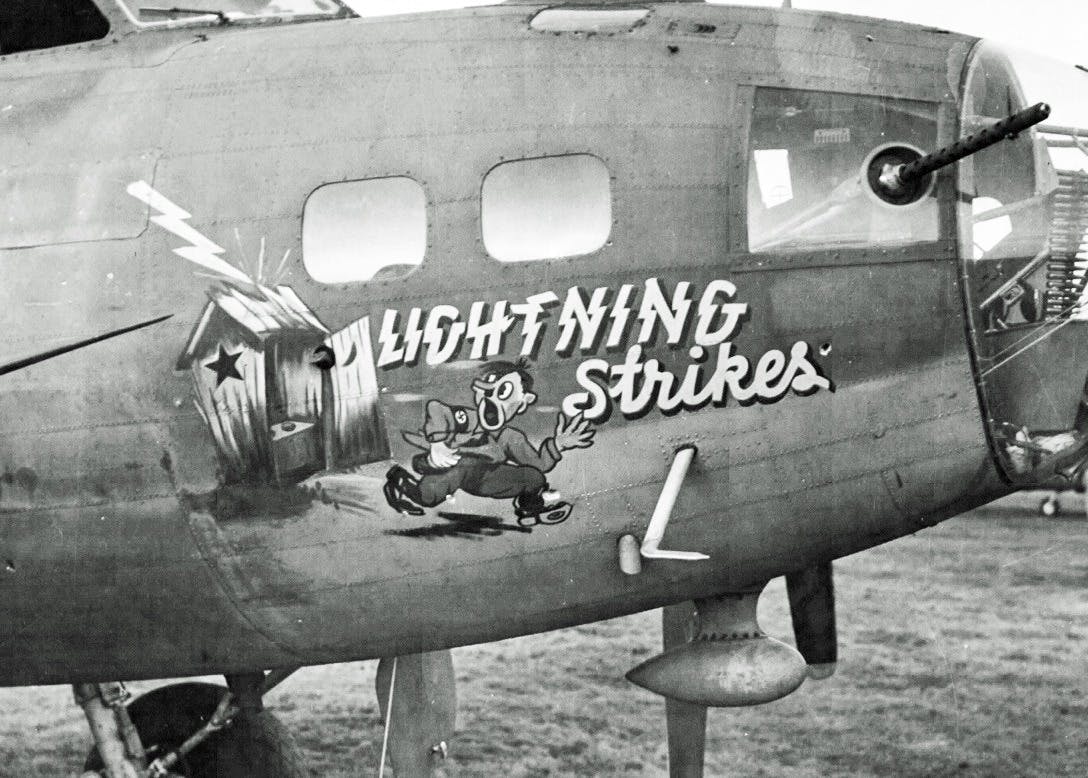
Lightning Strikes & The Ragged Irregulars of Bassingbourne
54m 17s
The transcription details a dangerous WWII bombing mission on October 9, 1943, by the U.S. 91st Bomber Group, nicknamed the "Raggedy Regulars." The mission targeted a German factory deep in enemy territory. A key focus is the B-17 bomber "Lightning Strikes" and its crew, including the charismatic bombardier Charles "Combat" Hudson. The mission was exceptionally hazardous due to the long range, which left the bombers without protective fighter escort for extended periods, and their assigned vulnerable position at the rear of the formation. The narrative describes the intense air battle over Germany, where swarms of enemy fighters attacked the formation, resulting in significant Allied losses. It explains the tense bomb run procedure, during which pilots could not take evasive action. The story is framed by a historian's visit to an airfield museum, emphasizing the importance of preserving these firsthand accounts of heroism and sacrifice from a generation that endured terrifyingly high casualty rates in the air war over Europe.
It's waiting me, please, of course it's fast! He's going where he's going, where he's going, where he's going! There's more, there's coming in! Get him, Charlie, get him! You got him, Charlie, you got him! On the 9th of October 1943, one of the bloodiest air battles of the war was unfolding over German skies. Over 300 fighters were attacking, the flying fortresses of the American First Air Division, who were on a daylight bombing raid to anglum East Germany. The men on the aircraft that flew that day were seasoned combat crews. They thought later this is some of the hardest combat than ever fought in. It was one of the first times the American planes from the 8th Air Force had been able to strike this far into the Nazi homeland. New modifications to the fortress meant that they could now travel much greater distances, but it also presented them with a new problem. You know the disadvantage of long range bombing missions meant that the friendly escort fighters simply couldn't keep up with you with their smaller fuel tanks, so you were literally flying without their protection. This is the remarkable true story of 10 men in one of those flying fortresses, a plane called Lightning Strikes. By the end of the mission, three quarters of the bomber group were in a destroyer, or badly damaged, and 50 men never made it back. They were the raggedy regulars of Basingham. I'm Bruce Compton, History lover, Military Antique Collector, and Ex-Paratrooper. In amazing war stories, you're going to hear about incredible actions, all taken from records housed in museum collections. It's only by unearthing these wonderful tales that I hope to support these important institutions, honor the heroes that sacrifice so much and help preserve their legacies for future generations. In my mind, there is no better place than England in the summer. One of my favourite places to relax is a little-known air drum called Old Bucket-A-Marefield in Norfolk. During the war, it was home to an eight-there-force bomber squadron, and for those of you who are old enough to know, you'll be amazed to discover that two Hollywood legends served there. Jimmy Stewart and Walter Mattow. All through the day, you can sit on the terrace outside the calf and watch vintage planes come and go. It's lovely, and you really get a feel of what it must be like during that period. But there's another reason I'd love to visit. There is a fantastic museum there dedicated to the men that flew from the base. It's run by an old friend of mine, Jim Clarey, and if you get the chance, you really must visit. Details on how to find it are on our website and show notes. Anyway, as I was watching the Spitfire come in and lean, Jim sat down next to me and told me some sad news. A museum dedicated to the eight-there-force 91st bomber group had closed. The collection and those amazing stories of heroism had been lost to the public. He wondered if there was anything we could do. 91st bomber group, based at Bassingbourne Hartfordshire, was a particularly famous group for a number of reasons. The public at the time had heard about them because it was home to the famous flying fortress the Memphis Bell. The 91st bomber group has one of the most interesting nicknames amongst the Air Force and was known as the Ragged Erregulars of Bassingbourne. This nickname came about simply because their numbers were so depleted on missions over Europe that at times they only had enough aircraft to help other groups fill the gaps in their formations. One Airman who flew with the Erregulars was a man called Charles Combat Hudson. A large-in-life character, he certainly lived life to its fullest. He played hard and he worked hard. In fact, he used to often go down on evening passes and would have a very good time out when local pubs were local girls. And he would then come back normally a little bit drunken nearly hours in the morning. And when he was called for a mission, Donnie's uniform over his pajamas and he would fly the mission in his pajamas. The idea behind this was, in case it was cancelled, he would just go back straight into bed. The tale that Jim told me about Combat Hudson was incredible, a testament to the tenacity and perseverance that was the hallmark of people from that generation. We had to make sure that at least his legend was preserved, a testament to the type of man who flew with the raggedy-regulars. In his lifetime, amongst other things, he was a pro boxer and pro golfer, owned a famous restaurant, Charmin Charley's, became involved in a major prison break and was also bizarrely for a while, an exotic animal handler. And it was his story about his exploits on border B17 flying falters called Lightning Strikes on a fateful mission on October 1943 that was stay with me forever. It really is an amazing war story. Remember, everything you're about to hear is true, no matter how extraordinary it sounds. In the early hours of the 9th of October, the moon shone coldly over the airfield at Basingbull, but there was anything but quiet at the airbase. Seventeen fortresses of the 91st bomber group stood on the apron, each a swarm of activity, as men loaded ordnance, winched extra fuel tanks into the bombAs and made sure each of the machine guns were fully loaded. Inside the nearby buildings, the bomber crews were undergoing their mission briefing. On a platform in front of all the air crews, Major Donald E. Schiller, himself a pilot, was revealing the target of today's bombing run to the men. The first bomber division of which the 91st was part of was going to Anglam, a city 75 miles north of Berlin. There was a Whistler murmur from some of the crews. Most had not flown this far before, and they were fully aware that the missions they were now being sent on were becoming increasingly more deadly. Dr. Chris Mann is the head of the Department of War Studies at the Royal Military Academy saying to us, "In 1943 the war was in the balance, although defeated by the Soviets at Kursk and facing the prospect of the Anglo-American invasion of Sicily and subsequently mainland Italy in the summer, Germany was still far from defeated. Albert Speer's reforms of the German economy for total war had led to a considerable increase in the production of armaments. A key part of Allied strategy was to halt or at least disrupt this production through aerial bombing. This was undertaken by the combined air fleets of RAF bomber command and the eighth US Army Air Force. The British developed a technique of nighttime area bombing which targeted whole cities, not just their factories, but their entire infrastructure and populations in an effort to bring the German economy to a halt. The Americans believed that precision bombing was more effective. This approach required flying in daylight, with all the risks that involved at the hands of Germany's sophisticated air defenses. As a consequence, particularly in the early part of the campaign, US Army Air Force losses were terrifyingly high. Although the standard tour was 25 missions, the average crew only managed 11 before coming casualties. To be fair, the British loss rate was lower, but not by much. Major Sheerler pointed to a large map behind him. The main target of Fockerwolf Aircraft Component Blunt was 600 miles away, a total round trip of 1,200 miles, which would take them over the North Sea, Denmark, the Baltic Sea and Northern Germany and then all the way back again. But the target was only part of the group's objective. They were to be bait for the German fighters and hopefully draw them away from the other bomber divisions who were attacking more valuable targets further to the east. As Sheerler mentioned this part of the plan, there were more grumbles and crackles from the mid. Not only that, in order to make the bombers even more enticing to the enemy planes, the group was instructed to fly at 12,500 feet, well within the height window of the German fighters. As you can imagine, the men erupted at this order. Come on you, that fighter support for a mission like this would be limited. The P-47 Thunderbolts T-38 Lightnings and RAF Spitfires that would normally accompany them couldn't match the range of the newly modified B-17s. So for long periods, the entire division would be on its own and extremely vulnerable. Major Robert Paley is the official historian for the US-100th Air Force refueling wing, known as the Bloody Hundredth. They were first activated as a heavy bomber group in June 1932, and were part of the 8th Air Force, flying B-17s from Newton Aber in Norfolk, England. Flying a B-17 is nothing like the heavy bombers of today. Although they look large compared to modern planes, they didn't hold many bombs. They were in fact very cramped and were very difficult to get in and out of. It's one of the reasons why the 8th lost so many men. Once a plane was going down, more often than not, you went down with it. True to any bomber, they were ponderously slow which made them easy prey for enemy fighters. The only advantage you had was the flight ceiling, the altitude the bombers could fly. So in the event of your altitude being taken away and having no fighter escort, you really were a sitting duck. In one row of seats, the officers and crew allocated to lightning strikes. One of the more popular of the planes looked to each other in disbelief. The captain, first Lieutenant Hillary Bud-Evers, a fresh face 20-year-old from Cincinnati, Ohio, whispered to the man beside him. Second Lieutenant Charles Hudson was a tough-looking guy who grew up around an airfield in California. He had a small that could win women's hearts and a fist that could silence his detractors. The crew were glad to have him on their side, even though this was only to be his fourth mission. I wouldn't have it any other way, Bud. Hudson replied. But the news for these particular 10 men was going to get even worse. Major Sheila then started to read out the flying patterns. Lightning strikes was to be tail in Charlie in the final formation. A place no one wanted to be. Bringing up the last place on a bombing wing, usually meant that you were destined to get all the action. As enemy planes would usually attack from the front, fly through and pass the formation, and then circle round to continue their attack from behind. The crew's called this rear position, Purple Art Culmer. So on an operation like this, deep into enemy territory, and with limited fighter support, the men knew the chances of survival were terrifyingly low. At 7 AM, the crew went to their aircraft and started to load up. Each bomber had 10 men on board. Four flight officers, a pilot, co-pilot, navigator and bombardier. And six crew, who manned the guns, including a bull turret gunner, underneath the plane, a tail gunner and a top turret gunner. The lightning strikes' fortress had also recently been modified by the engineers, with two front facing 50 cows for the bombardier. Normally, he would have to share the cheek guns either side of the nose with the navigator. This addition was to mitigate the aircraft's lack of firepower to the front. At this point in the war, the latest fortress was the G-Type, and it had one important distinction, a front nose turret. The fortress's main weakness was defending against head-on attacks, something that the Germans had worked down. So the G-Type variant had a double-barrel 50-calber nose turret that the bombardier could operate. Lightning strikes, an F-Type in the variant before this, didn't have this turret. However, the talented ground crews had engineered to work around, where they sometimes placed 20-50 cows often taken from the tail guns, abusted fortresses and put them in a nose cone. First Lieutenant Hillary Evers, called Badby's Friends, was the captain of lightning strikes, a fortress in the 401 Squadron. He was an experienced pilot and had already clopped up a number of soldiers. The other officers on board were co-pilot, Second Lieutenant Robert S. Roberts from Kentucky. Navigator, Second Lieutenant Bruce D. Moore from Indiana, and of course, the charismatic bombardier, Second Lieutenant Charles S. Hudson from California. The rest of the crew, Sergeant's Alba, Wood, SCATH, Young, Colvin and Gibb, were also season fortress men. Their responsibility was primarily manning the guns and keeping their eyes peeled for enemy fighters. Although Alba had the extra responsibility of being the radio operator, Wood, who was the top gunner, was also the chief engineer. As they loaded up, a man jogged over to Hudson. It was Bo Gabler, his best friend, and a large of the life Texan. Bo and Charlie had gone through training together and had made an amusing pack with each other. If even them were on a different plane that was shot down, when they bailed out, they would waver each other as they jump to way. "Charlie, number our zeal?" asked Gabler. "Of course, but I am bailin' today!" replied Hudson, and with that, swung himself up through the hatch. With everyone on board, the four-mine he prepped with the engines fired into life. They each produced 750 horsepower and made a hell of a noise. Like these stripes, fully laden with its bomb load and extra fuel, heeds off the runway and into the dawn sky. The men watched the fields of England turn into a patchwork quilt below them, and must have wondered whether they would ever see the base and, in some cases, their loved ones are going. Squadron after squadron was circling in the sky above the batting ball base. They were building their box formations, which would offer them the greatest protection against enemy fighters. Eventually, the tail in Charlie Blaine lightning strikes during the group. Bob Roberts, the co-pilot, pointed up ahead. The lead plane of the entire wing had fired two green flares. This was to signal that all planes were present, and the run was now under way. The box flying formation was designed by the legendary Air Force Wing Commander Colonel Curtis Lemay. It was designed to create maximum protection not only for the planes in the square, but also the wider squadron as all the boxes were interlinked. Plains would form four corners of a square, and then each box would interlock with the other three boxes, both high and low, four and a half. The thinking was you needed to give your gunners the widest and safest fields of fire possible, while at the same time, giving them interlocking firepower. Obviously, you didn't want accidentally shoot down a friendly plane, but you also wanted a gun from the next plane to pick up from where you left off. This meant that pilots had very little leeway in moving their planes. They absolutely had to hold this formation for everyone's safety. The first part of the journey was uneventful. There's the group flew over the North Sea, the sun shone. The accompanying Spitfire fighters would give protection up to the edge of them up, then they would be on their own. The travel started as they neared the enemy held coast. Enemy fighters had been spotted in the distance, but none seemed to press their attack. Maybe they were worried about the Spitfire's higher up. So far on the run, four fortresses had had to abort the mission due to various technical difficulties, three of which were in ever squadron. Suddenly, the safety of their boxes was becoming broken, and only 13 planes remained in the 91st formation. Bombardier Charlie Hudson looked at in his large plexiglass window at the front of the plane and saw the fighter-escal'd start to peel away. They were on their own. It was 9/11am, the planes were nearing enemy-dominated airspace as they crossed over Denmark towards the Baltic Sea. Bad told the men to hang tight, things were going to get airy. It wasn't wrong. Major shearers' voice crackled over the radio from the lead plane, and then the enemy squadron of Fockewolf 190s were seen, closing into their position fast. The German attack had begun. Chaos broke out in the group, as Tracer from a myriad of guns flew through the sky. The first fortress to go down was Chief Sly III, which was piloted by First Lieutenant Charles Pimming. Evers and the crew watched in horror, as the plane drifted out a formation and started its slow death spiral to the ground. All American eyes searched to see if any parachutes emerged from the stricken fortress, but none did. Although there were several ways out of a fortress, including jumping through the Bombay doors if they were open, it was virtually impossible if the plane was in a spin. The centrifugal force alone would keep you pinned to the inside of the plane. The only small mercy would be that the high G-forces inside the plane meant that you were likely to black out before the end. It was a truly terrible way to go, and almost as bad for the men watching. Everyone had been instructed to spot friendly planes going down, and to count the parachutes so that the Air Force had records of where men were missing or killed in action, but it was also a stark reminder to the men of what their fate could be. The weather was completely clear, and the American planes could be seen from miles away. The bomber wing crawled into German airspace where they knew things would get even hotter. As they passed me a new brand-of-burg before the pivot north towards England, fighter seemed to come from everywhere. The guns all around the ship blazed out as enemy planes shot hearts. They'd never seen anything like it. The intercom was a life beside us. Messerschmitt 109s, 110s, 14s, 4kW 190s, Junker's ADA, pinecoals, and dolars, even Stuker dive bombers had a gun. It seemed all too far offer had been sent to get them. Gunners called out the positions of the attacking fighters to the rest of the crew. It literally had hundreds of planes swarmed around the fortress. Sergeant Taft, the bull gunner, claimed a kill. As did the tail gun, the sergeant did. Good work, boys. But still the Germans kept on coming. The division was now nearing the IP, the initial point. This was when they were to start the bomb run, and many of the crews used to call it "swetting time". It was a nerve-wracking part of the operation, as the planes were not allowed to take any evasive action, no matter what was being thrown at them, as the bombardier zeroed in the northern sights. It's well known that Norton, the company that made the bomb site, said that their site was so accurate that it could hit a pickle barrel from 1,000 feet. Well, that was blatantly untrue. What isn't as well known is the fact that it wasn't the best bomb site available at all. Apparently, the sparey bomb site was more technically advanced, but Norton managed to win the PR battle with the US Army Air Force, who went with that site instead. The pilots initially lined up the run, but then would flick the autopilot on and let the bombardier take control. The pilots had now essentially become passengers at this point. All that to do was try and survive the flag until they reached the own point. It was here when the bombardier would release his sticks, the column of bombs. It was only then that the pilots would resume manual flying, which enabled them to move their fortresses a little out of harm's way. Normally, Luftwaffe fighters wouldn't attack during these runs, as they were worried about being hit from friendly ground-based flat guns. But not this time, however. As the planes closed in on the IP point, more fucker walks suicidally flew through their own flat to attack head-on. The pilots passed so close that, culling the left waist gunner yelled at, "Cheers! I could see what that guy's face! He was close!" Such ferocity brought down another fortress in the group. Its number three engine burst into flames. A game they may watch as the pilots spread to the other engines. This time, four parachutes were spotted but they are the six sadly, did we like it out? Come on, go on to the intercom. Meticulous record-keeping is absolutely vital in war. Not only does it give commanders an understanding of enemy strengths and weaknesses, that forms the basis of telling loved ones what the fates of their children and partners were. So everyone was ordered to mark exactly when and where a plane had gone down and how many people, if any, had escaped from it. Of course, depending on what was going on, this wasn't always possible. But the men took this responsibility very seriously. The full mission had now reached the IP point and then ten and ever switched the plane onto autopilot. Jarls Hudson had taken his place at the front of the aircraft and was peering intently through his northern bombsite. And that's when hella ruptured like a volcano around them. The flat guns had opened up. The small black and white clouds looked harmless enough from a distance, but once they got close, you realised how deadly they were. The flat shells were primed to explode at specific altitudes, spraying deadly hot metal that could rip through the thin skins of the bombers. A direct heat would be powerful enough to blow a wing, clean off or cause the plane to instantly break up. As lightning strikes started its run, the enemy increased the intensity of its attacks. Copilot Bob Roberts said he hadn't seen anything like it. The German pilots were literally flying through their own flank and were using plane mounted missiles to press their attacks. Another plane, the old stand-byer, began to drift out of the formation. The captain, Lieutenant James Judy, told the group his bomb doors wouldn't open and they had already lost their weight gunner, killed by a single shot from an enemy plane. Suddenly there was a huge bang. Lightly strikes had been hit and smoke was billowing from the starboard outer engine. Bob Roberts shut it down, switched on the suppression fire system and feathered the problem. Meanwhile, Bombardier Charles Hudson ignored all of this and continued to be focused on his task, calmly relaying the progress of the run over the intercom. Meanwhile, the navigator Bruce Moore had grabbed one of the cheek guns and was firing at the approaching fighters. The crew of plane 42, 373 were in a fight for their lives and they knew it. It must have seemed impossible that they could make it through such parochial opposition. Hello, I hope you're enjoying this episode of Amazing Wall Stories. I'm Ed Sayer, co-founder and producer of this show and I just wanted to tell you about our new website, amazing wallstories.com. Inside you can find out more about our podcast, take a deep dive into some of the weapons and equipment used by our heroes or you can sign up to our awesome newsletter where we give you the lowdown on military museums, host fun reader polls and of course feature little known amazing wall stories that Bruce and I have come across during our research. So after you finish listening, please take time to visit and if you think you have an amazing wall story you'd like us to feature, then do get in touch. Just click on the link on our show notes. Amazing Wall Stories.com, the home of military heroes. The 50 cows were literally glowing red hot as planes shot around the fortress. The crew were a felt bot they'd take the wrong turn and flown through the gates of hell itself. The plane was pepied with holes right through the fuselage from the incessant flat. A head Hudson could see the first and the bummer wings all done start to explode over the targets. They just needed to hold a steady for a little longer. Then another bang, another engine, the starboard inner started to smoke but it was still working. And eventually after what must have seen an eternity, Bomberdale had some announced bombs away. And after watching them fall to mark their impact, he left from his seat and yelled, "Get out of here." But others didn't need any more persuading. Flicking the autopilot off, he pulled the plane round with the formation and started the homeward journey. Dropping your payload must have been in some sense a relief to the crew. They had done what they had been sent out to do but they still had a perilous journey back. Often being pursued by relentless and vengeful enemy, the only benefit for the crews was that the planes were now devoid of their heavy cargo and with the bomb-aid doors closed it meant that they could fly faster away from the target than when they approached it. But there was a problem. The bomb-aid doors wouldn't close. The hydraulics must be shot through from flat, coupled with the fact that they were without one engine and a second was at half power, they were at risk of dropping out of formation. Then another three planes in the crew quickly went down. But the crew were so busy shooting they couldn't see if any of the men made it out. Like this right shudder, as yet another fighter flew off the air churned with flat. Suddenly a yell was heard over the intercourse. Hudson had been thrown violently back against the wall of the bomb-aid's compartment as bullets streaked through the nose of the aircraft. He had been hit in the arm, maybe from a bullet ricochet or a piece of steel from the aircraft. Whatever the cause, searing hot metal had shattered the bone in his wrist and had knocked into the floor. More helped him to his feet. Charlie struck him off and belladded him to get back to his gun. If they didn't keep shooting at those fighters then they were all doomed. A minister in Simolfin had some toughties broken arm into the neck of his Mae West life jacket. That back in his seat and kept on firing with the twin nose guns. He must have looked to sight. The yellow with his life jacket streaked crimson with his own blood. Meanwhile the pilot and co-pilot were desperately trying to get line-instrikes back into formation. They knew that to be out on their own was certain death. The fighting became so intense that both Hudson and Moore soon ran out of ammunition. Navigate a Bruce Moore left the front to get more rounds. To get to the spare ammunition he had to work his way through the bomb-aid and over a four inch gantry with the bomb-aid door still stuck open wide. It must have been completely terrifying, especially as the captain was flinging the plane around. He zonked him, he emptied the belts out of the boxes and dried them around his neck. Then heavily lightened down, he then started his perilous journey back to the front of the plane. Fifty caliber ammunition belts weighed an absolute ton. There were stored in metal ammunition boxes and you had to have a lot of upper body strength to lift one. It was much easier for gunners to empty the belts onto the floor and to drape the belts over their shoulders. At least they didn't have to also carry the weight of the box as well. Meanwhile Hudson had been knocked to the ground yet again. This time a flat shell had exploded near the nose of the plane and a piece of metal had ripped through his right shoulder. The bombardier found himself on his back feet above his head. Dazed he came around and picked himself up the game only to be hit a third time. A small sliver of flak sliced through his right arm just above his elbow. He thought he was going to be killed little by little, a death from a thousand cuts. The front of the plane looked like a cheese grater. More arrived back with the ammunition and was shocked to see the state the bombardier was in. However, combat Hudson used to be a professional fighter and was used to pain. He grimaced at the navigator. Lieutenant Moore had learnt his lesson once and instead of checking on Hudson he got on the intercom and he stayed arse wood the engineer to help load the gun. In the cockpit, Amazon rovers through sheer determination had managed to get lightning strikes tucked in behind Major Sheila's lead plane. It was a superb piece of flying. Now back in formation the men breed the little more easy. They had the protection of the box again. However, it proved to be short lived because at that moment the third engine began to give up. By now as they need the Baltic Sea, the flak had stopped but the pursuit from enemy fighters continued. The starboard outer engine was getting worse and lightning strikes with beginning to fall out a formation again. They had to get the Bombay doors closed. Captain Bun Evers told co-pilot Roberts to take command whilst he went back to sea whether he could manually close the doors. As he made his way back to the Bombay, he could see the cables have been shot through. Large holes go right through the aircraft on every side. The captain wondered how they'd even made it this far, inching across the gantry over the front and drop, but grabbed the windchannel. Bombers were designed to be streamlined, having the Bombay doors open caused significant drag and especially so if you had engine trouble or had received other damage, it was imperative that you got the doors shut if you were to keep up with the rest of the formation. At that moment, an enemy fighter caused Roberts to dive. The Lieutenant Evers was thrown against the ceiling of the bomber and then slammed back down. His legs destroyed the tiny gantry. The pain in his groin was excruciating but he would take that over plummeting out of the aircraft without a parachute into the Void to allow. Holding himself up, he grabbed the winch and managed to close the Bombay doors. Slowly, bad hobbled back to the cockpit and tried and painfully back into his seat. With number three engines spluttering, captain Evers decided to shut it down in case he caught a fire. With only two engines running, lightning strikes once again began to fall out of formation. They were losing a serious amount of speed and altitude. They had to get faster otherwise they would be picked off by an enemy fighter for sure. Evers got on the intercom and told the crew to start throwing out everything they had to make the plane lighter. All guns, ammunition, anything in fact that could be jettisoned should be thrown out. Hudson laughed as he imagined the German farmers wondering what all this kit was raining down amongst them. As the crew heaved out the guns, ammunition in fact everything they could lay their hands on, the captain instructed Hudson to keep his fifty cows just in case. They needed those nose guns to defend themselves from more head-on attacks. Light news strikes had reached the coast and was only seventy feet above the North Sea as it headed to Old England. Combat Hudson sluck down in the nose as the double dose of morphine fully kicked in, as well as numbing the pain the effects of the medicine made his world seemingly move in ultra slow motion to him. Haysily he looked at the port window where he spotted enemy planes flying hard at them. Over the intercom he turned his Colvin the less white gunner called out. Combat Hudson shook his groggy head. He couldn't get up just yet. As he clambered to his feet he saw through the shattered plexiglass one fight to break off to pursue another B-17. The other kept straight at lining stripes. The German fighter pilots worked out that the safest place to attack the B-17 was head-on. The reason being is because it was the only angle where the least amount of guns could be trained on them. Bearing in mind, the troubled state lightning strike was in, the Germans probably figured that they had already thrown their guns overboard so in theory this was going to be an easy kill for them. Evans started to move the plane as much as he could without losing too much speed. The fighter's guns opened up but thankfully he had shot too early and miscompletely. The German fighter plane roared past. Hudson had the only working guns left on the plane. The rest along with the remaining ammo had been thrown overboard. The enemy plane looped around and lined up for another pass, this time at the rear. Lightly striped was now over the channel, nearly home. Hudson got on the intercom. Evans flew the plane through. The crew braced themselves for the inevitable but incredibly the German pilot missed the game. It was to be's undoing. The German flew right past over the top of the fortress but made another fake Lara, pulling his nose up. He gave Hudson the perfect target. The crew was shouting over the intercom. Charlie squeezed the trigger and the twin 50 cows opened up. The bullet smashed into the fighter, killing the pilot instantly. Charlie, Charlie, you got him. Charlie bruised more, panned in his shoulder. Luckily for him, Hudson's morphine had kicked him and he didn't feel a thing. The enemy slowly turned over and smashed into the sea in front of the fortress. Cold water from the crash sprayed through the shattered nose of Light Instrite, soaking Hudson as he threw through the crew. But despite everything, they weren't out of danger yet. The bomber limped over the coast of Suffolk, flying low and made a b-line for Batsy Boom. Landing a plane is one of the most dangerous aspects of flying. Landing a badly damaged fortress was another thing altogether, especially if you were injured. Even if not, you're mentally and physically exhausted from battle so the pilots had to keep their wits about them to get those beasts down in one piece. Charlie Hudson had now collapsed in the front from exhaustion and was being tended to by more, but he had lost a lot of blood. They had been flying for eight and a half hours and all were just holding on. As the airbase at Bassingbone loomed into view, others grabbed the very pistol and shot a red flare into the sky. A signal that he had injured on board and would need urgent medical attention. He throttled the two remaining engines back and broke the fortress down beside the runway. Damage planes weren't allowed to land on the concrete, encased, they crashed and closed the strip for other planes. But Light Instrites had one last nasty surprise in store for the crew. As the captain applied the brakes, nothing happened. This was going to be tight for ever. He only had two engines in which to apply engine braking. The two-track witness screamed in anger, and then the unthinkable, the right landing gear collapsed. The plane doesn't have the grass and from moment it looked like it might flip. But eventually the fortress came to a halt, having performed a ground loop which brought it to a stop facing the opposite direction. Embalances raced across the runway towards them. Across the airfield, Badd saw Major Sheeler's plane being tended to, and a stretcher carrying Hentman, the rear gunner, being manhandled off the plane. Out of the other window, he saw two other fortresses stuck together. The Shamrock special had crashed into the careful virgin whose brakes had clearly failed on landing. All accounts they had been the lucky ones. The death toll on that day was horrific. The 91st lost five planes on the mission. 50 men out of action. Sadly, 30 of them lost their lives. Major Piley puts the mission into perspective. The raggedy regulars certainly lived up to their name on that mission. Records show that they were attacked by over 300 enemy fighters for over 3.5 hours. However, it wasn't just that mission that was grueling. The very next day on the 10th, there was another maximum effort raid where the 8th Air Force lost another 30 B-17s. In fact, in the four missions they flew in October 1943, they lost 148 aircraft. That's nearly 1,500 men, either killed or taken prisoner. The B-17 crews of the 8th Air Force had a higher loss rate than any other division of the U.S. Armed Forces in all theaters of war. By the end of the war, the 91st had flown 340 missions and had the highest number of losses of any bomb group in the 8th Air Force, 197 fortresses lost in action. Despite the odds being stacked against them, the crew led by first less tenant, but others, all thankfully survived the war. Unfortunately, or fortunately, depending on your point of view, two of them, Ernest Colvin, the white gunner and Gilbert Taff, the bull turret gunner, both became prisoners of war. Taff, on the very next day after the angling mission. Lieutenant Charles Hudson received a DSC for his actions on that day and stayed in the Air Force, eventually obtaining the rank of Lieutenant Colonel. He became the U.S. Air Force's highest-awarded bombardier, and by the war's end had flown 37 missions. However, he wasn't the only man to receive a DSC on that mission. Major Schiller's rear gunner and Major Sidney Hampton had his entire armed loaned off at the shoulder from the Fockelwall fighter, but still didn't leave his post. Incredibly, he too survived. Hudson was finally reunited with his friend, Bo Gabner, after the war. The Texan had survived a prison walk-and and confirmed that it was him who waved at lightning strikes as he jumped out, just as he promised he would. But Evans died at the grand old age of 90. He was actively involved along with Charles Hudson in the 91st Memorial Group, which until recently used to regularly meet to remember. Charming Charlie, as Hudson became known after the war, beat Evans and lived until the age of 95. The fortress-light in strikes wasn't quite as lucky as it's crew. Unfortunately, on the 21st of February 1944, it was shot down by German fighter. By this point of the war, it had completed 23 missions. The crew on that mission, all different from those in this story, all survived. They bowed out and became prisons of war. A final word from Jim Clarey. 77 years ago, these heroic young men of the 8th Air Force completed their last missions over Europe. The Museum of Old Buckenham commemorates their sacrifices and losses during this arduous campaign. If you're interested in the 8th Air Force and its history, please come and visit us where we have two wonderful museums there dedicated to these heroes. Military museums aren't just bases of learning. They are places of remembrance. To find out more about this operation and the many others the 8th Air Force took part in, then please go to amazingwarstories.com to see some of the museums and organisations we are supporting. While I shot at our website, please do consider back in this venture with a subscription if you can afford it. We don't charge the museums for raising their profiles, so we rely entirely on your generosity to keep our mission going. I really want to help these vital institutions in these difficult times. They've taken a financial battery and I'm worried that if we're not careful, the important stories they hold will become locked away from the public forever. So please do spread the word of what we're trying to do here and if you can, please take the time to rate this podcast as it helps to be discovered by new listeners. One final thing, a word of thanks to the people, museums and organisations who free of charge gave up their time to help me tell this story. This episode of amazingwarstories was researched, written and produced by Ed Sair. The associate producer is Lois Crompton. Sair design and 3D mastering is by Vorderville Sairn and the music is by extreme music.
Podcast Summary
Key Points:
The transcription recounts a perilous WWII bombing mission on October 9, 1943, where the U.S. 91st Bomber Group, known as the "Raggedy Regulars," attacked deep into Germany with limited fighter escort.
It focuses on the B-17 "Lightning Strikes" and its crew, particularly bombardier Charles "Combat" Hudson, highlighting the extreme dangers of daylight precision bombing and the high casualty rates.
The narrative details the intense air battle, the strategic vulnerability of the bombers, the crew's experiences during the bomb run, and frames the story as part of an effort to preserve such historical accounts through museums.
Summary:
S. " The mission targeted a German factory deep in enemy territory. A key focus is the B-17 bomber "Lightning Strikes" and its crew, including the charismatic bombardier Charles "Combat" Hudson.
The mission was exceptionally hazardous due to the long range, which left the bombers without protective fighter escort for extended periods, and their assigned vulnerable position at the rear of the formation. The narrative describes the intense air battle over Germany, where swarms of enemy fighters attacked the formation, resulting in significant Allied losses. It explains the tense bomb run procedure, during which pilots could not take evasive action.
The story is framed by a historian's visit to an airfield museum, emphasizing the importance of preserving these firsthand accounts of heroism and sacrifice from a generation that endured terrifyingly high casualty rates in the air war over Europe.
FAQs
The 91st Bomber Group was part of a daylight bombing raid targeting a Focke-Wulf aircraft component factory in Anglam, East Germany, approximately 75 miles north of Berlin.
Long-range missions meant friendly escort fighters like P-47s and Spitfires couldn't keep up due to smaller fuel tanks, leaving the bombers unprotected for extended periods over enemy territory.
Charles Hudson was a charismatic bombardier on the B-17 'Lightning Strikes,' known for his adventurous life as a pro boxer, golfer, restaurant owner, and for flying missions in his pajamas over his uniform.
The group earned this nickname because their numbers were so depleted from combat losses that they often only had enough aircraft to fill gaps in other groups' formations.
It was the tail-end position in a formation, considered the most dangerous because enemy fighters typically attacked from the rear after passing through the front, making it a high-casualty spot.
The Americans favored precision daylight bombing of specific industrial targets, while the British used nighttime area bombing aimed at crippling entire cities' infrastructure and morale.
Chat with AI
Loading...
Pro features
Go deeper with this episode
Unlock creator-grade tools that turn any transcript into show notes and subtitle files.
 PodcastTranscript AI