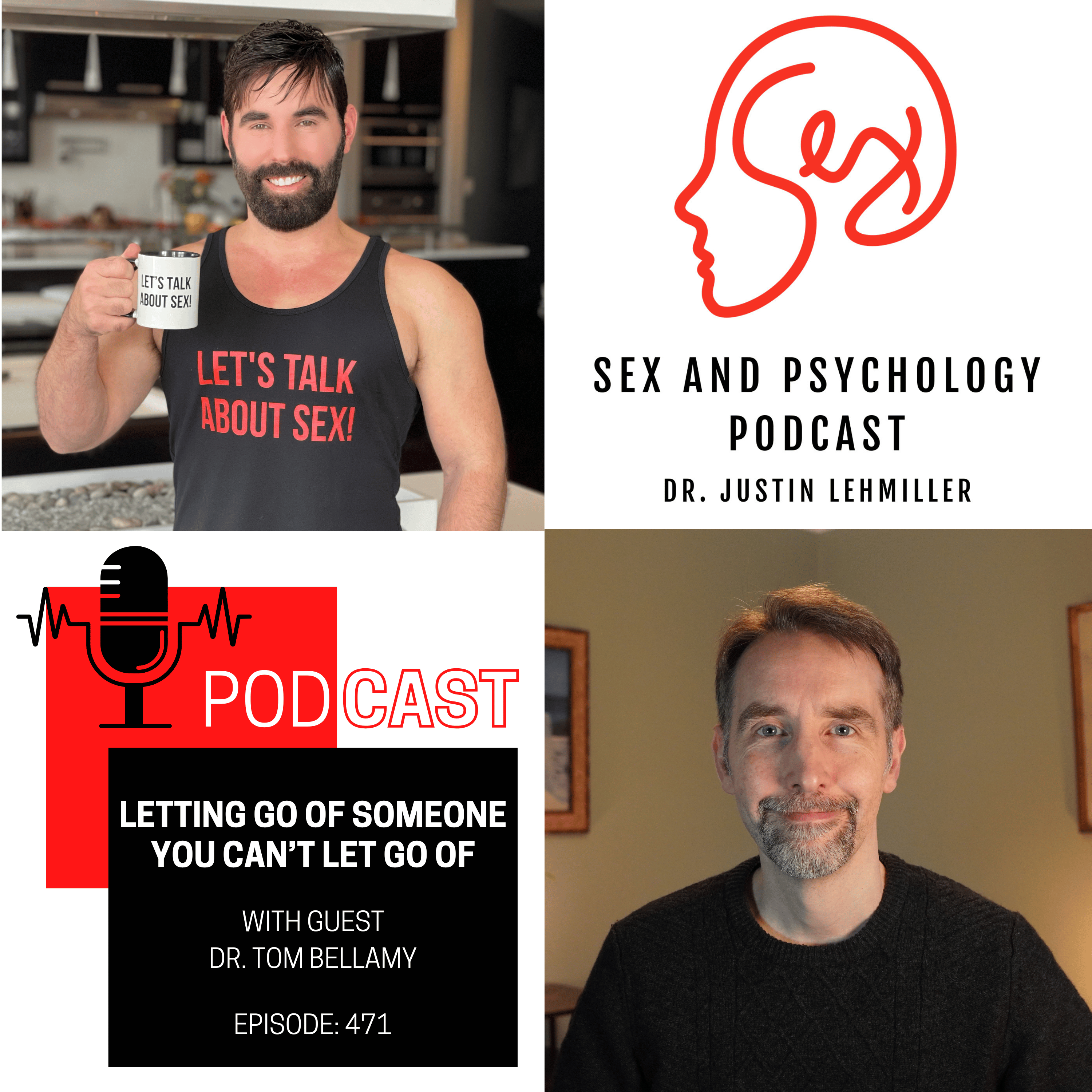
[MUSIC] You're listening to The Sex and Psychology Podcast. The sex ed you never got in school and won't get anywhere else. I am your host, Dr. Justin Nameller. I am a social psychologist and research fellow at the Kinsey Institute, and author of the book Tell Me What You Want, the Science of Sexual Desire, and how it can help you improve your sex life. In the last episode, we talked all about what limerence is and why we experience it. We described limerence as a state of intense romantic obsession with another person, wherein they become the central focus of your thoughts and feelings in a way that's incredibly hard to control. Limerence can be an incredible feeling, and sometimes it marks the start of an exciting romance. However, limerence also has a dark side and can sometimes turn into a problem. This is especially true in cases where we develop feelings of limerence for people we're not supposed to, like a coworker or your best friend's spouse, or for people who don't feel the same way about us, where it's an unrequited love, or for people who are just toxic or abusive toward us. In today's show, we're going to explore when and under what circumstances limerence can be unhealthy, as well as how to navigate those situations. Is there anything you can do to break the spell of limerence and move on with your life? Actually, there's quite a lot, as you'll find out. I am joined once again by Dr. Tom Bellamy, a neuroscientist and honorary associate professor at the University of Nottingham. He has published over 40 scientific papers, abstracts, and book chapters on neurophysiology. He runs the popular blog, Living With Limerence, and he is the author of the new book, Smitten, Romantic Obsession, The Neuroscience Of Limerence, and How To Make Love Last. This is going to be another fascinating episode that will help you to better understand what you can do to loosen the grip of limerence and help you move on when it becomes a problem in your life. Stick around and we're going to jump in right after the break. Do you ever find yourself dreaming about a career where you get to talk about sex and psychology all day long? What if I told you there's a place that can connect you with world-class experts and has a large thriving community? Sexual Health Alliance does just that. Sexual Health Alliance helps you to build the career of your dreams and is at the forefront of sexuality education. Students come from all parts of the world and from all types of backgrounds. Whether you're in school just starting out on your journey or building advanced skills in your profession, sexual health alliances, comprehensive certifications, engaging events, and self-paced online education will move you beyond the basics and set you up to become six-septional. Visit sexualhealthalliance.com and start building the sexuality career of your dreams today. And let them know that you heard about sexual health alliance on this podcast. Okay, Tom. In the last episode we talked all about what limerences and why we experience it. So in this show we're going to talk about overcoming it because sometimes limerence becomes a problem in people's lives. So let's start there. When does limerence become a problem or issue? You know, we talked a little bit in the last episode about how limerence can be a very positive force in people's lives. You know, it can be part of the early stages of a new romantic relationship and you have this intense infatuation and passion for somebody else. But by the same token, limerence can also become this deep source of pain and anxiety in someone's life as well. So when is limerence a problem that's in need of treatment or something that we might need to overcome? I think there's two very common scenarios for limerence being a problem. The first is if you become limerant for somebody who doesn't reciprocate or who isn't a good match. So you can become infatuated with somebody that treats you badly or is unavailable or who, you know, for whatever reason is just not a good match for you. And so really there's only pain ahead if you continue to be obsessively infatuated with that person and unable to break away. So perhaps the worst case scenario for that set up would be somebody that's manipulative. So somebody that is encouraging your attachments because they're selfish or narcissistic or, you know, they want something out of you. And so then it becomes a real challenge because you have to break away from somebody that is going to resist that and wants to keep you within their throald, you know, as their limerant pet, essentially. So the second big life situation in which limerence is a problem is if you are already in a committed monogamous relationship and then you become limerant for somebody outside the relationship because then of course you've got the pull of well, there's duty and there's commitment and there's everything that I used to believe about love and everything that I committed to. But now I'm feeling this overwhelming infatuation, this overwhelming desire for a new person and obviously there's practical problems with that but there's also the sort of internal emotional crisis that that's going to cause, you know, what does this mean? What does this mean about my marriage? What does this mean about who I am and what love is and all of those sorts of questions. And again, if we look for the worst case scenario of that, it would be somebody that had never experienced limerence before but had a, you know, happy and fulfilled love life and have got married, maybe had a family, but then they experienced limerence for the first time ever with somebody new outside the marriage because then that's going to be an emotional storm of this is what true love is. I've never had this before and what does that mean? So then it becomes even harder to try and navigate those, you know, emotional trials between what do you privilege? Is it these totally new emotions or is it the old emotions and the love and the attachment and the affection for a long term partner? So those are the two communist scenarios that I hear from from people who are really suffering with limerence. And they're definitely tricky situations. So, you know, when we're talking about overcoming limerence, what's the goal here? Is it to eliminate limerence altogether or is it to try and understand and integrate what these limerence feelings are telling you? And I ask this because, you know, when it comes to limerence, sometimes it doesn't say as much about ourselves as it does about kind of these feelings that we're projecting onto other people and what we're seeing in that other person and what they come to symbolize or represent to us? So, what do you think? Is the goal to eliminate limerence entirely or is it to just really try and better understand what limerence is actually telling us about ourselves and what we need right now? I don't think you can eliminate limerence entirely. I think it is part of, if you are a limerent, so I'll talk in sort of as we now as a limerent myself. If you are a limerent, it's part of who you are. It is part of our makeup. It's not something that I think needs to be eliminated. I don't think it's a defect. I don't think it's a disorder, but it's certainly a part of our emotional makeup that has the potential to be wonderful or destructive. So, kind of like fire, you know, it's great when you need to be warmed, but it's potentially dangerous other times. So, I look on it as something that needs to be integrated into our lives in a healthy way, essentially. You need to understand what limerence is, what it means and what it doesn't mean, and understand it within that context of your broader life goals. Because just at the simplest level, if you think about a young person who discovers their limerence and they're just embarking on the start of their romantic life, they're going to meet somebody, they're going to potentially become limerent for them. If that's reciprocated, then it's wonderful. I mean, it is just that euphoric connection and you have an amazing honeymoon period in the relationship, but limerence will fade. You won't get those intense emotional fireworks. They don't last beyond typically kind of a couple of years if the relationship is reciprocated and you form a bond. So, at that point, you either have to kind of decide, well, you know, monogamous union was really what I wanted to buy life and I maybe want to have children and I want to raise those children in a stable household and so on. People see that as an old-fashioned desire nowadays, but many people still feel that. So, at that point, you've got to confront the fact that there are still going to be other people out in the world that you can become limerent for. But so, if you break up with your partner and connect with a new limerent object, you'll go through the same cycle. You'll get that euphoria for a couple of years and then it will fade away and then you'll be in the same situation again. And so that would be a life essentially of serial monogamy where you're having a number of relationships that are much the same, but none of them are going to last beyond the limerent feelings if that's what you're prioritizing. So, at some point, you do have to kind of have those difficult conversations with yourself, I suppose, about, well, what is it that I really want and why do I want those things? You know, they're kind of really profound self-examination. And I actually think that's one of the real benefits that can come from these negative limerence experiences where you become limerent for somebody that isn't good for you or you're in a committed relationship and you become limerent for someone outside it. It really is like a lifequake and it does throw everything up in the air, but it is an opportunity for renewal. It's an opportunity for you to kind of examine the decisions that you are making, why you are making them, what your goals are in life, what you actually want to achieve, what matters more to you, is it, you know, stable long-term bond into the future, or is it, you know, a series of shorter kind of romantically exciting and novel experiences. And then it becomes the challenge of all long-term relationships about how do you balance the kind of companion at love of stability, security, affection with the erotic love of excitement and attraction and so on. And how do you manage to kind of keep the balance of cultivating the two within a relationship? And so it is an inevitable thing that if you experience limerence, you will meet potentially multiple limerent objects over the course of your life. And you kind of have to decide how are you going to respond and how are you going to process the limerence experience when you have it. So it sounds like the starting point if limerence is becoming a negative source of energy in your life is really figuring out what do I really want out of life doing that self-check-in to figure out what your wants and needs and so forth are before you can move forward in a healthy way. Now let's say that limerence you've identified it has a problem in your life and you want to work toward overcoming it. In your book you talk about this three-step process for reducing limerence when it is this negative source of energy and attraction in your life. So let's walk through those things one by one. You say the first step is to limit contact but that's one of those things that's easier said than done. You know when you feel this obsessive longing for another person, the desire to call them, text them, check in on their social media can feel almost like a compulsion. So how do you realistically limit contact, especially if this is somebody that you work with or see socially or you feel emotionally dependent on, you know, what's the starting point for that? That's one of the biggest practical problems with coping with limerence. So this three-step plan is really about how to get over limerence for a specific person. So I think it's important to kind of slightly separate that from understanding what limerence means for you in your life and what your sort of particular personal vulnerabilities are, which is kind of where therapy, personal therapy would really be, you know, advised for kind of putting limerence within the context of your life. But if there's a particular person that you're trying to get over, then limiting contact is essentially just removing the drug, the supply of the drug, if you think of that person as being your source of addiction. Now, yes, practically it can be difficult to do. If you don't have control over how much contact you have, if it's a co-worker or if it's somebody, you know, that has at the same school or university and you can't avoid them or maybe neighbor something like that, then yes, you're not going to be able to control that direct contact entirely yourself. So the point there is to sort of focus on the bits that you can control. So texting is a great example because you can limit the amount that you text and often it's wise to not go full-cold turkey suddenly and just say, I'm never texting them again, like, you know, a barrups no contact because your subconscious will rebel. Exactly as you say, that just the craving and the temptation will be kind of irresistible. So there's a sort of a strategy that you can adopt that I call the sort of staged withdrawal where you taper it off. So you decrease the amount of contact that you have through the channels that are within your control. So you might start saying things like, okay, well, I'm not going to text after eight o'clock or I'm going to limit myself to four texts a day or something like that. And actually, it's very useful and very powerful to set an absolute target. So rather than, oh, I'm going to text less or I won't text, you know, all night long, you give yourself something where there's no ambiguity about whether or not you've succeeded. But, you know, in recovery from any kind of addiction, there are going to be relapses, there are going to be setbacks and missteps. So it's important as well as a sort of general principle for recovery, not to be too hard on yourself when you do miss it. But not also to just say, oh, I give up is too hard. Just say, well, I had a lapse today, tomorrow's a new day, try to get back on target and say, no texting after eight o'clock. And then what you tried to do is essentially, as you make progress in recovery, you tighten up the specifics and you make it more while no texting after six p.m. No texting at the weekend at all or our only text every other day. And then you could eventually get to the point of realising, actually, don't really want to text them anymore after all. So it's about, I suppose, treating your liver and subconscious not as an enemy that you have to force into boot camp and, you know, brow beat it with your willpower. But as a kind of almost like a vulnerable child and you're responsible for coaxing them into the right behaviour that's good for them, but without doing it in a kind of aggressive way or a sudden or abrupt way, that's often more successful. It's kind of staging it and taking it a little step at a time. Yeah, that makes total sense to me as a social psychologist, you know, that has me thinking about how thought suppression doesn't work. You know, when we have thoughts that we don't want to have telling ourselves, don't think about that is not an effective strategy. And in the end, just makes us think about it even more and it becomes this obsessive preoccupation, right? And so if you're just trying to say, I'm not going to text this person ever again, it's probably not going to work. But as you say, setting those specific concrete measurable goals is going to be a much more helpful approach in the long term. As I love to say on this show, masturbation isn't anything to be ashamed of and pleasure doesn't need to look one way. Our sponsor, Erica Lust, is here to re-imagine how we see and feel pleasure. Erica Lust is an award-winning filmmaker and the force behind the world's leading platform for ethical cinematic adult films. With Erica Lust, you get more than porn. You get real intimacy, real orgasms, real stories. Every film is made with consent, craft, and care, from casting to climax. Whether you're watching solo or with a partner, Erica Lust's work celebrates what actually turns people on, with equal pleasure for everyone involved. And right now, Erica Lust is offering our listeners 45% off your subscription when you enter the code
[email protected]. That's Erica Lust with a K. Check the show notes for the link or visit EricaLust.com and use promo code Justin. Many of us associate February with Love, which makes it the perfect time to show a little love to someone special in your life or maybe even yourself. And cozy Earth makes that easy. Their bamboo pajama set has become my go-to at the end of the day, and anytime I just want to relax and lounge. It's unbelievably soft and lightweight. Honestly, it feels like a little slice of luxury, and somehow it manages to feel cozy without overeating. If you run warm at night like I do, that really matters. And right now, cozy Earth is doing something they almost never do, a buy one get one pajama deal for Valentine's season. So you can treat yourself and someone you care about at the same time. What really sets cozy Earth apart is their quality. These aren't pajamas that you replace after a season. They come with a 10-year warranty, which tells you that this comfort is built to last. Also, if you don't love them, returns are hassle free, but trust me, you're not going to want to part with them. These pajamas sold out during the holidays, and now they're back, but only from January 25th through February 8th. Head to cozy Earth.com and use my code Justin Bogo, that's Justin B-O-G-O, to get the buy one get one deal. And if you get a post-purchase survey, be sure to mention that you heard about cozy Earth right here. Celebrate everyday love with comfort that makes the little moments count. Now, you say the second step toward reducing limmerance for a specific person is to train your executive brain. So what does that mean psychologically or what does it look like behaviorally? What kinds of practices are actually going to work here? The basis of this is that a state of addiction is a state where the wanting drive driven by dopamine has got sensitized, so it's become stronger and stronger. At the same time that that executive control, the most evolutionary recent parts of the brain, the prefrontal cortex, that feedback control that should moderate our desires and help us to not indulge in voices that are bad for us and things like that, that gets weakened. So you get this perverse situation where the accelerator pedal is flawed at the same time as the break is released. And so the recovery plan has to essentially try and reverse that training. So try and strengthen the executive feedback and weaken the wanting drive that powerful desire. So as much as anything, it's kind of just becoming more aware of those wanting urges, those limmerant impulses as they come up from the subconscious. So one of the reasons why it's so hard to kind of break an addiction is that it's become behaviorally a habit. So it's happening subconsciously. You don't really engage your executive brain very much. You're before you know, you just feel discomfort, before you know it, your phones in your hand and you're scrolling and looking for the text or wanting to reread the text or check out their photo on social media or something like that. And you're not even consciously engaged at any point, it's just your brain has learned, this gives me emotional relief. So the habit cycle is initiated before you're consciously aware. So training the executive is essentially just trying to break into that habit cycle before it really gets established. And so it can be things like when an intrusive thought comes in that you just take a moment and stop and think that was a limmerant thought. That was an intrusive thought. And even just the power of recognizing it, it kind of engages that conscious part of your mind and puts you slightly more in control again of thinking you're looking at your thoughts as they're happening and you're processing them intellectually. And you don't even have to say, I'm not going to do it, you know, I'm going to put my phone out and it's enough to just start realizing, ah, that was a limmerant impulse. And that's why I'm feeding this. And then you can start to sort of go on the secondary level of how much do I really want to look at that picture. And then if you do look at the picture of them, you think, do I actually feel better or not? You know, do I actually feel a bit queasy now and a bit like, I wish I hadn't done it. And so it's really about essentially trying to kind of wake up your mental CEO and get them to pay more attention to what's going on on the shop floor and get that point of intervention. And the other thing that you can do is to try and exercise that executive muscle a bit in other areas of life. So, you know, think in terms of again, the overall thing of limmer, it's one of the few benefits is that it can force that self-examination. It can force you to start asking questions and develop yourself, develop yourself awareness, develop yourself a steam. And so there are many keystone habits that help with that. So things that we all know we should do, but they're hard to do, you know, so things like getting regular exercise, getting good sleep, eating well, you know, whole foods. There's a kind of halo effect that if you do manage to cultivate that executive control and that self-discipline in other areas of life, it starts to become easier to apply it to all areas of life. So really what you're trying to do is make sure that in the decision-making process, once you felt a limmerant urge that your executive brain is engaged and also to just cultivate and exercise that executive control as far as you can in kind of other areas of life as well. And that will lead to actually massive benefits in what some other areas of your life as well. Not least that you'll be healthier and happier. Yeah, so it sounds like it's really important to become more mindful of our thoughts and actions so that we're not acting on autopilot or out of habit. And really questioning, well, is this something I really want to do? Is this going to make me happier instead of just acting automatically? But also, you know, I appreciate the advice to about healthy lifestyle. And you know, it's one of those things that is good for almost every aspect of life because when we're not getting enough sleep and when we don't have a healthy lifestyle, it's very easy for us to become emotionally dysregulated, right? Because we don't have the same executive function when we're constantly chronically tired. And, you know, not feeling well. And so especially for something like overcoming or reducing limmerants, you know, having that healthy lifestyle is actually going to be an important part of being able to move on because it's going to ensure you have the cognitive bandwidth to do these things that you actually need to do. One other point on that is that of course it's always hard if you're struggling. The people just say, oh, well, you know, just sort of see how I'm like, I can't see because I'm constantly thinking about them, you know, I'm improving your exercise or I don't have any energy, you know, because I can't see. And that's totally valid. It's totally true that it can seem like superficial advice. But a way to deal with that is again, you need to engage with the limmerants at its own level to an extent that it is a subconscious drive. It's a subconscious impulse. And people tend to use, they learn over their life that limmerants is a strategy for mood repair. So if they're feeding low, a little hit of limmerant high by looking at their photo or reading their last text or remembering a time when you are happy together, that gives you sort of fleeting relief from the discomfort. But it's the same problem as scrolling social media or YouTube or whatever to give that mood repair. It's shallow dopamine hits. It's not happiness. It's pleasure. And so one way of actually engaging with limmerants at its own level subconsciously is to think about the story that you're telling yourself about limmerants because we do subconsciously essentially think in stories. We're kind of telling ourselves a narrative about, oh, you know, this is star crossed lovers, you know, we were destined to be together, but we're, you know, thwarted by fate or something like that. Turn that story around and look at it like, well, this is actually heroes journey. I'm a flawed hero and I'm going through a trial and it's hard. The things that are coming at me because of the limmerants, it's hard for me to do these things. It's a trial. It takes energy and determination and begin essentially telling yourself that story of your, you taking control of your fate, becoming the master of your fate and trying to forge a better future. And so things like that can also be used to try and sort of motivate yourself to encourage yourself in a way that the kind of shallow hit of dopamine doesn't do. It isn't transformative. It's just a kind of fleeting moment of relief. Makes a total sense. Now, the third step in this process as you describe in the book is to devalue rewards, which involves basically rewriting the links that we have in our brain to this person that we feel limmerants for. So how do people actually do that? You know, what does it mean to devalue rewards? So this is a bit more controversial, I guess, as a step because it does need to be used with caution. Essentially, what's happened is over the course of the developing limmerants, you've idealized this person. They've become the embodiment of romantic potential and promise and excitement and love. And so inevitably limmerants have a very distorted picture of their limmerant object. They see them as this exemplar of romantic perfection. And so what you need to do is reverse that by telling yourself the opposite story, which is focusing on their negative aspects. And limmerants intrinsically, if anyone's listening to this who's going through it, they'll immediately feel an aversion to that. The idea of thinking badly about their limmerant object is just like the worst thing, but that's why it works. You're essentially trying to reverse the rewards to punishment. And again, if you kind of root this in the science behind it, to try and desensitize the reward signaling, that takes time. If you're getting an intermittent reward, it's very resistant to what's called extinction. So the listening of the reward. But if you now link the same stimulus to punishment, that greatly accelerates extinction. So the thinking behind this is to mentor these switch things around and try and link discomfort to the limmerant object in your mind. So what you do is you take things like daydreams. So most limmerants have daydreams, happy daydreams about when they were with their limmerant objects, or maybe even happy fantasies. And they use that to give themselves comfort and to kind of encourage themselves. So what you do is you very tactically decide, I am going to spoil that daydream. I'm going to turn it into a nightmare. I call this the day mayor strategy where you kind of reverse it and deliberately put a kind of a bad ending onto the daydream. So something like if you imagine, you know, riding off into the sunset with your limmerant object, you then have them pull up the reins on the horse and say, oh, this was a terrible mistake. I regret that I can't stand this. I can't do this. And then they kind of ride off in the opposite direction. So you deliberately change it so that you can no longer use that as a source of comfort because you always have this kind of code or at the end where everything goes wrong. Or you think about you dwell on the negative consequences. So let's say you have a family, you have kids and you're sort of contemplating an affair. Well, you think about your kids finding out and sitting there in front of you in tears when you've ruined their life and their security and their happiness. And you dwell and immerse yourself emotionally into that experience before it happens so that you can use that kind of as a source of aversion. So it's about that spoiling memories of them by replacing the happy memories with the bad memories because often limmers will keep going back to a time when everything was great. You know, when they had, oh, that time that we were together, you know, that was great. And then you find one where you had a terrible experience with them and dwell on that instead and kind of try to condition yourself to think that's actually the reality of our relationship. That negative interaction is the real reality of it. The positive thing was the anomaly. You know, this is it. So this is all fake. And you know, many people could say, well, it's not real. And I'm devaluing this person. It's not fair on them. But the point is the fantasy was fake too. That was all imagined. It was all in your mind. And doing this, going through this process of kind of devaluing and punishing is not actually going to hurt anybody because it's only happening inside your mind. So they don't, the Oliminant object doesn't actually ultimately suffer from it. But I think an important thing to stay is that this is a temporary process. You don't want to end up with that distorted negative view of your Oliminant object. What you're hoping for, what you're aiming for is a properly neutral realistic view of them. So, you know, do this spoiling rewards process for a while to kind of if you like remove that source of comfort for yourself. But then try to transition into actually seeing them as they are. A person with good traits and bad traits, who you became limberant for, for reasons that are mostly about your own psychological and emotional vulnerabilities. And there weren't really about them. They're special, but they're special because if what they mean to you, they're actually just an ordinary person. So the goal ultimately is to see them clearly and to move on from the limberant experience and feel like that was a formative experience in my past that taught me about myself, taught me about my psychological and romantic vulnerabilities. I'm grateful to my Limeron object that I learned those lessons, but they are in the past now and my future doesn't have them in it. So that's the kind of sweet spots to be aiming towards. Yeah, that makes sense. And you know, for people who are really struggling with limerons or getting over a limeron object, sometimes the self-help strategies won't necessarily be enough for them and they might need to go the extra step of seeking professional therapy, but just make sure that if you're seeking out therapy that you work with a therapist who is really trained in and understands the science of limerons because as you talk about in your book, when therapists don't really understand it, sometimes things can go wrong in therapy because they diagnose the issue in an incorrect way and aren't treating it in the way it really needs to be handled. But for people who want to learn more about that, they can check out your book. So thank you so much for your time, Tom. I really appreciate having you here and learning from you and learning all about the science of limerons. Can you please tell my listeners where they can go to learn more about you and your work and get a copy of your new book? Sure, yeah. So the blog is livingwithlimerence.com. I also have a YouTube channel, which is @DrTomBellamy. The book is going to be out in the US on 3rd of February. It's already out in the UK. It can probably tell from my accent, I'm based in the UK. And so yeah, those are the places to find me online. Oh great. Now, we should include things to all of that in the show notes. Thank you again so much for your time. I really appreciate having you here. You're very welcome. It was great talking to you. Thank you for listening. To keep up with new episodes of this podcast, visit my website
[email protected] or subscribe on your favorite platform where I hope you'll take a moment to rate and review the show. If you listen on Apple podcasts, please consider becoming a sex and psychology premium subscriber to enjoy @FreeListening for just $3.99 a month. You can also follow me on social media for daily sex research updates. I'm on Blue Sky and X at Justin Laymiller and Instagram @JustInJayLayMiller. Also, be sure to check out my book, tell me what you want. Thanks again for listening. Until next time. [Music]
 PodcastTranscript AI