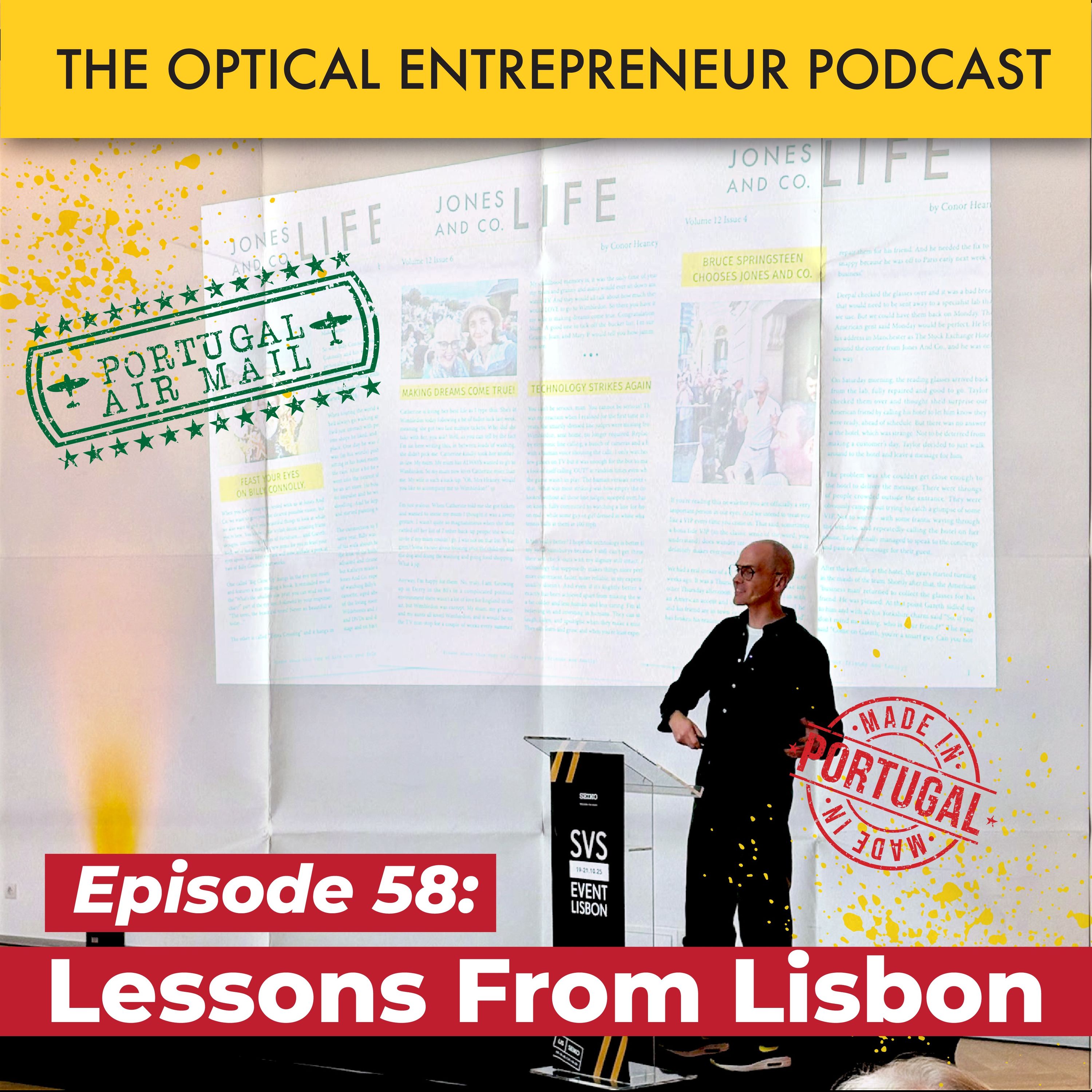
(upbeat music) This is the Optical Entrepreneur Podcast brought to you by Optical Success Academy and Psycho. Whether you call yourself an optometrist, an optician, or an optical practice owner, then wherever you're listening to this right now, this is for you. It's me revealing everything I can to make you a more successful business owner. Thank you for listening. I appreciate you being here in our growing community. (upbeat music) Hello and welcome to another episode of the Optical Entrepreneur Podcast. We are here in December. We have reached the end of another year and really nice the time to be looking ahead to what you want to be different next year and setting things up to improve and build on where you're at and achieve more success in 2026. So I just wanted to get this one last podcast out to you guys and hopefully help inspire you with some ideas of things that you can build into your plan for 2026. And I'm gonna share a recording with you from a live event. I did in Lisbon and Portugal. It was organized by our lens supplier, Psycho, who brought together around 60 independent practice owners and organized a two day workshop in the amazing beautiful city of Lisbon. And it was all based on resilience. And resilience is such an important trait that you need as a business owner because one of the things you know for certain is that you're gonna get hit with challenges and crisis and problems. We don't know what those exact problems will be. We don't know exactly when it will happen, but we know that 2026 and every year will include a healthy amount of challenges for business owners. So be able to be resilient and keep going and bounce back and all of those things allow you to have a great year and make good things happen in spite of the fact that you're gonna be dealing with challenges along the way. So that was the theme for resilience. So the presentation that I delivered in Portugal was called Five and a Half Simple Strategies. I've learned about building an unbreakable business. And really it was all about resilience for independent practice owners. So there's a lot of good stuff in there. I've framed it as Five and a Half Simple Strategies. And I think these should inform your plan and your focus for 2026. The audio hopefully is good enough. We were in a big grand hotel room. So if it sounds like we're in a cathedral or something, I hope you can bear with us and get the value that we're talking about in there. Lisbon itself, if you haven't been, is a beautiful city. I highly recommend it. And also I was delivering visual slides as well during the presentation. So you'll be able to pick it up through the audio, but we will also try to include the slides as a download for you so you can see the graphics and the few things that we talk about, the few visual things. And if for some reason you can't find the slides as a download, just ping an email to
[email protected] and the guys will happily help you. So that's it. Further ado, we will get into five and a half simple strategies I've learned about building an unbreakable business. Thanks for being here. Thanks for following along and being interested in everything we do here in Optical Success Academy. And if you would like our help in making 2026 your best year yet, just reach out to Lacey at
[email protected] to inquire about membership and how we can help you. But otherwise have a great final few weeks of 2025 and I'm looking forward to 2026. Thanks. (thunder rumbling) All right, hello everybody. It's nice to be here. I feel like pressure now because Jonathan said that he doesn't really do fun. Unlike, if you know me, I don't really do fun either. But I can go fast so I'll probably get to the fun part of the event, seems possible. But it's really nice to be here and thank you for seeing Viking us all. And also doing events ourselves. I know how much kind of energy it takes and then I, at a single event, you guys always, when I say you guys are pulling me in verity, you always seem to take care of all the little details. It was so nice to be picked up by private drivers at the airport and you're definitely spoiling everybody. So, but thank you guys for organizing this event. Jonathan literally said, I can talk about anything I like as long as it's late to resilient. So this was my best attempt. I've got five and a half simple strategies I've learned about business and they are simple. I think in that they're really obvious. They're really clear. They're really, you know, they just make sense. So I'm just kind of trying to share those with you and I over the next 40 minutes or so. If you don't know who I am, first of all, I merely just warm up back for Mr. Paul Allen. So this, you know, the only way is up from my presentation is just going to get better and better and better and I'm so glad that I'm going to be sitting in one of those chairs looking up for the majority of the next two days. And I'm an automatist, practice owner. Many of all I've done in my practice is really just focused on increasing the average dispense value in terms of delivering more value to clients so they spend more. And as a result, we can see relatively few people and do very well. That's pretty much what we've obsessed over. I've been running Optical Success Academy sharing what we do with other independents for the last 10 years and also I work in progress. So again, I'm probably most excited about coming here for learning and, you know, from what we're going to be going over the next couple of days. The last year in Rexam, where we learned about communication styles and all that, really, like I love all that kind of stuff. And I am a work in progress. I did check with my wife and I am a flawed individual. So she's excited that I'm here trying to better myself. And last year, I remember the reds and the yellows and the blues and the greens. So I was a red and we are human beings as well, but I was a red. So I asked Catherine before I came. I was kind of thinking about, okay, Johnathan said, talk about resilience. So I asked her any stories on what would you say? How can I talk about resilience? She wasn't very helpful, but she did tell me, you always think you're right. And it was interesting, what Johnathan said, Connor preached in a good way. Catherine doesn't like me preaching. She's like, you preach in the wrong way. It must be hard being so perfect. She says that to me at least once a week. She's normally, you know, she'll say something over dinner, relaying a problem that she had that day. And I'll give her a solution. But she said, this is not hard being so perfect. You're always going to advise getting mode. When advice is not asked for or wanted. So, you know, I think I'm just a red. It's not a red. It's not red, so yeah. So anyway, here we are. Yes, thank you again to Johnathan and everyone at Seiko. I think it is really nice that so many, if you guys find Seiko through optical success academy and equally harden any of you find optical success academy through Seiko, so I agree our philosophies are a nice match. And so I appreciate all the support you guys give us. Okay, so let's dive into resilience. It is resilience. There's the capacity which span or recover quickly from difficulties or toughness. So you do have a little worksheet on your tables. There are full in the blanks as you go along. This is my attempt to keep everybody awake during my presentation. I don't have the skills to do that with flares. So I'm kind of using a worksheet to do that. And so you know, it's bounce back ability, it's stick toativeness, it's durability, all of that good stuff. And it's really important to have resilience in general in life, but definitely as a business owner. Because what we know for sure, what I did diet, we know the bad stuff is going to happen. To us, we just don't know what or when or high. But we know for certain that bad stuff is going to happen. So therefore it's really helpful if we have resilience. So we're always kind of ready. And I kind of learned that lesson early on. I grew up, and Irish, obviously I grew up in Ireland and my granny, her maiden name was Murphy. So in her kitchen, above the kitchen sink, there was a little sign that said Murphy's Law, anything that can go wrong will go wrong and at the worst possible moment. And I remember being a kid just thinking that was a funny little sign, like a humorous thing. And then when I opened my business, I realized, ah, it's actually tried. That's like, that's how it works. Duff will go wrong and at the worst possible moment. So again, it's a kind of advertisement for getting resilience and being resilient. So before I give you my five and a half simple strategy, you've got three resiliency top tips and one mission. So the tips are, first of all, to be more resilient. It really helps if you practice accurate thinking. So accurate thinking is merely looking at the world or looking at any situation just entirely accurately, just as it is, just the facts exactly, you know, as it is. Because then you can actually deal with it and respond in a way that moves you towards what you want. Versus, if you look at the world or look at any situation from a viewpoint off, but that's not fair, or why is it like this? Or surely I shouldn't have to do this. Or, you know, all of that is kind of wishful thinking that doesn't do anything to help you improve the situation. So by actually looking at the kind of, you know, the warts and all, just give it to me. Because then I can at least align with that reality and kind of move in the right direction. So the better you are, accurate thinking, the easier it is to respond and, you know, be resilient. And if you know that as well, then it helps you to just be more prepared with anything that comes at you. Whenever something does go wrong, you're like, great, I was kind of expecting something to go wrong. So here it is, I don't need a stress out about it, I can just deal with it. And also, the 10 times thinking is really just the case of, if you approach anything that you're trying to do, with the view that it's probably going to be 10 times higher than you're expecting. So therefore, if we just do a lot more stuff, we'll probably get there. Rather than if we say, oh, this will be easy, this will be straightforward and this will be simple, you'll probably underestimate and then things will go wrong and you won't necessarily get the result you want. But if you're, you know, thinking that I'm expecting this thing to fail, therefore I'm going to do a lot of last stuff, then some of those things can go wrong and you can actually still get the result. So just that accurate thinking, I think is really, really helpful and useful as a practice owner in business. The second tip, top tip is this goes out to Gareth first, Gareth. Gareth taught me this a week or two ago. So we sent Gareth on the leadership. Gareth's a flawed individual as well. Here's here to grow as a human being. Gareth was a gentleman's uncle. So we sent Gareth on a leadership training a few weeks ago and he landed by this looking after your shift. So basically sleep, hydration, exercise, and diet. And I think again, as business owners, it's very easy to neglect yourself and looking after yourself. But a lot of the time, your day is just so much harder if you're lacking in any of those areas versus if you've had a good night's sleep, you're well-hydrated, alcohol doesn't quite, you know, you exercise, you go for your morning run, you eat well, like that just sets you up to be more resilient and tackle more of what comes your way. So look after your shared as a little tip. And then the third is that you become the average of who you hang out with. So that's just so true. If you hang around other people that are pragmatic and realistic and optimistic and have a can-do-it attitude, then that's who you become. You become more like that versus if you hang around with people that are negative, that will rub off when you become more negative and even go back to the mainstream media. If you just listen or you pay a lot of attention to the mainstream media, it's going to make you feel at what's the point, what, you know. It's just all so negative. So if you surround yourself with people that are focused on making good things happen, as a result, you will become more like that yourself. So three little tips. This is the USA. Cryed, and again, a lot of what happens, a lot of the good things that happen in an optical success academy doesn't really have anything to do with me or any kind of magic. It's really just, we've got a group of people that all, you know, are positive influence on each other because of that effect. And Sir Clay Woodward, who's the England rugby coach, talks about energizers and energy sappers. So when he was building the World Cup winning team, he was building a team of energizers. We want the people on that team that would lift the energy of everybody around him, rather than energy sappers that would suck the energy of everyone around him. So again, be thoughtful and strategic about who you spend trying with and who you, who has the biggest impact and influence on you. OK, and the mission-- so your mission, should you choose to accept it? We've still had that from Paul's little spy video. I like the spy video that I received. Am I allowed to say that? Is that all? Oh, shut up. OK. So your mission is to just have an average dispense breakthrough, average dispense breakthrough. So think about it. What would happen if you increased your average dispense value and you practiced by 50 pounds or 100 pounds or 200 or 400? What would happen to your business? And for me, I kind of realized that early on. And really, I didn't think about it in this terminology. But really, what the result in is a much more resilient business. If your average sale or your average dispense is a couple of hundred pounds more, and what I currently is, your business is going to be so much more resilient. So that's kind of the overarching mission, if you like, for these five and a half strategies I'm going to go through. And that really, this is where I started optical success coming. I stole this slide from Rachel. Thank you, Rachel. So this is a report that Rachel requested in the post, I don't know, 2014 or something like that. This was literally the first thing I wrote. Every suspense break through. Hi, my optical practice, it's an average dispense value of 750 pounds over five times the industry average and how you can maximize your dispense value not taking the same steps. So really, that's kind of been the overarching thing for my business that we continue on that journey today. So just again, as a show of hands, who here in this room has increased the average dispense value by 100 pounds or more at some point in the last five, 10 years. Just a quick show of hands, look around. So if you-- and I could probably go on, who's done it more than 200, 300? I know Rachel yours probably increased by 500 or so or more even from your journey to where you are today. But I think in reality, probably most people here have increased it by 50 or 100 at some point. And I think the trick is to not stop and to keep going in that direction and keep finding ways to add more value to your clients so that they cheerfully, happily spend more money with you because of how special and how unique you're making what you do. So again, the reasons for continuing to go further on that journey is it makes your business more and more resilient. And so that's kind of the connection here. Johnson made everything back to resiliency. So that's what I've tried to do here. So this is an old photo, but this is Jones with help. And then over here, can you see the Specksaber sign, 2-4-1 from 69 points. So that's literally just outside the Jones Co. And the spectroverse, he did just try and wind me up. They like rent the space and the appetize. And it's a real bottle of the mines. But the first day I went in and saw that it was like a Wednesday morning or something. And I remember during the morning Hubble. And I noticed that. And I asked the guys, what was our sales yesterday? And coincidentally, our sales was around about 6,900 points a day before, which was a very good day for us back then. So then I told them, I said to the guys, so did you see the poster outside today? And they said, yes. And I said, OK, so let's figure it out. How many pairs of glasses would we need to have sold to do 6,900 pounds yesterday? And the mass is 100 pairs of glasses. We would have sell 100 pairs of glasses. And how many did we-- I think we had maybe seven clients that previous day. So we did with seven clients what, if we were selling faster than 6,900 pounds, we'd have to see 100 people. And not only that, it's two for one. So we would have to make 200 pairs of glasses, 200 pairs to check in, setting appointments, 200 to adjust. It's just the teaking even thinking about it. So I just used that as a little story about how we're being as high-market as we can go, or as upmarket as we can go. It's just playing to our strengths, where it's just going down market and focusing on volume and low prices is like we're never going to win that game. It's like ridiculous to be even contemplate what we would have to do. So anyway, that's just a little analogy for how do we think about it. The bullying continued. This was during COVID. Can't see her optician right now, we can help. Also, I should really give a shout out to Gareth. We haven't given him a round of applause in a while. During COVID, I was at home in my bunker safe. Most of the other staff were furloughed and working from home. Gareth was the hero that kept Jones and co-jury going during COVID. He would go in every day and do any of the emergency stuff. So not all, what was your phrase? Not all. Not all heroes were capes. So thank you, Gareth. What else? They even write to me at home. I got either in Clizor or a little time. They sent me this wealth. We flipped through the door. They really find the way me up. They sent me this through my door and they're advertising on TV. They're getting celebrities. And we can't afford to do that. I'm going to do this. We've never gone that far that you can have your asses claimed for free with spec singers. But the best is up the top, but one at a time, please, one at a time. We have one on that one. But really, I have the spec singers. My first job ever in an optician was inspect singers between the summers of first human second year. And after I qualified, my first job was inspectors in Garby. So it's just about a healthy competition. OK. So again, the mission is average dispense breaks through. These are the five in the house. Simple strategies. This one is niche independent IRA that clients will pay high premium price or four. And high premium price is important. I don't really want just independent IRA unless it kind of supports good, high premium prices. Because that's our strategy is see fewer people, but they're such a good job that they will happily pay more money. So I think it's really important to think about what frames do you choose to stock? And does it support that or not? Because your business will be far more resilient if you're working with frames and brands that allow you to operate at a level of high premium prices. And again, when you start to make moves in that direction, just continue to take another few steps in that direction. So do more of what works. And so that's the first strategy. I think it's very simple. How do we why are we successful at younger code? Or we sell high value frames, you know, that's a relative term, but that's the simple one of the simple strategies. And anyone can do that by choosing to do it and figure it out. Some of the specifics, margin, so if I'm selling, you know, rebands and promfords and margins, instantly I'm like splashing my profitability as a business, so I'm less resilient. So for me, that's one of the most attractive reasons to work with frame companies that support us being at lose higher price points, because I want to deliver the best possible experience as well. I want to have amazing staff and qualified staff and amazing service and a great environment and all of those good things which cost money. So therefore, that's kind of why I want to have a good margin that allows me to run the best business that I can, differentiation as well, you know, if we can offer products that are perceived as something different and something that you don't come across every single day and every single place, frames that are, you know, people in the know, only know about it, then that makes us different, which is, as Jonathan said, it's like a major objective for what we're trying to do. It's just be different from all the other places that are right there. Some sort of feelings is, so frames with feelings is, you know, if you look at Apple as an example what they did with the iPhone, they took a phone, which before the iPhone, phones were, nobody really got excited by phones, it definitely didn't queue up overnight to get the latest one. And really one of the reasons Apple succeeded is they just made it just kind of, it's so desirable and it just oozes style and it tracks people's interest and it makes people feel something looking at it using it. So it's the same thing with frames or frame brands that people, when you show them to them, they just create that same, those same emotions and those same desires. So make sure you're working with brands that they do that and aren't just perceived as just another pair of glasses and referrals as well. So again, I think one of our, let's sort, the advantage of so far industry is our work is on everybody's face, walking around. So if we have great frames that are different, that have a story to tell, then conversations are happening all day long everywhere in evenings and restaurants, people are talking to their friends about their glasses and we should lean into that and that generates referrals. So that is my reasoning for having niche independent ira. That's number one. Number two is the art of price presentation. So this is basically that the price of client will happily pay, but it depends on how you present it. So how much someone will pay depends on how you present it. So it's not, it's not about a number, it's about how is it presented. And there's, well, three things here. The first is the price guide. So the price guide is, it's really up, you know, it's almost like a menu of prices with lenses that people can choose, they're lenses and it's about presenting that in the most effective way. It's free. It doesn't, a gentleman mentioned about, you know, if you look at your, your, what's the term that you guys do, the business, business review, if you look at your business review, it doesn't cost you anything to, to learn and start practicing presenting the lens options in the right way. It doesn't cost you anything to learn how to talk about different options and multiple pairs and all those types of things. So I think that's a really, really good place to start and a place to, it's a fundamental thing to keep going back to and just trying to find improvements and tweaks and how we present lens options to our clients. So what I'm transposable is, again, it's a, so it's a psychological, human psychological principle where how we perceive anything can be influenced by the things we show around it. So I read about it first from a guy called Robert Chaldini who's a professor of psychology in the, in the States and when he's teaching the contrast, but it's well to his students, he gets, he does it through an experiment where he gets all the students to have three buckets of water in front of them. You have a, on the left you have a bucket of cold water, on the right you have a bucket of hot water and on the middle you have a bucket of lukewarm water. So he gets the students to put both their hands in the bucket of lukewarm water for a minute and then after a minute you ask them to put the left hand in the cold water, the right hand in the hot water and I've done that back the front. He starts by putting their left hand in the cold water, the right hand in the hot water and leaves them there for a minute, okay? And then after a minute he says, okay, now I've got both hands in the lukewarm water and he says that there are minds at the low and because they're left hands saying this water's really, really hot and the right hand saying, no, this water's really, really cold, but they're brain-same, but it's the same bucket of water how it can be hot and cold. So that he does that to kind of illustrate that how we perceive anything is influenced by the things we show around it and before and after it. So the way we present frames, the way we present lens options, all of those things, there's a lot we can control in terms of how somebody perceive that number. The option principle is basically, give people too many options, they'll be confused and then say, I'll have to go and think about it. Give people not enough options and they'll say, they can't make a good choice because they don't have anything to compare it to so they're going to go away and think about it. So there's a real art to finding the right amount of options and we don't really, well, we don't do the good, better, best thing mainly because, thinking are in this way, it's never just the good, better, best option because there's different indexes, we might play around with proteins, but then we talk about transitions or lenses and instantly options just explode and become overwhelming. So for us, we just do, this is our premium version and this is the top of the range which you prefer because again, if we're talking about indexes and things like that, we can, you know, we can then just keep it manageable. So again, really taking the art price presentation seriously with your team and continually working on it is something that will make your business much more resilient. All right, so again, upgrades, dine grades, sunglasses, multiple pairs, payment options. If we just talk to every patient about that every single time, there's loads of opportunities there, but if we don't do it consistently, then we're going to miss, we're going to miss stuff. Okay, number three is the eyewear discovery conversation. So again, this will make your business more resilient because it kind of creates dispensing opportunities out of thin air. You know, thing people will come in and there's an interaction, they don't necessarily present with a clear need, but if you do a conversation with them to discover what their needs are in relation to eyewear, they, you know, often you'll find needs that they decide to do something. So making it, the turning everything into a conversation basically, so not just taking everything at face value with a client, but exploring and turning it into a conversation, people on there for a lot more needs, and there's a big difference between selling something or did the client buy something? I would say in most opticians, the default is clients just buy something, they come in and they're like, I need this. Can you help me with this? Yes, here you go. Off you go. And that's not really, I go, you know, I'm probably not the most, I'm probably just too red. If my staff said that, I would say a trained monkey can do that. What we need to do is have a conversation and find out as well as that, is there anything else that they might need that they haven't thought about yet? That's serviced, that's helping them. So again, that's our job is to sell them not in the typical way, but to kind of explore with them, because they haven't thought about anything, they're just pitched up because they've had one little thought. Our job is to help them explore. And selling as well is serving, that's, in my head, they're selling is serving, that's what it is. And the thing you have to ask them questions, find out about them, explore the options and let them decide what they want to do. But, you know, if you really embrace that and start having better conversations, you will find a lot more opportunities. Leaky buckets are basically a lot of these opportunities that are there every day, and they just kind of slip through our fingers. Unless we get really good at having conversations, and those opportunities are everywhere. It's every single interaction, somebody on the phone to call up to book an appointment. Don't just book an appointment, have a conversation, somebody comes in for an eye exam, it doesn't matter whether the prescriptions change or not, have a conversation. Somebody's coming across for a dispense, they need new verificals, great, still have a conversation. Fitting appointment, they've just bought glasses two weeks ago, I don't care, have a conversation, they might want something else, they might need something, you know. So it's just that default, walk-in adjustments, can you just adjust these, yes, no problem, have a conversation. So just making that your default and training that as a team makes your business so much more resilient, because you'll pick up all these extra dispenses that otherwise wouldn't happen, so your business again is much more resilient. And now a word from our sponsor. Hi, Connor Heaney here, in 2017, after feeling frustrated and underappreciated by our previous lens supplier, my practice started working with Seiko as our primary lens company, and we haven't looked back. The Seiko team are a joy to work with, they are extremely helpful and flexible to our needs, which means we can provide far better service to our clients at Jones & Co styling opticians. Our patients are delighted with the quality of vision they get from their Seiko lenses, and for over four years now it's been an excellent and profitable partnership with Seiko for my practice. I can't recommend them highly enough to receive a Seiko information pack, including a special lens offer for podcast listeners, send an email to
[email protected] with the subject podcast. Find out how Seiko can help your practice the same way they help mine. Send an email to
[email protected] with the subject podcast. Okay, number four is sales carry on the free, so if you design a unique experience, they will happily pay more. The sales choreography is about designing the whole experience, how it feels, how it looks, what it actually feels like to the client. I always remember reading something about Steven Spielberg, where he talks about the fact that human beings are human beings, so if you think about if an audience goes to the cinema to watch the latest Steven Spielberg film, it's a very diverse audience, typically. It's just going to be a whole mix of ages and different people and different walks of life and different values and stuff like that, but he can still make them all laugh at the very same moment. He can make them all cry at the very same moment. He can make them all go at the same moment, like he knows what creates feelings in people, so he can design a experience that that kind of is fairly universal, and it's the same with our practice. We can do things that most of our clients will feel really positive about it and actually love and rave about it, so you don't have to think about what we do, it only works in Jonesville, because we're a super high-end practice, whatever, it's not, it's just it works for human beings. But generally speaking, the things that make one person feel special will make most people feel that way. So you should design an experience that does that, and then they'll travel past dozens of other practices to come to you, and again, that makes your business resilient, where people are seeking you out because of the experience you offer in the way it makes them feel. And then, you know, it's irrelevant that they got a little flyer through the door from some other place, or their friend told them about something else, or some of what it works, said why do you spend so much in glasses, I got these ones online, like all of that isn't really relevant if they feel this strong connection to you in terms of the way you make them feel. So don't just ask how much will they pay, ask how much will they pay when we present it like this. And so it's all about, when we present it like this, what about if we did it this way and, you know, design that. Critical non-essentials are the things that they're not related to glasses, or eye care at all, hence they're non-essential, they don't have anything to do with doing an eye test or providing vision, but they're critical because these are the things that make people feel something. So like the drinks you serve, the environment that you create, you know, the people who are serving and the high-interested you are, and all of those kind of critical non-essentials have a massive impact. So I think I've got a little video here, yeah. So this is just a two minute, not even a two minute video of Jones and Co, just kind of showing, we've just made this for our new website, but we're just trying to show, I guess, what a client experience feels like at Jones and Co, but really what we're doing is trying to design an experience that makes people feel something. So I'll just let you peek at this. [Music] [Music] [Music] So that's just about designing your experience and there's really just a lot, lots of little details that all add up to make people feel something, and any, any independent practice can design that, and again, that makes your business more resilient. Okay, number five is having a community of raving fan clients. If you have a community of raving fan clients, your business will be far more resilient. So really, your client base is your business. It's the people that you have relationships with that know you, and that's the most valuable asset that you own, however, a lot of practice, it's simple to understand, but a lot of practice owners don't really do enough to take care of this asset, and the quality of relationships matter. So again, the quality of your list of patients is massively affected by the way you meet them feel when they were in your practice. So if they've had an incredible experience, the quality of that list goes through the roof and they're excited to hear from you. So those two things go together, I think, in terms of creating a unique and great experience, and then also, you know, now you listen or through that list, so do relationship marketing. So that's the way I think about our marketing, is it's relationship marketing, we're continued to build these relationships. And therefore, a lot of the stuff we talk about isn't classes, is that we're a little article, this is a newsletter, print newsletter, we send out most months, you know, that's a lot of article about Billy Connelly because we got a little Billy Connelly print, and that's a lot of article about my wife, Linda Wimbledon, and not inviting me. You know, Bruce Spring thing, didn't actually come to Jonesapoe, he was in Manchester on tour and his reading glasses broke, that's not very rock and roll is it, when you're reading glasses break, when you're a rock star, but he sent one of his, he sent his assistant to us to repair his classes. So we're just, it's just like a relationship, these are all the things I would talk to, my clients and patients about it, if I was just talking to them face to face. So we just put that stuff in print, because we want to nurture those relationships, we do events, again, relationships are, you do stuff with people, you invite them to things, so we do that with our clients. What do we have here, up and the left, we, you know, that's, is it Philip? James, James from Tale, he's one of the designers of Tale, so he came and gave a little talk about design to our clients, there was a David Hockney exhibition in Manchester, so we bought a load of tickets and took our clients along, this is like a, you know, a client appreciation evening at Jonesco, these are two of our clients in Popright, they don't know each other, the one the last quite broke, but yeah, it's just having fun, so that's it for him, one rice gay, and then one of the last to start, what people's happy in their having a good time? Our email newsletter goes like, again, a lot of what we're talking about is, like, left is like TripAdvisor, but better, basically that is us just recommending stuff, it's a little restaurant in Manchester, you might want to check it out. Johniston, we were nominated for best customer service across thousands of business and across all sex, we didn't win. Not to put a bad omen on the optician awards for you, next year, I don't know if I can be bothered entering again, we'll see, puppies just got from puppy, so again, a lot of what we're talking to our patients about is, it's a lot, glasses, optical stuff, yes, we do that as well, but a lot of it is, we're trying to build relationships, and therefore you have a, you know, a community of breaking fans, and 5.5, this is a bonus one, is number one is the worst number in business, so if you're, if you're trying, first of all, if you're trying to do it yourself, oh, that's such a bad situation because there's only one of you, then if you have a team, but you've only got one really great team member and everyone else is a bit so-so, oh, that's a really bad situation as well, because they might leave, you might get hit by a bus, who knows, like, one's just a bad number, it would be better if we made out of it on the team great, so just constantly be investing in your team, developing them, training them, so 5.5, this build a resilient, high-performing team, and get them the best training and give them responsibility, so again, an amazing team doesn't just happen, it comes through training, I remember we were at an event in Belfast, we ran a little optical success academy meeting there, and it was a really nice hotel in Belfast, and the service, sometimes in hotels, services, hitting mess, particularly when you're running an event, there's lots of people all together at once, but this hotel was really, really good, so we had a local guy turn up to give us a walking tour in the evening, where he was kind of showing us around the sites of Belfast, and I said to him in passing, "Oh, the hotel's great, the staff were really really good," and he said, "Oh, yeah, I know the guy that owns a hotel, they do loads of training," so he was quite insightful, but he said, he wasn't surprised that the service was amazing, he thought it was, of course, it's amazing, they do loads of training, they put loads of effort into delivering a great customer experience, so they're constantly training their team, so that's kind of how we all get there, so if you're one of an amazing team, just really invest in training them, set high standards, set high expectations, and believe in them more, and they believe in themselves, that's what I say to my team every time I ask them to do something that they're nervous about doing, it's like, "I'm just going to do it," and they kind of push them a little bit, and then they generally do it, and then they're more resilient, and they're happy they've done it, kind of. So this simple versus easy thing, so those strategies are all simple, it's very clear, it's basically, if you want a more resilient business and more profitable business, sell more high-end independent frames that are different and give you a better margin, present price, and really master that, well, design a unique customer experience so that your clients feel really special, and feel they're really valued, but I miss the eye-ware discovery conversations, you'll convert more people, I'll make you more resilient, and then if you have an amazing community of people that are your clients, then of course they'll keep coming back, so they're five simple strategies, but the difference between simple and easy, easy, everybody wants easy, everybody, like if it's easy, and I just do this one thing and it'll happen, like the quick button or the fast button, that's what people want, but that's not how life is, those are simple, but they're actually, they take effort to do, they take resilience, they take commitment, they take discipline, they think a lot of energy to do, it's still simple, so I think again, if you think accurately about that, you can go further, if you expect everything to be easy, you're always going to be disappointed because it never ends, so that's the difference between simple and easy, this isn't really a good show actually, I've just watched recently, it ties in perfectly with resilience, there's so much resilience in that show, it's basically, it's like one series on Amazon Prime, and it's about the making of the Godfather movie, so if everyone's involved, that's Mario Krutso on the back of the right team, and it's fictional, it's based on the true story, but it's a drama, so it's about him writing the book, and how he struggled to get it published, and then the film rights were bought, and then they weren't going to make it, and then the producer that was making it, he really wanted to make it, but nobody would believe in him, and then they were trying to get all the actors, and they really have, and the match you wanted to shut it, there was so many hurdles they hit along the way, so it's a really inspiring show, I recommend it, but in one of the episodes, basically one of the guys, they're talking about how hard this is, oh my God, and one of the guys says if it was easy, everybody would do it, so again that's the same thing with businesses, these things are, they're simple, but if they were easy, everyone would do it, why do everyone would not do it, because they're not easy, so again that's a little bit of motivation to put the effort in, and why people don't do it, and why more people don't do this, because again it's simple, you've probably seen this before, it's like a matrix of work and activities and how it can be split up, so you have urgent and important, so urgent from the top, urgent and non-urgent, and then important and not important, so you can categorize anything that you do, any job, any task, and to top left is urgent and important, which is it's important, it matters, and as urgent it needs to happen like now it's today, the top right is it's important, this really matters, but it's not urgent, like it doesn't need to be done today, bottom left is it's urgent, but actually it's not that important, it's not like a really high values thing, it's, you know, there's urgency there, but it's not important, and then bottom right is, it's kind of like it's waste time, it's not urgent, it's not important, if I don't do it, it doesn't have any impact on anybody or anything, so I think that's easy enough to understand, but I was going to try and go a little bit deeper with it, in terms of why do people not do more of this stuff, so the quadrants have kind of labeled them here, the top left quadrant is the crisis quadrant, which is you're responding to crises, this needs my attention today, it's important, it matters, I need to do it today, so that is entirely reactive, like we don't have to work filling that box, every day that will automatically sell by itself, new crisis will just show up, so that's why we often spend a lot of time there, beneath it, the urgent, not important, I think the best way to think about that is it's low value work, and it's just not, it's just busy work that fills our time, and we end up doing stuff that we shouldn't be doing as best as owners, we should be delegating it and giving it to our team members, and then often because that's really where most people spend their time, crisis and lower value work, that's kind of tiring, so then they're so, we head fried, so then we go over here, we're a little bit of procrastination, I'll scroll through social media, I'll go and have another coffee or whatever, do I just need to distract myself from the pain that is my day, and I still die because I'm not actually doing what I'm supposed to be doing, so you just end up in this loop between dealing with crisis, and then doing stuff that isn't that important, but replying to emails and all that, and then intermittent breaks of just distracting yourself. But the success box up at the top is that's the way to your goals, so if you want to make something happen that you haven't done yet or get to a place that you're not having to write that yet, you kind of need to plan it and decide what you need to do, you need to be strategic, but none of that is reactive, nobody comes along and says, it's really important that you do this today, that's all kind of on you, you individually to kind of schedule that time and commit time regularly, commit enough time working on the success stuff because that's how you get to do the things that you want to do, otherwise your day will just be filled up with one and two, and the success box as well, that doesn't happen in the test room, so again, he crafts a big hurdle for a lot of practice orders is, if you're just in the test room, you're kind of in between one and three, you're, you know, you do stuff disurgent and important, but it's not going to get you to your goals necessarily, so again blocking out time regularly every day or every week, whatever way you do it, so that you've got the time on that success box, that then gets you moving towards where you want to go, so that then you can get to, you know, that's why if you want to implement those five strategies, you just need to get the time in that box to do it, otherwise you'll go back to work and go ahead with one and three, and actually that simple idea, I didn't get done, so that's my attempt at understanding why more people don't do the simple stuff that will actually make things better, and it's a challenge, we all tend to wrap against it, you know, I'm as guilty as anyone from getting stuff back into that stuff, but I think the clear you are about what's really happening, the easier it is to take steps in that direction. And then this is kind of one of the final things. So up at the top, how we want it to be is set a goal and achieve it in a straight line is kind of what we hope it's going to be like. But in reality, we set a goal. We're starting out. It's looking good. And then we start doubting ourselves. We're doubting here. And then we're learning. And then we're failing. And then we're practicing. And then we're feeling lost. And then we're getting it. And then we're struggling. And then we might achieve it. So that's the reality of, like that's Murphy's Law. If you like, it's basically, there's a lot of doubting, failing, feeling lost, and struggling in the process of achieving your goal. And if you know that's normal, it makes it easier to commit and stay consistent and keep going. And I think it's important as well, because particularly in these moments, if you're doubting yourself, or it feels like you're failing, or you're feeling lost, or you're struggling, in those moments, you're kind of a little bit vulnerable. So it's really important, again, who you surround yourself with. Because in those moments, if you ask people for advice, and they haven't done the thing that you want to do, it's just so easy to let their advice make you doubt yourself further or make you give up or make you stop. So again, if you're aware of that, it makes it easier. If you take an advice from people that hasn't done what you're trying to do, at the very least, you need to take a pinch of salt with that advice. And I think really one of the key suggest principles is modeling, basically find someone that's done it, and they can give you the advice of how to do it, because if you ask someone that's done what you're trying to do, and you tell them that you feel like you're doubting yourself or you're feeling a bit lost, they'll say, yeah, that's normal. You doubt yourself fail, feel lost, struggling, it's all part of the process, keep going. And you'll keep going. So I think that's pretty legit, so this is a five and a half simple strategies. You can use it all, check what, score yourself, pick one or two to work on, and try to keep it practical. And I think I've caught up a few minutes there as well, so a lot of people on your points with Verity. So thank you, Sakele, thank you, Jonathan, thank you guys, appreciate it, and I'm looking forward to Paul in learning over the next couple of days. Thanks a lot. Thank you for listening to the Optical Entrepreneur Podcast. If you're brand new to our world, head over to opticalsuccessacademy.com, where you can get started with my special report, the nine keys that unlock the hidden profits in your practice. Or, if you've been listening to the show for a while, you like what you hear, and you think you could benefit from this type of help to accelerate the growth and profitability of your practice, reach out to my team at
[email protected] and tell us exactly what you're looking for. You'll find all this information in the show notes, and if you know someone who would benefit from today's show, please share it with them. Until next time, make it a great month!
 PodcastTranscript AI