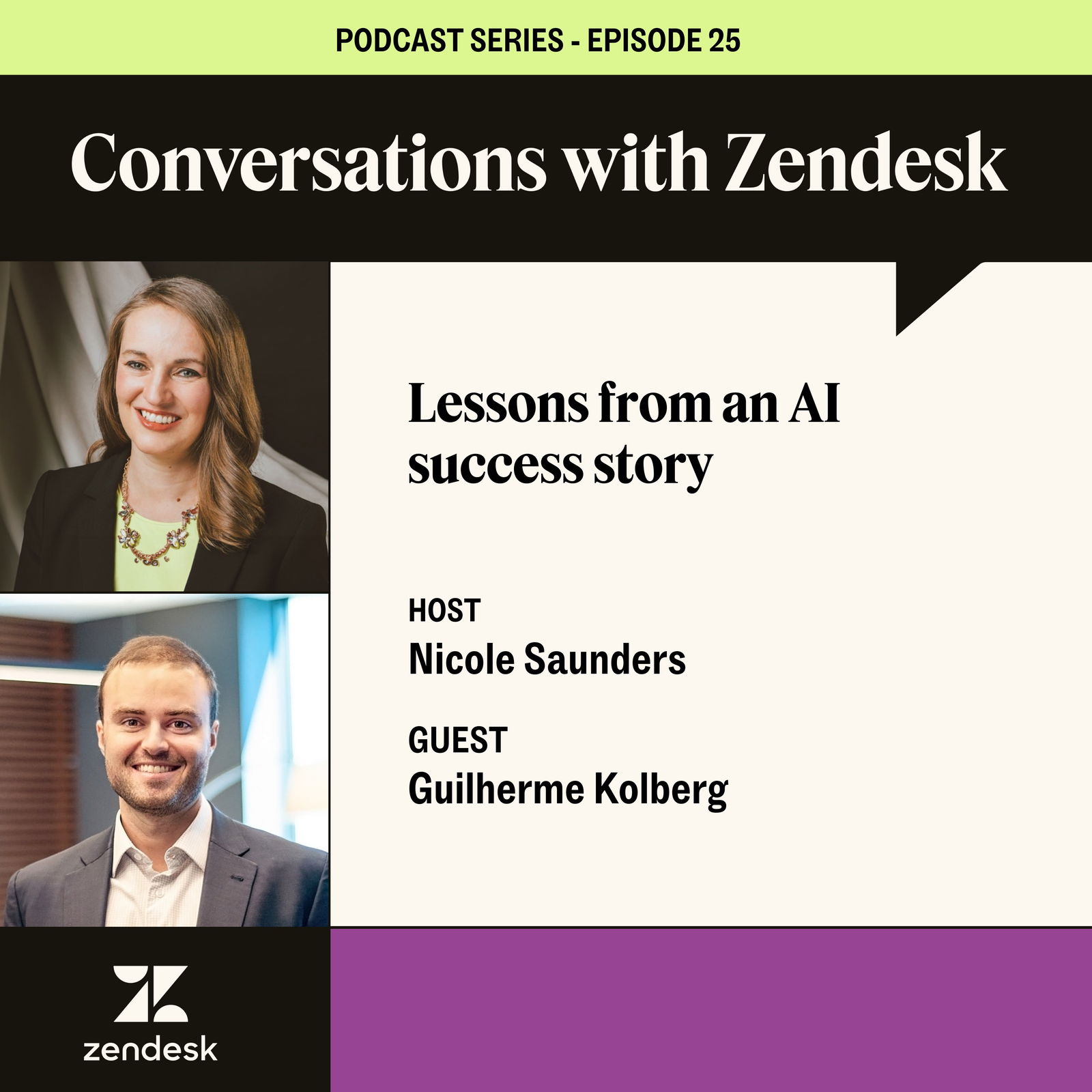
These jobs will migrate to other clients issues to help our other needs from clients. Not only customer support, but maybe people today that they are in customer support, they will be on sales. They will be on how we can achieve customer success. So for example, how can help our clients to use our product better? And not only handling issues. Hello and welcome to the Conversations with Zendesk Podcast. I'm your host Nicole Vonners. Today we're talking with Galaermi Colberg, head of CX and customer care at XP Incorporated, a leading financial services company in Brazil that has the mission to help Brazilian people to invest their savings better. We wanted to speak with XP because they're an early AI success story. And Galaermi shared with us how they first approached implementation, what they've discovered along the way, the impacts they've seen already, including things like reduced handle time and greater agents had a fraction. If you're interested in taking the next steps with your own team, we actually recently released a new guide for CX leaders covering the best practices and tips for AI implementation. It's free and it's available at zendesk.com/intelligent-cx. And if you're looking to dive deeper into that topic, I encourage you to sign up for our upcoming webinar, unlocking the power of AI for CX, which is coming up on June 4th. We'll be teaming up with experts from AWS and IDC to discuss everything you need to know about AI for CX, from trends to challenges and much more. The link to register for that is available in our show notes. Also, please be sure to follow Zendesk on LinkedIn to hear about this event and others that are coming up soon. And as always, we love hearing from you. So if you have a question or some feedback on the podcast, you can drop us a line anytime at
[email protected]. Alright, on to the show. My conversation with Guillermo was recorded in person at Zendesk's Relate Conference in Las Vegas in April. Before we get to that, we're going to hear from some Zendesk customers that we spoke to on the X-Spo floor about how they're thinking about and using AI. We're going to tell us a little bit about how you're currently using AI, either for where you're in your personal life. To us, AI is just another tool or the toolkit to say, this is how we can help customers faster. This is how we can help agents become more efficient at what they do. At Foreign Global, we're just kind of getting our feet wet in it and doing a little testing to see where we can put it into some workflows. I think it would really be helpful for our team and especially customers, our knowledge base is kind of complex. So having some AI chat bots would be really helpful for us. It's hard getting knowledge built and created, so being able to make that easier for our agents to be able to share the knowledge that they see every day. That's what we're kind of really looking at. It's really useful in writing content, but helps we like to change the tone. How do I make something shorter? So that's actually really useful. We're pondering with Ultima already. We love it. It was plug-and-play, got the bugs integration. It really reduced the traffic for our agents, the striven-out of the automation rate, and it's just been a really dreamy partnership. I absolutely love ChatGPT to tell me what the best car is going to be for me for my next car. Ooh, I love that. What a great use case, saving you time. I actually just took a three-week trip to South Korea in Japan. Oh wow. I went eight years ago and it was a blast, but ahead to plan, we used ChatGPT. It took us 30 minutes to plan a trip for an entire city. We followed that list, and it was excellent. The huge thank you to everyone who spoke with us for that segment. It sounds like there are a lot of different things that people are using AI for. So let's take that deeper now and hear all about how XP has had some great successes with using AI to power their customer service. Here's my interview with Delayame Colberg. Delayame, welcome to Conversations with Centres. How are you doing today? I'm fine with you. I'm doing quite well. Now of course you're recording this episode live from Relate 24 in Las Vegas. How has the conference been for you so far? It's amazing. It's amazing. We came here last year for Relate, and this year we saw how all the technology evolved, and we are much more mature in our Zendes program. So it's being really insightful for us. Awesome. So tell us a little bit about your organization. What does XP ID and what does your support structure look like? Yeah. So XP is a disrupted company from Brazil. We are called the Brazilian Charche Web, because we are a financial services company. We're born in 2001, and we started helping individuals in helping invest their money better. At the beginning, for example, our father, he believed that XP would become an university, because we did education programs, and then people became clients, and they started to invest. Nowadays we have a network of more than 15,000 financial advisors. They helped their clients and videos to help their money. And in your six department, we organize in a matricio way, in the way that we have all the technology team, product teams, and all the capabilities that we need in order to help our clients to be better served. Got it. A lot of organizations that we're talking to here are excited about AI, just like you were talking about, are just starting to get going with it. But I understand that you've actually already started to implement some AI into your support use case. Tell us a little bit about how you got into it and what those initial conversations were like. Like every company we wanted to do everything. So we start to implement, and then start with the big bads. And the things that we learned last year, that the basics that you have to crawl before you walk. So we started trying to implement this bot that will connect directly to end users. And then we will start an automation that is really complex. And then Zendass could late 2023, it was a game changer first. Because I really like the approach that Zendass took, and we took that in turn. Because okay, you have all this technology, we all know this is a trend. But let's start the way that the AI can help agents. So we start using native features from Zendass. And then we start going deeper into client strategy. So right now we use for agents productivity. But we also use directly with end users and also to start some more robust automations behind. Got it. So what were some of the biggest challenges as you got started and what would you advise other companies as they're getting started with it? I would say the biggest challenge and we still face in this challenge is how you approach AI inside a big company. Because the ice, the gold rush and every department wants to implement it and every people under organization wants to try to experiment. Will you have a more centralized approach or a more decentralized approach? I don't have the answer yet. I can have next year, but we start more decentralized at the need of last year we move to a more hybrid approach where we have this central team that is directly connected with the CTO and their architecture team that they are enabling. Okay, how we will consume different AI features and then we have these different business units there are evolving on it. So we do have two ways that we do. One is using Zendesk, so use our partners, their native features so that's much easier to implement because it's just plugin play and then you connect it was really easy. And the second was okay, how we can build internally our capability or internal knowledge base not only for customer support, but also for sales, also for other domains. And how we cannot sure that we provide 64 clients with their data. Got it. What have been your biggest wins with that AI so far? What kinds of results have you seen? The first move that we made it was okay, let's turn it on Zendesk and let's call a group of 10 agents and let them use it. Man, see how to check the results. And then we saw the group where monitor C said we are monitor average handling time. And then in one week we saw like this. Okay, but it's not only the 10 agents that are using but almost 100% of the agents is they are using Zendesk. What's this happening? So the agents they discovered all by themselves the features and they start to use it. And when we saw they were. Share experience inside our Microsoft Teams group. Okay, you can do that. You can do that. And then it was nice for us because okay, that's the really the goal that agents first they have to see it. AI has a tool to help them. And regarding the results, I mean what she really good results. So people that were using Zendesk AI, especially the features like change tone, expand. We saw an increase in C sat around five points and we saw a decrease in average handling time around 5%. So you've really seen some substantial business impacts that sounds like and obviously more to come. Yes, yes, a lot, a lot. That's it here. And then we start using other features such as summarized because one problem that we have as a big company, I believe every company has its promise. So you have different teams handling different types of requests. It's normal that clients sometimes they get transferred. It's not what we want. We are working hard on smart priority right now. But when this does happen, like the summarized features, it helps a lot because the agent doesn't have to read all the conversation. I think that's nice to mention that 70% of our clients they contact us by chat. Okay, so it makes sense that there would be a lot of AI engagement around that given you use it. Yeah, it's easier for us to implement it. Normally clients prefer voice. In a voice, I believe it's much harder to do this first to implement it than it is for messaging. Very good. You mentioned that your agents had gone through, started finding some of the features.
They saw them adopting things, maybe that you hadn't even trained them on. What is their reaction then? It sounds like they're excited. Do they overall really like it? Has it been a mixed bag? What would you say? They like it. They like it a lot. We didn't have a problem like, okay, but AI would take my job because in XP we have this really terminal sentiment. So people want, they want to be in customer service, but they want to be agents for three, four or five years. And then they will move on in their careers. So they know that something transitory, what we want is that they can handle much more complex issues. Okay, I don't want a human being treating things that a robot can do. So it sounds like it's really evolving their role into something that's going to be a little bit more fulfilling, something that's going to help them build their career. Are there other ways that you see your agents' roles evolving with the implementation of AI? One of our main goals inside customer service is that, okay, how can we help XP to not have a customer service department anymore because our product is so digital is so frictionless. And they really engage in this perception. So for example, when we do like this continuous improvement programs, all the agents they like to participate. So they come with ideas, they come with, okay, we have to fix this bug inside our app or we can write this information matter in our knowledge base so clients can help themselves. And with AI, there are some agents that they are really into the AI, so they tell us ideas that I know and I can start this automation. And some of them they know how to code. So they start to build their own little processes so they can automate their workflows. So we relax the sentiment, okay, we have goals, so we have to help or we have to improve our customer experience. We have to reduce costs since we have to be much more scalable than we are. And they like this idea and they help us a lot. That's great. So we have to know about how the agents have responded, how have your customers responded or do they even know the difference? Before Jenny, I had most of the people hate it, bots, right, especially in Brazil. I went to talk with a human, not with a robot. And what we did is we invest a lot of time creating these 100% automated flows for our bot experience. So for example, if you want to get your text documents from XP in order to file taxes, you can do it everything on WhatsApp or web chat, whatever you want. Wow. We expand a lot of energy trying to build this 100% automated flows for clients. And they love it. We saw an increase in the flexure rates. We saw an increase in satisfaction and also a decrease in costs. That's fantastic. That's the dream, right? The goal. But the challenge here is how you work with other departments. So we are not like this encumment, this really old company, but we are not a company that was more like three, five years ago. So we do have some legacy systems. We do have multiple process, multiple flows. We have to have this continuous improvement program with the entire company. I mean, it's always going to be an ongoing process, right? Because of course, once you get one thing optimized, some new technology will come up for there'll be something else you want. We like to say it's an infinite job. Yes. Because when we go up to days problems, the clients will want more. Yeah. There's always one that's coming up. Because the client here, she doesn't compare, XP with other financial companies. He compares with Netflix, it compares with Google, it compares with Amazon. So the expectation are increasing. Got it. You talked about how you've been designing these flows and that customers have responded positively. How are you making sure to balance human side of engagement with the new technology in the AI? That's hard. That's hard. I would say that it's right, and the best example is how you create chatbots. Because you can create a chatbots that is, they flex 100% of your tickets, but then some clients will go crazy. Don't want that. You don't want that. Or you can create a chatbot that the first thing that went wrong, you already goes to a human. And then you increase costs. What's the balance? So two things were really clear for us when the clients start to swear. It's a good time. It's not a good time, but it's a good time that you need to do something a little different. Yeah. So we train our bots, we identify if the client is angry. Right now, we are tested and that's sentimental analysis to do that. But when the client is swearing, here she goes directly to an agent and an escalated channel. And secondly, the mix between how you make a more conversational about a chat GPT or a decision tree. Now we have mixed models where the client writes what he wants. And then when we know, okay, he's talking about an issue with his credit card and then we direct with a list of options. And then we put what we have as 100% automated for. And he always have a 10 and option to speak with an agent. And now we are, we reaching our about 65% of the flexion rate. And we start last year with 50. So that's a huge advance. And we still we saw any past increases in our CESET squad increases. That's why how about it's a long journey. Even if AI is disrupting everything, it's not from one day to another. You've started on the AI journey. What do you think is coming up next for you? So I believe for the next two, three years, many companies they are facing this challenge as how we can connect all the companies, how we can connect the systems, how we can build a knowledge base. So if everything is integrated, if with one vendor or multiple vendors, but if it's integrated, it's much more easier than you can start to plug AI inside that. So let's say this next three years will be all about how we can integrate and connect our infrastructure or median or big company, I would say is the same. And secondly, is how you can gain a lot of traction by decentralizing again. So you have the capabilities and then you decentralize that by different themes that they can work on their own use cases. For example, XB rate here talking about customer service, but we do have a sales team that you use in an AI in order to sell spray cards. For example, so that are engaging prospects. So we just talked a little bit about your near term vision for AI. What's coming in the next two or three years and how you'd like to see it integrated? What's your long term vision or your big dreams for AI in long term? I don't like to talk about long term vision, but if I could back, I would say that many of the words today will be done by AI, like all the tasks that can, that are silly, that can be automated, that to be done by AI. We are using a lot AI with Asian supervisor. One day AI, well trained. So you don't need this agency to provide it anymore. Not only customer support, but maybe people today that they aren't customer support, they will be on sales. So for example, how can help our clients to use our product better and not only handling issues. So I do believe AI is going to do a lot in especially in your work environment, but also order of fields. For example, in Brazil, we have a poor population. This poor population receives ads from the government, but they do have a cell phone. They do have access for the internet. So how can we make all this process much better for the population, much more easier for government by using AI? So I believe that's a huge amount of things that we can achieve as society. It'll be really exciting to see what direction all of that goes in. Has been the biggest surprise to you or the biggest result that was unexpected out of your AI implementation. We discovered that there was this agent that he was using an AI in order to write his boss an email to get a raise. So he was going to send us, right? Okay, how can I get a raise? And then he was making this really nice and tax telling why he should get a raise at this time. And then he was making some initiative and a lot of cleverness with doing that. The tools are there, so you just have to use it. And I think people that are not using the air permission to build a building, you have all the tools, but we still like only use your hands. Yeah. For example, we do make a lot of analysis. So analysis and PowerPoint presentations. And right now we see many employees start using AI in different kinds of AI in order to build presentations in order to make analysis. So for example, five years ago, I was reading clients reviews on a Excel spreadsheet right now that don't need to do that anymore. So I just have a prompt on GPT that doesn't make that for me. That's great. It's a good time savings. What is the biggest thing that you have learned that you would recommend to other businesses that are just starting to think about using AI? You have to learn to crawl before you learn to walk. That's what I've learned. So I've learned a lot about AI. I've learned a lot about AI. One last question for you. And it's our favorite question to ask on the conversations with NANDOS podcast. Which is, do you have an example of a time that you were the customer and received some really great support or had a really great customer experience with another company? I had one recently. My second daughter, she was born a month ago. Congratulations. One month ago. So my older one, she's three years old now and she kind of jealous. So I spent a lot of time with her.
her and then I started going with her to a park called Parqueda Monica that is a comic in Brazil really famous and then I was okay if I'm going to stay a lot in Sao Paulo maybe I let me check if they have this ear pass and then I check online they have the ear pass I bought it and then did they when I arrived at the park with the ear pass you see Guilherme and Sofia Sofia's the name of my daughter is that you yeah it's me we want to thank you because we didn't have an ad-work pass we're just testing something that if you're going to be up for clients and you are the first one to buy it you went Sofia so they gave us a lot of presence and comics and really nice things oh my gosh that's an amazing story how wonderful yeah thank you so much for taking the time with me today I hope that you enjoy the rest of relates yeah a little wonderful thank you so much thank you if you missed relate you can still catch the recordings just visit our show notes for the link and if you enjoyed today's episode please leave us a review on iTunes or Spotify be sure to subscribe or get notifications for future episodes and join us next time when I'll be speaking with Brent Plyscow vice president of customer support at Upwork until next time I'm Nicole Saunders Frisenda's the intelligent heart of customer service
 PodcastTranscript AI