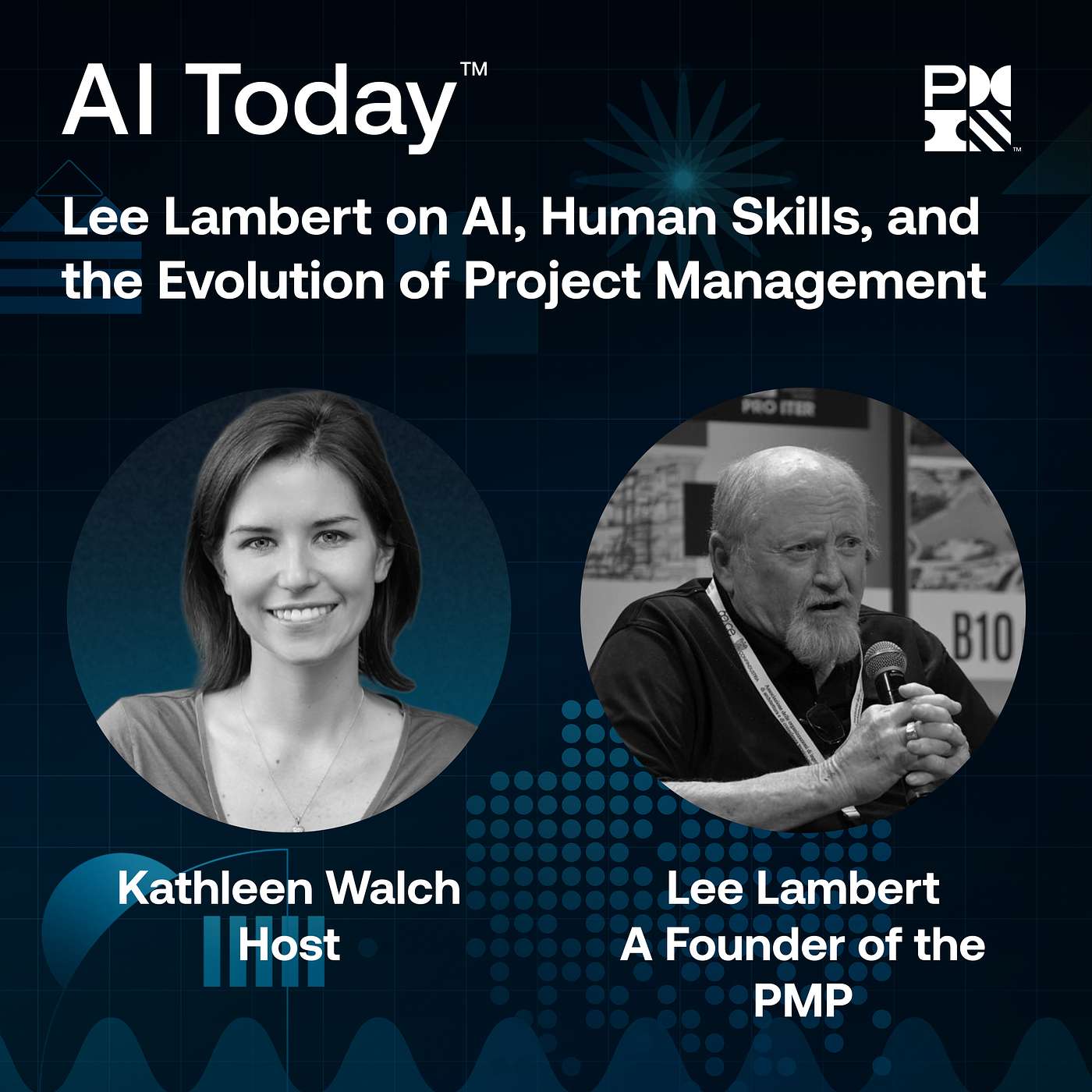
Lee Lambert on AI, Human Skills, and the Evolution of Project Management
22m 14s
The transcription features discussions from the AI Today podcast, now affiliated with PMI, exploring AI's role in project management. The interview with Lee Lambert delves into the history and evolution of PMI certification, highlighting the journey from its inception to becoming a recognized profession. Lambert also shares insights on AI's current and future impact on project management, emphasizing the need for human skills in conjunction with AI tools. The conversation underscores the importance of adapting to new technologies like AI while retaining critical thinking and soft skills to navigate the evolving landscape of project management successfully.
Transcription
4071 Words, 21738 Characters
>> The AI Today podcast, powered by the Project Management Institute, cuts through the AI hype to deliver you proven strategies, real-world examples, and actionable insights that drive AI project success. Tune in to learn from PMI hosts and guest experts. >> Hello and welcome to the AI Today podcast. I'm your host, Kathleen Mulch, and if this is your first time listening to AI Today Then Welcome and I'm so excited that you found the podcast. And if you've been here before, then welcome back. >> You may have noticed that we are now well into season 9, which I'm so excited about. And the AI Today podcast is now part of Project Management Institute PMI. So it's officially on PMI.org, which is super exciting. As we continue to integrate into the PMI, we'll be interviewing and engaging with various thought leaders, AI practitioners and project professionals to highlight both the AI transformation of project management and the project management of AI transformations. >> I'm so excited to be recording this podcast live at PMI's Global Summit 2025 event that's taking place in Phoenix, Arizona. And I am so excited to be interviewing somebody today, Lee Lambert, who is a founder of the PMP and a PMI fellow. So welcome, Lee, and thanks so much for joining us. >> Thank you, Kathleen. I've been looking forward to this for quite a while. I don't get a chance to talk live very often. So this is a special event for me as well. >> Oh, that's really wonderful. So for our listeners that may not be familiar with you, can you start by introducing yourself? Let this know maybe your project management journey. And especially I'm interested in hearing about being a founder of the PMP, how that all came about. >> I've been in project management 60 years. Been a PMI member for 48 years. I'm a past president of one of the chapters. And but I really struck gold with PMI in 1984, when I was invited to be one of five people to form this new certification thing. And of course at that time, nobody really knew what we were going to do. I get it a question all the time, did you anticipate the success? Are you kidding? We were lucky we got a few members. And so we've stayed with that. The original five have been involved almost from the beginning. And recently that some of them have passed. But the fact of the matter is we stayed true to what we wanted to do. We decided that if we're going to be a profession, that was the big issue of the day. The five original founders of PMI, that's what they were all about. They said, we are a professor, we're not a part time job or a profession. So they stayed true to that. And everything that we did said, to really be a profession, it turns out you have to have a certification program. So we interviewed other associations, and sure enough, they all had their own certification. So that's really what started it. And that was the driving force. It really wasn't about certification as an employment beneficiary. It was about proving we're a profession. We deserve to be recognized as a profession. And there was a lot of anti-settlement about that, but people began to realize we don't do project minimum spare time. It's a full-time job. And once people began to realize that, then they realized that, yeah, okay, I think the certification is a good idea. It was very slow, picking up, very, very slow. By 95, 10 years after we started, there were only like 6,000. But it was very slow, very slow to move. >> You know, and it's interesting too, because as a co-developer of the CPMI methodology, which is now certification and official gold standard certification at PMI, it is really interesting. And I feel like I can relate in many ways with this journey, right? Because guess what? We are just about nine years old, our certification. So it joined the PMI portfolio a year ago. And you can see that uptick, right? It's slow to adjust. >> Oh, absolutely. >> People behind it, even though AI is so incredibly high, we think about this was in 2018, which was well before large language models came into play. >> Well before. >> Well before, and so you had to build it from scratch. And so that's why we came up with the methodology, because customers were saying to us, okay, we want to run and manage an AI project. There must be a methodology we can follow. And there wasn't, which was shocking. And so I really can understand your entire evolution. >> That's the way it evolves, yeah? So digging deeper into this AI topic, as someone who did help create the PMP, and you got to really shape project management as a profession and get to see its evolution, right? And live it firsthand as well. How do you see AI influencing the fundamentals of project management over the next few years? >> Yeah, the impact has been minimal today, I think, I believe. But my position is this, I think in the next four to five years, it's going to change the landscape of project management. Because one of the difficulties we've always had is getting enough information in a timely way. And so now with the advent of AI, I mean, we can have the information we need to support decision making almost instantly. And that's going to change a lot of things. Back it off, it changes planning. The one area where I'm a little disappointed is risk management. It's going to make risk management what it should have been a long time ago. And so I see nothing but good. I was a little anti-AI in the Atlantic Conference. And then as I investigated, I thought, damn, I wish I had had this when I was actually managing projects. >> I know, it's game changing. >> Yeah, oh, big time game changing, yeah. And so as part of our portfolio, we do have CPMAI, our methodology for running and managing AI projects. However, I often get asked, well, how is the PMP going to change itself? And you know, went with the advent of AI, is AI going to be a part of it, is that expected? So do you think that the PMP itself will evolve in response to AI? And if so, what changes do you expect to see? I don't see any way around that. I think they're so integral to one another that to have a separate certification, for example. Doesn't make sense because the people that are certified PMP should have been using the AI concepts before they were available, while now they're available. And I don't think, I hope we, I don't want us to be a plethora of certifications. I really would like to see us pick a few and, like I was surprised when we announced a new advanced project management. I hadn't really been made aware of that. I'm interested in what that's going to look like. >> I know for everybody and it will be interesting. So what I find interesting too is CPMAI has been for project adjacent folks. So not folks that identify as a project manager, but folks that are running and managing AI projects. And so who is that? Well, that can be data scientists. That can be data engineers, the technology side. So I always like, I always bring up my husband and I tell him every time I do. So maybe he can listen and now actually hear how I say that. So he is a software engineer. He went to school for software engineering. This is what he does every day right. He identifies as a software engineer. But he runs and manages AI projects, right? And at least some capacity. So he would never call himself a project manager, but does that. And so I think that it's really important. Sometimes to have that differentiation, because I don't know that he would get a PMP. Actually, he probably never would get a PMP unless it's absolutely cold. >> No, probably not. >> Because that's not how he identifies to his core. But he would get CPMAI certified. And so I do like the separation of them. I do compliment, right? I always say it's ESN not an either or to the certification. So it's interesting to see how it will evolve over time. >> So the way I've always said is everything is a project. So everybody's a project manager, not a year title. But you do the things that project managers do. I've stayed with that constantly. I just don't think it's that big a difference. But it is different like software engineers. Certain things we would do differently. And so no, and I'm taking that class right now. >> I know. >> It's not easy. I got to admit. >> I do admit. >> Yeah, I know. For folks that don't know is going through the CPMAI training and certification. So before you know it, he can add that to his signature. So when it comes to project management, what aspects of the project managers role? Do you believe AI will enhance? And where will human judgments still remain that make it a replacement? >> Well, I think it's clear that it's going to enhance the timing and the quality of decision making. And I think that at the end of the day, that's still going to be a human that makes those decisions. If people can understand, AI is providing information, especially what it does. And then the human aspect says, well, now let's take that information we have and make a decision. We've gotten some information six months before we would have last year. And now we can make a decision. So when I do that, people say, well, now what am I going to do? And I say, well, how about doing some other innovative, creative work? If you're going to get extra time, you're not going to just sit there and relax. You're going to find something else to do. >> You know, I like that you say that because I always, people get afraid, especially project managers. And this is why I bring this up. So they get afraid that they're going to lose their job. And so sometimes in the media, it's being portrayed that AI is replacing jobs. Well, you have to dig one level deeper and go. Was that because they were a little bloated during the pandemic and now they're right-sizing? And AI is a really nice system to blame rather than admitting the fact that you- >> What they're doing is looking for something to blame. >> And that's exactly what they're doing. So when you think about, okay, what can AI do? And how can it alleviate some of the tasks that you do as a project manager, right? Meeting minutes, I mean, this is table stakes. Please, I hope everybody is doing it at this point. But then creating risk registers, sharders, right? No, also emails and communication. How do you tailor it to different stakeholders, right? How do you send out regular engagement without having to actually do this manually? This is a ton of time savings. And then you're right, well, what do you do with those additional time savings? And I say, I don't know, maybe your job, right? >> Your job, I love it. >> It's like, it actually gives you time to do your job. >> Yeah, right, right, that's good, I like that. All right, you know, I think it's hard for people to admit there's a better way to do things. Especially the older school, I mean, here I'm 80 years old. The older school is like, what I've learned is I have to evolve. I mean, I've gone through earned value, I've gone through agile, I've gone through AI. And if you don't adapt, I mean, that's our big model this year, adaptability. >> Adapt or die? >> Yeah, exactly, no, that's true. So these people talk about AI taking their job. Well, if you don't learn to embrace AI, you'll lose your job. >> Yeah. >> But it won't be AI's fault. It'll be you fault. >> [LAUGH] >> Yeah. >> But it's easy to blame AI. >> Yeah, exactly. I know, you know what I like, I like that you have that mindset too, because it's this idea of a lifelong learner, right? And so you can always continue to learn, and it really is an interesting journey. So when it comes to skills that project managers need, right? Because you've been able to see kind of the whole evolution. And I think that technology can change things, but then fundamentally there are skills that have stayed the same. Over the course of this life cycle, or this evolution of project management. So what skills should project managers start developing now to stay relevant in this AI driven era? >> I still think, in fact, even more so with AI, I think the human skills, the power skills are the key. If you don't know how to work with people, it doesn't matter how good your information is. So I'm really big on that, I think that, I mean, I love automation, I love machinery and all that. But at the end of the day, it's you and me that have to get things done. >> You know, it's interesting that you say that because soft skills, right? That's been a common theme that how do you bring in soft skills? And how are they, how and why are they so critically important? But now this comes down to changing the way that we teach. Because we don't always teach those soft skills. >> That's what we don't. >> And so we don't necessarily teach creativity, critical thinking. And I was actually talking with somebody else and she brought up confidence. I thought that was really interesting, that AI can make you more confident depending on the situation that you're in. >> Yeah, I agree. >> And so that was really interesting. And so now, if we know that soft skills are important, how do we teach that? And how do we continue to be that lifelong learner in these soft skills? >> Yeah, I've started to teach, I've got quick teaching, a long time ago. But I've started to do some workshops on the human skills. And people, it's kind of strange. They act like I'm telling them something that's innovative and, oh my god, I love, I mean, I've been doing this since in the 60s. And as people, I think we overemphasize tools and techniques, I really do. I think we've put so much emphasis on those that we've sort of left the power skills to the side. >> Yeah, so in what ways do you think that folks can maybe flex that power skill muscle? >> Well, they've got to do some in-depth thinking about how can I capitalize on a person's skill? That, just because you have a title doesn't mean you have a skill. And if you can identify those skills and then draw on those to create good things for projects, I think that's the answer, I just don't think we've emphasized enough. >> Yeah. >> There's great books out there, there's great books, there's great people that give these courses, but they're kind of in passing, they don't really take it seriously. >> Yeah, it's interesting, because in the AI today podcast series for listeners that want to go back, there's a whole little mini series that we did on the soft skills of AI. >> Oh, is that right? >> If there was, and so it's, and I write for Forbes too, and so I have Forbes articles on this. And so it's how do you use your soft skills to be better working with AI tools? How do AI tools help you be better with the soft skills? So if you think about communication, for example, how does writing a better prompt give you better results? That's where I would have gone first, the communication. People tell me, ask me, what's the most important power communication? No doubt about it, man. Yeah, no doubt. >> And so how do you use your communication skills to write better prompts to get better answers? But then how does, you know, Gen AI in particular, right? And a large language model help you be better with communication. So how does it help you engage with different stakeholders? How does it help you maybe write your email in a more friendly tone when you just came out of meeting your eye rate, and you don't want to be nasty, you know, send an ad program, and it can help, right? And so it's like, it's almost that pause that you need that goes, okay, help me do this. And if you're sending it to maybe an executive team, high level, right? High level bullet points. How do they like it versus you're sending it to somebody that's actively engaged on the project? Needs a lot of details. It's really easy now to tailor those skills. >> Well, I think the key to that is a person being willing to do self-assessment. But what are my strengths? What are my weaknesses? When AI first came on, I have a hundred thousand connections on LinkedIn. I write it three or four days sometimes, and I would write it myself. I was a sports writer in the Bay Area, and so I'd write it myself. I'm a conflict writer. And somebody, I wanted to say it was peer, but I'm not sure it was, said, are you using AI to do your posts? I said, no, I'm a writer, I don't need to use AI for it. And so he kept asking me, and finally about about a month ago, I was writing four posts. And I had written all four, I'm like, I always do, I was proud of them. And then I said, okay, now I'm going to try rewriting two of these. So I hit the rewriting 10 seconds, it took me a half hour to write it, 10 seconds, it's rewritten. And I looked, and I had to admit, it was way better than mine. It was way better, better word choice, better drama, better, it was terrible. I mean, I, and I had to admit it. So now what I do, because I didn't want to change my style, well now I'm learning to adapt your style as well. I do, if I do four, I'll do two with AI and two myself. So I want people to keep my, I need to keep my style. But I'll tell you, to me it was this, if it can do that for simple posts, what can it do with complex information? Yeah, no, I'm so, yeah. And I always say, keep the human in the loop, because you have to use your expertise at the end of the day. Especially when we complex information. Sure. Because as I said, my husband's a software engineer, right? So he's a coder at heart. And a lot of people do use AI to write code. It can make you so much more efficient. I'm sure. And move things along. But you do need to check that because it can introduce errors, right? And bugs and things that you don't want. And maybe go down a path that you shouldn't be going down. So that's why I always say, at the end of the day, keep the human in the loop. Yeah, I've been spending a lot of time. I do a human skills, AI and human skills. And spend a lot of time on problems. People really need to understand these large language models are dangerous. If you don't write the prompt correctly, you'll just get a bunch of stuff. And it's not, yeah. So this is where critical thinking soft skill comes into play. Exactly. So then that was what we share in the podcast. And so we say, OK, use your critical thinking skills, right? To help you use the tool better. But then use your critical thinking skills on the response. And does that make sense? Trust but verify, right? What's that? Is that an actual case, right? With case log? You get in a lot of trouble when you state cases that aren't actually real? Absolutely. Or was that, is this an actual link to an article? Click the link. Make sure it works. Sometimes it looks like it is, and then it actually isn't. Right? But it's an it's digging deeper. And it's like, is this the truth? Is this right? Right. And so that's why I say it's a trust but verify system. Well, that's where that bias thing comes in. You've got to really be careful. I know I have biases. And if I'm not careful, it'll find their way in. Yeah, right. I know. And now it just becomes like your confidence loop. Right. That's right. This is wonderful. And you're like, no, we're totally wrong. Yeah. Yeah. Makes all the sense in the world to me. Yeah. Oh, my gosh. Lee, this has been such a wonderful podcast. So as I said, podcasting for nine years. And I always ask my guests the same final question because they get to bring in their own unique experiences. And some get very philosophical. Some get very practical with this answer. So I'm excited to hear yours. As the final note, what do you believe the future of AI is in general? And it's application to organizations and beyond. I think it's in its infancy right now. I think it'll be a major player. And I think people are going to have to adapt to understand. It's not the same it used to be. We never had this kind of information before. I mean, when I was a GE, it take days to do something that now five minutes and stun. So I think people need to, they need to accept the fact that it's changing. If they don't accept it, they'll be looking for a job. Yeah. Really? I mean, you, I don't know how you could survive in a competitive world when somebody's using it and someone's not. I don't see how that's going to work. I know. So, but I still, even in addition to that, I think the human skills are going to be a big player in making that work. Yeah. I see. I love it. Everybody gives a different answer. And there is no right or wrong answer. No, no. I love that question so much. It's just your personal opinion and where you see things. Soft skills, human skills, right? Yep. And adapt or die, like we said. Yep. So, and it's that idea of a growth mindset, which I always think is so incredibly important, right? You, if neither have a growth mindset, you're a lifelong learner or a fixed mindset, that you don't need to learn that anymore. Yeah. And this is really going to get amplified with AI. Well, and that's, that's been a big buzzword mindset this year. I mean, it's everywhere. And that's the point you're trying to make. You've got to get out of that static mindset and get new, new world. Yeah. Yeah. No, I agree. So, I love this. This has been such a wonderful podcast lead. Thank you so much for joining me today. My pleasure. Thanks for listening to this episode of AI today. Please make sure to rate this podcast on Apple Podcasts, Spotify, or your favorite podcast platform. And if you want to lead both the AI transformation of project management and the project management of AI transformations, check out resources from the Project Management Institute, including the CPMAI certification, our various eLearning courses, and the PMI by AIBlog. Until you join us next time, keep innovating.
Podcast Summary
Key Points:
The AI Today podcast is now part of Project Management Institute (PMI), focusing on AI transformation and project management.
Interview with Lee Lambert, a founder of the PMP and a PMI fellow, discussing the history of PMI certification.
Discussion on AI's impact on project management, emphasizing the importance of human skills alongside AI tools.
Summary:
The transcription features discussions from the AI Today podcast, now affiliated with PMI, exploring AI's role in project management. The interview with Lee Lambert delves into the history and evolution of PMI certification, highlighting the journey from its inception to becoming a recognized profession. Lambert also shares insights on AI's current and future impact on project management, emphasizing the need for human skills in conjunction with AI tools.
The conversation underscores the importance of adapting to new technologies like AI while retaining critical thinking and soft skills to navigate the evolving landscape of project management successfully.
FAQs
The PMP certification was created by five individuals in 1984 to establish project management as a profession, emphasizing the importance of certification to be recognized as a profession.
AI is expected to significantly change project management by providing instant access to information for decision-making, improving planning processes, and enhancing risk management.
It is likely that the PMP certification will integrate AI concepts, as the skills are integral to project management. The focus may be on adapting existing certifications rather than creating new ones.
Human skills, also known as power skills, are crucial for project managers in the AI-driven era. Effective communication, critical thinking, creativity, and adaptability are key skills to develop.
Project managers can leverage AI tools for efficiency but should maintain a human-in-the-loop approach to ensure accuracy, critical thinking, and verification of AI-generated outputs.
Chat with AI
Loading...
Pro features
Go deeper with this episode
Unlock creator-grade tools that turn any transcript into show notes and subtitle files.
 PodcastTranscript AI