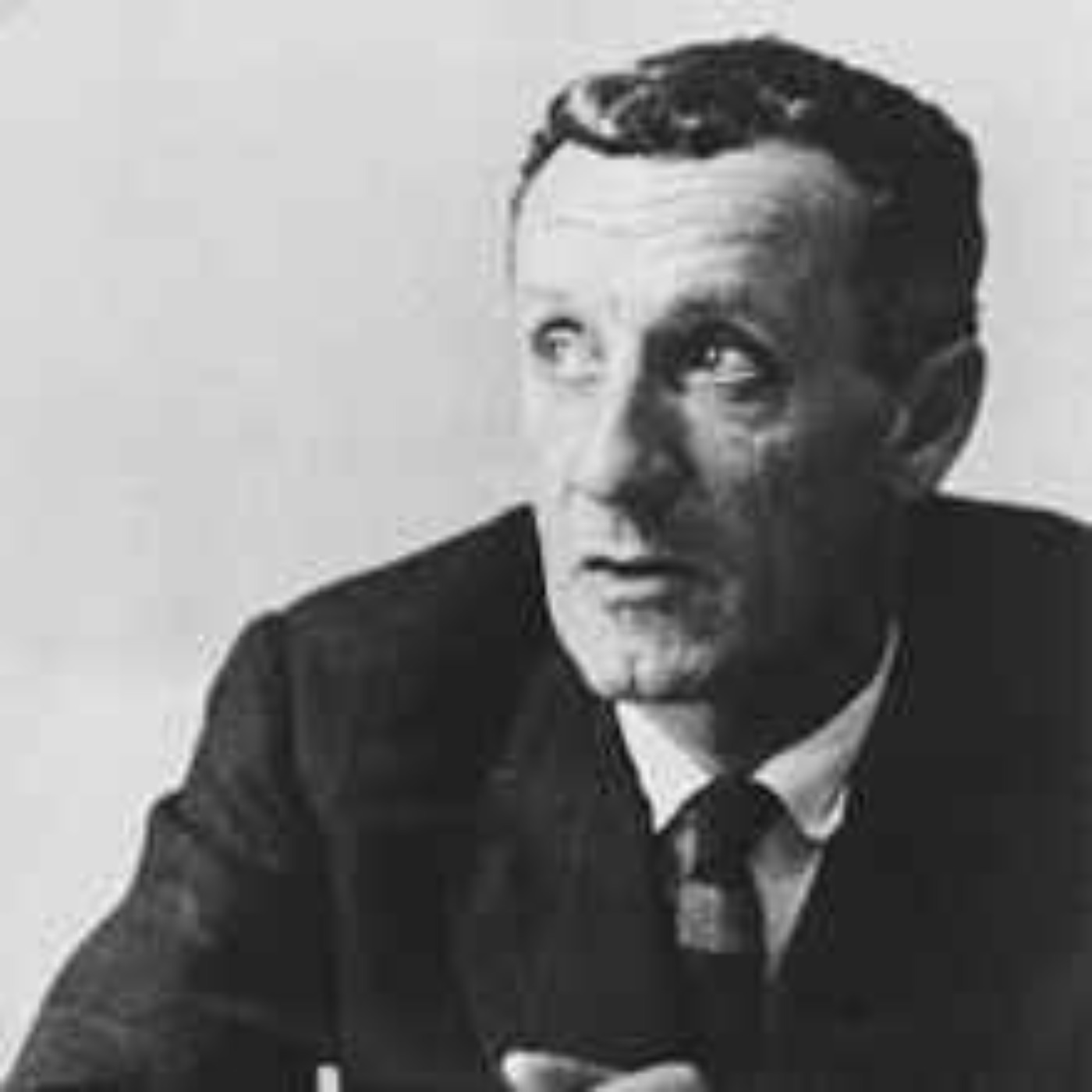
Lecture 12 – Merleau-Ponty, Space and the Sexual Body
27m 46s
In this lecture, Merleau-Ponty continues his phenomenology of perception by examining pathological cases to illuminate the nature of embodiment. He critiques the traditional distinction between objective and subjective space, arguing that our lived, corporeal space—shaped by movement and situation—is the foundation for any abstract conception of space. The case of Schneider, a World War I veteran with occipital brain damage, is central. Schneider can perform concrete tasks but cannot execute abstract movements or experience erotic situations. He lacks the ability to perceive situations as sexually meaningful, reducing sexuality to mechanical function. This shows that erotic perception is not merely psychological or physiological but requires an embodied intentionality that engages with the world in a flexible, reciprocal manner. Merleau-Ponty contrasts his view with Freud’s, agreeing that sexuality pervades existence but rejecting the idea that it can be reduced to unconscious drives or pathology. Instead, sexuality is a fundamental, contingent expression of our being-toward-the-world. The lecture concludes that psychic blindness demonstrates the failure of both empiricist and intellectualist accounts, which treat the body as an object or the mind as separate. True understanding requires recognizing the body as a situated, intentional subject that gives meaning to space, sexuality, and existence itself.
Hello, folks. Last week we looked at what Merlot Ponte had to say about the Phantom Lim, which offered insight into his broader strategy and phenomenology of perception. The Phantom Lim demonstrated how, either a solely psychological, aphysiological, expedient, or sufficient for explaining our lived embodiment. A coherent explanation of the Phantom Lim required a deeper ground for both physical and physiological facts. This ground was the body itself, viewed from its position as a peek towards the world, which is to say, as a lived and habituated body, rather than the body conceptually represented or empirically described. In phenomenology of perception, there are a number of pathological cases which Merlot Ponte examines. The Phantom Lim is one of the most significant. Another one, which we will look at this week, is the case of psychic blindness, which we will look specifically at in the context of Merlot Ponte's treatment of embodied sexuality. This lecture will begin with an account of what Merlot Ponte has to say about space. It is important to grasp what Merlot Ponte means by space, as that is important for understanding for Merlot Ponte at least that the body is not a neutral and disinterested thing, but something projecting itself into space, into situations. Once we grasp what Merlot Ponte means by space, then we can get a sense of how all situations operate. For example, we will be able to understand Merlot Ponte's distinction between objective space or corporeal space. This distinction is embodied to relief by a particular case study Merlot Ponte focuses on. That is Schneider. Schneider's illness provides a very instructive account as to how humans relate to a body space. In a second part of the lecture, I will explain how Merlot Ponte deploys the Schneider case to make explicit how an individual with brain injury came to have a restrictive subject-opt relation to the world. This will in turn enable me in the final section to explain what Merlot Ponte has to say about sexuality in general, erotic perception, and their significance for our understanding of a body but part one, objective space and corporeal space. The reason Merlot Ponte turns to pathological conditions is because they illuminate how the looks of the human being is not the mind per se, but rather it is an ambiguous bodily being. Physiological and psychological conditions can certainly coincide, but this is because the body itself instanciates their union. Now, conversely, the body could even very well be the instantiation of their dissolution. The main point, though, is that psyche and the physiological are from Merlot Ponte, theoretical abstractions abstracted out of our corporeal existence. Disentangling the theoretical from the concrete is one of the primary tasks of philosophy. Here Merlot Ponte repeats our established addiction between theory and furnaces, or theoretical knowledge and practical knowledge, but would Merlot Ponte pursue in the latter as primary, rather in secondary. This is important for Merlot Ponte, because to understand things in a concrete, contextual and situational way, we need to avoid reifying and constructing abstract theoretical edifices, and instead we need to follow Hoosterl by returning to the things themselves. But how do we talk about something like space without getting abstract? When Merlot Ponte talks about the spatiality of body, he asks us to think of bodily spaces to stick from object of space or corporeal space as to stick from object of space. By object of space, Merlot Ponte is really talking about space, which objects come to occupy. That is where they are located, are positioned. When we immediately into it or sit something about the external world, we perceive it as a form of object of space. This is here, that is there. Object of space is how I encounter things first and foremost as up and down, above and below, in front or behind each other. Put in the simplest terms possible, space is the way things are arranged in relation to each other. What is the end result, though, of this subjectivity? What if we move back to another stage of abstraction, say, two-dimensional space? Merlot Ponte argues that the objective determination of space, as a pure externality of points, is basically by-dimensional, are two-dimensional, not three-dimensional. So just length and breadth and not depth. However, as we saw, depth has existential significance for Merlot Ponte, and this puts Merlot Ponte at a distance from some of the key figures of the philosophical tradition. His recognition of space and depth overturns, for example, the Schubertly's idea that depth is not real, and ultimately is not even apprehensive of, or even lock a Newton who saw spaces existing independently of any sensible experience or measure. What Merlot Ponte is driving at is the idea that objective conceptions of thought diminish our understanding of perception. Against this, however, Merlot Ponte counterposes the existentially situated space of our corporeal experience. He argues that this existential space is the prior ontological ground of objective and euclidean space or geometrical space. This is the say that we cannot think of euclidean space without first thinking of depth. This view puts Merlot Ponte's similar to odds with the philosophical tradition. Or, nearly, we would think that the mathematical abstraction is more real or more accurate and a concrete corporeal experience. How does such an emphasis work for Merlot Ponte? First, he shows that the very terms in which we articulate spatial relations such as above, below are really not meaningful without embodied experience. The first important point that Merlot Ponte makes is that, like the being of the object, the being of the body is inseparable from its spatial givenness. For both Cartesian and Kantian philosophy or quite Merlot Ponte otherwise calls intellectualism, this spatiality of an object is already bound up with his being. For Day Cart objectivity is basically defined by extension. For Kant, space is in a priori form of intuition and that means that it is impossible for us to perceive, picture or imagine any object which is not given spatially. The existence of an object follows from and is complicated by the intrinsic and intelligible nature of space, therefore. For Merlot Ponte, on the contrary, beginning phenomenologically, from the existence of the body as it is given, we learn that in Merlot Ponte's words, space must be embedded in existence. That is, space and if our dioride, the space of our bodies is grasped situationally, not positionally. If we were to think of space in a geometrical way, objective space is defined by tree dimensionality, so lint, breadth and height and position. If we were Cartesian, we might make this even more abstract by defining space on a two-dimensional plane simply as points which are in extrinsic relation to each other. The trouble with this though is that there is no difference, a distance of two centimeters between two pines on a two-dimensional plane is utterly indifferent. Similarly, any given point is indistinguishable from any other. However, our bodies, as we well know, occupy tree-dimensional space. Depth thus has existential and situational significance. Depth reveals to me that I too am a thing, among other things, this still does sound pretty abstract though. There is also the problem that if we adopt a theoretical or geometrical model, it will make it seem that the contingent fact of our bodily being in space is not primary and obscures the supposedly true geometrical account of space. The opposite is true for mental Ponte. It is in fact the oriented space of our bodily being that has ontological priority. It is a body meant in space, which makes space itself at all intelligible. If you think about it, notions like up, down, under, over adjacent, besides in behind, are meaningless without the experience of being embodied. And a two-dimensional geometrical sense, these notions are abstractly conceived, and as such are utterly placed, our utterly situationalists. Once we get down to it, Malu Ponte's point is actually quite simple. The point is that only a being that can take up space is at all possible for that being to be able to perceive space. Consequently, the perception or immediate experience of space is instantiated through relation. One cannot experience physical objects in isolation. There is a difference in place between up, down, left, and right, in front, and behind, and so on. To perceive space is to perceive things in space, things in relation to me and themselves. The point
is that theoretical space is in some sense, how much an A is. At least if we restrict our analysis to geometry, if the space is how much an A is, it necessarily must be undifferentiated. Our bodies, though, are not undifferentiated in relation to the space as they inhabit. They are continually differentiating their relation to the world. Now, we might come up with all kinds of mathematical models, which do just that, as we can model space, even hold the meaning of lived and oriented space. This though can only be the case because the meaning of the model is derived from existential fact. We take up space in an active and differentiating way by active and differentiating, I mean, movement itself. And certainly, though, we might say, objectively, there is no bodily space without a tuition of abstract and universal space. From Meloponthi, this is not the case, as he says himself, and I quote, "Far from my body's being for me, "no more than a fragment of space, "there would be no space at all for me if I had no body." What happens when our perception of lived space breaks down? This is where Meloponthi turns to one of the major case studies in the phenomenology of perception that of psychic blindness. Part two, Schneider and the sexual body. To further enrich our understanding of both the spatial and motel body, Meloponthi turns to the case of Schneider, an injured wall-war-worn veteran. Schneider was injured by Schrapnall in the occipital low part of the brain. This is the part of the brain that has to do with visual processing and automatic motion. The reason Meloponthi sees the case of Schneider as valuable is because he exhibited a peculiar type of psychic blindness, specifically Schneider's blindness towards sexual situations. The overall purpose of Meloponthi's examination of this case is to help Schrapnall understanding of how the body is primordially lived, situated before being positioned or even positive. The case study of psychic blindness of the World War One Veteran Schneider, who was injured on the back of the head by a shell-spenter, was conducted by a neuropsychologist Ademir Gelben-Kartkostin. Their finding showed Schneider was able to perform concrete movements, although he nevertheless had great difficulty in performing abstract movements. For example, Schneider was implied in factory work manufacturing, letter wallets, and could perform to a reasonable standard, the practical task required for their production. However, when asked to point to a particular reach of his body, say his nose, Schneider had found this to be very difficult, a great challenge. So having to undertake laborious preparatory movements of his whole body whilst simultaneously making explicit perceptions of the whereabouts of his limbs, Schneider's case goes straight to the heart of Meloponthi's philosophy, as well as the discussion we had in the previous part about the distinction between object of space and lived corporeal space, the distinction between the abstract and the concrete, between the immediate practical task of everyday life, underlines the difference between the body as a means, and the body as an end. Put in a Kantian register, Meloponthi takes from Schneider's case the transcendental conditions for being in embodied being as such. Schneider's condition explains the difference between a being in itself and a being far itself. The far itself of embodiment is only intelligible as self-moving, or the body is intelligible only in a context of spatial relations, a patient that is unable to perform abstract movements no longer holds a capacity to organize, unify, inland meaning to the world since they have lost the capacity for a symbolic or representative function. As Meloponthi put it himself, and I quote, "If a being is consciousness, he must be nothing but a network of intentions. If he ceases to be definable in terms of the act of since-giving, he will absence into the condition of a thing." Indeed, the continued existence of Schneider's concrete movements can only be analysed in terms of there being merely deeply conditioned motor reflexes as movements in themselves. While Schneider suffered from a variety of perceptual and motor defects due to the brain trauma he experienced during the First World War, one of the symptoms Meloponthi focused particularly on was Schneider's inability to experience sexual feeling or arousal. Due to his occipital injury, Schneider could not be stimulated sexually by visual arousal. Parna-graphic images, for example, did not arousen in any way. Schneider, though, could be aroused in a mechanical way through direct touch. Schneider could be aroused albeit not in a particularly sustained way. There was an essential detachment to Schneider's sexual activity. It was as if he had become split between his subjectivity and the objective world. According to Meloponthi, what Schneider was lacking was a sense of the embodied situation. In sexual terms, his perception of sexuality was situationless. What this points to is that the erotic itself or sexual being is an embodied phenomena. While this might seem obvious, that is, it does not seem too profound to suggest sex and body. Meloponthi is more interested in showing real eroticism requiring situational dispositionality. Schneider had lost the capacity to perceive a situation in an erotic fashion. What does this mean, though? For Schneider's perspective, it meant that sexuality was reduced to function. You just conceived of sexuality in a mechanical and even in an abstract way. As in, it was related to this sexual function in relation to that specific tactile arousal. Furthermore, Schneider did not find different potential sexual partners, any more attractive than any other. He had lost the capacity, in other words, for lived embodied sexuality. So, beyond the incitement of sexual sensation and beyond any abstract psychological interpretation or representation of external sexual opportunities, Schneider, according to Meloponthi, did not have sexual situativeness available to him. For example, you could go on a date and perceive the immediate sensations of the person he was on the date with, but would not perceive say something like "fertation" or "playful amorous intrigue." This was because an erotic situation is essentially flexible, requiring reciprocity, dialectic, or a back and forth. Schneider would have to resort to abstract psychological representations or experiential sensations to find the situation arousing. Arotic perception, then, is thus not purely a psychic or large physical affair. Rather, erotic perception is embodied, actively adjusting to the encounter in and of itself. I suppose, rather tragically for Schneider, the world became purely theoretical, conceived only as effectively disinterested and neutral. Schneider does perceive what is going on in a very basic sense, but it has no effective horizon in terms of, say, possibility or sexual history. Problundedly, the world ceased to speak to him in an erotic way, part three, existential sexuality. Merloponti's account of sexuality does play some in contact with Friday and Psychonassus. While Merloponti does agree with Friday and some issues it does draw some rather different implications. Or it does agree with Friday is on the idea that sexuality is not as he puts it an autonomous cycle. What is important about Friday was the discovery of sexuality as a form of relations, dispositions and attitudes which had previously been held to reside in consciousness. Additionally, Merloponti thought that Friday was right to suggest that sex is not something that could be only in the sort of in terms of one's genitalia. The op-shot of psychoanalysis from Merloponti was that it does not make sexual psychology merely biological, or the byproduct of sets of instincts. Rather, psychoanalysis is valuable where it seeks to infuse existence with the question of sexuality. As embodied beings, we are sexual beings and this needs to be acknowledged if we do not wear at risk of carrying out a grossly inaccurate self-interpretation of ourselves. So, what Friday, Merloponti understands our embodied sexuality as fundamental to our being towards the world. Merloponti's words and I quote, "sexuality therefore ought not anymore than the body in general to be regarded as a fortuitous content of our experience. Existence has no fortuitous attributes, no content which is not contributed towards give it its form." While Friday showed that our unconscious sexuality via repression was a huge existential significance, Merloponti really takes this insight in different directions. In Merloponti, the unconscious is the anti-predicative. Our sexuality is taught of an existential sense, in a sense of deep subjectivity, if you like, entwined with the intentionality of the body and our habituated historical existence and narratives. The difference between Friday and Merloponti, I think resides in the fact that for Friday,
sexuality was pathological in some sense, at least minimally. For Meloponty our sexuality, even our sexual history is vital and necessary part of our lives because it is a projection of our being towards the world. It is perhaps question of emphasis. While Freud thought we only are our sexuality or that existence could be reduced to sexuality, Meloponty sees it as a fundamental expression of our active embodied existence. Sexuality belongs to our sphere of live signification. Phenomenologically, the erotic situation itself is only intelligible where it is charged with meaning and intention. As long as we discern meaning and intention are not the distinct possession or product of our consciousness alone. It is quite a radical thought that Meloponty is developing here and the character for example, sexuality would need to be restricted to our secondary animal life. In contrast, Meloponty is suggesting that what counts as normal sexuality is in fact not at all that normal. One sexuality is only meaningful because of its contingency, because of its worldly adaptability and because it is essentially always in question. This contingency of the world as it occurs, its situation, was precisely what was not available to Schneider. As Meloponty suggests normal sexuality is always a "mute and permanent" question. In a purely philosophical sense, what Schneider's case has shown to Meloponty is that psychic blindness is only explicable in terms of the loss of the middle term of body intentionality. In terms of rationalism or empiricism, Schneider can no longer perform abstract movements, does not have the ability to organize since the unity of the body are a "grast" meaning of the world. The enduring existence of Schneider's basic and concrete movements cannot be explained in purely rationalist or empirical terms. There, there can only be analyzed as deeply conditioned motor reflexes as movements in themselves. Psychic and physiological approaches cannot explain the fact. For example, that Schneider can smack his limb when bitten by a mosquito but could not point to the same spot when a doctor presses a ruler against it. The overall claims that if we conceive the psyche as independent of the body or the body is simply an object in the world just like any other, then we are on very shaky ground. It is quite clear Schneider does not lack mortality nor thought. His case though, those expose the limitations of rationalist and imperceptors to approaches to understanding the human being. In fact, they miss out on the very human being side of the equation. Meloponty does lead us to a recognition of the middle ground between, and I quote, "movement is a third person process and thought is a representation of movement." What Schneider lacks is the capacity for corporeal projection or to use Meloponty's important phrase "motor intentionality." This intentionality is an intentionality of the act and not of a consciousness as in the phenomenology of Husserl. And to quote Meloponty again, as has often been said, "it is the body which catches and comprehends movement." The cultivation of habit is indeed the grasping of a significance but it is the motor grasping of a motor significance. Schneider therefore lacks motor embodiment. It is the body then actively understanding itself and movement, space and habituation, which has the most impart and philosophical significance. The body understands significance and meaning, not as derived from a constituting consciousness but of a cognitive corporeality. Our live corporeality is neither a simple coordination of pre-existent data from the individual sense organs. Nar is a subsumed under a law in the imminence of a far itself. It is a nexus of living meanings, a living synthesis which arises in the action itself. If I reach over to put a tea bag in a cup, I do not make a comparison of representations of the position of my arm to my body in relation to the cup. Nar do I act in accordance with the positional intentions of a consciousness that would have the objects within the world, including the body, explicitly laid out before it. As Meloponty writes, and I quote again, "consciousness is in the forest place, nothing matter if I think, but if I can." To act is not to know and indeed, as any self-respecting philosopher will tell you, nothing is more difficult to grasp than exactly what I am doing. Meloponty has then reappropriate behavior in the body as the original thought of human agency. In conclusion, "For Meloponty Schneider's case provides clear evidence as how the body fundamentally relates to space. Schneider's illness stems from an inherent split in his subjectivity. In a way, look at the case now from a distance, Schneider presents a parody of the subject object distinction, and overcoming this distinction lies at the core of our capacity to understand the human being. For Meloponty, indeed, is a being in the world. Schneider does not have the unity of a guest-alte body image. It is only when we project our own body being into the world that we can see that objects take on meaning and significance and not as objects in themselves. As with Schneider's sexual dysfunctionality, we need to understand the human being in excess of our psychic content, our as an object among others. This understanding requires us to account for an intentional arc. The intentional arc is a unity of the sense desires intelligence, spatial sensibility, and motility. In addition, the intentional arc incorporates the sedimented traits, habits, and dispositions acquired from simply existing in the human milieu. Here, the intentional arc could be extended to include sexual, political, relational, ideological, or moral situations. Schneider's intentional arc was deflated, and thereby he had no ability to inhabit, retain, or project his motor intentionality into and with the world itself. The way of being of the embodied subject, the how it is in its existence, structures as being. So one will find that what one says about one aspect of the human being is echoed in another aspect, all of which are given an existential totality, all of which hold a common meaning or a common style of being. This, since the body is less like an object and more like a work of art, and here we perhaps can see Nietzsche's influence on how Merluponte constructs his notion of the body. Just as the artwork teaches us how to perceive it, by perceiving it, the body teaches us what is life, by living with it, by attending to the immediacy of the phenomenological giviness of the body. It is not that one arrives at an idea or scheme of the body piecemeal, experientially or bit by bit. My awareness of my body's position is not one that I accumulate or derive in additive or subtractive way, rather my body images totality. I know the whereabouts of my legs without looking, certainly do not have to explicitly coordinate my limbs like Schneider in order to move towards a certain goal. The importance of Schneider is that his diminished capacity for body projection reveals the absence of a power to perceive oneself situationally. That power is the source of all meaning for Merluponte, it is embodied power. It is even while we are free.
Podcast Summary
Key Points:
Merleau-Ponty uses pathological cases like the Phantom Limb and psychic blindness to argue that the body is a lived, habituated entity, not a mere object or abstraction.
He distinguishes between objective space (geometrical, positional) and corporeal space (situational, existential), arguing that the latter is ontologically prior.
The case of Schneider, a brain-injured veteran, illustrates the loss of abstract movement and erotic perception, revealing how embodied intentionality structures our relation to the world.
Merleau-Ponty critiques both empiricism and rationalism, showing that psychic blindness cannot be explained by purely physiological or psychological accounts.
Sexuality is not a biological instinct but an embodied, situational expression of existence, differing from Freud’s emphasis on pathology and reductionism.
Summary:
In this lecture, Merleau-Ponty continues his phenomenology of perception by examining pathological cases to illuminate the nature of embodiment. He critiques the traditional distinction between objective and subjective space, arguing that our lived, corporeal space—shaped by movement and situation—is the foundation for any abstract conception of space. The case of Schneider, a World War I veteran with occipital brain damage, is central.
Schneider can perform concrete tasks but cannot execute abstract movements or experience erotic situations. He lacks the ability to perceive situations as sexually meaningful, reducing sexuality to mechanical function. This shows that erotic perception is not merely psychological or physiological but requires an embodied intentionality that engages with the world in a flexible, reciprocal manner.
Merleau-Ponty contrasts his view with Freud’s, agreeing that sexuality pervades existence but rejecting the idea that it can be reduced to unconscious drives or pathology. Instead, sexuality is a fundamental, contingent expression of our being-toward-the-world. The lecture concludes that psychic blindness demonstrates the failure of both empiricist and intellectualist accounts, which treat the body as an object or the mind as separate.
True understanding requires recognizing the body as a situated, intentional subject that gives meaning to space, sexuality, and existence itself.
FAQs
Merleau-Ponty argues the Phantom Limb is not solely psychological or physiological, but requires understanding the body as a lived, habituated entity projecting into the world.
Objective space is a geometrical arrangement of objects, while corporeal space is the lived, situated space of the body, which has ontological priority.
Schneider, a brain-injured veteran, could perform concrete movements but not abstract ones, showing a loss of body intentionality and situational perception.
Schneider lacked embodied situationality; he could be aroused mechanically but not perceive erotic contexts like flirtation, reducing sexuality to function.
Merleau-Ponty agrees sexuality is fundamental to existence, but sees it as an active, embodied expression rather than a pathological or reductive force.
Depth has existential meaning, revealing the body's situatedness and overturning traditional views of space as purely geometric.
Chat with AI
Loading...
Pro features
Go deeper with this episode
Unlock creator-grade tools that turn any transcript into show notes and subtitle files.
 PodcastTranscript AI