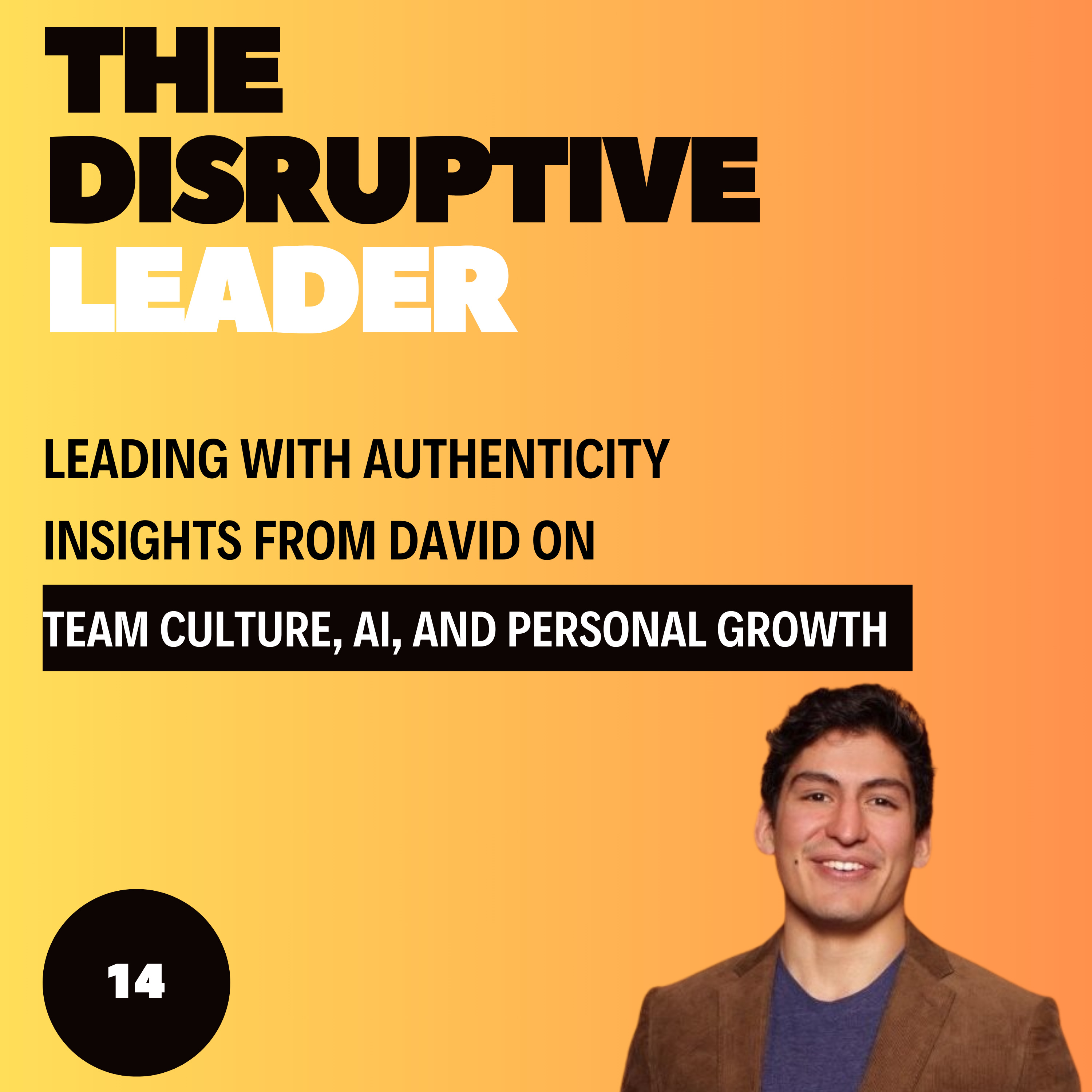
Leading with Authenticity: Insights from David on Team Culture, AI, and Personal Growth
from The Disruptive Leader
42m 20s
In this conversation, David shares his approach to productivity, leadership, and coaching. He makes Tuesdays "terrific" by starting later, using extra time for meditation or a hot shower. Meditation, a daily 10-minute practice, helps him stay present and focused amidst work pressures like annual planning and Q4 deals, as well as personal life events. As a leader who became a manager early, David emphasizes leading by example to shape culture. He demonstrates humility and teamwork through small acts, like fetching water for his team, which also creates moments for connection. In coaching, he distinguishes between skill deficits (addressed with targeted practice) and critical thinking (developed through reflective questions and experiments). For example, he helps reps understand the importance of next steps by using specific storytelling exercises. David also builds genuine human connections by learning about team members' personal interests, such as volleyball, cycling, or ballet, to genuinely root for them rather than manipulate. He believes this human-centric approach fosters mutual respect and enables him to give his best to his team. Ultimately, David focuses on authenticity, patience, and creating a culture where behaviors are lived, not just spoken.
(upbeat music) - Already. - Good morning, David. How are you today? - I'm doing very well, Ronny. I'm excited that it's Tuesday. I'm excited for this start of quarter. And yeah, just looking forward to the things that this month can bring. - I love it. I love it. Is it terrific Tuesday or terrible Tuesday? - So, let me just talk about this a second ago, but I like to make my Tuesday's terrific. And the way I make my Tuesday's terrific is I like to get a leader start on Tuesday. So my Monday, Wednesday, Thursday, Friday, usually I start, like an 830. But on Tuesday's, like, started nine. 'Cause Monday's you wanna hit the ground running. It's the start of the week. Friday, you wanna, you're excited for the end of the week. Thursday's like Friday, June year. Wednesday, you're like halfway there. But I feel like Tuesday has nothing to look for. Or two sometimes. So I like to do a later start on a Tuesday. So I can give Tuesday something to look forward to. - Okay. - A little say you want. - A little things. - Yeah, you found the positive every tiny little stuff. And what do you do with that extra half hour you get in the morning? - It depends. Some days I'll do extra sleep. Some days I will do a little bit of more longer meditation. Just to get some breathing done. I usually do workout most days up at 630. So take an extra hot shower. (laughing) - Okay. - I'm not one of these like cold shower people. I can't do that. I can't cold plunge. I like to think, care myself. So I enjoy just sitting under the hot water. - Oh yeah. - It's that. It's those little things. - A couple of follow up questions that come to my mind. You mentioned you do meditation in the morning. Is that like a daily practice? Is that something you do to set the bath of the day? - It's something that I started to do 'cause my wife got me into it. But it's usually like 10 minutes is usually what I do. Just 10 minutes. - That's a lot. - Yeah, like it's a neat thing to do just in between meetings every now and then. And like if you have a meal and we're like, "All right, this might drain me." Let me take a few, let me take 10 minutes to just breathe in. And I don't, YouTube has a bunch of guided meditation practices. They're 10 minutes long. So you put it on, close your eyes, do what that video tells you to do. And that's easy. Or sometimes I like to do the, and again, this is all to the power of YouTube. And they have four seconds in, six seconds out, timing meditations. So all you have to do is listen for the breath, for the breaths. So it makes it very easy to focus on your breath rather than thinking like, "What time is it? What am I supposed to do now?" The guided meditation is really to help. I think. - And what is meditation leaving you with or providing you with? What are you getting out of it? - I think it's focused. 'Cause I think at any given point in a day, there's a thousand and one things that could be happening. You know, we use a slack at HubSpot. And I'm notorious for one of the people that might take the longest to reply on slack. But I don't do that on purpose. It's just, I have other things I gotta do. Then there's email that comes in. And then we're at a part of the year. We're working on annual planning. And we're at a part of the year where we're working on deals. And we're trying to have the strongest quarter. 'Cause it's Q4, you wanna finish the year as strong as possible. So at any, oh, and then on top of that, like, my cousin's about to have a baby. So I have family, that's what's happening to me. So all these things just hit me. And I think of, if I have a bucket of water and water is my attention in the bucket, all these things just become like leaks in my bucket. So I have less energy, less attention, I'm less present. And curiously enough, I'm at my best when I'm my most present, when I'm my most patient. So I think about it like, if I know how to be at my best, I can do my best more consistently. And for me, meditation is a way to stay present 'cause that helps me be at my best. And then when faced with the challenge, the best version of David is better equipped to tackle that challenge than the worst version of David. So I try to put all those things in my favor 'cause then I can be at my best and get through the headaches a lot quicker. - I love that. And I was listening to our previous episode and for everyone listening, this episode number two could be our. - No much more to talk about 'cause David is wonderful, beautiful soul. - It reminds us to kind. - But curiously, talking about being present and I was listening to our previous podcast and there's a couple of things that I wanted to continue the conversation on. One of them was in leadership, like in our previous conversation, you were talking about having multicultural teams and how you lead multicultural teams and giving back and all of this. Talk to me a little bit about leading by example. - I read and this is at the start of my leadership career. So I again, going back to our previous podcast and if you haven't listened to it, it's I'll catch you up quickly. I became a leader very quickly in my career. I was 24, 25 when I first got promoted. So for me, there was a lot and there still is a lot of imposter syndrome of. And since these guys don't know how they made a mistake, I'm not the guy. So I think that actually helped me and I've realized as I've gone older, I'm a pretty anxious person. When that anxiety can either be your enemy or it can be the friend that's next to you to be like, "Hey, you're feeling me, pay attention, don't just ignore it, but there's something here that the universe is trying to tell you something." So for me, that fear, that anxiety turned into, okay, I need to level up as quickly as possible. I need to become the best leader. It can be as quickly as possible. And then I started trying to think who are some leaders that I might want to learn from who are like the thought leaders in the field. And I realized when I'm leading a team that is older than me that has more career experience, I can't be the one that says, "Do this because I'm the boss." I can't be that person that's not who I am and that's so inauthentic to me. And I think in leadership authenticity really matters. So I gravitated towards the types of writings that were more, how do I want to be led? And that's where Simon Seneck's "Eaters Eat Last" really resonated with me. So when you ask me about the importance or to me, what it means to lead by example, I think a lot about the principles of that book and the idea of there's behaviors that create culture. And if I want my culture to be one of humility, of my humility, sorry, humbleness, I'm thinking it's fancy. If I want my culture to be humble, if I want my culture to be hardworking, I also want to disarmament of, we stay humble, but we hustle hard, but we stay humble, but we hustle hard. We want to hit the targets, but we also want to get recognized. We're not all that in a bag of chips. Then the behavior that I demonstrate on a day-to-day basis needs to echo that. So one of the things that I started doing with my team, I drink a lot of water during the day. I also read an article from NPR that said that if you are hydrated, you think faster than if you're not hydrated. So it made sense to me. I talk for a living, I think for a living, and it just stay hydrated. So I started to go get water for myself and I realized, oh, if I have it in me to be thirsty, chances are the people next to me are also thirsty. So then I made it a habit to every time I got to go get water, say, hey, who needs water? And that was my way to showcase humbleness, but there's an element of team, we're in this together. So you would see me in the office walking back with eight cups of water or jugs or water bottles or whatever, and I would be walking back in every person. And that also became a moment of view when I'm checking with every individual, how are you doing? Who is it? Do you have a challenge right now? What's going on? Let's talk through it. You're worried about making some cool calls. I'm right there with you. I get butterflies too, but you know what? I have it in me to be brave. So do you. I'll make this next call. And it turned into rather than saying why aren't you doing the thing? It turned into how can I make it so that barrier of entry for you to do that thing seems smaller, seems less daunting? I think there's really neat parallel with when you watch someone cook on YouTube. And you're seeing them break down. You're like, this is so easy. I can do that too. That's my first thought. I can do poach stags. Just do the thing in the water. You're easy. And seeing someone do it makes it so much more attainable. So I wanted to copy that spirit. So for me, leading by example, really does mean me showing up on my best, because if I'm showing up on my best, if I'm patient with you, if I'm actively listening to you, then I expect you to do that with me, but I also expect you to do that with every customer and every prospect you talk to, because that's just how we do the things we do. If I don't have an ego, and we have our biggest months, and I'm not talking crap about everybody else or the market or the competitor, then I'm expecting the exact same thing from you. I need you to recognize that big wind happened, but let's break it down. Let's make it a habit. Let's make it a process. Don't just go, oh, everything I touch turns into gold because I'm so good. That's not gonna help anybody. I've never done that. I can't have you doing that yourself. When I think about patients, I think it's natural. We interact with people, and every person's a little different. And of course, we're gonna get frustrated.
But if I'm frustrated with you, then you take that away as it's okay for me to be frustrated with other people. That's not how we operate. That's not helpful for anybody. So not to say I do as 100% at a time, because I'm a person, 200, human too. But I look to actively be at my best, I look to be patient as much as I can. Because if I can show those behaviors in real time, then it's a lot easier for everyone else to be like, okay, that's what David expects from me. If he hasn't in him to do that, so do I. And that's how culture becomes something that is not just spoken about, but something that becomes lived. Because I think it's a lot easier to say things, and that just becomes a noise. We want to do the things, and that's where culture really happens. So yeah, I think leading by example means think about the behaviors. And think about what you want your teens to replicate. And that's where if you're on a Zoom call, like now we're all a lot remote. I like my team to see my hands when I'm speaking, because I need them to know like I'm focused here. And I might do the like I'll play around with what I do in my hands, but it's important for me to communicate to you that I'm present with you. That's the little things. It's the little things I agree. I'm not going to do that. Typically they somehow get punished for asking so many questions, although it's too wonderful soft skills. And then you mentioned coaching. How do you coach your team or like what strategies or how often or how do you how are you approaching that? I think first thing is again I'm not a guru. I am someone who likes to learn a lot. So at every stage of my career I've gotten coached by someone who is far better than me at it. So when I was sales rep, shout out Ricker version Carol Mahoney, like they coached me on how to become a better sales rep. But I became manager realist. Oh, I don't know how to coach. I hired them again. As in the director now, I've been gone coach by this gentleman named Torre Hidaldo and David Shepherd, like incredible executive coaches. And what they do is give you perspective that you didn't previously have. And I see that as something incredible, valuable because if you're looking at the world through your own narrow point of view, then that's your own narrow point of view. When you ask someone for their world view, your view gets expanded. And now you can look at more possibilities. So now we go back to coaching. When I think about coaching, I like to understand is what am I coaching? Am I coaching a skilled deficit? Or am I coaching thought development and critical thinking? Because if there's a missing skill set, you got to teach that skill set, you got to play around with that skill set, and you got to elevate that skill set. So that might turn into Rania, we got to talk through CRM usage and the activity that I have for you, I know we're going to do a CRM scam, because I want to see where you're at. So I can help you think about the difference between prioritizing and yeah, so that's a skill set that I want you to have that you might not have already. When I'm thinking about that critical thinking component, that's where as a coach or as a leader, I do my best work by saying, how come let's walk through that? So I have an idea because I notice activities on okay, where did that come from? I came from the support. Cool. What do you think might be leading to that? I don't know. Well, let's think about it. And now it turns into a thought experiment where I think you do your best work as a leader by creating moments of reflection in other people. I might have this individual who's that saw this rap is really bad at putting up next steps. I'm like, all right, well, if I say, you're right, they need to do next steps, you know it. I know it. Now we're good. What am I getting the way? What am I getting in the way? Because clearly, like the person that says they know that the next steps are important. So let's assume that they know that. What might be holding them back? They don't recognize the importance of being action oriented within the next 48 hours. Cool. So let's, here's an interesting game to play. If I say, tell me a story, Rania, I just can leave you open ended. It's going to take you roughly 30 seconds to come up with a story. But if I say, tell me a story when you are frustrated by the drums, it's going to take you seven seconds, five seconds to tell me a story. So you do that experiment with the rep. And now that rep is in a position where they recognize, oh, because you were specific I was far more action oriented. Like cool. Now how does that apply to sales? So that turns into a woman of reflection for the manager, a woman of reflection for the rep, and then I coach the little skill set in the grand scheme of how do we help this individual recognize the importance of next steps. I think that's really important to keep an open mind and to think about ways to demystify the job. Because sales can be so ambiguous, it can be so up in the air. So when you find opportunities to make it feel concrete, take them because that's how you take skill set and rather than speaking about it or looking out in the slide deck becomes action oriented. Yeah. And the more actionable is the, I don't want to say the quicker, but the more realistic or even to actually apply it. Yeah, that makes a lot of sense. And David, we we spoke on our last episode briefly about the importance of learning new things. And so you mentioned learning the guitar. I mentioned learning the drums. Do you also encourage that with your team apart from coaching them on skills and skillsets and actionable things that are non-work relatable, but actually do impact work? I have it. But I ought to. I'm going to be cool. Like everyone trying to learn new skill set that you previously didn't have. And let's talk about it in a few months. That's a good idea. I'm going to take that from this on. I haven't run you. But I do know, I think in the end, this is where I'm lucky. I tend to know what my teams care about. So for example, general, my team's really into volleyball. So I try to look up like volleyball plays, so I can understand like the person's perspective or another team of the mind is really into cycling. So I try to get a sense of how does that work? What's the athleticism behind it? What might be difficult or easy? Another team of the mind is super into ballet. Right? I'm like, oh, Jesus, I need to evolve the way I think about ballet because these people are freaking athletes. The muscular and the strength of stability. That's incredible. So it's something where I think I'm able to understand that they care about something outside of work. And I like to double down on that. But I've never made it a conscious effort. And so the reason I was asking that is I'm trying to figure out or understand or prove as a good leader. Where do you like, where does the crossover between work and personal sort of, where is that crossover? So for example, someone in your team like ballet, so you're going to try and understand a little bit more about ballet and the skill and the muscle and everything that goes towards that. But where do you draw the line between my role as a leader stops here? And doesn't spill into the personal. It's that makes any sense. Yeah. Because I'll flip it a different way. I think again, we go back to the importance of being genuine. Because I don't ever want to be manipulative. I don't ever want to know about somebody so I can then take that into no, like that's just a nice hat thing to do, you know, like I don't want to be that person. But I do think every person is so there's a there's a gallon on one of my teams that this woman and she like started really doubling down and running marathons and she has a target and task. And like I actively want to root for her. Right. So I want to ask how her like training is going not because I want to build like funny rapport, but because I think it's incredible that you're willing to run a marathon. Like I run 5K and I'm exhausted and I hated it. I'm like, why would I want to do this to myself? To find someone that's willing to run 26 miles, like who knows to you? Let's talk about the mindset that goes behind that because that is incredible thing that you have that I don't that I think is incredibly neat to learn about. If we're going back to that theory of find reasons to root for people, that's where I want to learn about your personal life, not because I want to manipulate you, but because I think it's individual. It's cool to root for you. You had Jose on this podcast earlier in Mauricio. One of the things I was appreciate about like Jose was the genuine love that he had for his kids. And when Jose talks about his kids, his face lights up. I'm like, that's so cool, man. That is so cool that you can do that. And I want to feel as excited about something as you do about your kids. Like I want to and that's what I think learning about the personal side of the thing isn't to get more from the person, but I think it's to establish a more human connection and find a reason why you are willing to give this person your very best. But like Mauricio, he's so hard working just because of the way he was brought up. And I find it incredible to learn about how him and I are both Colombian, but our life experiences so different. And yet this person within his life experience, he has it in him. This like 5 6 7th gear. So my me learning about his life, it's not so I can be like, let me manipulate him to getting more revenue, but it turns until dude, I want to root for you. And I want to know that when I'm exhausted on a Tuesday morning and you and our meeting, you deserve my very best because I know this about you. So me learning about you is less about me trying to get more from you and more about me giving you more of me. That's the way I think. Yes. Yes. And then I love that you use the term sort of human centric, genuine human connection because that is what it boils down to. It's we're all in the martyck industry, we're all in the CRM industry, we're all selling, managing and so on and so forth. But at the end of the day, especially what I'm finding is more so in a remote environment, without that genuine human connection, what's between us here as screen? Yeah. And then to establish and build that human connection, I think it takes a little bit more than just staying in that bubble and realm of my relationship as I am your leader at work. Because to be successful at work, there's the whole other side of the coin, which is my home and my activities and my sleep and my nutrition and my, I'll be there. And so that's why I was wondering.
Where does that spillover sort of start and end when building that human connection? I think there's definitely things where I'm not looking at prying to your private life. Like I'm not looking to get a sense of like, I don't need to know if like you and your husband or you and your spouse are fighting. I don't need to know that. That's very much your business. That said, if you are going through something and this is where I really do think that idea for me life is for the romantic. I think there's something really nice about rooting for individuals and wanting the absolute best for them. And it's almost like a movie character. Like you get more invested in the movie character when you've learned about that person's life. Like when you've seen like the struggles they gone through like that's where when they get that big win in the movie, you're like, let's go because you saw their development. You saw what it meant to them. So I think when you learn about people again, it goes back to be genuine because you're not doing this or in my opinion in my perspective, you're not doing this to manipulate anybody. I think it's about doing it where you can root for them and be genuinely ecstatic for those individuals when they achieve things that they didn't think possible or that they were. Don't you think they were daunted by or they found scary to do not because you're going to win to you, but because independent of you that life matters. And I think there's something that makes life more interesting if you can like jump in both feet into deep into the pool and really root for that individual. Yeah. Yeah. So you lead a team that you've been leading teams since you were very young and suddenly now there is this new not so new anymore thing called AI. That's like, changing everything. How are you how are you introducing it to your team? How are you managing? Are you trying to get people in your team that have a resistance to you the AI? Let's start with the following and I'm going to be real vulnerable. Brian, I was so freaked out by AI. Part of me still is I saw a terminator one, two and three. Like I saw those movies. I saw some workouts. Like I saw these movies. I think as people go, I'm hesitant as I, hey, man, I get it. I'm that person there. So when there's resistance to it, I understand why there's resistance to it. I'm not going to say you need to be doing because I get it. I think everyone's under on journey type of thing. That said, you cannot deny me the efficiency gains that you get. Like I have an exercise that I do every half year, which is skip levels where I like to meet one and one with not just my managers, but with every individual person that ultimately is in my life. Ultimately is in my work. And I want to give you an hour of time, not half an hour. I want to do an hour because again, I want to find reasons to root for you. And I want you to tell me about what's going on and you don't have to tell me everything in your personal life, but I want your perspective on things. And I want to ask you hard question. I want to take a lot of notes. It's all anonymous, but I need to have the notes. So can you imagine trying to find patterns. 35. You know, you can't, it's hard. And they're not, I'm not asking ABCD questions. I'm asking open ended questions because I want your genuine opinion. So that's for me using AI has been incredibly helpful because it's the ability to say, hey, can you help me consolidate these notes into like certain themes and patterns. And then I was like, here you go. Thank you. So my human connection is still there. AI is not managing on my behalf, but I'm using AI to get a better sense of how I can help my teams. So this is where I think the evolution of what it's mystical and what it can be that's scary and daunting versus the application we give it. Like meets, right? Like it's scary to think I'm being managed by AI. I'm a person. I don't want code telling me what to do with my life. That said, as a person, I can do better in my job. If taking 35. Individual interviews and not having to codify them one by one. By one, losing a month and a half worth of time can just be done within a 30 second script run that AI can do for me. So that's where I started to react. And then that's build it over into, okay, how would I do it if I was a rep? Let me see if AI does help me research the camera a little bit quicker. And then you see like the chat spot. Or the agent that our mission is launching like, yes, that does help me do my job a little more efficiently. So I think it's a lot about how can we reduce the fear by not necessarily thinking about AI as this huge daunting thing that's going to replace all of us. But rather looking at it as what do I dislike about my job today that's a pain in the butt today. And what would it look like if someone did that thinking in parallel to me, not for me, but in parallel to me. Because I'm the one prompting AI with what I wanted to do. It's not just going to be like done like you need to give it the prompt. And that's where I found that bridge. So if you're like me and you also saw a terminator one, two and three. And you're worried about sky net. And what happens when I decide oh, humans are the problems. Let me just destroy the mall. Recognize that was a movie and recognize that there's an opportunity for you to do your job better more efficiently. And that doesn't mean that you remove the humanity. Yeah. So it's more like finding the application. It's like adopting the CRM. Yeah, moving from itself to CRM. Now it's like moving from the human to. Okay, I will allow this creepy robot coming and do stuff for me and trust it that it will murder me and. And it can be as simple as I took all these notes, but now I have to go back through them and forget exactly what might have been the one. So yeah, can you help me find patterns in these notes? Done. Right. And it's like little things like that where. Say, please, and thank you again of the robots. You want to be one of the ones that was polite. Which I find myself doing right now. I don't know if you do this to you, but whenever I am prompting, I'm like, please help me. Thank you very like I don't know why, but I naturally default into. Please and thank you. Anyway, that's so nice. I am worried about what they do when they take over. But I digress. I think it comes back to that finding places where you have a little bit of a disgna take extra work for me to do. Is there where to get that a little bit smoother with AI? Yeah, that's that's very I love that. And be polite and kind to the robot anyway. Okay, and my last question, keep in track of time, because I don't want to take extra of your time, because I know that time is very valuable. If you could go back five, 10 years and do one thing differently, what would it have been and why? I could go back in time five years, so it's 19 or it's 2019. It could be seven years and have to be five could be seven six. If you could just rewind a little and do something differently. If anything, maybe there's. No, I, I try not to think about like regrets too much, because that's how you get to where you are. But if I could do things a little bit easy, if I could go back in time, I think my messaging around how to tackle a tough month or a tough year would evolve. You think that the default to be like team is going to be a tough year. Let's go. Like the entire world of tech is hard right now, but it took me a while. And this is again, the perspective, you know what here it is. I would have gone executive coached way earlier. I would have gone that rather than doing that this year, I was on that two years ago. When I first got a job. Because I think that perspective is so important, the things that you don't know, like the perspective of you haven't been through it. Why wait till you have the headaches and you get the grades when you can learn from someone who already has them and they can download that experience into your brain. So I would have done that a lot earlier that that's an easy answer. But I think. I said it earlier and I got this from one of my coaches, they've shepherd that idea of what if X isn't the root cause, but rather the symptom. And I think opening the dialogue with that raise creates invites more curiosity. And I think sometimes as a leader, you want to have the answers because you feel the pressure of being right. And sometimes that distracts away from what it'll actually bring the answer. So if you approach it with I've analyzed, I've got all the data here. You go folks. It turns into David did now we got to do. Whereas if I say, Hey, what if that X root isn't the problem, but rather a symptom, I have these theories. What do you all think? What do you think it invites a more productive dialogue and you get to bulletproof your idea further. I wish I would have gone that phrase again earlier a few years back, not to say I did a poor job, but I could have done such a better job. And we could be a team with far more experience, but also that's could have what it should have. So let's not worry about that. that we're here today.
Let's do the best that we have today. And then I was asking that not just not to take the path of regrets or could have would have showed up a bit more by asking these type of questions to thought leaders like yourselves for the listeners. Maybe there's a listener that could be like aha. Maybe I should go find my coach now. I think it's I think it's a way of inspiring. Yes, all right. So I'll take that and I'll say I should I would go back and I would get coached way earlier. I think there's a lot of value in doing it sooner and earlier. Like you don't need to skin your kneegee for your realize that you need help. Yeah. Oh, wow. Yeah. That's a great statement. It's quite common to asking for help can be like a. Oh, it can bring up the insecurities in us, right? Like when you feel like you're at a deficit and you're drowning like asking for help can feel like validation of all God, I do suck at this job. And like that hurts and I'm someone who loves what I do and I want to do my best at it. So yeah, it's a bit of a like I said last time I spoke like I do have an ego. I try to keep it in check, but I do have an ego. And yeah, like it sucks to feel like you're less than that said, there's also a world where the headaches get minimal. You have more inspiration as you tackle you today. You avoid the burnout. If you just admit yourself, hey, it's not that I'm going to suck at this forever. It's that I need a little. Yeah. Yeah. Awesome. Love that. Brilliant. Thank you, David, for this wonderful conversation on terrific Tuesday. I hope you have enjoyed this. This is what you love. I did enjoy this and I hope you're thinking me right now. Really pretty. Oh, of course, it's my absolute pleasure. And it's been really sort of hard and soulwarming to reconnect with you because you were vividly in our survival. I'll just put it that way. And then life sent us all over the place. And here we are having another great conversation. So thank you always and forever. Have a beautiful day. Share the recording with me. We'll do. Yeah. And keep being
Podcast Summary
Key Points:
David makes his Tuesdays "terrific" by starting later (9 a.m.) to give the day something to look forward to, using the extra time for sleep, meditation, or a hot shower.
He practices daily 10-minute guided meditation (via YouTube) to stay present, which helps him focus and be his best self amid work and personal distractions.
Leading by example means demonstrating desired behaviors (e.g., humility, teamwork) through small actions like fetching water for his team, fostering a lived culture.
Coaching involves distinguishing between skill deficits (taught through practice) and critical thinking (developed through reflective questions and experiments).
David learns about team members' personal interests (e.g., volleyball, ballet, marathons) to build genuine human connection and root for them, not to manipulate.
Summary:
In this conversation, David shares his approach to productivity, leadership, and coaching. He makes Tuesdays "terrific" by starting later, using extra time for meditation or a hot shower. Meditation, a daily 10-minute practice, helps him stay present and focused amidst work pressures like annual planning and Q4 deals, as well as personal life events.
As a leader who became a manager early, David emphasizes leading by example to shape culture. He demonstrates humility and teamwork through small acts, like fetching water for his team, which also creates moments for connection. In coaching, he distinguishes between skill deficits (addressed with targeted practice) and critical thinking (developed through reflective questions and experiments).
For example, he helps reps understand the importance of next steps by using specific storytelling exercises. David also builds genuine human connections by learning about team members' personal interests, such as volleyball, cycling, or ballet, to genuinely root for them rather than manipulate. He believes this human-centric approach fosters mutual respect and enables him to give his best to his team.
Ultimately, David focuses on authenticity, patience, and creating a culture where behaviors are lived, not just spoken.
FAQs
David starts his Tuesdays later than other days, usually at 9 a.m., to give Tuesday something to look forward to, using the extra time for sleep or longer meditation.
David does 10-minute guided meditations from YouTube, focusing on breathing exercises like 4 seconds in and 6 seconds out, to stay present and focused.
Meditation helps David stay present and focused, reducing distractions from work, family, and other demands, so he can be his best self and handle challenges more effectively.
David leads by example by demonstrating behaviors like humility and teamwork, such as getting water for his team, to create a culture where actions match values.
David distinguishes between coaching skill deficits and critical thinking, using reflection and concrete experiments to help reps improve, like exploring why next steps are missed.
David learns about his team's personal interests, like volleyball or ballet, to build genuine human connection and root for them, rather than to manipulate.
Chat with AI
Loading...
Pro features
Go deeper with this episode
Unlock creator-grade tools that turn any transcript into show notes and subtitle files.
 PodcastTranscript AI