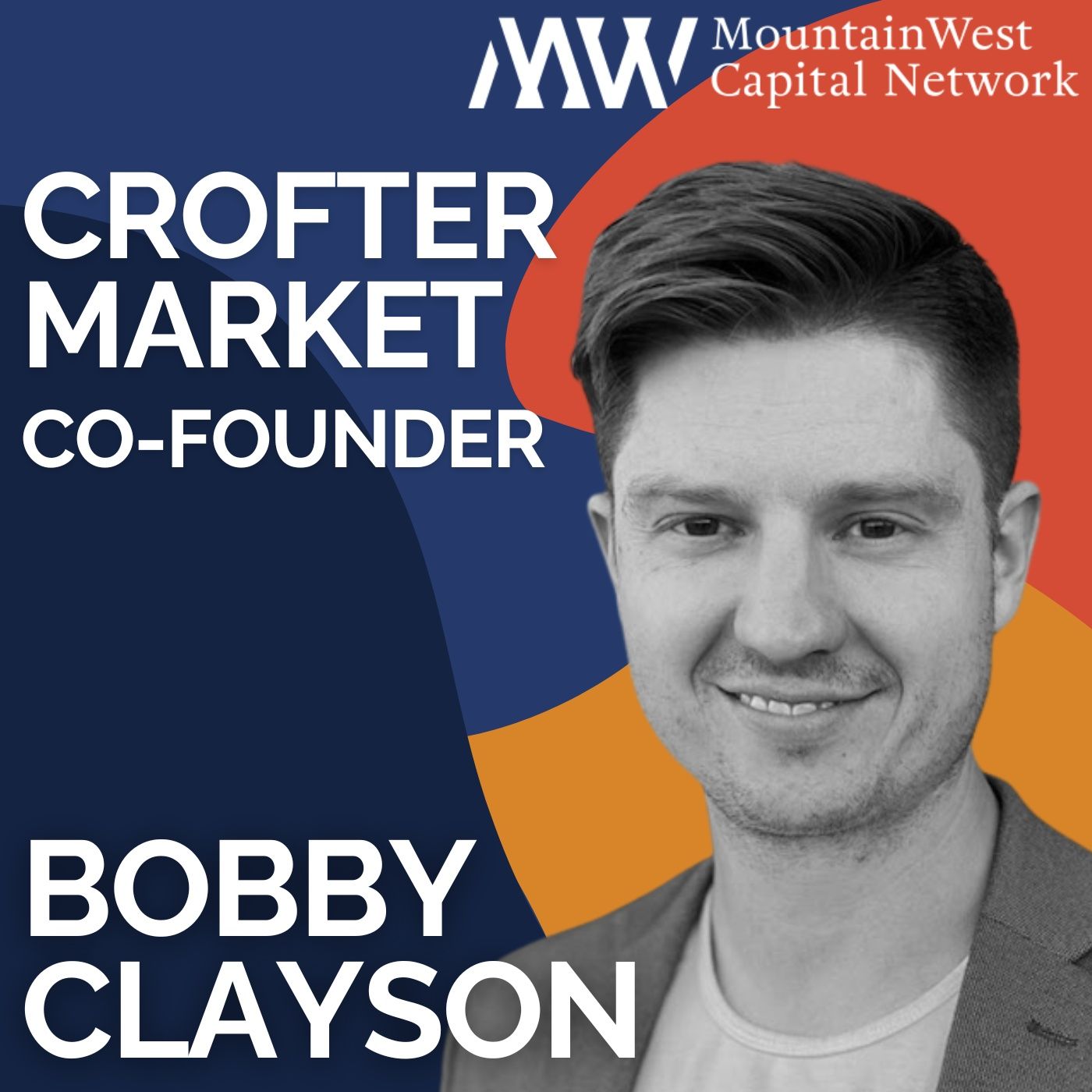
Leading Through Hypergrowth to Reinvention | Crofter Market with Bobby Clayson
54m 39s
In this podcast interview, entrepreneur Bobby Clayson discusses his journey co-founding Taxbit, a cryptocurrency tax compliance company that became a Utah unicorn. He explains how his early expertise in blockchain led to the company's creation after the IRS clarified crypto tax rules, highlighting the collaborative founding team with backgrounds in crypto, tax law, and accounting. Clayson credits Utah's unique pioneer heritage—combining a collective, cooperative culture with strong execution—as a key driver for the state's outsized entrepreneurial success. He details Taxbit's strategic pivot from consumer to enterprise, emphasizing a method of taking small, validated steps to navigate uncertainty rather than gambling on untested directions. Now leading Croft Your Market, Clayson is tackling food system vulnerabilities, inspired by pandemic-era supply chain disruptions and a personal shift toward sustainable food production. Throughout, he stresses respecting different professional disciplines and balancing agility with decisive, incremental progress.
[MUSIC] If you dive into anybody's discipline, you understand that it's deeper and more important. And I think we started with a deep respect for each other's disciplines and expertise. So how do you not fall into either of these two traps? How do you become agile but keep moving in the right direction and stay focused? And so that was a massive turning point for me in particular about learning to recognize physiologically my ego. [MUSIC] Welcome to the Mountain West Capital Network podcast where we sit down with the founders and leaders building Utah's fastest growing companies. I'm Sherry Waldron, the executive director of Mountain West Capital Network. And I'm Jason Roberts, president of the Mountain West Capital Network and managing director at Fertivity. Each episode we explore the stories, decisions and lessons behind businesses that are shaping our state's economy. Mountain West Capital Network is best known for the Utah 100 where we recognize the state's fastest growing companies. But this podcast is about the people and purpose behind those numbers. >> Today's conversation is a great example of that. >> Our guest today is a seasoned entrepreneur with over a decade of experience building and scaling startups. His blockchain expertise shown as a co-founder of Taxbit, which he helped start in 2018 to simplify cryptocurrency tax and accounting compliance. Taxbit is one of Utah's unicorn companies with a 1.3 billion valuation, serving individuals, enterprises and governments in the digital asset space. And we recently celebrated Taxbit as number nine on our Utah 100. >> Today as a CEO and founder of Croft Your Market, Bobby is tackling fixing America's food system. Launching response to supply chain vulnerabilities exposed during the pandemic. Croft Your Market connects consumers with local, regenerative and sustainable raise food through online shopping, curbside pickup and next-day delivery. >> Bobby Clayson, welcome to the podcast. >> Thank you so much for having me. I am super happy to be here. >> Yeah, we're excited. And we're going to jump right in, you know, a sharing mentioned Taxbit. We wanted to kind of understand, you know, from your perspective, you know, this is one of the fastest growing companies in Utah, which is awesome. How did you first get pulled into the company and what about the opportunity that made you say yes? >> Yeah, so it's an interesting story, really kind of the first steps of conceiving of Taxbit happened in 2017, as there was a pretty substantial rise in crypto prices that year, right? We all know they go up and down. That wasn't up here a big time. And it was one of those moments that I had been into crypto and deeply into the tech of blockchain since like about 2012. Deep, deep amount of interest in the topic. I started to see on social media and in private communication sent to me a growing interest in the space. And I saw people who did not know anything about it, didn't know what it was, asking me for advice about why or how they should invest in it. And the reason they were doing that is because while people were going crazy talking about what coins they were investing in, I was posting to Facebook like, hey, I know this magic internet money is really exciting for you, you should know what you're talking about and what you're investing in before you mortgage your house and move into a tent or whatever you're going to do. There's a lot of crazy stories out there just trying to educate people about what it was and some of the cycles in the space that had happened in the past. And how it would transform is trying to get people educated. Then I had people asking me about the subject and then eventually I started to get invited to actually speak in front of growing investor groups amount of subject. So that's where I got pulled into these different meetings. I'm pretty good at taking technical subjects and breaking them down into something that a layperson can understand. And so I just almost went on like a circuit and eventually came into a group where I met my co-founders towards the latter part of 2017. The IRS had just come out and said that crypto was to be taxed like capital gains tax. It's a piece of property. You can't tend 31 exchange it. None of the other creative tax theories floating around Reddit or whatever were valid. No, they made it really clear. They were going to collect their due. And of course people immediately started freaking out. I did a presentation about this in one investor group and then later that year in December, person who became a co-founder, Austin Woodward, CPA, did his own taxes for a few dozen trades for the year. And freaked out and was like that takes so much time. It's nothing like trying to do your taxes for trading stocks or anything else. It's way more complicated. You have all these data points. You have to pull together. And that's when in January, he was like, this needs to be automated and we need to be the people that do it. So he got with his brother and spoke to his dad. And then they reached out to me and they're like a your software engineer and your crypto expert. Let's start this company and it was before we knew what we were doing and we were in it. So that's how it started. That's crazy town. Yeah, honestly. Suddenly you're an expert in crypto currency. And then next thing, you know, you're starting a business and you're talking to, I don't know, I think that's. Yeah, it did you feel overwhelmed? I didn't feel overwhelmed. And here's actually the reason additional backstories like I'd been part of startup since 2012. I wanted to found a company. I'd even proposed some ideas to some of these groups about ways we could capitalize on the growing, you know, blockchain, enthusiasm that didn't really go anywhere. Thankfully. And I grew up in the home of a entrepreneur. My dad. So this was like in my blood to do and in fact in late 2017 before any of this, I was sitting at lunch with a friend talking blockchain. Is everyone fussed? So why not? Yeah. And I was like, he was an entrepreneur. He bought his own small business and stuff like that. And we were sitting there and I looked at him while eating a mess of chicken wings. And I was like, this is the year I'm doing it. I'm going to find something. And I'm going to start my own company. I've been doing all this work up to it. And then that just kind of fell in my lap. And I was like, let's go for it. So wow. I think that to my own parents, you know, they were working the nine to five's. They just didn't, it wasn't even in their realm of like start. If I would have been sitting at the dinner table and had a conversation, I'm going to start my own company that had been like what? You know, there's no, but you know, I think that's so amazing that for years you had thought about this, you saw your own father as an entrepreneur. So it's in your blood. And I wanted to talk a little bit about because Utah is just this vibrant hub of startups. You know, you said I've been part of startups, you know, since, you know, for years now. But from your perspective, do you think Utah is unique? Like what makes Utah unique in a special place for building and starting companies and having them be successful? It is unique. There's a couple of things that I've heard people point out that I think are accurate that I could add to. You know, we have a large population of return missionaries who can be left-wridged into sales positions like that's one reason. Let me finish. Yeah. Let's go what it is, right? Why not? And you have, you know, above average education level here in the state, you've got a high degree of education and drive to be educated. I think those participate. I think one of the things about our heritage as a state that's very unique from the rest of the country really stands out. And it's actually something that you wouldn't normally associate with entrepreneurship. And that is we're a highly collective community here. America is really interesting because we are immediately or in not too many generations past self-selected to be here. Right? This is where a country of immigrants, so to speak. Self-selected to leave whatever stability and known quantities that we came from into an unknown pioneer setting in the last few hundred years. Right. And Utah definitely has that. It's got that pioneer spirit to enter the wilderness, not even the wilderness, the desert to the tough wilderness. Wilderness, you know, get here and just find a bunch of grass and mountains. But what's interesting is that our pioneer ancestors, if you will, were collectivists, they did this together as an intentional thing. As you could even say a hierarchical thing as an institutionalized pioneerism, which is a very unique combination. I don't know anywhere else that you find that. There was a company, I'm sure they're still around, Zanger, Fulkman, is their name. They're like business consultancy. And they did this study that's really interesting about what characteristics are likely to make a company succeed. And there are two basic things. One of them is competency and the ability to effectively execute. No surprise. The other one was cooperation. How well do the people in your organization cooperate or do they compete with each other? And if you look at the numbers, if they didn't have either of those things, it's like 5% chance they're going to succeed. If they had a strong collective spirit, but they didn't have strong execution, it was like 20%. If they had strong execution, but they weren't cooperative as a little more cutthroat there, that environment, you had 40% little higher. But what they discovered is that if you have both of those, you're 80% plus likely to succeed as a business. The other, the ability to effectively execute, to be able to identify priorities, to be able to get things done, and also be pulling in the same direction without being at each other's throats. And if you've been in any company, you have seen all of those configurations in one form or another, if you think about it. And so I think culturally we actually fit into that 80% category, and you can see that with the fact that we have an outsized number of billion dollar companies for our population. Yeah. I've not heard it explain that way before. That was amazing. Yeah, all that. And I think it actually supports a lot of conversations we've had. Yeah. I mean, Sherry and I have been blessed to do this for the last year now. And we've seen a number of examples of just what you've described. On the same page, same vision, same mission, and they're executing at a very high level as well as other things. So, yes. Yeah, I think that's very consistent. I think it goes to one of the things, your founding team at Taxbit, you had different backgrounds, right? Some expertise in crypto, accounting, and tax law. So how did that combination shape the early direction of the company and eventually lead to the pivot toward enterprise? We'd like to explore it out. 100%. I think one thing that you might see in some companies is some degree of disrespect for other departments. I think it's actually somewhat common, especially in the failed ones. You have engineering and sales look at each other as like, we're not the same people. They're culturally different. That's for sure. If you get to know engineers and sales people, I've been both. So I guess I can handle that. But that's a major issue, I think, is there's a lack of respect for the disciplines of those around. You look simple from the outside. It looks like a joke from the outside to some degree. And you'll hear comments made like that. And I'm like, uh, marketing is just really messing around with fonts and colors. Like, who cares? And it's just not true. If you dive into anybody's discipline, you understand that it's deeper and more important. And the way that that kind of came about to lead from being a consumer focus business, which we started to finding an enterprise opportunity that nobody had identified. In 2017, it was obvious that we had to exist, which is why by the end of the first year, there was like 12 competitors doing roughly the same thing. But by that time, we had pivoted seeing an opportunity that wasn't there. And the way that that came about was me as the blockchain expert. I did not know this regulatory background. But I felt like there must be some opportunity in the enterprise space. And I just simply started to have regular discussions and write obnoxiously lengthy emails about how crypto was going to be adopted and how it is being adopted. And who's using it and how beyond a bunch of retail traders going on, making an account and making trades based on what they read on social media. I knew this was much bigger. And I started to lay this out and be like, this is how it's going to be adopted. This is where it's at. And that seed sort of entered into the brains of my co-founders, one who was a tax attorney. And he started to look at regulation was like, oh my goodness, I think these exchanges are getting away with not reporting 1099s. The IRS is not going to let that go. Eventually, they're going to be required to do that. And we sat there and discussed it and let their whole process. And in the end, we realized we needed to make a pivot to something rather than being roughly at the same time as everybody else seeing the same obvious opportunity. We could be a bit early and see this opportunity that was not yet 100% transparent. But we knew we could prove. That's interesting. Taxbit grew incredibly fast and a brand new and consistently we talked about changing industry. So shifting is a little. What did that experience teach you about building an uncertainty that you apply today and with CrofterMark? 100%. You have two seemingly competing concepts when you're talking about adapting to evolving circumstances. One of those is agility, being capable of changing, adapting, keeping your options open and looking for opportunities to pivot. And then you have decisiveness, which is like we're making this decision. We're going in a direction. And when you're trying to adapt to a new circumstance and unfolding, uncertain circumstance, there's really kind of two false pathways people go down in my opinion. One is to keep your options open all the time. And you're always open to opportunity and you're never really going in any direction. You're trying to go in multiple directions at once. And people think this is agility when really it's in decision. And you are trying to do five things poorly instead of one or two things well. The other one is to go the opposite direction and to pick your direction and to go all in. Just push your chips in and go, this is what we're doing. That is gambling. That's more gambling because you could be right or you could be wrong. And the truth is until you interact with reality, your theory about what your product should be is just that. It's a theory. And that's how you should treat it. When you have an idea as somebody who's an entrepreneur, you need to treat it as a theory that you're going to go out and prove or disprove and evolve to solve a problem. Right? And the answer is that you are decisive in the smallest steps you can possibly make. Okay. So what that looks like is we believe we should go enterprise. Right? We believe that there's this product here that has huge opportunity and it's a bigger opportunity than the consumer space. And we think that's a good direction. We also thought about going international and handling tax codes in Canada and Australia. Is that a thing? And we have these options. We determine that we can't do both. We can we can continue to serve US-based consumers. But we can't do all of that. We've got to pick one of the other in terms of internationalized or go enterprise. That was sort of the pivot point that we were at. So the process went okay. We need to begin to move in the direction of enterprise because we believe that's the right decision. But we're going to do that in increments. Right? We're not going to spend a whole bunch of engineering time and build this product and then go sell it. Mom, we need to make validation. So Justin started making contacts with the IRS and with other professionals and experts in the space and saying here's our theory. The IRS is not enforcing this right now. The SEC is not enforcing this right now. But we believe that they will and they're making moves and he got validation in that direction. Austin went and started talking to the different exchanges out there in companies that we had and saying we're building this product. This is 100% something that you need. We've gotten validation that that's what you need and started getting interest. And then on my side, we simply started making some updates to ingest large amounts of data without trying to do everything at once yet again. And so we just took these incremental steps and when they started to line up that the law was on our side, the exchanges were interested and we could technically accomplish it. Then we said okay, forget going international, we're going enterprise and then we made more steps in that direction. Yeah, that's a great. I love how detailed you are in some of that in outlining these. I mean, those are key milestones. An huge shift and obviously successful. I mean, you've built a very successful Fintech company and then you've shifted into food system and out agriculture, which is, you know, very good for you. A little bit different. So why walk walk a baluster through your thought process there. Yeah, you know, I think aside from having a background and a father who was an entrepreneur, I have a certain personal proclivity towards entrepreneurship. And that is that I see everything is somehow defective and insufficient. So in a positive way. In a way in which we can fix it. Right. And I turn that off when I go home to my wife and go with the gratitude side of that. That plays out better than in my day job as they can handle. Yeah, in my day job, you know, people appreciate you seeing flaws and not in personal relationships at all times. But basically what led me in the direction of food systems was just seeing another problem. I see problems and I immediately conceive of solutions. And the one that I saw was supply chain. And the biggest most terrifying one was food supply chain because that was supposed to be an essential service, right? And essential services were supposed to be open. And yet when you walked into the grocery store, you saw beef prices skyrocketing and you saw rationing. Like when was the last time our country had food rationing? World War II was last time that we said we need to make sure that this lasts us and our lives long enough to make it through the engagement. And so that concerned me and also concerned me because as far as I could see driving down in the rural parts of Utah cows were still living in the fields. So why are they not in the grocery store afterwards? There's something must be something going on. And then I caught a video from a rancher in Texas who became an advisory board member for our company actually. It's great. And he had this viral video of him just saying we don't have any place to bring these cattle because all of the processing plants are closed down. And so we're literally euthanizing these animals by the millions. And we're paying for it and you're paying for it. And that like lit a fire in my mind. And I kind of conceived a bit. But at the end of the day, those supply chain issues went away as things started to lift and things started to resolve. And at the end of the day, I went, I don't know if that's there's an opportunity there. But my wife and I did become interested in raising our own food. Like that was the results of that experience. And so we bought six and a half acres in Salem, started raising chickens, milking goats, and sheep. And that's what we eat for a big chunk of our of our food. And as we I got deeper into this, I realized there was a second problem. And that is believe it or not, our food system is not healthy for us by and large. To be honest with you are a highly processed food system. Our our agricultural processes are leaving chemical residues on our food. They're having an impact on our microbiomes that are resulting in chronic disease. We don't die of yellow fever anymore in this day and age. We don't die from a sudden flu or malaria. In our day and age, we suffer from expensive chronic disease. And die. And it's a massive epidemic in our country. And the more research we do with the more we see it's related to our food system. And so I realized there's a second ongoing need in this space. And that is to help ranchers and farmers who are growing organic, regenerative and sustainably raised food to market because they don't have a way to get it there. And so seeing that problem, I said, I now have to solve this problem. I have to move in this direction. And so we decided the best way to do that was to use a marketplace where you could buy directly from the farmer and you have full transparency in how each thing was was raised and grown. So many things come to mind. I'm just going to say right now, Alan Hall. You know, he's a former entrepreneur of the year of ours, but I'm sure you know Alan. I remember him speaking and he said this and it stuck with me ever since. And as so many people are they're building companies because they're like, I really want to do this. And then they try and find the need to try and like build a company to like whatever he's like so backward. Yes. And so I listened to you and you're doing exactly what he said. And that is find the need and then work to solve it. And there's there's multiple reasons to do it that way. Number one, you don't want to be a hammer looking for a nail. You want to find what the issue is and then solve it. It's really difficult to be agile when you fall in love with your solution. And you fall in love with your tech and fall in love with your current model or current iteration of your business. Because now you're attached to it and you don't want to pivot. And so you're looking for another direction. If you fall in love with the problem, you can adapt. You can you can say, I don't care what this looks like. What I care about is achieving the end result and solving the problem that is clear and present to me and to other people very clearly. And so I think that's how entrepreneurship really works. And that's how you become flexible. And that's why we went from being a pure marketplace where we're just an online retailer. And the farmer is fulfilling all their goods to adding this logistical side as we said, we don't know anything about this. But we know that if we don't centralize the logistics that this will never make the progress or have the impact that we wanted to. Really quick. Crofter market. Tell me about the name. Yeah. So we went through like three names or something early. Main story. A lot in a company. They really, really do. So that's why I always ask, like, how did you come to that? Yes. So we said, this is a online farmer's market. That's what you're getting. Is it digital? Will be national online farmer's market. You can buy local food. But that just seemed a little funny as a company name. So we just started looking up, well, who do we represent on the producer side? We represent the small farmer. And that's what a Crofter is. It's an old English term for a small home stutter or or farmer. And so we're a small farmer market. I had to look it up. What does that mean? Like that? Not a family name. That's not this. Like what does that mean? And then the images started coming up of these farmers. And then that just kind of drew my heart in a little bit more. And anyways, good job. I love that. Another great entrepreneur in Utah was Rick Alden revisited with him, the school candy. I remember saying to him, this was a great company. You know, congratulations. Could you do it again in your laughing? What do you think you said? Well, I don't know. I could tell you why I said or just tell me if you want me to say it first or you. Well, he just said, you know what? He's like, it's there's so many things that go into it as timing. Yes. And it's your team who's surrounding you and supporting you. So could I go and build another school candy? Maybe not. Yeah. But could I do another business? Yes. I could absolutely. But all of these things have to come into play. So that's what he said. What do you say? Oh, I would just repeat something that someone else said that I found completely true. And that was, I think Sam Alden talked about skill and luck. And he said, if you were to measure, I'll probably butcher this, but he said, if you were to measure your success, it's going to be your skill times your luck. And skill is on a scale from zero to 10. And luck is on a scale from zero to a thousand. So, so you can thousand times negative two is still failed business, right? You cannot be incredibly lucky and not get anywhere. And so you can't overemphasize luck in the sense that skill is not necessary. But at the same time, being in the right place at the right time and meeting the right people, Austin and Justin and having our first investors literally right there in the group with us, moving us forward is incredibly lucky. It's incredibly lucky. So whatever skill I have, wherever I phone, that's zero to 10. It was massively amplified by, I don't know, Providence or something crazy. Yeah, I think that's so fascinating. Crofter market connects consumers directly with these farmers, right? Yes. And so, but they handle the logistics and the distribution, which by the way, I got onto your website, and I started, I haven't finished it yet. It's all completely honest, because then I had to be here. But I started getting interested because I was like, eggs meet. Like this is amazing. That's our dobre. Yes. Like the whole, the whole thing. I've got my, I got my account set up. But what's been the hardest part of making this model work? Yeah. What's the biggest challenge so far? I, there've been it's nothing but challenges. Yeah. Okay. So they could do it in a hierarchy or order. You, you, you pick, but I think probably the first one, this is a different business than building tax, bit, tax, bit, was a SaaS company. You mill the product, you find people who need it and you sell it to it. A marketplace is a two-sided network. We have two sets of customers. We have producers that are customers. We have customers, consumers who are our customers. And when you're dealing with that, you have twice as many problems. You're, you're basically both a B2B and a B2C business. So to speak, if we were retail, we could easily buy beef and resell it and we would lose half of our problems. But we're convincing farmers to place their products and set aside some inventory and the hope that we sell it. It's a chicken and an egg problem. We need consumers to get producers and we need producers to get consumers. Yeah. So the first step and the first issue that we dealt with was onboarding producers and getting them to join our network. And we found a lot of suspicion. Believe it or not, there's not a lot of tech forward farmers out there. Believe it or not. Even ones that are forward in their agricultural practices, they're regeneratively raising, they're doing unique things that are not conventional. They're more receptive, but they are still a bit of a challenge. And so we had to do a fair amount of PR so to speak to show goodwill, to show good intention to overcome the initial, you could say skepticism about what we were about and whether this would be good for them. Yeah. Once we accomplished that, the next big thing is balancing your network. If you have too many farmers, some of them sell a whole bunch, don't you lose a bunch and then you lose some consumers because you've lost product. If you have too many consumers and they're buying too many products and you don't have enough farmers, then you run out of product and you become unreliable and people stop coming back. That is the nature of a marketplace. It's a real juggling act. They're fantastically successful when they work and they just tank really terribly when they do what they do, which they don't wash. Yeah. So figuring out how to do that, how to create marketing and sales pipelines on each side such that we were not committed until we had that balanced is been a huge thing. And I owe a huge debt of gratitude to my team for being capable of doing that and understanding that concept. Okay. The last one was starting small enough. Yeah. That's been a big one. We started like statewide or even we're thinking nationwide because we can onboard any farmers and they're going to do their own fulfillment. And once we added logistics and fulfillment to our process, we have to scale way, way down into a geographical area that we could get our arms around. And so we had to start thinking more specifically about how far away does a farmer have to be? What radius are we going to do for farmers and what radius are we focusing on for acquiring consumers? And that is a big problem for businesses. You have entrepreneurs are inherently optimistic people. Yes. And that optimism can crush you because you want to put your arms around too much and you need to start as small as possible. So such good advice. This is so good. So good. Bobby, you've highlighted some challenges. I want to shift it to maybe a little bit more the positive. What's been maybe the best part of you know shifting from tax bit to where you're at now? What's been the best part of it? And then maybe a second part of that would be has the influence of advisors or mentors been influential in making it successful? Yeah, absolutely. To answer the first question, what's the best part? You know, the best part to me is seeing positive things happen for our producers and consumers. Hearing positive reports, we had a farmer who had some backlog of meat and he had his own sales channels. He was selling direct to consumer. But if you know a farmer, they don't have a lot of time to market and customer service. That's part of why we're valuable to them. And we got them on our platform and we started moving product for them and we moved this backlog for them to be up current. And another consumer was doing their own marketing and they stopped doing all of their own marketing. And now they're 100% sold through Crofter. And so that releases them to focus on their farms and what they're doing and doing what they do really well for consumers. As I mentioned before, a lot of the reason that there is demand in the market for the food that we're selling is because people have recognized the connection to food and chronic disease. And so the stories are truly inspiring. There's something that you could highlight. We did interviews with people early on who have gone in this direction. And literally changed their life from being like riddled with an autoimmune disease. They couldn't get out of bed to running at 10k within three months of changing their diet. And that's hopeful to people. So, you know, to be frank, I had all the financial success I could ever desire with tax bit. And that would be great. I'm aiming for that with Crofter. But to be able to see an actual impact is actually the most rewarding thing at this point. You know, Sherry reminds me of Justin Gredians. And you know, just the changes that occurred in her life as a result of making obviously some changes in her diet as well as many other things. So this is, I think this is really powerful stuff. It is. And really appreciate it. But yeah, what's been the impact of advisors or mentors in this journey? Massive. And it's been especially important to us because with tax bit, we had all of the expertise we needed in the founding team. Honestly, we did. Aside from some of the other general elements that we got from, you know, investors and some connections, we mostly had the expertise we needed. In this case, we're all kind of entering a quasi new space. Me and our VP of client relations are both small farmers ourselves. And so we've got some expertise there. But we needed a lot more. And one thing that none of us had handled was dealing with logistics. And so we just had to figure that out. And the way that we did that is we kind of mapped out first the number of competencies that we needed for our business to succeed. You can tell them a methodical person. Yeah, you are. My love language here. Yeah, I get it. Awesome. Let's go. We're all spread shooters are. Yeah. So we mapped out the competencies that we would need. And then we mapped out our own competencies as a business. And we looked at what the overlap was. And we looked at what the deficiencies were. The obvious ones were we needed more expertise with farming and ranching and in that community. And a lot more with logistics. Those were the two main things that were in our space. But to finish the process from there, we kind of divided the skills that we did not have. The competencies we did we did not have into two categories. Category number one was immediate operational need. Media operational need means we can't move forward unless we have somebody who's competent at this or we're going to fall on our faces. And that's who you hire, right? That's when it's who you hire. The second one is we can fake it till we make it, but we need someone to give us really, really good advice. And so that's where you pick up advisors and people who are mentors and even potentially partners in some sense that are in the industry that see your potential in the future. The way to get mentors and advisors is flattery. I'm being kind of facetious, but I'm not. We all have a little ego. And it's 100% something that we need to control. But at the same time, we all like to be considered subject matter experts. I wouldn't be here if I didn't if I didn't agree that. But the truth is that if you want a really good mentor, you need to find somebody in that space. You need to listen to their advice. You need to take their advice. There's nothing more annoying to someone who has their advice asked than to not have it taken. Right? No, everyone hates that. Right? We immediately stop talking to that person or eventually at least. And then the other part is they want to see an impact. Right? We all have an ego and we all have the side of us that wants to have a positive impact for the good feels. Right? And so one important thing that I've done with all the advisors that we've brought and all the mentors that I have, which I could talk about a lot, was that once I took their advice and I saw an impact, I came back with them with two things. Number one, results with gratitude. This is the impact you made. This is the direction we're going because of your advice. Thank you so much. And the next was questions. Okay, but we also had problems here and this didn't pan out how we thought what do we need to do about that? And you build this relationship of trust. And the last thing in terms of gaining mentors or advisors is just some reciprocation. Right? Being willing to reciprocate even if it's just a gesture, paying for lunch, giving a side of B for something like that. Somebody who wants it really goes a long way. And there's so many people who are just really super generous. And it's not as hard as you think as long as you know how to act professionally and with gratitude and with deference in the process, you will definitely find people who can help you out. I love that. So we've established you are a serial entrepreneur. We were thinking maybe just one other company, but we now we're learning there's more than just the one other company that you've been involved with throughout your life. And you've been a leader in these companies. So what lessons have you learned along the way as far as your leadership skills that you could pass along to a lot of our listeners. So many people and we say this all the time and was like, I could do that. Like that sounds great. Like why not? Like how hard could it be? Look at how successful they are now. But like obviously like you learn lessons along the way. What could you pass along to them and how you've changed maybe the way you lead? Absolutely. Absolutely. Great. Great. You know, I mentioned ego in the last response to that question. And it is one of those things that it gives you drive, it gives you ambition, it gives you identity, and it can also make you be really stupid. And like I was part of tax bit. I'm not still part of tax bit. And there's some good reasons for that. And a lot of that came down to behavior that was a self-centered and egotistical. And I drove in a certain direction. And I bucked leadership and I created problems around me to some degree when I thought I was right. And that was a really hard lesson to learn. Once I got removed from tax bit, you can go on my LinkedIn. I wrote a whole post about why I'm no longer with the company. And it really just came down to the fact that I was a egotistical bucked heads and did not back down when I should have and did not become deferential and diplomatic when I should have my background is as an engineer. And again, if you talked to engineers, yeah, we're all blunt. We can be a little straightforward. We can struggle with tact. And so that was something that I had to learn. The process of learning that was really interesting because I actually was released. The decision was made to separate me from the company two weeks into 2020. Lockdown. So I had no place to go. I had nothing to distract me from the fact that I had been separated from a company that I started. And I had nothing to do but think about it. And try and figure it out and try and parse through like what happened. And as is our nature, it was really easy to early on point fingers and mentally say this wasn't my fault and all these other things. I came across a person who's just a really, really great content creator. You know, Hujako Willink is, you know, who that is. What the name? He's an ex-Navy seal that has a business leadership program that he has. Really, really, really excellent. He's very much about taking extreme ownership of your circumstances and looking inward and figuring out no matter what happened, how you can adjust what you're doing to obtain mission success. And he's got a really, he's got a multiple great books and I read previous two. The one I was reading at the time was called Leadership Strategy and Tactics. It's a really great book. Now I was listening to it and I was hearing all of these things and I was agreeing with what he was saying in terms of like, hey, if you're in this situation and you feel this way, that's your ego and you need to curb that ego and here's how you need to act. And I was like, yeah, definitely. Well, about that. And then I got to one section that was like talking about something specific that I had gone through and I immediately felt that like defensiveness well up. And I was like, whatever, he's wrong. He's turned off the book. And did listen to it for like three days, right? And then like three days later, I'm on a walk and I'm like, I guess I'll start listening to it and I'm listening and defensive feelings come up and I stop and I'm like, why did I agree so much with everything that he said? And now all of a sudden with this one particular point, I'm suddenly very upset. I'm like, it's when he's been talking about this whole book and that is that is a sign of your ego and you need to recognize that this is just Pope Jericho in a particular way. Like what happens? Wow. I get warm, I get frustrated, like clenched on my teeth a little bit more and a whole lot of other things. That just took me down a journey towards becoming a better leader through understanding that you need to be in control of your ego. Like I said, it drives you. It gives you identity. It gives you ambition because all things you need as an entrepreneur. But when it gets out of its cage, it's destructive to you and everyone else around you. And so that's what I try and do and I don't preach it so much as try and live it to the best that I can. So it's an example and it becomes infectious to your culture when you do that. Crazy. Always learning, always. And I did not expect that answer. So thank you for sharing that. That is going to resonate with so many people. So thank you for that. Yeah, it's I mean, super powerful. And yeah, I think my last question would be along the same lines. I mean, you've given some incredible advice maybe indirectly. But what advice would you give someone that again, similar desires to whether that's create a platform or empower others in multiple ways, what advice would you give that individual? I mean, obviously the first and foremost that you've highlighted for me is the importance of being humble. And you know, and I think you've said in a very powerful way and hopefully those that are listening will apply that. But what additional advice besides, you know, the humility. Yeah, I would say there's two basic things. I would say that I've had a lot of people ask me and take me to lunch about how to become an entrepreneur. And that's awesome. And I'm always happy to do it. And I'm sometimes harsh not in like a angry way, but in a very straightforward way for their benefit when I'm asked these questions. Is I first tell them some behaviors that are them delaying actually doing what they say they want to do, which is start their own company. One of those things that is helpful that we talked about is reading books. Yeah. But reading books also can become that thing that you do instead of taking action. It feels like action, but it's not. And you can always tell yourself, I don't know enough, I need to know more about this and get experience here and there. And keep yourself reading and not doing. So I tell them that. And so I say, I'm happy to give you my book references. They're fantastic books. I'm always reading. I'm a huge book nerd. And I have some very impactful books. But if you are not taking concrete steps in your direction, then you are just delaying and you're doing it probably because you're scared or you're unsure or you're worried about judgment or any number of things. So the two things you need to do, if you have an idea, it doesn't matter what it is, you should just start moonlighting that idea. You need to figure out how to get the prototype built. You need to figure out if your customers really want what you're building. You need to get a test it in front of people to see if your UX is good or anything like that. You need to move in that direction. Even if you end up scrapping that I've had tons of ideas. One thing that I like to tell people that always hurts their feelings is that their ideas are terrible. And let me explain what I mean by that. I say, ideas are garbage. And the reason that is everyone's got ideas. And ideas are so easy to generate. And if you have any industry experiencing, you've dealt with some frustration and pain, you have an idea. But execution is everything. So this one idea if it doesn't work out, if it flops, if you can't get funding, if you execute it poorly, if someone steals it, you know, there's going to be a dozen more coming your way. So you need to take concrete steps and get in that direction and let it go if it doesn't work and start over. If you don't have an idea, here's my number one piece of advice. And that is you need to go work for a startup. You need to go work for a company. In my opinion, that is 20 people or less past 20 people, you reach a point where you don't know everyone in the company that well. Under 20 people, you know every person in that company. And that means you have access to the CEO, the director of marketing, the sales people, the other engineers, the CSMs, or whatever other people you have in that business. And you get to understand what it is they do. And why a lot better. You get to experience those pivots, you get to experience things that you shouldn't do and log those away and move forward and try not to make those mistakes again. It's really great to work for a large stable company when you're moonlighting your idea and you can spend nine to five and then your evenings and your weekends are on your business. And that's a great strategy. But if you're not doing that, you should be working for a startup so you can get that critical early experience. Yeah. And understand what it's really like. It's crofter market of family business. It's not really a family business. My brother was doing some marketing for us. And my, all right. Well, maybe it's kind of a family business. Oh, wait. My brother was doing some marketing. And of course, the eggs we sell on the platform are from my farm. Everything else from other farmers got like 500 chickens. And so we've heard Zachary Nairos Zachary Nose, you drive to Woodland Hills on pretty much the only road to get to Woodland Hills. You've passed my house. And you will see a large set of structures out there and probably about 500 chickens roaming around. So my kids, my cheap child labor, uh, get out there and then they pick eggs every day and they wash them and they pack a gym and my wife manages that. And that's what we sell on the platforms. They're learning along the way. That's great. There's substantial family involvement. We'll say the head. Where do you see crofter market in five, 10 years? Do you have a vision? We're heavily focused on Utah right now. We want to nail this economy. We want to grow in this role. We want to solve all of the connecting logistical pieces and make sure we figure out how they scale, which is how most marketplaces actually start. They really geographically limit figure out the model and then they transplant it someplace else. Our objective is to bring this national and to make this one of the ways that people feed their family on a regular basis. You have a set of things that you buy that you really, really care about how it's raised or grown and you get it from crofter market because you know you can see it's it's a 100% transparent to you and you can make your decisions. And if you want to go buy wheat thins from Costco or whatever, whatever you want to do in addition to that, go ahead. But we'll provide your main staples and a lot of other things that are all healthy and good for you. I love it. I love your passion for this. It's just it's awesome. It really is amazing to hear. Thank you for sharing your journey, your story with us today. There was a lot of unexpected build gems in there and I appreciate that. From helping build tax bid in the early days to reimagining how food moves from farms to families through crofter market, your story is a powerful reminder that entrepreneurship isn't just about growth or numbers. It's about learning along the way, evolving and building with the purpose. We appreciate your honesty, your perspective and impact that you're working towards or sharing you on. I really, really am. Yeah. And for our listeners who want to learn more about crofter market, connect with you, Bobby, or explore how they can support local farmers. Where's the best place for them to find you? You can go to crofter.com with some contact information there. You can also reach out to us on Instagram or X. Okay. Everyone listening. Thank you for joining us in the winner circle. We also want to give a special thank you to Zachary Reed, our executive producer and neighbor of Bobby here. We're learning and the team at launch pod media who help bring each of these stories to life. And if you're not already connected with the Mountain West capital network, be sure to follow us on LinkedIn and social media. You'll find updates on Utah's fastest growing companies, upcoming podcast episodes, and all the incredible things Mountain West capital network is doing from our signature events to membership opportunities and ways to get involved in Utah's thriving business community. Welcome to the winner circle.
Podcast Summary
Key Points:
The guest, Bobby Clayson, co-founded Taxbit after recognizing the need to automate complex cryptocurrency tax compliance following IRS guidance.
He attributes Utah's entrepreneurial success to a unique blend of collective community spirit and strong execution, fostering high cooperation and competency.
Taxbit's pivot from consumer to enterprise was achieved through incremental validation and decisive, small steps rather than gambling on untested theories.
His current venture, Croft Your Market, addresses food supply chain vulnerabilities exposed during the pandemic by connecting consumers with local, sustainable food sources.
Clayson emphasizes the importance of respecting diverse disciplines within a team and maintaining agility through focused, validated experimentation.
Summary:
In this podcast interview, entrepreneur Bobby Clayson discusses his journey co-founding Taxbit, a cryptocurrency tax compliance company that became a Utah unicorn. He explains how his early expertise in blockchain led to the company's creation after the IRS clarified crypto tax rules, highlighting the collaborative founding team with backgrounds in crypto, tax law, and accounting. Clayson credits Utah's unique pioneer heritage—combining a collective, cooperative culture with strong execution—as a key driver for the state's outsized entrepreneurial success.
He details Taxbit's strategic pivot from consumer to enterprise, emphasizing a method of taking small, validated steps to navigate uncertainty rather than gambling on untested directions. Now leading Croft Your Market, Clayson is tackling food system vulnerabilities, inspired by pandemic-era supply chain disruptions and a personal shift toward sustainable food production. Throughout, he stresses respecting different professional disciplines and balancing agility with decisive, incremental progress.
FAQs
He was invited to speak about cryptocurrency at investor groups due to his expertise, which led to meeting his co-founders. They recognized the need to automate crypto tax compliance after IRS regulations clarified crypto as taxable property, prompting them to start the company together.
Utah combines a collective, cooperative community spirit with strong execution capabilities, which research shows significantly boosts business success rates. This cultural blend, along with factors like a educated population and return missionaries, fosters an outsized number of successful companies.
Their varied backgrounds in crypto, tax law, and accounting fostered mutual respect and collaboration. This allowed them to identify and pivot toward an enterprise opportunity in crypto tax compliance that competitors overlooked, leveraging regulatory insights and technical knowledge.
They balanced agility and decisiveness by taking incremental steps to validate new directions, like engaging with the IRS and potential enterprise clients, before fully committing. This allowed them to pivot from consumer-focused services to enterprise solutions with reduced risk.
He was motivated by supply chain vulnerabilities exposed during the pandemic, such as food rationing and processing plant closures. Seeing these defects in the system inspired him to create a solution connecting consumers with local, regenerative food sources through online platforms.
He credits a tendency to see problems as opportunities for improvement, inherited from his entrepreneurial father. This mindset drives him to conceive solutions, whether in cryptocurrency taxation or food supply chains, while balancing gratitude in personal relationships.
Chat with AI
Loading...
Pro features
Go deeper with this episode
Unlock creator-grade tools that turn any transcript into show notes and subtitle files.
 PodcastTranscript AI