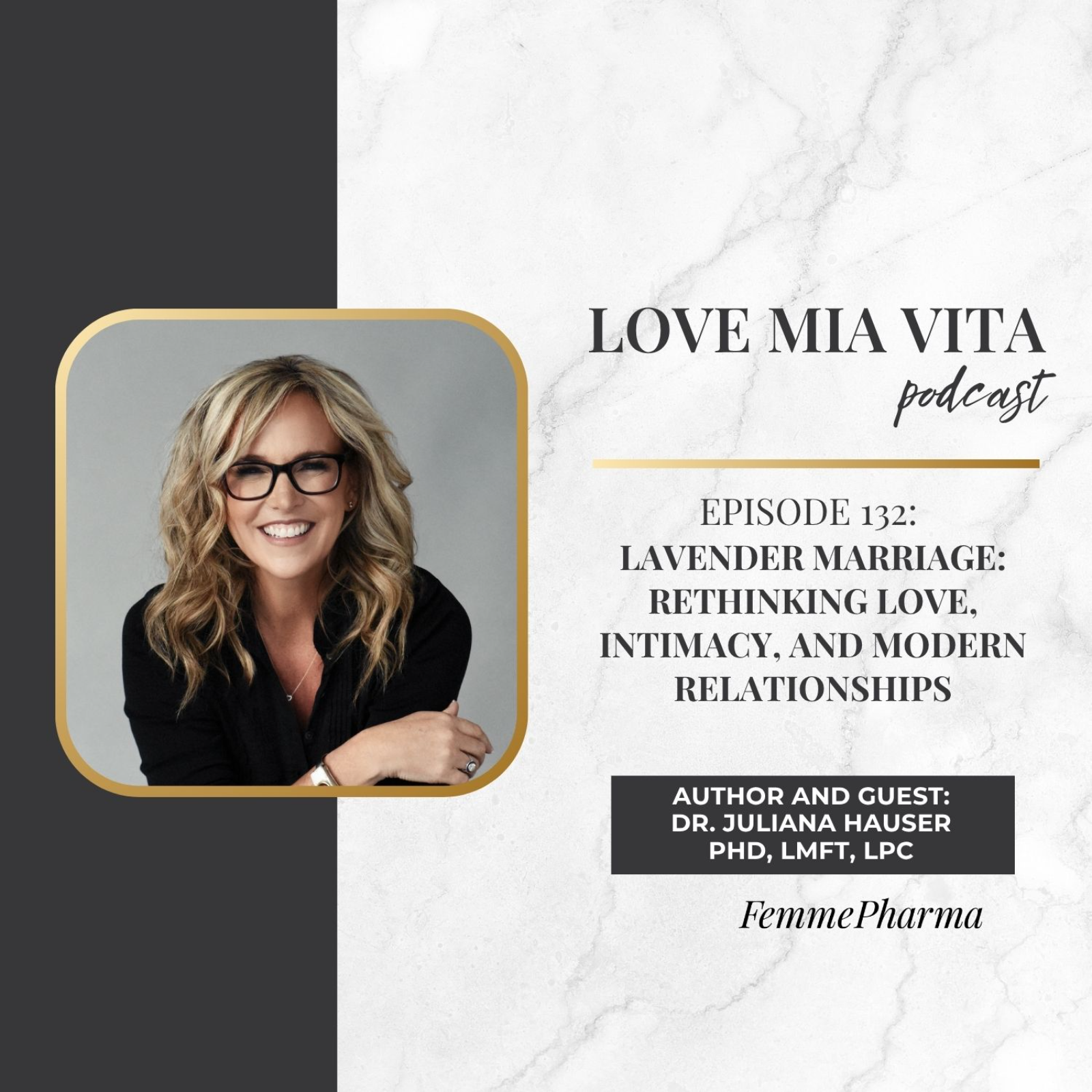
Lavender Marriage Rethinking Love, Intimacy, and Modern Relationships
from Love Mia Vita
38m 12s
The podcast explores the concept of "lavender marriages"—relationships between individuals of different genders and sexual orientations—highlighting both their historical roots and modern evolution. Originating in a time when LGBTQ+ identities were hidden due to societal constraints, such unions now reflect a shift in how people seek emotional safety and authenticity in relationships. Dr. Juliana Hauser emphasizes that women increasingly value emotionally available, equitable partners, often perceiving gay men as more supportive and empathetic than heterosexual men. She stresses that intimacy extends beyond physical intimacy to include deep emotional connection, trust, and shared values. Research shows that a child’s well-being depends more on caregiving quality than on parental gender or sexual orientation. The discussion also addresses the emotional harm caused by betrayal and dishonesty, underscoring the importance of authenticity, vulnerability, and mutual agency. Ultimately, the podcast advocates for personal freedom in relationship choices, urging individuals to prioritize emotional fulfillment and safety over traditional norms. It concludes with a call to move beyond labels like "lavender" or "traditional," focusing instead on whether a relationship genuinely supports one’s well-being. The message is clear: true partnership is defined by mutual respect, emotional safety, and authenticity—regardless of gender or sexual orientation.
(upbeat music)
- Hello, welcome to the Love Me of Eat podcast
sponsored by Fem Farma.
I'm Jerry DPNO, founder and CEO.
Thank you for joining us as we discuss all aspects
of women's healthcare.
Please note, this podcast is for educational purposes only,
always refer to your healthcare practitioner
for personal advice.
(upbeat music)
- Hello, Dr. Juliana Hauser,
and welcome back to the Love Me of Eat podcast.
I have my frequent guest, Dr. Juliana Hauser,
who is a psychologist and sex therapist
and so much more.
For those of you that haven't met Dr. Juliana,
perhaps you can share a little bit about your background.
- Yes, I am a twice licensed therapist
and I come from Lexington, Kentucky
and have an expertise in sexuality,
menopause, and all things relationships.
- And Dr. Juliana is also a Medical Advisory Council member
to Fem Farma Consumer Healthcare.
And for those of you that would like to find her
to potentially consult with her,
you can find her on her website,
site, Dr. Juliana.com.
So today, we're gonna talk about a very interesting
and very timely topic, which is lavender marriages.
Now let's define what that means.
So Dr. Juliana, what is a lavender marriage?
- You know, I always love it when I get to hear the topics
that we're gonna be talking about.
And I love it that you do such a variety
and pay attention to both the big topics
and the trends of what people are talking about.
And lavender marriages is one of them.
And it started off that you and I were having this
as always, I love our off recording conversations.
And you and I were talking,
and I made a flip comment about lavender marriages.
And so there's a variance of what it's considered now
and the origin of it.
But the basic definition is a relationship
that it's mixed gender and it is mixed sexual orientations.
And most typically it is a gay man and a heterosexual woman.
But there's other varieties of it as well.
And it began that the origins of lavender marriage
began when it really wasn't safe for men to be out
and with being gay and either the woman knew this
and it was like Don't Ask Don't Tell.
Or they didn't realize it and they never understood
that was the case, but it was a way for a man to be
in the conventional traditional marriage
and have his orientation hidden or secretive
either from society or from his spouse.
And now it is something that you see.
There's even like two TikTok stars.
And one is Jen Hamilton and the other is Chris Olsen
and they're talking about having a lavender marriage.
They both are saying that they were cheated on
by their significant partners.
And Chris jokingly proposed to her on TikTok
and she accepted.
And it's, you know, that we're gonna get into it.
But really the trend now is women,
cis-hat women are saying they're not so sure
they want to partner with cis-hat men
and they think that gay men are the bomb
and they would be a much better partner
than what is out there for them to choose from.
So there's the two origin stories of lavender marriage.
- Yeah, and I know that these marriages
did exist historically and we know that the term lavender
at least came from a description of the gay community, right?
So that was really the color.
So hence the term lavender marriages.
But it's more than just the Hollywood phenomenon.
I know that we talk about some of the characteristics
of these relationships that make them feel safer
or secure in some ways and for individuals
that have chosen to partner in a lavender marriage.
Some of the same characteristics apply
as they do in a heterosexual marriage.
But they're probably substantially more
that help to make the couple feel more secure
in that type of relationship.
And we'll talk more about that and yes,
depending upon your religious beliefs
or your culture or ethnicity,
individuals may have felt that they had to enter
into what was considered to be a traditional
partnered relationship between a man and a woman.
And often that was in defiance of their true self.
And that's unfortunate because then there must have been
the issue of if one party was aware
and the other one wasn't.
So is there a sense of betrayal?
Is there a sense of the loss of agency?
So there are a lot of dynamics.
- Thank goodness we have evolved.
I know we have far to go and still a lot to protect.
But I love knowing those stories and have friends also
who are in the situations and just heartbreaking
to witness that authenticity of who you are
is also a privilege and not everyone has the same access
to that. And so it's, you know,
being in an quote lavender marriage,
especially back in the day was a way to have safety.
And, you know, we don't know.
He's like the Hollywood marriages.
There's a whole lot that were public after the fact
came to light afterwards that it was, they both knew.
They understood what was going on and it's served everyone
and others that wasn't the case.
And I certainly know people in my life how they weren't aware
and the betrayal of that felt really difficult.
But it was also a self-patrial to the individual
who wasn't able to live their authentic life safely either.
And it's interesting to have it transition now to,
like we were thinking about authenticity and choice
and that being a privilege to have that transition
to where we are now.
It's interesting. You and I both love the concept of agency.
And I love the concept of agency being in a relationship
of being able to create a relationship or a marriage
that works for you and doesn't have to be exactly
what is told either by religion or by tradition,
whether it's your own family tradition
or what, you know, what you thought you're going to be.
But really creating relationships that work for you
and that make your life better and whatever that means
whether it's financial so you can get health insurance
or it is safety so that you have emotional safety
and someone who you feel is at your emotional equal.
There's a lot of reasons to go the non-traditional route.
I'd love there to be a different word
than lavender marriage right now
'cause I think the transition raises a bit of the origin
that I think is important for us to remember.
But the concept of doing on your own now
is something I'm highly believe in.
- Now when we think about the lavender marriage,
there obviously are some emotional and relationship issues
that one needs to take into consideration.
So there's emotional, there is the romantic
versus the friendship.
Let's explore that a little bit.
- I'm asked this question in heterosexual relationships
all the time.
Can it be a good relationship if you're not having sex?
And how do we position sex in the definition
of a good marriage and a good relationship?
And my answer is always, it just depends
which is such an unsatisfying answer to give,
but it's I think a powerful one
because there are many people who partner
and do not have a sexual relationship
regardless of what their orientation is.
It's not possible or it's not a priority
and they're very happy and in a very fulfilled relationship.
So if that can happen in an outward facing
traditional relationship, then why does that have to be
the foundation of a relationship that is non-traditional?
And again, I don't love always using traditional
non-traditional, but in a relationship
that isn't a typical pairing of orientations.
And I, when I've asked people who are in those relationships,
there is a couple that their social media is all about
being an lavender marriage.
And they answer questions and they talk about it
and they kiss.
And so they will show themselves kissing.
And when they've been asked, well, you all don't have sex.
How are you all being affectionate?
They say, well, we don't share everything,
but we love showing that we care about each other
in a very deep way.
And that is so profoundly important to us to have
in the way that we define a sexual connection.
And to me, sexual connection is everything
from holding hands to penetrative sex
and everything in between.
And so in a way they are in a sexual relationship
because if you are being affectionate with each other,
you could put that on the sexual continuum.
But I'm not sure, but the way that they imply it
is that they're not doing anything beyond kissing
with each other and they have an agreement outside of that.
but they are pairing.
The agreement that they have goes far and beyond what their sexual relationship is to.
It's all about emotions and finances and being a good partner and being a good friend.
And I think that's crucial.
And so in some ways, if having a sexual relationship that includes more in the continuum isn't
a high priority, then this kind of pairing takes one more thing off of the list that you
have to have compatibility on.
When you think about intimacy and the way I think about intimacy is not necessarily physical
intimacy in terms of having sex or even kissing or hugging or showing signs of affection, right?
When I think about intimacy, I think about is this the person that you want to share your
deepest and darkest thoughts. Is this the person that is there for you? We've referred
to your right or die. So is this your right or die? That's, to me, that is intimacy.
And that intimacy can be formed with members of the same sex. It can be formed with members
of the opposite sex. And let's face it, if you have a best friend or a soulmate and
that person doesn't share the same sexual orientation, that's really cool. And that's
why at least the way I see partnering in that fashion, I think it's very plausible to
partner in that fashion, if you have all of those other requirements satisfied, because
you would do the same in a heterosexual relationship. Yes, I had a friend once come to me and she
was half joking, but half serious. And she said, when I look at the, we had done the
list exercise, when I look at my list of who I, who is really going to be my sole partner
in life, my best friend, a female who is married to a man, who she had no sexual feeling
towards, is everything on my list. I just don't want to have sex with her. And she's like,
what does that mean? Is my soulmate my best friend? And I'm not meant to have a relationship
with a heterosexual man, or is he not out there? And can this exist in a man everything
that I'm looking for and wanting? And I think that does go to what you're talking about
with intimacy is that there's just so many levels and layers to it. And I think ultimately,
when we're looking at this trend of lavender marriages currently, and in the current kind
of definition of it, I think what it really is showing us is what women are missing,
and what they're asking for in relationships, and assuming half jokingly, but half serious,
that a gay man would have it, because the stereotype, although it's not accurate 100%
of the time, is that a gay man is going to be a whole lot more emotionally available,
and emotionally evolved, and the stereotype is that a heterosexual man isn't. And it's
certainly that isn't true on either sides of it 100%. But the stereotypes come from a place
that a lot of women who have friends that are gay men, that they seem to celebrate women
without as much iron and problems, and that they automatically, again, as a stereotype
to a degree, have a respect for what women do in the world, and have an understanding
of what it's like to be a marginalized group, whereas traditionally heterosexual cis men
don't have that experience. And just wanting to have that commonality, the women are
wanting that. And in general, I think all of that is encapsulated in a lot of women don't
think that men like women, meaning like they secretly hate women, and that their behavior
is rooted in this disdain for women, even if they may love their wife, but their behavior
isn't really supporting it, and there's an inheritance in gay men that they love women.
And so just, I think women in general just wanted to be liked, liked by a man, and know
what that feels like. And sadly, that is a problem that we're not seeing nearly as
much as women are wanting it. And when I can go back and like the history of marriage,
because I think about that a lot in my couple's work of like, what does the point of marriage,
a lot changed in what women want and what they need when we had the means to become
financially independent when we didn't need men for housing, for lineage, for land, for
our livelihood, when we can provide that for ourselves, then we start looking for marriage
to be all these other things, and that we want. And I think we have done a very good job
teaching CISET men how to evolve into that list. I see a lot more in the younger generations,
but it's a lot, I do a lot of teaching on forties on up to CISET men about how to show up
and show that you like women, particularly the person that you're partnered with, but
also just in general. I think that makes a big difference too.
You know, you mentioned something that really resonates with me and its equity. And finding
that equity 50 years ago is probably very challenging, right? So women were relegated
to very stereotypically female roles, if you couldn't call it that, but relegated to
roles of caregiver, stay at home, even if they had aspirations to do something different.
And over time, that has we have evolved. Society, I believe, is evolving, although I wonder
these days how much we've really evolved. And so looking for a partner who actually
can be equitable in the relationship is happily equitable. Exactly. Exactly. So yes, when
your partner can celebrate your success authentically, that to me is more equitable.
Yeah, I agree. And I think there's this fantasy that in 11th or a marriage that equity
comes back, that when you are both in a marginalized group, maybe you have a fair shot for both
of you to have equity and being authentic to in a lot of places, let alone just having
fairness of health insurance access. And you know, beyond the logistics of it or being
able to afford a mortgage or rent where you can't do it when you're on your own, but
just providing safety for each other on a lot of levels. To me, I'm all for it. I'm all
for relationships that bring people to a happier, more fulfilled, equitable place, because
those are the people who are making better decisions in the world. And we need more of that.
I agree with you 150%. And when you think about the characteristics of any relationship,
and you know this as a professional, when you think about the characteristics of any
relationship, you want to look at someone who regards you as their very best friend and
partner. You can trust them. You feel safe with them. You have shared interests. It's
okay to have different interests, but at least some shared interests. So finding that
person, even if they are not your sexual partner, if they have a different sexual partner,
it's okay, because they meet all the other criteria that are important in forming a partnership
in bonding together, in potentially raising a child or children together, if that's
what you choose to do. And so when we think about this, is it much less complicated to
find that person? So let's talk about how that impacts family dynamics, because let's
face it, individuals who are in and will use lavender for the moment. I also want to
talk about mixed relationships, because there is a difference between mixed and lavender.
But how does that impact the family dynamic? So you choose to have a child together.
Yeah, and that certainly is growing. That decision, people who want to have children, need
to have a different gender, but that's not their orientation they want it genetically to
be theirs. Through my work, just what I see, and then the research shows that it is about
the stability and safety in the home more than any other detail that makes a difference
in a child's life. And believe me, all sides have tried to discern as orientation or
is a two-parent family, and the studies just don't back that. And the ones that are really
viewed as good research base, they don't find it. And if there is someone identified as
a mother in the family, then it's typically the mother or the primary caregivers level
of happiness and contentment that is the most correlated of how the kids are doing and
and how they do long-term.
And so if you have one person.
in that home. That is the safe and secure caregiver for the family.
All the other details just fall away. And I know there's other people who disagree with that.
I think you and I are the same page of we would champion anyone who chooses to be a parent
and is a good one. It doesn't matter. All the other parts of it too. That's my opinion.
They just haven't we we have been witnessed to just years and years of marriages, gay marriages,
same gender marriages with families and the kids are great and fine. And so we just even know
and don't really that just isn't related. And so if you mix it up, I just I again if your needs
are met, it to me what does it matter what the details are and to me it's nobody else's business.
And I think it's just a shame that we've we've changed it in that way. I wrote a list out of
everything we expect of our of a marriage right now. Sexual partner, best friend, co parent,
economic partner, roommate, emotional component, adventure partner, family member, caregiver,
and lover. And there's more. But I was like I was just kind of going through this. I was like
that is such a that's a lot. And like hit out of the park with every single one of those roles is
it's really a miracle at this point. And and so if you can find ease with even half of those
roles with somebody, what a beautiful partnership you've had, what genders or what orientations
or any of that. If people can answer like that, can you imagine if we had if we had the freedom
to choose who's really right for us instead of what society has said is right, can you imagine
how much better our lives would be in our communities would be our children would be if we were
able to partner better and given that freedom from a very young age and modeled that.
And perhaps we would produce the divorce rate because that's so when you think about it these
marriages between heterosexual persons that are considered the norm if there's such a thing
and 50% end in divorce over 50. And that is and that is staggering. These are people that made
promises to one another and what are the reasons. And so when you talk about incompatibility,
if incompatibility is one of the key features to your point wouldn't it be much better if we're
a person of the same sexual orientation or even if they were of a different orientation but they
met all the other criteria they are your right or die they are the best person you can imagine when
you wake up in the morning that's the person you want to have coffee with and it's the person you
want to kiss good night irrespective of whether you're having sexual intercourse wouldn't that be
wonderful yes yeah that's so that is I guess that's the best possible scenario but then there's
this other scenario we need to we need to talk about that and that is relationships that should have
been lavender but end up devolving because one partner really needs something different
and perhaps we can dive into what that does to the relationship so the trail the dishonesty if
there is dishonesty so and we talk a lot about agency so what does that do to one's agency?
you know it's I in the work that I do a fair cheating you know whatever word you want to put to
it are a large part of of my work and I've seen all sides of it the yes the actual sex part of
the cheating or the if it's an emotional affair with without sex happening betrayal is the biggest
problem it's it's more than the details for a lot of them or at least eventually get to that place
of you didn't have my best interest at heart I wasn't considered in this situation are two big
themes that have to be repaired in this big rupture and sometimes that repair is pretty easily
and sometimes it doesn't repair at all and it takes both parties to want to do that I often
go back to like my position isn't that the person who cheated is always the quote bad one and you know
or you know the behavior of betrayal is a very negative behavior but oftentimes there is a lack
of ability to be truthful whether it's self-induced and the person could have said and could have
done a lot more practically didn't do it or didn't feel like they could didn't have the skill
set to have it come forward with it and and and and end up choosing or falling into this kind of
betrayal instead of doing the bigger harder thing but I I go back to this kind of caveat of
authenticity is a privilege and not everyone has that the same access to that authenticity whether
sexual orientation or it's unhappiness some of the hardest marriages that are falling apart that I've
been a part of are the ones who actually don't have something big like that to point to is just
they no longer work and they won't that long list that I gave some big players on it just weren't
compatible anymore so what do you do and you know some people's answer is you know polyamory or ethical
nominogamy and I have quite a few clients that are in that category by choice and this will be
how I often start my my counseling sessions which is like hey we're gonna take out there's no room
right now in the solution aspect of this that involves what everything should be and what we've
been told by everything the way through this whether you stay together or you don't is to
stand in agency both of you which means you both have to stand in the truth of who you are and
have the bravery to share that with the other person and if you don't know how to do that if you're
the one that's betrayed and done all this secretive then the you your job besides repair is to
learn how to be truthful and that is a skill for a lot of adults that they have to learn and some
of it is character but a lot of it is is learning that when you have learned it's not safe to be truthful
about who you are and what you want then you don't learn the skill of doing it and surviving and
being okay and again a lot of people learn quickly in life and young in life that it's not okay
who they are and that falls away I think in our marriages you don't just automatically
and frankly I'm not sure you really know how truthful somebody is until you've been with them
a long time and and I'm not sure when you meet somebody you can tell when they're a liar
and that can become clearly but if you haven't experienced somebody you can think they are and
not know as well or somebody can see themselves as a very honest person until they're really tested
and again I'll go back to it's just it's a privilege in a lot of ways be authentic and it's a skill
I love the expression the truth and who you are and and I do believe in the authenticity aspect
with the person that you claim to care about even if that is in what you perceive to be the best
possible lavender marriage same sex relationship whatever but those are those are fundamentals
and as someone has lived through and not presently because I'm with my very best friend who is
my husband but having had an experience with someone who wasn't truthful it's pretty it can
be pretty devastating to find out that you are in a relationship with a liar it's awful and
and I have had the same experience and I've actually had it with two different people that
was in significant relationships with and it was tested with my own theory I'm like yeah
it's not everyone knows how to be honest and not everybody has the skill of that and that doesn't
matter when you're hurting and and you're just left with what is truthful about any of this you
when when you learn that somebody can lie about these big things then you learn they can lie about
everything and it changes your way in the world too so I don't diminish the pain of it and
and I have experienced it and it took a lot of work for me to learn how to trust myself again
in my own judgment and and to trust other people it's world shattering like you it's it changes like
how you look at the world and how the world works when you realize somebody can lie to your face
repeatedly and in the context of intimacy and not necessarily sexual intimacy so it also
has a significant impact on the way in which you will treat intimacy sharing your deepest darkest
thoughts and and in you know being the best of yourself and also showing the worst of yourself
because that that is part of the intimacy equation and if you have been lied to cheated betrayed
in the end.
in significant ways, learning to trust that intimacy, that relationship that involves
intimacy. Again, not sexual intimacy, necessarily, but emotional intimacy with another person is
something you, and you can rebound. I'm, you know, evidence of that, your evidence of
that. So it, it can happen. But not without work.
Yeah. Oh, it's a lot of work. And, and the work is in the concept of vulnerability. The
work is in the concept of self trust. The work is in knowing you're going to be okay, even
if someone treats you terribly. And that can be really difficult. It can be. And, and it's
also why I say that that there's a lot of work, like self, self work that can only be done
when you get into another relationship that part, part of trusting again is having to
take that leap. And that can be some of the hardest parts of a relationship is taking
that first step after you've had felt betrayed in it. And there's a lot of research right
now and it's really vernacular of like a dismissive avoidant person. Somebody who doesn't
have the skill to really, they will go to such lengths to avoid feeling uncomfortable
and not care at all what it does. And they've not even able to consider somebody else's feelings
and what that means. And then that is self preservation at all costs. And what that does
to somebody afterwards people, like some studies are showing is one of the most damaging relationships
to be in. This is somebody like that, which makes me again, go back to, it's a skill. Authenticity
is a skill. And everyone has different access to that and exposure to what that means to.
And your authenticity really changes when you've been the one who's been betrayed.
So when we think about some key takeaways in terms of lavender marriages, what are the
key takeaways for people listening in? You know what? Do what feels right for you and
truly who cares what people think of, who you are partnered with, if you and especially
in your home and in your life, if you feel happy and seen and supported and safe and all
that list of things of the role of your partner, then it is nobody else's business and just
do what makes you happy. And I don't mean a recklessly happy. I mean, like in those private
moments, do you feel content with your life because of the person that you have with it?
And are they making your life better? That's the never one takeaway is I think we need
to get rid of the word traditional and anything that falls underneath that. I think we have
proven traditional, doesn't work. And we don't need to do position everything that's not
traditional as non-traditional. It is to me, is it work or does it not work? Is it working
for you or does it not work for you? And I think if you can be curious about that and
be open to how it is defined after you throw away what didn't work, then there's so many
possibilities. And a lavender may or may not be for you. Having sex with the person that
you are with may be very important to you. So that's not going to happen. Or maybe you
have a different roommate, then you have who your sexual partner is and you have multiple
people that are fulfilling different needs. There's a growing trend in the retirement community
of not living with your person, whether it's staying married, but just not living the
same house anymore, or dating and not getting married in your 70s and 80s. All of that
is so exciting to me to hear that we are getting to change that. So I say do it on your
own, do what you want, find your authenticity and be somebody that others can be authentic
to as well. There is reciprocity and authenticity and relationships and you want to give and
receive that.
You know, I even felt awkward calling this lavender marriages because by putting a label
on it, it's defying the UBU. I mean, that really, it's whoever, it's who, who are you?
What makes you psychologically and physically feel fulfilled and happy? Because let's face
it, if you're in a relationship, whether it's with a person of the same sex or the opposite
sex, if it's not right, it does impact family, your psychological and physical health.
So UBU, figure out what makes you happy and fulfilled. And if that's someone of the
same sex, go there. And if it's someone of the opposite sex, but they're not your sexual
partner, that's cool too.
Yes.
And again, it's a reckless, it's not to say that your reckless, what is reckless is doing
something that others expect you to do, but it's not you.
Yes. And I, and I, I said there too with people, you know, and I'm not, again, like I,
I know the damage of, and how hard divorce is that I have gone through that. I'm not
saying that I'm a proponent for that as well. But I also find it very sad when I'm with
people and they are, they choose misery and, and they choose it because of traditional
values. And again, it's not the grass is greener, divorce is very hard also, but have grown
it more and more unclear as to why someone would choose that. I mean, I, I intellectually
know why, but gosh, life is short. And if you didn't partner well, or if the relationship
has changed or something that isn't fulfilling, then, then there, there are so many options.
And the other part that I do, like I will often transition my couple's work. If it's clear
the relationship is not going to work and isn't a good one, then I switch it to, instead
of saving the marriage to having a divorce with dignity, you can transit just like we're
talking about lavender marriages and doing things differently. You can divorce and still
be friends, but you don't have to just scourge the village as a part of things. And if people
didn't have to go to betrayal in order to find the truth of who they are or what they need,
then that would be so much more likely to happen. Great advice. Great advice. Dr. Juliana
Hauser. Thank you. Once again, we're being my guest. You can hear more of Dr. Juliana Hauser
by listening to the FEMF, via Vita podcast. Visit our website at FEMFarma.com. And you'll
see in the tab the podcast list and we have many with Dr. Juliana. They're all fabulous.
So once again, thank you. Thank you to our guests for listening in and love me Avita.
For the love me Avita podcast comes from FEMFarma. We talk a lot on this show about maintaining
a vibrant life at every stage. And that includes your intimate health. Me Avita personal lubricant
and moisturizer is formulated to address dryness and thinning skin made without hormones
or harsh chemicals. It's about reclaiming your confidence and comfort on your own terms.
Here's the science backed solution trusted by women everywhere. Find your relief at FEMFarma.com.
Thank you for joining us on the love me Avita podcast. Love me Avita means love my life.
And that is a mantra we should all live by. Please like and subscribe wherever you get
your podcasts and remember to follow us on social media and on FEMFarma.com. Thank you
and be well.
Podcast Summary
Key Points:
A lavender marriage refers to a mixed-gender, mixed-sexual-orientation relationship, historically emerging as a way for gay men to marry heterosexual women while concealing their orientation due to societal and legal restrictions.
The term originates from the LGBTQ+ community’s use of lavender to symbolize queerness, and today it reflects a growing trend among women seeking emotionally available and equitable partners, often perceiving gay men as more emotionally supportive than cis-hetero men.
Intimacy in such relationships is defined broadly—beyond sex—encompassing emotional safety, deep trust, shared values, and mutual respect, with affectionate gestures like holding hands or sharing thoughts playing key roles.
The success of a lavender marriage hinges on authenticity, emotional equity, and mutual agency, where both partners feel seen, supported, and safe, transcending traditional gender or sexual role expectations.
Research indicates that a child’s well-being depends more on the quality of care and emotional stability in the home than on parental gender or sexual orientation.
Dishonesty or betrayal—whether sexual or emotional—can deeply harm trust and emotional intimacy, making authenticity and vulnerability critical to long-term relationship health.
The concept of "traditional" marriage is increasingly seen as outdated and ineffective, with modern relationships prioritizing personal fulfillment, emotional compatibility, and individual agency over societal norms.
Ultimately, the ideal relationship is one where individuals feel happy, fulfilled, and safe—regardless of gender or sexual orientation—emphasizing self-trust, mutual respect, and the freedom to choose authentically.
Summary:
The podcast explores the concept of "lavender marriages"—relationships between individuals of different genders and sexual orientations—highlighting both their historical roots and modern evolution. Originating in a time when LGBTQ+ identities were hidden due to societal constraints, such unions now reflect a shift in how people seek emotional safety and authenticity in relationships. Dr.
Juliana Hauser emphasizes that women increasingly value emotionally available, equitable partners, often perceiving gay men as more supportive and empathetic than heterosexual men. She stresses that intimacy extends beyond physical intimacy to include deep emotional connection, trust, and shared values. Research shows that a child’s well-being depends more on caregiving quality than on parental gender or sexual orientation.
The discussion also addresses the emotional harm caused by betrayal and dishonesty, underscoring the importance of authenticity, vulnerability, and mutual agency. Ultimately, the podcast advocates for personal freedom in relationship choices, urging individuals to prioritize emotional fulfillment and safety over traditional norms. It concludes with a call to move beyond labels like "lavender" or "traditional," focusing instead on whether a relationship genuinely supports one’s well-being.
The message is clear: true partnership is defined by mutual respect, emotional safety, and authenticity—regardless of gender or sexual orientation.
FAQs
A lavender marriage is a relationship between individuals of different genders and sexual orientations, most commonly a gay man and a heterosexual woman. Historically, it allowed men to be in traditional marriages while hiding their sexual orientation, offering safety and stability in a time when being openly gay was not socially or legally acceptable.
The term 'lavender' originated as a slang reference to the gay community, with lavender being a color associated with LGBTQ+ identities. It reflects the historical and cultural context of how same-sex relationships were hidden or coded within heterosexual frameworks.
Yes, many relationships—regardless of orientation—can be deeply fulfilling without sexual intimacy. Emotional connection, trust, and shared values often define a healthy relationship, and intimacy can include affection, support, and deep emotional bonding beyond physical sex.
Key characteristics include emotional safety, mutual trust, shared values, being a best friend, financial partnership, and being a supportive partner. These elements can exist across gender and sexual orientation lines, with authenticity and emotional availability being central to long-term fulfillment.
Many women are seeking partners who offer emotional availability, empathy, and understanding—qualities they perceive as more common in gay men. This reflects a broader shift in women's desires for equitable, emotionally supportive relationships beyond traditional gender roles.
Yes, if one partner hides their true orientation or engages in dishonesty, it can lead to betrayal and a loss of trust. Authenticity and transparency are crucial; a lack of honesty in a relationship—especially regarding sexual orientation—can severely damage emotional intimacy and long-term trust.
Chat with AI
Loading...
Pro features
Go deeper with this episode
Unlock creator-grade tools that turn any transcript into show notes and subtitle files.
 PodcastTranscript AI