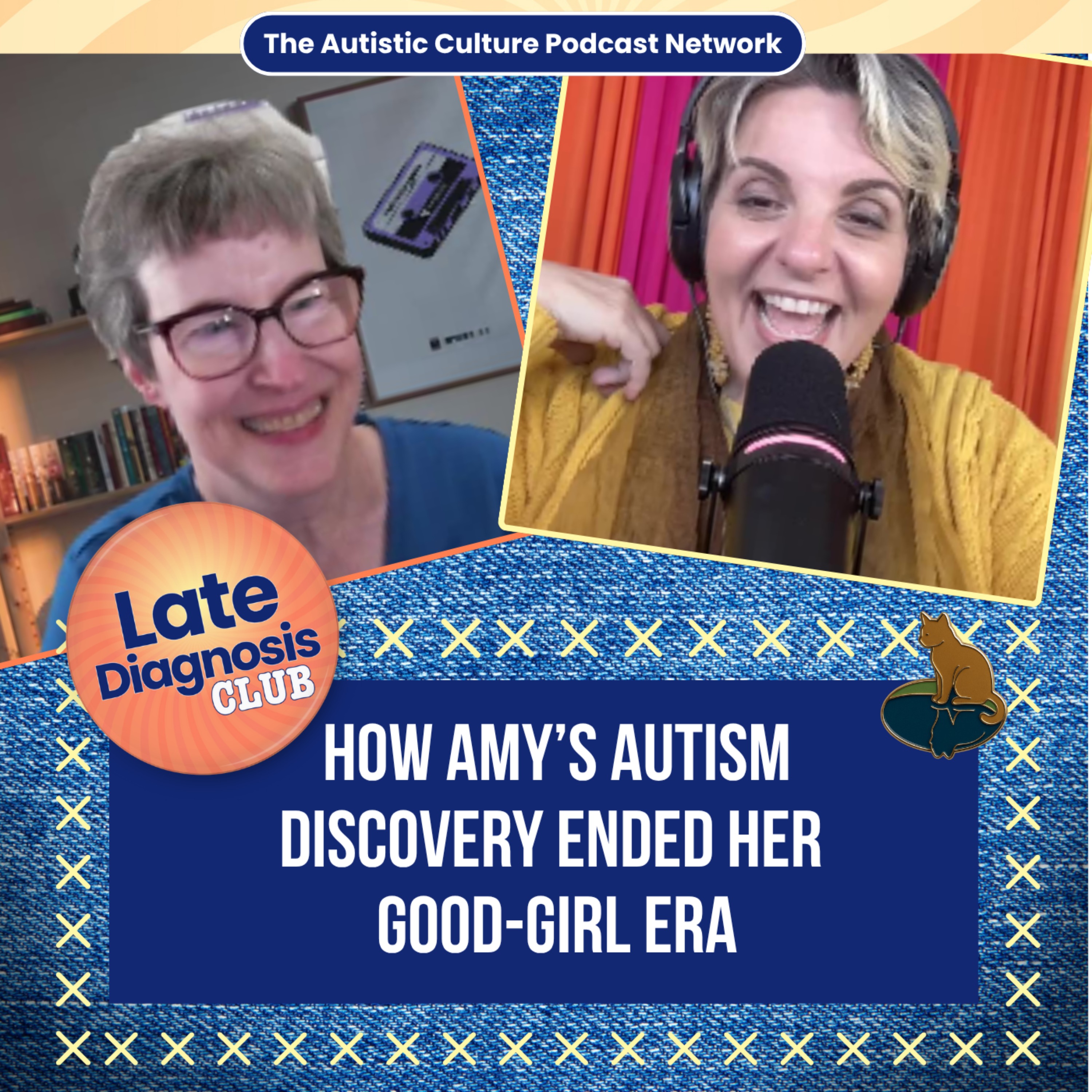
Late Diagnosis Club: How Amy's Autism Discovery Ended Her Good-Girl Era
from Autistic Culture Presents
39m 58s
Amy shares her experience of being diagnosed with autism in her late thirties after a lifetime of feeling overwhelmed and conforming to others' expectations. She recounts early differences, such as sensory issues with hair care and social challenges, and explains how her niece’s autism diagnosis sparked her own journey of self-discovery. Despite encountering dismissive therapists, she pursued an assessment through a supportive, virtual service, which affirmed her identity.
Since her diagnosis, Amy has focused on unlearning harmful patterns, such as self-pressure and people-pleasing, and now prioritizes authenticity, self-care, and trusting her intuition. She discusses the impact of autism on her relationships, including experiences of domestic violence and difficulty disclosing her diagnosis to family. Amy emphasizes the importance of neuroaffirming communities and shifting away from deficit-based views of autism, embracing instead a life of intentionality and self-acceptance. Her story underscores the value of late diagnosis in reclaiming one’s identity and building a fulfilling life.
(knocking) Hey, welcome back to the Late Diagnosis Club. Come on in, the meeting's about to start. Today's story starts with a question. What if your entire life, your jobs, your relationships, even your sense of self was shaped by expectations that were never even yours? Amy Perman's inner fifties and only recently discovered that she is autistic. Before that, she was always overwhelmed. She was always trying to please everyone, always bending herself into whatever shape the world seemed to want from her. Toxic workplaces, a mother who micromanaged her, a body that sent up distress signals every time she ignored her own needs, and then came the diagnosis. And finally, Amy had permission, permission to start over, permission to slow down, permission to create an intentional life where she balances relationships, work, and pursuing her passions. Amy writes about this process in her sub-stack, seeking authenticity, and today, she tells us how she got here and what she's learning to let go of along the way. From the Autistic Culture Podcast Network, I'm Dr. Angela Kingdon. Stay with us. (upbeat music) Amy, no small talk here. Welcome. Let's get right into it. I am really glad to hear a little more about you and your story, so welcome. Thank you so much. I am just so excited to be here. I was diagnosed at 39, so very well into my life. I would love to hear your story. How did you figure it out? Did you get diagnosed or yourself identifying? Tell me a little bit about your journey to neurodivergence discovery. I would say that I've always felt different. I don't really care because I want to be me and basically at some level, I think I've always known if you don't like me, well, go on. I mean, just go on, life goes on, right? And did you have that, I don't know, social differences or challenges or bullying? How would you explain what looking different was like in your brand of looking different? Well, I was born with Ambleopia, which is when one of your eyes turns in. And so that was not corrected until I was six years old. Did you have the patch like a lazy eye? Yes. My sister has that. It's very traumatizing. Yes. And I mean, in those days, because I'm far-sided, the glass is really magnify your eyes. And you can look at the batons I got on the playground. And I also had short hair. And to be honest, I think people thought I was a bully. And I hated that. Right. Yeah, I had that too. I remember going to, we were at a cruise ship. And it was a Dutch night going Dutch. And they had cute little Dutch girl hats. And then they had some Dutch boy hats. And they gave me the Dutch boy hat. And I was like, no, no, no, I'm a Dutch girl. They gave me the Dutch girl hat. And they're like, you're a boy. This is your hat. And then I was like, I'm a girl. I always had short hair because I would not shower. And I wouldn't brush my hair. So my mom kept my hair super short, because it was always like matted, because I didn't like that whole sensory experience. I think my mom assumed I would not take care of my hair. And that-- And I really-- she never outright told me I couldn't have it. But I think if she had just been that bored with me, it would have been a lot better, because I was constantly begging her, can I have fun on hair? And I have a big tails and all the other things. Now, when I was in junior high, I was allowed to have it, because then I could take care of my hair, to both-- Yeah. Although I felt like now I was to take care of it, to be honest with you. But that mean there was a big deal. But as you can see, I took that back and so forth. What was your light bulb moment that you might be neurodivergent? Did somebody else get a diagnosis? My niece got a diagnosis. And I really believe that's when the wheels started churning. That-- wait a minute. You hear about this being genetic. And it's like, well, did it come from her dad? Or did it come from her mom? Well, maybe it came from both of them. Yeah, but that does happen, too. Birds of a feather do seem to flock together. Right. Right. How old was your niece at the time, like, 5, 6, 7 kind of thing? I think she was probably 7. But she was at the school initiated. So that's the standard when we're supposed to be caught time. Obviously, that wasn't an option. Yeah, it was. That age. [LAUGHTER] I mean, it would have been a gift to be diagnosed at 39. I think that would have been-- I got a few extra years, but I did. I didn't necessarily integrate it in the way I would today, because there wasn't the information out there. Right. So I got diagnosed just before the autism spectrum disorder changes. I was technically diagnosed with Asperger. And my belief was, at least I know what it is now, and I can try and fix this horrible affliction that I am afflicted with. So I lost another 10 years trying to cure my autism with apple cider vinegar and shit, not a great plant, or whatever we're supposed to be doing now to bleach enemas or something horrifying. So I need to take folate. Oh, great. I'm a no-tylon-alver, of course. Yeah, well, I blame my mom for that. And I guess it was me taking Tylenol that caused all my children's problems. But-- So then what happened? So your knees get diagnosed. Some things are starting to sound familiar. Well, as I realized and accepted that I was going to be childless, I found an online community, started by Jody Day, another great person from the UK. It's called the Childless Collective. And in that group of women, I felt accepted. And they were interested in what I had to say. And to be honest, I'm not really sure if I felt that before, because I never felt loved by my mom. And I'm not trying to diminish my mother. I'm just want you to hear while I see it. I respect that she did her best. But I don't think I felt the love and nurturing that I made it as a person. And so the next aha moment was that I was a highly sensitive person. This was something I'd had a trait that identified by Elaine Aaron. And there's a lot of dispute about whether these people are autistic or not. We're going to talk about HSPs, highly sensitive people, highly controversial community. Yes. I will tell you, that was one of my-- I want to say in the '90s, I got that book HSP. And I was like, oh my god, this is me. I had no idea there was any connection to neurodivergence. But it was definitely a gateway for me, too, for sure. Right. And then from there, I learned of Julie BLN in the United States. And she has the sensitive empowerment community, which is also a non-line community. She started sharing with us that she had learned that she was autistic. And I was like, oh, I can't be autistic. I mean, that was a bit much for me to swallow. But the more I thought about it, the more curious I became. And she has her version of a test. It's not a doctor's-- Yeah, yeah, yeah, a thing a doctor for women that was geared towards women. I passed it-- I mean, I-- Oh, yeah, I'm not going to be with-- I'm going to be with my colors. Right. And I was seeing a counselor. And I discussed it with her. And she said, well, I see where you meet those qualities. I see I rewest this assessment. But you're not-- I don't think you're autistic. Right. You have checked all the items on the checklist. But I am noticing you are making conversation. And you are not a young boy. So you can't be autistic. I chose not to see her anymore because this is what I found. OK, I spent 30 years talking to six different counselors. And it's a bit upsetting to me that with all the time and money I invested in myself, that no one picked up on this. So frustrating. So frustrating. It's like so obvious if anyone, any medical professional, any therapist, my OB/GYN, it's five questions you could have identified it. How did no one to-- no teacher, no one, nothing, ever-- Nobody, because I didn't cause any trouble. That's what I feel like. You were a good girl. I was a good girl
I did what everybody said I should do. What's here? I'm not no pseudoscience here. I'm just curious. What's your birth order? Do you have siblings? I am the oldest daughter. I have a brother and I have three younger sisters. The sister after me, there's a six year gap. And so I was very happy to help my mom with my three of those sisters. Mm-hmm. And I'm sure she appreciated the help. But I would say I was parentified from what I've learned now. Yeah, right. We didn't have those words. We didn't know that. Once you did that-- I don't call it quiz-- but once you did that self-assessment is a better way to say it. At that point, were you confident enough? Like a lot of especially women struggle with imposter syndrome and especially in the face of somebody qualified in psychology telling you, oh, you're not autistic, I'm surprised you made that decision with such clarity. You know, I think I knew. And what was just-- I did talk to my personal physician and I very cute as to her. She was very supportive of me. I think that part of the problem of being parentified is you don't acknowledge your own needs because you're still used to being more concerned with everyone else. So I was referred to what is a neuropsychologist, I believe. And so there was a year wait to see this man. And I have no confidence that he has any skill in assessing autism and adults or females. And this is going to cost me some big bucks. Right. And wait a year. And wait a year. I don't have a year to wait. OK, I have a life to live. Right. So I found the company led by Ms. Lauren Howard, LB Health. It was-- I felt very vulnerable. I'm not going to lie. It was-- but you know, one thing that I really applaud them for doing is they-- you have a choice. You can have an advocate with you. One of their-- they have someone that their role is to be your advocate. And knowing that that person was going to be there, they met with me before the appointment. And so-- and you know, I think the fact that it's virtual is good because we're not-- there's no pretense. You know, there's not that pretense. There's one less dresser. I was invited to bring a family member, a friend, a dog, whatever I wanted to-- to make me feel comfortable. Yeah. Wow. And I am forever grateful to LB Health. That's awesome. Yeah, finding supportive, neuroaffirming, affordable, reasonably time diagnosis. Now, that said, we are going to take a break. But I do want to say, if you had just self-diagnosed or self-assessed yourself, I do feel like that would be equally valid. Like, you already knew the fact you left your therapist when she doubted it is just such a baller move. So badass. I am very impressed with that. And if you are someone who didn't do that and paid for many sessions after and now you hate yourself, it is time to forgive yourself. I have done that, too. Not everybody is a badass. Like, Amy, she learned the hard way. So we all have our own timing. Things work out in their own timing. So I want to talk more about the impact your diagnosis has had on your life since. But let's take a quick break and we'll come back and we'll dig into that. [MUSIC PLAYING] Welcome back to the late diagnosis. Club, I am your story steward, Angela Kingdon. And I am here today with Amy talking about her neurodivergent discovery story. So Amy, I hope you're ready because it is time for LDC Unlocked to start. So as you know, being autistic is all about skipping the small talk. We like to tell it like it is. We like to go deep. So LDC Unlocked is our club member moment to share a secret or a deep truth or maybe something you have never shared before. Basically, it's like we're playing truth or dare, but I just picked truth for you. So there is no dare. There's only truth. So here is your LDC Unlocked question and that is, what is something that you have had to unlearn since discovering your autistic? That there's no point in pressuring myself. It is all it does is create more stress. It's not effective. It's counterproductive. It's hard. But we cannot-- pressure is not a motivator. Period. Was that a go-to for you before? Was that like a masking technique or something? I would say it was because I should do this and I should do that. And there were these implied rewards by these certain behaviors. If you do this, you're going to find a man to marry. And you're going to get married and have children. Well, guess what? That's not how it happened. And I did everything I was supposed to. Yeah. Well, let's talk about that journey. I know that you have wished to experience motherhood and have, I guess, come to, would you say, except the ship has sailed the moment. As best as I can. As best as I can. Yeah. How does being autistic affect that journey for you? Did it answer any questions? Did it help you understand why things were different in that area for you? I think that as being autistic, it took me a very long time to realize that not everyone has good intentions. I don't think I was encouraged to trust my intuition. And when I finally realized, yes, I need to trust my intuition, then I don't see myself getting into some of these difficult situations, I guess you could say. First of all, our susceptibility, we talked about this on an episode of the Autistic Culture podcast called Culture Autistic with Jude Mills, our likelihood of being recruited for religious extremism or cults, but also sometimes there are cults of one. So having a narcissist, a dangerous partner, for me, I experienced domestic violence, which is very common. I know sexual assault is much more common in autistic populations. We are vulnerable and we're so used to being told that our worth comes from how much we're willing to bask. It's very hard to forgive realizing that the source of this is not easy to forget. But I do see that as a need to do. I believe I'm on the pathway, but we don't expect this from our parents. I know for me, and this is different because it's a romantic partner is domestic violence, right? But I know for me being autistic really made it confusing because I felt like my husband was right. He was violent towards me because I was so fucking annoying to him. And I was so fucking annoying to me. Right. I was beating me up. I was cutting from the time I was 13. I was using food as a way to punish myself and hide for my emotions. Like, if I could have pulled a knife on me, I would have pulled a knife on me. I did. So I was like, this-- I mean, I remember so clearly thinking, this does make sense. Like, if I had to live with me, I would abuse me. And so I don't know if I've gotten to the forgiving him part. I'm still-- I don't know if phase one is forgiving me. But I still hear my brain slip into that. It makes sense. This person doesn't like you. You do have a terrible personality. And I mean, to be quite frank with you, I think we have to consider that even medical professionals are taking-- I don't like the word taking advantage. But I just think I would advise anyone to research any medical issues on your own and not to take anything as your-- you need to have a very well-rounded decision if you're going to-- if something is serious. And in my case, my eyes-- I had very odd issues with my corneus. And in hindsight, I feel like I should have been referred to a corneus specialist. But I didn't even know such a thing existed. Right. And I want to say, don't trust people. I hate to say that, but you've got to be careful who you trust. Do you think you were before your diagnosis? Do you think you asked fewer questions? Like, how do you think you have changed? I'm asking more questions. And I am owning that I have needs too.
And that I have a lot of us do though when we have a bad experience would be stop going to get healthcare. And I think that's the only way to get a job. Do you think that's changing in general or? I just don't think there's enough emphasis put on communicating with the patient. And in the US where it's a highly litigious world, you would think there would be more emphasis on patient communication. Because to me, it's as important as what they know about medicine. Because I really don't care what you know if I don't understand it. So let's go back to your family a little bit. Family, friends, people that you had close relationships with before and after the diagnosis. Can you share if you disclosed your diagnosis, how and when and what that process was like? I have disclosed officially to only my brother and he did not rest even well. Did you think he would? Was he like somebody you trusted? You know, I don't know if I even cared. But in hindsight, I realized that I probably wasn't ready to disclose yet. I think that, you know, but I didn't. But it's hard because you these are the people you grew up with. And it explains so much. Right. I know I thought I would share my diagnosis of people like, Oh, that is a mate. What is to have that explains everything? Well, he after he reminded me how difficult I am I was done. Have you come to terms with not telling other people was it because of that bad experience? Well, this is my, this is kind of my way of dealing it. I am trying to be authentically mate. And if you don't like me, okay, that's fine. So I don't really know that I'm going to, I mean, I would, it would have been nice to be supported. I do have one friend that's been very supportive, Cindy. Thank you. And your new friends in the late diagnosis club who have been through this. I guess we know. But, you know, I don't think it's important. I think the important thing is that we be who we are. It's hard because if someone said it's a lot of energy to educate someone about how autism is not just what you see on TV. And that takes an emotional toll as well. So that is why I've kind of, you know, I've kind of moved off that. But I will be who I am. I am not trying to be who I thought I was supposed to be for the teacher, the parent, the, the boyfriend. I'm trying to be me. It's time to be me. Oh, Amy, that's awesome. We're going to take a little break. When we come back, I want to ask you how you think we can shift away from that deficit language and take a more affirming view of autism, either for ourselves or for the community at large. So I'm going to get your take on that. But for now, let's take a quick break. We will be right back. All right, story keepers. We are back. I told you earlier that I am your story steward, but here is where you find out you are the keeper of these stories in the club. What happens in the club stays in the club. You are a member. We have been saving your seat here and sharing our stories with each other is so important to how we heal. How we begin to recognize that our pain and our experiences are shared for many of us that we're not crazy. And Amy, before I do want to ask your thoughts on shifting away from that deficit, we're broken language to a more affirming view of autism. But first, I want to change it up a little and hear a brag from you. So what is something you have done or accomplished or changed or embraced since you started to identify as autistic as neurodivergent, since your diagnosis? What are you most proud of? Just willing to jump in and give it a shot and not worry so much about the outcome. It's not about the outcome. It's about enjoying the experience. Life is here to enjoy. I have 50 years of it. 50 plus years of it are gone. I want to work a lot harder to enjoy the rest of my life. I love that so much. I think most people, certainly most kids who are diagnosed are prescribed a treatment plan. And obviously you went through a great diagnosis process with LB health. Most are not like that. When we find out we are autistic, my urge was to fix myself. And that really comes from that medical or deficit view. I'm like, oh, I have social communication deficits. How can I make up for my shortcoming? I remember telling somebody that it was like, it was like if you lose your hearing, you have to make your site get stronger. You lose your site, your hearing gets stronger. I'm like, these are the things I'm bad at. So I have had these other skills get stronger. But now I have to work on my weakness and I don't think that works very well. Like you're trying to turn yourself not autistic is a very less fun and less likely to be successful journey. So what are your thoughts on how we can take a more affirming approach to our diagnosis or identification? I will fully believe we need to embrace who we are. I believe that some people that are uncomfortable with us are uncomfortable with us because there's something about us that reminds them of something they don't want to deal with. I guess it just means that I am not willing anymore to modify myself to make you comfortable. Now that I understand myself and I'm kinder to myself and made more realistic expectations on myself are more realistic. I just think that I'm much more living in the moment and whatever comes in the moment I want to make the most of it.
whether that's, you know, smiling at someone in the line at the grocery store or reading someone when I'm at church, I wanna make the most of that moment. That's all we have. And I mean, yes, we need to spend some time planning for the future, but we need to live in the moment that is right here and now. - What are the here and now things that bring you joy? What are your special interests? What are the things you love the most? - I love cats or other animals. I really love animals. - Do you have any fur babies? - I do not have any fur babies, but I've sort of adopted one. There's one that likes to come to the porch a lot. And so I have officially bought her treats. - Okay. - Maybe she's adopting you. - Well, and that's how I see it. Because I have had pets in the house and I would, you know, just finances are over it. You know, they're not great right now. So I don't really know. But we've, I've been to a little mischievous makes a regular visit to the porch. And now I've, you know, progressed to eat your treats. So I love it. - I love being in nature. I really discover how much I enjoy being in nature. There's a local pond. And I love watching the ducks. I mean, just the way they interact. And that's fascinating to me. And that's something, you know, I was a biology major and I was probably something I didn't really honor as much as I wish I had. But I'm paying more attention to my interests. And I'm not so concerned about checking out the checklist. I'm more concerned about enjoying myself than I am about checking out this item on the checklist, you could say. - Yeah, okay, cool. How do you think you express being autistic? Do you think you have changed anything in your communication style to maybe un, there's the phrase of unmasking autism. I don't, that's not always the right decision. But are there ways you have, you would say you have unmasked? - I'm happier, genuine with myself, but it is still, I'm still a bit shame in that process because I am very fortunate in that right now, I've kind of had a time to step back from my career. And it's really been a lot to process to be very frank with you. - How recent was your diagnosis? - April. - April. - So about six months, you've known when did you take that first assessment? - Well, in December. - Okay, so yeah, not even quite a year, definitely. - Right, so it's still very fresh, it's very fresh. - Yes. - Is there anything about getting formally diagnosed that you at this point regret would take back, wouldn't do it again, or even just admitting to yourself you're autistic. Do you have any regrets about this journey? - You know, I guess because I've done a lot of work on myself, I've realized that I need to accept who I am. That's who I am. And in order to make the most of that, I've gotta accept it, that makes sense. - And do you feel like you could accept it equally well without that formal diagnosis, or was that an important piece for you? And say why? - I'm not sure. I think that once I realized I was in HSP, a lot of acceptance, there was a lot of acceptance with that. And understanding that other people have all kinds of thoughts going through the head all the time, you know, all the time. I really think I just really, I'd wanted to know. It was important to me, it kind of helped explain some things in the past, I guess, if you might say. And it helped me, it gives me, it's given me more motivations to take more proactive steps, not to get in a burnout situation again. - Yeah, that's very good. Yeah, for sure. Well, Amy, as always, our closing question is, what do you love most about being neurodivergent? So you're a newbie, but so far, what do you love most? - I just love other, like seeing things that other people don't see. I like being able to, I can feel like I can feel another person's joy, I can feel another person's sadness too. And it's not always fun, but feeling the joy. Like that's really great. That is really great. - I do, I do get that. This is one of my fascinations with info dumps, because even if someone is talking about something I don't care about, like I've had people talk about, I don't know, German tanks for World War II, like things I do not care about. - Right. - I get some sort of like proxy high, like you were to what's your spin you were talking to me about? Is it all creatures great and small? - Yes, I love, I love all creatures great and small. - Like I don't know this show. I feel like I read the book 30 years ago. I have vague recollections, like small town, but I actually know where I read it. I read that book in 1989, I think. - Uh huh. - It was like a long time ago. Never even thought about it again, but when you light up talking about it, oh my God, it's like I get a contact high. It's like so cool. - The synergy, we're thousands of miles apart, but we're feeding off of each other, and that's autism. - Yeah, I do love that, I do. I love that. Well, Amy, thank you so much for being open and authentic and sharing your truth stories like yours are why we have the Late Diagnosis Club to remind us that we are not alone in this journey and all of our journeys are unique and our neurodivergence or multiple, all the combinations and the cocktails they all show up differently, but what we have in common is growing up thinking of ourselves one way and then having this information that's sprung on us late in life. Whenever it comes, I've met people that were diagnosed in their 80s. So whenever that comes for you, it is in your own time. Whatever your, we can't change the past as much as we would like to. Maybe things would have been different if, but we each have our own journey and this club is about honoring whatever those journeys look like and from now, from today, making the best, most positive life choices we can make to have the life we want, whether it's smiling at someone in line at the grocery store or starting a PhD at 70, whatever those decisions are for you, the more you can love and accept yourself, the more you can embrace that. And your story is just such a beautiful example of that. With that, I am going to invite you to share in the late diagnosis club pledge of allegiance to the club. I shared this with you beforehand, so I know you are in an agreement with our pledge, but even if I didn't, your whole story represents this pledge so perfectly, what I'm going to do is I'm going to read it once. And if you are listening and you would like to say the pledge with Amy and I, I'll say it once you listen, audience members listen to it, see if you agree if you want to say it with us, you can say it with us either out loud or silently to yourself. And maybe today is not the day to say it, but maybe you will want to say it in a future day. So we will hold this space for you together. I'm going to share the pledge and then Amy and I will say it together. So here's how it goes. Today I pledge with my whole neurodivergent self that I will respect my own timing, honor, my needs, and trust my truth. That's the pledge. That is the late diagnosis commitment. So if you want to say that with us, you will find it in the show notes. Hopefully if you listen to enough episodes, you will memorize it like the pledge of allegiance. But Amy and I are going to do it today. Amy, it's in your chat so you can look at it and say it along with me. Here we go. Today I pledge with my whole neurodivergent self, with my whole neurodivergent self, that I will respect my own timing, that I will respect my own timing, honor, my needs, honor my needs, and trust my truth. And trust my truth. Hey, man. Hey, man. We did it. How did you join us in that pledge? Or not yet, that's fine. We want you to remember that you are welcome in the late diagnosis club. If you want membership, even if you have never felt welcome in a social club before, we are waiting for you and we are saving you a seat. Thanks for being a part of the late diagnosis club story keepers. If this episode spoke to you, please subscribe and leave us a review. For early access to episodes, ad-free listening and bonus content, head over to supercast.com and subscribe to Autistic Culture Plus. Until next time, we're saving you a seat. (upbeat music) (upbeat music)
Podcast Summary
Key Points:
Amy, diagnosed with autism at age 39, describes a lifelong feeling of being different and struggling to meet external expectations, which led to burnout, toxic relationships, and self-neglect.
Her diagnosis journey began after her niece was diagnosed, prompting self-reflection, followed by exploration of traits like being a Highly Sensitive Person (HSP) and eventual professional assessment through an affirming, virtual service.
Post-diagnosis, Amy has learned to prioritize self-acceptance, set boundaries, trust her intuition, and build a life aligned with her needs—moving away from masking and people-pleasing.
She highlights challenges like late diagnosis due to masking, lack of professional recognition, and experiences of domestic violence, emphasizing the need for neuroaffirming healthcare and community support.
Summary:
Amy shares her experience of being diagnosed with autism in her late thirties after a lifetime of feeling overwhelmed and conforming to others' expectations. She recounts early differences, such as sensory issues with hair care and social challenges, and explains how her niece’s autism diagnosis sparked her own journey of self-discovery. Despite encountering dismissive therapists, she pursued an assessment through a supportive, virtual service, which affirmed her identity.
Since her diagnosis, Amy has focused on unlearning harmful patterns, such as self-pressure and people-pleasing, and now prioritizes authenticity, self-care, and trusting her intuition. She discusses the impact of autism on her relationships, including experiences of domestic violence and difficulty disclosing her diagnosis to family. Amy emphasizes the importance of neuroaffirming communities and shifting away from deficit-based views of autism, embracing instead a life of intentionality and self-acceptance. Her story underscores the value of late diagnosis in reclaiming one’s identity and building a fulfilling life.
FAQs
Common signs include feeling different or overwhelmed, masking to please others, sensory sensitivities, and struggling with social expectations. Many women are diagnosed later in life after years of adapting to neurotypical norms.
A late diagnosis can provide clarity and permission to slow down, prioritize self-care, and build an intentional life. It often helps individuals understand past challenges and embrace their authentic selves.
Challenges include long wait times, high costs, and lack of professionals trained in adult or female autism. Many face dismissal or misdiagnosis, especially if they don't fit stereotypical presentations.
Autistic individuals may be more vulnerable to abuse due to difficulties in recognizing harmful intentions or trusting intuition. This vulnerability can stem from a lifetime of masking and being told to ignore their own needs.
Self-assessment can be a valid step, especially when formal diagnosis is inaccessible. It allows individuals to explore their identity and seek community support, even if they face skepticism from professionals.
Disclosure can be challenging; reactions may vary. It's important to prioritize personal safety and authenticity, and to seek support from understanding communities rather than expecting acceptance from everyone.
Chat with AI
Loading...
Pro features
Go deeper with this episode
Unlock creator-grade tools that turn any transcript into show notes and subtitle files.
 PodcastTranscript AI