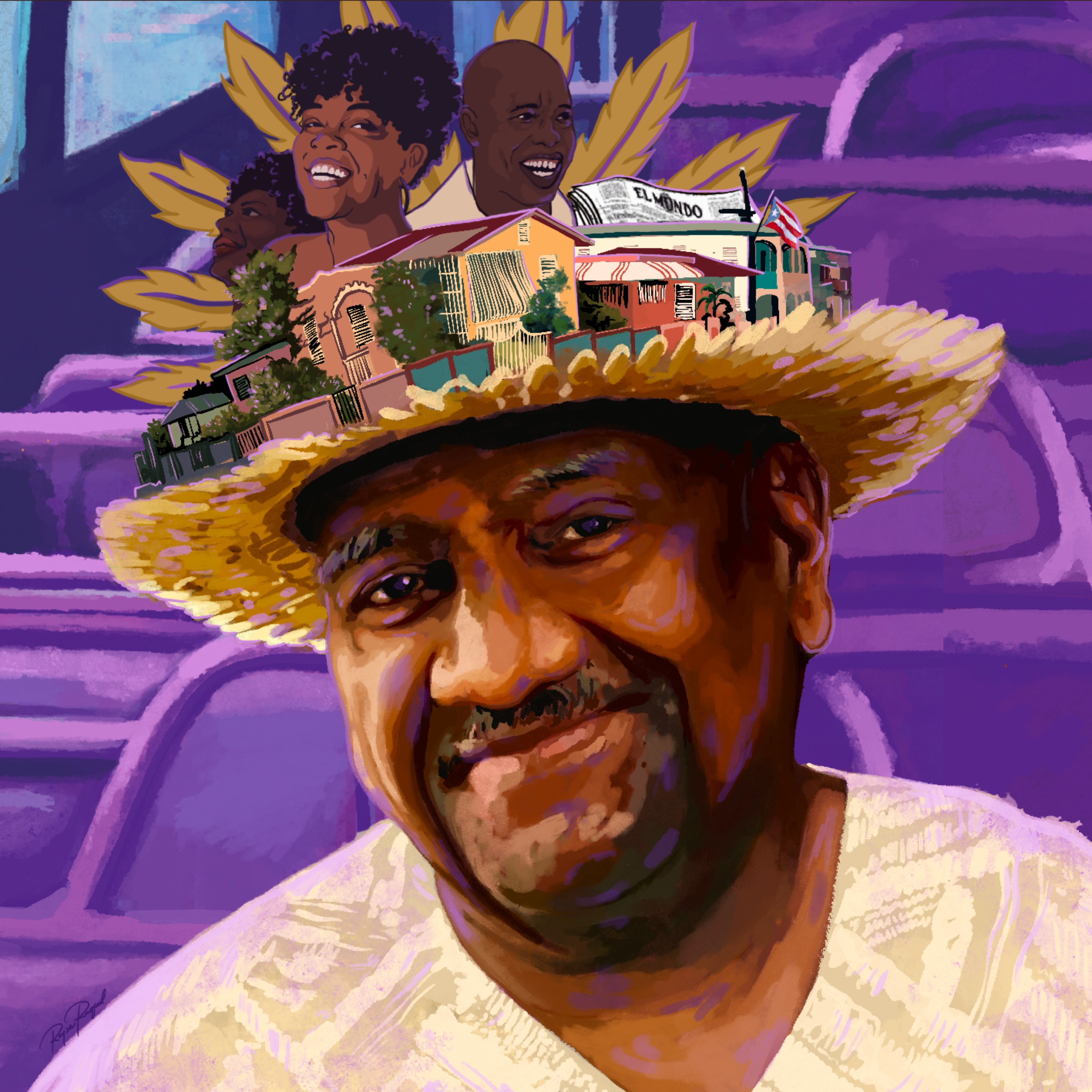
5. “Las Caras Lindas (De Mi Gente Negra)” — An Ode to Blackness
from La Brega: Campeones
37m 9s
La transcripción explora el profundo legado de la canción "Las Caras Lindas", compuesta por Tite Curet Alonso e interpretada por Ismael Rivera. La pieza se analiza como un himno de celebración y orgullo de la negritud, escrita desde y para la comunidad afropuertorriqueña. El episodio detalla cómo Tite Curet, a través de su lírica, centró la herencia africana del Caribe, confrontó el racismo sistémico y desafió la narrativa oficial puertorriqueña que históricamente ha minimizado la negritud para atraer inversiones estadounidenses. Testimonios de figuras como la profesora Barbara Abadía, la hija del compositor, Ilda, y el cantante Rubén Blades, revelan la intención comunitaria y el proceso creativo detrás de la canción. Su impacto es global: inspiró a Susana Baca en Perú a abrazar su identidad y a Flor de Toloache en Nueva York a crear una versión que resonara con una nueva generación. La canción se presenta no solo como una descripción musical, sino como un espejo que ofrece orgullo, un antídoto contra el racismo internalizado y un legado vivo que continúa afirmando y visibilizando la belleza de la gente negra.
Hola, ese quiel de la brega aquí con un gran reminder. Estamos en un conversación de Birlchock Q&A para futuros campeón LEGO Members. Tuesday, April 7, a 2 pm, a la hora de la hora, y se va a estar en el momento de la semana. El 7 de abril, a las 2 de la tarde, sus criptores de futuros los tendrán acceso a una conversación exclusiva de cómo se matió el cobre en la tercera temporada de la brega. Unete a futuros como campeón y llegale. Marguer Calendars ha convido a futuros los los de la empresa para la campeón y el día. Detalles en los shownodes. Gracias. ¡Verdad! Y acoje el episodio con el título en español. Piel Canela, un bolero que ha sido cubierto. ¡You know, a lot! Piel Canela literalmente significa "cinamon skin". Actualmente, Piel Canela, fue retenido por los rechazos de la música de la república de Afroporto. El comparecente de la esquina de la que se puede ser una espalda exátea en la fecha de la esquina de la ruta de la ruta de la ruta. Eso es Barbara Idaliz Abadilla Rhesash, profesor en San Francisco State University. Barbara también ha rotado un libro que ha musicalizado la rasa, musicalizando la ruta. El Canela de Sample, es la sexualización de este borde de la familia que no es completamente blanca, no completamente blanca. Bobi Capo también ha rotado una otra canción que ha rotado el negro de un borde que se tradúa a la llena "black man" de la ticlita. En esa canción, una esquina de black man es de un esquino, porque tiene un esquino, ¿verdad? Cuando un speiro de black man se ha rotado el negro, el gualdés con ti o la bamba y la llena. Él ha rotado su suelta, así en esa canción, que es la rasa que es la rasa que es la rasa que es la rasa. Esta canción es "Garbonerito", reto por una rasa de black man, Peter Belakis. ♪ Yo me cace como una negra en tan favor ♪ Aquí, se toca a la rasa de una rasa de black man, la rasa de black man. Yo me cace un chante de black man, y después, estamos a la rasa de black man. ♪ Con un olor bomba ♪ La rasa de black man, que es la rasa de black man. ♪ Yo soy un negro con ti ♪ Así que, son las rasa de black man, utilizan tíriotas y unas rasa de black man, incluso cuando se pueden tratar de ser algo de satirado. Entonces, tenemos son las rasa de black man, que son rasa de black man y satirado, que son rasa de black man. Pero en todos los paredes de rasa de black man, que Bada Bada ha llegado a la rasa, hay una que se piensa diferente. ♪ En las caras lindas, ¿qué te piensa y te piensa? Es una la rasa de black man y black man. ♪ ♪ Las caras lindas de mi je, te le cae. ♪ Y es tan simple y tan directo, las caras lindas de mi gente negra, de heridos de las frases de mi black man. Esta canción fue la primera recorre de la regalía y el rio de "Yfmael Rivera", y fue ritado por Catalino Curea Alonso, en 2000, hit after hit, para todos los estados como Celia Cruz. Cheo Feliciano, Nalúpe, Ector Labó, y su genia era legendaria, incluso entre otros genias. Por ejemplo, hay una historia sobre el renown de Colombia y writer Gabriel Garcia Marquez, ¿no? Él rodeó 100 años de solitude. A mí, él dice que él fue enviado de una de las songas de la de Teez. La plantación adentro. Marquez pilió que Teez ha hecho en una canción que ha hecho un libro de compilio. La historia de la de la de la de la América. Pero la caras lindas, la canción es algo más entera. Es un poder de la gente. Cuando él dice, "El amor de las frases de mi black folk, no es sólo por Puerto Ricans, es sobre la humanidad, es sobre la recognación, la humanidad de la blackness y la gente de black people de todos los estados. Él literalmente nos da un amor de la humanidad de black people. Perhaps él fue pensando a mí y mi familia también. Para futuros estudios y WNYC estudios, estoy a la Nacasa Nova Purgis, y esto es la brega. En este episodio, "Track 5". La caras lindas, un hode de blackness. Ahora me voy a ver con Barbara. Yo era raro por un amor, que era un salzafán, y una familia, los niños de la muro de el sonero mayor y el ribero de la maría de la maría. Así que yo estoy muy seguro de que he escuchado las caras lindas muchas veces en mi childhood, en los 80s. Pero me he admiso que yo nunca me he pensado de la atención de su léctrica. Entonces, en 2003, yo era la primera vez que mi maestro teeces, y las caras lindas reappear. Llegué en la raro, presionado y analizado, sobre y sobre, el sonero se reveló a él que no sólo celebró la violencia de blackness, pero propósito separar de la prejuicidad y discriminación. Los hermosos de las caras lindas. Los hermosos de molasses en el blumen. Cuando me vean por la cara, mi gran barrio de la llave de blackness. Cuando he finalmente tomado la léctrica como un adulto, mi sonreja para ver en el mundo y hablar de mí, y de mi hija de la luz de mi caída. De mi alma, la suelo y la mano. Los hermosos de la vida de los hermosos. Pero ellos se han tirado la cara tan adentro. En un entrevista en el show de Tommy, en Puerto Rican civil durante el 80s, Tite Cured fue a la gente de la gente que fue identificada. Yo soy Antillano. Y luego se ha llegado a la ciudad de Bicileja, de las africanas. Con las africanas claras, apenas como Don Dieta se llamó a una infancia de blackness, yo también me ha llegado a la gente de blackness. Porque de la interrogación de la mano, sobre mi Puerto Ricanidad. Por favor que me piden que me pide el mar de la cara de la mano. Yo me ha experimentado este tipo de prejuíces en algunos situos de San Juan. Los hermosos de los hermosos me han llegado a la mano porque de su primera impresión de mi color de la mano. El problema es que aquí en Puerto Rico, un poderoso medio de la rica de la rica de la rica de la rica y es su nombre de la gente como Cospol. Los hermosos de la rica son una rica perfecta. en sí, cuando la plataforma de la This is Where he ascendidoavam, lo que esta otra vez lo rompe theo de la Iz背, que cada vez se ligaba su energetición reactiva awww. Maules entriendo al94 un labery. Estudi qualifying Audrey vs.
stean sevoro turABlón relativelyɶtr; lo que a sí que me pinnedio en una cantidad de blancos naples.
Back in the 50s Puerto Rican politicians wanted to frame Puerto Rico as mixed race and distance it from blackness to make it more attractive to US investors and the political elite. Puerto Rico was not black. Coling myself black is a way to resist the myth of Mestizaje, the idea that we are racially harmonious. You know, the great Puerto Rican family. In reality, black people have always been treated differently on this island. I say it everywhere, especially on the beloved beauty pageants, where beauty is often equated with whiteness. And the beauty of blackness is always questioned and mostly absent. Why bodies are privileged over black bodies like teeth and mine? Because in the Carolina's, this does not happen. In fact, it's kind of the opposite. The Carolina is the most beautiful and profound Puerto Rico in the United States. That's Juan Otero Garaviz, a writer and professor of Puerto Rico and Caribbean literature at the University of Puerto Rico. For Juan, the Carolina is the most beautiful and profound poem written about blackness in Puerto Rico and the whole hemisphere. Tito was never interested in writing about our Hispanic, white, European heritage. Instead, he centered the stories of Caribbean natives and our African heritage. He was the voice of Ruben Blades, singer, composer, actor and writer. He was also a backup singer on La Carolina's. He wrote about society and not only describing what was happening, the unfairness of things that were happening, but also providing hope that we could by confronting those realities could change them for the better. Can you imagine being a girl that is in high school? I had my friends there with me and they say, listen, look what he does father wrote now. Of course, I felt very proud. And that is Ilda Curevela-Squez, daughter of Don Tito, talking about how she felt when La Carolina became a hit. Just one out of a flood of beautiful memories she has about her father. He was always busy with a book with the tape recorder or with a piece of paper, always writing with a pen or a pencil in his hands. And he always was singing, soniando, making the rhythm of the song that he was going to write. But Tito's road to son writing was bumpy. And this documentary from 2002, Tito tells the filmmaker Sonia Friedz that his father was a Spanish teacher and a musician, thought that Tito was too dumb for music. Being a son of a person that is Spanish in public schools, I imagine that he was looking for perfection. It was very hard for my father to have a person that most likely was criticizing him. I imagine that he did his best to show his father that he could. That it was possible for him to be successful. And Tito could not escape music. It's around at him. It was inside of him. It was in his jeans. My grandma, she was a musician also. She liked to sing songs. She wrote hymns. Because the other jeans that my father had, so it came from mother and father. When Tito was young, he and his mother moved to Barrio Vero Santurse, a predominantly black and working class neighborhood in the middle of San Juan. Leaving there, he got close with an uncle that used to be an editor at a newspaper. Tito used to accompany him on payday. And on those trips, he found a new passion. Here is Tito again in the documentary. He said, if people pay for this, referring to the newspaper, I will be a journalist when I grow up. Tito took a serious leap. He said that it was journalism that made him a real writer. journalism gave him the power of description through verbs and prose. You can hear the power of his lyricism in La Tirana, son by La Loupe. Here is Tito in another interview with Venezuela reporter Lida Santodominco, breaking down his lyrics. He's pointing out how he construct his songs. Van Piresen Tuno Vega. Van Piresen Tuno Vela. The Grammatical devices, he's using. La Gran Tirana. I don't know, but it's Tito. Lida is pretty sure that her father's experiences to live in this predominantly black and working-class community were fundamental to all his work and essential for the creation of La Caralinda. It was a description of his upbringing, even in Barrio Brero, predominantly black. Santurse, predominantly black, was an experience that moved him to write that song. Of course, who was the person that he gave that song to? One of his friends is my Rivera from Santurse also. Is my Rivera, El Sonero Mayor, the most important and influential salsa singer of his generation. And the other half of what makes this song so powerful. The way this black man is my el sings, the lyrics his black brother wrote for him is like they are offering a gift to every black person they have ever known and loved. He was able to describe how we wear the daily living of blacks in Puerto Rico. They laugh and they cry that they have beauty within themselves. Papi exalted a lot to the people. He does say that her father was always lifting black people up. He is always impressed by the beautiful ones, those beautiful purple ones. They smile so beautiful. Here, Tete, on his radio show, tells the story of how he first got inspired to write La Caralinda's when he took him the beauty of the woman of Loisa, predominantly black-town in Puerto Rico. This is why, for Africa, cliviges, our friend of Tete's, La Caralinda's offers a clear and accurate picture of where we come from. But it's also a mirror that shows us pride. The pride with black people feel about our blackness. Africa carries the pride of being black that Tete writes about in plain view. When I ask her how she celebrates her blackness, she did not miss a bit. That she was the most beautiful and most joyful black woman in her homeland. I confess that while this made me smile, it also made me feel some resentment. Because frankly, I have never felt that way. And that made me wonder why does it seem to be so easy for Tete and Africa to celebrate their blackness while I am still burdened by internalized racism. We back after the break, this is La Varega. I host Mrs. Ruben Blakes and you're listening to La Varega.
We'll continue now with Barbara Ithalice Abadhiarri Satch and the story of Don Tite Kuret and his beautiful faces. Before the break, I asked myself, "Why does it seem so effortless for Tite and Africa to celebrate their blackness while I deal with internalized racism?" The truth is, I have never felt like Africa or Tite. During my childhood, I felt that my existence was always questioned because my skin was darker than my family's. My brothers were like skin with green eyes. Blackness seemed to push me away from my own brothers. Internalized racism doesn't come out of nowhere. It's a system that's all around us. And we need community to face it and learn it. Las Caras Lindas is a great example of this. It was written in community for a community. Tite wrote the song thinking that he will give it to his friend Ismael Rivera. He then called all other musician friends to join him. Among them, Panamanian singers and writer Ruben Blades. "I am a Ruben Blades, Ruben Blades, Ruben Blades." Ruben Blades, Antite Cure, had already met his father in Puerto Rico in the early 70s. "I saw a man that showed up and he was dressed in a very special way because he had this big Puerto Rican hat and he had a shirt that looked like African. For some reason I thought he was a musician." They were both waiting for the doors to open for a concert of Puerto Rican San Salejen, Cereo Feliciano. "And that's how I met him. And from that moment on we became very, very good friends." When Ruben talks about Tite, you can tell how much he loved him and the great influence he had on Ruben's life. "The first time I ever sang in Puerto Rico by myself, I was nervous and he said, you're passing your test today. Your popular test here, don't worry, you're going to do really well. It was very comforting for me to have him there because he was Tite Cure Dalon, so he was bigger than Big." For Ruben, Tite's lyrics are timeless. "The songs, the lyrics have no expiration date because they are based on life." And La Carolina's continues to be received and integrated and adapted to each generation. You know, we have not fulfilled the dream. We are in the process of fulfilling the dream. So in the interim, every generation is going to be helped by the contributions of generations passed to reach that goal, to try to make their transition to as a better world possible. Tite wrote about blackness many times from different angles. In La Carolina's Tite celebrates. But in other songs, he condemns racism, like in the South-Sion, which literally means eviction. [Music] The song is based on the real-life eviction of Adolfina Villanueva, Sorio. She was a black housewife from Luis Apuerto Rico. In 1980, she was murdered by police as she was forcefully evicted from her home. She was still looking to find the order when authorities accelerated the process. They surrounded her home and shot through her windows. Sixteen bullets hit Adolfina. No one was prosecuted for her death. The South-Sis' song did the road specially for Ruben to sing. When I asked Ruben about the song, he abruptly stopped our conversation. We were on Zoom. He asked me if I could give him a moment. He left the call and then came back holding two things in his hands. [Music] First, he showed me a piece of cardboard with a hundred and note that read. Ruben, the family of Adolfina, Ruben adoles Fina's family. Then, he showed me a hand-made wooden Puerto Rican flag. [Music] Ruben tells me that it was the surviving members of Adolfina's family who gave him this cherished artifacts. They brought them the first time he sang the song "Live Importor Rico". [Music] And as he remembers that moment, tears come to his eyes. [Music] That voice break, that moment of connection between Adolfina's family and this international salsa superstar is another testament to the power of the suspend and it's a power that is transcendent. And perhaps that is why one of the most iconic covers of Las Teras Lindas was recorded thousands of miles away from Puerto Rico by the award-winning singer composer and giant of Afro-Perovia Music, Susana Baca. [Music] Susana remembers when she first heard Las Caras Lindas during her college years. The song gave her insight during a period where she was starting to grasp what being a Black Peruvian woman meant. It helped her realize she did not need to hide her blackness behind a weak or a perm and that she deserved respect. And so she understood and she lived my life. And Susana says that experience freed her mind and compelled her to cover the song with an Afro-Perovia rhythm. So that the youth of her country could make it their own. [Music] Susana never had the opportunity to meet Tite. She finally made it to Puerto Rico after he died in 2003. But Tite did have the chance to listen to Susana's cover because he used to host a public radio show in Puerto Rico. [Music] Tite would play her version of Las Caras Lindas on his show. He was so proud his song had traveled all the way to Peru. I played this audio from Tite for Susana. [Music] Susana was so happy that she just burst into the song. [Music] [Music] Listen to Susana Baca de la Colina, sing her favorite verse of the song "A Capella". Well, I was just overwhelmed by emotion. I got theory I'd it was also my birthday, by the way. [Music] Susana thinks there is no other song in the world that speaks so love and lie about us, Black people. [Music] I mean just the chorus too. [Music] I have simple but on point it just fills your heart with pride, you know, to be Black and you're beautiful. This is Mirella Ramos, founding member of Florida Tolo Ache, an all-female mariachi group based in New York City. And that's what it really what it says. It's very simple but it's necessary, you know, to phrase that we we need to tell ourselves and remind ourselves. Mirella's mother is Dominican, her father is Mexican, and she was raised in Puerto Rico. I also obviously saw myself in the song. It was one of those only songs that I grew up with where I felt identified and seen. As a young, Black mixed girl in Puerto Rico, there was not a lot of representation for her in popular music. I didn't have like a Black woman that I looked up to that was an artist and I knew that I wanted to be an artist since I was little. So, meet in Tite and hearing his song reassure her that she was not alone, that she could live how she felt inside. A beautiful Black person and someone capable of being a beautiful Black artist. I've always seen myself in this song and it results and celebrates a community that's not often celebrated.
which is the Afro Latinos, which I'm very proud to be. In appreciation for Tito's work, Flore de Toloache recorded a version of las caras lindas for their second album, and also named the album after the song. They chose to cover the song as a Wapango, a Mexican rhythm. The cool thing about the Wapango is it's very syncopated. (horns honking) That sixth aid is that African beat. It was also an opportunity for collaboration. My brother, Vellcro, who row this beautiful, beautiful rap, and then we also invited Pedro little Martinez from Cuba. (horns honking) And it was just like this explosion, you know, of like mariachi, which some of the rhythms are have African influence, you know, the roots. (upbeat music) - Today Mirella is basically giving John people what she wanted when she was a kid. At a recent music festival, a family came up to her after the performance to tell her how moved they were by the caras lindas. - And there was a family there with a little girl who's mixed like me. This little girl, even though she didn't understand everything I was singing about, she saw herself in it, just the same way I saw myself in it. - This process of analyzing the caras lindas has brought me a lot of joy, but it also brought me grief. Because when I tackle the question of where we are now in Puerto Rico regarding race, 45 years after this song was released, the answer is this heartening. The answer is found in the constant use of negro to talk about things that are seen as bad, dirty, and ugly. Or when people talk about making their race better, or wanting to fix their bad hair, or when you realize our poor citizens are black. Or when the schools that serve black communities are the ones that are chosen for closure. Or when they are raised 11 year old Almayarila Cruz Cruz, after she defended herself against constant races bullying in her school. Or when I see the constant anti-black attacks from neighbors towards a family in their hometown of Canoanas. Every single day, the existence of anti-black racism is confirmed in Puerto Rico. During that struggle, I see that sometimes I talk about blackness from a place of pain and frustration. And it's exhausting. But as Tita's friend Africa told me, this struggle is a dignified one, even when it feels constant. The struggle continues, but not a sad struggle. It's never a sad and hard struggle. We sing, we sing, we sing, we sing, and dance while we fight. We sing proud of our color and we reclaim our space with the power of music. We stand proud of our skin color and we take our rightful place with the power of music. That is why even when I do recognize that the fight against anti-black racism will not end anytime soon, surely not in my lifetime. I want to honor every single thing that actually celebrates blackness that celebrates us as the human beings we are dignified, full of tenderness, full of love and beauty. And the world can never take it away. Thank you, Don Tita. (upbeat music) We've heard how La Caralinas has made its way around the world. For our La Brega cover album, we're bringing it back to Beirre. (upbeat music) We asked La Tribal de Abrante, a 12 piece Afro-Boricoa Orchestra from the Archipelago to reimagine it. And they rooted it in a very Puerto Rican sound, bomba. (upbeat music) You can hear the full version in the La Brega cover album, out soon. (upbeat music) (upbeat music) This episode was written by Barbara Abadilla Rezach and produced by Sekiel Rodriguez-Handino with help from Gene Montalvo. It was edited by Marc Pagan, Maria Garcia and me Alana Casanova Burgess. Original art for this episode is by Reiza Rodriguez, the collective MoriVivi. Additional music this episode by Circulo Sacra, René Ghost and Ernesto Lucas. Special thanks this week to Radio Universidad de Puerto Rico, Sara Cruz Castro, Osvaldo Rivera Soto, Taller Community Alagoico and Elizabeth Andrade. - Excuse me, Alana. I want to dedicate this episode to the memory of my mother or guest there Rezach Vallala. (upbeat music) The La Brega team includes Gene Montalvo, Sekiel Rodriguez-Handino, Joaquin Kotler, Lilliana Ruiz, Dasha Sandoval, Marc Pagan, Maria Garcia, Victor Ramo Rosado, Juan Diego Ramirez, Marlon Bishop and Jenny Lotton. Fact checking this season is by Istra Pacheco and Maria Soledad. Our engineer is Joe Pord. Our theme song is by Ife, and Original Music is by Balloon. You can hear all the music featured in this episode and this season on our Spotify playlist. We've got a link in our show notes and don't forget to tap the heart to save it to your library because we'll be adding to it each week. This season of La Brega was made possible by the Mellon Foundation. I'm Alana Casanova-Burgis, join us next week for Track 6, Boricua La Luna. Bye. (upbeat music) (upbeat music)
Podcast Summary
Key Points:
La canción "Las Caras Lindas" de Tite Curet Alonso es un himno que celebra la belleza y el orgullo de la negritud, escrito para la comunidad afrodescendiente.
La obra de Tite Curet, incluyendo temas como "Las Caras Lindas" y "Sácame la Espina", aborda la identidad afropuertorriqueña, confronta el racismo y desafía el mito del mestizaje armonioso en Puerto Rico.
El impacto trasciende fronteras, inspirando a artistas como Susana Baca en Perú y Flor de Toloache en Nueva York, y sirve como espejo de orgullo para generaciones de afrolatinos.
Summary:
La transcripción explora el profundo legado de la canción "Las Caras Lindas", compuesta por Tite Curet Alonso e interpretada por Ismael Rivera. La pieza se analiza como un himno de celebración y orgullo de la negritud, escrita desde y para la comunidad afropuertorriqueña. El episodio detalla cómo Tite Curet, a través de su lírica, centró la herencia africana del Caribe, confrontó el racismo sistémico y desafió la narrativa oficial puertorriqueña que históricamente ha minimizado la negritud para atraer inversiones estadounidenses.
Testimonios de figuras como la profesora Barbara Abadía, la hija del compositor, Ilda, y el cantante Rubén Blades, revelan la intención comunitaria y el proceso creativo detrás de la canción. Su impacto es global: inspiró a Susana Baca en Perú a abrazar su identidad y a Flor de Toloache en Nueva York a crear una versión que resonara con una nueva generación. La canción se presenta no solo como una descripción musical, sino como un espejo que ofrece orgullo, un antídoto contra el racismo internalizado y un legado vivo que continúa afirmando y visibilizando la belleza de la gente negra.
FAQs
'Las Caras Lindas' es una canción escrita por Tite Curet Alonso que celebra la belleza de las personas negras. Es considerada un himno de orgullo y reconocimiento para la comunidad afrolatina.
Tite Curet Alonso fue un compositor puertorriqueño que centró su obra en la herencia africana del Caribe. Sus letras abordan el racismo, la identidad negra y ofrecen esperanza de cambio social.
Vivir en Santurce, un barrio predominantemente negro y de clase trabajadora, fue fundamental para su obra. Esta experiencia lo inspiró a escribir 'Las Caras Lindas' y a describir la vida diaria de los negros en Puerto Rico.
Rubén Blades fue un gran amigo y admirador de Tite Curet. Tite lo apoyó en sus inicios y su obra lírica tuvo una influencia profunda y duradera en la carrera de Blades.
La canción ha sido versionada internacionalmente, como por Susana Baca en Perú y Flor de Toloache en Nueva York. Sirve como espejo de orgullo para comunidades negras en distintas partes del mundo.
También condenó abiertamente el racismo y la injusticia. Un ejemplo es la canción 'Sácame de Aquí', basada en el desalojo y asesinato real de Adolfina Villanueva por la policía.
Chat with AI
Loading...
Pro features
Go deeper with this episode
Unlock creator-grade tools that turn any transcript into show notes and subtitle files.
 PodcastTranscript AI