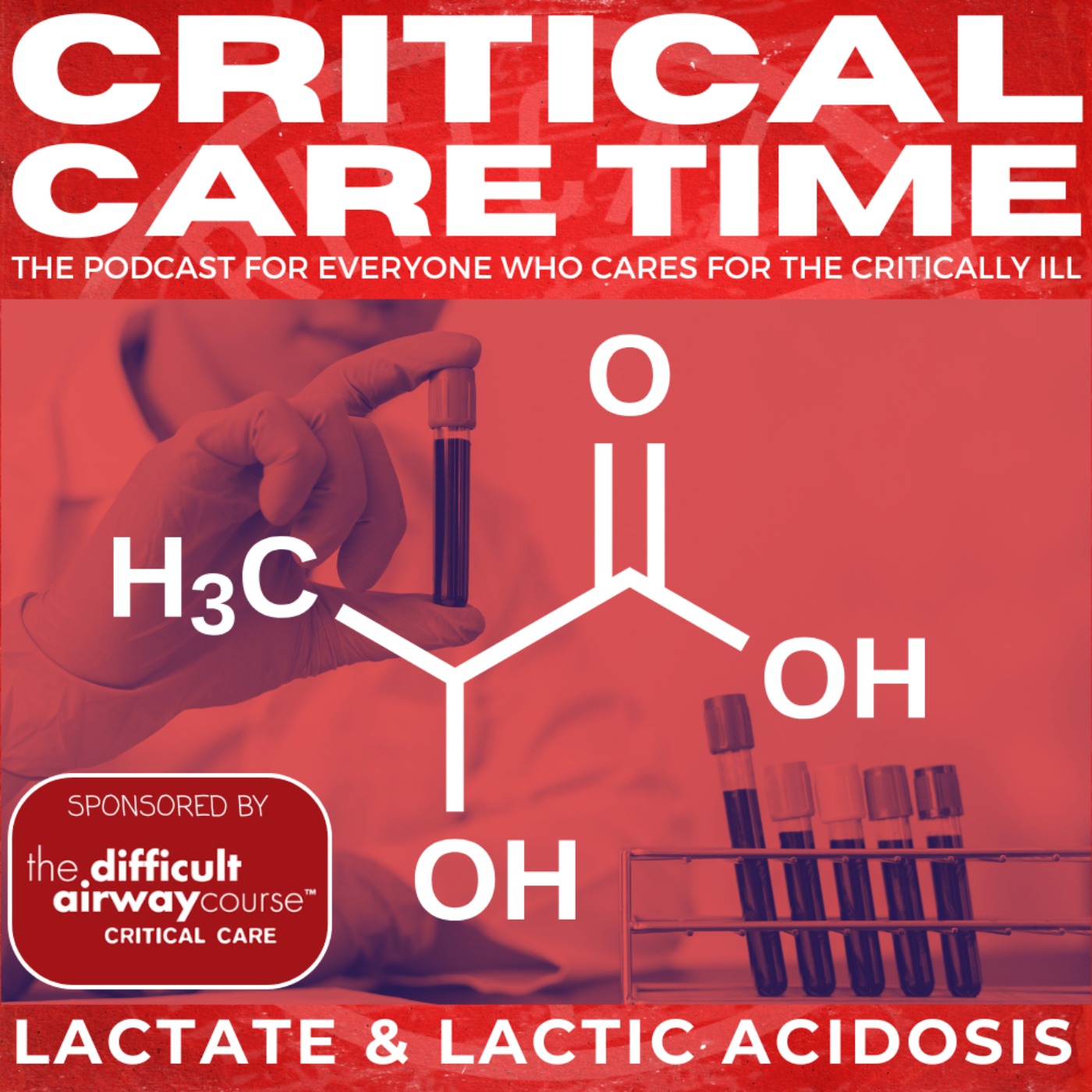
The discussion critiques the common clinical reflex to administer fluids for elevated lactate, emphasizing that lactate elevation has multiple etiologies, such as impaired clearance, and is not solely indicative of hypoperfusion. Lactate is explained as a normal metabolic product, with levels rising during strenuous exercise—exemplified by elite athletes—without implying illness. The biochemistry of lactate production is outlined: under aerobic conditions, glucose is efficiently metabolized to CO₂ and ATP via oxidative pathways, whereas anaerobic conditions lead to pyruvate conversion to lactate, yielding less ATP. The distinction between lactate (a conjugate base) and lactic acid (which lowers pH) is clarified, noting that lactic acidosis requires both elevated lactate and acidosis. The myth that lactated Ringer's contains lactic acid is debunked—it contains lactate, which can buffer acid. Overall, the takeaway is to avoid reductionist approaches to lactate interpretation and consider clinical context comprehensively.
Getting the call from the ER that there's an elevated lactate and saying, "Okay, how much fluid did you give them? Give them more fluid, then recheck so you can send them to the medicine team." That is just like, I've heard that, I've seen that, and it is just like, not great. It's not great doctrine, you lose doctor points for sure, you lose, I think, credibility instead, like, recognize elevated serum lactate, does not mean knee-jerk-gift fluids. You could have impaired clearance, you could have all those other causes we talked about. Welcome to Critical Care Time, the podcast for everyone who cares for the critically ill. I'm one of your hosts, Dr. Cyrus Askin. And I'm your co-host, Dr. Nick Mark. How about that energy? Sorry folks, working nights this week, waking up to record this episode, but we got a really great one for you planned. Something you've been needing to talk about, I think, since literally episode one of this show. That's right. That's very true. Working for you are like, "Hey, Cyrus, how's it going?" and instead I just got awkward silence, and then I just responded with further awkward silence. Okay. Yeah. That's as one does. Okay, yes. Nick is absolutely right as he often is. We're going to be talking about a topic in medicine that is, I think, quite clinically relevant, also a great topic to discuss here early in the academic year. We really wanted to kick season three off with a bang, with something that's going to be fun. Or a burn, if you will. Or a burn. I love it. Yes. Lots of useful pearls for the season clinician, for brand new med students, for trainees, for everyone in between. All right. We're keeping them in suspense too long. Tell them what the episode's about. All right. So we are going to demystify lactate or lactic acid, or are they the same? Oh, I don't know. Well, we'll find out today. And we're going to try to help you guys differentiate between different causes for lactic acidosis, why we even care about lactic acidosis, so on and so forth. We're going to bust so many myths along the way, it's going to be like an episode of mythbusters. It is. It is. Yes. Please don't sue us. We need every penny we have in the coffers. Okay. Um, with that being said, let's go ahead and get to it. All right. All right, Nick. So why don't you help us collectively understand what lactic acid is? Yeah. So at risk of invoking some biochemistry PTSD, we're going to use some scary biochem words a little bit on this episode, but trust me, it's all for the cause of understanding. So if you remember glucose, it's six carbons. And what your body wants to do is you want to metabolize that and extract all the energy you can from each of those bonds. And ideally, you're going to turn it into carbon dioxide. And along the way, you're going to turn it into something called pyruvate, which is three carbons. And lactate or lactic acid is a three carbon breakdown product of pyruvate. I guess the way I like to frame this is I like to think of myself as little tiny steam engines, right? They're using oxygen to burn fuel, in this case glucose into carbon dioxide. And along the way, they produce heat and they extract energy to do useful work, right? So normally, our cells consume oxygen, and they turn one molecule of glucose into six molecules of CO2. Remember, it's six carbons. And they extract about 30, 32 ATP or dentistry and triphosphate, which is sort of like the, I think of it as sort of like the double A battery of the cell. It's sort of a convenient amount of energy for doing metabolically useful work. Or for those that are financially inclined, it's the currency upon which our cells trade. Exactly. Exactly. It's like the Bitcoin of the cell, if you like. I like, yes, the Bitcoin of the cell, I like that. Or the Dogecoin, or the Diaryacol, or fortunately there is no deflation at ATP. That's right. Yes. One of the cool things about this process is it's actually pretty efficient. The thermodynamic efficiency of our cells taking glucose and turning that into ATP is about 42%, which, you know, for fans of Hitchhiker's Guide to the Galaxy is the meaning of life. Amen. And your muscles turn glucose into actual work. It's a little less efficient. It's maybe more like 20 to 25% efficient, which, you know, for sake of comparison is probably about the same as like a Honda Civic, depending on how efficiently you drive. Oh, man. Be still my beating heart, my Honda Civic from many, many moons ago. It's not a perfect analogy, right? I mean, your cells aren't a heat engine. They're more like a chemo, osmotic engine cycle instead of like an auto cycle, rank and cycle, whatever. But, you know, I think the analogy is good in the sense that think of your cells as little engines that are turning fuel plus oxygen into CO2, which you're breathing out, and they're extracting work along the way. But here's the problem. What if there isn't oxygen, right? I was going to ask, you're holding me in suspense. Right. So just like if you try to drive your Honda Civic underwater, where there isn't oxygen, things aren't going to go well. Fortunately. It's very, very Dwight Shrewt, Michael Scott of you. That's right. Yeah. If you follow, if you follow the GPS very literally, you could get into trouble. But, but fortunately, more like maybe James Bond's car, right? It's got like another mode that will work in the lake, which can use an alternative pathway, an alternative electronic software to use glucose, even without oxygen, right? This pathway, instead of turning glucose into pyruvate and then pyruvate, runs through the citric acid cycle and off to CO2, this kind of stops halfway. It stops at glycolysis, and then all this pyruvate builds up. And then it could turn that pyruvate into lactate, which is a way to get rid of that pyruvate and keep the cycle going. Awesome. Yeah. So, and we're going to get into some of the details here in terms of like the mediators, the players, if you will, just to make sure things are nice and clean. But yes, essentially, a lot of this is a discussion of how do we utilize glucose to generate energy in the presence of oxygen, in the absence of oxygen. And then we're really going to try to hit some of the clinically relevant pearls to make sure that you guys come away from this. Not just with a headache, but with some practical tools that you can use when you're taking care of patients. So, with that being said, why should we care about lactate acid, Nick? I mean, what does it matter? I mean, so I think there's kind of two reasons to care. One reason is that acidosis in general is bad. If you have a severe metabolic acidosis, like a pH less than 7.27.1, this is going to cause a lot of different enzymes and cellular processes to work, as well. And also, for example, like the cardiac muscle won't pump as well. Your smooth muscle around your arteries will start to relax, because it won't squeeze as well, so you'll have a lower vascular tone. So that's why we often associate acidosis with shock. The other reason is that, I mean, you're presumably making more lactate for a reason. And so that reason itself may be a problem. Yes. Yes, I think that's, well said. And I think, Nick, we were talking about this as we were putting this episode together, but there's not really anything intrinsically bad about lactate or lactic acid in and of itself, right? I mean, we make this chemical, it's a normal metabolic product that we use to keep our bodies working. It's kind of why our muscles, one of the reasons anyway, maybe the principal reason why our muscles burn during vigorous exercise. But of course, we make lactate at rest, too. It's not all like an on-off switch situation. Right, and one of my favorite papers looked at Olympic rowers, like people who had literally one gold, I think silver medals in the Olympics. Oh, so losers. First loser. So they put them on an urge and they had them do like a maximal 2K row. And they did the blood gases right afterwards. And they found that the mean lactate concentration was 26 milimoles per liter. So that's the units you're used to, right? That's like a crazy high lactate. The highest value, maybe the gold, the gold medal value was 32 milimoles per liter, right? And this is in somebody who managed to drop his pH to like 6.85 or something. So, you know, I think, you know, if you, if you look at like elite Olympic athletes, you wouldn't be like, oh, these people are about to die. They, you know, you'd be like, oh, these people are like the paragon of health. And I just want to emphasize that like having a high lactate in the context of like, that you're a sexier size is not just normal, but being able to get your lactate that high means you really gave it your all. Exactly. Yeah. Context matters. And let's Pete the cat said, give it to your all, give it to your all in Christmas. We give. So we give it our all. That's not really relevant. But I just remembered Pete the cat. Anyway. So, um, okay. So why, why is lactic acidosis such a confusing concept amongst clinicians, whether they be potentially somewhat seasoned or junior or whatever, I think that, well, there's a couple of reasons. One, we're going to get to this. There's the terms lactate and lactic acid, which we, we really do use interchangeably. I'm sorry folks. We just do. It's kind of the convention. There are different things. We'll get to that in a little bit. We'll disambiguate. We'll disambiguate and then we'll proceed to, um, interspersum ad infinitum. But really, I think that the teaching on lactic acidosis is sort of this victim of reduction is teaching. Simple is easy, easy is understandable, but the thing is simple is not always right. And too, too simple is often wrong. Exactly. Right. And it's kind of the, the failure of the reductionist model. So it's this idea of like, okay, check lactate if high badness must give fluids. That's a concept that is actually kind of echoing in my mind and has echo. I think that's like sepsis robots prime directive. You just laid out there. That's exactly right. I know, and so the thing is that your lactic acid or your lactate can be elevated for a number of reasons, totally unrelated to hypotension, totally unrelated to shock. Those other reasons are a bit more nuanced, take more explanation, more discussion. And so I think a lot of times they do fall by the wayside. And then this other manifestation, I think of reductionist thinking as it relates to lactic acid is this idea that there's this like, um, biological, on-off switch, like a like a light, you just flip it on and off. And it's also far too simple to look at it that way. Now, yes, there's this idea of an anaerobic threshold and that concept, that's a, that's a term that's used in exercise physiology. It's used in general physiology. I think it lends itself to people thinking, oh, there's like a switch, but it's not. It's really like that anaerobic threshold is the point during stress, whether it's exercise or sepsis or whatever, where your body transitions from predominantly aerobic metabolism to ramping up anaerobic respiration. It's a tipping point, but really think of it as more of a gradient, metabolic gradient rather than an on-off switch. And so like, you know, Nick, you're talking about a lead athlete, so I'll use myself as an example of the pinnacle of elite athleticism. And so, so just speaking in broad strokes, folks that truly are elite athletes, we'll see that anaerobic threshold cross at the, maybe 60 to 80% of VO2 max, so talking about oxygen consumption, not a hundred percent. It's not happening. It's not like you get to this point where there's, you just can't use oxygen anymore any flip. It happens earlier. It's a, it's a gradient. Yeah, I want to just emphasize one point here, which I think is just a, like a nomenclature point. People get very confused about in lactate in the context of exercise physiology. So this notion of switch to is just totally wrong. It's more like add on. Right. You know, I think of it kind of like if you have like a hybrid car and you know, you're driving at slow speed, you're using like electric motor and batteries. But then if you want to go faster, the gas motor kicks in, right? That's kind of what's happening here, right? Like if you need to go like above, you mentioned like the 60% of VO2 max threshold or 80% of VO2 max threshold, if you need to go higher, then you need all your energy sources. So you're going to use aerobic and anaerobic. Another, another point to emphasize too is that the normal lactate isn't zero, right? Like you'll often see like there's blue values in the chart. If it's like less than two or red values, if it's more than two, why is the normal value not zero? Well, because we make lactate all the time. We're constantly cycling lactate out of ourselves through our body. And some of ourselves can only make lactate. So just as a quick aside, right? If you're a red blood cell, you have to, you have some enzymes, you need to do some work. But you don't really want your red blood cell to be using oxygen. I think of this as like the, you know, like if you have a hungry waiter, fewer of your french fries are going to make it to the table, right? Like you don't want your red cell to be consuming oxygen. So your red cells produce lactate all the time 24/7. They have no ability to use oxygen. So that's awesome. I mean, I had another analogy I was going to throw in there, but I think you've done a really great job, Nick, of explaining it in terms that I like. So I think I'll probably just steal those and hungry waiter, yeah. Cast by analogy to the, to the, I don't know, into the fires of mountain. So, okay. So we've talked a lot about kind of the basic stuff, but maybe now we can talk a little bit about some of these terms that can be a bit confusing. And I think one to start with, or maybe a great place to start here would be lactate versus lactic acid. How do you explain that difference? That's a great point. So lactic acid is a weak acid. It releases a proton. It's going to lower the pH. And it's going to cause all of those bad things we talked about where your tissues, your enzymes are not going to function as well because of that lower pH. Lactic is the conjugate base. Okay, that means that it actually can accept a proton. It will not lower your pH, it could potentially raise your pH closer to normal. It will buffer acid doses. So why does this matter? Well, I think sometimes people get very confused by the idea that we are trending lactate, but also we're giving something called lactated ringers, right? And I think people get very confused by that because they're like, oh no, wait, the lactic acid is bad. We're giving lactate, well, you're not really giving the same thing, right? One is acid produced by your body, which is contributing to a metabolic acid dose. The other is a conjugate base with sodium that you're giving, which is actually buffering their pH and potentially raising it. So they're kind of opposites, even though they have these similar names. And so I try to be really, I think, I think one maybe challenging point is that we often measure lactate, but what we care about is the acidosis that goes with it. We care about the lactic acidosis. That's precise. Neurine. Yeah. So I try to be particular and talk about lactic acidosis and talk about measuring lactic or giving lactated ringers. But this is kind of one of these distinctions that like, I think, I think most people don't really care about this distinction, you know, it's kind of like when people, as an aside, when people talk about phosphate, which is PO4, which is like biologically useful. And sometimes people will say phosphorous, and I'm like, no, if you gave somebody phosphorous, they would like literally catch on fire because if you put phosphorous in water, it burns. Right. You know, but like, I know what you mean, right? If you say this person's phosphorous is low, like, I'm there with you. I'm not going to be a dick and you feel like, oh, catch on fire. Right. I mean, I think like to sort of reduce that down a little bit, not too reductionist might do you? What we really, when we say lactic acidosis is we're measuring an elevation in lactate, plus there is this associated deprotonation that's occurred. So there are additional protons in the system, so to speak, that are lowering the pH. So yes, we're measuring lactate, but all else being equal, assuming we haven't given that patient a giant lactate infusion, that measurement of lactate should be relatively proportional to their lactic acid levels. It's just sort of after the fact, after that lactic acid has deprotonated, resulted in a drop in pH, so on and so forth. And again, Nick, we were going to talk about this a little bit later, but that myth, lactated ringers does not have lactic acid in it, period, full stop. And again, we're on that later. Perfect. What I'll mention, too, is just this idea of lactic acidosis. So that would be the elevation in, again, what we test, lactate. So greater than two millimoles per liter, plus a pH that is less than 7.35, so technically an arterial pH that's less than 7.35. Getting, once again, to this idea of just because you have an elevation in your lactate, your lactate is a conjugate base, and does it necessarily in a vacuum mean that the patient's acidotic. You have to have that data to actually make the association. Yep. And as a reminder, too, for folks, it's one of the many causes of a high inion, gap metabolic acidosis or a hagma, but there are many others too. We're not going to get into that here, but it is one of the causes. All right. So now for our audience, audience is listening pleasure. I think we can maybe move on to some of the biochemistry here and review some of the processes Nick, you had alluded to earlier in the show. So why don't we talk about ATP generation, why is it relevant and how does that work in the context of oxygen versus in the absence of oxygen, or I should say absent, but like relatively less oxygen. So let me just back up for one second, and remember like I think in many of the episodes on this show, we've talked about how like our whole job basically comes down to oxygen delivery, right? Like ventilators are really about getting oxygen in and CO2 out. Shock is like making sure that blood is pumping oxygen to tissues. Well, I mean, now we need to talk about kind of like why did we do all this work? Like why are tissues using oxygen in the first place? So let's sort of take this step by step. So many of you have PTSD from biochemistry, and you may recall that there's this process called glycolysis, when cells take glucose, and then they convert it into energy. The first part of this process occurs in the cytoplasm. This is where we turn glucose into pyruvate. You don't get a lot of energy for this work. You only get about two ATP and some other stuff that we don't talk about. But you've taken your six carbon glucose, and you've turned it into two three carbon pyruvates. You kind of partially metabolized it, remember our goal is to extract every bit of chemical energy, which is going to mean turning that six carbon into six CO2s. So the next step after glycolysis occurs in the mitochondria. This is where pyruvate becomes a COA, a bunch of intermediates. It runs through the citric acid cycle. And at every one of those steps pretty much, we're extracting some useful energy. We're producing things that you may remember, like at ADH, NADH, that's the good old NAD. Good old NAD. Anyway, these guys are really just sort of like, I don't know, if ATP is a double A battery, this is like some weirdo nine volt battery or something. This is like a higher energy intermediate. What NADH does is it basically is used to bring chemical energy from glucose into the mitochondria into the electron transport chain. And it's used to pump electrons along this chain. And the way I like to think about this is like the mitochondria is kind of like a dam, a hydroelectric dam, where you can store energy by pumping water on one side. And then you can let that water out in a controlled way to capture that energy. And that's actually a really apt analogy because that's pretty much exactly what the mitochondria has. Yeah, that's actually really good. ATP synthesis is basically like a turbine. It actually literally spins as electrons go through it. And it makes ADP dancing diposterate into it as you try phosphate ATP. Super cool. Biology. And this is way more efficient too. That's why you go to all this trouble, right? Like we didn't do this to torture people undergrads, right? That's like a weeder course. We do this because it's really efficient. The process of citric acid plus oxygosphorylation releases about 30 ATP. So remember that first half glucose to pyruvate was two, the second half pyruvate to CO2 is 30. So we're getting a lot of bang for our buck. Now the really important note that I'll finish on here is that as the name implies, this highly efficient final step oxidative phosphorylation requires oxygen. That's the final electron acceptor. And without it, we can't do this. So oxygen is really the key to efficient high energy metabolism. Well said. So there's a couple other players here that I think we should talk about. And that would be PDH or pyruvate dehydrogenase and LDH or lactate dehydrogenase. And this is probably like the last layer of depth that we need to get to to really appreciate the concept in general. So, so pyruvate dehydrogenase is this critical enzyme complex at the end of glycolysis. So remember Nick was saying you go from glycolysis to the TCA cycle. Well, pyruvate dehydrogenase is important. And it kind of determines so to speak whether pyruvate is going to enter aerobic mitochondrial metabolism. So that pathway or if that pyruvate is instead going to be diverted towards anaerobic respiration. So when oxygen is plentiful, again, that's going to allow the ETC to do its thing. When oxygen's plentiful, PDH converts pyruvate into acetylcoate. That goes into the TCA cycle. It allows for the generation of NADH, FADH2 feeding the electron transport chain and giving us that 28 to 30 ATP per glucose molecule that we know and love. However, when oxygen is lacking, so less oxygen in the system or you're utilizing oxygen like like a mofo, the electron transport chain then backs up due to the lack of that turbine can't turn because there's no oxygen around. Yeah. There ain't any oxygen. And so things start to back up. You end up with kind of elevated levels of these metabolic products. And so what ends up happening is pyruvate instead of becoming acetylcoate becomes lactate through lactate dehydrogenase and so or LDH. That process allows for the regeneration of NAD plus and facilitates continued glycolysis. So you could think of PDH as kind of this gatekeeper for oxidative metabolism when oxygen levels are high and mitochondrial activities intact, everything's going well. But there are limits. So of course, talked about oxygen, but then you also have some cofactors, things like thiamine, liponic acid, CoA, FAD, NAD plus, so on and so forth. So for example, if the electron transport chain is backing up and that NADH is not being converted into NAD plus, that'll loan results in this high ratio of NADH to NAD plus. That's enough to sort of quote unquote turn off pyruvate dehydrogenase. So in summary, because I know that was a lot of talking in terms that probably evoke feelings of nausea, vomiting, shortness of breath, diarrhea. So think O2 plentiful, PDH activity is greater than LDH activity. Net result is more acetylcoate than lactate. NADO2 is less plentiful. You have LDH activity on the rise, less acetylcoate production, more lactate production or more lactate production. I'll just leave it at that. Yeah, beautiful. Yeah, I think just remember, you know, if you think about that chart, you know, that like giant page, you know, poster of like cellular metabolism, the citric acid cycle is right in the center and pyruvate dehydrogenase is right above it. It's like the exact center of the chart, because it's so central to all of this metabolism, glucose goes down and it either spins around the citric acid cycle and it's really efficient or it needs another place to go, which is LDH off to the side, making lactate. So the next question we need to ask is where does the lactate go, right? What do we do with this? Well, this introduces the idea of the cori cycle. So normally there's, there's, there is some cycling of lactate between the different cells, particularly in your gut, but also in your, in your muscles where you're producing some lactate, that lactate is going through the blood and then it's going back to organs that can metabolize it. And you know, one really important concept we need to introduce here is the idea that the level of lactate in your blood represents a steady state between production, how much are you making, and clearance, how much are you getting rid of? And so we should talk about where it's cleared. Most of it, about 70% is cleared in the liver, some of it about 20% is cleared in the kidneys and a little bit, about 10% is cleared in skeletal muscle. And so what that means is that if you have somebody in your ICU who's got liver failure or liver failure and kidney failure, about 90% of their ability to clear lactate, maybe, maybe somewhat impaired, not 100% gone, but like limited. And what that means is that their steady state, their sort of resting lactate level may be higher, and the kinetics of lactate may be altered, right? If their lactate goes up, it will take longer to come down, right? Like if, Cyrus, if you or I like, you know, run really hard or erred really hard or whatever, and we get like at lactate burn, it's going to go away in a few minutes, right? But somebody who's got organ dysfunction, it may persist for much longer, like half hour hour plus. Right. Yep. Yeah. So anyway, just to summarize, your cell turns glucose into pyruvate, pyruvate has a really important choice to make either the efficient route that uses oxygen or the less efficient route. That's also, that's a perfectly good alternative that makes lactate. That lactate can go back to the liver or kidney and it can get recycled. Yes, exactly. So, yeah, I mean, and just to make sure, you know, we've really hit this out of the park. So why is this query cycle necessary? So that's really what's going to prevent lactic acidosis from occurring. So like we said, your lactic acid, deprotonates, you lower the pH as more and more protons enter the blood, that's going to impair enzyme function. It's going to impair muscle function as well, muscle contraction. So that's not ideal. And then we have to maintain the energy supply, of course. So it's an idea of recycling lactate back into glucose eventually, you know, through a number of steps to sustain that ATP production, somewhat poultry ATP production, but it's ATP production nonetheless. Mm-hmm. Something is better than nothing. Something's better than nothing. That's right. And then, yeah, so really like, there's also this idea that we're shifting the metabolic burden. So, muscles rely on glycolysis, which is fast but inefficient, while the liver supports recovery by converting lactate into glucose. So that kind of like, I think, summarizes why the query cycle is important, but the query cycle isn't free, is it, Nick? No, exactly. So I mean, it costs energy to run this backwards, to turn lactate into glucose, which is what the liver is doing. It costs about 6 ATP in fact. So your negative overall, but when you're running away from a tiger, you don't care about your net energy level. You really just care about getting more energy to your muscles. So this is why your liver functions as a store of energy in the form of glycogen. And this is why you have the query cycle in first place, among other reasons, which is to take that store of glycogen, turn it into, turn it into glucose again, and then get it out to your muscles where they can use it. So it's not, the query cycle is not a great long-term strategy, but it is an excellent way to provide short-term energy when oxygen is limited. Or when you're working so hard, you just kind of maxed out how much oxygen you can use and you need more. That's right. That's right. Now, as a funnicide here, I'll just say that even though we turn pyruvate into lactate, and most vertebrates turn pyruvate into lactate, there are a few exceptions. And one really fun exception is that certain fish, like carp, including goldfish, will actually turn pyruvate into ethanol. So kind of like yeast, like what yeast do? Yeah, exactly. They're functioning like yeast, they have a same enzyme, but it's doing the same thing. And what that means is that if your goldfish is in an anaerobic fish bowl, like you don't have one of those little bubbly things in it, they will actually steadily produce alcohol in that water. And you could drink it. You could. Yeah. Getting high on your own spot. That's right. Yeah. Potentially. Potentially there's a business opportunity here that someone who wants to make an incredibly niche beverage could produce like goldfish, slugger or something, bottle the stuff. We'll try to keep workshopping that name. Okay. So I fully recognize that this may seem like a lot of biochemistry and is probably that in some ways, the densest episode that we've done here on a critical care time from that standpoint. But there's some very important clinical relevance here. It kind of alluded to this, but imagine crazy idea that you have this ICU patient who has kidney and liver dysfunction. So obviously, I say that tongue in cheekily, it's like not crazy at all. It's like most of your ICU patients. And so they're going to have impaired clearance, which means that we'll be kind of pedantic here. The lactic acid that is produced during anaerobic respiration cannot be converted efficiently back into pyruvate, meaning on aggregate, you're going to have more lactic acid. It's deprotonating into lactate plus that proton per unit time, especially in those patients with, again, liver and kidney disease. And that's what's really going to result, especially in these folks, in this potentially profound and clinically relevant lactic acidosis. That's right. Yeah, exactly. And I think it's important to remember that let's say that you have impaired clearance and increased production. So for example, we'll talk more about this in a minute, but somebody's having a fever or seizure or they're moving around a lot, you know, you combine that with impaired clearance and they're going to get a very high lactate. And you know, there's just a good reason to contextualize lactate, you know, and ask yourself, why are they making it and why orange they're clearing it? Absolutely. Okay, before we move on, we are proud to announce that this episode of Critical Care Time is sponsored by the Difficulty Airway course. The Difficulty Airway course, Critical Care, is the premier airway management course designed specifically for critical care physicians and APPs by practicing airway experts who understand the unique challenges of managing airways in the ICU. This includes deep dives into topics including anatomically and physiologically difficult airways, rapid sequence intubation, awake intubation, surgical airway techniques, airway ultrasound, high-risk extubations, and more. Now, you won't just be watching folks manage airways. This course provides hands-on, evidence-based, immersive training with code airway stations designed to prepare you for a wide range of situations you're likely to encounter. Plus, the Difficulty Airway course is taught by world-renowned airway experts who share the tips and tricks they've picked up over many years on the front lines. Now, you may be wondering when you could participate in such a course. I was just wondering when I can participate in such a course. Well, Nick, as luck would have it, there's a course being held at the Manchester Grand High in sunny San Diego, California, from November 14th to the 16th. Get excited. And when you register, your tuition not only includes entry to the course, but a copy of the new textbook Manual of Airway Management in Critical Care. Plus, since, you know, if you're here in our voices, you must be a critical caretime listener, you are entitled to a special discount. Use discount code CCTIME25 at checkout and save 250 bucks. You can find all the details you need at www.theairwaysite.com/critical-care. Gain the confidence and confidence to manage the most complex airway cases, even when the pressure is on, because when it comes to airway management, there is no such thing as being over-prepared. And now, let's get back to the ship. All right, so we have built this incredibly intricate foundation of biochemistry. People understand the nuances of why lactate is produced and how it's cleared. Now, we need to talk about the types of lactocacidosis, which are confusingly called A, B, and D, which is like a classic confusing internal medicine thing to do to people. D, A is impaired oxygen delivery or delivery consumption mismatch. So this is where you are not getting enough oxygen where it needs to go. Type B is impaired oxygen utilization. This is where your cells are not appropriately using the oxygen, which is hopefully abundant. And then type D, D, isn't Delta, is bacterial overgrowth. And we'll talk more about this in a second. We'll talk about all that stuff in a second. This is the least important one. If you walk away from this remembering A and B, you've got like 99% of the important knowledge. So, Nick, do you want to introduce this to type A? Sure. So, when I think about type A, which is hypoperfusion driven, this is where you're not delivering enough oxygen or you're consuming too much oxygen. I think about kind of four big categories for impaired oxygen delivery. First, you're not getting oxygen into your body. So if you're like really hypoxemic, right, that will cause hypoperfusion of oxygen. If you aren't pumping blood, let's say you're in shock, you may not be delivering that oxygenated blood to the tissues adequately. On the other hand, maybe you're just not carrying very much oxygenated blood. So if you're severely anemic, you could be getting oxygen to your body, your heart can be pumping. But you're just not carrying very much, so it's not enough to keep up with demand. The last thing, this is often kind of neglected, is it may not be getting where it needs to go. So, for example, right, like if you have a blocked artery in your leg or if you're gut, you could get gut or lymischemia and some of your body may be producing lactate, even though you're delivering oxygen to the rest. So you got to think about your body, kind of the whole thing, right, you know, if you're not getting enough oxygen to part of you, that part of you can produce lactate. And I want to kind of quickly just, um, footstop on one of those elements, just this idea of anemia or your blood not carrying enough oxygen. And the fact that very often, especially amongst kind of trainees or, you know, medsins would have you, that concept is confused with hypoxemia. So it's like, oh, they're hypoxemic. That's because they have this anemia. And it's like, no, hypoxemia really refers to the PAO2. But what we're talking about here is, is anemia most assuredly impacts oxygen delivery. It's that element that 1.34 times the hemoglobin, so on and so forth. So just remember that oxygen delivery is impaired, but this isn't a case where there's hypoxemia. Unless we're talking about the sixth cause of hypoxemia and kind of that low SCPO2, et cetera, et cetera, which we don't need to get back into. If you really want to get into that, listen to our episode on our, uh, listen to our hypoxemia masterclass. Um, I'll throw in two sort of fun, fun sort of like edge cases here for the physiology nerds. So when we're talking about ischemia to an organ, sometimes you will use the term stagnant um, hypoxia, right, where like the blood isn't getting where it needs to. And that could be due to a blockage. There's two other kind of interesting edge cases. One is when somebody is very cold, they can have peripheral vasoconstriction. And so the vasoconstriction can be so intense that it's not getting to tissues. Um, another one in aviation medicine is, uh, something called G force hypoxia, which is where basically like you've got so much G force pulling blood down that it's not getting like, say to your head and you have a blow nice, right? So like there's other sort of edge cases where, uh, you're getting, you're getting, it's local ischemia due to stagnant blood flow. Sweet. So, so now that we've done a little bit of that, um, kind of review of the one side of the coin, maybe Nick, you can take us to the other side of the coin. Yeah. So the other side of the coin, I think is one that we don't think about enough. And this is situations where you have increased oxygen demand or increased oxygen consumption. So this includes things like fevers, shivering, seizures, high exertion, or hypermetabolic states, like you might see with sepsis. And so really important to remember that like your, if we go back to the steam engine analogy, the amount of oxygen that we're using depends on the temperature of the engine, right? So if the engine runs hot, it burns more fuel. It burns more oxygen. And so in the case of human beings, our oxygen consumption increases by about 15 percent per degree Celsius. And what this means is that somebody who's running a temperature to 41 Celsius has about 60 percent higher oxygen consumption, right? This is, this is like a big deal, right? Like somebody who's oxygenation is 10 US at 37 degrees Celsius, who spikes a high fever, may actually become hypoxic due to this. This is a good reason to remember that fever control is not just about making somebody like yield better. In some cases, it actually can improve oxygen or a hypoprofusion, oxygen delivery. Anyway, good, good factor remember. It's also important to remember that like, you know, we think about exertion in the context of like exercise physiology a lot, like obviously if I'm at like maximal urge, right? Like that's exertion, right? But we forget sometimes that like somebody who's in respiratory failure, who has very high work of breathing, who's using all their accessory muscles, that's actually a lot of work too. And that can be causing increased oxygen consumption. This is, for example, why like using neuromustular blockers in ARDS may be beneficial, right? Because we're taking away that oxygen consumption in addition to other benefits. So I think now, you know, we've talked about type A, maybe it's time to go to the B side here and talk about type B, lactic acid doses, so this idea of metabolic or mitochondrial dysfunction. So there's kind of a few different categories within type B. I think it's just sort of a laundry list, right? Type A is kind of all these things that can cause it. I kind of go for the laundry list when I've like ruled out type A type stuff. For sure. For sure. Yeah. And so, so starting with, you know, some of the drugs in toxins, one of some of the drugs we're going to talk about, they're a number of them, but what some of the ones we'll focus on are metformin, propyl, um, and we'll talk a little about ethanol as well. You also have valproic acid, um, and RTIs. And globally speaking, there's this idea that there's mitochondrial toxicity being caused by these medications. You have pH inhibition, NAD+ depletion, it's going to perturb that NADH to NAD+ ratio, so on and so forth. So getting into the specific agents that we'll discuss. So propyl fall is one of the big ones, and we know that propyl fall, especially high doses of propyl fall, so greater than four migs per kilogram per hour, prolonged propyl infusions, can cause propyl fall-related infusion syndrome or PrIS. Which is really typified by this mitochondrial dysfunction and paired fatty acid metabolism. And overall, you see systemic metabolic injury, including lactic acidosis, because you're not able to do the normal high efficiency mitochondrial oxidative phosphorylation we talked about. That's right. So you have inhibition of complex one within the electron transport chain, we're called it. There are several enzyme complexes that make up the ETC, and so complex one gets hit in the setting of PrIS. And, uh, you can also see increased catecholamine release during PrIS, as well as impaired lactate clearance to the hepatic dysfunction. So that's definitely one drug that can be associated with a type B lactic acidosis. A couple others that I'll talk about here, um, would be metformin, so also impairs complex one. So it is a kind of can be a mitochondrial toxin, causes suppression of hepatic gluconeogenesis, can contribute to some lactate accumulation due to impairment of the cori cycle, and you also see then as a result, increased anaerobic glycolysis, um, which is further contributing to this lactic acidosis. And just remember that sometimes you might have a patient who's on metformin, been taking their metformin dutifully, um, but they also are coming in with an AKI on CKD, and so those works are going to often have increased serum levels of metformin, thereby contributing to this lactic acidosis. I can basically guarantee our listeners that on like critical care boards or something, you may get a question on metformin associated lactic acidosis or M-A-L-A mala. I can also pretty much guarantee our listeners that in real life, you won't see this because it's exceptionally rare. Um, this side effect of metformin was actually defined, I think, for other drugs in the class. And so metformin gets kind of painted with it, but it's extremely rare or maybe even unicorn like non-existent with metformin itself. So it's, you know, it's a good fact to know, but, you know, it's, it's, it's more a common at least with the drugs in the class that we don't even use anymore that I don't know their names of. Yeah. What are they? The bike? Bike and not by goonides. I can't even remember who it was. Bike goonides. Yeah. Yeah. The last drug that I'm going to talk about here is sodium nitroprocyde, which is not really used as often, perhaps it, as it used to be, it's, it's used, um, classically for like hypertensive crises, maybe used for like, um, uh, in the setting of a work dissection. So, so it's, uh, it's a potent, um, anti-hypertensive, um, as it's metabolized, however, it does produce cyanide, um, which is not great. Um, and so cyanide is going to be. Suboptimal to poison your patient with cyanide. Suboptimal, right? And so cyanide does impair complex four in the electron transport chain under normal circumstances. The liver will prevent this, but in the setting of hepatic dysfunction, it becomes a major risk factor. So we're certainly kind of worried about that. Yeah. I get, I get nervous when people with organ dysfunction are on high doses of nitride, especially for a long time. So, you know, you can check, uh, cyanosinate levels, which is sort of a tabolite, a sort of safety check, but in general, it's not a drug that I like to use for a long time because it does produce a small amount of cyanide. In some people, that small amount can accumulate and give you a large amount of cyanide, which is bad. That's right. And so if someone, Nick, maybe just reminder audience, if someone does happen to have a high level of cyanide, secondary to their nitride, what do you do? Yeah. So back in. Yesteryear, what I was like out of Ontario Fire Department, we had this crazy kit where you did all these, um, cereal steps and, uh, that was the pain in the ass. So, sorry, that was the pain in the butt, uh, PG podcast. And, uh, in. now it is, we have a better antidote called Hydroxocobalamin, or cyanicate, which is a vitamin D12 precursor. So cyanide binds to hydroxocobalamin and produces cyanocobalamin, which we better know as vitamin D12. Um, you know, as we've talked about before, this podcast, it has the side effect of making your urine turn like a very red color, which is maybe a little scary I've never seen before. But, um, pretty, pretty benign, it's a great drug for other reasons too, as we've talked about, like, it's a good scavenger of nitric oxide that you can use in vasoplegia. Good point. And so, one other point I hear on cyanide, so, uh, you can develop cyanide toxicity through other means. You might have like a, uh, false tooth that you break if you're a bond, uh, you know, if you're caring for, like, some villain at Nuremberg, you may be encounter this. But perhaps more likely is, uh, a victim of a house fire. So, yeah, so hydrogen cyanide is a highly toxic gas that's released during house fires, especially in close bases when you have combustion of synthetic materials. And so, if you ever work it up, burn, I see you. One of the things you really pay attention to is that, that serum, uh, that lactocaster, that lactate level, because we can kind of use that as a surrogate for, okay, this person was in a house fire. They were exposed to a lot of, um, pleather, that was burning, um, and now they've got significant, um, mitochondrial toxicity, they need a cyanokid. So just another relevant, uh, great fact. Yeah, the, the sort of buzzword associations of like what liberates cyanide when burned. Um, I always think about wool, silk, polyurethane, um, there's a couple other ones like, um, certain plastics that you might encounter. There actually, some people, 3D prints with home three printers can produce cyanide. So it's just like, it's always worth thinking when somebody was exposed to weird chemicals, could this be cyanide, would giving this person a little B12 precursor hurt them probably not. Right. Exactly. Yes. Like one of those situations where the treatment is very benign and not treating is, uh, problematic to say the least. Indeed. Um, so another common cause of type B lactic acid doses that we should talk about is a side effective meds that we're giving, like beta agonists. And so you may recall from our episode on Bayzer Pressors that like one of the things that makes epinephrine a little bit unique is that in addition to having a lot of alpha one agonism and a lot of beta one agonism, it also has a beta two adrenergic stimulant effect. And so what this can do when, when you have epinephrine, when you're giving somebody epinephrine or when somebody is making their own, like if they're exercising stress, septic, et cetera, this will cause your tissues to produce more lactate. So it's actually like, it actually turns on LDH and causes more pyruvate to shunt into lactate. And the idea here is basically like if you're running away from a tiger, you need to have your energy production ramps to maximal. So that's why epinephrine does this. The reason why it matters though is because sometimes we have somebody, let's say somebody with like cartogenic shock, we put on an epinephrine infusion and we're check a lactate and it's like five. And then we turn up the epinephrine because they're still hypotensive, they're CIS still low. And now they're, now their lactate is nine, right? We all freak out. Well, maybe that's just a side effect of the med. So you got, you got to consider the meds that you're giving when you do this. Awesome, great, yeah, great points and well stated. So kind of closing out type B, lactic acidosis, we talked about it being this sort of like catch all big, big bucket almost. So impaired clearance is another thing to think about here. So we've already discussed this but liver failure, renal failure, and then also mitochondrial disease. Those are cases where you can certainly develop a lactate elevation and has absolutely nothing to do with, you know, hypopercusion. But if you remember, like those mitochondrial diseases, like me lost the M in me losses for lactic acid doses, because you're a mitochondria, it's metabolizing. Yeah, yeah, sure. So other causes to know, so infection or sepsis in and of itself can cause a type B lactic acidosis, malignancy, DKA can actually contribute to a lactic acidosis. So can acute alcohol intoxication or severe alcohol intoxication, it can cause a lactic acidosis, and then there are some deficiencies we need to know about. So just kind of running through some of that cancer cells will sometimes preferentially switch from oxidative phosphorylation to anaerobic lycholysis, and you might see that in leukemia or lymphomo, so those folks could have a persistent lactic acidosis. And then alcoholic lactic acidosis. So this idea that ethanol is metabolized into acid aldehyde and then acetate, that process can then eventually result in increases in serum lactate, why? So again, this perturbation of the NADH to NAD+ ratio, that's going to sort of signal to pyruvate dehydrogenase, hey, you don't need to work so hard. And then it sort of conversely tells LVH, hey, do your thing and lactate gets generated. So what we can see is that over time you've got pyruvate being converted into lactate, pyruvate is not being used to fuel the electron transport chain. We've got hindrance of energy production, and then the kind of train can go off the tracks if this is allowed to persist, but also a lot of times these folks are hypoglycemic, and that in and of itself is going to worsen the situation and can further contribute to lactate. And finally, to make matters even worse, it's not uncommon to have a patient coming in with acute severe alcohol intoxication, who is also suffering from cirrhosis, and so their clearance is going to be impaired. So that's kind of like a pretty unfortunate situation. Great points all around, right? So I mean, we owe our listeners a whole episode talking about ketosis and a whole episode talking about alcohol. So I don't want to spoil too much of that here, but some really important points you just hit on, man, are like, when you have a lot of ethanol around, you need to use up a lot of NADH in order to metabolize it. And so then you don't have the NADH you need here. And so that causes you to shunt into lactate production. That makes sense. The other thing that's really important to remember is that because you've done all of that, it's going to impair glycogenolysis in your liver. So people with alcohol and toxication can be hypoglycemic because their liver has used up all of its NADH in metabolizing that ethanol, and it can't make glycogen into glucose. So it's why it should always check a glucose in somebody who's intoxicated. Yeah. Especially kids who have less glycogen stores. Absolutely. Yeah. And then again, like I was saying, it's like, you might also have folks that are coming in on a kind of pure alcohol diet. And so they're already coming in malnourished and that's not great either. And that actually brings us to some of the other causes that we should talk about. So first of all, you know, you can have a lactic acidosis that overlaps with other acidosis. So for example, DKA, diabetic acidosis and alcoholic lactic acidosis may overlap in some people. So sometimes you'll see like a larger anion gap and can be explained by the ketones. And maybe there's a lactate there as well. So it's always good to think about these as kind of like birds of a feather. Another thing that you can see in the context of people with alcoholism is diamond deficiency. You know, those of you who suffered through biochemistry and you had to memorize like which cofactors went with enzymes, right? Well, the reason why that was actually vaguely important is because now you know that like if you are a thymine deficient, your pyruvate dehydrogenase doesn't work properly. So this whole pathway is kind of messed up. And so you because of that lack of thymine, you have less pdh activity. And so you produce more lactate. There's also some other interesting deficiencies. Yeah, I think you did some research on one of them, man. Yeah, so there's another deficiency is so biotin, so biotin deficiency. It is admittedly hard one to get. Yeah, for sure. I mean, because our intestinal bacteria create biotin. It's pretty ubiquitous in many of the foods they'll eat. But for those of us that are, how shall I say, connoisseurs of the raw egg. So people that eat a lot of or for whatever reason consume a lot of raw eggs, well, you may be exposed to high levels of avidin, which is found in raw egg whites and actually finds biotin. Yeah. So if you're like Rocky Balboa in Rocky 1 and you're eating like 10 raw eggs every day, you could actually get a biotin deficiency. So, you know, probably should check Rocky's lactate, especially after the big fight. And so, you know, raw egg, inhaling raw eggs, notwithstanding, recall, we talked about kind of intestinal bacteria. And so, if, for example, you're on chronic avidotics, that could potentially kill off those bacteria, reducing your biotin production. And then we also know that some seizure medications, things like Phenatoin, Carbamazepine, they can cause more biotin consumption, thereby potentially contributing to a deficiency. Yeah. And I think, I think those are great points, you know, biotin deficiency is rare. But thiamine deficiency, not as rare as we think, you know, we mentioned the chronic alcohol users, but also people with like malnutrition, starvation, people who were on TPN for a long time without thiamine supplementation, people who had bariatric surgery can have impaired absorption of thiamine, also biotin potentially, people who are just chronically critically ill for a while, where we're just not nourishing them. Thiamine is one of these vitamins that you can get deficient relatively quickly. And then there's a few other random ones like pregnant women with hyperemesis can get thiamine deficient, and people who are on high dose loop diuretics chronically are also at risk for it, for a mechanism that I don't, I don't know actually. Anyway, point is, always think about thiamine deficiency, especially in people with those risk factors, and always think about it in people where they have kind of an unexplained lactate elevation. Okay. So now we've gotten to the clinically relevant part of the show where we spend a few hours talking about de-lactic acidosis, and of course, I say that with my tongue firmly planted in my cheek. So in typical medicine form, we have type A, type B, there is no type C to speak of, and then we have type D, lactocacidosis, it's needlessly confusing. But at least if you're a fan of serial chemistry, it's not that confusing. So when we talk about lactate generally, your lactocacidosis, we're talking about L lactate, which is the left enantiomer of the chemical in question. Now there's also a D enantiomer, that would be your D lactate, and that's the one we're going to be talking about now, which is really the kind of weird one made by bacteria. Right. And you know, just to be extra confusing, so it's like AB and D is for dextra rotary, because you've got to use a Latin word for an enantiomer. Come on. Anyway, why do people get D lactocacidosis? Well, we mentioned that our cells produce L or left-handed lactate, but some bacteria produce D or right-handed lactate. So in people who have an excess of certain gut bacteria, you can see increased systemic levels of D lactate, this is typically like the bacterial overgrowth syndrome that you may see with like short bowel syndrome, people that's surgeries, et cetera. You know, this is kind of a tough diagnosis to make, because your regular test for lactate, tests for L lactate, it won't detect D lactate. So typically, the way you come to this is like somebody has an increased anion gap, and you cross off all the things that you can test for. Their lactate is normal, their ketones are normal, they're not your remake, et cetera, et cetera. And then when you're like scratching your head and you've ruled everything out, you remember that there's this funny other Lactic Acidosis, which is a send out lab, and you send it and a week later, you find out that it's negative and it's something else because this is super rare. But anyway, it's good to know that this exists, this is also a classic test question, even if I've never seen it in real life, you know, I've tested for it before. So it takes a week for quests to get you the lab results. Also, another sponsor of the podcast, but we're not opposed. Okay. So just to sort of round this out brief discussion out, so clinical findings in a patient who might have D Lactic Acidosis, alter mental status, lured speech, a taxi, a gait disturbances, they might have some lethargy or agitation. And they'll often have really kind of by necessity, an increased anion gap or a hagma. So if you think about the, like, let's say, gold mark acronym, the D there is D Lactate or D Lactic Acidosis, and so really I would say if you have someone who's altered, who's got a hagma, you don't know why, and oh, by the way, they have SPS or short bowel syndrome on their medical history, sure, go ahead and test for it, why not? Yeah, forget everything you know about mud piles, learned gold mark or gold market instead as an acronym for this. Check out the show notes for more on that. So as we get towards the end of our discussion here, you know, we're going to talk a little bit about what do you do with an LVD Lactate or a high or a Lactic Acidosis, but maybe we could throw back to what we were discussing earlier and something we've discussed previously on the show, which is that Lactate versus Lactic Acid, and how it relates to the omnipresent and omnipotent Lactated Ringers. Yeah. So great point. You've probably heard things like don't give Lactated Ringers because it raises Lactate. That statement's like 98% false, but there's like a little bit of truth there that we should probably unpack. So first off, we should acknowledge the obvious, Lactated Ringers does in fact contain Lactate, like 28 ml per liter. But as we said earlier, Lactate is not the same thing as Lactic Acid. It's the conjugate base. It's not going to make you have an astrosis. It's good, right? White side of the force. One interesting thing to remember about pH and Lactate is if I only get to measure one of those two, I care more about the pH, right? It's the correlation between Lactate and pH is actually pretty poor. So really what I care about is I care about how much has this Lactic Acid is just caused their pH to drop and what are the implications of that. I think, you know, if you do a little bit of math here and bear with you folks, and you give somebody a bolus of Lactated Ringers, it should raise your Lactate, which is the thing that you're measuring, but it shouldn't raise it that much, right? Because if you think about it, like if you give me 85 kilogram guy, a liter of Lactate, that 28 mil equivalence of Lactate in the liter is going to spread out over my total body water, which is like 50 liters. So the total increase is going to be pretty small. It's going to be like 0.5 milicofins per liter per liter of bolus. So yes, if you measure my Lactate and it's like 0.5 and then you give me a liter of Lactated Ringers, maybe it'll be one. Then if you give me another one, maybe it'll be like one point something. And remember that I'm metabolizing it as you give it to me because hopefully my liver and kidney still work. And so like, you know, you should expect a small increase, but a Lactated Ringer is bolus, will not cause somebody's Lactate to rise a lot. Now there's one really, really, really important exception to this, right? And this is a mistake that I see all the time, which is that you have to be really careful where you draw blood from to do your Lactate test, right? Because if let's say you've been infusing Lactate into an IV, you finished the bolus and now you draw blood from there, you can get a spurious high value, which is like four times higher, just because of a little bit of residual Lactate in the IV catheter. And I definitely see that happen before me too. I see this actually all the time where like I get called about somebody from the ED and they're like, I wasn't going to call you about this person, but their Lactate shot up after a, you know, give his fluid and they look great, but now their Lactates like, you know, much higher. And usually it's a spurious effect because you contaminated your IV with this. So, you know, ideally, critically, patients have like two peripheral IVs, don't draw a Lactate from the same one that you're infusing Lactate into. If there's a doubt, you can just like poke them and get like a clean draw, but just remember this like potential for like Lactate, Lactated ringers can fool your test on if it's the same IV. I didn't want to ask you to Nick, you know, kind of, as we were talking about just kind of checking Lactate levels, you know, surviving substance campaign, which we talked about sort of in terms of the end of season two is like all about checking Lactates and repeating them and trending them. So, you know, what do you make of that? Are you checking serial Lactates? How do you, you know, what do you have to approach that? Yeah, I mean, I think the value of checking Lactates is you can monitor something without actually looking at the patient. So I suppose from just like a laziness perspective, serial Lactates are great. As a resuscitation marker, it's not awesome. In fact, one in one RCT Lactate guided resuscitation led to more fluid boluses worse outcomes compared to more clinical assessment, like using capillary refill, willing to that study in the show notes. I think, yeah, somebody's Lactate is high, and I do stuff. I may check it again to see if I'm making progress or not. I'm not against checking Lactates. Sure. It would be clear about that. I think it can be useful. The trend in Lactate can be useful too. I do think sometimes there's an over obsession with Lactates, particularly in sepsis, where like we have an order set where it's like Lactate Q2 hours with no stop on it. So like if you follow this order set, you would just like drain this person of all their blood checking their Lactate over and over again. I really think, if you're going to check Lactate, do it for a reason because you're titrating a specific therapy, if it's persistently high, think about why it's high, don't just keep trending it. Remember that the other resuscitation markers, like capillary fill, are probably the better resuscitation markers, even if they require you to get out from in front of your computer and go see your patients. I know that's messy. Yeah. That's awesome. That's great. I think great discussion of whether we should be trending Lactates. Why should we? Why shouldn't we? And then I think again, really foot stomping that idea of don't be hesitant to use Lactated Ringers because you think you're going to contribute to a Lactic Acidosis, you aren't. So we love Lactated Ringers on this podcast. We do. Now, I think getting kind of towards the end here, talking a little bit about diagnostic workup and management parole. So, you know, from my standpoint, when you are called to evaluate a patient with a Lactic Acidosis, I like to go through the A, B, and D algorithm. Generally, D is very quick to go through and then A and B is like, okay, so what? Nope. Nope. And next, yeah. So then it's kind of like, okay, does this person have evidence of a shock state otherwise? Do they have other labs that are maybe suggestive of that? So getting your blood gas with your Lactate, sure, that's great to sort of like get the ball rolling, but then looking at readle panel, hepatic panel. Does the person have a troponin elevation or a BNP elevation? What is your bedside echo showing? You know, does this person have other objective evidence that this is more of a type A, Lactic Acidosis, and then looking through their history and seeing, okay, have they had GI surgery that, again, maybe could be that one case where they have the type D, but more likely, okay, is this person have a history of chronic alcohol use? Are they likely to have a vitamin deficiency, perhaps a thymine deficiency? Is this person preparing for the boxing match of their life, and they're just pounding egg whites, like there's no tomorrow, there's your biotein deficiency? So another, another really common one, I think about is Iatrogenic too, like, are we giving this person F and F? Are we giving them Albuterol? Albuterol's huge. Albuterol's huge. We did. But yeah, Albuterol is a potent beta2 agonist, it will increase your Lactate, you know? Yeah. Just remember, like, sometimes it's our fault. Yeah. Totally agree. So, so really diagnostically, I think it's approaching the question with a open mind in curiosity and an eye towards digging in the history, doing a good exam, and I think first and foremost for me, Nick, it's answering the question, do I think this is a type A? Do I think this is a type B? And then from there, it's like, okay, what is the subset under type A or the subset under type B? Or, you know, is this sort of a mixed case where maybe there are elements of both and then I just have to sort of, like, go from there? Yeah, I think a good reminder of Hicom's dictum, right? Right. Patient can have as many diseases as they damn well, please. Absolutely. So, you know, sometimes there will be a combination of both, you know, the meds that they're on, problems with oxygen delivery, problems with oxygen consumption, because of, let's say, septic shock, and then maybe they've also got impaired clearance because of, you know, hepatic and renal failure, so like, you know, there can be many causes that are conspiring to raise your lactate. It's not always just one. And I think what I, I didn't necessarily mention this just now, but I will one more time is, you know, getting the call from the ER that there's an elevated lactate and saying, okay, how much fluid did you give them? Give them more fluid, veterinary checks, so you can send them to the medicine team. Like, that is just like, I've heard that. I've seen that, and it is just like, not great. It's not great doctrine. You lose doctor points for sure. You lose, I think, credibility instead, like, recognize elevated seromactate does not mean knee-jerk-gift fluids. You could have impaired clearance. You could have all those other causes we talked about. You could have cardiogenic shock when giving fluid pulses, like, the worst thing you could give, right? Sub-optimal. Sub-optimal. Yeah. Lactate should prompt you to think. It shouldn't prompt you to just impulsively give fluid. So, kind of like, with that all being said, maybe as we get to the very end here, any additional management pearls or things that, like, we should be thinking about Nick in terms of, like, reasonable empiric therapies, reasonable therapies to consider in the right circumstance, you know, how do you treat someone that has a lactic acidosis, you know, what are our options, I guess? Yeah. I think a couple of things. Number one, I like to think of, you know, we've talked about this before on the show, like, I like to think of a lactate as sort of a check engine light. Absolutely. It's a marker that there could be a problem. It could be a really minor thing, your windshield wiper fluid as well. It could be a really major thing, your engine's about to fail catastrophically. It's your job as the car mechanic or physician to figure out which of those it is, to do some diagnostics, right, and find the problem. So that's number one. Number two, you know, like, all the things that we talk about on this show, like, in our undifferentiated shock episode or pertinent here, like, is this person in shock? What kind of shock, you know, everything we talked about in the hypoxemia episode is relevant here. Like, is this a problem with oxygen delivery, a type A, acidosis? Similarly, like as we talked about on today's episode, like, is there a problem that's impairing oxygen consumption, a type B, acidosis? So, you know, kind of thinking it through, like, go see the patient, assess whether they are in shock or not. Think about what is the appropriate treatment for that shock if present. Think about things like antibiotics, source control, fluids, vasopressors, depending on the etiology. Look at their med list, you know, are there meds that, you know, are maybe inappropriate in somebody like up, they're continuing that form and even if that's kind of a unicorn, you know, are they, you know, then think about other factors like, is this person at risk for vitamin deficiency? Should I be supplementing? Are they pounding broad egg yolks? Some biotin. Right. You know, I would, I would remind people just to be, you know, avoid the sort of knee jerk, you know, I think what some people call the lactobolo reflex. I like that. I love lactobolo. C-O-Lactate. Give a bolus. Don't do that, you know. Yes, please. Please don't do that. Make it a lacto. Think about your patient reflex instead. If you listen to this podcast, please, please don't do that. Yeah. Remember a number two that, you know, the lactate is a number, we care about numbers, we care about quantifying things, but I really care about the effect of it. So like, I care more about the pH than the lactate. So if somebody's got a compensated lactate, lactocacidosis and their pH is, or they don't even have an acidosis, right? Like if somebody has an increased lactate and their pH is normal, that's not the same thing as somebody with an increased lactate whose pH is 6.9. And then remember two, that sometimes, you know, you're chasing your own tail, right? Where somebody is getting that lactobolo reflex, where their lactate is up, they're getting a bolus, they're drawing a lactate from the IV, where the lactated ringer is running, and they're getting a higher lactate level, so they're getting another bolus, and you can chase your tail and add into the item this way. So try not to do that. Yeah. And I think my final point is like, don't get us wrong. If the person is coming in with like three days of nausea, vomiting, diarrhea, and they've clearly like their hemoconcentrated and they've clearly lost plasma volume, then by all means, give them fluid. This isn't like a never give fluid for a lactocacidosis sort of rant. It's like, I think our big point to you listeners is, please be mindful and thoughtful when it comes to your approach to an elevated lactate. Don't just knee jerk. He just spends an hour talking about why lactate is up, so that you apply that knowledge think about, you know, as opposed to just reflexively doing the same thing every time you see this number is red, instead of blue. All right. So folks, we just spent about an hour or so talking about lactate and lactocacidosis, and hopefully you've now learned or heard everything you need to know to be a slayer of lactate or perhaps just to own lactate because like we said, it's not a bad thing per se. Remember lactate's a marker. It's not a toxin, interpret that lactate level in context, context is critical, and you know, think about perfusion, but also think about clearance, think about drugs, so on and so forth. And Nick, like you always say, and I just love this, I use this with my trainees. It's a check engine like that elevated lactate. This is not a if lactate give, give fluid that like lactobolo reflex, I love that. It just means take a moment to think about your patients. It's such a great metaphor. Nick, I love it. Or better yet, look at your patients. Yes. How about that? That's a novel like that. So if you want to learn more about this topic or other topics, please go to our website, check out our show notes. That website is www.criclecaretime.com while you're there. You can subscribe or mailing list, leave a comment. And just in case you guys don't already know Nick on his one page of website has a phenomenal resource for this. He's got a great infographic already up there to fulfill all of your lactate desires. We'll link to it. So check out the show notes. And with that, we come to the part of the show we have to say thanks, thanks to that shout out, man. First, you know, thanks to all the people who have left us reviews, especially five star reviews, given us a shout out on social media. We appreciate all of you. We love you all. Keep the feedback coming. Really helps us make a better show. And one favorite one favorite to ask is share the show with other people, you know, send them a text message. Hey, check this out. It was great, you know, help, help our audience expand. And of course, we would love to hear from you guys. So you can tweet us or access or whatever. You can hit us up on our critical care time Twitter. That's a crit care time or you can hit us up individually. Nick, I'm Mark. Askins underscore razor or on Instagram threads. Blue sky. We're on YouTube. Some version of critical care time should get you to get you to us. Indeed. Also we'd love to say a big thanks to the people who make this show possible, other than us. So there's, you know, the people over at Pod Pays to edit out all the us and us and make us sound smarter than we really are. Got Kurt Bellnapp for composing our awesome theme music, you know, and everybody else on the team who's who's contributed. We really appreciate everyone who makes this show possible. And finally, we will close out with our disclaimers that use express within this podcast and any associated media do not necessarily reflect the views of our employers. And finally, this podcast is for educational and entertainment purposes only and should not be used in lieu of seeking medical advice. Thank you guys so much for listening. And thanks for joining us here on season three. We look forward to bringing you a whole bunch more content on Dr. Siresaskin and I'm Dr. Dick Mark. See you next time.
Podcast Summary
Key Points:
Elevated serum lactate does not automatically indicate a need for aggressive fluid resuscitation; it can result from various causes beyond shock, including impaired clearance.
Lactate is a normal metabolic byproduct, even at rest, and levels can rise significantly during intense exercise without indicating pathology—context is crucial.
Lactic acidosis involves both elevated lactate (>2 mmol/L) and low pH (<7.35); lactate itself is a conjugate base, while lactic acid is the acidic form that lowers pH.
Metabolism shifts between aerobic and anaerobic pathways on a gradient, not a simple switch; anaerobic metabolism increases under stress (e.g., exercise, sepsis) to produce energy without oxygen.
Lactated Ringer's solution contains lactate (a base), not lactic acid, and can help buffer acidosis, contrary to common misconceptions.
Summary:
The discussion critiques the common clinical reflex to administer fluids for elevated lactate, emphasizing that lactate elevation has multiple etiologies, such as impaired clearance, and is not solely indicative of hypoperfusion. Lactate is explained as a normal metabolic product, with levels rising during strenuous exercise—exemplified by elite athletes—without implying illness. The biochemistry of lactate production is outlined: under aerobic conditions, glucose is efficiently metabolized to CO₂ and ATP via oxidative pathways, whereas anaerobic conditions lead to pyruvate conversion to lactate, yielding less ATP.
The distinction between lactate (a conjugate base) and lactic acid (which lowers pH) is clarified, noting that lactic acidosis requires both elevated lactate and acidosis. The myth that lactated Ringer's contains lactic acid is debunked—it contains lactate, which can buffer acid. Overall, the takeaway is to avoid reductionist approaches to lactate interpretation and consider clinical context comprehensively.
FAQs
No, an elevated lactate does not automatically mean you should give fluids. It could be due to impaired clearance or other causes, and a knee-jerk fluid response is not recommended.
Lactic acid is a weak acid that releases protons and lowers pH, while lactate is its conjugate base that can accept protons and buffer acidosis. They are often used interchangeably in clinical settings.
No, context matters. For example, elite athletes can have very high lactate levels after intense exercise without being in danger, as it reflects metabolic demand rather than illness.
Lactic acidosis is defined as an elevated lactate level (typically >2 mmol/L) combined with a low arterial pH (<7.35). It is one cause of a high anion gap metabolic acidosis.
No, lactated ringers contains lactate (the conjugate base), not lactic acid. It acts as a buffer and can help raise pH, rather than contributing to acidosis.
Lactate is a normal metabolic product, especially during anaerobic metabolism when oxygen is limited, such as during vigorous exercise. It is also constantly produced by cells like red blood cells that lack mitochondria.
Chat with AI
Loading...
Pro features
Go deeper with this episode
Unlock creator-grade tools that turn any transcript into show notes and subtitle files.
 PodcastTranscript AI