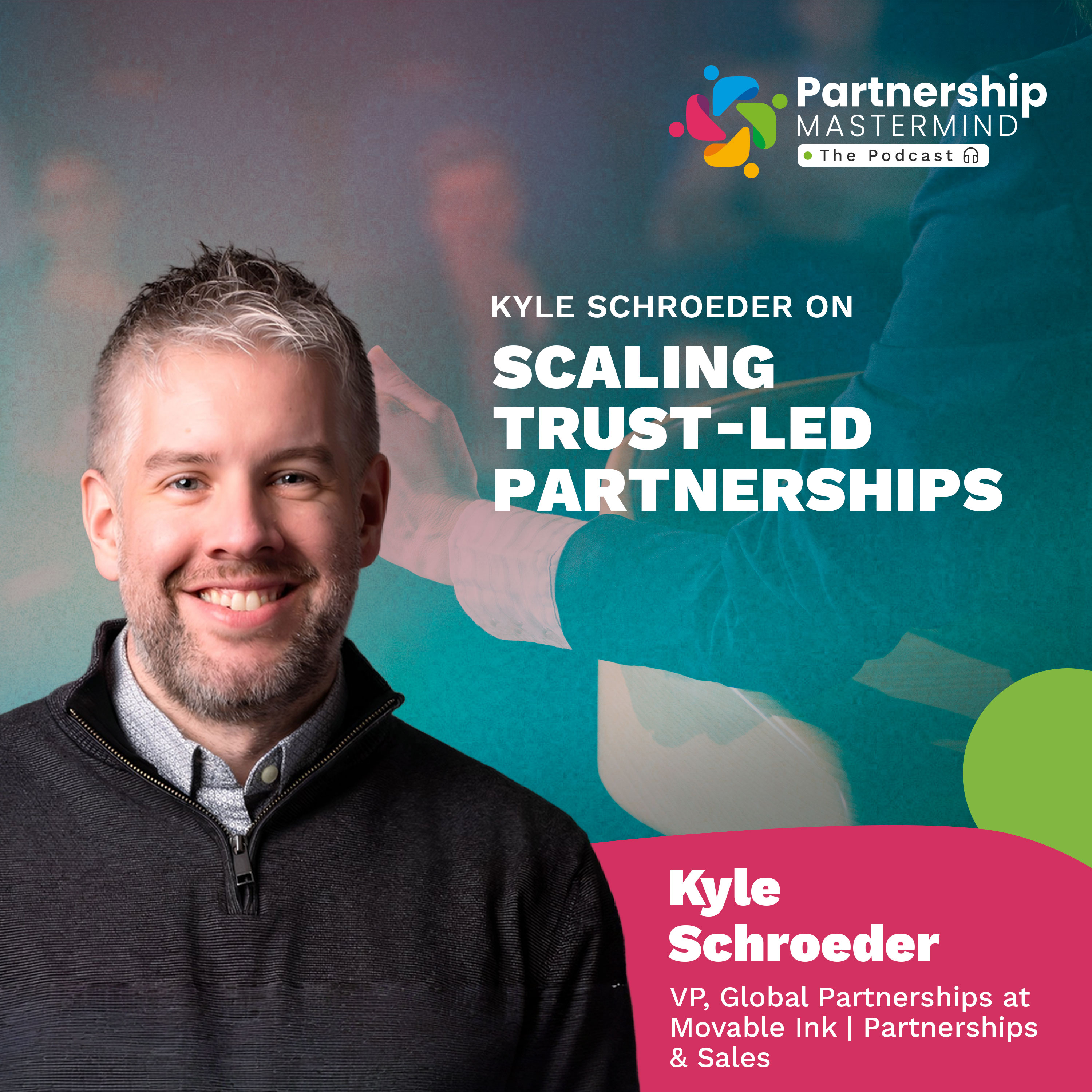
In this podcast, Chris LeVois interviews Kyle Schroeder, Global VP of Partnerships at Moveable Inc., who shares insights from over a decade of building scalable partner ecosystems. Kyle emphasizes that partnerships must function as a GTM operating system, co-selling with sales and building internal trust. He notes that partnership metrics are often misunderstood because they lack context—what works for one company may not apply to another. For reporting to the C-suite, consistency and showing progress over time are key, linking inputs to outputs to demonstrate business impact. Kyle highlights the shift from manual skills like spreadsheet lookups to leveraging AI for data analysis and experimentation, which is becoming a differentiator. He identifies partner bookings as a powerful KPI, though it requires context to be meaningful. Reflecting on his career, Kyle learned that GTM models must be tailored to the product and company stage; a reselling model that succeeded at a large firm like Exact Target failed at Moveable Inc. due to product differences. His journey from an internship at Exact Target through Salesforce to Moveable Inc. taught him the importance of adapting strategies to fit organizational maturity and scale. Overall, Kyle advocates for discipline, empathy, and storytelling to drive partnership success.
[MUSIC] Hello, everyone. Welcome back to the Partnership Mastermind podcast. I'm your host, Chris LeVois. I'm absolutely thrilled to have Kyle Schroeder, Global VP of Partnerships at Moveable Inc. in one of the rare partnership leaders who has actually built ecosystems that scale revenue, not just integrations. Kyle has spent over a decade inside Moveable Inc, helping turn partnerships into a real GTM operating system, co-selling with sales, building internal trust, and designing partner first motions. Kyle is known for pairing discipline with empathy, equal part systems, thinker, and people first leader. And today, we're going to dig deep into how he's built one of the more mature tech partner engines in SaaS. Kyle, welcome to the show. Thanks, Chris. I'm excited for this conversation. I appreciate some of the interviews I've been able to listen to and just the insights of this podcast, I will share. Amazing. Well, look, I'm absolutely thrilled to meet you, Kyle. Months and months ago, people were telling me, "Hey, you got to talk to this guy, Kyle. He's one of the best in the business. You graciously took a call with me pretty quickly." And I was certainly blown away on first pass, so I needed to get you on the pod. So here we are. We have two segments. Segment one is a fast five, we call it, quick hitting questions, and then segment two is the good stuff. So we're going to hit you with five quick questions just to get you warmed up and give the audience an opportunity to get to know you better. Is that okay? That sounds great. Okay, cool. In my perusing and creeping of your LinkedIn profile, to get to know you better, I always like to look at if anyone has testimonials, like endorsements, and you had 10 very strong endorsements for you. And one of them called you a Swiss Army knife operator, which I loved. So my question for you, Kyle, is which blade do you use most these days? And you can answer that in any way as pertains to leading a partnership program. Yeah, I mean, so many. One of the ones I've really been thinking a lot about and trying to leverage as much as possible is the ability to tell strong stories. I think partner win stories really encapsulate the value that's being created. And so I just find that there's so much momentum you can build off those that it's been an area we've really as a team tried to lean in on and amplify as much as possible, but internally and externally. Because it works really well internally as you're trying to build advocates for what you're working on, but also externally as your help and partners understand what the value is in that in that partnership. Love that. I think that's a great one. We're going to double click on that in a bit. And our pregame, you talked a lot about how excited and passionate about like internal trust and internal buy-in, which I totally believe. And I think icy layer struggles with like, it's not just enough to have good outcomes and be a high performer. You need to like make sure that that impact is recognized and felt and translated upwards. So I'm definitely excited to ask you about that. All right. Next question. You wrote a LinkedIn post about a month or so ago that I loved where you're it was around the Super Bowl. You said, you know, NFL teams firing coaches too fast. Right. That was the post. So I'm curious if partnerships had a head coach, you know, what stat would fans maybe misunderstand the most? Because I definitely love that football analogy. Yeah. I, my mind goes to really the probably the context of any of the stats, meaning like, I think in partnerships, what's misunderstood is that one metric from one company to the next means different things. So it's not that we're all playing, we're not all NFL teams. It's that some of us are playing basketball, some are playing football, some are playing hockey. And so what stats are the way those stats materialize? I think they're different from different organizations. So you really got to understand the context of the organization that you're part of. And I think too often partnerships are just bundled together and it's like, oh, well, you know, what were your source bookings or, you know, which, without knowing like, well, what's your average deal size and how many deals are you doing? It doesn't give you a sense for whether that's a good stat or a bad stat. And is it changing over time? Did it increase decrease? So, you know, I think that's the value of a stat is, you got to have the context to put it in. And too often that's missing from partnerships. Yeah, I think that's a great one. And to add on to that, like not just you understand, just you understanding it, if whether you're the leader of the team or a teammate, but making sure that the rest of the leadership team does. And can that was a mistake I made early in my leadership days of assuming that the CROs and the CFOs and the CEOs of the world, like just they grew up understanding like partnership, Lingo. And I had Bob Mar, CEO, Crossbeam on the pod a few months ago. And he's just like, look, that's a huge problem where you're creating cognitive dissonance for the C-suite to like interpret what you're trying to tell them. You're referencing all these KPIs and metrics that they haven't spent a career understanding. So a quick follow up for you on that one, Kyle. How important is it not just to have clarity and strong definitions for the metrics that you're reporting on, but to get better and better at reporting them in a way that's easily digestible by everyone in the upper layer. Yeah, I think that's key. And I think part of the key to that is the consistency that they need to be seeing those metrics on a regular basis in a way that makes sense to them. I think you have to have clear definitions around what you're measuring and why that matters and then show that over time. I think one of the things that I've just seen lately is the being able to show progress. We're increasing in this capacity or, hey, this metrics actually going down, is this an area we want to focus on? That's what I think the C-suite cares about. It's not just we did X amount of something. That actually is a 50% improvement over what we were doing before and then talking about, okay, we did these things. Those help drive that metric forward. Let's keep doing more of that. I think that's again where the C-suite tends to care and find those metrics helpful to understand what the business is doing. Yeah, I think that that's fantastic. And just as a restate for anyone listening, two great things there that Kyle said, make sure that even if you are reporting on pure partnership metrics, help the upper layer understand how does that roll up to board level O-K-Rs. And then the other thing that you said that are really like is how did it happen? I think that's something that a lot of early stage folks struggle with is like, okay, you've got these results, but where did they come from? Because what people like Kyle and Executers want to know is how can we invest more dollars to get more dollars back? So you need to understand the correlation between inputs to outputs to Kyle's point. Cool. All right. Third, third quick eating question for you. What's one partnership skill that perhaps really mattered five years or so ago, but really doesn't matter as much anymore? Obviously, there was so much disruption going on. Yeah, I mean, obviously AI has transformed me a lot of things. I think about some of the skills related there. I mean, I did a lot of e-lookups back in the day in spreadsheets trying to do account mapping and sort out customer overlap and parse out URLs to understand things. So I think there's that's something that I've done a lot in a long time. So I'm grateful for that. I think I was across the great job of transforming that, but but AI in general is helping take that away from the day to day for for part of professionals. I think that's a good one that definitely harkens me back to my early days. So then I'll follow up then, Kyle. Maybe what's a new skill that's emerging where you would say, you know what? If someone on my team didn't have this skill or I'm interviewing someone and it's just clear that they don't have this skill, like they're going to be in trouble. Like what's maybe a new skill that maybe wasn't as so critical before, but now is going to be increasingly critical. Everybody's talking about the catalog of our J.I. And I think that's true in partnership. So I think, you know, I'm challenging my team. We're trying to set up systems to get everybody thinking about, you know, new ways to leverage all the AI capabilities that are out there. There's no shortage of those. And so whether that's, you know, utilizing going data for partnerships benefit or, you know, anything along those lines, I think, a willingness and an interest in exploring that and figuring out and giving things to try and that space is going to be definitely a differentiator going forward because I think without doing that, you're just going to be. You're going to fall behind. There's too much work to be done and too much data points that if you don't have it, you're not going to be able to survive. I totally agree with that. You've heard Kyle loud and clear. So definitely to start leaning in there. It's not too late. Second last one for you on the warmups. I know you're big on reporting data analytics. You're definitely more mature side of things. So the question for you, and this might be a hard one. If you had to delete every KPI, but one, which KPI survives, which is to say, you know, I'm tying two arms behind your back. And you need to evaluate and measure the performance and understand what's going on with your partner program. And I give you one KPI. And I'll tell you what mine is in a second. What might that be? I gravitate towards partner bookings. And I know maybe that's the obvious answer, but I ultimately, my report to the CRO and I still think from a business impact. Like we're going to the end of the day. We're still looking at bookings associated partners. It's not perfect metric. And you got to get in context around it. The stories for how it's it's driving it. But I think that still gives you a lot of insight into your program. And the performance, your partners in a way that is still pretty impactful. I think it technically shows you a lot of other KPI's without even have access to them because you can't get that with those. So I think that packs a punch. I think for me, since you took a good answer, I would say partner manager activity level, like meeting activity level, because it's like, look, you can't, you can get a lot done async, Slack, DMs, etc. But like you need to have FaceTime with partners. And you're actually a big part of like in person as well. So I think you need, you can't have a successful partner program or partnerships with it like enough reps, enough FaceTime with the, with the reps. So that's one I've always studied really closely. And I found that it correlated quite well, almost one to one with like top of funnel, even middle of funnel as well. So that's that cool. Cool. All right. Last one for you. Then we'll get into the main main course. If you weren't in tech or partnerships and money wasn't a concern, what would you be doing with your life? I'd love to be an emergency room doctor. I think there's something about like the high pressure of being in the emergency room, like not just a regular doctor like the
Russian, you gotta make quick decisions, there's a lot going on, you gotta lead a group of people. I just find those situations very interesting. I don't think it's an easy job, but I think I feel like I do thrive pretty well in intense situations, be able to sort through them pretty sickly, so I do that direction. - Well, I don't know if I need to remind you that you are an executive in a tech startup environment. So I think the pressures, pressure is probably already pretty high. So this guy wants to ratchet up a notch and get his hands dirty. So I think that's right. That's definitely the most shocking answer I've received on this show, but nonetheless a cool one. Okay, cool. Well, you've just told him that you're, you can handle the pressure. So let's ratchet up the pressure. So the first segment, we always start the same way. We want to understand people's origins and stories. And the reason we do that is like partnerships is not something they offer in undergrads and in MBA programs. So we all have very peculiar paths. I myself was a PhD chemist. So let's start with you. So you know, you watch, you started at exact target as an example through an internship. Can you take us back there like, what was that experience like? What hooked you and convinced you? You know what? A career in partnerships might be a great path for me. - Sure. - I am, so I live in Indianapolis, Indiana and went to college here in the state went to Anderson University. And while I was a student, got an internship at exact target at the time. So into career fair, never had heard of exact target. And through this internship, just got placed on the partnerships team. It was basically you get hired as an intern and then they assign you to a team. And so that was really my first chance to learn, you know, the partner teams exist, what that means. And at that time, exact target was probably four to 500 people. And a fairly mature partner team. It was more channel sales at the time. They definitely had kind of a tech partner. They called it integrated business for some of their technologies. And so I really got the start there. And then graduated college, got hired on full time. And then spent the first part of my career working there at exact target, which became sales force. So I'm one of the unique ones where all of my jobs have been in partnerships. From internship to what I have now, I've always been in a partnership with lots of different types of jobs along the way. But just kind of fortunately, land on the team and have had a lot of mentors along the way to learn from at the different companies I've been a part of. But it's been a great journey. - I love that. Even the first thing I thought I was like, it's glad to hear that some job fairs are successful. Right? I'm a lot of that. That can be a struggle. But I think that's a great, great journey. And the follow up to that is you mentioned, like you watch exact target go public, you get acquired by sales force. So my question is, is like, what did that era of your career teach you about scale? And to give you more context as you think Kyle, you know, look, me personally, I've never worked at a company that is more than 1000 employees or 100 million in error beyond. I've spent my entire career in true startups. And I think there's a lot of advantages there, but if you don't know what it looks like, it's hard to think sometimes at the scale that you're gonna need to eventually. So like what did that era teach you about scale, rapid growth and having to be so dynamic and adapt so quickly? Where does your mind take you on that one? - Yeah, a couple days. And I was in more junior roles when I was at exact target. So not necessarily in the leadership capacity that I'm in now, but I think, you know, I saw two things. One, I saw how to build a partner organization and what kind of function you need and what it looks like when you reach that larger size in order to support all the different things you're doing. Whereas again, I think a lot of smaller organizations have a very, you know, small partner team and so you don't have the benefit of those different roles. So that was insightful. And then I think I just, as a business, I saw the evolution from a private company. We went public, then we were acquired. So like just seeing what that looks like as you transform and fold in. And then sales force was a significantly larger organization and you see how they approach channels and alliances just gave me a perspective again of what it looks like when you can truly go deep on large partnerships and have the resources to do so. And, you know, I think you can see why so many companies and people aspire to that. But it gives you perspective for what success is going to look like once you get there. Got it. I think that's great. And then now let's fast forward and talk about your, the start of your tenure at Moveable Link, which I think you're approaching your 11 year university, which is pretty incredible. So quick question is like, you know, in joining Moveable Link, can you help us understand what was the state of the partnerships, the GTM motion, the whole company as a whole? And like let's just focus on like the earliest of days for you, what were you walking into? And where was your head at in terms of like, okay, how am I even going to approach building this thing from zero to one? - Yeah, so it's been 11 years that I've been in Moveable Link. We were 30 people or so when I joined. And really the catalyst for me joining was a recognition at that time that that was when your organization wanted to kind of formalize partnerships. So partnerships had been done. There were a few relationships in the industry that existed and you know, sales-owned it. Our other leadership played roles in those, but it didn't have the structure. And so there were kind of at the time I joined, like two people from the company moved over to the partner team, two people were hired externally. We kind of became that team in order to say, hey, what are we going to go do? And how can we leverage partners to extend the reach of the organization? So coming from Salesforce, it's either done at a larger scale. Moveable Link was a partner of Salesforce at that time on the ISV side. So it was a known company that I was familiar with. And so it was like, how are we going to take what work really well in that exact target Salesforce model and bring that to Moveable Link? So learned a lot for sure. We'll make it into some of those learnings, but the same thing that work at a very large organization don't always pan out at a smaller company. So I saw that firsthand and was able to pivot and adjust accordingly. Well, I'm glad you brought that up because that was the exact next question in our pregame. You mentioned that one of the really, I don't want to call it a mistake, it's just a learning, right? You're like, you're just getting started was trying to run one motion that worked for you in a previous company and applied to the next. I have personally suffered from that as well. I think for you, it was reselling worked, maybe exact target and then maybe didn't work. So I'm curious, the next question is like, what did that moment in experience teach you about kind of choosing the right GTM model versus just, you know, rinse and repeating something that had worked in a prior skin? Yeah, so at exact target, a lot of the business was resell and channel sales. And so, you know, that's what I experienced for multiple years and work really well. And was it, you know, big revenue drivers, you had partners out selling on your behalf in the marketplace in certain, you know, verticals and segments. So, you know, again, this was 15 plus years ago, you know, movable links thinking, okay, this is a way we can continue doing our direct sales and when I accelerated with channel sales. So hiring somebody that's done it before and, you know, I had the relationships and came in and we brought the partners on board and got them excited and then it didn't work. Like we didn't actually see that, you know, the sales happened to follow and customer success was challenged. I think that the big learning ultimately was just that it's, you know, the program models gotta be adjusted and situational to each company. And to the, and to the parameters that exist. And so I think the main takeaway there was the nature of the product that we have at MoveBelink, which is much more of a consultative solution sell product is really tough to do in a resell model because what it takes for that reseller to stand up and really become experts on your product is tough to get them to do if they don't have enough kind of incentive to do so. Whereas products like exact target were, where it's more of a, you know, Indian platform and they were able to kind of own the whole process and they had a, you know, through practice wrapped around it made that a little bit different. So, yeah, fortunately we, you know, recognize this within a year or so and we're able to pivot and say, you know, the CoSEL approach is a much stronger way to go to market. We invested more heavily in our tech partners which strengthened our product that we have here at MoveBelink. So, again, kind of understanding what values created the market, the partners that aligned to that, how that fits into your customer base, allow us to make the adjustments we needed to see success on the partner motion. - Yeah, that's awesome. But thanks for sharing that, Colin. I think a big takeaway for a new and listening, especially a new and who's responsible for like leading the ship, so to speak, is like the need to be adaptive. Like if you just get your, you know, your first head of partnerships job, it's so tempting to Kyle's point to just bring everything that worked and you see this in pro sports, right? Like a new head coach gets hired, they bring all their old assisting coaches and then they just run the same playbook. So to speak, so Kyle is saying you need to be versatile and adapt in real time. So that brings me to the next segment, which is around, you know, the evolving partner operating model, which you alluded to. And so in our conversations in the past, you've talked a lot about how MoveBelink's partnership model has evolved over time, whether it was from territory alignment to now going deeper with a smaller set of strategic partners. Can you just walk us through with that evolution? Like literally what does that look and feel like? Why is it, you already mentioned why it's important to evolve? Sorry, but like walk us through kind of the evolution of the partner operating model that you've personally been at the helm of. Yeah, so part of GoMecta, kind of when I joined MoveBelink, one of the things we quickly realized was that the company, the organization that people in the business didn't understand partnerships, which is not uncommon though. The reps weren't familiar with it. You know, they thought partner meant customer. And so, you know, we have a stuck on that. And so really from day one, you know, we acknowledge and recognize Halus and our number one customer is the sales team. Like we've got to get them to understand and be excited about working with our partners and that they're receiving value from that. And so because that became our North Star and how we thought about, you know, building this out, we really set up the team to be more regional based. And so much like you might align solutions, consult them.
or other supporting functions, we built a team to say, we're gonna put one partnership's role in each sales team. So that every rep on that team has one partnership's person to go to, as their go-to resource for everything. And then we aligned the goals and the structure of that role to align with what the sales team cared about. So they carried the same sales code as the region, and they could then go into strategic planning with the sales leader and the reps to say, okay, across our book of accounts, customers, prospects, opportunities, how do we leverage the entire partner ecosystem to accomplish whatever it is that we're looking to do to drive those better customer outcomes. That could be a booking, that could be a turn prevention, that could be use cases, et cetera. And it just, when you're aligned the incentives and the teams and the goals, then it built the trust with the sales team to say, hey, I see what values here, which then created the flywheel everybody once of us working with the sales team, the sales team working with the partners, building the partner and sales relationships, and it really got the motion going. So we ran that for multiple years very successfully to the point where I do feel like we truly have a partner for this organization that reps are proactively coming to me and my team asking for partner support, how do I work with partners, and how do I get a particular partner involved on a deal or a customer conversation. And so what I think we have seen now is I think now the opportunities go deep. So we built the trust and support across the business. Now, how do we really take the best partners that we've identified as, you know, the ones that have performed well and have the most potential and expand those relationships in a scalable and exponential way. And so now we've kind of reshifted the resources to go to own those relationships strategically, work across the organization and drive scale. But I think the key value there is that the reps already bought in. Like we're not trying to convince them, you know, you need to do this or how to do this. It's now about say, okay, you're excited about partnering. Let's put all that energy into this group of partners where the value will get at the end of this is the largest. Yeah, I think that's a brilliant approach. And that's why I was so taken back from it when you had first introduced it to me because I don't think it's a utilize that commonly. But what I love about it to your point is it aligns you with sales so much better. And like, look, it's a big, it's not a secret that like partnerships and sales can sometimes have very, you know, big frictions in their in their relationship. And I'm actually running a big survey right now. And I have a question for partnership operators that says, hey, on a scale of one to five, how would you rate the average health between your partnerships team and your sales team? And right now the average is 2.70 to five. Right. So I would say that's pretty bad. And I think part of the, it's counterintuitive at first because it's like, well, 70% of partner managers have a quota that is closed one revenue. And eighties have 100% quota that is closed one revenue. So like, shouldn't we get along? But I think, I think you're not, that's not enough alignment to Kyle's point. So when you have like same territory, same accounts, same incentive, same quota, literally, then they can honestly look at each other and be like, you know what, we're in this together. So we might as well act like it. So I'm glad that that model works and anyone listening should, should he do that. Is that resonate? Yeah, one thing I'll add to is, you know, when I go to advocate for promotions for my team, for example, that one of the first questions I get is, well, let me go talk to the sales leader that they worked with to see what they thought. Right. Like if the sales leader can advocate for them and say, hey, they are adding value to my region and helping me achieve our goals, then that puts them in the bucket of, yeah, let's look at a promotion. If they don't have the support of the region they're supporting, then it makes it really tough. And so, definitely, I think having that tight alignment has just proven to be really strong and successful. Again, and I think this is a challenge everybody sees, which is, you know, yes, partner metrics are critical and important, but you need the people to just question like, I don't know what this means or is it really, does it really matter? But what does matter is are we hitting our regional numbers? Are we closing deals and to the sales reps, I agree that that support is meaningful in doing so. And so it just helped like you need all these pieces. You need to success stories, you need the data and the advocates of the field, not what comes together to prove that, you know, what we're doing is working, even when there might be questions about, you know, what was their involvement on this particular deal, which is sometimes hard to navigate through. I totally agree. And then my final question on this segment, Kyle, is, and this is helpful for a lot of folks, because you already told us like, hey, you came in, a move link, you were going to try the reseller, that didn't work, so you had to pivot. So for anyone listening, like what signals indicates to you that it's time to consider changing the operator model? Because you have done several times over now, because of your tenure length. So like what signals do you see where it's like, you know what, maybe I need to have a conversation with leadership and yourself to maybe re factor kind of what the operating model is, whether it's from territory to like deep strategic partners or rep alignment changes. How do you, what signals do you see that, that give you that, that indication? Yeah, you know, I guess I have two answers. One is, I do think sometimes we're too quick to change, right? You don't even give it enough time to run through. I think that's a challenge, you know, I think partnerships are about the long game, you've got to invest and you know, see them pan out over time. So I, you know, to say we're going to try for quarters, probably not enough time. I do think you've got to have those milestones and metrics in places that we try to do if we're going to change something and launch new initiatives like his work, you know, moving more to our strategic partner manager model. You know, for each partner, we want to set milestones, not just we want to hit a bookings target, but we want to be in three, six, 12 months. I think those are going to be the indicators, says this working or not and have the open and honest conversation, the accountability around those things. And we quickly saw on our model with the reselling that, you know, we got partners on board and then six months in, okay, we don't really see any adoption yet, nine months in, the adoption is still not there. And so it became pretty obvious. And so then that, you know, within a year or so, we said, okay, we have to rethink this and go back to challenge what were the assumptions we had in place. Are those still true and use that to inform, hey, is there a better, better way to approach this. But I think you got to have this understanding where you're trying to accomplish to be able to set that. So I spent a lot more time trying to put that thought into it so that we can have the mechanisms to reflect on it. And, you know, ideally, I just, like, I think that's the purpose of a partner plan. Like we, everybody wants to partner plans. I find so many of them are just a, you know, a sheet to fill out to check a box, but they can affect a plan actually says, here's what we think we're going to go out and do. How we're going to do it uniquely, what success looks like. And it gives you the metrics to come back to and understand if we're accomplishing it. So, yep, that's another underutilized tool that people aren't taking for advantage of. Yeah, I mean, that was fantastic. That's really my love language. And you might not know it. But having spent 10 years as a scientist, like you just basically walk through like the experimental model. Right? Like what's the hypothesis? Like literally, like for a partner operating model, like literally, like what is our hypothesis of if we do X, we will get Y. And then the next step is like, what's the procedure? Like literally, what are we going to do? But then the final point that you are really strong on is how do we know if we were successful or not? Right? How will we measure the outcomes and therefore draw a conclusion at the end? Right? And then what you said is you need to have some mechanism, some cadence for like stopping to smell the roses and see if they smell good or not. Like evaluating, okay, our hypothesis six months ago was if we test this territory model, we will see stronger rep alignment as evidence by these metrics as a leading indicator, which will then downstream turn into these lag indicators, which is close to revenue. Oh, six months went by. None of those things are true. So whether we didn't execute properly or it's just not a viable strategy. Let's get back to the drawing board. I don't want to put words in your mouth. But is that kind of more or less a way to think about it? Yeah, I'm going to really, yes, agree and I really encourage my team to take the extra time to plan out what we're going to do and be thoughtful and not, you know, I do like taking action, but we got to know why we're doing it so that we have, we can assess it. Like otherwise, I don't know how to put things into context. You know, I sometimes I'll, you know, we might say, oh, you know, we source, I don't know, 10 ops this quarter. And all of that's great. You know, what did we do? Well, yeah, well, we did with this by accident. We did we did we build a strategy and do it like because I can't like we said earlier, it's not repeatable. If I don't understand what we set out to do, did we accomplish it and why? And so that reflection period and assessment, I think is what then helps, you know, when businesses want to figure out how to build fly wheels and how to scale and how to make things repeatable. Yeah, yeah, you got to have that assessment period in there to understand how the strategy is played themselves out. Yeah, totally, totally. And to be fair to like the, the IC layer, which we've all been like, it's tough to play the long game in Zuma when you're staying down the barrel of like a month, we are quarterly quota. So like that drives that incentivizes to like be a gunslinger. But to your point, like you do need to be able to zoom on. That's why having good leaders like yourself will help you get there faster. Cool, that was a great segment on operating model. Now we're going to switch gears and talk about kind of trust as an operating system. And I really want to get into your philosophy and mechanics of trust. Because that was something that stood out in our pregame interview was just how important this concept is to you. So first things first, you talk a lot about partner first culture. How do you know when that's real versus just something people say, which you know, a lot of us try to say, oh yeah, we're a partner first organization blah, blah, blah. But like, that's not true in a lot of cases. So how do you actually know when that's real is the first question? Yeah, I see in the business when things start to take off on their own, you know, and you know, we put some, some things in motion. We help set the conditions and connect folks. And when I hear like, oh, the, you know, sales leaders, meaning with a peer sales leader at a partner, you know, on a regular basis, like they catch up each quarter. Like those types of things really tell me, okay, they're embracing this that, you know, we got it going. We, you know, we maybe made the initial connection and facilitated the first call, but they're taking it wrong with it. I think those are some positive signs. I think when I see the organization being proactive to say, hey, you know, heard about this partner in a deal like, can the team, you know, do we know them? Can we get. some help and support. Think again, just reaffirms that partnerships are on the mind. And then a big one for us has been buy-in for leadership. Like all of our sales pipeline reviews, always have a question who are the partners involved. When you start incorporating partner-related accountability into the sales organization, then you know that it's really as partner first. That just like you need to confirm budget and make sure that you've got champions identified, you also have to know who are your partners and have you engaged them and have you leveraged them. So again, I think for us, those were key things along the way our co-sell model that we run that have helped us kind of truly define that part of first culture. - Yeah, I love that. I think those are great signals and evidence that you are becoming a partners first organization. I think if it is like the difference between like, if you're an early startup, you're doing like a ton of outbound, trying to knock on people's doors. And then eventually you grow and you have so much, you know, your product market fit. And then now people are coming to you inbound, so to speak. And I think that's a really great signal of product market fit. So it sounds like the same analogy can be applied internally. It's like, hey, if sales is knocking on your door versus you always trying to annoy them to like co-sell with you, then you're probably doing something right. So then the next question Kyle, and this I'm gonna ask you two part, and it's about like the responsibility of both the leader of the department, which is you and then the ICs within it. Like what are your responsibilities in literally building the trust across Yorks? I'll start with you at the leader level. What do you think? Anyone who's listening who's say a head of partnerships, VP of partnerships, director of partnerships, what do you think their key responsibilities are as it pertains to building trust across the York with the most important stakeholders? - Number one, I would say is communication. And that's, you know, you gotta be consistent. You've gotta be transparent. You gotta be proactive. And you gotta be able to articulate value. Like I think it's, you know, to me, a lot so much of it falls back to being able to communicate well and to communicate timely. I think it's hard to trust someone when you don't ever hear from them and you don't know what they're doing. And you have doubt and you're, you know, you wonder what's going on or did they ever fall through on that thing. So I think you can establish a lot of trust by really strong communication of, you know, good, bad, you know, like being up front with folks. And so I've really tried to focus on that. I think it's like, you know, yes, there's the idea of relationship building and meeting people face to face. I think even just the little things of following through consistently, like if said, "Hey, I'm gonna do something." Then you just close the loop. Yeah, so, "Caribid, it's done." I think people really appreciate that. I think like from a sales standpoint, you know, trying to keep sales reps in the loop, you know, if I assume like, you know, for a given customer, you're the owner. So you've got to be in the loop on what we're doing. Like if we're operating in a way that you feel like, "Hey, they're going to run my back." "Right, I don't know what's going on." I think, again, that erodes trust. And so, kind of that involvement of the team is important. And then I, you know, I think just, you know, the follow through and dependability, you know, if there's a commitment made or, you know, you have aligned on something, you know, a way in which partners will or won't do something in an account, you know, making sure that there's the follow through is really key. And I think those, and then you do that consistently over time, like, you know, trust doesn't happen instantly. And I think that's why even when you talk about partnerships being a long game, it's because trust takes time. And I think sometimes the hardest partnerships are when there's a lot of turnover at that partner. When people are constantly leaving a company, you know, it's, yes, you'd, that company name is a partner, but, you know, the partnership has really made up the trust to the people in the organization. And if they've had a lot of turnover and people have departed, you gotta rebuild that trust. And it takes time. It doesn't happen instantly. - Totally. That was a fantastic answer. Tone of great insights for anyone at the leader level listening. A couple of things that I took away, like, accountability, super important. I think that's personally one of my favorite words. If you go ask any of the people that I've ever managed and they say, "Hey, what's Chris's number one thing you gotta bring?" And it's accountability, right? Like, I think it stops and ends there and it sounds like you're on the same page. But one thing you said that I also resonated with was, you said, "You gotta be proactive "but not just when things are good, "but when things are bad." I think that's a really important lesson. 'Cause like, look, when you're crushing, people notice that pretty easily anyway. The more important moments are when pipeline is behind, you're not pacing to hit target. And you have to figure out why. Like, that is when you really need to communicate that both to partners or to your leadership. So I appreciate that. And then the final final question on that, Kyle, is, "For the ICs, the partner manager "is the senior tech partner managers of the world?" Like, what responsibilities do you think they bear when it comes to building that trust, whether it's within your internal work, but obviously it could be with an external partner as well. Like, what do you think they fit into that? - Yeah, me and the same principles would apply. So I would overlook those. I think internally, I really, again, in our model where we're more regionally focused, or even for partner managers that sit between like a sales rep in the partner, I think you build trust when you help kind of protect that rep to some degree. If you're, when they get blindsided or feel like you're wasting their time, that's when you a road trust. Because then they're not going to want to commit their time to spend working with you. But if you can prove that, hey, if I'm asking for a call, we're gonna come prepared, we're gonna know what we're talking about. There's gonna be a value exchange. It may not go perfect and not everyone will be a home run, but by and large, I'm not gonna waste your time. I think, again, that's another place where you build that trust. And then I think similarly, externally, that when you're working with partners that you can be as direct and up front with what's going on, I think, I tell a rep, my team all the time, if there's something you are wanting from a partner, you just gotta tell them, you don't need 30 minutes to dance around it only to then, if you're actually, at the end of the day, you just want an introduction. Let's start there, say, what we're not trying to work towards is this. And here's why, and then build your case. But I think, again, people respect that, that you can be clear on what you're looking for. And then again, I think you're about strong communication and fall through and the accountability with that. And you see that trust really start to build up. - Yeah, I think that's great. And just to wrap up this segment, I'm gonna follow up. So you talked about like, sometimes you just can need to ask for it. And I think that's like an underrated tactic. Right, I think partner managers, in the early days, want to like dance around the thing that they're like, you know, trying to get after. So I'm curious, like, you know, from your experience with your own team as an example, like, how do you really coach them into that behavior? 'Cause I find, and I'll put it a different way, I find that the average partner manager, even senior IC, and having been with myself, they struggle with like direct conversations, like being direct, you know, challenging directly, driving accountability. Like imagine, you already said this, like imagine you and a partner ever agreed to do XYZ, right, and giving quarter, and like, you're having your big monthly follow-up. And they're just not picking up the pieces, right? So they're burning trust with you. Like, how would you advise any partner manager listening who really struggles with having these direct, challenging conversations, perhaps putting a little bit of pressure on the other partner? 'Cause I'm challenged right now, Kyle, I see it all the time. It's a really, really difficult thing to do. So how do you approach that? - Yeah, it also reminds me of the scenario that I see all the time, which maybe someone residing with, which is like, hey, I wanna, you know, approach partner X about an introduction. So it first starts with this like long email that I just, you know, how's it going? And then you ask for a call. And then we wait two weeks, and then we get on the phone. And you know, like, and you're just like prolonging this over multiple touch points, because you feel like the soft ask in is the better way. Whereas what I would coach the team on an like an exterior is why don't you just go to Slack and say, you know, hey, Chris, you know, I'm looking for an introduction here, here's why, here's what I can do for you. I've prewritten the email, like, are you open to sending it? And more often than not, it's easier to just say yes, if, you know, and take care of it, then to commit to, you know, three touch points, a 30 minute call, and all the time, the, the, the mind share that's needed. So I think when you kind of explain that and show it that helps, I think on the broader question you asked, you know, part of it is you can, I think you can be direct and upfront, you know, with removing the emotion behind it. And I think that's part of it that I think sometimes that the concern is when I'm direct, I'm gonna offend them or I'm going to, you know, make them upset, but you can do it in a way that's more, you know, focused on the commitments that were made and talk about that. And I think people get appreciated. Like, hey, you know, we agree we're gonna do these couple things, but, you know, clearly we're not there. You know, is this still a priority? Or are you still committed to these? You know, like, and I think, again, things change, people have all experienced it. You know, sorry, hey, yeah, something came up. This wasn't a great month, you know, my fault. But, I think, again, if those things are tied back to the important priorities and goals, then I think it's worth being direct on them. I would be careful about like being overly direct on things that don't matter, right? Like, you want to pick two and make sure that you're driving towards things that have an impact the other day. - Yeah, 100%. I think those are all great advice. And my other top up on that is on the trust building side. Like, if you're down in the dumps with a given partner, like they're not holding up to the bargain vice versa. Like, you know, bringing empathy to the equation and vulnerability can be a great way to build trust. Like, say, say you've got seven strategic partners, which means, you know, let's just say you have eight. Each of those partners technically can treat its 12.5% of what you're expected to output. And if they're not delivering, that's your vulnerable. So, like, saying, like, hey, look, like, just want to catch up. You know, I know we had agreed to these things. You know, for whatever reason, it seems like your side's struggling to kind of keep up with that. I just would love to, like, level set. As honest as you can be, like, is there any major change over there? As you know, like, you're one of the big bet partners I have. And obviously, I have so much confidence in you, but right now, things are in pacing the way we would like. And I just need to understand, like, what's really happening. So, like, that type of approach, I think, really helpful. I think when you start by sharing your goals, you know, if you say, hey, my goals are this, you know, like, again, everybody gets that already has goals, and they're accountable to certain things. And, you know, yeah, if I'm said, hey, I'm, I've committed to a million dollars in this partnership, and we're not way behind, like, you know, people understand that. And then, like, you know, I think the question becomes, if we can't get there, what can we do? And like, let's work on the alternative. Let's know.
not be too frustrated the fact that we're not there, let's get real about where we can go. And I think that those would be my approaches that seem to work pretty well. - Exactly, and that's a great segue. Speaking of goals, we're gonna go into the next segment, which is all around metrics, attribution, and internal credibility. Something in following your content for a while now, like you're clearly like big on, clean reporting, really strong, clear communication of what's going on within your partner org. So the first question I have is, you know, you personally, you get deep into the dashboards, you're writing big reports each quarter, you're constantly keeping everyone aware of kind of what's happening with the partner team. So like, I know there's some obvious elements to this answer, but like, why is it so important that you personally stay so close to the data? - I think this has to be a question about trust. I think this is one way I'd build trust is because I know my metrics and I know the data. And I think especially as I've moved into a leadership role, I'm not in the weeds of every deal, on every partnership and every interaction. And so, I think by forcing myself to comb through the data, look at the reports, find the anomalies, look at the trends, you know, how's this partner doing, you know, cord over quarter year, over year, allows me to see, you know, things within the partner ecosystem that I would otherwise miss. And so I think it, you know, helps me personally become comfortable with the data, so that then when my peer, my other, the exact other executives come to me with questions, I can answer them. I think partner leaders look, you know, I don't want to be the one that says, well, I don't know, I gotta go ask the team. Like if every question has to go to the team, it just begs the question of what role are you playing if you don't have the answers. So I don't have to have 100% of the answers, but I do want to have a good understanding overall on the things that matter. And so that's where I've just got systems built in every quarter to run my reports, do the analysis, reflect on what's working, what's not, and be able to share that with the business. And the other thing I found is it also pre-empts the questions. Instead of waiting around for, you know, people to, you know, question what's going on, deliver the data, and then I'll take questions on the data. And I find that again, in many cases, people appreciate it, and there's not a lot of questions. And so we've been able to, you know, get in front of unnecessary kind of fire drills to answer things that people are wondering about. - Yeah, I love that phrase like pre-empts the questions. I think that's when you have rock solid data. It kind of tells you the answers to whatever questions you might have, whether things are good or bad. So I like that phrasing of it. Follow up question on your their Kyle for your team level at the IC layer. What expectations in systems you have in place for them to be like reporting to you, 'cause like, it's all vertical up. Like you report to the CRO who reports to the CEO, but then you need that information, right? So like what expectations do you have for your team in the sense of like, are they just accessing dashboards that are pre-built for them, and then they can easily like gendered report or do they have to like manually put together some pieces of data that then they all consolidate and then you have access to that. Like, because the reason I ask as you think about it is I see wildly different setups at orgs where some partner managers feel like very supported and they have access to a ton of reporting dashboard and it's easy. And other companies, they're just like, you know, scratching and cloning, trying to find data, but it's every partner manager has different, you know, kind of models for how they're measuring things and it's a total disaster for the leader of us. So just curious, how do you kind of have things set up for your team as it pertains to all things reporting? Yeah, we definitely have dashboards and reports that are standardized for the team to leverage. You know, I think my expectations for the individual contributors and the team are primarily three things. So one, we have a custom case object where they track all their partner activity and so I expect that to be updated, you know, and as near real time as possible because that's where they're putting in the detail around everything that's going on that then feeds into those kind of global reports. So, you know, they should be able to update those, manage those and report out on what they've done. So that should be the kind of their key data point. We do quarterly win stories. I want, you know, summarize not just the data points, but tell me what the impact was for your given partners on given deals. So that reporting is going to happen where they're going to feed up, because again, I can see the high level, but I want to know the specifics. Like the specifics make the story a powerful and so they're doing that on a quarterly basis. And then, you know, this year with our new strategic partner management approach, then they're going to be responsible for updating a partner plan. So if we define the goals, how are we progressing against those and making sure that they have the report and to support that? So, you know, it's common, each of a number of things. I do think, you know, people need to be comfortable in the data and getting to what they need in order to make data-driven decisions. But I also think, you know, whether it's myself or a rev-up organization, or others can help support them in kind of getting the base reports they need to set up. - Got it. Super strong setup. I think a lot of people would love to be in that situation where you have so much support and a leader like yourself. But even if you're not like, you do need to take things in your own hands, you know, kind of reference of the good ol' V-look up formula days. Well, guess what? You get L-alems to write them for you. So you have a lot more power than you think. You just need to do the research to understand how you can do it. Cool. Last question on this segment. It's on a spicy topic, which is like, influence pipeline versus source pipeline. I'm not sure exactly what the setup is there on the comp and quota model, whether or not you recognize influence or something you strategically go after. But the final question on this segment is, like, how does your team kind of think about source versus influence? Is that a mechanism that you're using internally? Because I'm getting asked constantly nowadays, like, hey, like, do you recognize influence revenue or influence pipeline? So just curious what that setup might look like at movable link if at all. Yeah, one of the best things we did five or six years ago is we decoupled the source and influence from compensation. So my team is not paid more or less based on those metrics, which I found takes all the debate out of those topics that so much of the debate of, you know, was this source, was it influenced? How much was it influenced? Really comes down to, do I get credits to get paid? And so we eliminated that. And that alleviated a lot of problems. It allowed us to be a little bit more objective around, you know, defining clear criteria and saying, was a source, was this influenced or not? And so, again, I think the systems around it dictate a bit of how that goes. And then, unfortunately, again, I think in our organization, because we are bought in on partnerships kind of top down, there is value, see, and sourcing in and influencing. I think the belief is the more you build the partnership, the source stops will kind of come naturally. So we haven't been over indexed on sourcing historically. And, you know, I think the importance with influence, I would tie back to my comment about stories. Like it's one thing to say, you know, partners are in deals, but, you know, I was talking about it on a spectrum. You can be very involved, you know, co-stelling and, you know, eight different touch points on site with the prospect to get that across the line. Or it could be, you know, someone shot it, you know, three sentence email to a decision maker and said, you know, we love these guys at MobileLink, you should give them a shot. Both are very important. I want both of them and everything in between, but, you know, it does, the stories help you understand the scope at which that influence took place. So that's why I think we've indexed into that is to put some context around whatever influence metrics we have. It helps you understand why we should care. - I love that. I mean, that was a master class. Like so many people are so stuck and confused about how to think about influence. And so you touch on some really important compensation implications, which are real, 'cause incentives drive behavior. I love the uncoupling piece. And then the storytelling, I think, is critical. But at the end of the day, like, look, we're responsible for moving pipeline, moving revenue, creating it and moving it. So if influence is a successful lever, like incentivize and recognize it, but you need to be able to tell the story, which I think is great, great phrasing. Cool. All right, well, we're gonna get into the stretch run now, just two kind of quick segments. So first, we're gonna shift from systems to people, because your leadership is definitely something that stands out to me. So the first question is like, look, you clearly care about your team, so many leaders care about their team, but you also have high standards. And so the first question is, how do you balance empathy with accountability? And I'll tee this up for you, Colin, saying that, like when I first became a people manager, the empathy part was easy. Like being, you know, friendly, being, you know, like leading by example, all of this stuff, I found that easy. But then as soon as the stakes got higher, and I had to drive more accountability or as people's performances started in behavior, started to slip, and I had to like have that backbone. I found that was really challenging. So I'm curious, how do you balance empathy and people leader side versus like, actually driving real accountability to drive change when things are off track? Yeah, it's, you know, it's tough. It's not an easy thing to do. I think it's taken me years to learn what works and what doesn't. I also think some questions like this are, you know, have to be adapted to an individual personality and strength. Like I'm going to play to my strengths to do this, whereas somebody else will play to theirs. You know, I found that again, being clear in communications, you know, kind of being upfront on expectations makes such a difference. That if I do have high standards and high expectations, I got to make sure those are clear and understood. Like, you know, if I want, you know, partner plans delivered by Friday, but I don't say, you know, I don't communicate that and give sufficient time, then, you know, it's not fair to the team. So I think, you know, get over communicating things that are important to me to the point of even saying, guys, this week, these are my top three priorities. Can you please spend time on these? Like I will do those types of slacks to the group so that they understand, you know, okay, I gotta get these three things done this week. You know, it's making it as clear as possible. - Yep. - You know, little things like we did a big initiative a couple of years ago to develop like a user guide, which where I really walked through who I am as a leader, what makes, you know, what things I value, what things are my weaknesses, what things make me tick. Just to be upfront, I think helping people understand those things are important. Like, you know, for example, I've just been very clear, like, you know, meeting recaps need to be out with out to the partner within 48 hours. Like I, if I'm see to go out a week after, that is, like that is exceedable, what's acceptable. So like I'm just very clear on that stuff. Like we missed the window and I find that frustrating. And I talk a lot about like for me, excellence is an important value that, you know, whether we're gonna do a part of it or not.
we're gonna do a call or we're gonna, whatever we're gonna do, I really think if we do it at a high level, that's gonna stand out and leave a positive impact if further builds that trust. So, you know, working with the team to help them understand those things. And lastly, one of the learnings I've had that it was not easy early on was, I think it's the mistake is to let things go that bother you. And so, you know, if I see a problem starting to form like, well, let's just wait, you know, like let's hope it just solves itself. That's the mistake because then what happens is you blink and now it's been going on for six months or a year. It's affecting others and it's really hard to go back and say, hey, I didn't say anything for the last year. You've been doing this thing or not doing this thing. - That's my problem. - And so, again, it's as hard as it is, I think, you know, jump it on it right away, whether that's a slack to say, hey, solve this, do we do something else? Or, you know, to people that have a lot of trust, like, hey, solve that slack. I think you'll be able to direct here. Like, I think people are gonna misread what you're saying. Like, I know you come from a good spot, that's not gonna go well, you know, consider revising. And I think people appreciate that, right? Everybody wants feedback. I think feedback is tough to do on just an annual basis. If you do it in a moment. And again, you gotta give the context. It's, you know, hey, this is why I solve. Here's why I don't think this was the most effective approach or this was like this thing. - Yeah, of course. - And I think people appreciate that and also then communicates what you expect going forward. So, you know, and then if it becomes a problem, you know, because I've had to, you know, part ways with some team members, then you also have to quickly start documenting it. That was another mistake, if not actually kind of, really being explicit. Like, because then I think people feel like, oh, we talked about it, but I didn't know that's what you meant. Or I didn't know you were that serious. And so, if it's truly becoming a problem where you're saying, hey, this is impacting performance, I do think you gotta quickly get to a, you know, like a recap of one-on-one's or a lot more formality. And again, I think that's best for the employee and for you as the manager to have, you know, this is what, this very specifically is what I'm not seeing and I need to see differently so that there's no confusion. Because again, I think it's in that confusion that you can struggle with meeting those expectations. - And that was a master class. I loved every bit of that. And anyone listening, whether you're early into people management or later in people management, there's so much there for you. We have two final questions to get us out on time, Kyle. One on this topic and then one on AI. So, the final question on the people side is, you know, how is, it's about how is your management style changed over the years? So, if someone, say someone has worked for you for the last five or so years, right? Same person. How would they describe, like, hey, how is Kyle's kind of management in leadership style change? What's a quick short answer you can give on that one? - Yeah, I would hope that over time it just become more confident and focused in what's important, you know, that I think, you know, I've just been through enough cycles that I can, you know, know where it's worth spending time and going deep and what things don't matter and kind of let those go. You know, delegations always an ongoing, you know, challenge to that, you know, I wanna be able to trust my team and hand more things off to them, which goes back to, again, communicating expectations and how to go about doing that. So, I think that's an area I've improved in over time as my team has grown. And again, I just, I, you know, probably one of the things most people say is, like, I communicate a lot. Like, I, more communication is usually my way of operating because I just think, I'd rather people ignore stuff because it's too much that they feel like they don't know what's going on and so that's something I've just continued to lean into. Even like if it's in a business update that I see because I'm in certain channels or in conversations or to meet in. - Sure. - And I can follow that to my team just to help them know what's going on. - Yeah. - Those things I think they really appreciate and that's probably not something I would have done earlier on. - Totally love that. And I love everything you said about the expectations that anybody would have. I think that is like one of the most important things you need to do all the time. Okay, cool. We'll get you here on this. This is a switch of topics, but it's on AI. I can't have a podcast interview if we don't ask. At least one question on AI. So, in your humble opinion, Kyle, you're very informed opinion. Like what do you see AI actually changing when it comes to like partnership execution over the next few years? And maybe what's one thing that you don't think you think is being a little bit overhyped. So like one thing that you actually have conviction AI will disrupt in a positive way for partnership execution. And maybe what's one thing that you're like, "You know what? "I think that's being a bit overblown. "I don't see that thing changing so dramatically." - Sure. You know, I do think there's probably a lot in both categories. My mind first jumps to, just the ability to use AI to comb through a partner data internally and use that to draw out insights and better actions. I mean, again, I remember back early days at MovableLink, we had like custom Salesforce reports set up to listen to keywords in freeform fields to try to find partner mentions. And use that to extract and say, "Oh yeah, that's a good one." I comment in and now I can follow up with them, which that's been all streamlined through, going tools and anything else, you know, zoom transcripts that allow you to really, you know, understand that, set the alerting and even operationalize how you turn those into, you know, partner collaborations, partner referrals, any of those types of things. So I think that's only going to continue to happen. And I think that's going to transform, kind of go to market overall as we just get smarter with the data that's available to take action on. I'm excited for that. I think that's often the work that's the hardest to do, right, extremely time consuming. If you're doing it manually. And, you know, even I started to see on my team, you know, used to like, if you want to get up to speed on a deal, you'd have to go set up meeting with the rep and spend 15, 20 minutes getting a debrief. Now I can just go to Gaung and say, what's the latest on this deal and get the recap there? I think like those efficiencies are absolutely going to continue to move the needle. I think on the flip side, you know, I think so much of the focus of AI is like, the operationalizing of things. And while there are those, that is true. At some point, you can't operationalize everything on partnership because it does come down to the relationship at the end of the day. And so I think that's a part that if it's purely interacting with the AI and it's all automated and there's no relationship, I don't think those are going to be the partnerships that last. I think, you know, we talk about, you know, people want to do business with people they know and like, trust and, you know, that that's still going to be front and center and that, you know, our best partnerships are where there's, you know, trusted relationships between two organizations. Obviously, you got to have the foundations in place around the value creation and all that. But I think the AI only supports that. I don't need to replace all that. So there's still going to be a level of, you know, work that those partner leaders, partner managers are going to do to build those relationships and demonstrate that trust, whether that be, you know, in calls with the partners, in person events, all of that. And I still think it comes together in a really meaningful way going forward. Yeah, I love that. I'm a chat every T can't source the deals to your point of like, you still need to do people first. But look, we're at time. Kyle, this is truly an absolutely fantastic interview. Thank you so much. Thank you, everyone, for tuning the partnership out of my podcast and feel free to hit up, Kyle, on LinkedIn. He's absolutely must follow. Thanks so much, Kyle.
Podcast Summary
Key Points:
Partnerships require internal trust and storytelling to convey value, using win stories to build advocates both internally and externally.
Partnership metrics must be contextualized for each organization; one-size-fits-all KPIs are misleading without understanding company-specific factors like deal size and revenue models.
Consistent, digestible reporting to the C-suite is critical, showing progress over time and linking inputs to outputs to secure investment.
AI has automated old skills like manual data lookup, while new skills like leveraging AI for partnership data and experimentation are becoming essential.
Partner bookings are a key KPI because they pack insight into program performance, though they must be paired with context.
GTM models must be tailored to the product and company stage; what works at a large firm (e.g., reselling) may fail at a smaller one, requiring adaptation.
Summary:
, who shares insights from over a decade of building scalable partner ecosystems. Kyle emphasizes that partnerships must function as a GTM operating system, co-selling with sales and building internal trust. He notes that partnership metrics are often misunderstood because they lack context—what works for one company may not apply to another.
For reporting to the C-suite, consistency and showing progress over time are key, linking inputs to outputs to demonstrate business impact. Kyle highlights the shift from manual skills like spreadsheet lookups to leveraging AI for data analysis and experimentation, which is becoming a differentiator. He identifies partner bookings as a powerful KPI, though it requires context to be meaningful.
Reflecting on his career, Kyle learned that GTM models must be tailored to the product and company stage; a reselling model that succeeded at a large firm like Exact Target failed at Moveable Inc. due to product differences. His journey from an internship at Exact Target through Salesforce to Moveable Inc.
taught him the importance of adapting strategies to fit organizational maturity and scale. Overall, Kyle advocates for discipline, empathy, and storytelling to drive partnership success.
FAQs
The ability to tell strong partner win stories, which builds momentum internally and externally by showcasing value.
Because one metric means different things across companies due to varying contexts like deal size and volume, so context is essential for proper evaluation.
By providing consistent, clear definitions, showing progress over time, and linking metrics to board-level OKRs and the inputs that drove results.
Manual data tasks like VLOOKUPs and account mapping, which AI and tools like Crossbeam have automated.
A willingness to explore and leverage AI capabilities for data analysis and efficiency, as it’s a key differentiator.
Partner bookings, because it reflects business impact and indirectly reveals insights into other KPIs.
Chat with AI
Loading...
Pro features
Go deeper with this episode
Unlock creator-grade tools that turn any transcript into show notes and subtitle files.
 PodcastTranscript AI