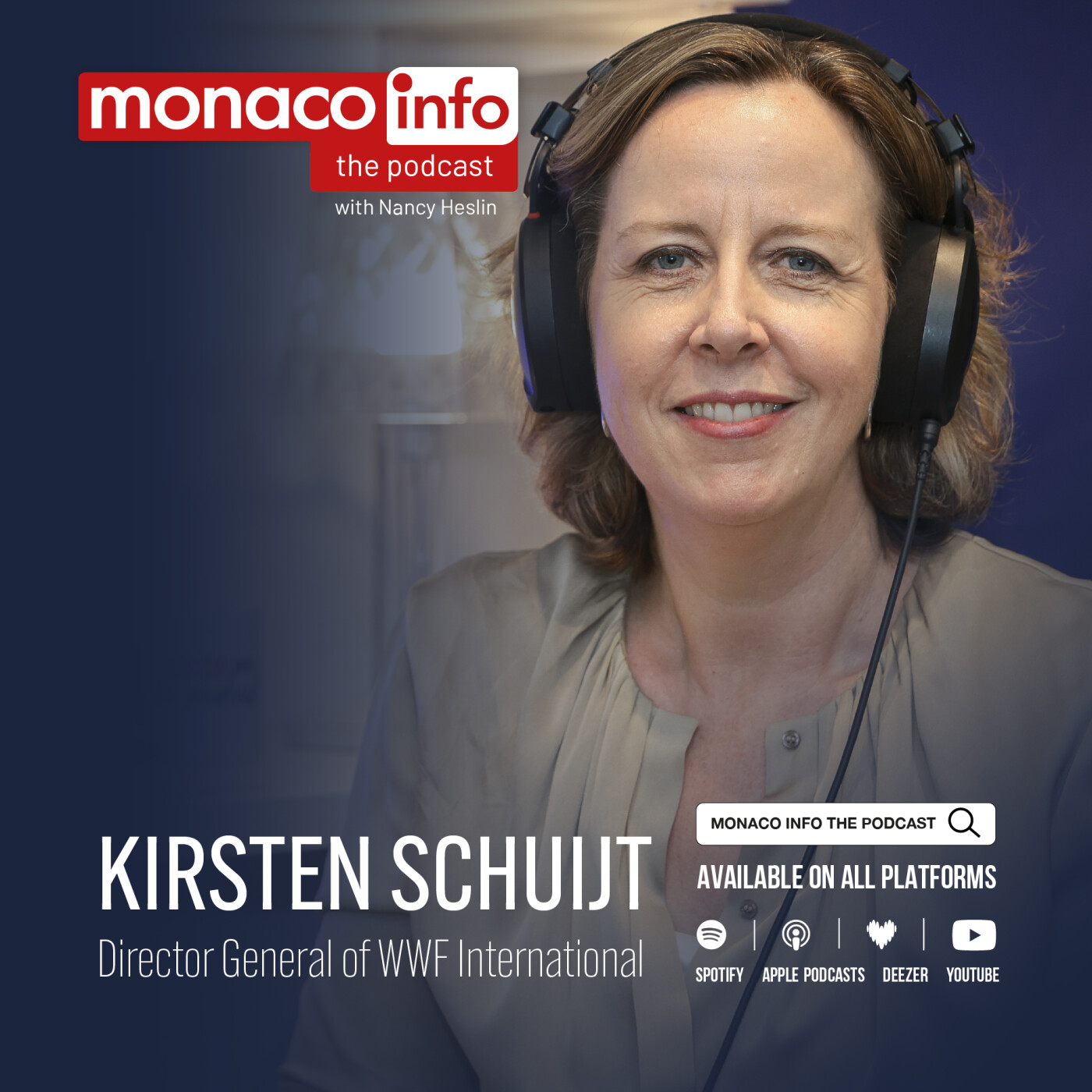
Kirsten Schout, the first female director general of WWF International, discussed her conservation journey inspired by women pioneers like Jane Goodall. WWF, a global conservation organization present in 80 countries, focuses on protecting species and habitats. The iconic panda logo represents WWF's commitment to wildlife conservation and has evolved over the years. Kirsten emphasized the importance of biodiversity preservation and building resilient ecosystems to adapt to rapid changes. She highlighted the depletion of biodiversity and the significance of saving iconic species like pandas and tigers. Kirsten stressed the interconnectedness between humans and nature, advocating for a deeper connection to promote conservation efforts.
Transcription
10540 Words, 57082 Characters
the people making Monaco take the mic. I'm Nancy Heslin, and welcome to Monaco Info, the podcast. (upbeat music) Our guest today was so inspired by women pioneers like Jane Goodall that she applied for an internship with the Dutch Embassy and found herself in Nairobi as a field researcher at a nature reserve. Seeing the rift rally with its herds of elephants and zebras became a defining moment for a career in conservation, which eventually led to an appointment as the first female director general of the WWF International. Welcome Kirsten Schout. Did I get that right? - You did. - Thank you so much. - Thank you so much for coming on Monaco Info, the podcast. Now, you're based out of Switzerland. Do you often come to Monaco to the principality for work? - So I come here once a year from Lucky. - Hello. - We do a fundraising event, and we do that for the Mediterranean, and so that's why I'm here today. - Well, we're very lucky to have you with us. I have a lot of questions, but I thought we could start the conversation by maybe defining some things for listeners, like the WWF. So the World Wildlife Fund for Nature is celebrating its 65th anniversary next year. Can you tell listeners what's some of the history and some of the key points they should know just that we'll bring them into this conversation a little bit easier? - So I think one of the first things to know about WWF is it's a global conservation organization. And we work in places. We work to protect species and the habitats in which they live. We do that through working with people, through the people who live in these places all the way up to working with corporates and governments who influence those places. And we do that across about 80 countries. So we have a presence in Latin America, Africa, Europe, North America and Asia. Some of the most difficult places we work as well. So very remote, often places of conflict. And we, yeah, as you said, we've been doing that for 65 years. We started tiny. In fact, I live very close to the first director general. - Oh, wow. - He was 94 years old. And then when I hear the stories of what he tells me, it's amazing how it started. But it literally was a group of men, mostly from Europe and those days who really cared deeply about the depletion of wildlife. This was right after the post-colonial period. And they saw a lot of species being depleted, especially in Africa. And so they set up WWF to fundraise for conservation programs. That's how it started. And then it grew into this, yeah, this huge organization where we're working across so many places. - I just want to point out that it's, again, when we look at the timeline to be able to visit some of the countries that easily we can access today, wouldn't have been the case back 65 years ago when they really set out on this mission. - No, it's true. I mean, in those days, it was very difficult to even, you know, you couldn't get on a plane and see it the way you can today. So actually in the roots of WWF, which is why I love what we do is working through local organizations. So, you know, we fundraised here, but we would send a lot of the money actually to local organizations and let them get on with it. And we'd get report backs and stuff like that. And that is still what we do. So yes, we have a presence in these countries, but most of our work is actually through local organizations, whether those are community organizations, women organizations or more broader national NGOs. - So let's talk about the panda. This famous panda logo, everybody knows the WWF logo. What is that story? How did that become the face of the association? - So when these founders, 65 years ago, set up WWF, they knew very well that a strong logo makes a huge difference. And I have to say, the number one asset of WWF today is our people everywhere. We have the most amazing people, but the second one is our logo. And it does open a lot of doors and gets things done. And so they were looking for a logo. They were looking for an animal because that's of course what we were about, especially in those days. And so this was also the time that the first giant panda was brought into Europe. And it was in the London zoo. And it was a panicked Chi Chi. And they visited and they saw this amazing animal. I mean, a panda is quite a, it's a strong animal. It's a cuddly animal. It's beautiful, it's black and white. So in its true, the story goes, and I've heard it's true that it helps that it's black and white. So it saves costs in printing and stuff like that. And so they actually started drawing the logo. And one last thing about the panda logo, because I think that's good to note as well, so it's based on a real iconic species that by the way was going extinct in those days. It's also a story of and species that has improved. So there's a lot more giant pandas today than there were when we were established. But the logo is also evolved. So if you look at the panda logo that was drawn 65 years ago, it was a very sweet little animal. And if you look at the panda logo today, it's much stronger, much bolder, much more courageous. And that I think also symbolizes what WWF is today. Speaking of bold and courageous, let's have a little delve into your life, Kirsten. You were born in the Netherlands. You grew up in Germany and Denmark. You had all these influences and cultures and languages. It seems from a young age. How did that influence you? How did you adapt to so much change at a young age? Yeah, I mean, I guess when you grow up with it, you don't know any better. And for me, it's something that I still do in my life. Like, I love change, I love movement. And I think that's why I do the job that I do. But I think the two influences, definitely, you pointed out, is just moving around a lot, growing up in these different cultures. I also went to international schools, which means that from the age of seven or eight, I just, you know, my best friends were from different religions, different backgrounds. And it became the most natural thing. So I can relate and engage to anybody. Like, I don't see skin color. I don't see cultural backgrounds or religions. I just don't have it in me. And then the other-- so it's the international stuff. The other thing I have to say, we move to Denmark when I was about eight years old. And the Netherlands is a great country, and I love Amsterdam. But it's not well known for its biodiversity. Scandinavia is. And so we spend a lot of time as a family in Sweden and Norway. And that's really where-- That's really where we live. We love Sweden, me too. And that's where I fell in love, really with nature. So we ran to a little house on a little lake. And I spend most of my vacations walking through forests and seeing snakes and insects and birds and fish. And so that's really where my love for nature started. And it's not just my love for nature, but realizing at a very young age that we're so much part of nature and nature is so much bigger than we are. Now, is that something that comes from also within your family? Was your family involved in conservation? Or was this just something that came from within you? It's something that really came within me. Yeah, it's not something. My parents love animals and nature for sure, especially my mom. And I come from a family that has moved around a lot, a very international family, my grandparents. My mother was born in Indonesia, and I have family in Australia, South Africa, United States. So that's in there. The love, really love and passion for nature is something that I developed. And when you were a young girl, did you dream of doing something with nature when you grew up or did you want to be a writer? Did you want to be some kind of world-class traveler? So I remember our linguist. Yeah, well, that's very exciting. No, when I was about 10 or 11 years old, I just wanted to be a biologist in Africa. Really? So I had this love for elephants. I still do. There's something about elephants, which are really, really quite amazing. When was the first time you saw an elephant? So apart from zoos, it was actually when I went to Kenya. So I got out of the airport. We drove to Nairobi National Park. And we saw these birds of elephants. And they're the most amazing animals. Why? Because we have the zoo experience. So what is it to see them in their natural habitat? So what I love about animals, of course, is their size. I mean, they are so huge. And so you feel so tiny. And I think it symbolizes a little bit how I see our relationship with nature more generally. But what I love about elephants is that as they go through life, whether you see a tiny little baby elephant, or when you see a teenage elephant, or when you see this big matriarchs, these mothers, you can relate to them. You can see the teenagers fighting each other. You can see the babies crawling underneath the moms. And you can see these big majestic matriarchs really hurting and showing the way to the rest of their family. So they're actually, as humans, one of the species that I think we can relate to more. We know that they grieve when they lose family members. We know that they have-- What do you mean by that? So they grieve when they lose family members? They actually grieve, which is something that why it's so painful when you look at the poaching. There's a lot of poaching taking place for ivory. We often forget that these aren't just animals that you kill. These are family members of bigger herds, of elephants. And so when one of them is shot and killed for their tusks, this happens so many times over such a long period of time. These are real families that are losing family members. And elephants are known to grieve. They go back to the place where they lost their family member, and they actually grieve there. And when you start thinking about that as humans, this is what we're doing. It's not just animals we're killing. We're killing real feeling species who are losing members of their family. And they're losing memory, right? Elephants have an incredible amount of memory that goes across generations. They will know exactly where to go to look for water, for example, during dry spells. They know how to get back there. They know where to fight it. Nobody really knows why that is. But it's something that they inherit through families over generations. And that's what we're getting rid of as we're killing and poaching these animals. How do you separate your emotions from work and what you hope that your efforts achieve? Or maybe you don't. I was going to say that. I think for me, there has never been a distinction between who I am and my job. And I think also, that's why I can do what I do. I'm not a different person at home or with my friends than I am in the officer. Then I am here sitting here talking to you. If we go back to when I was 12 years old, and I wanted to be that, you know, that fuel biologist in Africa, I mean, I also was a ranger. I was a youth member at WWF. So I was 12 years old. I was already participating with WWF. And I've been engaged in conservation in different ways and forms. And have always just done what I thought was the right thing. And this, to me, is doing the right thing. I mean, I'm getting emotional when you're talking about elephants. So I think how do you keep it together when you're in the field, and you see such emotion and grief? I mean, it is for me conservation and doing what I do is for a large part just being an awe, right? So that's where it starts. That's where I get my energy from is the beauty of nature, being an awe of nature and feeling a really deep connection to nature. Can I share something with you? I was listening to a podcast that they were talking about how people should relax. And they said, you know, what you should do is go into the park or when you go for a run or you out in nature, don't have earphones in all the time. I never do. I walk my dog. I don't even take a phone. I'm always trying to just absorb what's around me. And I didn't-- I found it strange that you have to actually give people advice to say when you go in a park, observe the trees. Right. Well, we have become so disconnected from nature, right? I mean, that is the huge issue. And so the fact that-- and you can feel it, like during COVID, it was really interesting. You know, a lot of people went back into nature, right? Because there's not much else we could do. So people walked for us, people walked beaches, and people reconnected with nature. And it actually made us feel good. And a lot of pieces have been published about the psychological benefits of being in nature. But the fact that we have to teach our kids to do that, the fact that we have to tell people to take off their airports when they're outside, it's crazy. Because you can feel it, and you can sense it. And for me, the bottom line of that is that we are-- what we have done in our societies is if we have separated humans from nature. And that comes from the fact that we think, as humans, we're above nature. We are here to take care of nature. We're here to control nature. In whatever way we want, whether it's controlling rivers and damning them, or whether it's controlling for us and make them all nice and neat like post-stamps, that comes from a long evolution of wanting to control nature and separating humans from nature. The moment you drop that, which is what I don't have that concept, the moment you see that humans are part of nature, that's when I think you really start feeling that connection. And to me, that is also a really important aspect of strategy of what we're doing with WWF. I mean, it's conservation, but a large part is this. It's educating people that nature matters, that we're part of nature, that you're not conserving nature for WWF. Nor are you even doing it for species. You're doing it also for the future of humankind. How would you define conservation? What does conservation mean to you? Let's go with that. That's a really interesting question. Because when we talk about this and all of the pressure we feel to reach 2030 and our goals, sometimes I think people get a little lost about what we're actually talking about. So for you, what does it mean? So for me, it means two things. One thing is definitely just keeping biodiversity intact and with an emphasis on diversity. The diversity of our biological systems, ecosystems, nature. And so it doesn't mean hanging on to every single bit that was here 200 years ago. I don't think that that is the right perspective on conservation. To me, it is about looking at the diversity of life on earth that includes humans, but that includes the diversity of species and insects and fish and landscapes and keeping that diversity. The second aspect of the definition of conservation for me is around resilience. It's not just about protection, but it's about building resilience into systems and ecosystems so that they can adapt because we're living in a world that has so many changes and that are happening so rapidly when you're looking at climate change, when you're looking at conflicts, polarization, just population growth and demand for food. And what we need to do is to make sure that systems, including people and species, can actually adapt to those changes. And that means having strong resilient ecosystems. If you look back to Young Kirsten when she was a ranger, how has your perception of conservation changed? What have been some eye-opening moments for you along the way? And positive. Yeah, I think-- look, I think one of the-- to start with a negative thing, I think one-- honestly, what I've seen is just the incredible depletional biodiversity, right? I mean, whether it was the child or when I really started working in conservation when I was 20, 23 years old, I've always been traveling the world. I scuba dive, I'm out in Clive, and do everything. I walk through tropical forests. I lived in Africa 25 years ago, and if I go back to those places and compare it to where it is today, it's pretty depressing. I mean, the truth of the matter is, and let's just be honest, and open about it, we are losing biodiversity every single day, everywhere. It's out here in the Mediterranean. It's out in Southeast Asia, Africa, Latin America, everywhere. So that, I think, is the one big shock. You see it with your own eyes. I think the other thing that I've found is that back to resilience is how incredibly resilient nature is, and that's something I've seen over those decades as well. There have been moments where you think you lose something, and then it comes back. And I think the species-- I mentioned the giant pandas-- is a great example. There have been so many moments where we thought we're about to lose a species and iconic species. I'm not talking about the insects and the butterflies that people don't seem to care about. OK, let's talk about pandas. Let's talk about tigers. These are species that we almost lost. And they're coming back. What do you mean, really, by almost lost? Because, again, from people that are on the outside, and we read the news, and it's like, oh, they're facing extinction, OK, what does that really mean? How close are we becoming to these moments? And why does it matter? So when you're talking about what I mean is basic extinction. I mean, these are species of which there were millions, thousands, and they've been depleted to several hundred, right? That's what we're talking about. And what I love about it is they have been brought back. Why is that important? That's always a great question. Why are individual species important? I think for me, it starts with the love of these species and nature and the respect of life. We can have all sorts of arguments of why an individual species may be-- who cares if the tiger goes extinct? Why would we care sitting here in Monaco? But I think it is a love of life. It's a love of species. First of all, secondly, these iconic species, especially the bigger ones, but all the way up to the tiny little butterflies and bees and insects that we have, they each have a role to play in the system, just as we have a role to play. And if you take away the Jenga towers, if you take away one block, it's OK. If you keep taking several blocks, the whole system collapses. And that, I think, is what we're witnessing right now, is we publish a report every other year, as WWF call the Living Planet Report. And since 1970, we've lost close to 74% of species. Groups of species living in the wild. 74%. 74%. Now I'm 51. I was born in 1974, which means in my lifetime, we've lost about 74% of species living in the wild. So that's where we are. It's not about the individual, to me, I love individual species, but even if you don't, you keep pulling out those blocks and those Jenga towers. And at some moment, the system will collapse. So it is about a love of life. It's for me, about a love of our planet. And it's about the future of humankind. What does it mean to be in the field and doing your work? Because when we talk about Kirsten Schout, there's all this, she spent a lot of time in the field. She's been in Kenya, Malawi, like, OK, what does that mean? Can you describe to the listener, what is a day in the field? What is a week in the field? How long are you actually living like this with your work? Yeah. Look, what I actually don't really like the term in the field, because it makes it sound like something abstract, right? But what it really is, it-- I think it sounds cool. OK, because fine, let's keep it. We'll talk about being in the field. It's like you're on a mission or something like that. You know, these are these wonderful turns. But what it is, it's actually nothing abstract. It is the heart of what we do, right? Because the field is just the places that we're trying to conserve. Not just WWF, but with many, many partners. And so we're talking about places like Congo Base and in Central Africa. We're talking about Gaza, the Gaza landscapes, and southern and eastern Africa, all the way to the Arctic, the cruel triangle, the Amazon in South America. And so these are these big ecosystems that we have all identified as the most important tropical forests, the most diverse oceans, the most important art places in the Arctic, and the most important global wetlands. And so this is what the field is, right? So there are places with real species, with real forests, or coral reefs, and people living there. And so what does it mean to be there? Again, to me, you cannot do the job that I do without having a lot for places. Because that's why I do what I do. I'm not in my job to speak to policymakers, or CEOs of big corporates, for the sake of speaking to them. I'm doing it because I want to make a difference on the ground. And we need to see conservation impact on the ground. And so I've spent a lot, I have spent a lot of time in the field, and I still do, because every single year, I still prioritize going into the field, because that's what I love. You can't see Kristen's eyes, which she really lights up, and thinking about that. It is the coolest part, because that's where you see, that's where number one, that's where you see biodiversity. So what do you do? Like, give us an example. OK, you'll learn somewhere. I'll tell you one of my coolest trips that I've done, which was actually right after COVID. And it's just an example, but it just shows you how great it is. So it was right after COVID, and for various reasons, I really, really had to go to Republic of Congo, to go into one of the field projects that we do there. It's a place called Tokopikunda, which is one of the most remote areas in the Congo Basin. It's a big wetland area, but with massive tropical forests. And so I land, it's a lot of driving, a lot of driving through the country, long, long roads, African roads, until you hit this wall of greenness. And you meet-- I meet my local team. So we always have local WF staff there on the grounds. We sit around campfires, we sit around the table. And I learn, and I listen mostly. The first days are listening and soaking it all up, trying to understand what are you guys doing? What is happening on the ground? What are your challenges? How can I help? So that's the first part. The second part is we go into the field. And in this case, that's why I'm sharing. It was the coolest bit. We literally spend three, four days walking through the forest. With local communities, these were the Baka communities. And these were women and men who literally live for generations in these forests. They knew exactly where to find the roots, where to eat. They knew where to find the fruit in the trees. And we camped out in the forest for several days. And it wasn't about the experience of the camping. It was to really soak up those systems, to soak up the knowledge and the understanding of, what is it that these people are seeing for generations? And how can we help them conserve their landscapes? That is to me. And that is also, I think, my biggest passion within WWF and why I sit in this position is because we need to make sure that we empower the people who live and work in the places we're trying to conserve to conserve their landscapes. And so we do that for several days. And then usually what I do as well is meet up with big stakeholders around. So I meet government officials back in the capital city and I meet corporates because these are all part of that system that impact this place. And that's what being in the field is like. Do the locals, when they're sharing what they're experiencing, what they're seeing, their knowledge, is there a heaviness? Do they feel the burden of change? Do they feel panic? Are they saying, why are we not doing anything? Totally. Totally. Because they live and breathe this every single day, right? They, on the one hand, they're seeing their-- this isn't an ecosystem to them. This is home. This is their homes. And they are seeing it being lost over generations. That same group of Baka in Republic of Congo, their fathers knew every single plant. And you can imagine this is like one of the most diverse tropical forests on the planet. Every single plant, every single bird, they know where to find the wild species. Already the suns don't have that memory anymore. So we're not just losing ecosystems and their homes. We're also losing incredibly important knowledge of these systems. And we're losing possible cures for-- there's a lot of medication coming from tropical forests. So they're seeing their livelihoods. They're dependent on their forests. They're seeing their homes being depleted. And a lot of it has nothing to do with them, right? The forces and the pressures that are causing the loss of these forests or coral reefs is coming from outside has nothing to do with them. But this is one of the challenges, right? And maybe as a non-governmental organization, I don't know if it's more difficult or easier for you to be the middleman to embrace the whole of society approach like WWF. How do you achieve that? There are so many players involved in one decision. So how do we advance? Yeah. So what's the secret? Well, the secret. The secret-- and again, this is why I loved WWF-- is that we are the middleman. We're the convener. So we will always sit around the table and talk and get people around the table and jointly come up with solutions. Because that, to me, is the only way you can get to really impact on the ground. That is under a lot of pressure. And you know, if you look around whether it's in this part of the world or other parts, there's a huge pressure on-- there's a lot of polarization. So actually, people are-- there's a huge pressure for us to take sides. For us to speak out against or for your black and white in the box outside the box. And that's the general trend. And WWF sits in the middle. And actually, it's probably the hardest thing to sit in the middle and to still believe that solutions are not found in black and white boxes. But solutions are found in the gray areas in between. And that's what we do. And so it means sometimes stepping over, stepping outside our comfort zone and talking to people that initially have no interesting conservation and trying to convince them to change their behavior. I have to say the one big lesson for me for being that middleman is that it takes a long, long time. Well, I was going to ask you, how difficult is it to just not react? Because I would imagine some people are quite opinionated, even though they can be a high up as a shareholder in an organization. I find that people are really opinionated. They believe they're right. And they can spend a lot of time-- how do you, as a leader, manage all these different personalities still trying to achieve the same outcome? So I think there is one general rule for me is that is we do react when it affects our mission. So when you're talking about conservation, when you're talking about conservation impact in those places, I was just talking about we do speak up. But we do-- we challenge. And we say no. And we draw lines and boundaries. And you know, WWF has a high reputation. Our brand is very strong. And we don't give it away. And so if you want to work with us, and if you want to move from beyond sitting around the table to really partnering and making a difference, then that definitely comes at a cost. However, I don't believe that as WWF or as an NGO, you cannot be constantly engaged in attacking and defending because you get pulled into 1,000 directions. Conservation today isn't any more what it used to be, right? We are focusing not just on places and species. We're focusing on food and finance, working with corporates and governments and indigenous groups. And you can imagine the amount of topics that we can be asked to have an opinion on. To me, the most important thing is, when it impacts our mission, we'll speak up. All the other stuff-- it's up to other people to speak up on that. And what about your role as a woman? Now, oddly honest, I don't really like asking people too much about, OK, so what was it like for you as a woman growing up? But I would imagine you're dealing with a lot of different cultures in this particular role. First of all, you are the first female director general at WWF International. Do you feel like, first of all, you have some kind of responsibility for gender equality in conservation and leading women? And how do you deal with maybe some of the attitudes that you come across that are just cultural differences? So yeah, it's interesting. So on the first female director general of WWF International, I was also the first CEO in WWF Netherlands. I was the first female conservation director. So I've been so many first female roles in my career. I never thought about it. That's the interesting thing. It was never like, OK, now I represent the women of the world in conservation. Look at me. No, never ever. Like I said, I do it because I love it. And because I think I can make a difference. I think that is why I do what I do. I still think I can make a difference in whatever I do. I think the interestingly in all these roles, the biggest change has been in leadership styles. I think that is where I've seen a big difference between-- and that's not just WWF for conservation. But I think more generally, it's the kind of leadership style, so that in response to your question, where have I seen some of the biggest challenges, it's-- my leadership style is different. So people have challenged me in the beginning, can you make tough decisions? Can you be top down? All the kind of leadership attributes that people usually associate with-- leadership styles. And I think my style is I can make very tough decisions. And I have been, which is otherwise, I wouldn't be in this job. But I think I'm also more engaging. I'm probably more collaborative. I do have a particular eye for people and relationships. And honestly, I think it's a strength. And I think that's how you get things done. But I remember when I started, that was-- that was some of the questions. Can you make tough decisions, really? I remember that was one of the comments. Yeah. Can they have anything to do with gender? No, but I think it's a stereotype, especially, you know, 15, 20 years ago when I started, definitely. And nowadays, we know that there are strong attributes to female leadership as well. Conservation is interesting. So WWF, actually, if you look at it globally, most of our staff are actually female staff. So-- and that's because a large part of what we do is communications. It's people in culture, which are, you know, more traditional female roles in many of the countries where we work. It's the conservation stuff, the field stuff where I came from, you know, where actually most of them have traditionally been men. I've learned a lot from men. And I want to be honest about that as well. And actually, it's been a lot of the male conservation leaders that have inspired me and that have challenged me in addition to the Jane Goodalls and the others. Have you met Jane Goodall? I have. Yeah. I have met her, not for a very long time, but I saw her speak and we spoke briefly. I mean, she's just an amazing woman. And there's a lot of amazing woman in conservation that have inspired me, but so have men. And so for me, back to your question, what is it that I'd like to do? I think it's definitely-- I have a role to play maybe not even actively, but just being who I am and inspiring other women across WBF and in other organizations that, you know, you can be a woman and a strong leader. But also, you can be a mother and you can be a leader, which I think is another thing that I've seen is combining motherhood with some of these challenging leadership positions and showing that it can be done. But more importantly, for me, I think will be the real conservation leaders of the women on the ground. And it's those mothers and leaders in those places that we were talking about who actually are the strongest conservation leaders. And how do we make sure that we build that capacity and that we actually empower them and strengthen them to do the real work on the ground? And that's some of the stuff that I'm involved in as well. Well, that actually brings me to one of my questions because I was fascinated to learn from you earlier that women make up almost half of the world's fishing workforce, but get very little recognition or resources. You even said that across the world, often marginalized groups such as women, indigenous leaders, and local communities are leading conservation efforts, pioneering sustainable fishing methods, and restoring marine ecosystems. Despite their critical role, they are often excluded from decision-making processes. So how do we then make it more inclusive for these types of women and for underrepresented groups? I mean, this is a big challenge. It is. And I think it's the biggest challenge that we have as the conservation sector and WWF within that. If I may just add, I don't think people realize that those statistics, half of the fishermen are women, so we can no longer say fishermen. That's right. We talk about fisher people, or fisher persons, and the same with farmers. I mean, a lot of farmers in Africa and Asia, a lot of women, a lot of land is being farmed by women who bring their kids on their backs, and they go and farm their lands. And so no, absolutely. I mean, women and women play a key role in the families, also here in Europe. It's not just far away in terms of the food we eat, right? And making sure that it's sustainable and that it doesn't lead to deforestation in the Amazon. So women have a key role to play all over the world in conservation. The most important thing is we're calling it inclusive conservation, right? And it's making sure that when we design programs in conservation, when we implement programs, when we monitor and evaluate programs, that they are inclusive, that they are inclusive of indigenous groups, local communities, women, youth, which is another really important group, that I think we should engage in the work that we do, and just be very explicit and conscious about it throughout everything that we do. Well, you bring up youth, and I am fascinated by these sort of cross-generational conversations, which I kind of think are lacking. And I had an amazing experience about a year ago here in Monaco, and I was in a room with millennials, and they all had their own entrepreneurial, echo entrepreneurial businesses. And they were quite accomplished. They were all in a group. It was just a small room of people. So there were maybe a dozen of them. And then there was a couple other people my age in their 50s. And I didn't realize the weight that that particular millennial group was really feeling about the ticking clock towards what's happening with our world. And when I started really listening, I was moderating. When I started listening to the dialogue between a 50-year-old and a group of millennials, it shocked me, because they are so used to hearing people that speak the way they do and share those opinions. And then the 50-year-olds, we also have our own way of talking. And I thought, why aren't we having more of these conversations? They're very uncomfortable, because it's very difficult. But you have to find that common ground. How do we do that? You had a great article. You wrote about this, and I loved this if you let me read this. You said, I found myself a Madagascar flanked by two incredible inspiring women, one a seasoned conservationist, the other my 15-year-old daughter. Paint the picture here. What is happening in that moment in Madagascar where you have these two generations that both have a strong impact and influence on you? Well, it was another amazing trip to the field. And for me, so my daughter has grown up in conservation and WBF, not that she wants to do anything in conservation yet. But she-- so I took her to Madagascar. She respects nature like you do. Oh, yeah, yeah. In awe, totally, totally. And she loves nature, and she will get to a place where she will want to make the world a better place, like her mother. But she'll find her own path within that. And being able to take her there and to see real stuff, real action on the ground, rather than hearing about it in the Netherlands, where we were living at that moment. And the other woman was Nani, who is the CEO of the Madagascar program, an amazing-- a close friend of mine, an amazing leader for many, many years within WBF. And having these conversations, as you say, in bridging not only generation, but also just cultures, right? I mean, here's this 15-year-old girl who's grown up, like most 15-year-olds, with iPhones and Netflix, and going out in Amsterdam, those were, I think, the highlights in her life. And having her talk directly to this other woman later, I think is really, really important to show, to teach generations about what's is still possible, because let me back up one second, because I wanted to respond to your first point, too. I also have done a lot of teaching at universities and with students, and my daughter's generation, as well. There is a lot of anxiety out there. And I think it is. I have no idea. Climate anxiety, especially, that's going on. And part of it is social media, what they're seeing. It's a lot of drama, a lot of negative news. And part of it is just the world in which we live, right? It's the reality. I think, for me, the biggest challenge for us, as WBF, in addition to making impact on the ground, it is finding the good things amongst all that chaos, and still finding a way to make a difference. And this, I think, is the most important message that we should have to these young generations, which is why I brought my daughter to Madagascar to see the real stuff that we're still doing on the ground. We can still make a difference, make it concrete. Beautiful things are born out of really, really bad situations of chaos. And even though the world may sound and feel like a bad place sometimes, and just so difficult, and you're not seeing how you can still make a difference, through that chaos and darkness, finding those little spots of light and specks of light that you can hang on to and still make a difference and just make it concrete. I think that is for us, in our fifties and our generation, we owe it to the younger generations that they don't lose hope. Again, it was Jane Goodall who said that the biggest threat to the day's world is apathy. It's when people lose hope, and we all become empathetic, and we think, okay, so there's nothing we can do. The problems are so big and so huge. Well, then we might as well sit back and do nothing and give up. And that is the biggest risk, and making sure that we connect and engage these young people to show that, yes, the world is sometimes a difficult place, but we can still make a difference. And you guys make a real difference. Look what happened, you know, just last week in Nepal. Look at what happened last year in Kenya, and I can go on in the number of countries where youth have demanded change and have gotten changed. And that is what I'm hoping. That's what I'm trying to teach my now 17-year-old daughter and her friends, but also the many other young people is that don't stop believing and hanging on to the things where you can still make a difference. And find those spots of light in chaos. Does your daughter end with her friends? Do they approach you about these kind of subjects? Knowing that you are really the ultimate source. Do they share their anxiety with you? They have questions about what they're reading? They do. I mean, the number one question I get now, they're 17 choosing universities. So what study can I choose so that I can get exactly the same position that you're having? They want like a blueprint for their CV, which is so-- Piece of cake. I love it. I love it. So no, they do. And we have long conversations, which is what I love. So I love kids all-- I just love kids' period, but I love kids all ages. But now we're getting into an age, like 17, 18, 19, where they're really interested in the world. And they start asking these questions, which just-- I've seen things from different perspectives, as you say, and having debates and real conversations about, OK, so now what? This is what it is. This is what's going to happen. This is what we can expect. What's my role within that? I think in the end, that's what we have to do. You can't change the world. It is what it is. But what's your particular moment in this time that you can do? I had this wonderful-- many years ago, I was in a conference in Zambia. And there was this Zambian youth leader who stood up and gave a beautiful speech. And I'll never forget what he said. He said, every generation has a battle to fight. And what's our battle? What's our particular battle this today, in the world that we have inherited? And the future that we are going to live, what is our particular place in this world? And what's the battle of our generation? I think really reflecting deeply on that, knowing that you're not going to change the world. But you have a role to play a really important role. And what is that? I was actually going to ask you, in all the years that you've been in conservation in this field, was there an aha moment for you? I mean, obviously, you do have this deep connection to nature and wanting to do good. But with all the people that you've come in contact with and being at a lecture and listening, that what was the moment for you that was just like a light switch where you thought, oh, I see it so differently now. And it just makes a huge impact in your life. There have been many moments, and I still have them. Because if there's one thing that I have, is I'm always learning. And I'm always curious about everybody and everything and asking 1,000 questions. So I keep-- My kind of gal. Totally. Totally. That's why I keep developing. And I think doing-- so I have learned so much from-- I definitely had that aha moment when I first traveled to Africa. Being this 12-year-old that always wanted to go to Africa, being the 23-year-old that fought to finally get to Africa and going into the field, driving out of the Narrowby airport and driving through the Riv Valley and seeing those curds of zebras and impalas and giraffes and just feeling tiny. Really, really tiny and knowing that there's something so much bigger that we're part of. That has been a really, really important moment for me. That's when I knew I wanted to be in conservation. I could have done other things as well. But that was a really, really important moment. I think moments like those long walks through the forest in the public of Congo, where I'm sitting there and listening deeply to women and men and young people talking about the knowledge of their forest. And just being inspired and in awe and thinking, of course, we have to protect this, right? And just learning about different perspectives. I think that's something that always keeps me going. And as I said, there is no black and white. There is no right or wrong, but always finding for that great-- looking for that gray area where you can still make a difference. Well, we're in the Mediterranean region. And one of the things that I find very frustrating is I love the sea. I'm not frustrated by the fact I love the sea. I love the sea. I love swimming in the sea. I love what I see when I have my goggles on. I love rowing. I love connecting with water in any way I can. And what you're talking about going out in the field and traveling-- I mean, we have this remarkable sea right behind me, the Mediterranean. And there's so many people here that don't even put their feet in the water. And I often think you can't understand the ocean or the sea until you connect with it. You have to be part of it, as you say, to see the grandness of it and our small part within that. This is very frustrating for me. I mean, I want people to understand the pollution that's happening. You go out and rowing, you see the plastic on things. What type of projects are you at WWF working within the Mediterranean specifically? And how can we get people to really connect with what's happening in our backdoor here? Yeah. In monarchy. And by the way, I'm an ocean person, too. I love the sea. And it's where I grew up, and I love it. I go diving, everything. And I share your frustration. The hardest part, also for us at WWF, is to convey the wealth and the diversity and the richness of what's underwater. So a lot of people don't know. But it is oceans or some of the richest ecosystems. And the Mediterranean is one of the most diverse ecosystems in the world. It is also, as you say, it's heavily polluted. It's also the sea in the world that is mostly prone to climate change. I think it's heating up 20 times faster than any other 20 times the Mediterranean is heating up 20 times faster than most other places. And that has an impact on its wildlife, and it has an impact on the communities, right? I mean, the Mediterranean is not just a bunch of-- it's not just a big bowl of water with some fish living in there. It's deeply related to traditions and communities and people and livelihoods. And so, yeah, I think for us, as WWF, we've been working here, I think, from the very beginning. It's been one of our flagship landscapes, seascapes, where we have been working. We work a lot on protected areas, from marine protected areas to protected areas around sea grass. We work a lot on overfishing and making sure that we turn that around. And there've been some successes there as well. Because you have a lot-- Sorry, you have long-term collaborations with the Prince Albert II of Monaco Foundation, the Stalios Philanthropic Foundation. You work with them as well in these areas. Yeah, which is, again, is why I'm here. So this is something that we've been doing for 13 years. And every single year, we fundraise. And we fundraise for the Mediterranean Sea. And that goes to the work on the ground that we're doing on some of these topics. So if the sea is-- if the Mediterranean specifically is heating 20 times faster than it should be, would you call that a tipping point? Because I hear this reference of tipping point. Can you describe what is a tipping point and why they matter? Yeah, so tipping points is when you keep-- it's actually back to the Jenga tower that we were talking about. When you deplete a lot and a lot over time. And there is a moment where an ecosystem reaches a point where the collapse is sped up, right? Like it's not just incremental, but there is a collapse. One example-- I don't know about the Mediterranean. There are well-known tipping points. I'm sure we're close to it in the Mediterranean. The two tipping points globally, where we are closest to, is in the Amazon and in the Arctic. When the Amazon, we know that we have been deforesting so much that there is a moment of a point of no return, where you lose so much forest that the local climate, for example, changes, because forest play a key role in regulating climate locally, that you keep deforesting that actually there is a tipping point that the whole Amazonian ecosystem collapses. We're seeing it in the Arctic, right? Where we're losing so much ice and sea ice and land ice. And there is a moment where that whole ecosystem will collapse as well. If you're thinking about the heating up of the Mediterranean and you add to that, the massive overfishing over such a long period of time, and you add to that pollution, including especially plastic pollution, which is killing so much wildlife in our oceans globally. There is a moment where the system can no longer function as it is. And then we reach a point of no return. We're not there yet in the Mediterranean. We want to be clear there as well. We can still make a difference. And one thing I have to say, because you're an ocean person, one thing that I love about the ocean at this moment in time is this is the time of the oceans. Again, having been in conservation for so long, we've talked about species. We've talked about tropical forests. The oceans have never, ever gotten a lot of attention, because it's just far away, exactly the reasons you've said. But right now, it's the decade of the oceans. And so we just got the WTO, the World Trade Organization, fisheries subsidies, agreement ratified. We're about hopefully-- Which means what? Which means that for the first time, there's lots of money, and we're talking billions of dollars going into unsustainable agriculture, unsustainable fisheries globally. And this fisheries agreement means that we're going to shift those subsidies into more sustainable fishing. It means that subsidies of governments to large-scale fisheries can no longer go to the depletion of fish stocks globally. And so that is a huge-- that's a huge-- that's not additional money. That's actually shifting the money that's out there already into more sustainable practices. High seas trading is about to be-- What is this means? It's supposed to be rectified as some time in September. But what does that actually mean? And why is it hopeful? Well, what is hopeful? So what it means is that countries put their signature under a global agreement, like we have for Paris. We've got the climate agreement. And they agree to a whole set of objectives to make a change. That's basically what ratification means is that it could be all countries in the world. It could be a subset of countries. But they basically agree to a set of goals and objectives of what they're going to do. And they're going to monitor it and hopefully hold themselves accountable as well to that. So why that is important-- these global agreements, especially today, is because we live in a world where a lot of people like to challenge us that multilateralism is dead. That collaboration is no longer possible at a global level. We're seeing blocks, we're seeing polarization. People sitting against each other. What the oceans world at this moment is showing is that actually collaboration is still possible. And in fact, it's necessary if we really, really want to make a change in the oceans. The one bit that I'm very disappointed about that we didn't get is a global plastic treaty. And we've been fighting really hard to get it with others. A few weeks ago, we hope to get it in Geneva. In June, wasn't it? And actually here in Johannes, and I was here as well. And we're still not getting it in-- What is the issue for that? What is the reason that that particular treaty cannot come together? Well, it's very simple. It's economic interest. So plastic is made of oil. And we use plastic a lot. And let's be honest, there's a lot of good plastic. There's a lot of value in plastic. But the problem is at this moment is that there is a lot of economic interests in making sure that we keep producing a lot of plastic. Because that's what makes a lot of money, especially for countries that make oil, and that have oil in their backyards. And so that has been the biggest problem at this moment. There's a lot of economic interest, not to have a global plastic treaty. I don't know what to say. Well, I'm very upset because we're talking about conservation on this podcast. But you know what the real big issue with plastic is? It's not just conservation and species. It's actually health. And it's the health of our-- it's our health, but it's the health of our children and grandchildren. And that's the biggest issue that people are failing to see. Again, it's not about nature out there. Nature is us. I do have one quick question before I sort of just round off with how do you feel hopeful about the future and what you're actually doing to move towards 2030 and beyond. But deep sea mining-- this is a pretty hot topic. Is this going to be something that is going to be difficult to get people to agree on the same level? I mean, people argue about this subject all the time. It's all about money. Can you, in maybe a sentence or two for listeners, just explain really what are we talking about with deep sea mining? And what do you see as the way forward? So with deep sea mining, of course, the issue is that there are rare and precious metals that we use for our iPhone and for our laptops. And so all the things that we cherish, they require a particular type of mineral. And they know that that's being found at the bottom of the sea. The problem is that these are nodules. So these are really highly valuable nodules that are found deep, deep in the sea that require special techniques in order to take them out of the sea. In parts of the sea, where we know that biodiversity is most likely very high, and yet we don't know enough about it. So as we know, we're just talking about how incredibly threatened the seas are, no matter where you sit. And on top of that, now we're going to say, OK, let's start mining these nodules. We just don't know at this moment what the impact is going to be on the environment. And so what we're saying together with others is, look, we're not opposing deep sea-med mining, but we're saying, let's first get the science right and know what's going to be the impact of those activities. And then let's come up with a good plan on if we're going to do it, how to do it in the right ways, with no harm or as little harm as possible to those ecosystems. That's what's going on. But of course, again, the economic pressures are so huge that there is a lot of pressure from countries and from mining companies to start mining them. And we've seen, of course, that pressure is increasing. So to round off, how would you say, let's take this on a positive note going forward in the future? What is WWF's biggest project initiative that you really see is going to make an impact? And the second part of that question, just to really end the episode, is what would you like your legacy to be? So for WWF, let me start with that. And maybe end then with what I'd love to leave behind when I leave, is I think for WWF, my hope lies in the fact that we can still connect the dots and make a difference on the ground. And that means that we need to focus not just on the place-based work that we were just talking about, protected areas, working with fisheries, but also working at the biggest drivers that are impacting those landscapes. And for us, that means working on three systems, the food system, the climate system, and the financial system. Just to give you an example, the food system, the biggest driver of biodiversity loss is the way we eat and produce and waste our food globally. So for us as WWF, those are pathways in which we are really, really building up our capacity, building up our partnering and engagement with important players outside. And I think we can make a difference there as WWF, because we do sit around the table when we do have the capacity to bring these people into the field and see what impact, whether you sit here in Monaco and you eat your dinner, what the impact of that plate of food has actually on deforestation in the Amazon, for example, or the depletion of wildlife in summer or ocean. So that, to me, is the biggest thing. Is over the next five years, we've launched what we're calling a roadmap 2030, which really looks at the six biggest things that we can do as WWF, thriving biodiversity, food, finance, and climate, and doing that in an inclusive way with the people who live and work in the places we're trying to conserve, which brings me to my legacy. For me, and I'm sure you've heard it across all my answers, I really strongly believe that conservation can only be sustainable if it is driven and owned and lived by the people who live in the places. And whether it is here in the Mediterranean, we have to find a way for the people in Monaco to own the conservation activities in the Mediterranean. It can be a WWF coming in here from outside and telling you guys what to do. All the way down to the back, I live in the Congo Basin, where we really support them and empower them to make their decisions on how they want to conserve their ecosystems. I think the days of 65 years ago, when WWF was established, when you have a European NGO coming in and telling the rest of the world how to conserve their places, those days are over, and we know it's not sustainable. So we have to find a way to engage youth, to engage women, and to empower them to make their decisions so that they can live in a better place, two or three, one or two or three generations down the line. Wow. Well, Kirsten Scout, I can understand why you are the first female director general of WWF International. You did not waste one word today. I would spend another hour talking to you, fascinating. Thank you so much for coming on Monaco Info, the podcast. Thank you so much.
Podcast Summary
Key Points:
Kirsten Schout was inspired by women pioneers like Jane Goodall and became the first female director general of WWF International.
WWF is a global conservation organization working in about 80 countries to protect species and habitats.
The WWF logo, a panda, symbolizes the organization's focus on wildlife conservation and has evolved over time.
Summary:
Kirsten Schout, the first female director general of WWF International, discussed her conservation journey inspired by women pioneers like Jane Goodall. WWF, a global conservation organization present in 80 countries, focuses on protecting species and habitats. The iconic panda logo represents WWF's commitment to wildlife conservation and has evolved over the years.
Kirsten emphasized the importance of biodiversity preservation and building resilient ecosystems to adapt to rapid changes. She highlighted the depletion of biodiversity and the significance of saving iconic species like pandas and tigers. Kirsten stressed the interconnectedness between humans and nature, advocating for a deeper connection to promote conservation efforts.
FAQs
The WWF is a global conservation organization that works to protect species and habitats across 80 countries. It started with a group of men deeply concerned about wildlife depletion, especially in Africa.
The panda logo was chosen for its iconic and endangered status. It represents resilience and strength, evolving over time to symbolize WWF's mission.
Growing up in diverse cultures and nature-loving family inspired Kirsten's passion for conservation and connection to nature.
Conservation for Kirsten entails maintaining biodiversity with a focus on diversity and building resilience in ecosystems to adapt to rapid changes.
Conserving biodiversity is crucial for the love of life, maintaining balance in ecosystems, and ensuring the future of humankind.
Kirsten has witnessed a significant loss of biodiversity over the years, with a 74% decline in species living in the wild since 1970, emphasizing the urgent need for conservation.
Chat with AI
Loading...
Pro features
Go deeper with this episode
Unlock creator-grade tools that turn any transcript into show notes and subtitle files.
 PodcastTranscript AI