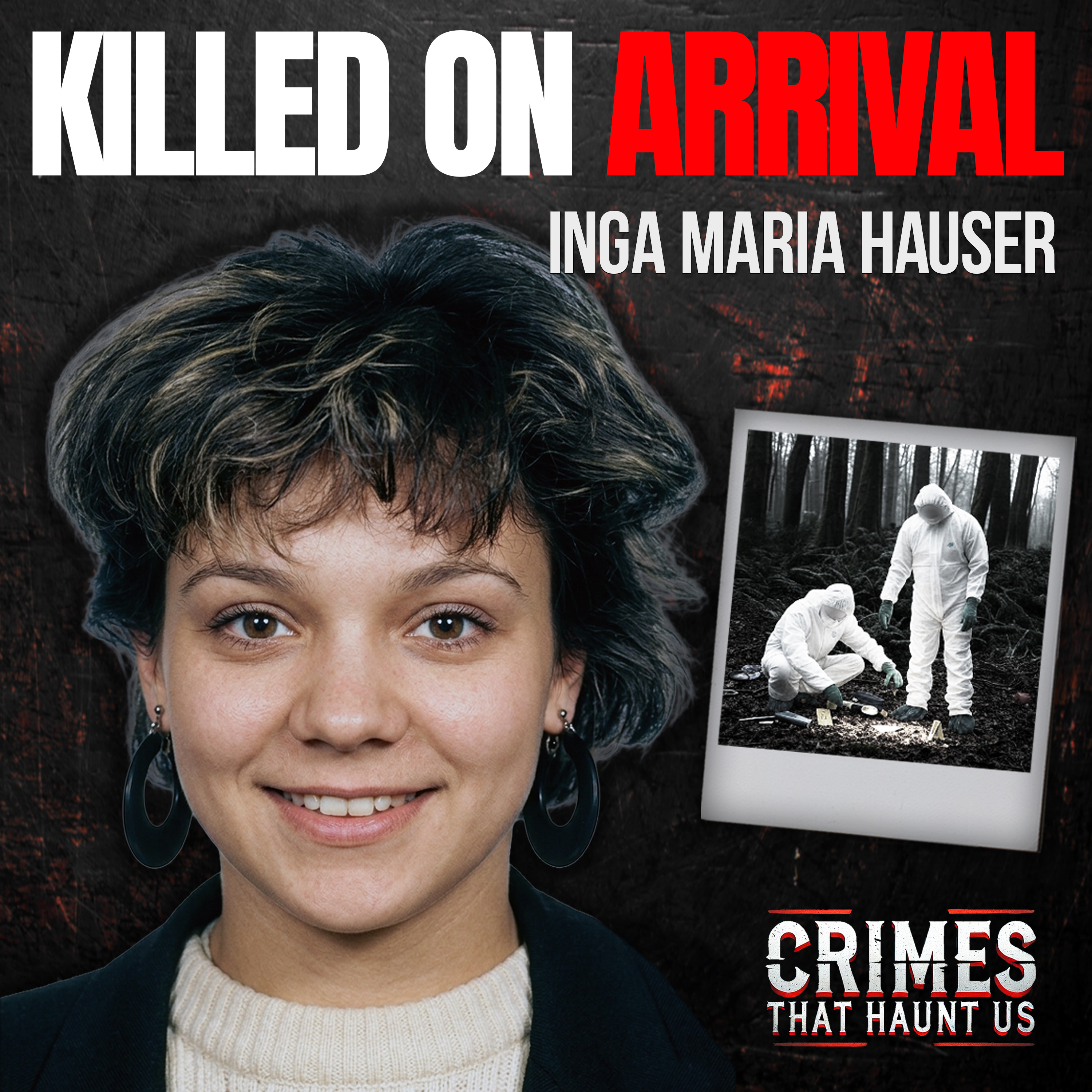
Speaker 1Imagine stepping off a ferry, alone in a foreign land, full of excitement for the journey ahead, only to vanish without a trace. This was the fate of 18-year-old German student Inga Maria Hauser. In April 1988, her lifeless body was found deep in the Ballypatrick Forest Park, brutally assaulted and discarded in the undergrowth. No one saw her leave the ferry, and her killer has evaded justice for over three decades. Was she lured into a vehicle by someone she trusted? Could a local predator with intimate knowledge of the area have been responsible? Despite DNA evidence, countless appeals, and a relentless investigation, the identity of her murderer remains unknown. The question lingers, who killed Inga, and why? Welcome to Crimes That Haunt Us. If you enjoy these deep dives, please follow the show and leave a quick rating. It really helps new listeners find us. The story begins in Munich, Germany, on May 28th. 1969, with the birth of Inga Maria Hauser to Joseph and Almut Hauser. A younger sister, Frederike, would soon join her, completing a tight-knit family. Inga Maria grew up into a spirited, adventurous soul, independent beyond her years, with a hunger to see the world. So it was in late March 1988 that this vibrant 18-year-old bid farewell to her Munich home, her heart set on a solo inter-rail odyssey across the United Kingdom. She set her dreams into a large hiker's backpack, adorned with patches and badges, a pair of white trainers dangling from the straps by their laces. A signature detail that would later haunt her tale. Her journey began with a ferry from the Hook of Holland, cutting through the waves to Harwich, an English seaside town where her feet first touched British soil. From there, she pressed on to London, arriving on Thursday, March 31st, 1988. The sprawling capital swallowed her whole, its chaos and turmoil. She was then forced to leave her home, and her family, her charm igniting her imagination. In a postcard sent home, her words danced with excitement, I am totally entranced by London. Beyond that fleeting note, her time in the city remains a shadow. Where she wandered, or who she met, lost to the fog of history. By Monday, April 4th, Inga Maria was on the move again, boarding a train to Oxford. Her diary captured the moment, went to Oxford, stayed at the youth hostel, ate too much, decided to go to Bath. Around this time, another postcard winged its way to Germany, brimming with joy. You probably could not imagine how much I like England, she wrote. I would preferably stay a year longer. And you don't need to worry about me, for the people here are so lovable and so ready to help. See you soon. Happy Easter, your Inga Maria. Her final entry that day carried a spark of anticipation. The day after tomorrow, I'm going on to Ireland. I'm looking forward to that the best. Those words, scribbled in innocence, would soon turn chilling. On Tuesday, April 5th, her restless spirit carried her from Bath to Cambridge, then to Bristol, where she caught a train to Liverpool. She didn't linger there, hopping on another train to Preston, and finally boarding an overnight train bound for Inverness, Scotland. She arrived on April 6th, gazing out at the misty expanse of Loch Ness. Her diary sang with wonder. I have just arrived in Inverness at Loch Ness, where the monster lives, but I have certainly not seen it yet. My journey has run without a hit so far, and it is really indescribably beautiful here. Unfortunately, my money is slowly running out. She rang home that day, her voice bubbling with tales of adventure, reassuring her family across the miles. From Inverness, she journeyed to Glasgow, then on to Stranra via Ayr. Her sights set on Ireland. Her last diary entry penned that day shimmered with awe. Went from Glasgow to Ayr, and then on to Stranra to get over to Ireland. Saw the sea. Beautiful and mysterious. Wonder where I stay tonight. Need more money. Those final words, etched in her own hand, marked the end of her voice. At 7pm, Inga Maria stepped aboard the ferry to Larn, Northern Ireland. Her patched backpack slung over her shoulder, white trainers swaying with each step. Eyewitnesses later told the Royal Ulster Constabulary they had seen her on board. Her distinctive style of clothing was a little bit like the ones worn by the Royal Ulster Constabulary in England, as she wore a white suit, a blue dress, and a white jacket. She was wearing a white suit, and a white jacket. She was wearing a white suit, impossible to miss. The Galloway Princess docked at 9.40pm, but here the trail goes cold. No one saw her disembark. Not one of the 400 plus passengers and crew recalled seeing her stepping onto Larn Pier. She had planned to take a train to Belfast, just a few hundred yards from the ferry port, to crash at a hostel before exploring the next day. But no witness emerged to place her on that path. Inga Maria, striking with her bright, bright eyes and bold backpack, should have stood out. Yet she vanished into the night, her dwindling cash and unfamiliarity with the area leaving her vulnerable. Police later theorized she left the ferry in a vehicle, perhaps a truck. Her family recalled at the idea. She was safety conscious, they insisted. She'd never get into a stranger's car, especially abroad. But whatever happened that night, Inga Maria Hauser was never seen alive again. Days passed in silence. Her family had been in the car for a long time. She had been in the car for a long time. She had been used to her every other day calls grew uneasy. By April 11th, when she missed a planned meeting with a friend in London, their worry turned to dread. Joseph and Almut flew to Northern Ireland, alerting the police. A massive search ensued, but the trail was barren. Then, on April 20th, 1988, just two weeks after her arrival, the call they'd feared shattered their world. A farmer scouring Ballypatrick, Forest Park for stray sheep, stumbled into a nightmare. There, deep in the borscht bushes, lay Inga Maria's partially nude body, face down, abandoned like discarded refuse. The forest, one of Northern Ireland's largest public parks, sprawls along the A2 road between Cushendal and Ballycastle. It's six-mile scenic drive, a magnet for summer tourists. Nearly 40 miles from Larne, it's a place of rugged beauty and now unspeakable horror. The dumps are over-the-counter, but no one knows what's going on. There's no sign of Inga, who's been found dead in the woods, and there's no sign of Inga, who's been arrested, and no one knows what's going on. There's no sign of Inga, who's been arrested, and no one knows what's going on. Entering via the main gate, driving the quiet road, and choosing a spot near the exit to offload his grim cargo. Despite early media reports of Inga being buried in a shallow grave, the deposition site was to the contrary. No effort was made to hide her. Her body wasn't buried or even covered, just left there, barely concealed from the road, yet glaringly obvious to anyone wandering the forest trails. With visitors frequent in the off-season, discovery was inevitable. It was as if her killer didn't care. Her belongings, clothes, travel documents, an expensive camera lay scattered around her, a careless breadcrumb trail to her identity. The camera's film, later developed, revealed snapshots of her Scottish journey, but none of Northern Ireland. She never had the chance. The scene offered no clues of the assault itself. No blood, no struggle in the growth. She'd been killed elsewhere, her body hauled here and discarded. The post-mortem painted a brutal picture. Sexual assault, followed by a frenzied attack. Blunt force trauma scarred her head, neck, and face. Blows raining down from an unknown weapon. Defensive wounds marked her arms. She'd fought fiercely for her life. But the killing blow was chillingly unique. Her neck snapped clean. Not strangled. Not choked. Broken. With a force so precise it stunned investigators. Manual strangulation leaves marks, ligatures, bruising, petechia in the eyes. But this was different, suggesting a killer with skill, perhaps trained in combat. Theory swirled. Could it have been a soldier, a squaddy returning to duty on the ferry, versed in lethal hand-to-hand techniques? Inga, hailing from a Germany teeming with military presence, might have trusted such a figure, accepting a ride. But in 1988 Northern Ireland, amid the troubles, any British soldier would have travelled incognito, unlikely to flaunt their status. Especially after the brutal murder of two off-duty corporals in Belfast just weeks earlier, beaten to death by a mob in front of global cameras. That line of inquiry fizzled, leaving more questions than answers. Inga was no naive child. Nearing 19, she had criss-crossed Europe by train, never hitchhiking, always cautious. Yet some or someone on that two-hour ferry ride from Strandra to Laan pierced her defences. Did she meet a kindly older man, a fatherly type who disarmed her? Or was there a woman in the vehicle, her presence a false promise of safety? If so, what role did she play? Accomplice or terrified bystander? No one saw her leave the ferry on foot, pointing to a lift gone horribly wrong. Her family's torment deepened with early speculation she had been held captive for days tortured before her death. The pathologist had decided early on that Inga's body, untouched by predators, hadn't lain there long. He theorised that Inga had been alive shortly up until her body was discovered some two weeks after she stepped off the ferry in Laan. This theory wouldn't bear thinking about. It would suggest Inga was abducted, then held against her will for days or weeks, suffering terror and fear only the imagination could ponder. However, years later, forensic entomology overturned that theory feeling she had been in the forest for weeks, likely killed and dumped within hours of docking in Laan. Entomology is the scientific study of insects, often used in forensic investigations to analyze insect activity on a body to establish the time of death. That shift reframed everything. Alibis. Timelines. Suspects. On June 9th, 1988, just over two months after Inga Maria Hauser's disappearance and less than two months after her body was discovered, the BBC's Crimewatch UK broadcast a detailed segment about her case, thrusting the unsolved murder into the national spotlight. They revealed Inga's last photograph, which was taken in Scotland. They also published a sketch of a male Inga had drawn on her travels and asked the public's help in identifying him. Yet despite the volume of calls, no single tip broke the case wide open. The Royal Ulster Constabulary was not the only one to report the case. The Royal Ulster Constabulary sifted through each lead with urgency, cross-referencing them against the scant evidence. A partial DNA sample from the crime scene, eyewitness accounts from the ferry, and the grim details of her murder. Several assaults, blunt force trauma, and a broken neck. Some calls may have corroborated the theory that she'd entered a vehicle, perhaps a truck, upon docking, but none pinpointed a suspect or a precise location. In 1989, genetic evidence pointed to a man, but it led nowhere. This genetic evidence was analyzed using the DNA profiling techniques available at the time, which, while rudimentary compared to modern standards, were groundbreaking for the late 80s. This analysis pointed to an unidentified male as a suspect, marking one of the earliest applications of DNA evidence in the case. The discovery was pivotal, as it provided a concrete lead in a case that had otherwise been shrouded in uncertainty. However, despite this data, it was difficult to determine the exact identity of the man. The genetic profile, though linked to a male, could not be matched to a specific individual at the time due to the absence of a comprehensive DNA database. Unlike today's capabilities, where full profiles can be cross-referenced across millions of samples, the 1989 analysis could only confirm the presence of an unknown male's DNA, not identify him. The match probability was said to be 1 in 2,000 due to the forensic techniques available at that time. On April 23rd, 1991, three years after Inga Maria Hauser's brutal murder left her family shattered, her parents, Joseph and Almut, took a desperate step to pierce the suffocating silence surrounding her death. With the investigation at a standstill, they offered their entire life savings, £3,000, as a reward for information leading to her killer's arrest. This wasn't just money, it was everything they had. A raw plea to shake loose a witness or betray a secret from the shadows of Ballypatrick Forest. But the response was a crushing void. No tips, no confessions, just silence. For Joseph and Almut, the unclaimed reward deepened their torment, a wound that lingered until their own deaths. Joseph in 2006, Almut in 2019. On July 19th, 2005, a spark of hope pierced the cold case gloom. A meticulous cold case review, fueled by leaps in forensic science advancements, revisited the biological evidence collected from her body 17 years earlier. What had once been a frustratingly incomplete genetic trace, a partial DNA sample linking an unknown male to the crime, transformed into a breakthrough, a full detailed DNA profile of the suspected killer. Extracted lightly from seminal fluid or skin cells left during the savage assaults, this profile was a game changer, offering a precise genetic fingerprint that could, in theory, unmask the monster who'd snapped her neck and dumped her among the gore forest bushes. The police service of Northern Ireland, formerly the RUC, seized the moment, reigniting the investigation with renewed vigor, cross-referencing the profile against databases and suspects old and new. For Inga Maria's aging family, especially her mother, Almut, still clinging to the fading hope of justice, this forensic leap was a lifeline. On July 13th, 2005, Crimewatch UK returned to her story, airing a new feature that leaned hard into the updated evidence and the enduring mystery of her final hours. With the DNA profile now in hand, the program pleaded for witnesses to come forward, hoping to connect that genetic fingerprint to a face, a name, a moment. The response was electric. A caller reached out, their voice trembling with a memory that seemed to pierce the fog of 17 years. They claimed to have seen a girl matching Inga Maria's description: blonde, bright-eyed, her distinctive hiker's backpack slung over her shoulder, white trainers dangling over her shoulder, white trainers dangling over her shoulder, white trainers dangling from the straps, climbing into a lorry as the Galloway Princess emptied its passengers onto Lan's Pier that fateful night. It was a tantalizing lead, aligning with the police theory that she had left the ferry in a vehicle, possibly a truck, rather than on foot. The caller couldn't pinpoint the driver, the lorry's make or its destination. No other witnesses corroborated the sighting, and the DNA profile, while precise, had no match in the system to tie it to a suspect. The Pearsonite chased the thread as far as it could go. But like so many leads before, it unraveled into another maddening dead-end. By the late 2000s, with a full DNA profile of the killer in hand from the 2005 forensic breakthrough, detectives began to narrow their gaze, homing in on a cluster of small, tight-knit villages east of Ballymoney, Ahmoy, Lough Gile, and Clock Mills. These rural hamlets, nestled in County Antrim's rolling countryside, were a world away from the bustling ferry port of Naan, where Inga Maria had last been seen alive, yet just a stone's throw from Ballypatrick Forest, where her body was dumped two weeks later. The choice wasn't random. Investigators believed the killer's casual disposal of her body, left face-down in gorse bushes with no attempt at concealment, hinted at a chilling familiarity with the area, a local who knew the forest's winding paths and quiet corners like the back of their hand. Ahmoy, with its quaint streets and proximity to the A-44, offered ease of access to the forest's entrance. Lough Gile, a speck of a village steeped in rural isolation, whispered of secrets kept close, and Clock Mills, straddling old trade routes, could have been a staging ground for someone with a vehicle, a truck perhaps, like the one a 2005 Crimewatch witness recalled Inga Maria boarding. Detectives descended on these communities, knocking on doors, probed pub conversations, and scrutinized decades-old memories. They hunted for a man, likely middle-aged by now, whose past might betray a violent streak, whose hands might match the DNA, whose life might have intersected with a German backpacker's fleeting presence. But the killer's identity remained a phantom, tauntingly close yet infuriatingly out of reach in the shadow-draped heels of Ballymoney. On March 24, 2011, a newspaper from the Ballymoney and Moyle Times ran the headline "A Murderer Among Us?" Whispers began to circulate that a man from the East Ballymoney area had been seen with fresh, angry scratches raked across his face in the days following Inga Maria's murder on April 6, 1988. It was a detail too visceral to ignore. Her post-mortem had revealed defensive wounds on her arms, proof she had fought fiercely against her attacker, clawing for her life before he snapped her neck and dumped her in Ballypatrick Forest. Detectives pounced on the lead, scouring the rural hamlets for a name to match the rumor: a local, perhaps a truck driver or a farmer, someone who had been on that ferry from Strand Ra to Naan or lingered near the forest's edge. The man's identity remained a shadow, pieced together from hushed conversations in pubs or fleeting memories of neighbors who had long dismissed the oddity of his wounds. Was he a recluse hiding in plain sight, his scratches explained away as a bar fight or a farm accident? Or had he felt the heat slipped into the cracks of those tight-knit communities and vanished before their necks could close? The peers and I chased the phantom lead with dogged intensity, cross-referencing it against their DNA evidence and the timeline of that fateful night. But once again, the trail dissolved into mist. The man with the scratched face, like so many specters in this case, slipped through their grasp, leaving behind only whispers and the gnawing certainty that someone, somewhere, still carried the scars of Inga Maria's last stand. February 5th, 2019. Inga Maria Howser's murder case took a dramatic turn. The Police Service of Northern Ireland, or PSNI, armed with a full squad of police officers, took to the streets of the town with a full DNA profile from the 2005 forensic breakthrough, zeroed in on two new suspects. A 60-year-old man and a 57-year-old woman from the Bally Money area, just miles from where Inga Maria's body was found in Ballypatrick Forest. The man, now graying and weathered by time, was suspected of being the hands behind the 18-year-old German backpacker's brutal death. Her sexual assault, the frenzy blows to her head and the chilling snap of her neck, while the woman stood accused of with-holding. That month, the PSNI's Major Investigation Team moved with precision. Submitting a file to the Public Prosecution Service that outlined their case, the arrests sent ripples through the rural communities of East Bally Money. However, by July 8th, 2020, the Public Prosecution Service, after meticulously reviewing the files submitted by the PSNI's Major Investigation Team, delivered a crushing verdict. The evidence was too thin to proceed. Despite the tantalizing prospect of finally naming the killer hoods assaulted and murdered the 18-year-old German backpacker, the case unraveled under scrutiny. The PPS found no concrete links tying the man to Inga Maria or the crime scene, no match between his DNA and the full profile extracted in 2005, no witness placing him on the land ferry she had disembarked from on April 6th, 1988, and no physical trace connecting him to the forest near 40 miles away where her body lay for two weeks. The woman, suspected of withholding information, slipped through the net too. Whatever knowledge she might have held remained locked behind a wall of silence, unprovable without stronger corroboration. On November 18th, 2024, a pre-inquest review, the first public probe in decades, reignited hope that, after 36 years, justice might claw its way to the surface. This review signaled a significant shift, marking the first public examination of the case in decades. The pre-inquest review, aimed to inform the public about the case, was not the first public examination of the case. Investigate discrepancies in the timeline of her murder, analyzed the role of previously questioned persons of interest, and highlight the psychological profile of her suspected attacker. But as of the time of airing this documentary, there has been no further updates in the case and it remains open and unsolved. Inga Maria Hauser's life was filled with adventure, curiosity, and a deep love for the world around her. Her tragic death robbed her of a future she so eagerly embraced. Yet her spirit lives on. In the memories of those who loved her, in the hearts of those who continue to fight for her justice, and in the unwavering determination of those who refuse to let her story be forgotten. Thank you for watching and listening to Inga Maria's story. If this case haunted you, please follow Crimes That Haunt Us and leave a rating. It makes a huge difference. I'll see you in the next episode.
 PodcastTranscript AI