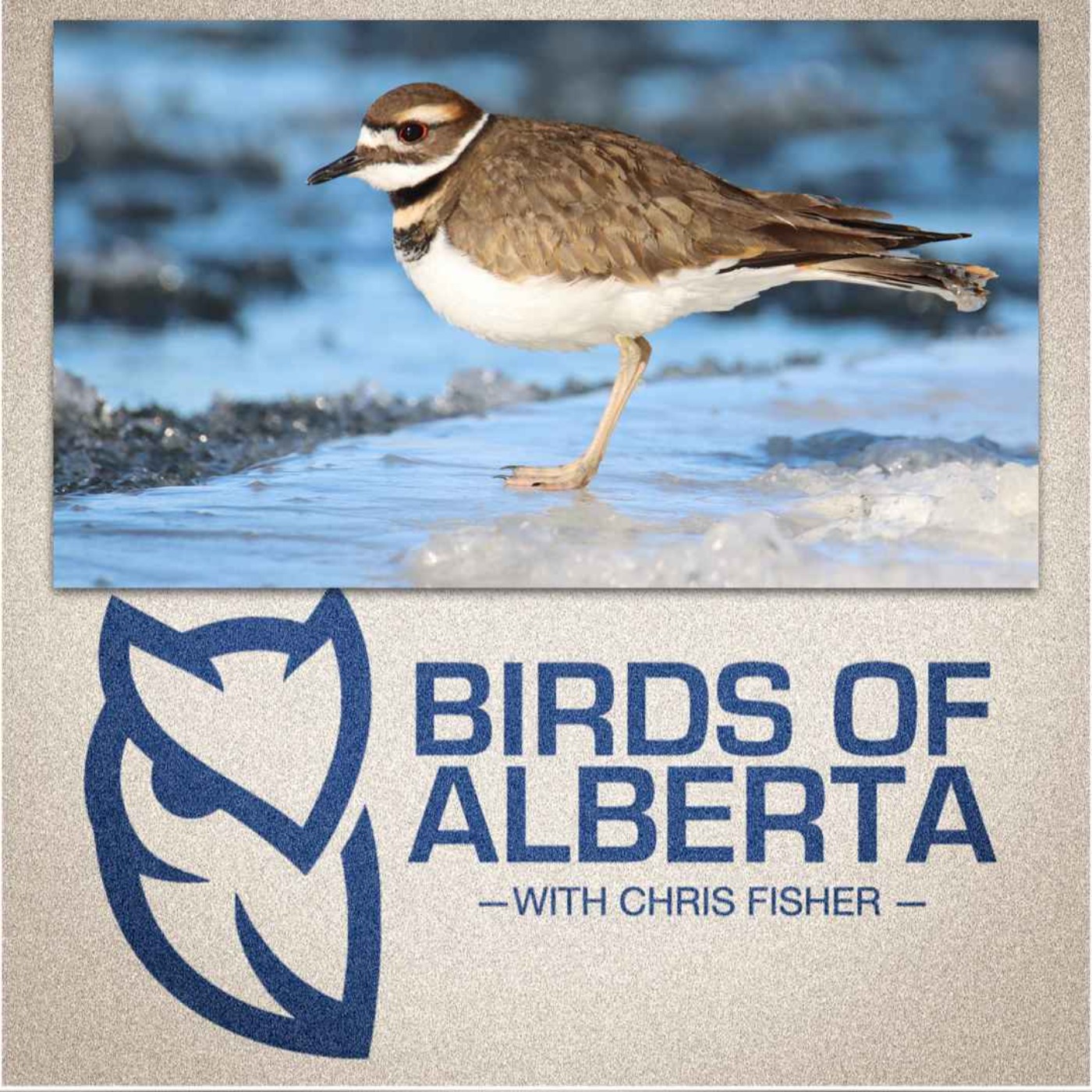
The Killdeer is a prominent and adaptable bird species in Alberta, easily recognized by its loud "kill-deer" call and striking double black breast bands. Unlike many birds, it thrives in human-disturbed areas such as gravel lots, farm fields, and parking lots, often nesting in open, exposed locations. Its behavior is characterized by constant vigilance and dramatic defensive tactics, most notably the "broken wing act" used to lure threats away from its nest and chicks. Killdeer are early spring migrants, returning while snow is still on the ground, and both parents actively care for their precocial chicks, which are mobile within hours of hatching. Conservation efforts, supported by the Migratory Birds Convention Act, sometimes involve relocating nests to safer areas, showcasing the bird's resilience. Despite their high-strung nature, Killdeer have successfully adapted to modern landscapes, making them a familiar and enduring presence across the province.
Welcome to the Birds of Alberta podcast. I'm Chris Fisher, co-author of the best selling field guide birds of Alberta. Now we all know from living here that Alberta really values and celebrates our natural landscapes. This, this, well this is obvious to anyone who's tried to book a campground site in a provincial park, you know log on six months in advance of your plan. We can get away and good luck finding anything other than that one site located adjacent to the sanitary dump station. Well we see this passion for outdoors also in our public polling. For instance 94% of Alberta's are supportive of bird watching and in a 2023 Alberta Conservation Association pool 55% of Alberta's 55% of Alberta's reported to having participated in bird watching in the last year. Yeah, in the last year folks that's like two and a half million people that seen up that at some point in the year they've enjoyed the sights of birds in their backyard or city parks or nature reserves or while camping. No doubt as they take a birdie walk away from the stench at their site as other campers drain the sewage from their RVs. Now you got to admit that it is pretty darn special that to and a half million Albertans have something in common especially when it comes to birds and within that general birding thing we got there there is one specific experience at I'd wager that these Albertans have all shared because for one single Alberta bird species it is not about you having to go off and find it in a natural area. This is a bird that will find you even if you're minding your own business because this is a bird that mines your business too. So whether you find yourself walking out to feed the herd or showing up at the workshop or driving down to the boat launch or strolling along the riverside near the downtown core this bird will find you and call you out. It's a short bird that may be the most notice bird in the province. It's out front and center both tolerant and vociferously intolerant making it the lead dramatist among all the birds of Alberta. This is the Kildir. Now every book and birding app will tell you that the Kildir is a medium-sized plover. See plovers by the way are one of the main branches of the entire sandpiper clan. Now Kildirs are long-legged and lean they're built more like a runner. Let's say Usain Bolt then Dwayne the Rock. Now how to glance their plumage is all warm earth tones. Dusty brown back a clean white underside but what really jumps out at us are those two bold black breastband stack neatly across their white chest. Most plovers only bother with having one. The Kildir went for a double double. So technically these black and white test bands try to achieve what orcas and pandas pull off something called disruptive coloration but actually not the black and white of zebra is apparently we now know that their stripes are for controlling biting flies but back to the Kildir their stripes will peel really bold when viewed on a computer screen or the pages of a guidebook but those patterns actually break out their outline when viewed against a rocky pebbly and patchy ground and make it difficult for predators to spot them where they actually hang out and live. The Kildirs face is quite striking in a subtle rural Alberta sort of way. It has a bright white forehead and throat it's framed by sharp black lines and has a rich chest nutty wash on the top of the head and of course it has big black eyes and those eyes actually have a surprising thin red ring around them. See Kildirs always look alert like they're thinking three steps ahead of you. Kildir doesn't really matter what it looks like it could be a chameleon in its coloration and still be easily identified by its voice alone. See a Kildir wouldn't be anything without that voice it's a call that is loud insistent warning call saying kill dear. This call is usually delivered at a volume of that suggests you've personally offended it for inexcusably passing nearby and sometimes they will for go that distinctive to tone call and just simplify it to a single note but it often bubbles together also into a raging boil. Whatever they are saying Kildir well it is always heard before they are seen. Now like many Albertans who have camped outside under Albertus summer stars I've even heard Kildir calling in the dark of night. That makes me think that sleeping Kildir well even then they call out warnings to intruders real or imagined in their dreams. So if there ever was a bird that lives life with with nervous energy it's the Kildir. It's all about motion and vigilance. There's there's never been a home security system designed to match the Kildir for detection deterrence and defense. This bird takes that job very seriously indeed. You see you just never see one simply just standing there you know Kildir will always spot you first of course and call you out. It seems flustered, piecing and trotting and stopping abruptly and then darting off again. It's like it's late for something but just can't quite remember what it is. And even when you spot one away from their nesting grounds like when they are of forging on bugs and insects from the bear ground they are always on their toes. That stop and go run and it isn't all that random either. It's it's just classic plover forging behavior. They all run for a bit and stop and look with the hope that it had scared a bug into moving from a hiding place. See Kildir move they pause they scan and they snatch up insects and other small invertebrates from the ground with quick precise jabs of their thin tweezer like Bill. But the behavior that Kildir are best known among all our Alberta birds is their flare for the ultra dramatic. See they nest right out in the open on gravel bars and dirt fields and even parking lots and they rely on deception rather than concealment and when you get too close well that is when the performance begins. Now if you spend any time away from the concrete Nashville you will at some point come across the famous broken wing act performance by Kildir. Now while several of Alberta's other birds perform a variation of this trick it is really the Kildir that is the master Thessian and raises this act to something Oscar worthy because folks this is pure theater. Kildir have been putting on their stage show long before the Greek dramas honor Dionysis Kildir performances are designed to lure threats away from eggs or chicks and they are presented in three predictable acts. In act one the parent will at some point of its choosing allow you to walk in close. For the second act the parent will drop a wing and drag it in the gravel its tail will spread showing off a chestnut romp teasing you to come to the Kildir are begging you to follow it and put it out of its intense misery. But now we have arrived to act three and realize that we have been duped by these birds because the very moment you take the bait and veer off your original course that same Kildir appearing lame and wounded just a moment ago well it miraculously recovers and flies off perfectly fine. Kildir play us as compassionate suckers and their potential predators well as greedy opportunists. This performance must surely play a role in the Kildir's adaptability to our human altered landscapes. They have taken to Nestein in Alberta's gravel lots and farm lots and roadside shoulders and anywhere else that is flat and sparsely vegetated. It's a bird that's adapted not by
hiding from us but by outsmarting us, living right underfoot, yet always one step ahead. Well, as we have learned so far, there has been little subtle about a kill there. So do you think things would change in their approach to courtship? Well, well not even a little. You see, their flirtations play out also in the wide opens, free of melodic serenades or enticing gifts. Rather, they get right to it with the same tightly wound energy as they do everything else. It's part choreography, part shouting match, all with a hint of chaos. Their courtship starts on the ground with the male puffed up and posturing with his neck outstretched. Those double chestbands, well they actually expand on full display like it knows exactly how sharp he is looking. His neck almost seems to double in length. He'll square off in front of the female, lowering his head and raising his tail and then breaking into the stiff, deliberate runs and stops and turns and of course calling very very loudly and repeatedly. There is a heck of a lot of screaming going on in these early stages as if volume alone might be the secret in sealing the deal. But then comes one of the most interesting bits. It's called the scrape ceremony. The male will will crouch down and rapidly kick backwards with his feet carving out a shallow depression in the substrate, either gravel or sand. In the heat freezes, he looks over his shoulders as if to say, "Hey, well, what do you think of this one?" And if the female is interested, she'll step in, she'll check out the scrape, maybe settle into it briefly to see how it feels. If not, well, he'll try it again and again and again. It's basically an open house showing, but without much of a house to show. Kildir's courtship is less about elaborate plumage or so on and more about coordination and persistence. Proving you can hold the territory, read the landscape and pick a decent place to raise a family. These are obviously traits that Kildir's value greatly. And so once that bond is formed, it locks in quickly and Kildir waste no time. That simple scrape becomes a nest, very simple nest at that. For blotchy greenie eggs are laid and they sit out almost comically exposed among the gravel and rocks. Suddenly, all that theatrical courtship energy, well, it flips over into the high alert defensive parental mode that suits the Kildir's just fine. Little baby Kildir chicks, well, they are born ready to meet the world. As known as Prokosha, little chicks are downy, wide eyed and ready to run within hours of hatching. That little simple scrape nest, well, didn't require much effort to put together and it is now abandoned and left behind when the last chick hatches and takes its first step into the big open world. Instead, they follow their parents out into the world almost immediately. Their tiny little matchstick legs work an overtime to keep up with the best darn guardian you could ever imagine. See, a Kildir's family dynamic really shines. Both adults are fully engaged. They both shepherd the chicks, keep them loosely grouped and remained in constant communication with soft parental calls. It's less of a tight formation and more of a coordinated chaos across the landscape, everyone young and old. They're all moving and feeding and pausing and then moving again. The chicks themselves, well, they're actually pretty good marvels of camouflage. Looking not too much like their parents, the little puff balls are like model brown and a buffy color and this coloration actually vanishes perfectly the moment they stop moving. And meanwhile, well, the parent parents are always on guard and at the drop of a hat, they'll go into full defensive mode. This is where that famous broken wing display gets dialed up to 11. It's all told a high risk, high reward strategy of family raising. No, Hittinness means fewer sent cues for predators, but it also means that the parents are required for constant vigilance. And the Kildir, well, of course, it meets that challenge with relentless awareness. Always watching. Always calling. Always ready to perform when needed. But within a few weeks, those chicks are running confidently, feeding themselves and starting to look, well, a lot less like little wind up toys and more like proper little shorebirds like mom and dad and then just like that, family unit loosens. It's less likely tightly coordinated and they all fly off from the nesting area and collect just like proper shorebirds and actually will even socialize in small groups as Alberta's colder fall weather closes in. So what about this strange name Kildir? See, birdwatchers, well, we tend to forget how weird it is. But when you point out that bird to someone hearing their name for the first time, well, you better brace yourself for some good questions that may come your way. See obviously this little shorebird doesn't hunt or kill or even feed on deer. The name is Anomato Piac and an admittedly imperfect impersonation of their most distinctive primal screams. These first nation's names for this bird seem to forgo the Anomato Piac and instead refer to the bird in their language as the bringer of the rains. This is most likely in reference to the Kildir's very early spring arrival coinciding with spring rains. In Western science, well, it took a little while for it to settle on the Kildir name as well. Mark Katsby, one of the original North American naturalists, wrote in 1731 in his natural history of Carolina and he called this bird the Chatterin plover, which I'll admit, is a hundred and a half bad. By the time John James Audibon released his well-known and seminal birds of America in the 1830s, well, the Anomato Piac and an Aem Kildir had completely won out. Here in Alberta we might call Kildir a reluctant migrant. They tend to take a more measured approach, come fall in the arrival of cold temperatures or drift southwards rather than bolting for the exits. But it really seems to drive the final Exodus is when the ground freezes and their invertebrate foods while they disappear altogether. But I think spring migration is the real treat. See Kildir are among the very first waterbirds to return arriving while there's still snow on the ground. First arrivals are usually reported, well, you know, heard first, I guess, around St. Patrick's Day, often in the very same areas where the last birds of fall were seen only three and a half months before. So Kildir migration is about timing and resilience and a little bit of stubbornness. They leave when they must and they return as soon as they can. And in between, I kind of like to think that these Kildir are spending their winter worrying about if there's anything up in Alberta that are intruding on their home turf. Now when you think about it, well Kildir are pretty incredible little birds. Kildir is more than just a hint of irony in that these are some of our most tightly wound and reactionary species to us. But yet they need to live and nest in precisely the places that have some of our most intense disturbances. They are, after all, choosing calm forests or mountain tops. Far away from us, it's parking lots and gas wells in sandy beaches that they need. And despite their righteous post-hastations, Kildir kind of benefit from land use changes here in the 21st century. Now, the good thing is that Kildir not only have their instinctive security systems in place.
They also have a Canadian federal law to help them out. You see the Migratory Birds Conventions Act protects nests of most birds, including killed here, from being destroyed or disturbed when the nests are occupied. And it may come as a surprise that every single man-joon on industrial sites across the province, biologists like myself, are tasked to find and identify nests. And then we generally put place mitigations to protect the nests for a bit. In most cases, it simply means establishing a temporary no-go buffer zone around the nests until the nests site itself is no longer active. But every now and then, the situation can get a bit more complex. My friend Diana Ascina Boyne, recently, well, she had to take it a step beyond. And she actively had to relocate a killed here nests that was an imminent peril. Now, all that seems easier said than done, especially when relocating a killed here nests involves something which is not really much of a nest at all to begin with. Now, after all the permitting and permissions were approved, Diana started off by taking detailed photos of the nest and egg site. Once she was certain, she could document backwards and forwards and upside down every single rock and pebble in and around the nest, she slid a piece of plywood into the sand beneath the eggs and painstakingly reconstituted the nest to photographic perfection. This was a job that she needed to get just right for the killed here also. Well, they have a photographic memory of their nest site too. The birds, of course, did not help her out in any way as they were unleashing an uninterrupted firehose of hate throughout this whole process. With the nest perfectly recomposed, it was then slid a few meters away in a safe direction. The biologists, while they left the scene to hide ways away and watch. But would the birds return to their eggs or would the stress cause them to abandon their magical floating nest altogether? Well, it turns out that the parents did in fact return to check out the nest and even provided some important incubation for the eggs within minutes. With the nest still in the danger zone, Diana had to continue to repeat the nest sledding a few more times until it was well out of harm's way. And this operation not only gave the killed dear family a second chance of success, but it also reveals their overall secret to success in dealing with modern day Alberta. See, killed dear are uniquely aggressively tolerant and have a parenting instinct that is so strong that can override many of the routine stressors that inevitably occur when nesting in open and highly disturbed areas. They have, in a strange way, the perfect temperament for success to thrive in modern Alberta. And despite having a personality that would be a deal breaker for any human friendship, it is an attitude that has allowed the killed dear to find their secret to success. While in for us, the killed dear's punchy personality has introduced them to at least two and a half million of us, making killed dear the most impossible to ignore among the birds of Alberta.
Podcast Summary
Key Points:
The Killdeer is a highly noticeable and vocal bird in Alberta, known for its distinctive "kill-deer" call and bold black double breast bands.
It exhibits unique behaviors such as the "broken wing act" to distract predators from its nest, and adapts well to human-altered landscapes like gravel lots and parking lots.
Killdeer are early spring migrants, with both parents actively engaged in raising precocial chicks that are mobile shortly after hatching.
Their nests are protected under the Migratory Birds Convention Act, and conservation efforts sometimes involve relocating nests to safer locations.
Despite their nervous and defensive temperament, Killdeer thrive in disturbed environments, making them a common and resilient species in Alberta.
Summary:
The Killdeer is a prominent and adaptable bird species in Alberta, easily recognized by its loud "kill-deer" call and striking double black breast bands. Unlike many birds, it thrives in human-disturbed areas such as gravel lots, farm fields, and parking lots, often nesting in open, exposed locations. Its behavior is characterized by constant vigilance and dramatic defensive tactics, most notably the "broken wing act" used to lure threats away from its nest and chicks.
Killdeer are early spring migrants, returning while snow is still on the ground, and both parents actively care for their precocial chicks, which are mobile within hours of hatching. Conservation efforts, supported by the Migratory Birds Convention Act, sometimes involve relocating nests to safer areas, showcasing the bird's resilience. Despite their high-strung nature, Killdeer have successfully adapted to modern landscapes, making them a familiar and enduring presence across the province.
FAQs
The Killdeer is a medium-sized plover, a type of shorebird, known for its loud call and dramatic behavior. It is commonly found in Alberta in open areas like gravel bars, dirt fields, parking lots, and roadside shoulders, often adapting to human-altered landscapes.
The Killdeer uses a famous 'broken wing act' to lure threats away from its nest. It feigns injury by dragging a wing and spreading its tail, tricking predators into following it, then flies off once the nest is safe.
The Killdeer's call is a loud, insistent 'kill-deer' sound, often heard before the bird is seen. This vocal warning is a key part of its defensive behavior, alerting to intruders and helping it thrive in disturbed environments.
Killdeer courtship involves loud calls, posturing, and a 'scrape ceremony' where the male kicks back to create a shallow nest depression. The female inspects it, and if interested, they bond quickly, focusing on territory and nesting site suitability.
Killdeer nest in simple scrapes on open ground, laying blotchy greenish eggs that are well-camouflaged. Both parents guard the nest and chicks, with the family leaving the nest soon after hatching to forage together.
The Killdeer is protected under the Migratory Birds Convention Act in Canada, which prohibits disturbing or destroying active nests. Biologists often establish buffer zones or, in rare cases, relocate nests to ensure their safety.
Chat with AI
Loading...
Pro features
Go deeper with this episode
Unlock creator-grade tools that turn any transcript into show notes and subtitle files.
 PodcastTranscript AI