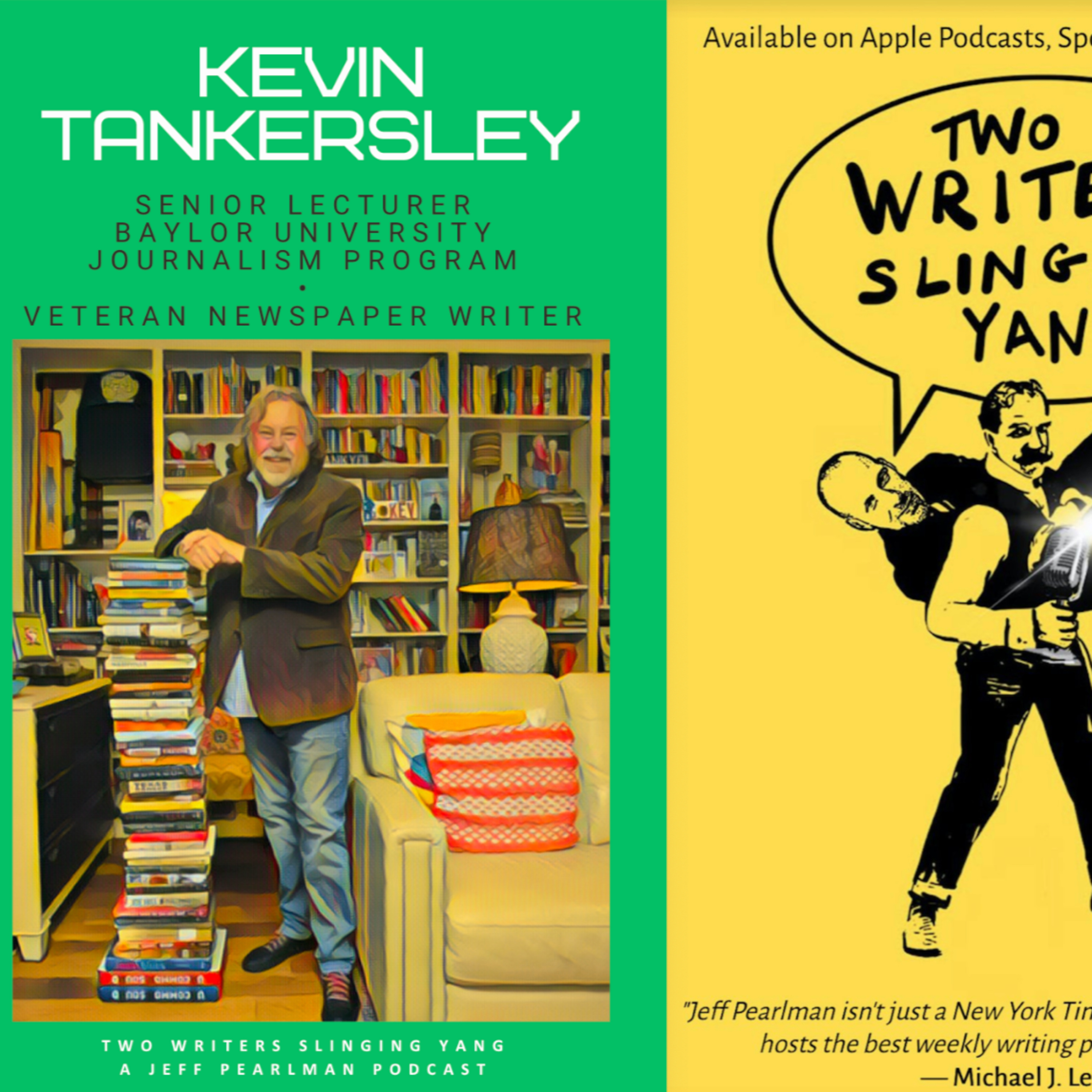
Kevin Tankersley: Baylor University journalism professor and veteran writer
from Two Writers Slinging Yang
44m 4s
The transcription begins with the speaker criticizing the WMBA's handling of questions about the relationship between two top draft picks, Yukon's Easy Fud and Yukon's Paid Backers, defending journalist Kevin Sherrington's line of inquiry as proper reporting. The conversation then transitions to a podcast where host Jeff Perron interviews Kevin Tankersley, a Baylor University senior lecturer and veteran journalist. They discuss the evolving landscape of journalism education, with Tankersley affirming that while traditional newspapers are declining, there remains a need for skilled reporters, especially in sports, TV, and public relations. Both professors note challenges with modern students: poor grammar from texting, disengagement, and distraction from phones and laptops during class. Tankersley shares strategies like requiring paper assignments and mixing traditional media (e.g., NPR) with newer outlets to broaden students' consumption habits. He reflects on the early days of online news, realizing that free content undermined print subscriptions and advertising revenue. The conversation also touches on Tankersley's career, including freelancing and writing feature stories like one on "Biscuits O'Brien." Overall, the summary highlights the tension between adapting journalism education to digital realities while preserving core skills like writing and reporting.
So last week, there was a bit of controversy over the WMBA's Dallas Wings using the first overall pick in the draft on Yukon's easy fud. Who, last we checked, was either the girlfriend or ex-girlfriend of last year's first overall pick, Yukon's paid backers. And the WMBA told people not to ask about it. And Fud's agent told people not to ask about it. So Fud appeared on ESPN and on Good Morning America. And nobody asked a legitimately reasonable question, how do you feel about playing alongside your girlfriend or ex-girlfriend? And when Kevin Sherrington of the Dallas Morning news finally threw out the question at a press conference, he was ridiculed and threatened. How dare you? You crossed the line. It was ridiculous. A bad WMBA franchise has used back-to-back numbering picks on two women who date. How do you not ask about the status of their relationship? How do you not ask whether it was factored into the team's draft plans? We are not in the business of pretending reality is fake or asking a question is somehow in a front to humanity. It's called reporting. And it's what we do. [MUSIC PLAYING] My name is Jeff Perron. I'm the New York Times best selling author of 11 books. And I was a two-hour singing game. The podcast will one writer of me talks writing with another writer every single week. And these guests is Kevin Tankersley, the Baller University Journalist and Professor and longtime newspaper scribe. This is episode number 465. Let's sing some B.A. Dad, your podcast sets. And you're starting to look increasingly like a decaying bird-side mom. All right, Kevin. First of all, thanks for doing this. I just want to say-- I've been doing this podcast for about nine years, nine and a half years. You are the first person to wear a suit jacket for the podcast. I just want to-- I know you picked that out. You probably just had that tailored for the occasion. I really appreciate that. Thank you. Absolutely. I shop at the finest thrift stores in Waco. Oh, very nice. I find my wardrobe. So here's it's all for you, man. Wait, are you a thrift store shopper? Absolutely. Love it. Love it. All right, how much would you say if you had to guess you spent on the jacket you were wearing at whatever thrift store you bought it? If you had to guess to me? $4.6. Very nice. Very nice. Now, I don't know-- is Waco a hotbed for thrifting? There are some good stores. And most of them are stores you can find anywhere. Goodwill, Salvation Army. Salvation Army, I hit up every Wednesday on the way home because everything's half price. My wife has said, I really don't need to buy any more jackets. I could teach twice a week here at Baylor. So for 15 weeks, that's 30 days of teaching. I can wear a different jacket every day and not repeat myself. And so she has said enough. And she has a very good point there. No more jackets for Kevin, damn it. Yeah. Well, we'll see. So I live out here in Southern California, and I am an adjunct professor. I don't even know if you call it a professor. I'm an adjunct to Chapman University. And you teach at Baylor University, your senior lecturer. You have multiple classes. You are a journalist by trade. And I am the longer I do this and the more I see the changing nature of the profession. I keep asking myself, should I be directing people to journalism? Is there actually a path forward for these students in journalism? Is they wide field for them to pursue in 2026? And I think I want to start with that, Kevin. Do you ask yourself these questions? And do you have an answer? Answer your question. Yes. I'm an old newspaper guy. My parents subscribed to the White Goat Shrubing Herald to the Dallas Morning News. So I grew up around newspapers. I worked for the White Goat Shrubing Herald full time for five years after college. I was a freelancer for the trip for my entire time through college. So yes, there's a need for people to tell these stories. Is it going to be traditional newspapers? No. Newspapers, this newspapers are hurting the White Goat Shrubing Herald Publishers three days a week now. The Atlanta General Constitution just stopped publishing entirely at the end of last year. The post is cutting people. I've heard you talk about that. So there's always a need. There's always going to be a need for people to report and write the news. Now, how that news is transmitted to readers or listeners or viewers, that's changing. But yes, there's still a need. And yes, these jobs are out there. And I get that question a lot. When I talk to prospective students, when they visit campus, and those questions usually come from dads. From dads who are content, what, their kids to be lawyers or doctors instead of journalists? Yes. Yes. My department is journalism public relations and new media. And so parents here that were journalism, I think, newspapers, rightfully so. And they start worried. But there are jobs for our graduates. Yes. So what do you find the-- I don't know, 18, 19, 20-year-old baller student who's taking one of your classes? What do they-- I imagine they don't say, oh, I really want to write for sports illustrator. I really want to watch right for the Dallas one. I don't-- why are they taking your classes and what are they interested in doing? Lots of the students in our department are going into-- they want to go into sports. They want to go into TV sports. You had one of our graduates on-- works for CBS Sports-- a year or so ago. Sharon and I can't remember his last name. But they lost them wanting to go into sports, TV sports. Lots of them wanting to go into public relations. We do have a few who want to write from newspapers. We have-- I know we have one fairly recent graduate of the Lake O'Churban Hero. We had two. One of them kind of job with the Dallas Morning News. A few things I've noticed. I'm interested if you do as well or how we should deal with this. No one-- I have a lot of students now who are grammatically awful. And I think it has to do with typing on a cell phone, receiving everything on a telephone, not thinking about periods, not thinking about capitalization. I'm wondering if you-- is that just Southern California or if you run into that, too? And how much attention do you pay to it? I run into that all the time, yeah. And I have to pay attention to that. I may be old school, but all of my writing assignments, I ask my students to turn them in on paper, double space, so I can use my red pen and make old school AP editing style marks, editing marks when I'm looking for papers. And so the texting generation-- it's tough trying to get them to write in our style, but it's doable. And do they-- I mean, when you say AP style to these kids, or you say it's supposed to be this way, do they even-- I remember when I was an undergrad at Delaware, an Ida Professor Bill Fleischman. And he was teaching us-- he was an old school newspaper guy from the Philly Daily News. And he was teaching us how to design, do layout. And he was using all these abstract devices that we would never, ever use anymore. And it kind of felt like a waste of time a little. And I wonder if there are things we're teaching AP style-- I don't even know-- inverted pyramid, blah, blah, blah, blah, blah-- that are maybe we just teach them because we know them, but they're outdated. I don't even know. No, yes? I don't think they're outdated. Once again, the stories my students and our graduates are going to write when they get out of the real world are probably not going to be in newspapers, but they're going to be in somewhere. They're going to be newsletters, news releases, press releases. They're going to be used somewhere. And so the style that we teach them, it's definitely applicable across a number of things. And lots of-- I don't know of lots, but we have students who, after journalism, after graduating from here with a degree in journalism, want to head to law school. And I tell them, this is a good building block for law school, because you're bringing together a bunch of information and bringing it all together in some concise form and putting it out there. And as a new law school graduate, that's what you're going to be doing. You're not going to be trying cases. You're going to be working for the partners, reading cases, summarizing cases. And I said, this is a good training for that. I've had something going on lately. I'm glad to have you here to ask about this. I feel like I was reading the reviews to your class. And I feel like the reviews are written about you. Could be the reviews are written about me, which are really fun class. He's very like-greater. You know, blah, blah, blah. And I suspect we're probably similar. I don't want to get people back grades. You have to work hard. In my class, if you're not a great writer, but you bust your ass and you try hard, I'm not going to fail you. I just want you to try and improve and actually get enjoyment out of it. And lately, I've really been struggling, in particular with one student who just doesn't.
doesn't seem to give a shit. And like, yes, it doesn't give a shit. And like it's very dismissive, kind of disrespectful, et cetera. And my wife is like, you can't take this stuff personally. But I take it very, very personally. Is that dumb? Am I just making a really bad mistake there? - I don't know. It's hard not to take it personally. I want all my students to do well. And if they try hard, I appreciate that. I will reward the efforts. And I know it's not like in high school, where if you just turn something in, you'll get a 50 or whatever. If they show that they're trying and they're improving and they're listening to what I say and they're paying attention to the editing marks I put on their papers, they're gonna do okay. If somebody is just half-asseted through the class, they're just not gonna do well. - Have you failed students? - See, we don't fail students. We give the grades they earn. So absolutely, students have earned F's in my classes, yes. - Does that hurt you? Like I'm actually being serious, doesn't it? - Like I don't want to give an F. I just don't want, I haven't actually, but I would, but it does hurt me a little bit. Know that this is dumb. - Oh, I hate giving F's. I absolutely hate it. Because I assume Chapman is a private university. Baylor is a private university. It is not an inexpensive university. And that should not come into play, you know, regarding grades, but it's in the back of my mind. The student or somebody has paid X amount of dollars for this class and I hate it, but, you know, if a student hasn't turned in stuff, then that's usually where F's come from. Students just don't turn in stuff, but they know they haven't turned it in because I'm, I keep up fairly well on grading. So if they're not doing well, they know it. It's not, I don't drop it on them at the end of the semester. - You've been a full-time lecturer there since 2006 and obviously a lot of technology has changed in the 20 years since you started doing it. One thing I struggle with, I'm actually, this is almost like a therapy session for me Kevin, which I go, okay, like I struggle, like this is the first year I've had their laptops closed almost the entirety of class because I, I was starting to look around and you know you're lecturing and they're pretending they're taking notes, but you know they're watching their screens a little too intently and there is a Padres game on or there is a Chargers game on and you just know they're, so are there ways or techniques or devices you have found that are effective in keeping their attention in this distracted age we live in? - The only thing I can tell them is what I am telling you, you're going to need for this next assignment or what I'm telling you is going to be on the next test. From in one of my classrooms, it's tough to walk around and see what they're doing. Lots of them do take, do take notes on paper and I appreciate that, but if they want to take notes on their tablet on their phone, their computer, great as long as they're taking notes, I don't care. I don't want to say I gave up that battle on phones, but it's just impossible, it's a no-end situation. If they want to spend time on their phones, then that will probably be reflected in the grade on the next assignment or on the next test. So as Jiggen threw, I was trying to find some pieces from the Kevin Tankersley, Phil Akschan, and September, September 20th, 1986, was the first piece I could find. Waco Tribune, Henry Maltese. Every man trips midway. Kordevax, Xavier Sanders, hit Tyden Rick Cutler on an AER touchdown pass, leading the fourth quarter to lead the ever-man Bulldogs to a 12-10 win over the Midway Panthers Friday night at Panther Field. Touchdown, Cap, a five-play drive that started Midway's 29-yard line. The score is set up by Sanders, complete into Gory Williams, who came up with the catch between the Panther defenders. First of all, we're making history because this is the first time Gory Williams has been rented on this podcast. Second of all, you graduated from college, you start writing like, what did you know about writing? What didn't you know about writing? So that was between high school and college. After high school, I got to, went to junior college, McClellan Community College, and I went to a Waco for a while, then I went and did some other stuff. And so in '86, I had not finished my bachelor's degree, but I was working doing something else and freelancing for the Waco Tribune Herald. So I'm doing a little bit about writing. I've learned a little bit in high school. The journalism structure of McClellan, Cassie Burleson, ended up being a colleague of mine here in Baylor for a long time. She was great in teaching writing. So I'm doing little bits about writing, but I knew enough how to write a sports story. And if I remember that story, Midway, here in Waco, Waco Midway was hosting Everman, which was with Fort Worth, Texas about 90 miles up the road. And I think I tripled dip on that story. I think I sold it to the Waco Tribune Herald for our star telegram, and then now defunct Dallas Times Herald. And that's the only time I've tripled dip on a story. - Wow, you probably got what? $15 from one place, 12 from another, 20 from another. - Something, something like that, maybe 25. - 12 years later. Also, Waco Tribune Herald, the cowboy way, subhead. Biscuits O'Brien gives school children to taste some of the old west. Your lead, when Biscuits O'Brien took the lid off and Dutch oven and saw that some of this and the little of that in the big property, he explained, well, look at that. They turned into biscuits. Of course, this was at least the seventh time two days that O'Brien had prepared the biscuits. He doesn't measure ingredients, but manages to whip up a bat to feather the light, perfectly brown biscuits each time. O'Brien, who is known as Montaix Jones, is a retired Episcopal priest who lives in Colorado City. He now makes his living traveling to school's festivals and conventions, telling tales of the old west, recounting stories of cowboys and camp crooks on the cattle drives of last century. First of all, I love stories like that, and I loved writing stories like that. Back in '98, around this time, what was your staff writer at the newspaper? What was your beat at this point? 98. I believe I was in the features department and I was concentrating on food. And so I'd read somewhere that Biscuits O'Brien was gonna be here. And so I had to go to a camp ground to find him. This is before cell phones. So I had to go find him to interview him before this cooking demonstration that he was doing. I don't remember where the demonstration was, but I remember having to find him at a camp ground and drive around until I found somebody who looks like he might be Biscuits O'Brien. And he was a great guy. This is also historically the first mention of Biscuits O'Brien on this market. I'm guessing looking from Biscuits O'Brien might not be around anymore. If he was retired priest, that long ago, he might not be of not thought of his name in a long time. - Yeah. When did you, as a guy who's worked in media for a long time, you also worked as a sports information director at Arkansas Little Rock? When did you first sort of notice that maybe the journalism ecosystem that we always knew and thought would be around was sort of changing in unpredictable and perhaps unfriendly ways? Like when did you start seeing a shift in everything? - Man, I remember I was at the Waco Tribune Herald when the Trib debuted its first website in one even WacoTrib.com, it was accesswaco.com. And the newspapers throwing content up there and I don't think it was behind a paywall when it first started. And I remember thinking, well, and this sounds, I'm like a whole lot more prophetic than I am, but I was thinking, if people can go on this internet thing and read the stories for free, then they're not gonna go to the news stand and pick up a paper every day or then I'm gonna subscribe and I haven't thrown to the front yard every day, both of which I remember those things. - Yeah. - So that was kind of the start. And then once advertising, advertising did not follow the newspaper, any newspaper to the online press ups. And that's when advertising wasn't following newspapers online, that's when I knew that we were in trouble. And I was not the first person to recognize that either. - I was working for Sports Illustrated when I was around the same time and I remember they started their website. It was cnn Sports Illustrated.com so they'd type that whole thing in. And I remember being confused by it all. This would sound funny to young people today, like how, like, wait, so we're just giving away the articles. Like we're just giving away the articles. All that it costs whatever, $150 a year for a subscription to Sports Illustrated. We're just gonna give away the stuff. How does that work? - Right. I mean, I'm old school. I'm like holding onto stuff. I like having hard copies of stuff that I read. And so, you know, I would have kept buying Sports Illustrated. I still buy magazines. And it's just not the same, but, like I said, I'm old. And so younger people, if they can read it online for free, or if anybody can read it online for free, why not? - Can you tell how your students consume information? Like what are the major ways they are getting their news? And can two old guys like us teach young people how to sort of consume news on their comfort level? - I ask where they get their news and most news starts. Most of the news consumption starts [BLANK_AUDIO]
somewhere on social media. It's not Facebook anymore. It's usually TikTok. And that's why there are so many companies and news organizations putting forth the effort to put stuff on TikTok. I'm not a TikTok user. I don't know what all is on there. And that's 'cause I'm old. But like in my writing classes, I have a different media outlets every week for students to consume me the read or watch or listen to. And then they have to do a post about it. Give me a couple of paragraphs about what you read and what you think about that media outlets. And there's some traditional stuff, National Public Radio, the Wake Up Tribune Herald, the student paper Herald campus. It's some newer stuff, but I try to just make it a mix of media and force them to to interact with some other form media than just the stuff they find on social media. - Do you find that the 20 year old Waco student no longer just goes to ESPN.com or the New York Times.com, like they're not just, "Oh, I'm gonna go to this website. I'm gonna scroll this website. I'm gonna read that." Not a thing for young people. - I don't think so. Like they start at TikTok. And if there's a link to a story, they wanna see more of it, they'll follow that. But I don't think they'll automatically start with the New York Times or ESPN.com. - You worked as a sports information director. Wait, is unusual because starting this podcast they ask how much you know about sports and you were a little like 60%. You were the sports information director at Arkansas Little Rock and at McClendon Community College. How did you wind up the sports information at Arkansas Little Rock, a fairly prominent sports school? - I left the waycoach, Jimmy and Harold. I started in the public information office across town at McClendon Community College. And shortly after I got there, I realized I was not a good fit for that position. It just wanted a good fit for me. The former head basketball, men's head coach at McClendon, good friend of mine named Steve Shields. He was an assistant basketball coach in Little Rock under Porter Moser, who is now the head coach at Oklahoma. And so I'd started job hunting. I found a sports information job. I knew what sports information was. I knew what the field was. And I thought, well, I can ride, I can do all this stuff. I can do a sports information job. And so I found an opening at another school. And so I called Steve to ask if he would recommend me for that opening if I could put him down as a reference. He said, yeah, but let me tell you what we got here. So there was an assistant SID job open in Little Rock. And so I went up for an interview there, got that. And I was there for five years, a year or so, as the assistant and then two or three years, four years maybe as the head SID. You were there from 2000, 2005. And I've always wanted to have known a lot of SIDs. And it seems like I remember when I was in college, it seemed like a really cool job. Because you know, whatever sports and athletes and blah, blah, blah. It kind of strikes me now as like kind of a big headache. You're dealing with a lot of egos, a lot of coaches who are pricings in the ass, a lot of athletes who might be entitled, but I don't know, Arkansas Little Rock, oh, 2000, 2005, fun job or SID a job? Mostly a fun job. There were some coaches who were kind of jackasses. But I worked with a lot of good people. And Baylor now we're trying to start, my department is starting up a sports media major. And so I was asked if I wanted to teach a class on sports information on sports media relations. And the field has changed so much since I did it. There's no way I could teach that. But it was a good gig. I enjoyed the gig, working there at Little Rock. I was able to go back to school, or go to graduate school, get my masters. And without that opportunity, I wouldn't be doing what I'm doing now. When you introduce yourself to students when they step into your class, do you give your name and then do you say, I don't want to brag, but I was the media coordinator for the 2002 NCAA Central Regional Golf Championship. I don't like dropping names, but you know. That was a good gig. I was a good gig. We housed the NCAA thing. And so at the time, it was a really good resume builder. Now it's just something that I did. - Yeah, fair. You married a teacher-turned chef, your wife Abby. And you guys write the, you co-bi-line, the food column for Waco's Magazine. And your recent piece, you wrote, a RISO series that's Rubin Time, which by the way, as a Jewish host from New York, I approve of this message. Here we spend a couple of days in Cleveland last summer, prior to a week long stay in Cincinnati, where I took part in Cincinnati sounds. Exploring a musical city spaces, places, and sounds at the University of Cincinnati. Cleveland on the southern shore of Lake Geary is two and a 15 miles north of Cincinnati. I wasn't sure the way. But a lot, we wound up at the larger delicatessen bakery, a Jewish Eastern European bakery. The large Rubin sounds with corn bees that we've been in South Carolina, we split, reminded of another deli visit a couple years ago, we were in Fort Worth. And you dive into sort of corn beef and turning brisket into corn beef and blah, blah. Long wave saying, what is it like writing with your wife bylining stuff like with someone else? - It's great. And I'm not saying that just because I know the show, that she'll be listening to this. We work really well together. Because she did go to culinary school, she's a chef, we co-right the column. I usually do most of the writing of the story. We'll work the recipes, our hers, our, there are recipes we've adapted from somewhere. The cooking is all hers. And so it's co-byeline, but I write most of the stories, but we collaborate on what we're going to write about. That's a big collaborative effort. And before I turn the stories in, to my editors of the wake, when they always go to her first, and the stories, the recipes all go to her, she looks them over and I've gotta get her okay, since it's both our bylines before I send them to the magazine. But it's great. We really work well together. We, our office stories, she makes the food, we do a photo shoot on our front porch, a wake on photographer will come over, and will stage the food on a table on our porch. And it just works well together. >> The weird thing is I had Abby on this podcast last week, and she said she does all the writing. So I don't know what's going on. I don't know what you're talking about. Let me see this getting back to teaching a little bit. Do you feel like it is possible to have a student enter your class at Waco, and that person is not a good writer. It's not a good writer. Doesn't get writing, doesn't get the beats of writing, doesn't get writing, and you can turn them into a good writer. >> Writing can be taught. So if a student pays attention, listens to what I say, and listens to what others say in other writing classes or at the University Writing Center, then a student can be a decent writer. And it's one of those things, you just get better with practice like anything. And so if they see them wants to get better, then yes, she or he can definitely get better. Just has to put this in my front line, like with anything else, but it can be done, yeah. >> Do you think a bad writer, or a student who doesn't really know how to write, come, I've actually had this debate a million times, is really, really great writing, something that is learned, or is there something in your brain that allows you to be a really great writer? You know what I mean? Like in someone who is a math major, and doesn't really get writing with enough work but become a great writer, or is there, do you feel like there's a ceiling? >> There's probably a ceiling. I don't know if somebody who just doesn't get writing, I don't know if they would ever be a great writer, but they can be a decent writer. I don't get math, so I'll never be a great math person. I might, I'm decent, I might even be a stretch there. I can do some math, but I'm not a math person. So I'm never gonna be great at math, there's no matter how much I try, no matter how hard I try, that's not my gift. So somebody who's, somebody who's, I think anybody can be a decent writer. >> Great writers, different thing. >> Do you still get a jolt of excitement when you walk into a classroom? Like does it still do it for you? >> Absolutely, that's what I love walking into a classroom. >> Wait, why? >> Because I get to talk about stuff that I like, 'cause like I'm an old newspaper guy, the classes I teach,
a beginning writing class and then an introduction to mask, introduction to mask communication class. Intro to mask calm, the history of books and newspapers and magazines and TV and music. And so I get to, you know, teach, I get to talk about stuff that I like. Most of the stuff that I read when I'm not working has something to do with what I'm teaching in one of my classes and it's not a chore to read what I'm going to be teaching. Because of stuff I enjoy. Probably next in the fall. Now the fall I will, I'll bring some stuff in from from your two-box book and when I'm talking about the history of music. I just read the biography of Lauren Michaels. So I'll use that when I'm talking about the history of TV and Saturday night live. I read the kernel of the game about, uh, Kern Tom Parker and Elvis. And I brought that into the music unit that I just finished yesterday. What's your all-time favorite book? All-time favorite book is The Warp of Other Sons by Isabel Wilkerson without a doubt. She talks about the Great Migration when millions of black Americans fled the South from 1910, 1970 or so. And so she talks about the big picture of the Great Migration. But she also traces the routes of three individuals who left the South under Jim Crow Law and found themselves in other parts of the country. And I love telling my students about that book because I tell them that she spent 15 years working on that book. And so I tell my students, if you're 20 years old and you start a doc, a word doc tonight, that's you finishing that word document when you're 35 years old. That kind of shows them what kind of dedication she had to the spud. It's a beautiful work. Actually, it's really interesting. I always say to my students, one of the first things I tell them is, um, I always say, you guys sitting there, so I'm 53 and they're in there, they're whatever 20. I always say, you guys think the line from where you are to where I am is eternal and it takes forever. But you guys do not realize how fast time goes by and how quick it is. And I always say, I always, I literally always say, I look back at college and my one roommate became a banker because his dad worked in banks and for 30 years, he's worked at a bank. My other roommate became a lawyer because he didn't know what else to do. So he went to law school and I said, I never think about weekends. I never were looking forward to the weekends because I love my job so much. And you guys all think time it takes forever, but it goes by so fast. And I just want to enjoy yourself and find something you love. And I feel like nobody probably listens to me, but I do feel like time. It's a thing these guys don't realize the duration of and how fast it goes by. Yeah, that's absolutely correct. I've had students, I will ask students, you know, what do you want to do when you graduate? And I've had several say, you know, I don't know, but I want to make a lot of money. And I understand that, especially at that their stage in life, you know, they're just looking at that's that's what's going to make me happy. That's I've been doing this for like six months, you know, 20 years. And I tell my students, this is not meant as a slam and what I do. I don't feel like this is a real job because I like to come in. I talk to bright young people about stuff that I like, stuff that I've done. I can tell them, you know, I'm talking about interviewing. I can say, I'm even eating somebody and this is how this went. And you know, all my stories don't start, you know, 30 years ago when I was at the Wake O'Tribian Herald, some of my stories start because I do write for the wake owing, do string for the AP sometimes. You know, I was in a press box yesterday and here's what happened. So it's it's it's a good gig. I like what I'm doing a lot. Also, I mean, if someone says to you, I might what you're if you say what you're a curve on, they said, I just want to make a lot of money. You could say, see this jacket. This was only six dollars. You don't need a lot of money to dress like that. Exactly. It doesn't cost much to look like this. But you know, also, you know, our department, we we crank out a bunch of public relations to that still have a bunch of public relations majors. And if they go into public relations, they can actually make make a good living. They can make money in public relations. Yep. And so they're not they're not all going to be living a life of poverty. You might be the only human being in America to own a Florida, Marlon's Taylor tanker's Lee Jersey. Now Taylor tankers Lee lifetime eight and three with a 4.5 year A pitch and 168 games. The pride of Vicksburg, Mississippi is now 43 and living somewhere. How did you wind up with a Taylor tanker's Lee Jersey? I saw that Jersey on eBay. I knew there was a majorly player named tanker's Lee. And so just research, Fennel's tap, Fennel's him. And so I just want to look over Jersey. I now own exactly one Jersey. That's the only Jersey I ever bought. And it's a game used. It's signed by him. And so I have probably bought it. I looked him up. He's vice president of the lumber company. He went to the Carolina's North Carolina maybe and I sent him an email and he replied. And I said, look, this is the only Jersey I bought. And I think I've worn it twice. It'll eventually be on the wall here in my office, but it's at home in the closet right now. You bought it signed or actually reached out to him and he signed it. I bought it signed. Question number two, I'm just going to be honest with you. And I think of Waco, the two things I think of our balar and obviously David Krasch. Give me your pitch for Waco is the next vacation destination. I will say, you know, Waco, a lot of people, it's David Krasch and it is a fixer upper show on HDTV with Chip and Joanna Gaines. It was huge. It was huge. I teach a class called Mass Media and Pop Culture. We were talking about reality TV and we were talking about fixer upper because it brought so many people to Waco at one point on Zillow or realtor.com. The most searched zip code in the country was in Waco, Texas because people saw these houses that Chip and Joanna Gaines were fixing up and obviously it's their hometown. They want to make their hometown look as good as possible. That people just, it was crazy the amount of people who came to town when fixer upper was at its best. It was at the height of its popularity. Is that your pitch for coming to Waco? No, obviously, I'm just saying it was at one point a huge destination job. Waco is a great town. We've got some pretty good light music. We have Bailey University. We've got a couple other schools here. Some pretty good restaurants. It's a good place. I like living here. It's a good place to live, good place for my kids to grow up. We're happy here. Former home of Ken Star. Former home of one time Bailey University president Ken Star. Correct. Yeah. Blake Ken Star. Yeah. So, it was a surprise when he was announced as president of Baylor. That was a shock. Not because it was him, just because nobody had heard his name at all in relation to Baylor. And it came out that, oh, he was a new president. And I met Ken a couple of times. I see him like a good guy. I judged a rib cooking contest once. It was me, the president of the Texas Barbecue Association, Ken Star, and Brady Taylor, the local meteorologist at CBS channel KTVTX channel 10, the same station home with Darry Brown from Chapman University. And my kids were much more excited about me getting to meet Brady Taylor than they were at Ken Star because they didn't really Ken Star was, but they saw Brady Taylor on TV all the time. I'm just saying, I'm just throwing this out there the next rib contest. I think you should reach out to Taylor tankersley and ask him if he'd like to come to wake him and be at Columbia Tech. That would be awesome. Well, listen, Kevin, first of all, thank you so much for doing this. I'm very much appreciated. Thank you for, thank you for teaching the future, the future journalists and media members of America and Texas based in particular. And I really appreciate it. And you know, congrats on having a really freaking kick ass career. Well, I appreciate your time. And there's no reason we to suck up now, but I really like listening to your podcast. You do a really good job of asking questions. And when I talk to my students about interviewing, we talk about how to interview somebody and you are really, really good at that because you listen to the people you're interviewing and ask questions. I'm sure you obviously did your research, but you listen and you ask questions based on what people say. And that's the sound of a really good interviewer. Well, you know what's so interesting is I recently had the class I teach. I talked to them about interviewing and I had a really good writer, meer and fader come in and we talked about interviewing. And I said exactly that. It's all about listening to what the person says and feeding off what they say. It's not even that complicated. Listen to what they say.
have your ideas that you want to ask about on the side, but just listen to what they say. And then they all had to do a Q&A. I mean, half of them handed in, what is your favorite color? Blue, why did you come to Chapman? Because I want the weather. And I was like, is no one listening to me? Is there? (laughing) Do I exist? You don't just throw me crazy? I don't know if you have it. I don't, it doesn't seem like it's that complicated of a thing. Listen to what someone says and respond, but it may be it's harder than we think. It is, and I tell them that. I want to talk about everything. I said, you know, this is easier. This is harder than you think it is, but when somebody answers a question, listen to what they say. - Right. - And the example I give is, if he hears back, I interviewed Dr. John Ed McCall and she's the president of the Clinton Community College across town. And it was just my very first question, kind of a throw away to get the conversation going, hey, what's going on at MCC? And she gave me like a 20 minute answer with no notes. She was prepared for that question. And I said, you know, it was just hard to keep my mind focused for 20 minutes when she was answering every other question I had. But it is harder than it seems. I do the same assignment in my class. You're gonna do a Q and A with the classmate. Before we do that, I say, okay, what are some questions you're gonna ask and then I'll write them on the board. - So great, here are 10 or 12 questions for you to start with. But don't limit yourself just to these. Listen to the answers that you get and ask questions based on that as well. - Right. I would say if you asked someone a question and they respond with, and that's when I needed hard replacement surgery and your follow-up is, so how do you feel about your team this year? You down? - Absolutely. - Yeah, you feel. I was interviewing a musician for a white-goent story a couple of months ago and started about music and he had had a heart transplant. I said, okay, well, the focus of this story has just changed. - Right. - It's no longer music, it's something completely different. - Yeah, and even to get nerdy about this, to me, that's the joy of it all, is like you learn something about this person. I think it's really cool when you have a very big idea of what a story is gonna be and your story winds up being nothing like that whatsoever. That means you actually did a good reporting job. - Absolutely. Now, I tell my students when you're gonna interview somebody, do research on that person first. Find out what they do, read other stuff that's been written about them and I don't always follow my own directions. Because I don't wanna have some preconceived notions about this person, I try not to write. I try not to read anything that's already been written about that person. - No, I don't. - But I wanna know something about them, what they do, where they work, things like that. But I also wanna be open minded enough not to think, oh, their story is going to be this. And just listen to what they say and go from there. - I also tell them don't waste bullets, meaning if you're interviewing Shohei O'Tani, don't ask Shohei O'Tani how old you are or where you're from. Like, you're losing him from that. You're showing immediately, you didn't know research whatsoever. And you're wasting your 20 minutes you have with the guy by asking how this is. Well, Kevin, I appreciate you doing this. Of all the professors I've had from Wico who only tell her tankers Lee Jersey and co-op byline of food column with their wife, you were by far the best guest I've had, by far. - Man, I cannot tell you how much that means to me. - I wanna thank these guests, Kevin Tankers, they've been joining me on "Too Riders" singing the name. You follow Kevin on Twitter, @Kevin_Tank_Wico, and I'm rolling, I'm a sailor, to take his classes. If you have a chance, and enjoy "Too Riders" singing the name, please go to the vehicle if you choice and leave it. I'll be really appreciative. Music is by the great MC Whiteout. Thanks again for joining me. Remember, keep riding.
Podcast Summary
Key Points:
The speaker criticizes the WMBA and media for avoiding a legitimate question about the relationship between two top draft picks, Yukon's Easy Fud and Yukon's Paid Backers.
Kevin Sherrington faced backlash for asking about their relationship status, which the speaker defends as proper reporting.
The podcast host, Jeff Perron, interviews Kevin Tankersley, a Baylor University lecturer and journalist, about the state of journalism education.
Tankersley emphasizes that journalism still has a future, though traditional newspapers are declining, and students often aim for sports, TV, or public relations careers.
Both professors struggle with students' poor grammar from texting, disengaged attitudes, and the challenge of keeping attention in a distracted age.
Tankersley recalls early signs of journalism's decline, such as newspapers giving away content online for free, and notes that students now primarily consume news via social media like TikTok.
He uses a mix of traditional and new media assignments to broaden students' news consumption habits.
Summary:
The transcription begins with the speaker criticizing the WMBA's handling of questions about the relationship between two top draft picks, Yukon's Easy Fud and Yukon's Paid Backers, defending journalist Kevin Sherrington's line of inquiry as proper reporting. The conversation then transitions to a podcast where host Jeff Perron interviews Kevin Tankersley, a Baylor University senior lecturer and veteran journalist. They discuss the evolving landscape of journalism education, with Tankersley affirming that while traditional newspapers are declining, there remains a need for skilled reporters, especially in sports, TV, and public relations.
Both professors note challenges with modern students: poor grammar from texting, disengagement, and distraction from phones and laptops during class. , NPR) with newer outlets to broaden students' consumption habits. He reflects on the early days of online news, realizing that free content undermined print subscriptions and advertising revenue.
" Overall, the summary highlights the tension between adapting journalism education to digital realities while preserving core skills like writing and reporting.
FAQs
The WMBA's Dallas Wings used the first overall pick on Yukon's Easy Fud, who is reportedly the girlfriend or ex-girlfriend of last year's first overall pick, Yukon's Paid Backers. The WMBA and Fud's agent told people not to ask about it, and a reporter who asked was ridiculed.
Kevin Sherrington asked how Fud felt about playing alongside her girlfriend or ex-girlfriend, which was seen as a legitimate question by the speaker but led to ridicule and threats against the reporter.
Yes, there is always a need for people to report and write the news, though how it's transmitted is changing. Jobs exist in areas like sports, TV, public relations, and even law, where journalism skills are useful.
Most students start on social media, especially TikTok, and then follow links if they want more details. They rarely begin with traditional sites like ESPN.com or the New York Times.
Many students have poor grammar due to texting habits, and professors struggle with distractions from phones and laptops during class. Techniques like requiring paper assignments and linking attention to grades are used.
Professors take it personally but aim to reward effort and improvement. If students half-ass the work, they earn low grades, including Fs, which can be painful given the cost of private universities.
Chat with AI
Loading...
Pro features
Go deeper with this episode
Unlock creator-grade tools that turn any transcript into show notes and subtitle files.
 PodcastTranscript AI