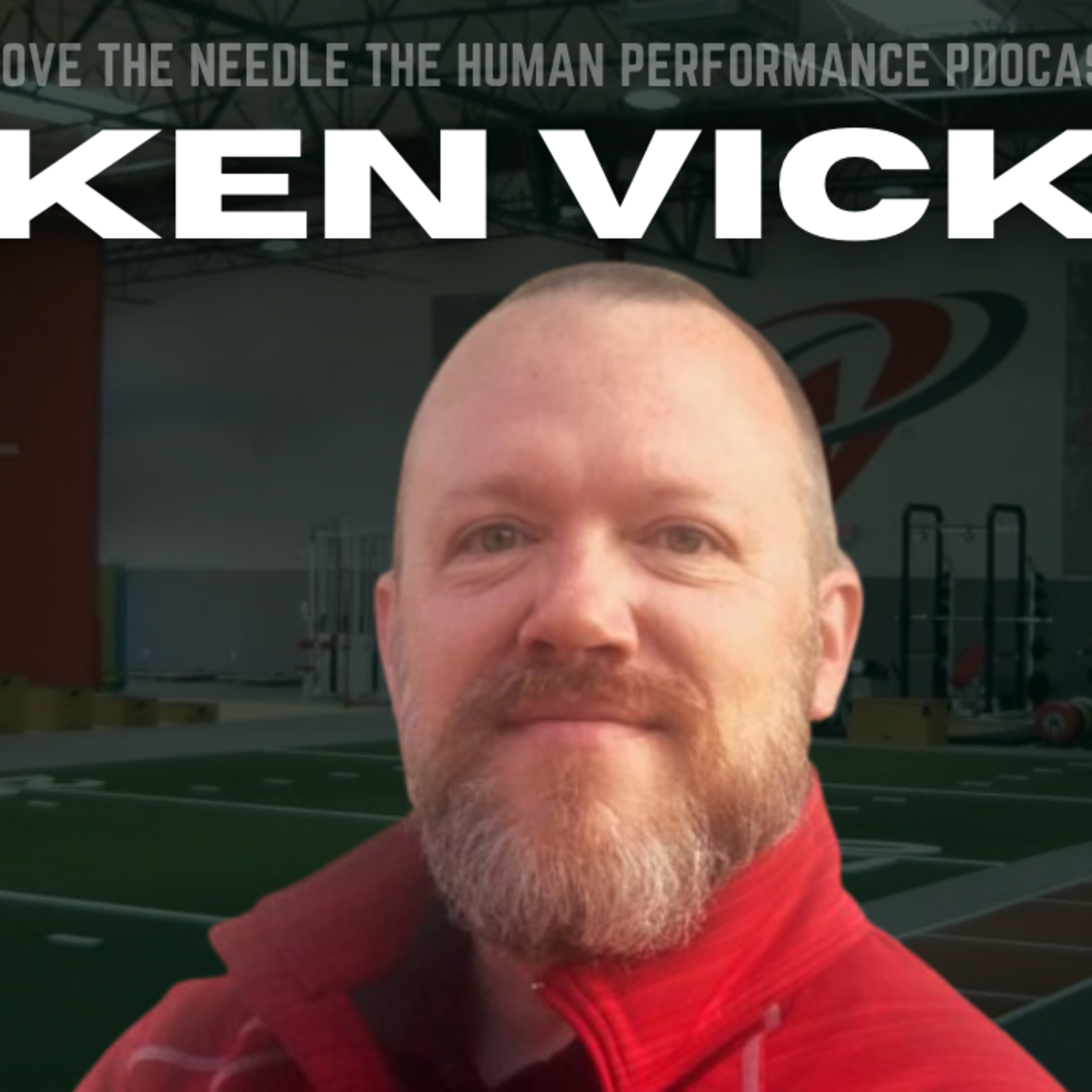
from Move the Needle: The Human Performance Podcast
65m 14s
In this podcast episode, Ken Vic, president and high-performance director of Velocity Sports Performance, discusses the shortcomings of current performance education, which he believes overly emphasizes theory without practical application. He advocates for an interactive, mentored system that balances principle and practice, using frameworks to bridge gaps. Central to his philosophy is the "shocks and springs" model, which prioritizes eccentric actions over concentric ones in most sports. Eccentric actions either absorb force like shocks or potentiate output like springs, and this functional lens helps evaluate and train athletes. Ken critiques the broad spectrum of education—from cheap online courses to PhDs—and highlights the need for niche experts (e.g., Altis, Sportsmith) and generalist platforms. He stresses that sport context and athlete archetypes (e.g., elastic vs. muscular) must guide training. Using tools like force plates, coaches can assess an athlete's breaking ability and eccentric efficiency, informing tailored prescriptions. The conversation also touches on the importance of mentoring and the challenge of scaling quality education without diluting it. Overall, Ken emphasizes that effective coaching integrates science, art, and sport-specific demands, moving beyond rigid theoretical models.
Welcome to Move the Needle, the human performance podcast with your host, Haras Nour and Mike Sullivan. Our show today is brought to you by Hawking Dynamics, Tenant Emotion, Lumin sports and Simpson Equipment. On the shorter day we are joined by Ken Vic, Ken is currently the president and high-performance director of Velocity Sports Performance and has been coaching for over the last 30 years. Over those three decades Ken has coached athletes at Ten Olympic Games, has built and operated multiple high-performance businesses and now guides Velocity's global education program that has impacted over 10,000 coaches worldwide. On the podcast today we talk about the education system within our profession and we dive into his frameworks around shocks and springs that launch us into a very ploy-o-intensive conversation. Now before we get into the episode, if you enjoy this podcast head over to our website MTNperform.com and check out our subscription MTN Premium. Premium is a in-depth educational content subscription that highlights content from coaches all around the world, many of whom we have featured right here on this podcast. Now enjoy the episode and again big thanks to our sponsors Hawking, Samson, Tenanty and of course Lumin sports. I'm also listening to your episode with with less than Danny and you had talked about the foray more into the educational space performance a little bit as Velocity has been kind of in push-in, the kind of pushing. And so this kind of was in line with one of that questions and this is completely a selfless question. Applies to very, very few people outside of myself, my hundred and you but if you were to try to create or as you are really pushing the performance education space like what would be your plan from like really trying to scale a without losing quality of just high-level performance education in our field that has I mean it's got a wide spectrum. Yeah yeah it's I mean there's a lot of ways to attack that question there Mike so a couple things I guess if I try to answer that brand for me first of all I'm the worst marketer there is so let's just put that out there. Obviously if I was a better marketer more people would know about Velocity and myself so I'm not good at marketing with that said brand for me is something that should encompass what you're about what you believe in and when people hear about your brand it ties to that whatever your message is your beliefs what you're about. So when you ask me like how would I build the brand then that for me means it goes back to what are we about and you said you know you talked about the space the education space in our field is all over the place we have everything from the cheap online course you can do that's $29 and it's going to tell you how to teach something to your degrees to your PhD right the whole range of degrees and I think education in our space sucks. I think my takeaway over the years seeing education across lots of velocities I mean we've we've educated somewhere over 10 thousand coaches we had counted it's got to be interactive it's got to be mentored it's got to be guided it is not strictly a theoretical field this is art and science right you got both so we can do a good job of teaching a lot of the science within typical education settings classrooms degrees but it doesn't do you a lot of good so you got to get out and practice to develop your art and how you apply the science and actually see it up you know in the real world so I try to find a balance and figure out how to get both principle and practical those two things kind of drive me because we can have all the principles the first principles and the great science but sometimes you got to throw some of them out the window not out the window but you got to compromise you got to find how to apply them and if you're all practical then you're shot on the other side if you got no principles so I think our education reflects that gap currently and that's kind of my goal so how would I go about doing it I am trying to take what we've had to do over the years whether it was learning how to myself manage and run facilities that I own that were far away whether it was trying to do that across the country on a broad basis whether that's been around the world with people from a lot of different cultures and countries and professions it's bridging gaps between principle and practice and frameworks are a big part of what drives that so can we educate enough key principles in science have a framework that we can deliver to practitioners and then they have some practical things they can use in as tools so my goal is to bridge the gap but I mean where do you guys see that how do you see education in our space I mean I think that the thing that we try to do is finding practitioners that present high-level refined practical thoughts methodologies and kind of highlight the spectrum of those because I think that there are so many niches and there's so many topics that you can niche down to within this field and the general nature of training is probably been talked about in every CSCS textbook and I don't know exercise science degree you can get however I I believe that once you begin to learn you realize that there are people and there's very intelligent individuals that understand niches and then you pull those small aspects yeah they're to kind of like frame your methodology and that's really what I've done throughout the years is learn from a lot of different people and then allow all those small pieces to to refine my methodology and honestly I say now like if I do an entire course if I have a couple conversations with one individual and I add like one small tweak to the program I'm doing it was well worth it whereas like early in your career you take a you learn from a you do an internship and your program is just that program because it's like a wholesale change because you know nothing but then you begin to learn these niches and figure out where they fit into your program and you create your methodology but one of the things I was I'm not gonna I'm not gonna ask who do you think does a poor job in performance because we don't want to put anybody on blast but we do a lot of we do want to ask who do you view from like an educational perspective whether it's like a company or whether it's an individual that you think does like an elite job in this performance education space currently I think most of the really great ones happening we probably don't get access to because they are great practitioners who are mentoring somebody so you know like you said there they have their expertise they have their systems and they're teaching the people working with them so that is really the core of it once we go back beyond that publicly there's a lot of good people and you hit on a point right there's a lot of good people that have very specific areas of expertise and can teach you a lot about it I've always relied on that I am a really good generalist I have a few domains I can go really really deep in in human performance and then I have a whole bunch of domains I know enough about and I'm good at asking questions so I can find other people so that's most but who's publicly out there I could say as well um I like coming from that generalist side so there's tons of little niche ones but generalist you know the guys at sportsmith rapacy they're putting out a lot of good content that covers a lot of different areas you know I really like altis it probably has a lot of alignment with my own approaches and philosophy on a much broader level I don't enjoy the basic here's everything courses or pieces here's how to do all your coaching in one they're not bad okay I'm not saying they're bad I just both myself obviously don't get much out of it but I also find they don't do a lot for coaches I mean they might be a good minute when you start to take this xyz certification that teaches you how to do everything in coaching but you can do that in a lot of different ways so um how did I answer your question yeah there's tons of great people out there I like altis I like what sportsmiths doing I love I love some of the different people that have courses that way you know whether it's you want to go into isometrics and look what Alex has done you're going into plyo stuff and you look what uh matman kineswatson's done or you go to him and flying again like there's a lot of good niche people I think broads hard yeah can I should have played before we start you're in a lot of say sportsmiths on our podcast that's uh not not not not not not to let the cut that out for sure that that that that's a fair thing but look here's the thing and I this is you know and I haven't you know I consumed a number of your guys podcasts I've seen you got just you know talking on some other podcasts I haven't looked at all your content you know on on your premium membership but I think you're doing the right things from my perspective you're giving that base of different experts diving into topics and I think that's a really I
like that model and I like those tools when you give somebody that. And there's lots of us out there. We get to have other people that are good too. So you got to mix it up. Yeah, for sure. And we do our best. We try to diversify as much as we can. But like you said, we do try to dive into as much topic areas we can. So we'll kind of pivot into that area. And we try to hesitate to ask questions that we know guests have answered in the past. But at the same time, like sometimes those answers create great context moving forward. So I'm going to ask you a question. You've answered many times. And then we'll kind of play off that a little bit. So let's just start with the idea of the shocks and the springs if you don't mind. And as we kind of get into it and branch off from there, can you just start us off by just describing shocks and springs. And then we kind of create our own conversation there. Yeah, I mean, I love the conversation. So for me, all of it stems from a key thing that I've experienced and observed. And that's I will argue that the eccentric action is more important in most cases than the concentric. E-centric actions are what should be valued far higher in most of sport. Because sport is movement. And most of those movements are some type of stretch shortening cycle. There's an eccentric action that often proceeds the concentric. And eccentric actions give you two options. They can either give you an advantage or they can cause damage. And that was a big driver for me and ending up in this place. And this was years ago early in my career. But eccentric actions are where people get hurt. That's where the micro damage happens in overuse injury. It's also where the traumatic injury happens. E-centric actions can give you an advantage. If you can go into that stop in fewer steps, if you can land and get back out of the next thing, if you can handle a harder stop, you have an advantage over other people. So for me, in a majority of sports and definitely in the team and court sports, eccentric actions are more important than the concentric. Now, that's kind of funky because we live in an output concentric world, right? We measure the outputs. How high did they jump? How hard did they throw? How fast did they run? Those are what I'd call outputs and they're concentric. And they make the difference in a game, but they're usually set up and preceded with an eccentric. So for shocks and springs, fundamentally, we start for me with the idea that eccentric are generally more important. And then if we look at eccentric, there's two main functions. They either function as a shock, absorbing energy and attenuating forces, or they act as a spring, potentiating and using that energy to create more output. And those two things matter. So I think that's where I start. And I usually go into and share the car analogy, right? Every vehicle has shocks and springs. And they have both of those for a reason because they need both. But they're different. Right? The shocks are going to absorb those bumps. They're going to protect the frame. They're going to help smooth out the ride. The springs are going to keep those tires in contact with the ground. They're going to help you be a little bit more reactive, have better handling a little faster. Kind of similar to people. And they can be tuned. You don't tune your shocks and springs or put the same ones on a Formula One car versus your luxury sedan versus your heavy construction equipment or tank or something. They need to be tuned differently for different jobs. And so that lens of shocks and springs gave us a way to share this, conceptualize and create a framework to evaluate movements and then go into training them. I definitely want to dig into the training prescription for these fairly specific. However, when you started mentioning the cars, everybody talks about the car analogy of at least shocks or something within that realm. Probably it's just a singular focus. Shocks and springs is fairly more, there's a little bit more nuance. But then you started talking about the sports car all the way to the construction, whatever, piece of equipment. That begins to get my mind thinking about archetypes of athletes and how some are in the way I frame it is more elastic to muscular driven. You probably have another framework to think about the same thing. Where does this fit with shocks and springs? Is it more predisposed towards shocks, springs, distribution of either? How do you begin to think about this when you talk about archetypes of athlete? Yeah, that's. A lot of peeps is to pull together there. So when I look at it, I kind of work backwards in most of these things. So going way back, what do we do? We help athletes and we came up with the it's rule. So instead of the kiss rule, keep it simple stupid, it's the sports stupid. And that was an internal piece that we had to give to ourselves often because it has coaches, sports medicine practitioners. Within some of our teams years ago, this came up because our coaches got into some very big disagreements about how we were going to prep some athletes over about a two year period to the Olympics. And we had to keep coming back to this because we were getting lost in the weeds. So it sounds kind of general and fluffy, but it's not. We got to start with it's the sport. And so what sports? Sports movement. Okay? That's most sport or in some cases restriction or anti-movement. But sports movement and movement means a combination of both motor control and physical capacities. Okay? Those physical capacities are influenced by both nature and nurture. Okay? You got both the nervous system and the physical part and they are partially genetic and they're partially what they've done over the time. So I share all that first hunter because if I don't have that framework for me, I can't really start answering that question. So how do shocks and springs fit in? Well they are a functional lens. They're not a genetic lens. They're a functional lens. They're how do you use these eccentric actions? But if that's the movement, now comes into it, what's the athlete bringing into that movement? Right? And this is where, you know, looking at profiling or as you say archetyping comes in and what are the qualities they have? So it does. There's a whole lot that maps to it. But depending on their choice of sport and level we're talking about, they might not be the perfect archetype for that function, right? And this is real true on team and court sports, the more diverse movements they need. They need both potentiating spring actions to be quick, but they're also going to need shock type concentric where they can attenuate forces. So you don't get to in a lot of team sports settings, say one or the other. And of course, it's a continuum and there are these players who are going to tend towards one side and there's other players who are going to tend towards the other side. So I'm not even sure if I answered your question right, but here's the beginning part and we can get into the weeds. Those are functional, that's a functional lens and then we can overlay what the athlete brings into it and how we meet those functional demands. So for clarifying, would you say that like all eccentric actions, we are going to fit into one of the two shops or screens or are there things that lay outside of this specific framework? Yeah, it's a continuum like any framework, right? The reality is movements, complex human beings are complex. We use frameworks to try to be more efficient in our work, to communicate it better, to apply it better. So they're not perfect, but they're a good practical tool. Just like profiling architects, they're not perfect, but they're a good tool. So is it one or the other? Yeah, pretty much. I mean, they blend at a point, but most things you do eccentrically that wind up that counter movement, those things, the intent of those, the purpose is generally to get more out of the next movement. Whereas if I'm talking about a shocks type eccentric, my whole job is right now. I got to handle these forces. I have to slow down, I have to decelerate, I have to land from this, you know, double corkscrew, whatever on slope style and land onto the ground. That's the purpose. So there's all that range. And then there's a big part in my, this might be a little bit of something going through your head in this question. That's a physical point. Now we have a whole different piece. Remember what I said, it's the sport. I got to keep reminding myself, it's the sports do, but don't forget. We're looking at a lot of these things from the physical lens of it, but sometimes that athlete uses the timing and the eccentric tactically or technically. That's a whole confounding factor that changes stuff. Working in a lot of different sports, you see that this is only a physical question. This is a sometimes strategic and not just strategy of like movement output, but strategically of timing in the game, strategically of reading other things first. There's a whole other piece that happens in the sports side that goes into this. So we keep, it's not where we tend to spend our time, but we have to keep that perspective and remember.
remember those pieces. We can get as professionals, I think, really in the weeds of the physical, and even the motor control, but forget the context of the sport. So yeah, there's a whole lot to pursue. We can go a lot of ways here. - Well, I wanted to dive into training prescription. However, I don't wanna dive into training prescription until we talk about evaluation of like knowing the training prescription to prescribe. And one of the things that I think is impactful and a piece of the puzzle of evaluation is using something like a force plate in the CMJ. And whenever I look at force time curves on a CMJ, there are certain things that you can see that depict an athlete to have better breaking ability than others. And ideally, all of our athletes have a good breaking ability. However, there are some that are leveraged to harness eccentric actions better than others where some will rely on concentric outputs. Whenever you're looking at your evaluation tool and let's talk about like force plate specifically or anything else that you use, but that's kind of like my frame that I'm coming into this with. Like how do you look at an athlete and then change or nuance that eccentric action to shocks and springs based on your evaluation that you use? - Yeah, so a lot of things too unpacking there. But I like that. I think there's a lot of good things that you're asking about. Okay, so how do we go about it? One, what are we trying to do? And again, these things sound a little too philosophical sometimes, but I cannot start there. I have to decide am I trying to and am I trying to develop this athlete? Say younger, broader perspective? Am I trying to optimize this athlete, get specific outputs at a higher level, or am I trying to help this athlete maintain where they're at? And that's as kind of fluffy as that sounds, that really is the first driver 'cause it's gonna impact everything else after. So what do I look at? Okay, great. We know what we're trying to do. What are the movements we're doing that in? And so is it that they need to be able to absorb more? If I have the athlete come back from injury and desaleration has been an issue, I'm looking at the shocks side more, whatever. That's probably gonna have a higher value. If I'm looking at the, our slope style athlete or our half-pig path, if we've worked with those national teams, I'm looking at how their shocksides working. If I'm looking at the sprinter, if I'm looking at the quick defender in basketball, if I'm looking at that athlete that needs the spring sites, I bias that in my assessment. Okay, so just we're working down the list. So how do I actually do it? For me, let's make sure we take the thresholds off the table. So meaning there's certain values and things we determine. They need a minimum threshold for. This is the cover charge to get in the door. Do you have it? So do you have a enough strength? A lot of discussion about what that means, but there's some KPIs if you spend time in a sport. You can say, okay, I know he needs at least this. So generally a strength test through IMTP, or a belt squat and isometric force test, that's gonna give us an idea. Do they have enough capacity to generate force? Then we move into how they use that capacity. So using that capacity, counter-moving jumps are great, right? They give us a ton of information. They've been used for a long time. They're valid. They're pretty stable. So counter-moving jumps are great. Some athletes aren't great at them like hockey players or swimmers or track cyclists that are mostly concentric, but pretty good. But here's my problem with counter-moving jumps. Just using them. Now it's practical. So there's times I 100% just do that, 'cause it's a practicality side. But it's a slow stretch shortening cycle. And even if your Q is fast and high, it's still gonna be a little bit on the longer side. It's not a fast stretch shortening cycle. So again, why am I doing this test? What sport is it for and which side am I looking for? For me, the general outlook is I need multiple tests to look at them across that range. Do they have the force capacity check? Okay, let's see now how they use that stretch shortening cycle. We're gonna do the counter-moving jump. A basic test we started with a long time ago from a practical side was could they jump as high off a depth jump as they did in their counter-moving jump from their counter-moving jump height? And this is something we could do at the time practically years ago. I mean, I had my first four splits back in the 90s, but then didn't have them for a long time. So, athlete can jump this high. Well, we said they should be able to handle that landing. We also know that with additional momentum, if they have enough e-centre qualities, they should be able to jump higher 'cause they have more momentum going into it. That's been a pretty good field practical test over there. Gives me some good data on their shocks side of the equation. Can they handle faster momentum to jump for height and get a big output? It's not perfect, but testing true e-centre qualities gets tough. On the other side, I now need to see something that's happening on the faster side. I need quickness off the ground. I need to look at that elastic quality. Elastics are really dangerous, word in our field, but I would say that. And that's gonna be some form of reactive jump. Whether a multi rebound test tends to work best, whether that was in the past four jump on the just jump, now it's on a force plate, or a gate or a timing pad. But I want a couple different versions. So that kind of gives me a view. And my basic level of profiling hunter coming up with kind of my nice, simple quadrant view would be I'm gonna use a multi rebound jump test to look at their reactivity. And then I'm going to use a comparison between the counter movement jump and squat jump to look at their rate of force development. To see if they are wired a little bit towards the velocity side of the equation or the force side of the equation. And this goes back to Bosco's work. We've modified that some over time, and we're continuing to modify that now with force plates becoming more ubiquitous. But that was kind of the practical pieces from a number years ago. Okay, so let's dig into that, tell me where you wanna go and what I can elaborate on. - I think what would be interesting is maybe if there's an example of like an athlete that you've worked with recently, where you had to go through the decision making tree of shocks and springs. And then like, okay, because of this context of this athlete, here is a specific intervention that I went into. I think that is front of my view. - Yeah, no, I think that's great. So think about that most basic, 'cause we could dig into any of those way more once you decide what the goal is and everything else. Yes, you're going to look at other specific metrics, other specific tests, so forth. But in that broad sense, I'm sure I'll come up with somebody here. Okay, so basic testing, right? Are they biased towards using the speed side of the equation or the four side of equation to create power? And I think I gotta keep saying that part out loud always to myself and coaches, because we're going with the idea that they need a big power output, so how do they do it? And there we're gonna start grouping the first set. Like, okay, great, they need, they're really good in what people would call maybe muscular driven, but they're good at using their muscle contractile capacity to create power outputs, right? We've all seen this, we have lots of examples in sports. We got this other one over here that's the opposite, they're all about speed. They made me more fast switch, all the shorter dips, things we know, two different athletes. But I'm not gonna stop there now, we're gonna do same idea, we're gonna create some quadrants and you can break this down into more groups. But now I'm looking at their reactivity. Okay, so I got that, we see where they're at. And when we create these quadrants, and I love the idea of profiling our archetypes, it's very real and practical, but I also make fun of myself and caution our younger coaches. It's not real. It's a framework for us to look at real qualities, but they don't live in one of four quadrants. Okay, it's just part of it. So first of all, we use our eyes. Does the data, does the profile match what we see in their sport and what they tell us? And sometimes we gotta look deeper 'cause it doesn't match. Next, before I start assigning or prescribing training, along that same line, are they really in that quadrant? I mean, let's say we take our RSI and we're like, okay, if you're above 2.5,
eight, you're in this group and if you're below, you're not there. Well, is it really that different between the guy that's 2.85 and the guy that's 2.75 are they really drastically different quadrants? So again, just a perspective we got to keep. So great, we do that. We decide what they need. From a practical standpoint, when I have that, we take the approach of you build and think very similar to what you've talked about, Hunter. We're going to build on their needs earlier in the off season and farther away from competition, season training, whatever it is. So the farther way we are, yeah, I can go after that kryptonite. I can do the things they're not good at. As we get towards season, competition, whatever, we're going to do more of what they're good at. So basic progression, but even there within a week, there's a couple nuances that come in. First, I break up days usually trying to think about when I'm trying to stimulate their nervous system versus when I'm trying to help them accumulate work and adaptation. Those are two different types of days. Stimulation days, we tend to do what they're good at, what they're wired for. Accumulation days were generally working at what they're not good at. Next, when I'm thinking about this, dosing wise, whatever they need the most, they can tolerate the least. So if they are very muscular driven, then you want to work on a lot of elasticity. You have to understand they probably can handle that work on elasticity far worse than the elastic athlete and vice versa. So whatever they need the most, they probably can't tolerate as much dosage and intensity out. So you have to be really smart and careful with how you do that. And I would tell you for me profiling the athlete that's trying to optimize, I'm looking at what to add. And in trying to profile the athlete that's already at a higher level or develop, I'm looking at what to take away as a stressor stimulus. So let me just stop there for a second because we can keep going to how we program and do it, but what made sense and what didn't. Now it makes sense and I want to talk about the specifics of like a training intervention. And I think that the scenario that I'll give you is something that you said earlier when you were talking about evaluating shocks based on a CMJ versus a depth jump at the same CMJ. So let's say you are working or I'm working with an athlete that has a higher CMJ than they do a depth jump at that CMJ height. Can you talk about what your training would look like vacuumed into like a week including some of that stimulate and accumulate aspects just using that hypothetical situation and then diving into specifics of how you program for that individual? Yeah, and we see it a lot. So again, we're talking about they can't if they drop from that same CMJ height, they can't achieve it. So something's wrong, something's wrong on that eccentric side. And when you look in the metrics, well, first when you look at the curve, you're often going to see the qualitative things that are like, oof, that does not look good and you can see it. So we got a problem with their shock sighted equation, their eccentric ability to handle higher momentum. And I think about all those stretch shortening cycles as the input momentum, the constraints of what happens during and then what's the output. So I need to then look a little bit first at do I have the basic force capacity? If their jump was crappy like that and their strengths really low, this is easy. Let's get stronger, right? That basic level of strengths probably going to take up their eccentric strength as well. It's not that though, they're strong, they're just really bad at using it this way. They don't have those shock absorbers to use. Happens a lot, especially in an athlete that's not training that way, an athlete that's not wired that way. So how are we going to improve it? And an athlete that's hurt. I mean, most of all, it's probably been an athlete that's hurt for talking about higher levels. So how do we train it? We're going to work on building the engine, right? So we're going to build that basic force capacity. And I want to emphasize building it eccentricly. Doesn't mean tempo squats, you know, eccentric tempo squats. They're great, they're fine. They're useful for a lot of things in teaching. They're not an eccentric training tool. You know, and I wish as a field, we would figure that out and get over it. We'd start doing a lot better. So to build up eccentric strength, I have to be at really heavy loads because our eccentric strength has more capacity. That means my traditional eccentric concentric lift, it's only going to help this if it's in the pretty heavy ranges. What else can I do? Well, there's a whole bunch of stuff I can do true eccentric overload. Gotta be ready for that, you know, we need some training age before we go there. That could be weight releases. That's great. Slow heavy method. Now we have so many awesome machines that can let us do true eccentric overload. We're entering a whole new game with that. So I think those are really big tools and I'm probably going to use those in some way. Not fast, I'm just building my eccentric force capacity. Then it's going to start transitioning to something that is a little bit faster that moves a little bit more. Now we're talking about things that we might be overloading by using our flywheel. Maybe we have an assist on the way up and we're overloading that concentric. We are getting into things and we're building step-by-step through depth jumps. We're working on what the term we use is reactivity-centric. A lot of people are using the term reflexive. But I want that fast loaded eccentric. In this phase, I'm probably looking at the possibility of isolation while I was doing that eccentric engine building, that eccentric force. Ocelations, I think are still slept on. They can be done for rapid speed and short or they can be used for rhythmic, which I think falls into a similar category of our deep bounce jumps or mat calls them deep tier. But things that go through a bigger range and are about rhythm and absorbing those forces. Then we'll progress that into, depending on what the movement outcome is, do they really need bigger shocks because they have to stop harder, land from jumps, whatever it is. Okay, great. Then we're probably going to take those plyo work into that zone and start overloading depth jumps, overloading our reactive eccentric. And there'll probably be some spring actions in there too where they potentiate, because usually in most of our sports, after that eccentric, even if it's overloaded, they still have to handle other stuff. So it's a little broad, so let me dig in more where you're kind of thinking about and want. Well, something that I've seen from you, like what you've, what you've recently talked about and posted about. And something that I think I probably can strategically use more often within my methodology is this combination of depth and drop jumps. But one of the things that I think about is the potency of the stimulus and the prescription that I decide to use. And people talk about loading parameters all the time with traditional movements and whatever, prolapse chart, like that's VBT, whatever you want to use to decide loading parameters. But I think that like the loading parameters for a depth jump and a drop jump is the height that you're going to drop from and then the contact or the time you spend on the ground. Where does your mind go from like a prescription perspective with depth and drop jumps from like how I'm deciding heights, how I'm deciding volumes, how I'm deciding frequency with those two specific similar but different exercises? No, I think it's a really interesting one. And I think like for me, there's still a ton of curiosity there. I think we have a lot to continue learning. So I can tell you what I do, but I will be very clear. I have a whole lot of questions, a lot of what we're doing space down what we've seen work for a lot of years. So here we go. Depth jumps, drop jumps, depth jumps. So anybody listening that doesn't know for me, that's a drop from an altitude that is for height. We are going to have longer contact times, probably deeper, ranges of motion, but the output is supposed to be height. A drop jump is for a limited constrained contact time. You still want height, but fast now becomes part of it. All right, so we have a constraint. So again, when I program hunter, I go input momentum, constraints output, and you can manipulate and measure all of those. And that's how I go about programming. So let's go to some real examples. Okay, I was telling Mike earlier this summer, I got to help out with some of the hockey players at one of our facilities. And this was junior players, college players, pro players, whether it's AHL or Reseezer NHL. As we profiled them, we decided which one they needed to work on. Right?
depending on the phase, where we're working on the speed side with drop jumps or the force and shock side with depth jumps. So how do we program them? Everybody goes through basic phases where at first we went through a lot of extensive both shocks and springs, done that more and more over the last decade, really a lot over the last six, seven years, but pretty long extensive periods, even with pretty remedial things. I like to pause in that answer right there, 10 and kind of elaborate on what that means, like extensive periods of shock and springs. Yeah, for sure. Extensive, for me, intensity tears, at the bottom we have extensive, we have medium and intensive. So we have then also shocks and springs. So I'd kind of look at that as a little bit of a matrix in itself, right? intensive, tear stuff, lower, lower intensity, higher volume, but we don't have as sharp of impacts or as big of forces. Whereas intensive, it's exactly that, it's higher intensities, bigger forces, higher rates of force development. But that could be in shock source springs, both can be intensive. If I'm doing a depth jump off a 48 inch drop and I got an extra 20 or 40 pounds of load, it's pretty fricking intensive. So it's not a matter of speed in itself, it's not a matter of shock source springs, both can be intensive or extensive. Maybe more my question was, how long do you see the need for extensive? Like, okay, like, yeah, no, it's over done oftentimes. Extensive is just like constantly over done. So it's like, what is the actual bandwidth that we need for extensive? Yeah, I think that's fair. I do think like a lot of things the pendulum swings too far and I think extensives are relied on too much. I don't think it's that they're done too long per se because I think there is a early on early off season developmental athlete early phases. There's a place for more extensive, okay? And I think from my experience, I see that both extensive spring action. So your typical pogo jumps, right? Your your rudiment series. Those things are one piece. I also see extensives in our deep bounce movements or like Matt calls them deep tear. So we do those extensively. And I've had a lot of success doing that in early off seasons to help players regain some of their elasticity, regain some of their range of motion. And I said we need to do those even unloaded. So boy, that's been a big move for me guys is where we would do these things just with body weight. Now early even with healthy people, we're often doing those using bands to assist and unload them but let them get through those ranges and get rhythms. So I like that early, but to your question Mike, as we progress, we can't stay there. Now we don't get rid of them, but they might become part of the warm up. They often become part of a recovery and active recovery type day. So we're still dosing them in small amounts throughout a year, but their purpose changes because their intensity is too low to drive adaptation. Great at the start, but I think a lot of people in our fields, both on the performance side and rehab side who haven't done these or been around them. Yeah, they stick with them too long. So you need to move up into that medium tear where you have more intensity and you can drive adaptation and you sprinkle in that intensive tear carefully and appropriately because it's great, but it's going to be highly neural and it's going to drive some adaptation and some peaking, but you can't use a lot of it. You got to be real careful. So I hope I'll a little bit of that. So before Mike hijacked my question, the screen middle of you answering it, I wanted to go back to hearing your thoughts about the death and drop drum since he just cut you. No, I made a perfect piece in there to go together because I think this doesn't matter. It was not a good idea. I just hijacked and made you answer something different and I'm still curing the death of the drop. Okay, well, I don't want to miss that because they're great. I love them. I see them applied poorly very often. It's a great tool in our way. I am a big believer we need to move. Our athletes in most of our cases need to not just be in a quote unquote, "wait room, they need to be doing movement." But those drops give us some great tools and to your point, Hunter, we can be pretty clear how we're manipulating the momentum in. We know how far they dropped or we know how much extra load they had. So my first step is I need to look at quality. You started at a low level and you'd get good quality. I mean, that's not sexy. It's not data, but it is data. It's watching. It's using your most important tools of coach. So you need to know what quality looks like. Had a younger coach in the wait room this morning. He's working with a bunch of MMA athletes and jujitsu athletes and quite a few of them are using oscillations right now. And he's still tuning his eye to see when that looks right. But that is step one. Okay, great. So we got quality. They're doing a low level one. They move through the range we want. They move elastically. And I'm going to really mess with you guys. I don't. When I say elastic, it could be through a depth jump or a drop jump, a deep tear, a pogo. All of those to me can be elastic. Now I know we often use those for those reactive type things through short quick motions. For me, the quality of elasticity is do they have smooth control in both directions? Now it could be short. Could be faster. But whatever it is, it's even and they're reusing energy. So that's elastic. So is it elastic? Does it look through the right range of motion? Do they keep their posture? Do they have the right rhythm? Okay, they got that. That's start going up. So this summer with hockey players to get specific as we looked at which one they needed. All right, we're in a phase where they're accumulating some work. The guys that need better shocks, they need to attenuate forces and absorb energy better. They're doing depth jumps now with a load. We have a set box height for this group. A little bit lower for our younger players, higher for our older players. And they are doing, they're coming in, they do a counter movement jump on the day. They get a couple tries. Here's your best. Now we're going to add load and we're going to add load until your rebound jump drops a certain percentage. And in a really heavy overload phase, keep in mind this is relative to some training agent strength. But we could look for a drop of 50%. So you got some guys dropping off a 20 inch box and they might have 40 plus 50 pounds in each hand. Some pretty big frickin' loads. And these were some strong hockey players. So that side of it, that's the most I've gone. 50% really heavy overload. We're really doing a lot here too, where you want not much overload. Maybe it's only a 10 to 15% decrement. So you program that out like you might do with your typical lifts, but now I have an output to check that I could handle the input. Okay, so I'll go to drop jump in a second, but is that, like how does that resonate for you? Yeah, no, that's interesting in adding load to the actual depth jump prescription is a interesting take as well in order to create a bigger stimulus. But yeah, hit drop in the other end of the continuum and how you think about that. And so all of this is based on two things again. Input and constraints right now. Input is momentum. So on this drop jump group, we dropped that added velocity, but we needed to add some additional mass for more momentum. That's a little different than the drop jump group. These guys were not adding mass. We are setting a constraint of contact time. We still need an output. My general finding is we either need to be doing it to a rebound box jump, jump over a hurdle. We need something to create a threshold output. So we have that. Now they're hitting the ground. They have to get off in that time. We are generally overloading them more in terms of the drop jump with increased height, not increased mass. There's limits to that. Our progressions are going to usually move more from two foot to stagger to one. So we'll typically work two foot up to a certain height. Then we're going to work into staggered single. We're going to play with vectors. Are they coming off laterally? Are they moving in a different way? That group I would generally prefer to move into those type of constraints than endless height. Yeah, great example from the summer. We had a couple of our junior guys. They're doing great. I mean, these kids have a bunch of training years. They trained at that facility since they were young. They probably, they're 1920 now and they probably have a honest training age of six to eight years of two to three days a week yearly throughout the year. So really good. But they're getting off the ground in 200 milliseconds off four inches. It's our, sorry.
I made the coaches stop at 30 something. They were probably at like 36, 34. I don't remember centimeters. But it's like, yeah, that's great. The numbers say we could go higher, don't do it. Let's change the constraint in the stimulus instead of just endlessly overloading this, especially hockey players who don't have the same ground contact times. I don't think you should go there endlessly. So the number said you could and prudent says don't do it. So there's one more layer I want to take this and get your opinion on. And depth drops are something where it's just a drop in a stick off of probably higher box than you're gonna perform a depth jump or depth drop jump from. But I wanted to get your take on utilizing those as a training tool to develop it sounds like shocks. And I've also had the idea and I haven't done it yet or programmed it, but I want to mess around it, mess around with it myself, is using a depth drop at a much higher height to then pair with a depth jump at a much lower height relative as like a potential effect. And I wanted to get your idea of one on depth drops just in general as a training tool and then also potentially the idea of potentiating a depth jump with a higher depth drop. - Yeah, so I love them. I think it's really useful. Depth drops fit to me in reflexive or reactive eccentric. So it is about quickly stopping that momentum, handling it, which means you have to absorb energy and attenuate those forces. So yes, I think it is a great training tool. Usually that comes very quickly after we've built force capacity, probably doing some deep and extensive stuff and oscillations. That's one of the next phases I'm gonna use in most cases. Little dependence on their capacity in sport. This is, I would say yeah, this is an area you see there's really expos some athletes who can't do that smoothly, quickly, reactively. It's a great place to expose some needs to. Like I think you can get a pretty good assessment of seeing how well they can do that. And it could be off a depth landing. It could be off a split squat drop. It could be off a bulk airing. It could be off to different positions. So I think all of those fall in that same box. I like them. I find them highly effective. I think you need to be very intelligent about how quickly you progress. I think a whole lot of coaches underestimate the forces. They're creating doing that. I think you've done this. You've played with doing this on the force plates, right? And seeing what that does. Dude, that's awesome. That makes coaches go, oh shit, look at what I see here. Yeah, that was like the birth of my current methodology. However, now there's people saying that the forces that are experienced within a depth drop aren't actually forces being attenuated by the system and more so, like the collision of just like your body with the ground. But it doesn't really make sense in my head and maybe it's just because I'm not smart enough. But like if the ground reaction forces occurring, like there has to be a equal and opposite force to counteract the ground reaction forces that the system's experiencing correct. So like even if it is just like collision, I think maybe the argument is like you can't necessarily attribute the forces to specific tissues or to whatever it may be, but it still seems like there's a adaptation that occurs from a breaking perspective with the forces that are experienced, even if your claim is it's a collision. Yeah, so here's where I think some of this comes up. I tend to talk about and think in terms of momentum and momentum is force and velocity, right? And I like that for our world because it has a vector, it has a direction. That's what we do in sport. Forces aren't just without vector. But there's also energy, very closely related is kinetic energy, momentum and kinetic energy, two sides to a coin in some ways, but energy's different. And so that comes into part of this and look, I'll leave that to the better biomechanist and physics to really get into. But there are some sides of this that when you talk about energy, yeah, you're not producing it the same way you're absorbing it from kinetic energy to potential and the kinetic, whatever. If your center of mass does not collapse, if I land in this perfect squat position, I land like any of our superheroes, right? We're doing our superhero landings like in the Marvel movies. And I just hit it and I don't collapse. Well, my body had to do something from keeping the rest of my body from falling down, right? Otherwise you go to the ground. So obviously I did work. Which tissues we get into? What did it affect? I think we bias some things. I don't think we can isolate. There's a lot of interesting space here when we start talking about tendons, fashion, muscle and what we're working. Going back to your question. I love these. I think there is use for them. I think they're a great tool. There's another part I was going to share. Oh, you talked about potentiating. I love potentiating these things as we move forward. I find that that does potentiate, that jumps. Isometrics make a lot of great parents for these things as well. If it's early in phases, I might be more likely to be using a yielding ISO in some way combined with this. If it's later, it's probably more of a pushing ISO. If I'm going for springs, it's going to tend towards pushing ISOs more. But yeah, there's some awesome ways you can potentiate, but you're doing that to train the nervous system, right? If I'm potentiating, that's what I'm after. I'm trying to get that and teach how to do that. So yeah, we can go down this pathway a lot, Hunter. I found a lot of good things there. Here's the other thing I would ask you. When you're doing that, I think you ask yourself the question. Am I doing this to build tougher tissues to create tissue adaptation? Am I building this to create better shocks or better springs? Like where's this going in the process? And that helps me kind of outline why I want to do it in when. I mean, I think from my perspective, I messed around with drops and saw the ground reaction forces first. And I thought, wow, if there's 10,000 newtons of force compared to the 3,000 from a 80% trap or deadlift, like there's something here you think about the orientation of muscle actions in both of those two things, concentricly oriented, eccentricly oriented. And then to me, it was the potency that I felt you could expose an athlete to from a breaking perspective. Because if we just purely talk about ground reaction forces and we're talking about a trap or deadlift is 80% as whatever, 3,000 newtons, 2,500 or 3,000 newtons, relative, roughly, then you look at a drop catch with 50% of that. Now we're at 5,000, 6,000. Then you go a 48-inch box and you're land rigid. And now you're at 9,000 to 11,000 newtons. It's like, OK, well, there has to be a increased exposure stimulus to breaking capacities with this progression of exposures. And I just think that to me, it's like one of the best ways to develop breaking capacity. But this is why I was so interested in the depth drop, depth jump conversation. Because I felt like me personally, it was like, OK, we get them to depth drops, high depth drops. We get them to 12,000 newtons of ground reaction force cool. But then it's like what I think I miss is then the progression to depth jumps and drop jumps. We're learning to not just break, but now deal with the eccentric load, the breaking need, but then be able to harness it and utilize it in outputs concentrically. Because while eccentric actions are vitally important, concentric actions are as well in my athletes. Well, that's what they're setting up. Yeah. And if you can harness the ability to leverage it, then you also need to give athletes the ability to then redistribute that concentrically. Because it's an important part of the equation, the more important part of the equation. But there is another part to the equation. So an interesting way to go into that and play with that for yourself, I find with that-- as we're trying to teach our coaches at this facility to use a force plate and it's all new-- do one of these instead of reactive, but do one of these drops, whether you're dropping into a split squat, you're dropping off a box and landing. And we were having the coaches do this last week with the interns, literally depth jumps. So we started-- we built up through these different exercises. They looked at forces. And we did landings and depth jumps. But within those landings, we went with two different ways. OK, make this one a reactive drop. Land hard, land fast, don't let your body collapse. OK, here's a different one. Land smoothly. Now you're going to still come to the stop ideally at that same depth and place. But I don't want you to land hard. I want you to land as soft and quiet as possible. And you see a very different force time curve. Now we're dropping from the same place. We have the same momentum. but they're using how they manage those forces.
is differently and you're going to see different spikes, different total imp, you're going to see some differences. And this is, I say this because I think one had helped a couple of them really think about it, but we'll do that in training. Like if you're not ready for this hard big drop, we might do them as small drops, right? But there's a real place to get that athlete to learn or a younger athlete to accumulate the work of the landing smoothly. And I suspect, don't have evidence, I suspect it changes the tissues we're delivering those forces to. There's some evidence out there about that, right? Radar of stopping, Radar of forced development or in breaking. It's going to tell us combined with stiffness is this more of the tend in the muscle. So there's a whole bunch of pieces here of how you, how you tune the whole muscular tendinous unit. But there's a place and this really comes up a lot in rehab where yeah, you're hitting some different tissues by doing it at these different rates, which also means it's part of why I need to have those fast rates. We hear about tendon research and the tendon research shows to structurally change the collagen content in tendon. I need a certain amount of mechanical load, right? I got to get that in there to stimulate it. But if we skip the speed side of the equation, we're not dealing with the rest of the tendon, how those things slide, the ECM, the IFM. And those are also rate dependent. Tendons aren't just steel cables. They're sliding happening in here. They are a gel like matrix and that gel and the way our system tunes changes with rate. So we need both and then depend on the athlete and the goal you got to play with those balances. So yeah, I think there's a big place to do a lot with that. So Ken, we have quite a few different directions that we say, hey, do we go here next? However, the issue is we're both running into some time while so what we're going to do is we're going to go ahead and wrap and leave some of these questions on the answer, but we do want to make sure that we have time for this question because we ask now all of our guests. And so we want to make sure we ask you as well. And that's a question that's powered by ten any emotion. And that is in your career, in your long career, having worked in many, many different, different routes and avenues, what easier, more most memorable story within our field? Yeah, it's a really hard question at first because there's so many awesome things. So I really struggle with that. But then when I start reflecting on it, it becomes really easy. The most memorable, it's not one story, it's a common thread of stories. It's when you connect with your athletes and you see the impact you had later on. For me, that's the most important. Like, there's all these great moments of competitions and winning and struggles. But the ones that jump out when you ask that might come to the athlete who years later becomes a strength coach and reaches out to you out of the blue. And it's been a decade and they're a strength coach at a college in Canada and says, man, you had this impact on me by the way you coached me. I'd think of a guy in the NFL who in all honesty, the time I trained the guy, I didn't know half the time if I was getting through or not. But I was trying to do what I could do. And three years later, he's an all pro and he messages out of the blue and like, coach, thanks for what you did. You stood by, you pushed me, you cared like those messages. And that's what kind of flesh for my head mic is a bunch of those. The people that went into the field, the people that I've been doing along enough now, those athletes are bringing their kids in as teenagers to train. It's always a scary first moment. But those are the moments that stand out for me. Talking to an athlete years later as a person and knowing that I could help them in some way pursue their goals, become a better person. And I was there to do that. That's when I feel like, good job. Ken, obviously, you know, you've been in the game for a long time. You've coached a lot of athletes, you've coached a lot of coaches and as a velocity. If people wanted to reach out, find out more about you and velocity, what you guys are putting out as a group, where, where can they go do that? Yeah, relaunch this coming year. So our website, velocityspusa.com, that'll be changed with the new year to focus on our coaching support and our education side. I share a lot on Twitter now under myself, coach Ken Vic, but both on Twitter and Instagram, the SP education channels exist, but aren't doing much, but they will be growing, starting December and really in January. So that's the best place to take a look. And hopefully we get to share a lot more and help some people on the way. Awesome. Well, Ken, thank you very much for jumping on. Chatting with us as Mike said, there's probably 10 more things that we could have talked about. If I start talking about drops and depth jumps and stuff. Sometimes you just gotta put a stop to hundreds. Yeah, I could. He has a great, he has a great reality. He's fun, man. It's what drives us forward. Definitely. Well, thank you. Yeah, thank you very much, man. Thanks for jumping on.
Podcast Summary
Key Points:
Ken Vic, president of Velocity Sports Performance, critiques the current performance education system as lacking a balance between theory and practice, advocating for a mentored, interactive approach.
He introduces the "shocks and springs" framework
Education should bridge principles and practical application, using frameworks like "shocks and springs" to evaluate and train athletes, while considering sport context and individual athlete archetypes.
Ken recommends niche experts (e.g., Altis, Sportsmith) for deep dives and generalist platforms for broad education, emphasizing that great mentoring often happens privately.
Evaluation tools like force plates (e.g., CMJ analysis) help assess an athlete's breaking ability and eccentric usage, guiding tailored training prescriptions.
Summary:
In this podcast episode, Ken Vic, president and high-performance director of Velocity Sports Performance, discusses the shortcomings of current performance education, which he believes overly emphasizes theory without practical application. He advocates for an interactive, mentored system that balances principle and practice, using frameworks to bridge gaps. Central to his philosophy is the "shocks and springs" model, which prioritizes eccentric actions over concentric ones in most sports.
Eccentric actions either absorb force like shocks or potentiate output like springs, and this functional lens helps evaluate and train athletes. , Altis, Sportsmith) and generalist platforms. , elastic vs.
muscular) must guide training. Using tools like force plates, coaches can assess an athlete's breaking ability and eccentric efficiency, informing tailored prescriptions. The conversation also touches on the importance of mentoring and the challenge of scaling quality education without diluting it.
Overall, Ken emphasizes that effective coaching integrates science, art, and sport-specific demands, moving beyond rigid theoretical models.
FAQs
Ken Vic is the president and high-performance director of Velocity Sports Performance with over 30 years of coaching experience, including coaching athletes at ten Olympic Games and impacting over 10,000 coaches worldwide through Velocity's global education program.
Ken believes education in the field sucks because it often lacks interactivity, mentorship, and guidance. He emphasizes it should balance science (principles) and art (practice), bridging the gap between theoretical knowledge and real-world application.
Shocks and springs describe two main functions of eccentric actions: shocks absorb energy and attenuate forces (like decelerating), while springs potentiate and use that energy for greater output (like jumping). They are a functional lens for evaluating and training movements.
He argues that eccentric actions are crucial because they can either provide an advantage (e.g., quicker stops or transitions) or cause damage (e.g., injuries). Since most sports involve stretch-shortening cycles, eccentric actions precede concentric outputs and are key to performance and safety.
He recommends using tools like force plates to analyze force-time curves, such as in a countermovement jump, to assess breaking ability and how athletes harness eccentric actions. Evaluation helps determine whether to prioritize shock or spring training based on the athlete's needs.
The 'it's the sport' rule (a play on KISS) reminds coaches to start with the sport's demands, which are movement-based. It ensures training focuses on motor control and physical capacities relevant to the sport, preventing getting lost in technical details.
Chat with AI
Loading...
Pro features
Go deeper with this episode
Unlock creator-grade tools that turn any transcript into show notes and subtitle files.
 PodcastTranscript AI