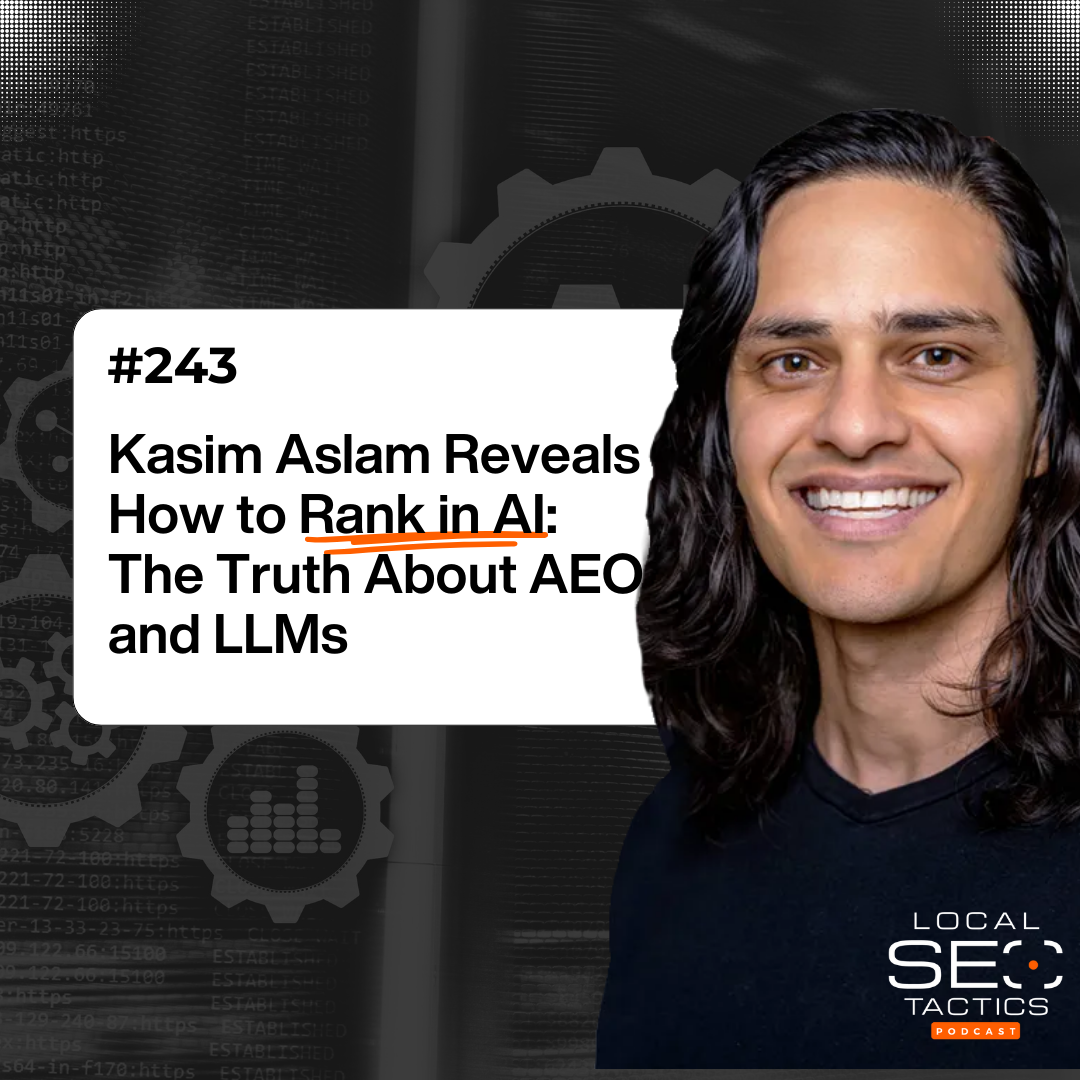
Kasim Aslam Reveals How to Rank in AI: The Truth About AEO and LLMs
31m 53s
The transcript discusses the shift from search engines to answer engines, highlighting the importance of AEO in the digital marketing landscape. It emphasizes the significance of peer-reviewed content like Reddit and the role of schema markup in AEO. The importance of establishing authority for local businesses through community engagement is stressed, along with insights into the impact of citations and the changing dynamics of SEO in the context of AI-driven results. Overall, the transcript provides valuable insights into the evolving strategies required for effective online visibility and success in the era of answer engines.
Transcription
5945 Words, 32636 Characters
I think this is a category kingmaker that it's a once-in-a-lifetime opportunity. How often do we have the context switch that we're about to have? You know, we're switching, we're changing from search engines to answer engines. I don't think that's happened since the advent of the internet to this degree. We've changed search engines, right? We went from AOL to LICO's to ask to do whatever, whatever, whatever, whatever. But it was just, it was the same general productive endeavor just improved across platforms. We're here here today to talk with Qasim Aslam about that I pronounced her last name correct because I blew it the first time with your first name. That's okay. It's Qasim Aslam. But honestly, I want to be like Oprah. I want to be the only one. So everybody can just go with Qasim. I'm the only Qasim worth knowing. So a little more background on Qasim. He's got a huge entrepreneurial background. He just exited out of a nice organization that he had. It probably one of the largest, if not the largest, Google ads agencies. He's got a bunch of other businesses. I'm going to let him just jump into that. And we're here really to talk about his new book, AEO Blueprint. We'll have a QR code up here on the screen as we talk about it. It's free to download. So, Qasim, take it away. Tell us a little bit more about yourself and let's jump into this book. Yeah, happy to. I'm a serial entrepreneur. I want a collection of entities. The AEO.co is one of my newest. I stumbled into AEO on accident. I was on the phone with a business partner, Nuno Tveras, and he mentioned answer engine optimization kind of in passing and I was like, what is that? And he was like, well, you know, SEO, of course. And I think all digital marketers probably got their start in SEO. And I was like, of course, and he's like, how do you think people, quote unquote, rank inside of LLM? It's the same way they rank inside of search engines. And then I meant it was just this lightning strike moment. I was like, I felt so stupid for not thinking about it before. And I went and I bought the domain name for, I forgot what it was. It was sub 10 grand. But I think it was a great name. And I bought the domain name Robert before. I knew what I was going to do with it. This is a year ago. A little more to year now. Flash forward. I have six employees who do nothing all day, but try to understand how LLM source or citations. And it's, it's a really tedious data driven process where everybody who works for me effectively goes and takes queries that we've predefined categorically in order to kind of, you know, triangulate what's happening here. So just to maybe say that in a little more accessible terms, they'll ask chat GPT a question. And then chat GPT will give them an answer. And that answer will come with citations because chat GPT will tell you this is how I came over the answer. These citations. And then they take those citations and they research them and try to figure out what about this citation would make chat GPT think it's valid or valuable. And they do that with perplexity and cloud and Gemini and Grock and so on. You know, the usual suspects, let's say. Every employee that I have, so there's six. There's one supervisor and then five technicians. For the last year, his asked 20 queries of three LLMs of peace every day, every business day for 12 months. So whatever that is, that's how much data I have. I have more data on this than any other, I think, anybody else alive, except maybe Monica on over at Search Atlas who's also a buddy. And we're learning a collection of things that I think are really interesting that I'd love to share with your audience. What I'm looking at right now is a spreadsheet that shows all of the queries across each of the LLMs. And I do a couple of things where my team does a couple of things. The example that I'm looking at here is local brick and mortar. So I have 10 different categories and they're the usual suspects, local brick and mortar professional services to ask, et cetera, et cetera. And we're trying to figure out, we're trying to, we're cross the research had done cross category because that's how you would crack an algorithm. Right. And there's a lot of consistency behind this. So with my local brick and mortar, the question query number one is best boutique coffee shop in Kim and Arizona. And query number two is where to find specialty coffee in Kim and Arizona. And query number three is top artisan coffee in Kim and Arizona. And there's 20 of those. And that same, each query is asked of chat GPT perplexity in Gemini in this particular instance. Now the reason we do three is more data driven than anything else. It's too hard at a certain point to crunch this much data with the tools that we've built. So there are some limitations. But we use just about our BLLM that we possibly can. In this particular instance, a couple of things have surfaced with the millions of data points that we're finding. The first thing, the most interesting thing for me is chat GPT's responses have anywhere between a 30 and a 50% overlap rate with Google search. Meaning about half the time, chat GPT's giving you the same results that Google's given you. In a different order, but the same results perplexities responses have something like a 60 to 80% overlap. So more often than not perplexities really just searching Google for you faster. Here's the thing that blew my freaking mind. And this is true for cloud. And this is true for GROC has its own kind of data set. Guess what Gemini's overlap is with Google search Gemini for those that are listening and don't know Gemini is a Google product. So what would you guess a Google products overlap with Google search would be? Well, and I'll I'll bury the lead. But it, you know, it was me, I'd say at least 80% right? So at least 80% like if not higher. Right. This is the thing that's crazy is in this particular query set across 20 different queries, it's zero. And across all of our data, it's sub 25%. So what that means, I think if I had to guess is chat GPT and perplexity are just searching Google for you faster, which is why they're better by the way. I think chat GPT perplexity cloud, they have better results than Gemini more often than not. And it's because they're going through Google's very, very, very mature forest. There's search graph. And they're they're mining in that very mature forest. And then they're coming back with a, you know, an adult plant, let's say if we're going to carry this analogy forward where Gemini is rebuilding the knowledge graph from the ground up. So the reason their answer suck right now is because instead of a mature plant, you get a little sapling. Google is the only company on the planet that has the information necessary to do an ad driven knowledge graph from zero. So I'm very, very, very, very, very, very long on Google. I actually think Google wins the AI game for a myriad of reasons. And it's interesting to me that Google is not using Google's own search graph. That would mean that chat GPT and perplexity and cloud the rest of them are they're building their house of cards on a foundation. Google can pull the plug on at any given time, which is insane. Now, does this happen? Well, no, obviously not. I would anticipate there being a couple of years here, but it's still crazy. Here's the other thing that's interesting. And I hope I'm not about to love a grenade at the SEO people because I know you're one of them. So forgive me if I see anything offensive. But all the SEOs that I know in my LinkedIn feeders saying SEO is the same thing as AEO. It's all the same endeavor. It's just a different window. That is proven not to be true. Then this single most important key performance indicator from SEO perspective, the one catalyst that we look at and have looked at for 10 years are backlinks SEO if you want to do SEO, especially high end SEO, you have to have high end backlinks. And that's been true for as long as Google has had premacy, just what this single most important key performance indicator for ranking inside of AEO is. Again, I cut a nose. No, the answer, but you already know the answer. Dude, let the cat out of the bag. Let's do it. I mean, it's technical schema is important, right? Is that, is that correct? Due to schema markup. Yeah. It blows my mind. I don't know what the hell schema was, Robert. I built websites 20 years ago, but I hadn't heard the word schema in as long. It's never mattered. It's never mattered. And then all of a sudden you have these LLMs that are obsessive with, and I know schema can matter for SEO on granular levels, especially if you're like e-commerce, you have like really specific attributes or whatever, but really for SEO. I don't know anybody that's invested in schema, backlinks have zero correlation to ranking outside of outside of their correlation to Google search graph. But those two things divorced from each other. backlinks have no no impact on ranking, but schema markup, which is weird because it puts us back into SEO circa 2004 where you can just keyphrase flow. The plot thickens. 20% profound at a study of tens of millions of Google AI driven results. 20% of Google citations came from one website, which is Reddit. Reddit is the most important website on the planet. What's really interesting about that is 18% of the citations came from YouTube, 18.8 almost 19%. So Reddit is actually more important than YouTube to Google. And that's understanding that YouTube is a Google on property. The plot thickens further. YouTube is 19 times the size of Reddit. So it's not apparent pursue comparison because Reddit is this little teeny tiny nothing in the world of content. And yet it just became the most important website on the internet because these LLM's Google especially, but all of them love hierarchically structured peer reviewed content. And Reddit's I think, not I think, but obviously demonstrably, the best place to go for that. Now does that mean that we all need to go start investing in Reddit? Yes, probably in the short term, but more importantly, we need to start paying attention to peer reviewed content. So that would be social signals. That's an Instagram comment just became as important to AEO as a high value backlink would have been to SEO. And it's changing all the time. I was telling you before we started recording that I can't publish this damn book because it keeps changing. We keep having to update it. So for anybody listening, be really really careful about what I'm saying. Don't take it as gospel because even though it's, you know, I have I have the data to support my assertions. It's going to change. But if you're willing to be flexible, I think this is a category, Kingmaker that it's a once in a lifetime opportunity. We're switching. We're changing from search engines to answer engines. We went from AOL to LICO's to ask to do whatever, whatever, whatever, whatever, but it was just it was the same general productive endeavor just improved across platforms. Suddenly, we're changing context entirely and an answer engine is not a search engine. They function entirely different. The way I like to think about it, a search engine is more like it's like a it's like a spaceship that you get on to go travel space. So you're wherever you are in space and you're like, oh, I wonder what that galaxy of information looks like. And then a spaceship will take you there and it'll it'll say, well, here's one. And then if you want to come back, you could say, here's another and then you have to come back and then you say, here, so you're traveling and it's hard and tedious and it's it's difficult and it requires you to do all this information gathering and figure out where the information cross pollinates and how it crosses and and how you want to do build your lexicon of knowledge. An answer engine is a little robot that goes to space for you and comes back and brings the information, but it says, hey, I visited all 500 of these galaxies and here's how this information really amalgamates. And here's what I think we should do next. And if you're really smart about the way that you use the answer engines, and unlike a search engine, which is actually if you really think about it, very rudimentary, it's stupid. You don't tell Google your intent. It intuits your intent very often. But in terms of search, you don't know, Google doesn't know what you're after. If you tell the answer engine, your intent, you don't even need to really ask it the question, which blows my mind still, because I'm old and this is all so new to me. So we have to approach this with the paradigm shift this necessary to really understand the change of frame. And I think this is the most important business endeavor. Somebody could could begin because category kings are going to be usurped. We're watching hundreds of billions of dollars billions with a B to be dramatic hundreds of billions of dollars of SEO equity wiped off the table 65% of all searches result in zero click. That is insanity. It should blow everybody's mind and terrify the whole world. And it's a whole paradigm shift, man. And if you're willing to invest in it now, you could be the one imagine getting to go back to 1997 and buying domain names. You know what I mean? That's where we are. We're at the advent of something where if you just start now, the equity that you'll build, and the beach head that you'll take is going to be absolutely invaluable. Yeah, you know, it's all it's it's really the same thing just amped up on super computers and turned up times a thousand. I mean, at the end of the day, right? In terms of what what AEO is. So I've got a quick question. So on a local basis, and you just be guessing here, or maybe one, but basically we're working with a lot of our clients telling them to join, try to join a subreddit for, you know, their their service industry, let's say. So join a subreddit and then just beyond it, make sure they have their business connected, you know, they're obviously their personal name and then associated with their business. But we've been telling people just go out and get on the subreddits, answer questions, just get out there, you know, at least get your name and your business out there. But don't try to pitch your business, obviously just, you know, contribute to the to the reddit. So you get, you know, get into the AIs better locally. Does that make sense? I mean, and the other question I have, I guess I don't disagree. The other question I have just real quick is, do you think the AIs or particularly Gemini, let's say, do you think the so the internet is effectively somewhat contaminated? Because it's got a knowledge base, but it's also already got a lot of like AI content out there right now. Is do you think, do you think AI is looking for a human created content? Like you're saying, pure, pure AI, we know that for a fact. AID prioritizes AI created content demonstrably. Now that's true if, if it can detect the content, but if you have the air locks on it that would be necessary, a human creates the content, puts it through the AI in order to amplify and then a human edits it, that's the, that's the cheat code. For local SEO, I think your reddit advice is sound. I also think it's inaccessible to a lot of small businesses. They're just going to have a hard time doing it, but I think it's really good advice. They just don't know if they'll do the work. The thing that I'm seeing from a local perspective in my data, and I'm going to use a bunch of words that I hate, okay, and that I'm repelled by, and this is not something that I like or I'm happy about Robert. But the citations that we're seeing move the needle, number one for local, and I throw up in my mouth as I say these words, Yelp. I hate Yelp. Go watch the documentary Billion Darboli. They're a group of pernicious evil blowhards that take advantage of small businesses, dirty scum suckers, right? But for whatever reason, AI, and this is all of them, chat, GPT perplexity and Gemini, all like Yelp. And then they like these old school, what should you have to start thinking through the lens of, for some reason, AI has turned into like a 75 year old grandma who just learned how to use the internet. It likes things like map quests, trip advisor, yellow pages, B-B-B, nextdoor.com. So like these old school, but very, very, very ingrained directory sites, make sure, and this goes back to NAP, right? This is table stakes, making sure that you've got all of your information correct across all of your listings, all that stuff. The thing that I think local businesses really need to do, and this will help them with your Reddit advice, all of them need to establish a level of authority in their space. And most people won't do this sadly, but if they do, the impact, it goes beyond their business. It becomes meta. I'll give you an example. Let's say you're, well, I'll give you an example, close to my heart, because I own an agency from Montessori Schools. Let's say you're in Montessori School. Montessori School really only wants, you know, let's say you're in Montessori School and all you have are, you know, the earlier programs. So you only want people who are potentially going to be pregnant, are pregnant, have infants, have toddlers, have elementary schoolers, and then you're done. What I think Montessori School should speak to though, I think Montessori School should become a pillar of the community in terms of the value that it begins to provide from its content driven perspective. And so a good Montessori School that was looking to build authority, and this could be true for, by the way, a dry cleaner, a nail salon, an auto mechanic. The thing about your business is the value you provide doesn't have to be related to your business. So if you're a good Montessori School or any brick and mortar business that all, every community needs a watering hole, a town cryer, a bulletin board, insert the thing that, you know what I mean, the thing that holds a place to gather, dude, you know, so if, if community starts, if you're a Montessori School loner and you launched yourself a podcast, God forbid, and you actually did a little work, God forbid, and you actually created a little content God forbid. And you started just doing nothing but interviewing other local businesses about other things going on locally, and every now and then you see it in some Montessori driven content and Montessori pedagogy and you talk about your school and that's fine. But really, you just become the center. That, and then you make it multimodal. So once you have the podcast, the podcast goes obviously in all the podcast channels, but then it also goes on YouTube and then you slice into reels and it goes on Instagram and Tik Tok and then maybe turn the carousels and then maybe turn into Twitter thread and maybe turn into a blog which all the way can happen in a snap, right? Content repurposing now with AI can literally happen with a button. So if you do that, you'll be the category kingmaker in your local geography and and and interestingly, you'll also decide who else gets to rank because these LLMs love a 30 driven citations. So let's say that you own the Montessori school, like gosh, not always Robert the best Montessori school, but that Montessori school links to this dry cleaner, this auto mechanic, this nail salon. As they're, you know, like the auto mechanic and dry cleaner in Ilcelon, they team up to sponsor the Montessori school soccer team. So there are logos on the jerseys and it makes sense to put the logo on the website. Now, interestingly and oddly, that citation to the LLM is further proof of authority because you're an authority in this localized geography. So the, the, the, the real endeavor is invest in establishing for local businesses, invest in establishing geographic geographic driven authority. And only you can do this. This is what's really cool about LLM driven or about AEO. I'll use my own term. Uh, AEO prioritizes small granular niche. SEO prioritizes scale. They like power pages and great big business. That's why I placed from mom and care.com do so well because they, they scale. And so if somebody goes to Google and says, you know, I need somebody to take care of my mother with dementia, you're going to get a place from mom or care.com because they bought all the links. But if you go to chat GPT and you say, I need to take, I need somebody to take care of my mother with dementia, you'll get all these little teeny tiny businesses and, and hospice care facilities that you've never, you never would have found on Google because chat GPT likes that localized like, Oh, look at how much authority you're having. Like in these, in these small granular spaces. So I realized what I just said is a lot of work. And, you know, if you don't do it, you're competitive will. So I think that's for businesses, you know, yeah. And, you know, 20 years ago, 30 years ago, that was done. You joined the Chamber of Commerce. You joined the better, you are the, you know, rotary or you joined Elks or you're joined the Masons or you did some form on networking. And, but you did it physically. Right. And you had to go do, you know, you know, you blew, you know, you're starting on a business, you might be spending five, 10 hours a week, quote, networking going to all this stuff. What you're talking about is really smart in that you're, you're creating a digital network literally for yourself. So, AI can see that and say, you know, and that's why it wouldn't be a bad idea to just start a regional podcast or your town or whatever. And, and you can get those connections that way with those links with all your guests, you know, because you're interviewing different businesses and stuff. But I'm a, obviously a big fix. Yeah. I love the example too. Right. Well, I think the podcast is the single biggest needle mover in the space of content creation because it's the most repurposedable type of content. Yeah. Where, well, you know, I think it has a limited shelf life in that three years and now people are going to put out AI podcasts. They're, they're going to, you know, yeah, I actually think that problem's going to solve itself, to be honest with you. How so? I think we're going to find the destination of, yeah, well, so it's a meritocratic environment, just like anything else. I think that there will be a place for AI-driven content and what I would anticipate, or at least what, you know, speaking from personal preference, right? I have no data to support this yet, but just as, as I play the prognosticative game of flashing myself forward, I don't want to listen to robots talk to each other. And I don't think anybody else does either. And so the authenticity of a real life human is going to be something that I think is judged as a premium. And, you know, in a world where people are like, oh, you won't be able to tell the difference. I don't know, dude. You know, like I'm, I'm really optimistic about AI, but I'm not that optimistic. I think people are going to know, and then other AI tools are going to know. So I think that people who are willing to do the man's scalable endeavors are going to be, they're going to be prioritized, and they're going to benefit strongly from that. Right. I think you're, like, you know, I'm kind of a Gary Vanderchock and/or in that. I do think you're going to have traditional podcast and content, human-based. And then you're going to have somebody that creates two AI clones of somebody that's gone, you know, Humphrey Bogart and whatever. And it's the whatever, you know, it's a total AI, everything's in their voice, but they're talking about contemporary topics or something. It might have some entertainment value. But I think there's going to be some AI creatives that do create that, but it's going to be more entertainment-based. Maybe I have no idea, but that's just that none of us do. But it's people like you that, you know, you're actually doing the hard research to figure out, at least in the world of AEO and SEO, you know, where things might go. A couple quick questions I want to run by. What tools are you seeing out there being used to monitor that AEO? I know of one. I was just wondering if you might know of a couple. So we've tested every single one of them that I could possibly find. And I've done deep, deep, deep, deep, deep dives on, not just the ones that are publicly available and accessible, but, you know, because of some of the friends I have, the ones that are in beta, behind closed doors, behind firewall, internal proprietary, et cetera. Here's my petrol opinion. It's impossible. It's an impossible endeavor because, unlike Google that allows for things like Search Console and Integrated API, one, the LLMs are not playing friendly, two, which means they don't want you to have the data, two, there's no such thing as ranking inside of an LLM. With Google, you know, we used to give some level of lip service to contextual search, which would mean like, you know, if I'm gay and you're straight and I'm a woman and you're a man and I'm Republican and you're a Democrat and I'm pro-vax and you're anti-vax, we each get different results. And that was true, I think marginally though, five to 10%. Now with ChatGPT, dude, if all that's true, and I ask for a coffee shop in Kingman Arizona and you ask for a coffee shop in Kingman Arizona, we'll get completely different results. And so there's no such thing as ranking, there's the increased likelihood of citation based off of a myriad of factors that are so context heavy, they're impossible to sterilize. Here's why I say that because everybody that's currently doing monitoring, what they're really doing is something like VPN based ad hoc queries with scraping citations and reporting back what they find, which is divorced from context, which is divorced from the endeavor. So if you're like, I want a rank for the best coffee shop in Kingman Arizona and the software says, well, my VPN based VPN from where? And what was the last query that that particular ChatGPT profile searched for? And what have you taught that GPT? And suddenly, we're so far away from the opportunity to apply your specific context that the data to me is worthless, what could be a value is custom GPT's trained on your avatar and your geography that you are then doing some level of sterilized search from. But even that will lead you to a degree of confirmation bias. The instant the GPT starts to figure out what it is that you're after, which it's going to do faster than you think, it starts to over index in that direction, their confirmation bias engines. That's the thing that's horrifying about ChatGPT, dude. If you're anti-vax and I'm provax and you look for scientific literature against vaccines, and I look for scientific literature against, or for pro, or not even with intent, let's say, you're anti-vax and I'm provax, let's say, and you look for vaccine information, I look for vaccine information, you'll get scientific literature with citations against vaccines and I'll get it for. So we're building a society that's going to be polarized echo chambers of everything that you believe is right because the LLMs aren't trying to deliver the correct information, they're trying to deliver the information that you want. And that's the problem with the reporting. So right now, the best reporting that you have is lag indication reporting, looking at UTM-based parameters, which is garbage because it's one out of 100 or one out of 1,000 people that actually pursue citations. Or, and this is what I actually think is a super valuable prototype, by the way, go look at search console impressions, because what I have noticed as you start to rank in LLMs is people generally don't click through, but what they will do is start to search for you, your brand name. And so if the impressions in search console begin to increase, that's an indication that your mentions inside of LLMs are increasing. But otherwise, with the petulence of spoiled child, I'm here to say, I have yet to see a reporting tool that impresses me at all. Not one that I would put in front of a client and say, I'm going to use this in order to get you to pay me money to prove that I'm able to move this needle. Have you, have you, what I'd be curious is to have two individuals, you know, both on chat GBT, two different laptops sit down, right in the same query, and see what served up. I mean, somebody that has a history of chat GBT, it's had it for a year or whatever the case is. You know, be interested in to see what, you know, how those results play out to, to, yeah, there's, there's going to be a way, I don't know enough about technology to know how to, how to sterilize your thumbprint to a degree that would allow for true objectivity. And that's the, that's the other problem to bring this conversation kind of cyclical. I realize now I'm chasing my own tail, but you're not looking to rank for subjectivity. You know, if I'm a hospice care place to use the place from I'm example, but I only want, you know, ultra high net worth individuals because I'm in North Scottsdale and I have a really, really, really expensive facility. I don't want objective ranking. I don't want everybody in Phoenix, Arizona, who says my mom has dementia. I need to put her somewhere. So like, it's the subjective search that you're, you're looking to rank for. But then if you index index in the direction of that subjectivity, you, you take out the x-axis. No, you take out, excuse me, x-y, you take out the z-axis. So the, the x-axis is what phrases do you rank for or what services are offered, let's say, the y-axis would be who do you rank for, but then the z-axis would be on what continuum of the funnel, where in time. And it's, I feel like that becomes an impossible endeavor to replicate. So I, I, I'm probably bad to talk to about this dude because I'm just so, so, so deep in the weeds. Yeah. You know, some love. It's not too much different. You know, it's not too much different than h-rafts or semrash or even search atlas that they're all, they give you information is a hundred percent accurate. There's no way. It's, it's a good, you know, it's a good way. But it's, you know, it's, it's something else. It's looking your finger and putting it in the wind. You know, a cardinal direction that the wind is blowing and that's it. Right. The real question is, is, are you making more money? What I would encourage every agent sooner to do is go revise their entire model for media efficiency ratio. Hey, just so you know, you put this much money in, you got that much money out over a period of time and you have to sign an annual contract because there's nothing that's going to happen on a month and month basis. Right. You know, and that just is what it is. And clients have understand that are great clients and clients that don't have garbage clients. Right. No, I agree. But that landscape is changing, you know, things are getting tougher for everybody. And, and so you've got to, you've got to produce more for your clients. This is the way it is. So, but they've, they've got to be committed to you as well. So that's a tough, it's like a marriage, right? Both got a, it's like a marriage. Yeah. You both got to give. So I got a jumpship for another call. Okay. So I appreciate you having me on and I hope this is valuable to your audience. They can have the book for free at aeo.co. Yep. And, uh, yeah, man, I'd love to stay buddies. Yeah. Yeah. We'll be in touch for sure. And, and we'll have all of customs stuff in the channels and everything you can, you can contact them through there. Any other last contact requests that you can throw out there. They can go to costum.me, k a s i m dot me. All right, man, you've been a great guest. We appreciate having you on. And until next time, we'll have you on again, hopefully in the future. And until next time, we'll see everybody. Thanks for watching local SEO tactics podcast. If you found this episode valuable, don't forget to like this video, subscribe to our channel, and hit the notification bell so you never miss any new insights. We've got more expert tips on SEO, AEO, and digital marketing strategies come in your way every week. Want to dive deeper? Check out our other videos right here. Or grab our free resources in the description below. Thanks again for tuning in and remember staying ahead on mine and starts right here. (upbeat music)
Podcast Summary
Key Points:
Transition from search engines to answer engines is a significant shift in the digital landscape.
AEO (Answer Engine Optimization) is becoming crucial for digital marketers.
Peer-reviewed content, such as Reddit, is gaining importance for AI algorithms.
Local businesses should focus on establishing authority in their communities for better online visibility.
Schema markup is emerging as a key performance indicator for AEO, surpassing the importance of backlinks.
Summary:
The transcript discusses the shift from search engines to answer engines, highlighting the importance of AEO in the digital marketing landscape. It emphasizes the significance of peer-reviewed content like Reddit and the role of schema markup in AEO. The importance of establishing authority for local businesses through community engagement is stressed, along with insights into the impact of citations and the changing dynamics of SEO in the context of AI-driven results.
Overall, the transcript provides valuable insights into the evolving strategies required for effective online visibility and success in the era of answer engines.
FAQs
Search engines function like spaceships taking users to information, while answer engines are like robots that gather and analyze information for users.
AEO focuses on optimizing for answer engines, which prioritize technical schema markup over backlinks, unlike SEO.
AI like chat GPT and perplexity often provide faster search results by mining Google's search graph. Google's product Gemini has minimal overlap with Google search results.
Establishing authority through community engagement, local content creation, and optimizing citations from sites like Yelp and old-school directories can boost local SEO.
AI engines value structured, peer-reviewed content like Reddit, making social signals crucial for AEO success.
Chat with AI
Loading...
Pro features
Go deeper with this episode
Unlock creator-grade tools that turn any transcript into show notes and subtitle files.
 PodcastTranscript AI