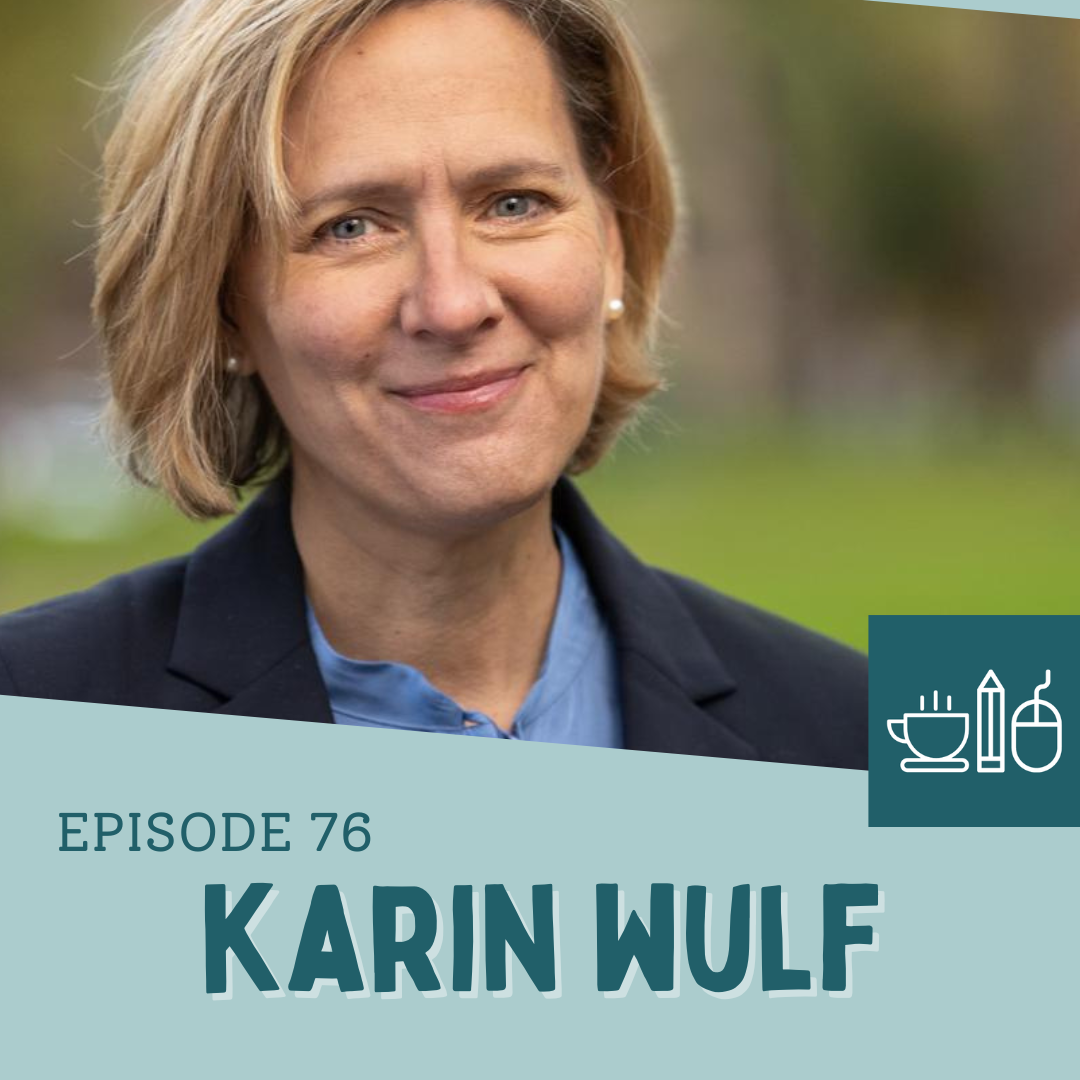
The transcription begins with an advertisement for Aura, a data protection service that removes personal information from broker sites, monitors breaches and the dark web, and offers identity theft insurance, all in one app with a free trial. The main content is a podcast episode where host Kate Carpenter interviews historian Karen Wolfe about her writing career and habits. Wolfe, director of the John Carter Brown Library, shares her lifelong love of words and physical writing, revealing her preference for Pilot Dr. Grip pens with blue ink and early morning writing sessions between 5 and 6 a.m. in her personal study. She describes her organizational methods, which include multiple notebooks for reading notes, writing tasks, and free writing, alongside a "veneer of organization over chaos" in managing sources. Wolfe explains that she begins writing in her head immediately when reading sources and relies heavily on revision, often deleting and rewriting extensively. She also discusses her blog and Instagram account as outlets for sharing "tidbits" and clearing her mind of buzzing ideas. A key theme is her struggle to find time for research and writing while holding demanding administrative roles, which she addresses by writing on weekends and holidays. Finally, she reflects on her book "Lineage," which evolved through several "phantom books" over two decades, transforming from a study of Quaker genealogy into a broader analysis of genealogy as an underappreciated technology of power in British America, driven by her genuine passion for the work.
Most people don't realize how much of their personal information is being bought and sold every day. Data brokers are making millions pulling details about you from public records and the internet, then packaging and selling it, usually without your consent. That's how your information lands in the hands of scammers, spammers, even stalkers. It's why you get endless robocalls and why ads seem to follow you everywhere. That's where Aura comes in. Aura actively removes your data from broker sites and keeps it off. They also instantly alert you if your information shows up in a breach or on the dark web. But Aura goes beyond data protection. With one app, you get a VPN, antivirus, password manager, spam call protection, dark web monitoring, and even up to $5 million in identity theft insurance, all backed by 24/7 US-based fraud support. Other companies might just sell credit monitoring or just a VPN. Aura gives you all of it, together at the same price competitors charge for just one service. Start your free trial today at Aura.com/Hidden. Protect yourself now at AURA.com/Hidden. Okay, fair warning listeners. In today's episode of "Drafking Past," my guest and I geeked out pretty hard for a minute about our favorite pens. I'm hoping a lot of you can relate, but if not, you'll just have to forgive our moment of office supply and nerdiness. I'm Kate Carpenter, the host of this podcast about the craft of writing history. And in this episode, I'm thrilled to be joined by Karen Wolfe. Thank you so much for having me on the huge fan of the show. I love listening to it and it's a real treat to be here with you. Karen is a historian and the current director and librarian of the John Carter Brown Library, as well as a professor at Brown University. Previously, she was the director of the Omaha-Hundra Institute of Early American History and Culture. She writes and speaks regularly for public audiences. Her new book, "Lineage," "Genialogy," and "The Politics of Connection" in British America, 1680-1820, came out this summer. In this episode, you'll hear me talk with Karen about what it was like to research a book whose sources were scattered in many different archives, and how she keeps her research in writing alive, even in the midst of a very busy schedule. She also told me about a little archival challenge that she likes to give herself to wake up her brain sometimes that I think will make you smile. This lets me real. We're all nerds here, at least when it comes to history. Here's my conversation with Dr. Karen Wolfe. I will just have you start by sort of describing the trajectory of your career as a writer to me. I love that question and also one of the reasons I love that question is because I don't think that's a question that a lot of historians get asked. I know you ask it, but I don't think anybody's ever asked me that before, even though I love writing, I love literally physical writing. I'm a complete nerd about wanting exactly the right pen. I have loved the shape of words, the sound of words, putting words together. I can't remember a time in my life when I didn't love how words fit together, either reading somebody, well, actually I prefer like reading somebody else's or putting them together to make them mean something. It's such a powerful act putting words together to try to describe how you're thinking. But if I think about myself as a writer, I would say that it's been a long process to get to thinking that writing was something I love that I couldn't live without, basically, that I would do it no matter what. I was a kid who wrote things, but not lots and lots of things, but once I got to college and got to write papers, I loved writing papers, I loved writing research papers, and I loved the connection of historical evidence to meaning-making through writing. That's a kind of a jumble of when you ask, what's your trajectory as a writer? I would say I have always loved words and I'm so grateful to have a life where I get to spend time putting them together. What has that looked like for you? Currior wise, where have you been putting your words together? So in many ways, I am a kind of standard issue academic historian in the sense that I went to college and thought, I love this reading and writing business and can I keep doing it sure? I could keep doing this if I worked as an academic. I've had several different kinds of academic jobs, but it was always exciting for me to work beyond the classroom as I think it is for many people. The kinds of work we get to do outside the classroom can be really invigorating and exciting. So I've been lucky to have jobs that let me work not just in programming and in supporting the development of the field as a whole and particularly in supporting and learning from early career scholars. I was the director of the Omanjandro Institute at William & Mary for seven, eight years before I came here to the John Carter Brown Library. In that job, I got to think about how does this field of early American history that I feel quite passionate about? How does it develop? What are the infrastructures that support people to do the kind of research and writing that I appreciate? How can I help support and develop those infrastructures? How should they change over time? And how do different components of professional expertise come into play there? Researchers, editors, publishers, producers, librarians, archivists, metadata, folks, platform builders? How do we all have a kind of piece of what ultimately comes out as historical work? And then I came to the John Carter Brown Library as its director and librarian in 2021 and I feel like that's been another kind of dimension to that thinking about infrastructure, research infrastructure and how can I help support and develop it. I feel just tremendously lucky. I'm endlessly curious and my curiosity is endlessly peaked in the jobs that I've had and I can't believe what a luxury that is. Before I go any further, I have to follow upon something you said in your first answer. What is the perfect pen? So I think everyone has a perfect pen and my perfect pen for a long time has been the pilot Dr. Grip. It is a refillable ballpoint. I love a medium ballpoint with blue ink, very fussy about the blue ink and it's kind of a wide pen. I've always loved a kind of a thick pen and it's got this little grippy base on it. Anyway, I probably have 30 of them sprinkled around my various bags and office and at home and so on. I love it. Only recently have I started to write with a slightly fancier pen but I'm too shy to even talk about it. Fair enough. I think a lot of us do have a favorite pen. I buy my favorites by the box also. What is your favorite pen? Certainly. I like the, let's see. You have to pull it from here. I like the Uniball Signo Micro 207. Oh, you must have very good handwriting. You must have very good handwriting because if you work with a kind of a fine point, you have a nice handwriting. My handwriting varies wildly based on how excited I am. The less excited I am, the better my handwriting is. Oh, that's very funny. I get boxes of both black and blue because for me they have different, different purposes. Okay. That is fair. I have, my handwriting is really messy and I feel like the thick ballpoint kind of disguises that a little bit. I can tell you too though that I also am a big fan of a glitter gel pen and I have a whole fistful of glitter pens. Following on that, when and where do you like to do your writing? I am, again, I feel like, well, first of all, I've been in this business for a long time. So I didn't fall into immediate good fortune. It's been a kind of a, well, I did. Let's be fair. I mean, I've had an incredibly fortunate career. But at the moment, just recently when we moved to Providence, I have my own study for the first time. And it's a relatively small space and it is all my own and I feel so virginial about it. It is decorated exactly as I want. I have unbelievable amount of stuff all over the walls. I'm like the barn's gallery of like studies, like tons of like frame stuff. It's just like dense and a billion clashing, William Morris pillows. And anyway, I love it. But I write, so I love writing there and I'm an early morning person. I've always been an early morning person. And one of the always, one of the best hours of my day is between 5 and 6 a.m. when I write in my quiet kind of cluttering study. Aside from the pilot pen, do you have any tools that you like to use to keep yourself organized and to write? Yeah, I have a massive number of different function notebooks. I usually have a bunch going at once. One is my reading notes notebook where I just take endless amounts of notes on what I'm reading or sometimes if I'm going to conference and stuff. And then I have a kind of perpetual calendar where that perpetual diary that I have.
that I keep lists of every writing task that needs to be done and what I'm planning to do on it, literally sometimes on a day we'll say finish paragraph x and I finish paragraph x and I have a notebook full of that is literally titled things to write that I like to jot in and then I have a very large notebook that I sometimes free write ideas in. So yeah, so I love I love actually in a lot of writing, but when I'm serious deep deep into writing, I am all on the laptop. How about organizing sources? What's your approach there? Slightly chaotic. I would so I'm a person who loves the idea of organizational materials. I would love to see the then diagram of people you interview and people who are excited by office supplies because I am betting it would be a pretty tight circle. But even though I love like organizational devices, in part I guess because of the long stage of my career, you know, I am a person who still has notebooks full of things that were photocopied for me at archives decades ago and then of course only in the last 15 years really archive photographs, which I sort of keep organized through TROPEE and I love that idea of like doing metadata organization, but sometimes honestly it's just wait, I know I was at that place, you know, in 2011 and it's just in my undifferentiated photos file. And then I'm like a heavy huge number of quite organized G-Drive folders for projects. This is the kind of project. This is the level of project. These are the due dates, you know, that kind of stuff. So it's a veneer of organization over a lot of chaos. Well, if you add to that bend diagram, the number of people I interview who say that they wish they were more organized. It continues to be awfully close to a perfect circle. Right, it's just like that, you know, you have to have your ambitions, right? How do you see the relationship between the research and writing? Where in the research process do you start writing? I think I'm writing in my head the minute I'm reading a source, but I'm a I'm a as a writer, I would say I'm mostly a reviser. I write a lot and revise a lot a lot. I can write 100 words and revise 110 of them. So, you know, I'm in my head narrating how a source is functioning, what's happening in this source. And then I'm revising and updating that in my head. I once asked another historian like, do you hear it all in your head too? And they were like, what are you talking about? Anyway, it's kind of noisy in my head. What's happening up there is I'm narrating that kind of historical context. So, I think I'm writing it like right from right from the beginning. And then truly, I think partly because of the kind of history that I'm interested in. And always like, I feel like I'm always like chasing not exactly scraps, sometimes scraps, but the small pieces of big puzzles. So, when I've got three pieces of what I know is an enormous picture, but I'm never going to get more than three pieces or maybe I'll get five eventually. I'm already kind of structuring it and thinking about it. And then if you if your question is, do I actually start like putting something down like into text? Pretty quickly actually, pretty quickly. What does revision look like for you? It looks like reading something on screen and then being horrified and deleting it all and then going back and fixing it. It looks like printing it out and moving it around on my desktop. It looks like sometimes having a sentence that I'm so attached to that I can't let go of that I will distort an entire project to keep that sentence. In other words, it looks lots of different ways, but it's active. Very, very. No, I really like that on your website. You have also for years now blogged essentially. You you call them, I think, tidbits and tropes. Is that right? Yeah. For the different sizes. How does that kind of writing interact with your more formal writing? Is it a way to test out ideas or does it have a different role? I think both. I think part of it is that the website is it is it is just like a digital commonplace book for me. You know, and I have these other analog notebooks that I keep that have got bits and scraps of things and folders full of photocopies and sometimes, you know, actual source materials that I that I've gathered together. And one way of expressing that and sharing that is writing it up and putting it on the blog. I love having the blog and it's like a relief almost. Maybe it's that loud noisy stuff that's going out of my head about a source that I want to say something about. I also do stuff on the Instagram. I have an Instagram account called vernacular genealogy where I put the tiniest piece of something a source that I it's just like buzzing around in my head and I just want to get it out of my head. And so I'll put an image of it on the Instagram account and write just a couple of sentences about it. And when it's buzzing too loudly, then that's actually when I've got to go write something a little bit longer and sometimes even a little longer yet. But I often have like pieces that are lurking around that, you know, I haven't had a chance to write up yet on the blog, but they're coming. And, you know, I'm sorry, you asked like how how does the blog writing relate to formal writing? And it definitely does because sometimes the sources that I know we're going to be a piece of a formal project. I've already started writing about them there or I've just started laying something out there or working something out or I just want to share them because I think they're so interesting. Share them with whom I have no idea, but it feels like it's very gratifying to me to be able to write it. You mentioned a lot of our conversation and certainly I've heard this from other people I've talked to that while you work obviously in the academic world, you're not in a research professor role. So you don't have sort of like blocked out time for your research and writing. One of the challenges that you face because of that. Yeah, it's a it's a it is a huge challenge actually. I haven't had a traditional academic leave since I think 2008. Partly this is my own fault. I think I could have some leaves, but I really love my jobs. I really want to do my jobs and I have things I want to accomplish and people I want to work with and projects I want to complete. So I don't want to step away. A less charitable thing to say is that I'm a control freak and I can't like give over the reins that might actually be true, but I haven't wanted to take a leave is the truth. So the reality of that means if I want to write things which I do that means just about every day I you know I'm up writing at five and it means most weekends and holidays. I'm if I'm not doing work for my day job which I'm often doing that too. Then I'm then I'm doing writing and yeah it's just it's just a lot of extra stuff. I don't feel sorry about it because I really really do deeply enjoy it all and find it really rewarding, but it is it is yeah it's working within the interstices. The flip side of that of course is that no one is demanding that you write or that you you publish a book. What keeps you going? Yeah I guess not. I mean it's a weird thing when you you know you have tenure and you get promoted and then you think like well why am I still doing this, but honestly I've never thought that because this is what I wanted to do. This is the real thing I wanted to do. I'm so lucky that like right now at the JCB when my brain is a little exhausted from spreadsheets and HR work or you know kind of managing events or whatever kinds of development work I'm doing you know I can dash upstairs and go into the stacks and 18th century paper yes you know and find something that is exciting and interesting and weird that I want to explain or explore or whatever or I can you know just ask myself okay you know okay this is this is kind of weird. Do you have this? Do people just confess to you? I'm wondering I'm about to confess to you but I'm wondering if this is like a confessional podcast. Sometimes yeah. Sometimes I'm like okay how long will it take me to find you know something from September 30th 1775 okay how long will it take me to get that okay time myself I have 15 minutes before my next meeting can I do it but I'm very lucky that I can do that it's like and my brain stays quite happy and humming along you know I really love the work that's the answer. I was curious and wanted to ask more about something that you said in the acknowledgments for lineage which is that you sort of talked about the idea that there were many versions of this book that you sort of thought you were writing or even maybe not even versions of this book but other books you thought you were writing along the way you call them phantom books which I really liked as a phrase tell me more about how how the book evolved as you were working on it. Yeah so you know I've been working on this book for or I've been working on some book or one of those books for really long time like more than two decades I started thinking about and noticing kind of fragments of what I came to think of as for vernacular genealogy when I was in the archives in Philadelphia looking at 18th century women's writing and seeing them querying their relatives about particular dates of somebody's marriage or birth or whatever and it looked it looked a lot like genealogical research and I just thought like what are these people doing don't they know
the 18th century is the age of the nuclear, it's the nuclear family now. They're not supposed to care about these extended family connections and also it's the age of democracy and meritocracy and like this stuff is old, this lineage stuff is out of date, don't they know? So there was a kind of like way in which my first thought was that I would write about just the sheer plethora of this material, especially among the kind of quaker-mid-Atlantic folks that I was studying at the time. And I thought it would be a book that would sort of swim with some of the scholarship about quaker particularity. And then the next thing that happened was that I began kind of seeing this material elsewhere and in a broader context and began thinking, oh, this is a project really about how genealogy is much more pervasive than we thought. Wow, okay, I thought genealogy was something that happens in the 19th century. Like, whoa, it's all over the place in the 18th century. And then the kind of third iteration I guess was thinking, wait a minute, if I am committed to thinking about what is particular about British America as opposed to Spanish, French, Dutch, Indigenous, African and African-Descended cultures in North America, what's particular to British American genealogy? Oh, well, wait, I can see some strands of that. Maybe that's the book. And then the last thing that happened I think, which is really the book that's here, which was, oh, genealogy is this both infrastructure and technology of power and it flies along under the radar as this kind of domesticated hobby that is not at the time, not at the 18th century, but subsequently, that's how we've thought about it, that's how we've characterized it. And that kind of caricature of genealogy fits very comfortably with how people have tried to describe the 18th century and precisely the ways that I was encountering this material in the first place. So I think there were kind of stages that I came to with this project that required then different kinds of research strategy and different kinds of research material, which kept it quite exciting, quite, and of course, that the, you know, I was along the way reading a lot of different secondary literature. I'm lucky that my jobs have always required me to just read and be conversant with the field broadly, thank goodness. And so it's really informed by, you know, a lot of exciting, both methodologically exciting, but also interpretively exciting work along the way. And anyway, that's how we came to the book that is between covers now. To talk more about the book that did ultimately result from Karen's research, I asked her to read a passage so that we could take a closer look at it. Here's Dr. Wolfe, reading from the start of chapter six of lineage titled Always Mama's Baby. As you'll hear the chapter title comes from Hortenspillars essay, Mama's Baby, Papa's Baby. In the early autumn of 1797, William and Hester Devam welcomed a new baby daughter. Susanna Devam was born on October 2nd near Liberty Town in Frederick County, Maryland. The Devam's lived about 50 miles west of Baltimore and about 20 miles south of the Pennsylvania border. And by the mid 19th century, some of their extended family had moved north of Gettysburg and had become part of the free black community there. One of the first entries in their multi-generational family record that included Susanna's birth, begun in the early 1760s, had marked William as a winter baby. He was born January 2nd, 1762, so became a father in his 30s. The details in the genealogy helped fill out a picture of this young family. Susanna was the younger sister of James, born in the summer of 1794 and Dina, born in the spring of 1796 and the older sister of Lucy. The surviving records illuminate the Devam family's lives and experiences on the knife edge of slavery and freedom. The births of William and his children are embedded within the fragments of a combined family account, begun as a genealogy of those who held the Devams in bondage. On three pages, measuring 9 by 3 1/2 inches, covered on both sides and showing signs of having been pulled out of a roughly stitched notebook, possibly a cash book or a memorandum book. The white family's record begins with the marriage of Richard and Sophia Simpson in 1753. It lists the birth of their 10 Simpson children, beginning with the first in 1794, 1754. The names and birth dates of 16 individuals whom the Simpson enslaved were bound in servitude for a term or for childhood into adulthood the way they held William were listed on a second and third page written now by different hands over several decades. Of these, only the particular family relationships of William recorded as Malodder William and Hester DeVan were made clear. William was born of a white mother and a black father and under the Maryland law that punished such relationships he was bound into servitude until he was an adult, likely until he was 30, which might indicate when he and Hester married and began their family. Hester was enslaved and thus her children were presumed to be enslaved too. These precious family details and likely many more known to the devans and carefully kept through their own shared memories as well as those recorded by the Simpsons in this abbreviated form were also what helped secure William's legal freedom and later the freedom of Hester and their children. One thing I really enjoyed about this introduction is that there is a bit of a subtle bait in switch that you've done here as the writer in that the first paragraph, especially if you've been reading up to the book up to this point you might think that this is a sweet but not particularly notable seeming family story right that maybe is recorded in their family Bible as other chapters might suggest. There's the hint that you know they have relatives who are part of the free black community. But then suddenly in the second paragraph you realize actually that this family history emerges from the margin so to speak of someone else's family history and someone else's accounting and tells you much more about both the beauty of their family structure but also the tragedy that it's happening as part of what went into writing these two paragraphs. I am guessing that for everyone who writes in an expository fashion, introductions are the hardest because they have to both explain and compel at the same time. They can't be too opaque but they can't be too transparent. They need to help you unfold something so I think I must have rewritten those paragraphs. I don't know 100 times easily and also I rearranged what was going to begin this chapter because there are two things happening there. One is that that item, that very that object itself is, was deeply meaningful to me as a researcher. It's something I came across on eBay and at the time I was up very late for me one night like until 10 o'clock which is like might as well be in the middle of the night for me but I saw this on eBay. There's a whole story to be told about eBay research too which is really important to talk about but and I immediately emailed librarians at two different institutions and they both got back to me but the first one was Tom Nolz at the American Antiquarian Society and he said I bought it and so now that's where it is and there is another story to be told to about archival materials from from Frederick County Maryland that have ended up out in the out in the world out in the market but anyway so the the object itself was something that I that was meaningful to me because I knew right away when I saw it on eBay. I knew what it was, I understood it at some level and I knew it would be important but the second piece is that that chapter was really it's a complicated chapter to write. I'm not sure how successful it is. It's probably the most important and maybe to lease straightforward and maybe to lease successful chapter the book because it's trying to explain how in this world of patriarchal thinking and patriarchal structures particularly of law how it is that maternity becomes so powerful and so potent particularly in illegal context and particularly in a perversely cruel context which is heritable maternal slavery. So that that chapter has lots of different kinds of material in it explaining the importance of maternity the kind of the long history of English legal thinking about how it is you attach status to women and to the children of women rather than to men and the progeny of men and some of that doesn't have to do a slavery but of course slavery is the British-American apex expression of that contradiction which is why using her 10 spillers formulation seemed important in the title of the chapter. So using that family story to explain how it is that freedom and slavery absolutely rested not with William and Mary.
himself, but with the women in his family was the way in to what I felt was the important crux of the story of that chapter. I do not want to totally take a stand around a hole, but I'm so glad that you mentioned this because I am so interested in how historians use eBay to find sources. And I feel like having done it myself, I feel like we don't talk about it very much. And yet I think everyone is doing it. I would love to someday oversee a column of historians writing about how they've used eBay finds. Yes, I've had a really great conversation with a wonderful textile historian, Marina Moskovitz, about who was here at Brown last year on a fellowship about thinking about eBay as how we compile sources. And I just have a revision to do on a formal historian journal article, but that's about the bastardie cases and most of which comes from a set of material, what I call the bastardie archive, that I bought over a decade on eBay. And that is as an 18th century historian, it's a very weird thing to say, I bought my archive. Oh, a whole other podcast there. Okay, I would love to do that. Yes, okay, right. I mean, it actually speaks to what else I want to ask you about because in this book, you are telling people stories, but you're also very much telling the stories of documents, how they came to be produced, the materiality of them. You talk about the size of this one and how it was held together. And that requires sort of blending two different types of stories. Was that a challenge as you were writing it? How to do kind of keep those two things together? Yeah, I think in my head, I wanted to tell the story of these two dimensions of how genealogy functions. And I think I expressed that in different ways in the book. Sometimes I talk about genealogy as this very emotional and affective practice, this practice of emotional meaning and connection among family members and sometimes as this very instrumental practice, sometimes of family members also, but very much of the state or other institutions. So sometimes I'm talking about it as like emotion and power, which can be held on kind of both sides of that calculus. But equally, it's about people and the instruments of genealogy and the people are creating them and sometimes they're creating those in the context of emotional meaning making, sometimes they're making them in the context of instrumental power. And sometimes it's so obviously both things at once that you can barely bring it apart, which is why tracing the production of the item always seemed possible where I could do it. So in this particular case, it is not hard to see how the people who are free and the people who are unfree are segregated on the page. And that's true of many other instances of genealogical accounts of white enslavers and enslaved people where the genealogies are nestled together in the same volume. And it's really like striking an emblematic intimacy of violence that is slavery. And sometimes it's a matter of tracing a governmental process of document making, of really data production. So in many ways, I think you've beautifully put your finger on that precise tension that was important to illuminate. People are doing the work, but they're doing the work of creating these instruments and these instruments of different kinds. I mean, as we've kind of touched on already in the case of eBay, this is a history that you can't just identify a few archives that you go to on a couple of trips and you get everything you need for anyone who, listen, you know, has never written a history. Like that's often what historians do, right? We say, okay, I'm working on this topic. These are the key archives. I'm going to go. I'm going to find it out. That is not what you had to do here at all. You are pulling bits and pieces from all sorts of different kinds of archives from eBay, from all kinds of places. How does it come together? I mean, is it just a matter of time to do have an approach? I noticed that I think on your blog, you say, like, ask me about my basement. So I guess this is me asking you about your basement. Oh my God, my basement. Oh, so many, so many printouts, so many printouts and things that were photocopied back in the day or things like, you know, a particular online set of materials would, or a set of materials would come online. Like the Tennessee Bible project was one that came online, I think in like 2010, 2011. And all of a sudden, I was able to sort chronologically and look across thousands of 10 of Bible records from Tennessee and locate the ones that had 18th century records and kind of sort those. And of course, like, I printed them all out so that I could, anyway, so that's a big piece of the kind of stuff in my basement. But yeah, there's genealogy is a fascinating topic because it's everywhere in the archives. Like I say all the time, you cannot unsee it. It's everywhere. It is in every kind of source. It's in legal records. It's in economic records. It's in obviously traditional, like family produced records. It's in the records of, you know, the town, the county, the every institution, you cannot get away from it, which means that looking for it in all these different places became like a responsibility. And I still feel like there are places where I didn't do a good enough job of showing, for example, the genealogical kind of echoes and resonances in, you know, particular kinds of sorts, because it's just it's so everywhere. But I did want to kind of cover as best I could British America. You know, there's a heavy concentration here of some things and too light on others. I wish I'd done more of New York, but it was a matter of going to just lots and lots and lots of places and looking at lots and lots and lots of different kinds of stuff. There were some efficiencies like at one relatively early on point, I realized this point about family bibles that family bibles were actually not the genealogical repository of the 18th century. Like some people put them there, but they're really not because they're, you know, really expensive and they're English and it's not until you get American bibles in the late 18th century that they're the place where people start putting this stuff. And I recognized that something like account books were a place where people were writing their family records. And once I recognized that, then I could go into, you know, an archive, a local historical society or a state historical society or a bigger collection and just look at all the account books and boom, there you go. There's a whole bunch of these. So there were some efficiencies I have to say and sometimes it was just turning a lot of pages. Do you have friends like who would send you things when they came across things in their own research? Oh, yes. Oh, yes. Oh, yes. Oh, yes. Oh, yes. Here. Yes. And my worst failure of acknowledgement is to the great historian of 18th century religion, Doug Winiarski, who early on sent me a gorgeous watercolor image from Newberry, Massachusetts, which is actually in the book. And of people I forgot to think, I forgot to think, Doug. Anyway. It was so badly about that. Like, oh my God, how could I have forgotten? And it was early on in the research too. And he said, oh, Karen, I found this thing. It's amazing looking, you know, and Doug's own like incredibly deep and detailed archival research was, was a, you know, extraordinary. And anyway, that was a real gift to me. But yes, people would say, have you thought about this? Did you see this? Did you see that? Yeah. So I was very, yeah, that was, people were very kind that way. I want to ask actually about the other book that you're working on now because it is related, but a very different kind of project. And that's for listeners who are maybe not familiar. Oxford University Press has what they call the very short introduction series, which are these sort of pocket-sized books on the range of topics where an eminent scholar on the subject sort of writes an overview so that you can, you know, if you're like, man, what do I need to know about genealogy? There it is for you. So you as I've just revealed you were working on one of bad genealogy. And I have always wondered what it's like to work on one of these books because they seem to me like a real challenge in the sense that they're both very capacious in their subject, right? They sort of, you know, everything I need to know on this subject. And yet, as the name of the series suggests, they are very short and you don't have much space. How do you approach a project like that? Yeah, I mean, I remember when I first started teaching survey courses and I would think, okay, I'm going to generalize so much that I'm mostly going to be wrong. Like I'm telling you things that, you know, I could go into so many examples of particulars which would show just something completely different than what I have, what I've stated here. And I think the very short introduction is sometimes an exercise in generalizing to a frustrating degree. And on the other hand, it's such an opportunity as a writer to really synthesize and summarize what you've learned basically. And that's how I approach it anyway. I don't approach it as like, this is the last word on this or this is the, you know, this is the grand statement on it. It's, here's what I have learned to this point. And I have to say that I've learned a lot.
from genealogists. I'm not a genealogist, I'm not a trained genealogist, I work in genealogical sources and I try to recreate some genealogies, although my book is a history of genealogy, it's not about genealogies per se, but I've learned a whole lot working alongside genealogists who've been very generous and that's been super helpful in trying to write a kind of overview of genealogy across time and space. You have to make choices. I would say that the genius of the very short introduction project is that you do have to write a chapter outline with the proposal so that you have to think at the 30,000 foot level right from the beginning. I think as a historian, it's so beguiling to look right down in the weeds, you know, like the worms I view, but in these books you have to start at the 30,000 foot level and then make really careful choices about how far into the weeds you're ever going to go and you know, I thought about it, it was described to me by my fantastic editor Nancy Toff who's now retired from Oxford and another editor has taken on the series, but she said, you know, just think of it as seven long blog posts and I was like, oh, okay, sure, but you know, tightly crafted, careful, but yeah, it's seven like long, yeah, long posts. Well, I wanted to ask a little bit about your writing community because I know both both from the acknowledgments of this book, but also from the number of people I've seen celebrating the release of your book that you have an expansive community of fellow writers and historians and friends who read your work and give you feedback on your writing. What kind of feedback is most helpful for you while you're working? That's so interesting because it's different kinds of feedback, I guess, and there are different kinds of feedback at different moments. I love writing a conference paper and going out and just seeing how people respond to it. I find conferences incredibly generative and also like circulating papers at a seminar and I did that a lot, a lot over the many years I was working on this book and I'm super grateful to people. Sometimes the most useful feedback for me is just having to get to the point where I'm willing to show it to someone and ask for their feedback. That's just jumping that hurdle. I've gotten far enough that it's going here and enough to send it. Then instantly floods in, oh, I know the three things I wish I'd done with this, it's like your self-feedback loop. Also, I think when your career is long as mine is now, you have friends and colleagues who serve different roles for you. I have friends who read this at different stages and different pieces and my super dear friend Julie Hardwick who's great historian of early modern France and gender and sexuality and family. We've been talking about these topics since we were in graduate school together so many decades ago now. Sometimes I can send Julie a half a paragraph because I'm just trying to say something and she will give me an instant read on that whether it's by text or phone or whatever. That's just as helpful as having circulated a chapter draft. I'm also lucky that my spouse is an incredible editor and he is better than anybody I know at adusing that key relationship between evidence and argument, which I'm always like that is the most important thing in historical writing. What's your evidence? What's your argument? What's the relationship between them? Sometimes when you're writing on things where the evidence is just not abundant, you have to explain that relationship. You don't have the luxury of saying I've got 57 quotes that tell me that person X said whatever Y. You've got to explain how your evidence relates to your argument and he's really, really good at picking the holes there and I'm very lucky in that. I just have a group of amazing colleagues and friends who have been reading this for too long. I'm very sorry to them but I'm very grateful to them. What is the most influential writing advice you've ever gotten? I think there's been lots and lots has been really helpful. I love reading people who write about writing. I love talking to people about writing. I like listening to you talk to people about writing. There are many things I've heard over time but I'm going to go back to something that this is so cliché but people talk about their PhD advisor but my PhD advisor, Jack Green, who I just saw again recently, and his 90s and the man has just finished an enormous long chapter of his current book but when I was in graduate school he finished a book that was super influential in early American history, pursuits of happiness. It was a summary really a kind of synthetic argument about British America and he just said to his seminar, well that's what I thought then. He had just finished the book but he was willing to say like that is what I thought then and I'm moving on and I love that because I thought that's right. The book just needs to be the thing that you thought then and you keep moving, you keep developing ideas, you keep having experiences. If you're me and you cannot quit the research you keep finding more stuff and wanting to write about it and explain it and putting it on Instagram but you don't stop evolving just because you've put something between covers or imprint and that I thought was enormously empowering. Absolutely, freeing even, you know, just the- Yes, yes. Who else do you read or what do you watch for inspiration? Are there other writers or sources of media you turn to? Oh gosh. Yes, no, I'm a reader. I'm not, I've literally never been great with visual media. There's a kind of a joke now about like people of my generation like we'll watch video and you know I- but it's totally true for whatever reason I've never been I watched television and I watch movies and things but visual media is not my preference like text. I really love text. I love reading and I am always reading lots of books at once. I just this summer Red Movedic for the first time. It was really a hostile to that book to tell you the truth. I feel like the 18th century has so messed with what we know about the 18th century that I and also the kind of broishness of it. I just was like no, I'm not reading that book but I read it and I've loved it and it was so weird and so indulgent, so wildly indulgent as a novel and I think, you know, I loved thinking about all the byways that you know Melville took to put that book together. It is just like a mad scrapbook of things he thought and words he thought up and metaphors he wanted to express and okay it sounds odd to like compare like reading Movedic with reading Martha Jones's recent memoir about her family, the trouble of color but I love that book. I read it very quickly in just like a day or two. It's a beautifully written book. It's so compelling. Some turns of phrase just kind of grab you. Some scenes she said you feel like you're sitting right there in the car with Dr. Jones and her father. So all of which to say that when I'm reading I'm like feeling that match of words and making meaning out of connecting words together. I'm a super nerdy reader what can I say? Well you have worked on Lini for a long time. It's wonderful that it's out now. I know you're still busy talking about it with people and probably will be for a long time to come. You're also busy with your day job and with other things and the very short introduction book but with that said do you have another another book or another project on the horizon that you're thinking about? Yeah I mean a couple because I like working on multiple things at once. I have a couple of projects. One's a joint project actually with a friend and colleague but I think the research project that I'm probably hoping that I'll finish next is a project that's about Esther Forgs and Johnny Tramein. Another book that I've worked on for a really long time and I you know I thought I had finished the research for it I don't know eight years ago or something like that but I love that project too and it's it's such a fun project because it is again a project of rich production of material. So I'm loving that. Well Dr. Karen well thanks so much for joining me on Dr. In the Past. Thank you for writing and for talking about your writing process with me. Thank you so much for the invitation and for the excellent conversation. Thanks for joining us for this episode of Dr. In the Past. You can visit draftingthepass.com to see show notes with links to all of the books we talked about, a complete transcript and more. While you're there you can sign up for the show newsletter to get updates about new episodes without having to rely on a search engine algorithm. Until next time remember that friends, even nerdy ones, don't let friends write boring history.
Podcast Summary
Key Points:
Data brokers collect and sell personal information without consent, leading to scams, robocalls, and targeted ads; Aura offers a comprehensive solution to remove data, monitor breaches, and provide identity theft protection.
Aura provides multiple services (VPN, antivirus, password manager, spam protection, dark web monitoring, $5M insurance) in one app at a competitive price, with a free trial available at Aura.com/Hidden.
Podcast host Kate Carpenter interviews historian Karen Wolfe about her career as a writer, her love of physical writing tools (favorite pens), and her writing routines.
Wolfe describes her journey from loving words as a child to becoming an academic historian, with roles at the Omohundro Institute and as director of the John Carter Brown Library.
Wolfe discusses her writing process
She explains her "phantom books" concept—how her book "Lineage" evolved over two decades from initial ideas about Quaker genealogy to a broader exploration of genealogy as a pervasive and powerful technology in British America.
Wolfe balances a demanding administrative career with personal writing by fitting it into weekends, holidays, and early mornings, driven by deep passion rather than external demands.
Summary:
The transcription begins with an advertisement for Aura, a data protection service that removes personal information from broker sites, monitors breaches and the dark web, and offers identity theft insurance, all in one app with a free trial. The main content is a podcast episode where host Kate Carpenter interviews historian Karen Wolfe about her writing career and habits. Wolfe, director of the John Carter Brown Library, shares her lifelong love of words and physical writing, revealing her preference for Pilot Dr.
m. in her personal study. She describes her organizational methods, which include multiple notebooks for reading notes, writing tasks, and free writing, alongside a "veneer of organization over chaos" in managing sources.
Wolfe explains that she begins writing in her head immediately when reading sources and relies heavily on revision, often deleting and rewriting extensively. She also discusses her blog and Instagram account as outlets for sharing "tidbits" and clearing her mind of buzzing ideas. A key theme is her struggle to find time for research and writing while holding demanding administrative roles, which she addresses by writing on weekends and holidays.
Finally, she reflects on her book "Lineage," which evolved through several "phantom books" over two decades, transforming from a study of Quaker genealogy into a broader analysis of genealogy as an underappreciated technology of power in British America, driven by her genuine passion for the work.
FAQs
Aura is a data protection service that removes your personal information from broker sites and monitors for breaches and dark web activity. It also includes a VPN, antivirus, password manager, spam call protection, and up to $5 million in identity theft insurance.
Aura actively removes your data from broker sites and keeps it off, preventing your information from being sold without consent. It also alerts you if your information appears in a breach or on the dark web.
Aura provides all its services together at the same price competitors charge for just one service, such as credit monitoring or a VPN alone.
Karen Wolfe is a historian, director and librarian of the John Carter Brown Library, and a professor at Brown University. She previously directed the Omaha-Hundra Institute of Early American History and Culture.
Her book, 'Lineage: Genealogy and the Politics of Connection in British America, 1680-1820,' explores how genealogy functioned as infrastructure and technology of power in British America. It evolved over two decades through multiple conceptual iterations.
Her favorite pen is the Pilot Dr. Grip, a refillable ballpoint with blue ink. She writes early in the morning between 5 and 6 a.m. in her own study, which she recently acquired.
Chat with AI
Loading...
Pro features
Go deeper with this episode
Unlock creator-grade tools that turn any transcript into show notes and subtitle files.
 PodcastTranscript AI