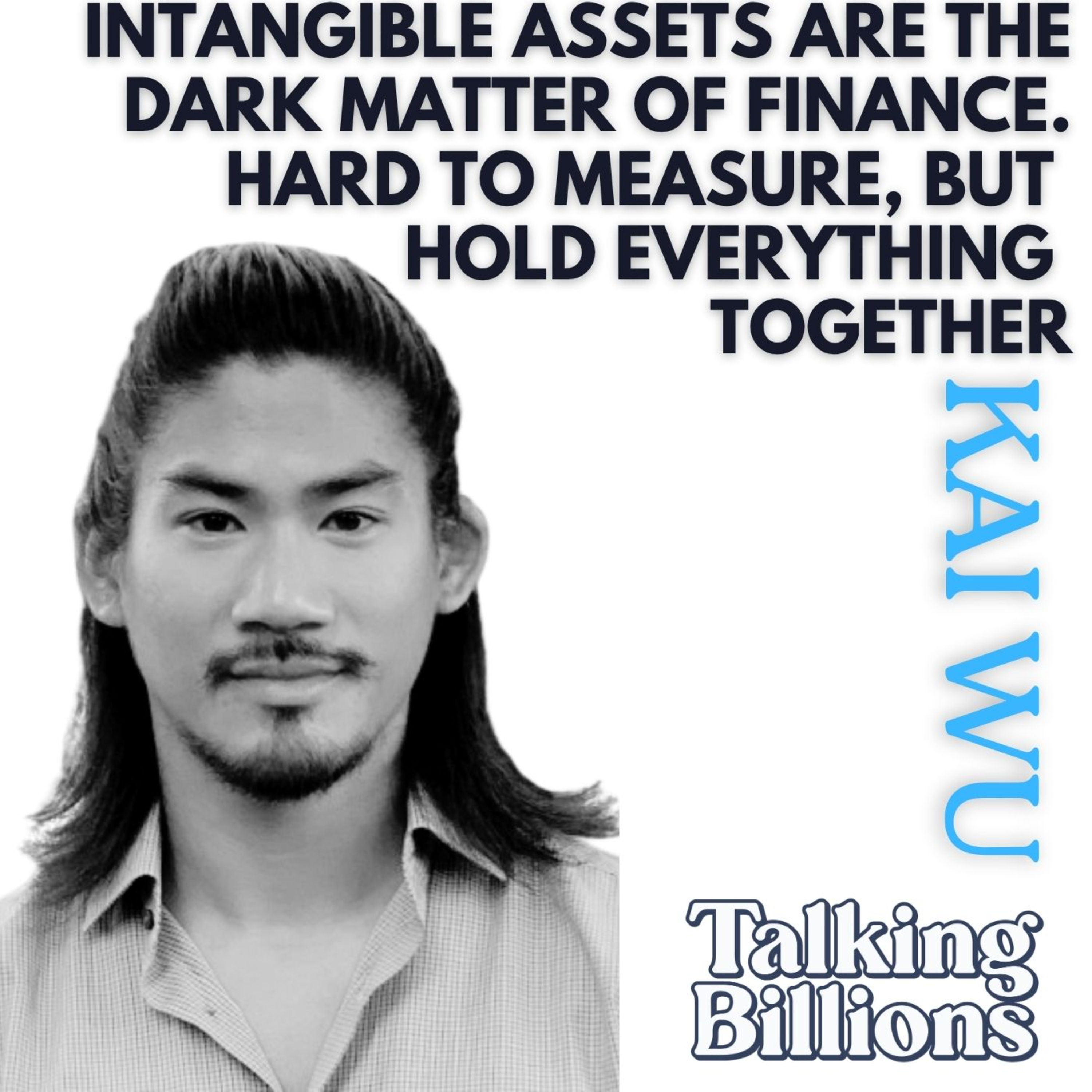
Kai Wu: Intangible Assets: The Dark Matter of Finance — The Invisible Forces Driving Company Value Why the Balance Sheet Misses Most of What Makes a Business Worth Owning
65m 37s
The speaker emphasizes that Warren Buffett's true inspiration lies not in his value investing origins or track record, but in his remarkable adaptability over nearly a century. Despite being known as a value investor, only 8% of Berkshire's purchases were made below price-to-book; the remaining 92% were bought above that metric. Over time, Buffett has increasingly focused on intangible assets—brand, intellectual property, human capital, and network effects—which the speaker calls the "dark matter" of finance because they are hard to measure and absent from traditional balance sheets. The speaker identifies four pillars of intangible assets: intellectual property, brand, human capital, and network effects, each contributing uniquely to business value. He critiques the polarization in investing between value and growth camps, arguing that growth and value are inseparable; a good business at any price can be a bad investment. The speaker's own journey from GMO to founding his firm was driven by a desire to build and research independently, allowing him to explore non-obvious ideas like large language models before they became mainstream. He underscores that balance sheets are incomplete snapshots of the past, failing to capture present or future intangible value, and advocates for a framework that merges growth and value perspectives for more accurate investing.
The reason why Buffett's such an inspiration is not that he has a great track record, that he's one of the original presenters of value investing, which of course is great. But I think to me, what impresses me the most is just his adaptability. He's almost 100 years old now, and he's invested through decades and decades, different market cycles, massive economic transformation. Over that time period, he has evolved. It turns out that only 8% of his investments as the HEMO-Burkshire have been purchased for price-to-book research below one. So you think, "Oh, he's just buying his like deep value stocks, that's not the case." That means 92% of his investments were purchased above Buffett's value. The other thing you see is that the trend is up and to the right. In other words, over time, he's put less and less weight on price-to-book and other traditional Ben Graham's Dialometrics and more and more on intangible assets. I call intangible assets the dark matter of finance. So I think about physics. The universe is held together by this dark matter, but it's a little tricky, a little hard to measure. It's not showing up on traditional balance sheets. That gets this idea of what are the different types of intangible assets. In my framework, I've created these four pillars, which was in AT&T, who on the internet was Google, Amazon, Meta, Netflix, who were able to build their businesses on the internet rails that were massively subsidized due to the over-capacity. That's another interesting lens to think about where value accrues in these revolutions. We're seeing a lot of the hyperscalers, like Google and Amazon, Microsoft, start to spend a lot of money on CapEx building AI data centers. AI data centers are interesting because they are very capital intensive. But the biggest cost is Nvidia GPUs, which if you were to somehow decompose the value, it's really the IP. To me, that's a really valuable asset that I think maybe it's an intangible asset. I guess what did I not say? I did not say money. I did not say the fame, the job title. Those are all very tangible things. You can go in the unfortunate or barrens or whatever. You can see a ranking of how successful people are on one dimension, which is how much money they have or whatever. But that's not what I'm optimizing for. I think that, again, there's no alpha in that. Welcome to Talking Villians. We talk about big ideas, big inspirations, big topics. We take on the hardest topic of all, money. How to make it, save it, keep it. But our conversations lead us to an even bigger question, what it means to live a rich life beyond money. My guests share their practices, principles, and evergreen wisdom. I'm your host, Bogumel Baranowski, author, TEDx speaker, and investment advisor to wealth creators with patient capital and an infinite investment horizon. I work with families and individuals who aspire to grow wealth over lifetime and generations, through disciplined, thoughtful investments in durable quality businesses, while giving money, meaning, join me on this quest to unearth and share the wisdom of the ages. Let me share with you the podcast program, Disclosure Statement. Blue Infinite as Capital LSC is a registered investment advisor and the opinions expressed by the firm's employees and podcast guests on this show are their own and do not reflect the opinions of Blue Infinite as Capital. All the statements and opinions expressed are based upon information considered reliable, although it should not be relied upon as such. Any statements or opinions are subject to change without notice. The information presented is for educational purposes only and does not intend to make an offer or solicitation for the sale or purchase of any specific securities, investments, or investment strategies. Investments involve risk and unless otherwise stated are not guaranteed. An information expressed does not take into account your specific situation or objectives and is not intended as recommendations appropriate for any individual. Listsners are encouraged to seek advice from a qualified tax, legal, or investment advisor to determine whether any information presented may be suitable for their specific situation. Past performance is not indicative of future performance. None of what you're about to hear is investment advice. After 20 years of investing, I've seen countless research tools come and go, but fiscal AI is different and it's become indispensable to my process. Fiscal AI is a modern data terminal built for investors who want institutional grade research without the complexity. Whether you are a retail investor or managing a portfolio professionally, it gives you instant access to 20 years of financials, earnings, transcripts, and an extensive segment and KPI database, all in one intuitive platform. It makes it a game changer, speed, and depth. There are data updates within minutes of earnings reports, not days. Once segment revenue, subscriber growth, it's all there. Easy to chart, compare, and export. I use fiscal AI daily to research my holdings, find new investment ideas, and deepen my analysis. It's fast, intuitive, and has genuinely transformed how I work. Use my link, see episode notes, for two weeks of free trial, plus 15% off. My guest today is Kai Wu. He's the founder and chief investment officer of Sparkline Capital. He's a former GMO and Calediscope capital investor whose research has become some of the most influential modern work on why traditional value investing fails to capture the true worth of companies built on software, brand, intellectual property, talent, and network effects. Kai, how are you? So nice to see you. Doing well, got to be here. Well I have to thank Matt Ziegler for connecting us. You're a nice spoke a few weeks ago, we had a fun conversation, and I was looking forward to this and recording with you and asking you more questions about the kind of work you do. The approach that you have, and it's going to come across in this conversation as I shared with you, I don't know anybody else. That looks at investing the way you do, and I feel like this audience would really benefit from you sharing it with us. Before I ask you about your business and investing, I want to hear more about Kai. You might know that by now, but I'm curious about your childhood upbringing the early days. How do you think that time shaped you? Honestly, my upbringing was pre-boring. My father's a doctor, my mom's an artist, did not grow up on Whip Reddit forums on Wall Street Best, did not grow up reading Value Alliance Wall Street Journal. You don't want to Harvard studies economics, purely liberal arts, and throughout college my goal was always to take as many different courses and as many different disciplines as possible. I studied Chinese, I studied government, did some math, some CS, on computer science. I never took that specialist approach. I took one accounting course, which was Past Fail. My childhood was not shaped by this desire to go into the investment industry. I fell in backwards a little bit, ended up going to GMO, out of college, and that's what set me on this path. We'll come back to that. My group of two doctors in the house, and I walked away thinking that I can be of service. They were of service to people they were helping. In my profession, you and I were managing money. I manage money for families, affluent families, and I'm here to be of service to help. Maybe it wasn't really a numbers preparation, although I think my grandma being an accountant prepared me more, but my parents told me to be of service. I want to ask you about this moment. When you realize you're learning all those things and you want to be in investing, this is the place to deploy all your talents. Was there a moment like that? I wouldn't say it was ever any one moment. Everyone always has Imposter Syndrome and you ask the question, "Oh, is this exactly what would best be deploying talents?" I think over time I've been very lucky to work with folks like Jeremy Grantham and GMO and others from whom I've learned a lot and have had the opportunity to express some of great creativity around research and other ideas. I think you kind of over time develop some positive reinforcement that you are on the right path and that people are appreciating your ideas and the returns are good. As you mentioned, serving your clients in a way that they're really happy about. Over time the momentum has been positive and of course have developed more and more confidence that what I am doing is on the right path and hopefully we can get into this, but 5-10 years from now there will be an impact on the industry that is positive. It's never one moment when you're 25-year-olds all, "Oh, yeah, I want to do this and this is the perfect thing for me." I think that would always be a little bit more digivistic if I were to say that. You mentioned in Postor's Syndrome, I'm thinking of humility and how humbling it is to be an investor. I think it's healthy to know. I'm reminded every day about the things I don't know or I got wrong and I want to be the least wrong. That's my goal. But anyways, I think it happens to all of us.
What was it like to work alongside Jeremy and Grantham? Oh, wow. It was an amazing experience. So basically what happened was I was at Harvard, as I mentioned, and I studied econ. I did my senior thesis on financial crises and bubbles. So I graduated, kind of, into the teeth of the global financial crisis, starting in '08. And you know, walked in the door, GMO, and you know, so Jeremy Grantham was the boss, of course, Ben Inker, I'm going to ran the date today, and then, you know, there might have been, you know, six to 10 investment folks on our team, which was a glass allocation. So I basically walked in the door, and you know, at the time the firm was doing extremely well, right? Because you know, Jeremy had just, and the firm had just correctly predicted basically the financial crises and returns were incredible. So all this money was coming in, and what they needed was, you know, among other things, somebody to kind of help think about how the forecasting capabilities of the firm could be expanded into other markets. And it just so happened that we had offices in Australia, London, San Francisco, and, you know, me being kind of the, you know, least experienced and kind of, you know, wet behind the ears, guy, kind of walked in, they said, hey, he wants to do this. And I was like, well, I'm not doing anything else, let me sign me up, right? So I spent the next year almost traveling around the world, you know, living in Sydney, Australia, London, and then Berkeley, California, working with, you know, these guys who were, you know, experts in their respective fields came back to the mothership in Boston and kind of had these relationships and had some really interesting experiences to bring back to the team. Yeah, and we, the group managed, are in 50, 60 billion dollars across a variety of funds ranging from aggressive, you know, kind of not aggressive, but, you know, leveraged like long short hedge funds all the way down to kind of lower actor share, you know, mutual funds that were more constrained, regards to what they could bet on. And yeah, I mean, I just a ton of experiencing great mentorship, you know, a lot of the folks I sat next to, you know, had, you know, a lot of experience in the industry, PhDs in the other fields as well. And, you know, they were really nice, you know, really open, willing to, you know, train to me and teach me, you know, even as a junior person. Incredible education. I can only imagine I learned that having good mentors in your life really helps and gives you a head start. And I can only imagine what it was like, especially at the time to be in the presence of the characters you describe. I'm thinking of Derek Sivers. He has this idea that, you know, you create your own business to have your own utopia. You eventually decided to co-found a hedge fund and now you have your own firm. Tell me what, what were you looking for? What were you chasing that you were not finding? Yeah, I mean, I think what it comes down to is that I'm a builder. And I mean that in two ways. So one is a traditional tech entrepreneur sense, right? I want to build some new organization or, you know, correct kind of creative culture or something just new from the ground up. So there's that entrepreneur component. But I think in addition to that is, you know, kind of a more intellectual like research driven mindset. You know, for example, when I was at Harvard studying econ, I considered doing a PhD in the topic. One of the challenges, of course, of doing that is when you publish or when you do research, it's really important that what you're focused on kind of fits into the broader literature, the context of what is it that people are interested in at the time and can kind of cite and build off of existing research. And the same goes for larger investment organizations, you know, not just GMO, but anywhere where there's, you know, you're one researcher amongst many. So the advantage of going independent and, you know, kind of running your own boutique firm is that you have independence. Again, not just from a business product standpoint, but also from a research standpoint where you can do research and topics that, you know, might not seem obviously commercial for the next few years that, you know, could potentially be quite interesting. So, for example, like I was doing work on large language models in, you know, 2019. Right. So this is year before Jackie B. T came out, you know, at another organization that might have seemed like kind of a waste of time. Why are you spending all your time on this kind of crazy idea of large language models and what's now AI? Obviously in hindsight, that was the right move and that set me and my firm out in the right direction. But, you know, it wasn't quite obvious at the time that that was, you know, a worthwhile investment. And so I do feel like by being independent, you have the ability to build not just an organization, but also you have the ability to build from an intellectual standpoint in directions that, you know, may be different from what, you know, the prevailing wisdom at the time, what's a just. I think it's an incredible experience to build your own investment practice and to have full control over how you express yourself in the world this way so I can really relate to that. And I think that's what you capture it here and with the business that you have now and we'll talk more about it. There was a moment that you realize that the balance sheet is an incomplete map of what the business is actually worth. And I really want to emphasize that and I'm curious about your thoughts. I've had guests on the show who remind me that what we see in financial statements is the past. If we might not capture the present really and even the future, talk to me about that. Why the balance sheet doesn't tell us the whole truth? Yeah, I mean, look like it's exactly what you said, the balance sheet is to record a snapshot in time. What is it that a company owns, right? What kind of factories, what real estate, how much cash is on the balance sheet? And you know, that works for some sort of companies, right? So investment companies, perhaps banks maybe, but for an increasing share, I'd say, you know, at this point, the majority of companies say technology, healthcare, consumer businesses, you know, brands, things like that. That is only a very small share of what actually constitutes value and hence, you know, the focus on intangible assets, which I think are increasingly important. Well, dive in into that in a second. You call yourself a black sheep because in value circles, you're too growth oriented in the growth circles, you're too value sensitive. I call myself a people corner me. I'm a value buyer, but a growth holder. I want to get a deal, but I'm willing to sit on an investment for a long time, longer than most. Talk to me about that. Why are you a black sheep in value circles? Well, yeah. So I come from kind of your Boston value, you know, tribe, which of which it's not just GMO, it's BALPost, you know, a lot of other folks, very famous. You know, I think, let's step back for a second. I think that the challenge with our industry has become, you know, it's become more institutionalized, it's become more polarized. Like in the same way as, you know, Democrats, Republicans, and government, you have these like factions of investors for whom, you know, you kind of are in the cool crowd if you, you know, say the same things. Oh, yeah, I like to buy boring businesses, you know, there's a premium because of like, you know, the, the unsexyness of the stuff I do, right? And then, conversely, it's, it's on the growth camp, you have, you know, the venture funds now are there, you know, folks for whom it's like, all right, well, this technology is going to change the world. I'm just going to kind of buy this at any price, right? Like, you know, I don't care. I only care about what the total addressable market is. You know, but, but obviously both sides are all kind of missing something, right? Like, you know, just because a business is good at some price, it could actually be a bad investment. So the idea is, you know, how do we kind of unite these two groups, right? How do you kind of find a middle ground that merges the best features of both? And I know we'll talk about this because we've talked about it before with Warren Buffett. I do feel like he's talked a lot about this too, that growth and value are joined as the hip. It makes no sense to evaluate an investment irrespective of its growth from a value lens and vice versa. And so yeah, a lot of what I'm trying to do with this intangible value framework is, provide a language and a way for value investors to say, you know what? I actually think that in video is a cheap stock, right? Or for growth investors to come into, you know, what's more the traditional value of space and, you know, find compelling investments there. I was kind of merging these two ideas in a way that I think is more healthy for financial markets. 100%. You know, I wrote a piece and I say on my sub stack that I called expensive truth about cheap stocks. And I explained that I see in myself and many fellow value investors this journey in our lifetime where we go from looking for the cheap and the cheapest and then realizing this is actually an expensive way to get there. And I think there's a bit of a catch because the value and price equation and would attract us to investing allowed us to save some money. The frugality is not what's going to make us really, really successful, but we'll come back to it and we'll talk more about Buffett just a thought expensive truth cheap stocks. Intangible assets, intangible value, they're four pillars that you write about. And intellectual property, brand, human capital, network effects for the benefit of this audience. Walk us through it. What is it? You know, intangible means we can't see it, but we kind of feel it. Yeah, absolutely. So I call intangible assets the dark matter of finance. So think about like physics, right? Like the universe is held together by this dark matter, but it's a little tricky, a little hard to measure. It's not showing up on traditional balance.
sheets. So that kind of gets this idea of what are the different types of intangible assets. In my framework, I've kind of created these four pillars which are just mentioned. Each is very different. And that's kind of one of the key features here that, you know, it's a heterogeneous set of things that can, you know, each of which is individually helpful to a business and obviously together can can compound. So for example, like intellectual property, and the best way to think about this would be, you know, a healthcare company. If you're like a pharmaceutical company, you know, how is it that you're able to generate, you know, profits? Well, you have a patent, right? You have IP around a specific drug which you may have spent a long time in a lot of money investing and building. And now you have the patent so you can kind of charge, you know, and charge money and earn profits on the, on the brand equity side, the best example might be like Coca-Cola. Now, the company spent over $100 billion in its lifetime investing in marketing and branding, right? And super well ads, things like that. Yet if you go to go to its balance sheet, basically nothing, right? So, you know, that's a great example of a company whose, you know, profitability is driven by the strength of its brand equity on human capital. It's really any services of business, but, you know, you could think of a, of a Goldman Sachs and finance or really any industry firms that, you know, are really focused on acquiring top talent. And I would add, it's not just the raw, how the raw skill, the, the workforce is also the culture, right? Then creating a system whereby the individuals in it are kind of able to kind of grow in the same direction and create value greater than the sum of its parts. And then the fourth one, I guess, is the most interesting, perhaps the most, what, at least under, I guess, is network effects. I guess that is becoming more well understood now, but the classic examples would be a social network like Facebook or Uber, you know, socket changes like New York socket exchange ice, which well in this category, even traditional telecoms, like AT&T have network effects. So, anything where it's like the, the, the value of the network is a nonlinear function, an increasing function of the number of nodes on the network has network effects. So, for example, like if you have a Facebook social network and there's only one account, that's not very interesting. At 10 accounts, that gets, that gets better at a hundred at a thousand at a billion. Suddenly, like, it has this lock in where it's very difficult for competing social networks to kind of attempt to, to encroach on the territory. The overarching, you know, truth here is that when you see a business that's making money, has good margins, good returns, it has something special, right? And then everybody else sees it. Obviously, you and I get excited as investors, but always think of the competitors or somebody that would enter the market. They also see it. So, the question they ask is, if I had unlimited capital or decent capital, can I replicate what they do? And the factors that you mentioned make it really, really hard for somebody else to go in and say, "I'm as good as Coca-Cola, I'm as good as Facebook, I'm as good as Amazon, and anybody else that we're going to talk about today." Kai, we're living in an investment world that's really anchored to old metrics. They were designed to evaluate factories and railroads. I mean, in a literal way, you know, Buffett bought textile mills and railroads. And we're trying to take the same measuring stick and look at the world that's intangible, invisible, yet very real. What could we be missing and how do we approach it with, you know, maybe different set of metrics? Yeah. So, you're talking about the challenge of quantifying intangible value, right? This dark matter of finance. Now, look, when I first set out to do this, the natural thing I did was I said, look, there's a few things in the income statements that could potentially be useful for creating a balance sheet item around intangibles. And those things have to do with R&D expenditures and sales and marketing expenditures. So, in theory, what one could do is say, "I'm going to capitalize," which means you take all the trailing R&D and you kind of create a balance sheet item with some assumed depreciation and marginalization schedule for each company's historical expenditures, right? I gave you the example of Coca-Cola with $100 billion. So, how much is what's the half-life of each of those investments and how effective are they so and so forth? And you can do that. And what it does is it gives you a balance sheet that now is treating intangible expenditures in a consistent manner as physical cap-ex, physical capital expenditures, which are already done this way, right? And that is helpful. It is a useful, um, directionally correct thing to do. But what I found was that it didn't really solve the problem. And the problem can be done in many ways, um, you know, trying to correct for, um, you know, uh, what I believe to be biases in traditional value strategies, um, just the performance of the value factor got less bad recently, but, you know, not, you know, not flipping the sign in a good way. Um, so, you know, that led me to say, or, well, why would this not be working? And there was a few out few reasons. I think the most important one is just that, okay, great. You spend $100 billion on doing something doesn't necessarily mean that that has a positive ROI, right? There are plenty of examples where companies have super bowl ads and they are, they lead the scandals and actually destroy brand value, um, same with R&D. I mean, companies can spend billions of dollars trying to develop a drug that flops. Um, and so it's a lot, just for the first principles, what you want to do instead is to focus less on this is what you're saying, kind of the past, right? The historical cost basis of, um, of R&D and, and marketing. And said, ask the question, I'll round what is the actual asset that has been created? Right? So let's just cut to the chase. If we think that IP at what one one instantiation of IP is, uh, is patents, let's just look at the patents. Let's look at the trademarks. Let's look at the, you know, profiles on LinkedIn of all the folks who work at company X, you know, if we can get a sense of, you know, think about like baseball cards or something like what, you know, how, how much talent each of these individuals brings to the table and then kind of add up and, and then collaborate to the corporate level, that could be interesting, right? And so trying to go to, I guess, what's called all the terms of data, um, so things that are not traditional cunning information, um, is a pretty interesting idea, you know, in addition because it's by definition a newer source of information, right? So there are, you know, hundreds of billions of dollars and lots of smart people who spend their time looking through accounting statements oftentimes with computers, um, whereas the alternative data stuff is just by definition newer, right? Love it's digitized information, um, which wasn't really easily accessible until more recently. Um, and especially another important component of this is that a lot of the information I just mentioned is, is unstructured, right? So it's oftentimes found in text. Okay, great. You have a patent, but you can't just take that and put it into a linear regression. You need to actually read those things and understand the content of, of the abstract and then all the different claims. Um, in order to do that, you need a new toolkit and that's where, you know, I mentioned large language models and, and what's now called AI comes into play, right? So kind of the, the, the lucky thing for me was I was starting Swarkline at the, at this time when, when natural language processing, which became AI, was just taking off, right? We had the advent of embeddings and now language models, which kind of gave this provided this tool to allow us to unlock a lot of the value that was, you know, traditionally not really accessible for quantitative investors, at least, right? For a discretionary investor, if you're a Warren Buffett, yeah, you can read it 10k, you can, you can go through the patents if you want to. Um, but, you know, for a quant, that's never really been accessible until more recently. So, you know, I think there's an element also of timing around here. As I'm listening to you, I'm thinking about something that's been on my mind for a while and I ask a few people about it and I can't get to the bottom of it, but a very basic way of looking at it is, I see almost two economies that we have now. One, that's kind of underground, very real. You have to hire tens of thousands of employees. Maybe you have to talk to unions, you have to get all kinds of licensing and permits and collect sales tax. If you're moving products around, you have to think about tariffs and conflicts going on and trading routes being disrupted, you know, political and and many, many layers. And then you have an intangible business. And here is an extreme, but I see a lot of startups even providing services to our industry. And it's a couple of kids at home that launch a product every week. Somebody emails me if you want to try something new. And as I'm talking to them, they're changing the interface. That's how quickly this thing is changing. But they can roll it out and make it available in a hundred countries. No tariffs, two guys, no employment issues, labor issues. They can really sit in places that they have no physical presence on and on and on. When I think about it, I see kind of this division divergence of two different economies right in front of me. Am I missing something? I think what you just write is accurate. I mean, I think another way of framing it would be to go back even further like a hundred years ago when, you know, Ben Graham wrote security analysis. You open that book and the principles make it a sense. Yeah, you know, find cheap companies. But the examples are all, as you imagine, railroad steel mills, like industrial businesses. And that's what the economy truly looked like back then. But over time, what's happened is that we've seen the rise of this intangible economy, you know, kind of in parallel in many cases. And it depends on how you want to measure it. But, you know, one could easily argue that over half, if not, you know, 80 plus percent of, you know, the largest kind of the companies represented by the S&P of hundreds, so the kind of large public companies in the US are now in the second category. So what's interesting, though, is you're also seeing this
conversions. And it's not like it's just started the past few years, but we are seeing in conversions between these two things. Right. So for example, like we're seeing a lot of the hyperscalers like Google and Amazon, Microsoft start to spend a lot of money on CapEx building AI data centers. But you know, the biggest cost is Nvidia GPUs, which, you know, of which the value, if you were to somehow decompose the value, it's really the IP, right? Like, you know, it's not just you can throw money at the problem. The reason these are effective is because Nvidia spent a long time and a lot of thought figuring out how to optimize the, you can kind of create these things. So it's in a way, it's like a physical product that, you know, can be tear for a semiconductor's can be tear. But for whom like the vast majority of that value is actually intangible to the IP embedded in those chips, right? I phone or similar to like they're oftentimes created in China or Taiwan or whatever and shipped ships here, the different pieces are very complex, double chip supply chain. But again, like, you know, apples, you know, made a deliberate decision to say we're going to be capital light. We're going to focus on the design and the IP. We're going to outsource the manufacturing, right? And that's also what Nvidia does with the SMC to other countries. So yes, like there is some separation, but they also kind of combine, combine back. I think also with AI, we're going to see things go the opposite way too. So I just described, you know, tech companies that are kind of becoming more asset heavy. You're also seeing the opposite, which is like industrial businesses that are using more and more tech, right? So like, you know, they're think of like the oldest school, you know, industrial business. They're just like, you know, doing what you describe way we're just going to kind of do things the old school way. But more and more, you know, you see industrial automation, you see robotics, you see, you know, inventory management that uses, you know, very, very detailed databases and sensors everywhere, right? So we're seeing kind of this conversions. I think go both ways. You know, but I do think we can go back to the point where, which is where does value accrue with what is commoditized, which is not. And I still think your point stands that, you know, just being able to throw money at a problem isn't really going to create a mode. That's not like what leads to incremental kind of return on domestic capital and excess of, you know, what is the cost of capital, what a lot of companies earn that incremental bit is going to be modes around intangible assets like like brand, rip or network effects. It's a question of how you use the resources that you have, including the capital and just the size of it is not enough, which is fascinating because I think it gives a chance to smaller players and maybe new entrants in a lot of industries we came and think of. But any disruptive force and we'll talk more about AI in a second creates opportunities where we didn't expect them and challenges where we didn't see them. Your research reframes Buffett not as a classic book value investor, but as someone who systematically gravitated towards intangible modes. We're actually honest. People that study Buffett follow Buffett, I think sometimes misunderstand how Buffett actually became who he is today, not how he started, but especially the later path. Can you talk about your research and how you reframe it? Yeah, I mean, look, I think to me, the reason why Buffett's such an inspiration is not, you know, that he is, has a great track record that he's, you know, one of the original presenters of value investing, which of course is great. But I think to me, what impresses at me the most is just his adaptability, right? He's almost 100 years old now and he's invested through decades and decades, different market cycles, you know, massive economic transformation. And over that time period, he has evolved, right? You know, when, and that's just so interesting, he was a direct disciple of Ben Graham, right? Ben Graham was actually his actual mentor. And as you mentioned, when he bought Berkshire Hathaway, Berkshire Hathaway was literally just a textile mill, a struggling New England textile mill. But if you look at kind of how he is writing and his philosophy is evolved since then, it would be unrecognizable. And people often still think of him as kind of this old school guy, partially its PR, right? The way he likes to present himself was the Oracle Omaha. But if you actually look at his investments, which I did, it turns out that, you know, first of all, it's not what you think. And second, it's changed a lot. So, you know, one metric people like to look at is the price of book ratio and investment, you know, that how much does this cost relative to the book value on his balance sheet, book value being, of course, a proxy for tangible value, but doesn't capture any tangible. Now, it turns out that only 8% of his investments as the, as the, at the Hemel Berkshire have been purchased for price to book ratio is below one, right? So you think, oh, he's just buying his like deep value stocks. That's not the case. That means 92% right of his investments more purchased above above value. And, you know, the other thing you see is that the, that the trend is up into the right. In other words, over time, he's put less and less weight on price to book and other kind of traditional Ben Graham style metrics and more and more on, on intangible assets. Now, I think the best way to talk about his evolution is through the, the, these like three arrows. So, error one is the industrial error when he, when he, of course, you know, bought Berkshire. But, you know, error two is what is what, you know, I call a consumer error. It's when he made his iconic investment in Coca-Cola, which I already mentioned, right? And that was with the help of Charlie Munger, who became his business partner. He was like, wait a second, this company, Coca-Cola actually has great intangible assets in the, in the form of brand equity primarily, but also management. He was, he was really impressed by the management over a Coke. And when he bought the stock, it had a price to book ratio over four, right, which implies that 75% plus of its value was not its, its book value. And of course, that went on to be a great investment and kind of defined the second epic of, of his helmet Berkshire. And then, you know, after famously avoiding text talks for a long time, he then, you know, in the third stage bought Apple. And that became at one point, you know, a significant percentage, maybe around half of his public equity investments. And of course, explained, you know, you know, all his returns basically, you know, a 40 public equity book over that over the subsequent 10 plus years. And why did he buy Apple? Well, it was not just the IP around technology, but he talked about this also the network effects around the Apple iOS ecosystem or the App Store. You know, once you have, once you're in the Apple ecosystem, it's easier for them to upsell your AirPods and things like this. So yeah, you look at his evolution and not just anecdotal, you can look at the actual metrics around it, like either using like regression, rolling regressions or looking at the kind of industry composition and things like that. And it's just this trend where he has always been a value investor. He always will be. Right. I'm not saying that he became a growth investor. This is that he started to be more thoughtful in terms of what other what other modes could be potentially added to his castle, right? Not not just, you know, looking forward to cheapest stocks, but also finding, you know, companies of strong brands and human capital intellectual property, then finally network effects. You know, Chris Mayer, the author of 100 Vaggers, brought this idea home for me. You know, he said that we're talking about buying dollar bills for 50 cents. He says, why not pay a dollar for a hundred dollar bill? And or even dollar 50, right? Or even two dollars. And I think it completely reframe for me. I mean, it's been happening for a while. But when he put it this way, I felt like I have the language to explain what I've been trying to capture for so long, just even looking at my clients' accounts, like there is a handful of companies that made the biggest contribution. There were obviously poor investments too that come, you know, surprised me and didn't work out. They had that happens. But the ones that really pulled the weight, I held them for a long period of time and they were not 50 cent dollars. They're a hundred dollar, well, 20 dollar bills for a dollar or 50 dollar bills for a dollar. And I think once you start seeing the world this way, you will really see how buff and made the billions, hundreds of billions. Yeah, he talks about this with regards to the cigar butts, right? Like he says, back in the day, I'm paraphrasing, obviously, back in the day, you know, the strategy was buy these cigar butts, you know, find them on the ground, 50 cent dollars, take one last puff and good. Now, the problem with the strategy was twofold. One was that, you know, you're only as good as your last trade. You can get that one puff, but then you're going to go find the next cigar butt. And that's really hard to do. And that ties into the second challenge, which is doesn't scale, right? You're talking about stocks and you can hold for a hundred years, actually, just keep compounding Coca-Cola Apple. That doesn't work for, you know, these turnaround value stocks and doesn't scale as well, right? So it's a little challenge. It's one thing to be actively trading and turning your portfolio over when you're, you know, running a small partnership like he like Buffett did in the first part of his career. But when you're running, you know, a trillion dollar company can't really do that. And so there's also an element of his style evolving, you know, purely by necessity as he, you know, kind of graduated into the big leagues. You know, he on a head to think more about what are the kind of long term, again, modes that they gave these companies the ability to compound over longer at a time as opposed to finding stocks that were just, you know, cheap at the moment, but, you know, that weren't truly high quality sustainable businesses. So two things to add one scale. And the other one that people don't talk about enough, which is the reinvestment risk, right? So you found one puff and you have this big gain whether it was acquired or you know, the market recognized its value. And here you're sitting halfway through the year. What are you going to do with the money? And you might not find another puff for six months, right? And your rate of return, if that's how you're looking at it, it's going to start to dwindle. So the reinvestment risk, I basically, the ability to put the money again to work is a very real risk that people don't talk about, but, but, but, realized it at some point. Kai, you're bullish on AI as technology, as many of us are, but your cost is on AI as investment. And I can't disagree with you. I actually agree with how you think about it, but tell us what you're going to do.
why you think about it this way. We're super excited. We see how it's a ripple through our lives and businesses and everything. And we kind of want to participate, but we don't want to get burned at the same time. - Yeah, I think the desire to participate while not getting burned, that's in a way kind of the perfect use case for this framework. We talked about the combination of value and growth, you know, styles into one, right? So how do we approach what is obviously a growth era? This transformative technology, but to do so with some price discipline, right? Where we're not going to do what we know we're not supposed to do is to yellow in at the top, right? And the challenge is that if you go back to basically every historical episode when there's been a technological revolution, whether it's like the dot-com boom in the late 90s or early 2000s, or the railroads 100 years earlier, you know, in all these cases, you find the same pattern, which is, you know, a massive build out in the infrastructure and stock prices, you know, soar as a result. And then there's a period where people realize, wait a second, I think we may have overdone it. And there's a crash. And, you know, those of those investors that were kind of overlead or into overvalued stocks ended up, you know, taking a big hit, right? So I think, you know, history does cause, does, does, does, does suggest caution. And if you look at where we are today, you see a lot of the same dynamics. So what I just described is what's called the capital cycle. This idea that, you know, firms will invest in fixed assets, the infrastructure to build out new technologies, whether that is the fiber optic cables in the dot-com boom in the internet or the rails in the railroad revolution. The problem is that there's this kind of game theory that happens where, you know, each firm individually says, hey, it's rational for me to try to capture this market. So I'm going to do it. But if everyone does it, then there's this kind of overbuilding situation. And that happened in the dot-com boom, where, you know, as we know, you know, all this fiber optic cable was laid. And then, you know, when demand ended up being not as, not enough to satisfy supply, the price is collapsed, right? So 85% of fiber was dark. And, you know, the price of bandwidth went down around the same amount, which was really bad for the fiber optic for the telecom companies, most of which when bankrupt, some of which like AT&Ds arrived, but, you know, obviously, were, you know, took a big write-off as a result. What was a good for was not the, what was actually the users of the technology. So who won the internet? Right, it wasn't AT&T. Who won the internet was, you know, Google, Amazon, Meta, right, Netflix, right, who were able to build their businesses on the internet rails that were massively subsidized due to the overcapacity. So that's another interesting lens to think about where value arose in these revolutions. Well, the speaking, you can say there's two categories of folks. There's the infrastructure of builders, the telecoms, and then the users or earlier adopters of technology, the internet native companies, you know, firms like, in the railroad boom that didn't build the rail, but, you know, most of those companies went bankrupt, but they were using it to ship goods back and forth and realized efficiencies and able to expand their market share relative to competitors. Right, so you think about where we are today in the AI cycle. Right, we've seen a big boom in terms of the CAPEX, right, companies, the big hybrid scales are spending, you know, almost a trillion dollars a year, and all these construction sites are planned, and you've already seen it priced into all the stocks, not just tech stocks, but also, you know, even utilities at this point. So that's happening. So then the question becomes, you know, what's the next phase of the trade, right? Where do things go from here? And I think history, again, is an interesting guide, you know, to the Netflix meta point. This, the thing about, you know, where we're just one, ultimately one, a position, and the answer of course being it depends on where you are in the cycle, but, you know, from where I sit today in 2026, it does feel like that first piece is starting to get ready played out. - To me, it's this, as I'm listening to you, a big question, you know, there will be the ones that provide a lot of value, and the ones that will capture the value. And just as an example, I think of airlines a lot, people say, I mean, Buffett Chokin, we said that the best thing for capitalism would be to, to shut them down before they took off. Now, it's funny, but it's not true, because airlines provided a huge value to families that were able to see each other, friends that could connect, even marriage, just that happened because people could fly and see each other. And business deals happen because of airlines being able to fly somewhere, meet people and connect and seal the deals. If we were still traveling by, you know, steamships and very slow travel, we wouldn't be able to fly coast to coast and close the deal, come back for dinner. So, airlines have provided a lot of value, but have failed to capture it successfully, especially since the deregulation, a couple of decades ago. But I'll leave it at that. I really like the point. - Yeah, no, I think you make two, I think airlines are a great example of two things. First is what you just said, that, you know, it's a technology that was invented, that changed the world and created a ton of value for people, but that the builders of that technology didn't actually capture the value. The second thing I think is interesting too, right? Because Buffett did say that, and then later, he went out and bought all the airlines in a ways, right? And, you know, why was that? Well, part of it's just value, but also it's that consolidation story, right? You know, you mentioned deregulation, there's too many airlines, so therefore they can be promised to zero, but then as there's consolidation, that could potentially create a market structure where now it's a bit more sustainable. So that's another question here too, which is, where will value your crew depends a lot on market structure, right? If you have all the hyperscalers, if, as you said, anyone can start building data centers, because, you know, it's just how much money you have is the only constraint. So, Oracle's a great example. They kind of all more legacy enterprise software company, they said, you know, I want to piece of this action. I want to get in the game. And so they started, you know, investing very heavily and taking over deals that say Microsoft didn't want. So now there's a new player in the game, it's not just a traditional three. You have the, these guys, Nebius and CoreWeef, they were doing the crypto mining. Now they're starting to do this, right? So what's become interesting is that anyone apparently can start a, a, a, a, a, a, a, a, a, a, a, a, cloud or a, you know, an AI data center company, all you just need is enough company, enough money, right? Which I think is, is not a, not a market structure that necessarily crews value. Now there are plenty of areas that, you know, are potentially more differentiated. But, you know, where, where most of the money is going is, you know, may or may not be that. - So true, a lot to explore. Kai, I want to ask you, you know, bringing it closer to home. You and I are in finance. We've been researching stocks for decades. And AI is definitely changing how things are done. And you talk about AI financial analysts, how it excels in what the junior analyst used to do, but it lacks senior judgment. I have a couple of thoughts here. One, I, I need probably you have worked, you know, by hand, taking things from the financial statements, putting them in a spreadsheet. I actually know where things are, where they belong. And I also know when they look wrong. We have a whole generation that will skip that step. You can have a solo operator like me, who doesn't need 20 analysts. I have the tools that replace 20 analysts. But I'm thinking, you know, 10, 20 years from now, there won't be former 20-year-olds entering the profession either. I have so many thoughts about it, but how do you think about it? AI disrupting this industry. In terms of like the labor force? Well, what's needed? What AI can do? What we still have to do? And like, if we can project 10, 20 years from now, you know, AI will take away some of the roles and maybe allow us to migrate to a higher value added in the chain. That's my imagination. Yeah. Well, I can answer the today question first, and then the tomorrow one next. So in terms of where we are now, I do stand by the, that piece I wrote a couple years ago at AI financial analysts. I think whenever a new technology comes around, like it disrupts in the bottoms up, right? That's just the classic disruptive innovation idea. So what are the low-hing fruit? Are kind of the most wrote tasks, like entering numbers into spreadsheets that, you know, you would normally have an analyst do, but now you don't need to do that. And those are areas where it's pretty low risk. Like, the AI is going to do it just fine, if not better. Well, most likely better than, you know, a tired analyst who's sitting there all night typing numbers in, right? This is the lower transcription error. You know, then you go up to the opposite extreme and say, all right, well, like, I'm just going to basically try to clone like George Soros or Druckermiller or something, right? These hedgehog managers that, you know, are very kind of instinctive, instinctual, right? Oh, yeah, I'm just going to read all their stuff and like tell AI, hey, read all the writings of Soros and then just like, use, do his style. That doesn't really work that well. You know, I tried it. It doesn't really work. And it's obvious why it wouldn't work, right? Because there's a lot more kind of judgment and reasoning required to do that. And it's a much more open-ended, not as close-ended problem. So I think where we are today, if I were, you know, giving advice, I guess, of, you know, how should one think about deploying AI into one's practice in a way that's complementary? It would be, yeah, you know, start with those, start with the things that AI is good at, humans are not good at, or areas that are kind of lower risk, I guess. I'm that are more routine, more wrote, and then kind of move you way up the chain over time. I'll give you a good example. Back, whenever I wrote that piece a few years ago, I did not think that AI coding, so I'm a quant, right? So I do a lot of coding and my analysis is like back testing and trying to understand how it's been factored with a performed intern time periods. I didn't think,
that these AI coding tools are ready for prime time. I wouldn't have trusted them. But starting late last year, we had Cloud Coding and Codex made some improvements such that now I'm using it in a way that I normally would have used a analyst. So I've employed analysts at various points in my career. And some of you would say, as you say, hey, so and so, I'd love if you would study how, say, this factor would perform in this period. And like, here's some code. Just got you started. And here are the databases that I want you to access. Like, don't use this one, but use this one. All right, that's something you can now give to an agent. And it'll write the script. It'll produce the report you want. It'll make sure it runs obviously. And then you can kind of ask the questions. OK, that's great. But can you please focus on the example of Netflix? I'm really interested in that as a potential way of spot checking the intuition behind this. So I think that's now in play. And I'd say that at this point, the line's kind of moving up. So will we get to the point where it goes all the way? It's hard to say. I don't know. But at least you can kind of see, even over the past two or three years, the progress, which has been, you know, impressive. But yeah, so your second question was around, like, where does this all end up? Like, what happens to jobs? I mean, again, it depends on the-- look, I think it's a certainty that in 10, 20 years, our jobs will look different. I've talked about the idea of a job being a bundle of tasks. Each of us, as a, you know, respect to roles, has like, say, 10, 20 things we do on a day-to-day basis. And some of those things are easily done or better done by LMS and other things, less so. Right? So I think over time what happens to the mix of our-- this bundle changes, right? Such that the stuff that LMS do better, either we just outsource LMS, right? Like, we're no longer doing like log tables, like my hand. And then the things that were better at, say, talking to clients or doing kind of creative thought, writing maybe, we do that ourselves. So I think that seems pretty clear. Also, there could be a separation of re-bundling of jobs. Where right now, like, you know, you have five jobs. They kind of have some overlap, but they're kind of distinct. Maybe what will happen was some tasks in two different-- adjacent jobs can combine to do a new job. And then, you know, that the other job goes away, for example. Or things can change, but that's not fundamental to like fatal. Right? One of the stats I like to cite is, you know, there's an MIT economist, David A. Tore, who found that 60% of jobs today didn't exist in like the 1940s or '50s, right? Like, airline pilot, things like that. So the fact that jobs change around and transform, that's totally fine. We've always seen that happen. And, you know, that's not itself a concern. What is a concern I do think is the speed of change and the ability for us as a workforce to adapt. I think if this shock happens tomorrow, in other words, it goes from cloud code being much better than it was three years ago, to being able to replace all of our stuff. And like, a year, that's going to be concerning. Right? So I think there's a path dependency a bit to these processes. Where if things happen slowly, it gives us a society more time to adjust. To reskill, governments to kind of change the way that the policy works. If it happens too fast, that can be very, very chaotic and lead to a lot of problems. I don't think it's going to be fast. I think the folks are like, oh yeah, tomorrow, a lot of these folks out in Silicon Valley think that it's going to happen in like one year. But I think that they're kind of ignoring the realities of having worked in a real company. Like in real companies, the fusion's very slow. There are a lot of challenges around compliance and regulation and labor unions, you mentioned, regulations. We're also governed by chips. It turns out that if we did want to have 100X increase in the amount of AI being used at the expense of jobs, well, we already need a lot more compute, which we don't have. We physically can't build it in the next few years. So there are plenty of things that kind of will slow down this process of diffusion. In a way that I think is actually ironically beneficial. I'm obviously an accelerationist. I like tech. But I also think that sometimes if things can be deployed in a more measured pace, that would be probably better for our society. And on the lay side, I do think that connected to that, you bring up a really good point around the pipeline of the pipeline. And I think that's the reason why I think we're going to have a lot more questions, which I completely am concerned about as well. If it's the case that younger generations or more junior employees don't have the ability to develop that intuition and train, how does that look in terms of the way we build up our human capital, which one of my intangible pillars is something I do care a lot about. And so there are a couple ideas that one could have. But again, it's not obvious how we solve that problem. Capital is a fascinating idea. I remember a CEO on a call. I was talking to him once. And he told me my most valuable asset leaves at five o'clock, six o'clock every night. And I find that there's some truth to it, or all the truth to it. As I'm listening to you, I'm thinking of Jean-Marie of a legendary value investor. And he told me anecdote that I think he showed in other places. How one of his kids was asked what does debt do? And he was a value investor. So the kid said, it's cool. My dad just sits and reads. And if you try to study an investor, I just to pick up one profession since we're in it. If you look from the outside, if you set with me in the room and looked at me all day and took notes, you would just see a guy that most of the time, silently sits and reads. I'm reading. And the only way you could look inside my brain is if I write something or if I talk to you, you start asking me questions, right? But that's the only part. And I noticed there are a lot of very capable investors that actually have a hard time verbally explaining their decisions. They will write up an investment case. But you and I know it's not the entire investment case. There's a lot of it intangible again that's not there. There are thousands of judgment calls that investors make. Calls in the sense of buy, sell, sit it out, sit it out. Wait. Act now that are not visible or not even recorded. The transactions that happen are just a glimpse of what's really happening. A lot of it is intangible, invisible between two years. And I think that's where AI will have a hard time capturing that aspect of judgment. That's why I liked your post and article. Do you have some thoughts about it? Yeah, I think there's an active area of research. I was at a conference at the Boots School in Chicago a few weeks ago on AI and investing. It was a combination of academics and then also practitioners. And that was a big topic of discussion, with just like this idea of like late-tens or implicit knowledge to what extent can we encode your source is intuitive investment style. Like quants like myself, it's pretty obvious. Everything is codified by definition. And that's kind of the first place where obviously we will be disrupted or if we're good, we'll be the ones disrupting with AI. But I think as you kind of move up the chain, you get to like, again, my example of a source is to be kind of the most extreme or someone in that category, being the most extreme person who basically seems indiscretable from the outside in. But I guess the question is to what extent will this information start to become more and more codified? Like for example, if you ever go on Chachi WT, you can actually ask it to reverse engineer your thought process. Hey, through our conversations over the past several months, what do you know about me? And I'll say, oh yeah, you're a fun manager. And then I kind of go through where it puts you on different personality spectrums and such. Not saying that that's all the information that I don't only talk to Chachi WT, obviously. But like you can kind of see where I'm going with this, that like maybe over time, like more and more I thought will be encoded. Like again, I'm not like some kind of like, I'm not this crazy, but you can see with some hedge funds saying, you know what? I'm just going to like record everything all the time in my office so that whenever a employees have an combo with another employee, that gets transcribed and then tagged with them. And then we're going to, you know, mine all that data to kind of, you know, build a bot of them. I mean, that's not like, that's a little bit dystopian, but like, it's not that far. I think there are some funds out there who are doing similar stuff already. So yeah, maybe that's the direction we had. I don't know if that's, you know, maybe at some point they put neural links or whatever into our brains and then they want to, they monitor all the ways our neurons fire until they can get that information. You know, parallel to that, I've been in meetings where you have a bunch of very capable senior analysts and portfolio managers listen to the same CEO tell the same story, same public information. A lot of people are obsessed and they say, how can you have an edge if everybody has access to the same public information? And what I notice, people leave the room and you can have in a group of 10 people that are convinced they should sell. You have people that are convinced they should buy more and their people convinced, I won't touch what I have. I want to keep it. And I'm thinking we heard the same thing. We walk away with it. Yeah, that's a bunch of market, right? It's, it's, we all the same set of information, but we all, I mean, I don't think we're like any sport. Like any sports game, like the rules are always the rules, right? But like, you know, each team's gonna kind of play things differently. I think that's fine. I mean, that is like a natural thing, that you know, given any available set of information, there's, you know, so many degrees of freedom, so many different ways to interpret that information. That it almost like is, yeah, I mean, I don't think we're in a point where it's like, you know, chess or something, where it's like, you know, giving pre-existing like state, we kind of like just know the end game, right? That's just not, it's just not that deterministic. And it's a lot more complex what we do. Yeah, much more complicated. Kai, one of two last questions I have for you. You've studied company culture, talent flows, political influence, brand equity, and vestibles, signals. Which one of the ones we talked about, you think that surprised you the most, that have the highest predictive power. You haven't fought about it and you realize,
Wow, this is really a very likely outcome, not for sure, but a predictive power of any of the pillars we talked about. So, this is between like brand, culture, what else do you say, political capital? You had human capital and you had, I guess, network effects. We talked about network effects. Yeah. I think it depends a lot on the typo company, right? So, for some companies, a traditional first book works really well, right? Like, you go back to banks and industrials. The problem is that that's a smaller and smaller share of the economy. But likewise, like, there are some areas where political capital matters more, others where human capital matters more. And you know, what I find is that each of these things contributes meaningfully to the total, right? Like, the example I always give is like Apple in the early days, yeah, they were really good at marketing because they had Steve Jobs. So, that was the act, they'd have no IP, right? They need someone to actually build the computer. And so, to some extent, you want as many edges you can get, right? So, you're never going to turn down the opportunity to look for companies that are strong in these one things. And from an investment standpoint, the more factors I can consider the less blind spots I have, right? Because you could end up in a situation where you buy a company and then you realize a way second, you know, it's in a highly regulated industry and they have no lobbyists, right? And so, maybe I should add that factor in too. So the idea is let's try to kind of develop the most holistic view of the world, which to a quant means add more factors, right? Add more dimensions to the analysis. You know, understanding, of course, that you're never going to be perfect, right? This is the idea of humility. There's always an idiosyncratic factors or even just things you haven't considered yet. But, you know, over time, as you, you know, assemble upon those things, the goal would be to add them to the models that they can become better and better over time. Fascinating and opening up to more inputs, I think it's very helpful and not limiting yourself. You know, when I read the news, people try to almost dumb and down to say interest rates are going up because of one thing and then goal is going up because of one thing. The world is much more complicated. I appreciate when people say it's actually seven different reasons and you could argue both ways. Kai, one last question. How do you think about success? Like from a professional standpoint or just, take it in any way you want. Yeah, I mean, like, look, I think, I think to me, professional and I guess life's success is the ability to have freedom, have independence, right? And it's not just like, oh, yeah, you know, I can just do whatever I want. It's, you know, I'm married. I have, you know, a kid. But like more from the standpoint of like intellectual freedom, right? The ability to kind of say, as I said in the beginning of this, of this discussion, this is a really interesting area of inquiry. And I don't think enough people are exploring it. I'm going to go ahead and do it, right? And am I pissing people off or am I just seem like kind of a dead end? But I'm going to go do it anyways, right? To me, that's like a really, you know, valuable asset that I think, you know, maybe it's an intangible asset, right? Well, I guess, I guess what did I not say? That's my aunt that I did not say money, right? Not say the fame, the job title, like those are all very tangible things, right? You can go on the unfortunate or barrens or whatever. And you can see a ranking of, you know, how successful people are on one dimension, which is like how much money they have or whatever, right? But that is not, that's like, it's mostly not what I'm optimizing for, right? And I think that again, like, there's no alpha in that. I think, and maybe to take some you care about it, yeah, maybe it'll come about as a second order consequence of developing some, some insight, right? Some IP or whatever beforehand, but that, you know, that you can never optimize for that as the end goal. You know, for me, again, I think trying to develop innovative ideas and, you know, having, you know, the, the ability to think independently is kind of the first order driver, kind of being research-oriented, I guess. And kind of whatever, wherever it leads, we'll see. I mean, hopefully it creates alpha for our clients, hopefully it, you know, leads to success for the business and, you know, maybe we'll be on that for a list at some point, but that's not, you know, that's all second order. That's all derivative of the idea of like we're not really innovative creative ideas because, you know, we're willing to think differently. It's not about the money. I like the idea of intellectual freedom. I think it's absolutely priceless to be able to have that kind of intellectual freedom to pursue the interest or curiosity that you have in any direction. And as you said, sometimes it leads somewhere. Sometimes it doesn't. It just brings you satisfaction. Kai, thank you so much. What a wonderful discussion. Well, look you up. I'll include in the notes, Sparkline, you're doing some cool things and doing incredible research and opening our eyes to something that I haven't thought about this way, to be honest with you. I'm very grateful for this time with you. Thank you. Yeah, that's why I think you're having me on. Before you go, just a quick reminder. If you want to check out physical AI and see how it can upgrade your research process, subscribe using the link in the show notes to get a free two week trial plus 15% off. You were listening to Talking Billions. We take on the hardest subject of all money. But our conversations lead us to an even bigger question. What it means to live a rich life beyond money. If you enjoyed the show, please take a moment and follow, subscribe, rate and share with friends and family. We rely on word of mouth to promote the show. Why don't click for you who means the world to us. Thank you. Until next time, your host, Bookman Baronowski. [Music]
Podcast Summary
Key Points:
Buffett's success is attributed more to his adaptability over decades than just his value investing track record.
Only 8% of Berkshire's investments were bought below price-to-book; 92% were purchased above that metric, showing a shift from traditional deep value.
Intangible assets (brand, IP, human capital, network effects) are increasingly critical, likened to "dark matter" that doesn't appear on balance sheets.
The speaker advocates merging growth and value investing, criticizing polarized camps that ignore price or quality.
Independence in research allows exploring non-obvious ideas (e.g., large language models in 2019) that larger firms might dismiss.
The balance sheet is an incomplete map; it records past tangible assets but fails to capture present and future intangible value.
Summary:
The speaker emphasizes that Warren Buffett's true inspiration lies not in his value investing origins or track record, but in his remarkable adaptability over nearly a century. Despite being known as a value investor, only 8% of Berkshire's purchases were made below price-to-book; the remaining 92% were bought above that metric. Over time, Buffett has increasingly focused on intangible assets—brand, intellectual property, human capital, and network effects—which the speaker calls the "dark matter" of finance because they are hard to measure and absent from traditional balance sheets.
The speaker identifies four pillars of intangible assets: intellectual property, brand, human capital, and network effects, each contributing uniquely to business value. He critiques the polarization in investing between value and growth camps, arguing that growth and value are inseparable; a good business at any price can be a bad investment. The speaker's own journey from GMO to founding his firm was driven by a desire to build and research independently, allowing him to explore non-obvious ideas like large language models before they became mainstream.
He underscores that balance sheets are incomplete snapshots of the past, failing to capture present or future intangible value, and advocates for a framework that merges growth and value perspectives for more accurate investing.
FAQs
Kai admires Buffett's adaptability over decades, noting that only 8% of Berkshire's investments were bought below price-to-book, showing he evolved from deep value to favoring intangible assets.
Intangible assets are non-physical assets like brand, IP, talent, and network effects that don't appear on balance sheets but drive modern company value. Kai calls them the 'dark matter of finance.'
The four pillars are intellectual property, brand, human capital, and network effects. Each helps businesses compound value, especially when combined.
He's too growth-focused for traditional value investors and too value-conscious for growth investors. He merges both by seeking quality businesses at reasonable prices, not just deep value or growth at any cost.
His parents taught him to be of service, while his liberal arts education and diverse studies (Chinese, government, math, CS) shaped his interdisciplinary approach. He fell into investing after college at GMO.
He joined just after the 2008 crisis, traveled globally to expand forecasting capabilities, and received mentorship from experts. This hands-on education shaped his independent research approach.
Chat with AI
Loading...
Pro features
Go deeper with this episode
Unlock creator-grade tools that turn any transcript into show notes and subtitle files.
 PodcastTranscript AI