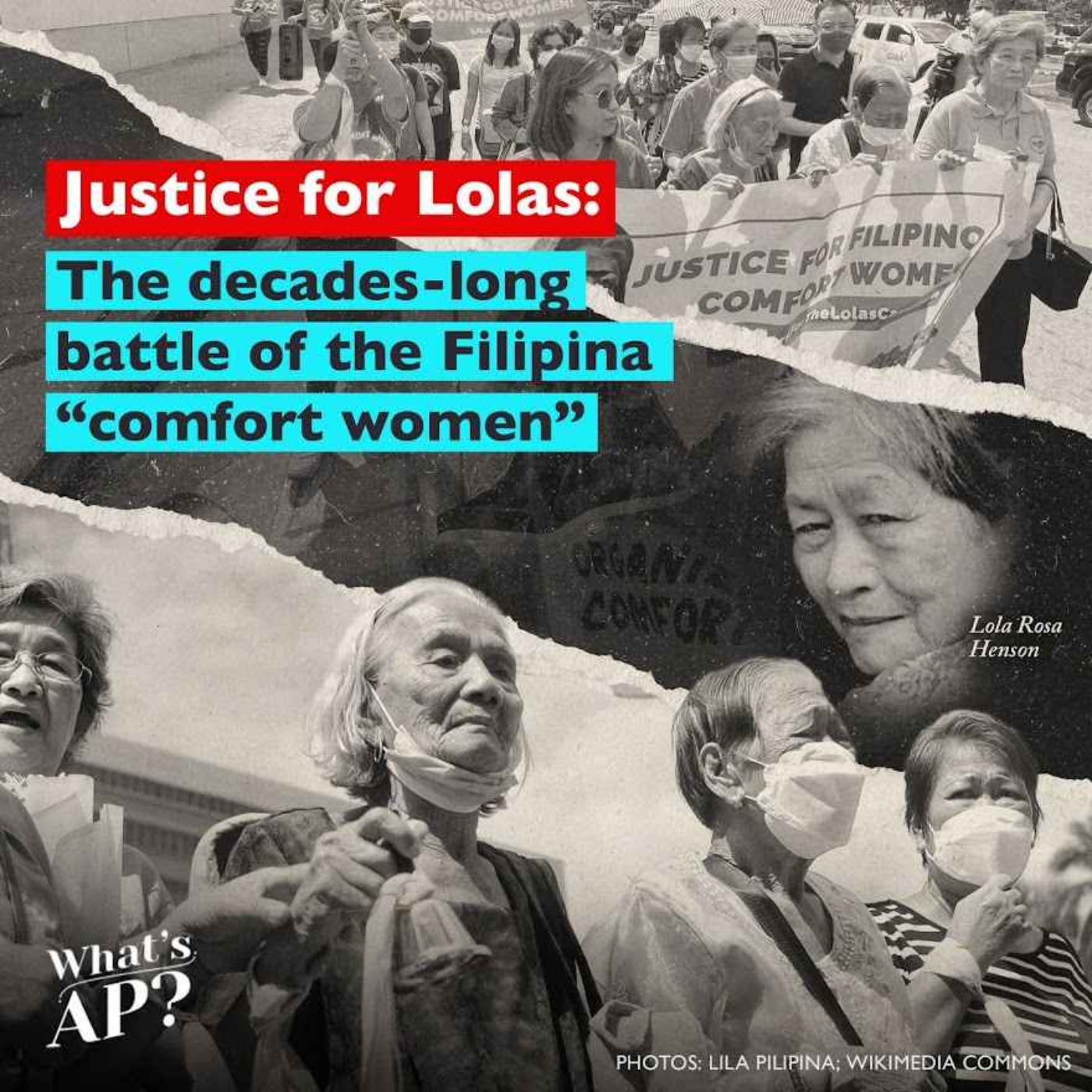
Justice for Lolas: The decades-long battle of the Filipina “comfort women”
41m 11s
The transcription delves into the dark reality of wartime atrocities, particularly focusing on the experiences of "comfort women" who were sexually enslaved during World War II. It highlights the stories of Filipino comfort women, known as Lolas, such as Lydia Antonio and Gertrude Ballisa-Lisa. The text discusses the movement of Lolas coming forward to share their harrowing experiences, seek justice, and preserve their legacy. Organizations like Lila Pilipina have played a crucial role in supporting these women. However, challenges persist, including denial of history, threats, and complications in Japanese history education. Despite these obstacles, efforts are ongoing to ensure that the stories of comfort women are heard and acknowledged, shedding light on this dark chapter of history.
Transcription
5411 Words, 30899 Characters
Hello dear listeners, here's the deal.
This is not going to be a funny or light episode.
We're going to be talking about real accounts of cruelty and violence, so this one is coming
with a big trigger warning for torture, murder, and military sexual slavery.
Be sure to listen to this one first before suggesting it to one of our younger listeners.
But definitely listen, because this episode is about war and its victims outside of armed combat.
We are going to take an unblinking look at what war can do to a person, and talk about,
and please hear the heavy aircoats, comfort women.
These are their stories of being taken prisoner and repeatedly sexually assaulted.
These women want their stories told.
They want the world to know that this happened, that horror was done to them, so that it never
happens to anyone else ever again.
Welcome to What's App, our Elimpan Lipunan Rebooted, the podcast that looks at Philippine
history with fresh eyes.
Today, it's Red Eyes, lots of tears shed while we researched this episode.
I'm Sab Shnabel, a historian and a comedian who has worked for Carla Seldran, the National
Museum of the Philippines, and the Guggenheim in Venice.
And I'm Siege Tentenko, reporter and history nerd.
Both Sab and I feel a little iffy about the term "comfort women".
But it's the historical term that is used, so let's start by tracing its origins.
The term "comfort woman" comes from the word "yanfu" in Japanese, "weanbu" in Korean,
and "weanfu" in Mandarin.
Please pardon my pronunciation.
It means something like comforting, or consoling woman.
Even then, they were finding ways to euphemistically say "sexual slaves".
Because let's be clear, these women were not willing participants.
Many were coerced, captured, or tricked into being repeatedly sexually assaulted, and also
physically assaulted.
While it originated in Korea, the term "comfort woman" was taken and used by Japanese imperial
soldiers.
In other countries like Taiwan and Korea, women would answer ads to be a nurse, server,
or entertainer.
And then they would be subjected to some of the worst conditions imaginable.
Forced to submit to repeated rapes, sometimes multiple times an hour.
They were also subjected to forced medical checkups and STD tests to ensure that they
weren't spreading diseases.
As if they could. As if they had any agency. I mean, there's just so much injustice in
this story, it's hard to come up with anything not angry to say.
And this is the reality of how some women were treated in the early 20th century.
For many people in Asia, World War II started earlier than 1939, which is the agreed-upon
date in Europe. Here in Asia, the invasion of China and the outbreak of the Sino-Japanese
War in 1937 is the marker for when the war started.
Yes, Japan in the early 20th century was an aggressive force that thought, if the West
was doing it, we can too. Go forth and liberate.
So they went about liberating different nations.
The Japanese advanced from Korea to China towards what we now know of as Vietnam, even
Taiwan fell under the Japanese banner.
And then in 1941, Japan revealed just how far they were willing to go.
Hawaii. They were going to provoke the United States, which at the time was claiming to
be neutral, biding their time and not joining World War II. In reality, they were already
helping the Allies.
A lot of these stories are more complicated than the overview we're providing. But there
has been substantial scholarship done on the period if you're interested. Basically, Japan
conquered a lot of Asia to provide their home islands with resources like metals and
gas for them to get through the coming war.
They took a lot more than just resources. Part of the service that was offered to their
soldiers was comfort, taken at comfort stations throughout the empire, supposedly to boost
their morale and reduce random incidents of sexual assault in Japanese occupied areas.
This is your final warning before we get into the heavier parts of the episode. After a
quick break, we will be taking an unflinching look at what happened to these women.
Comfort women were a reality in the Philippines. It wasn't as rampant or as systematized as
it was in other parts of Asia because the Japanese Imperial Army was only here for three years,
compared, for example, to the 35 years that they occupied Korea. But all the same, these
women suffered horribly during their captivity and after.
Now that we've gotten some context established, we'll be calling these women "Lolas" from
here on out. This is the preferred term used by those who advocate for their rights. It's
a little reminder that they're not defined by what they went through.
And it's important to think about how this dark period in our history concerns all of
us. This happened to real women with families and wants and dreams and pets and fears and
hobbies. Some were in high school. Some were married. Some had barely begun to menstruate.
And even after all these years, these women are still in tears when they talk about what
happened, like Lola Narcisa and Lola Estelita.
. (speaking in foreign language)
. We were told that the Lolas generally find it hard to say words like, "Ginahasa." They
prefer to say they were detained in the garrisons. Lola Narcisa and Lola Estelita managed to
survive because their garrisons were liberated by Allied forces. The full video containing
Lola Narcisa and Lola Estelita's stories is up on YouTube. Titled, "Lolas Revealed
the Story of the Filipino Comfort Women" by Lila Pilipina. These days, there are very
few Lolas left whose voices you will hear telling these stories firsthand. So it's important
to listen. Other stories have been preserved on paper, too. The next two stories are selections
from some of the Lolas' written testimonies, as read by voice actors. These were shared
with us by the feminist organization, Lila Pilipina, who are making sure that these stories
are never forgotten. We summarized them, but we wanted you to hear their words because
each of these women found something in the sharing of their story. For some, it was the
sharing itself that made them feel better. For others, it was finding community.
My name is Lydia Antonio. During the war, I went to visit Bulacan. We passed many Japanese
centuries and everyone was obliged to bow to the Japanese soldiers. I wasn't able to
bow nicely. The Japanese soldier got angry and slapped me and asked me to bow four times.
The other passengers were allowed to go and I was told to stay. I was taken in a military
jeep and then we headed toward Pampanga. On our way, the Japanese soldiers picked three
more women. We were not allowed to talk to each other. We arrived in San Fernando. We
were brought to a big house located along the highway. Inside the house, I saw many rooms
and wondered what they were for. I was asked to take a bath. When I was through with my
bath, I went to one of the rooms assigned to me. Outside, I saw through the window truck
loads of Japanese soldiers falling in line. At dawn, I was awakened by a hard shape. When
I opened my eyes, I saw a Japanese soldier already half naked. He told me to undress.
I did not follow his order and he kicked me. I resisted, but he was so strong that I could
not get free. Even then, I continued my struggle. I asked for help, but no one came to my rescue.
Every afternoon, Japanese soldiers would arrive in the house and made lines until midnight.
The other women in the house, they told me how to distinguish unofficial from an ordinary
soldier. We shared our stories. I was in that situation for one month until it was learned
that I was infected with gonorrhea. In January or February 1945, I went to see my stepmother
in barangaytad lac, Los Baños Laguna. The Americans were already in the Philippines.
She had come to Manila just in time for the battle of Manila, an ugly firefight that destroyed
the city forever. Many of Lola Lydia's family were killed in the Japanese retreat.
After the war, I went back to Manila and got a job as a sales lady. I lived quite a comfortable
life. I entered showbiz in the 60s. I became a bit player, but did not have the chance
to become a lead actress.
Lola Lydia is one of the lucky ones, relatively. She was able to live a life after the war,
but many were not so fortunate.
Next is a story of Lola Gertrude Ballisa-Lisa.
During the early part of the war, my husband was assigned as the district engineer of Camarines
War. And then when a certain bridge was dynamited, the Japanese caught my husband and made him
reconstruct the bridge. After the reconstruction, they took me from the house and made him ride
with me in one car many times over the bridge until they were satisfied. This was the first
time the Japanese saw me. Later on, my husband was assigned to Legaspi City. My children
were left alone with me in the house. This was the time the Japanese came to our house
on a military pickup bearing the Japanese red sun. The military vehicle brought me to
Reagan Barracks in El Bay. They picked up other girls. There were at least six of us
in one house, and then the commanding officer took me in his quarters. The officer who knew
how to speak English told me, "You see nothing, you hear nothing." And then, when there are
visitors, they would make me attend to their needs. Almost one year and two months we stayed
in that outpost. When the Americans came, there was much fighting. I escaped. I went
home to Legaspi City. My husband treated me like I had a contagious disease, and then
my relatives also looked down on me. My husband refused to have my children call me mother.
He separated my children from me. My mother died without talking to me. So did my father
and husband. During my captivity, I missed my children. I think I endured and lived because
I wanted to see my children again.
Even though what happened was not her fault, she was blamed for it. By her family. Many
women were wrongly accused of being collaborators who willingly subjected themselves to that
kind of treatment. It's the reason so many of them took so long to tell their stories.
Across the many decades, the Japanese government was able to take over the narrative and deny
that this even happened here. But in 1991, the tides began to turn.
Kim Hak-sun from South Korea gave the first public testimony about suffering sexual slavery
on August 14 that year. She was already 67 years old. Kim's testimony was the beginning
of a new movement. In September 1992, at a press conference, a Filipina came forward
with her story for the first time. Maria Rosa Luna Henson, or Lola Rosa, was 65 years old
when she first shared her story, which you're about to hear come straight from her book,
Comfort Woman, Slave of Destiny, published in 1996.
The happiest moments in my life were when I was with the Huk Balahap collecting the
medicine that I knew would be a big help to the guerrillas. In April 1943, I was asked
by my Huk comrades to collect some sacks of dried corn from the nearby town of Magalang.
One comrade sat with me in the cart, the other rode on the caribou's back. As we approached
the Japanese checkpoint near the town hospital of Angeles, the man beside me whispered, "Be
careful, there are some guns and ammunition hidden in the sacks of corn." I froze. I did
not know till then that what we were sitting on were guns. The sentry looked at the sacks
of corn, touching here and pressing there without saying anything. Finally, he allowed
us to pass. But after we had gone 30 meters from the checkpoint, he whistled and signaled
us to return. The soldier raised his hands and signaled that I was the only one to come
back. I walked to the checkpoint, thinking the guns were safe, but I would be in danger.
The guard led me at gunpoint to the second floor of the building that used to be the
town hospital. I saw six other women there. I was given a small room with a bamboo bed.
The room had no door, only a curtain. Japanese soldiers kept watched in the hall outside.
That night, nothing happened to me. The following day was hell. Without warning, a Japanese
soldier entered my room and pointed his bayonet at my chest. I thought he was going to kill
me, but he used his bayonet to slash my dress. I was too frightened to scream, and then he
raped me. When he was done, other soldiers came into my room, and they took turns raping
me. Twelve soldiers raped me in quick succession, after which I was given half an hour to rest.
Twelve more soldiers followed. They all lined up outside my room, waiting for their turn.
The next morning, I was too weak to get up. A woman brought me a cup of tea and breakfast.
I wanted to ask her some questions, but the guard in the hall outside stopped us from
saying anything to each other. My mother would tell me later that the hooks assaulted the
rice mill at night to free their imprisoned comrades. They found me there still chained,
and they freed me as well. One guerrilla carried me with him as the soldiers pursued him. I'm
able to carry me any farther. The hook dropped me in a shallow ditch on the roadside. Fortunately,
Anna, my mother's cousin, lived nearby. She informed my mother who promptly came to get
me. It was January 1944. I had been held captive as a sex slave for nine months. I regained
consciousness only two months after I was rescued from the garrison. I found myself
in my mother's house. I wept when I saw my mother's face. I wanted to speak, but no
words came from my mouth. I did not say a word for a long time.
And in the end, she did speak, and it was her words that encouraged other lolas to speak
as well. It was Lola Rosa Hansen that started the ripples that sliced through the silence
these women were suffering under. I was in tears as I told my story. It was very difficult
for me to relate what I had been through, but it was also a great relief. I felt like
a heavy weight had been removed from my shoulders as if thorns had been pulled out of my grieving
heart. I felt I had recovered my long lost strength and self-esteem. I felt better when
I returned home. I kept asking Rosario, my daughter, if she still respected me even after
she had heard the secret that I had kept for 50 years. I love you even more, she answered.
Not all women have as supportive a family, but the lolas have since stood by one another
saying me too. At the end of her book, Lola Rosa talks about the other lolas she met after
speaking out. Nelia Sancho brought all of us together in
a house in Quezon City. Gertrude saw me as I entered. She got up and embraced me, Lola
Rosa, she said dearly. "You are my inspiration." I hugged her back and said, "I'm so happy.
You too came out with your story." I met the other women, Lola Atanasia Cortez,
Amunita Balajaja, Tomasa Salinog and Francisco Macabebe. We had dinner together, after which
we sat around to tell each other our stories. I saw that we had many bitter and painful
experiences in common. Their stories firmed up my decision to go public. I realized that
my role was to serve as an example to other survivors of wartime sex slavery who may still
be ashamed to come out with their experience.
During their captivity, the Japanese kept the women they took prisoners separate. They
kept them from talking to each other because they knew that there is strength in community.
And now that these women have found each other, they aren't letting anything stop them from
fighting to have their stories told and acknowledged. And they've had some help.
This community of survivors started coming together with the help of Lila Pilipina, which
was established in 1992. These volunteers have heard these women's stories and are
making sure their legacy is not snuffed out by those who would deny them.
We spoke to Lila Pilipina to find out more about the plight of the women after the war
and what we can do to help them. I'm Sharon Cabusao Silva. I'm current
coordinator for Lila Pilipina, which is also known now as the Lila Pilipina Center for
Justice and Remembrance. So, this office of Lila Pilipina also served as a home for some
of the Lolas during the early 2000s. The first time that we heard about comfort women was
when Nelia Sancho at the time attended an international conference in South Korea. That
was the time that the first three South Korean women came forward to tell the public that
they had been military sex slaves of the Japanese Imperial Army during the time that Japan occupied Korea.
This was in December 1991, a few months after Kim Hak-soon first shared her story. At that
time, Kim and two other women filed a lawsuit against the Japanese government, known as
the case on the claim for reparations for Korean victims in the Pacific War.
Several months later, there was an article that appeared in the Philippine Daily Inquirer,
a document that was unearthed by this Japanese representative Hideko Ito, I think was his
name. The document contained a list of several names of Filipino women who were being treated
for sexually transmitted diseases. I think it was a Japanese doctor. It also contained
the sketch of a house in Ilo Ilo City. It was identified as a comfort station.
So when that news came out in the newspaper, Gabriela through Nelia Sancho and also several
other organizations formed the Task Force on Filipino Comfort Women precisely to help
identify the victims. So they came out with an open call on radio for victims of the Japanese
Imperial Army and World War II to come forward. And one of those who first responded in mid-1992,
Lola Maria Rosa Henson, and she told her ordeal before a group of journalists. And also they
decided to call on other Filipino women who had become victims. And that period sort of
opened the floodgate for many women to come forward. Other brave lolas followed suit, sharing
their experiences through stories and poems and art. But not everyone supports the telling
of this history. Some of the lolas even got to try to Japan to, you know, do some public
speaking about the issue. And even very recently, there were also cases of Japanese and South
Korean artists who did an exhibit on the Filipino comfort women issue. There was an anonymous
call that the gallery owner received, that they would burn down the gallery if they did not put
down the exhibit. Some of those photos were photos of Lila Filipina women or they demanded
that the exhibit, that section of the exhibit, be closed down. They had to put off the exhibit.
And then they presented letters to the artists and people from the cultural field there in Japan
exposing what happened and opposing what the Japanese government did.
Reports of these exhibits being closed down have made international news over the years,
such as in Tokyo in 2012 and Nagoya in 2019. Japanese history education has been quite
complicated. The study titled Examining the Japanese History Textbook Controversies,
written in 2001 by Kathleen Woods Masalski for Stanford University,
describes the Japanese Ministry of Education's rejection of a history textbook that contained,
quote, "too many illustrations of the dark side of the war, such as an air raid,
a city left in ruins by the atomic bomb and disabled veterans."
These textbooks remain a battleground for historians and advocates who want to tell
the truth about the war and conservative groups who want to paint Japan's past in a more positive
light. Only six years ago, in 2017, a history textbook used by 50 junior high schools in Japan
was reportedly published without mentioning the 1937 Nanjing Massacre or the Comfort Women System.
The Japanese youth now do not really have any idea about Japan's role in World War II,
and we have had cases where some Japanese youth would come over to the office,
and when they got to meet the Lola's, the Filipino Comfort Women, and Nadinig Nile,
they were really, really shocked because they said it was a very, very different narrative in Japan.
And to add insult to injury, Japanese conservatives claimed that these women
benefited from their enslavement, that they had any sort of agency in what was done to them.
Which makes me want to tear all my hair out.
The accusation that many Japanese right-wingers and scholars who are supported by Japan is that
these women were paid. They were actually prostitutes and they were not sex slaves,
which is an entirely deceptive statement.
Kinoha sila against their will. Tapos kinolong sila, and then they were gang raped.
But at some point, as one of the Lola's said, we had to survive because we had families,
we had parents and siblings that we knew were looking for us.
Some of them became mistresses of Japanese officials.
In the word of one of the Lola's, she said, because it was easier for us at the time
to ascent to this annals, to that, you know, being a mistress of a Japanese official,
because that afforded us some privileges. In fact, in the case of Lola Rosa Henson,
she was able to warn a town in Pampanga about the loss of Japanese because she had an occasion
where she was able to pass on a message to some of the Filipinos who were passing by the garrison.
And what happened is, instead of invading that town, the guerrilla movement was planning
to grade them on the Japanese garrison. The others said, "We are able to save other Filipinos,
but if we have a choice, we will not do that."
World War II was one of the most destructive wars in history,
and these Lola's were forced to fight in more ways than one. They fought to survive,
but they also fought their domination. They spied on Japanese soldiers despite the risk
and everything they endured. They would spirit away any intelligence they could find,
and used it to help where they could. Make no mistake, they didn't choose their circumstances,
but once they were at the garrison, they had to do what it took to survive.
There are so many heartbreaking stories of sacrifices we hope none of you ever have to make,
but these women made them. Then they lived with the trauma for 50 years without ever sharing the burden.
So, about now, you might be wondering where you can send these women anything they need,
and we will get to that, but there are a few more things you have to know before we give you that.
Because we can do more than just make old age easier on these women.
We can continue their fight for justice. And many do.
There's these international campaigns being made by 14 NGOs including Lila,
the Philippines, that should be part of UNESCO's Memory of the World Programme,
two-terials night talk. But of course, the Japanese side is resisting.
In fact, they have been interfering with the process.
On the other hand, the Lolas do have allies among Japanese citizens too.
Ordinary people who, without being asked,
will apologize to a Filipino for what the military has done,
even if the burden isn't personally on them.
How do the Japanese citizens define reparations? What for them would justice constitute?
Number one, it seems here atonement for everything that they did.
Individual compensation from the government. And then there were also calls and campaigns
for the comfort women issue to be included in Japanese history teachings and textbooks.
And on a more important note, we ask, what do the Lolas want? What are they asking for?
First is a formal public official apology from the Japanese government.
Not the kind of apology that was extended by the Japanese
state leaders in 1992 that were not backed up by state policy.
Not backed by any legal or social measures that would make the apology sincere and concrete.
There are four public apologies on record that were made in 1992
by then Prime Minister Miyazawa Kiichi and then Chief Cabinet Secretary Kato Koichi of Japan.
There is another "open letter" that was written in 2001.
But it's the support of social measures and policy where these apologies fall flat,
especially compared to countries that take their dark pasts more seriously.
In Germany, for instance, compared to the Holocaust, when Germany not only apologized publicly,
they also offered war reparations. There are even laws, I think, that prohibit
German citizens from even ridiculing their issues. It's not something that's even culturally acceptable.
There have been some fun set up that have helped ease the suffering of the Lolas.
But it hasn't been as big of a help as they hoped.
Even when the Asian Women's Fund was set up in the early 1990s,
the Japanese government said that the reparations were free because the Asian Women's Fund was already available.
It's not true because the funds for the AWF came also from Japanese citizens and corporations
who were already doing it even before the AWF was set up.
They also set up the AWF from the Japanese government through the Philippine government.
They excluded the NGOs who started the campaign in the first place.
So Lila Pilipina did not have a hand in the management and administration.
There were a total of how many victims that were listed there.
The only thing that Lila Pilipina did at the time was to assist those Lolas who did say yes
to accepting funds from the AWF. On the basis of we are very poor, we're very old, we don't have money
even for medicines. The AWF was set up with government funds.
But it also relied heavily on the efforts of private citizens who contributed
what was called atonement money and oversaw the operations.
The number of women who suffered sexual slavery in the Philippines
is somewhere between 400 to 1,000 according to different sources.
Of that number, it's estimated that 100 Filipinas received compensation.
The fund ran its projects in the Philippines from August 1996 to August 2001.
Nearly six years later in March 2007, the fund was dissolved.
Meanwhile, the Lolas who are with us to this day still need institutional support and care.
In the end, the real solution to the horrors of war is a world without it, if we can get there.
Long after the smoke has cleared and infrastructure is rebuilt,
there are still scars that will never fully heal.
But facing what happened has helped an entire generation of women.
These women who went through hell are on a mission to tell their stories and make people remember.
It's a mission that more people, more institutions need to share.
Hopefully whatever the Lolas have done will serve as an inspiration
and as a legal stepping stone for more responsive laws and more protectables for women.
Amid all this work by the Lolas and the organizations that stand with them,
support from the Philippine government has been symbolic at best.
While various Filipino presidents have acknowledged apologies from the Japanese
government since 1992, the Comfort Women Compensation and Benefit Act has not yet
been passed into law, despite being filed in 2004, 2013, and 2019.
And just this month, the UN Committee on the Elimination of All Forms of Discrimination
Against Women, or CEDAW, found that "The Philippines violated the rights of victims
of sexual slavery perpetrated by the Imperial Japanese Army during the Second World War
by failing to provide reparation, social support, and recognition commensurate with the harm suffered."
The decision is the result of a 2019 case filed with CEDAW by 24 members of a survivors group
called the Malaya Lolas, who had been lobbying for the Philippine government to support their
claims for reparations against the Japanese government. But our government has maintained
that it could not claim compensation for the Lolas after ratifying the 1956 Treaty of Peace with Japan.
All this while having programs and benefits for Filipino war veterans who are mostly men.
We don't know at this point how the government will act on the CEDAW decision,
but now, we're watching. As an individual, there is something you can do to help the Lolas.
Please contact us on Lila, the Philippine Facebook page. They can help on the social media campaign.
From a Lola or from Philippine history, just to keep the story alive. Some youth groups have also
raised funds for the Lolas. Very small amounts, whatever they can. They raise them, and we buy
whatever diapers and milk for the Lolas. And then they can also organize education discussions
in their own schools or in their communities. There are many ways to help them.
We need to show those who would deny this atrocity that we believe these women.
We've inherited this fight and we will keep it alive.
By the way, Lila, Filipina stands for Liga ng Mga Lola ng Filipina.
It's time to join the league. It's time for Quento Corner,
where we talk about something hopeful in the story that feels like a bit of light in the darkness.
Hopefully, it puts a little smile on your face. We're talking about the part of the story that
is the best thing we've heard. And that is how these women were described when they get together.
Noisy is not how we expected the Lolas to be described, but they like to tell jokes and stories
to laugh and catch up. These are not broken women. They aren't silent and sullen and shell-shocked.
They're singing and chatting and living their lives out loud. Their connection helped them stand
up for each other. And now you're a part of it. It's time that we get loud for these women.
Because while they have been demanding recognition for decades, they are still fighting.
These are women who went through the worst hell imaginable. And all they want is an apology
and an acknowledgement that what they went through was unimaginable. And maybe, just maybe,
because we know it happened, we can prevent it from happening again. But we won't ever get there
if we forget these stories. The struggle continues. And now, it's our turn to raise our fists for these
women and say, "We know what you did. And we won't forget." Thank you, Lolas, for bravely sharing
your story. Let's have the courage to take it from here. Class dismissed.
Talk to us on Twitter @historyrebooted, on facebook.com/historyrebooted,
and on Instagram @history.rebooted. Once again, I'm Siege Dantenko, Puma Podcast.
I'm on social media @SiegeTheDay, C-E-E-J The Day because I think you should seize the day.
And I'm Sab Schnabel, Puma Podcast. I'm on Twitter @SabrinaSchnabel, that's S-C-H-N-A-B-E-L.
Rhymes with Fable. Many, many thanks to Leela Pilipina for the source materials that helped
with our research for this episode. And of course, thank you to Anita Celdran, Julian Joven,
and Bubbles Magbayo for lending your voices to the Lolas written testimonies.
This episode of What's Up? Araling Panipun and Rebooted was produced by Nina Toralba and edited
by Joe Salcedo. Art by Trix Casillian.
Podcast Summary
Key Points:
Discussion of war atrocities and violence with a trigger warning.
Introduction to the topic of "comfort women" and their real-life experiences.
Historical background on the term "comfort women" and how they were coerced or tricked into sexual slavery during World War II.
Stories of Filipino "comfort women" (Lolas) like Lydia Antonio and Gertrude Ballisa-Lisa.
The movement of Lolas coming forward to share their stories and seek justice.
Efforts by organizations like Lila Pilipina to support and advocate for the rights of comfort women.
Challenges faced in acknowledging the history of comfort women, including denials and threats.
Complications in Japanese history education regarding wartime atrocities.
Summary:
The transcription delves into the dark reality of wartime atrocities, particularly focusing on the experiences of "comfort women" who were sexually enslaved during World War II. It highlights the stories of Filipino comfort women, known as Lolas, such as Lydia Antonio and Gertrude Ballisa-Lisa. The text discusses the movement of Lolas coming forward to share their harrowing experiences, seek justice, and preserve their legacy.
Organizations like Lila Pilipina have played a crucial role in supporting these women. However, challenges persist, including denial of history, threats, and complications in Japanese history education. Despite these obstacles, efforts are ongoing to ensure that the stories of comfort women are heard and acknowledged, shedding light on this dark chapter of history.
FAQs
The term 'comfort women' comes from Japanese 'yanfu', Korean 'weanbu', and Mandarin 'weanfu', meaning 'comforting woman'. It was used euphemistically to refer to sexual slaves.
Many women were coerced, captured, or tricked into becoming 'comfort women', subjected to repeated sexual and physical assaults against their will.
In Asia, World War II started in 1937 with the invasion of China and the Sino-Japanese War, earlier than the 1939 date in Europe.
Comfort women were forced to provide sexual services at comfort stations to Japanese soldiers to boost morale and prevent random sexual assaults in Japanese occupied areas.
Survivors of wartime sexual slavery started coming together with the help of organizations like Lila Pilipina, established in 1992, ensuring their stories are heard and their legacy preserved.
Chat with AI
Loading...
Pro features
Go deeper with this episode
Unlock creator-grade tools that turn any transcript into show notes and subtitle files.
 PodcastTranscript AI