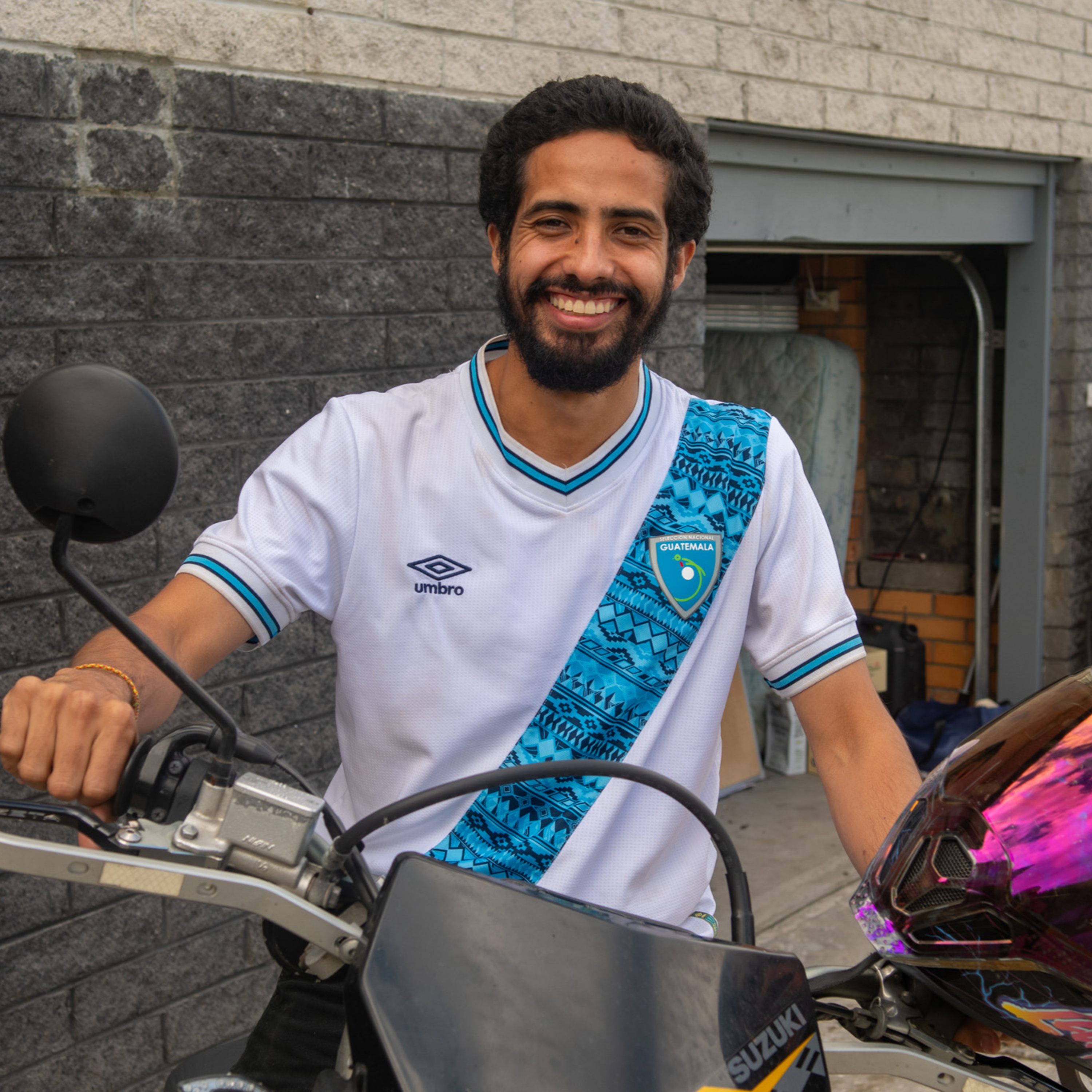
Julio from Guatemala : How a broken American dream lead to Tasmania
from 177 Nations of Tasmania
61m 44s
Julio, a Guatemalan now living in Tasmania, recounts his journey from a sheltered, privileged upbringing in Guatemala City. Growing up in a family-oriented, religious (Mormon) environment, he attended a bilingual school but was initially an unserious student. His life changed during a two-year church mission in California, where exposure to migrant communities and American life broadened his worldview and made him reconsider his plan to become a bridge engineer in Guatemala. He subsequently pursued university studies in the United States, excising academically but struggling with cultural integration and self-acceptance regarding his accent. A pivotal moment came when he connected online with Paige, an Australian who had also served a mission. After expressing his feelings and arranging a mutual visit agreement, he flew to Australia to meet her, which exceeded his expectations and set the course for their relationship and his eventual relocation to Tasmania, where he now resides.
[Music] Guatemala is the largest country in Central America by both area and population. Like other countries in the region, it suffered its fair share of economic and social instability over long periods of history. And it's a society of great wealth inequality and the consequences that brings. And one of those consequences is of course, high rates of immigration, particularly countries like the USA of however, Fania-Gua-Tamalan in Tasmania is a bit like citing a Tasmanian tiger. So I am indeed fortunate to be talking with possibly the only Guadamalan currently settled in Tasmania, apparently, Julio, who moved to Blackburn's Bay from Sydney with his wife only in 2025. And as it turns out, it has exceeded their expectations. But what brought a Guadamalan to Australia in the first place? Let alone Tasmania. Well, it's a long story with a few dramatic twists, including a defining moment at the US-Mexican border. So strap in. [Music] Hello, well, my name is Julio. I am from Guatemala City, Guatemala. I was born and raised in the city to give you a bit of context in Guatemala. Guatemala is a country that nowadays it's about 18 million people. When I was young, we were about 15, 14, so it's rapidly growing. But to me was a very interesting place because I have to say that I grew up in some sort of a bubble, I will probably say. First, first of all, because I grew up in the city. So I wasn't exposed to a lot of the rural life and a lot of the realities of life of many, many people. Unfortunately, one of the things, unfortunately, things about Guatemala is that it's a very unequal place. As far as when it comes to wealth. So people that live in the city have lived completely different lives than those who live in rural areas. So growing up in that bubble, I also have to say that I grew up with a lot of privilege. And that privilege came from sacrifices from both of my parents, just, you know, in the school that they put us in and the way that they thought of setting us up for our own futures. I also had a bit of a different experience because I grew up very religious. So Guatemala is also a very religious country altogether. Particularly, I grew up Christian. And more specifically, in the Church of Jesus Christ of Latter-Essence or Mormon, which also really shaped what my weekends look like and the type of people I associate it with. And it just really, really shaped my experience growing up, I would say. And it really, you know, way terming the person I am today. So growing up around with my wider family, I would say, family plays a really important role in South American culture to begin with. But for us specifically, it played a really important role specifically on my mom's side, as my dad has no siblings. My mom comes from a bigger family. She has eight siblings, so there's eight of them. And particularly, one of her sisters has also four kids, the same as her. And we're pretty much the same age and same gender as well. So it's boy, boy, girl, boy. So we kind of like each had her pair to, you know, go adventure with. And that was really, really nice growing up with. Because you have always someone to play with. Physically, we didn't like grow up super close to each other, but we would visit each other quite frequently or had sleepovers or spend time together. I wouldn't say that I grew up like incredibly rich in tradition, in like Guatemalan traditions per se. I would celebrate the main ones such as Christmas, Christmas would be pretty big, we would make tamales, we would have family over, we would cook, visit family like pretty much all day and eat all day. As most families do, however, there's other traditions that we probably didn't watch us closely or like, you know, follow us closely. A good example of that would be maybe Dia de los Muertos, Dia de los Muertos, Dia de los Muertos, Dia de los Muertos, Dia de los Muertos, Dia de los Muertos, which yes, we would eat, but I would only eat from when we visited my grandmothers, either one, they would always usually cook. But within the house, it was maybe every other year. It wasn't, you know, it wasn't as closely followed as many other families in Guatemala. What would you say in your childhood would be your strongest member, your fondest memory perhaps? It's easy actually, I don't have to think about it too much. My parents put us in really good schools, which took most of the money my parent, my dad made. Therefore, there wasn't, you know, a budget for traveling overseas and because I have remember growing up, I always longed for an overseas holiday, which most of my college, at the mortgages of my schoolmates would have. But one thing we did was hiking volcanoes. My dad was a very avid haika. So instead of going overseas, we would go hike avolcano, sleep overnight and then, you know, hike back the next day. And it was pretty much every year, since I, the first volcano I climb, I still have pictures of it. I was four years old. And it's funny because on the way up, I was, you know, like having a jolly time, just jumping around, laughing, you know, wasting all my energy going up, where everyone just kind of like focusing in, like, hiking up the volcano. But once I got up, I just got to tired and my legs, I just, you know, couldn't walk anymore. And good for us, there was, there were some volunteer firefighters who, you know, were doing drills. And one of them carried me on his back on the way down. We were quite fortunate. I think otherwise, I would have just to roll down or something. But it, yeah, it was definitely something we did, like religiously every year, sometimes multiple times a year. We would go hiking avolcanoes. And so you mentioned you went to pretty good school. So how was that experience? And what were you good at at school? I was good at making other people laugh. I would begin with, I was the youngest of four kids. So I would say that I was pretty inadvertently very spoiled. I didn't have it as hard as my older siblings did as far as my parents were a bit more loose with me. They gave me a bit of slack. So I wasn't, I didn't take school serious. And this probably one of the regrets I have looking back. Because school wasn't cheap. And my dad made a big sacrifice as I said earlier, just have us in that good school. So for a bit of context, the school I went to was an Austrian school. So it was an Austrian immersion school. So since I was four, I learned German. And English then when I started learning, when I was, I think about 10. So when I graduated, I was already fluent in English, German and obviously Spanish. So it just really set me up to go explore the world in a way. But I would say that I didn't take school serious. Like my job in school was to make other people laugh. I was definitely the class clown. And in high school, for example, did you have some kind of ambition or plan for what you would do when you finished? I think I started thinking about, seriously thinking about it when I was 17 years old. And that's when I kind of set a plan for myself and I said, okay, when I am 19, I will go on my church mission. We do on missions for church for two years. So I'll do that. And then once I get back, I'm gonna study civil engineering. I'm gonna get a master's in bridge building. And then I will work as a bridge engineer in Guatemala. Okay. Yeah, I was very set on my way. And I, what did I do? Why did you want to do that? I, so I remember growing up, I would always read in the newspapers that because Guatemala doesn't really have four seasons. We mainly have rainy and non rainy season. So during the rainy season, you would always read that bridges would be crumbling down or falling down. And because they were just not made properly. And I thought, you look, this is, this seems, this feels like such a seemingly easy thing to fix that would connect communities that would, you know, allow commerce to flow more freely. So that's kind of like where the idea came from. And then where it got like where I decided to, okay, this is what I want to do is I remember we had a visiting lecture in school. And he started showing us pictures of buildings of the world. And one of the buildings, one of the structures was the origin bridge, which is a bridge that connects, I think, Sweden and Denmark. And it's just an engineering like marvel. So when I saw that I was like, okay, I want to do bridges. And I feel like it also feels like a bit of my personality. I'm a bit of a bridge builder myself, like just making, you know, friendships, making connections between people. That's something that comes naturally to me, I would say. And that I enjoy doing. What I think that the catalyst moment for me where everything changed was when I went on my church mission. So as I said, we go on missions for two years and we don't really get a save to where we serve this mission. My dad did his mission and he served in Guatemala. Two of my My older siblings have done missions as well, once everything go out of my mind, one in Nicaragua.
I always thought, oh, you know what? I'll go probably, I'll Salvador, or Honduras, somewhere nearby. But to my surprise, I ended up being sent to California. And this is really where everything changed from my point of view, because I was 18 years old at the time. And I would say I was pretty mature. As far as life experiences go, and like I said earlier, I grew up in a bit of a bubble. And I was also, I would say, pretty spoiled. I didn't really know how to look after myself, like you know, cook for myself, or like, you know, washing clothes, and all of that, I was really catered to me. So in this period, in this transition period, in these two years, I just got to expose to so much in such a short period of time that my whole mindset just changed. And I think a bit of an important context here is that, as Guadamans, we look at the US as kind of the, we're really buying to this American dream, that you go to the US, you make money, you send money to your family, and you're kind of the, in a way, the savior of your family just, you know, being able to provide and give them opportunities that otherwise would be out of reach to your family back home. So moving to the US, kind of opened my eyes to that. And I said, like, look, despite, you know, being in Trilinwo and speaking these language, I had never really traveled overseas. I had been to Nicaragua once for a competition, a track meet, but besides that, I hadn't really ever left the country. So leaving the country and going to the US, just, you know, I just blew my mind, I said, look, there's more to life than just Guadamana. And that's where I realized, okay, you know what? Maybe staying in Guadamana and just being a bridge builder, there is not that it's meant, you know, it's in store for me. So yeah, that's this where everything changed, I would say. (upbeat music) The purpose of a mission from a religious point of view is to help others come closer to God, I would say. So I think the biggest thing I learned is I, I learned to become a bit more selfless and boot others and other people's needs in front of my own. That's definitely a big lesson. Another big lesson, I woke up to the reality of many people's lives. And what I mean is, because I was in California, California is very heavy on mainly Mexicans who cross the border and work in the field. So I got to spend a lot of time with these families and just learning about their life stories and all the sacrifices that they've made, made me realize one how privileged my life had been at that point. And it kind of woke me up to say, look who they're like, staying in Guatemala is not the only option. Like finding out about how these people have migrated yes, on their different circumstances, but how they have sought for a better future elsewhere kind of woke me up to the idea of saying, look, maybe there's something else I should be chasing. And then I thought, I would not, like if I'm going somewhere out of Guatemala to go study, it has to be the US just because of that, having been there before and now feeling like I spoke the language really well and I understood the culture and I had already made many friendship friends there as well. So I think that played a very big role. And so where did you study? So I started in Utah and it's actually, and I think this once again, one of the ways in which growing up as a member of the Church of Jesus Christ of Letters and really shaped my life in many ways because I went to a church sponsor school, a university sponsor school. And how was the experience of studying and living there and how different was it from what you'd experienced previously? I think that by this point, I would say that it's a different Julio going into university. Growing up, I said I didn't take school, but that's serious and I wasn't really into school. I was a bit of a class clown. I experienced a lot of growth and I mature a lot during my mission. So that set me up for school, because I took school very serious and I was a straight-a student. So I got scholarships for, and ultimately, I ended up being a pretty good student, I would say. And that's also, I think, just a change in mindset. I think it was difficult, yes, not being a native English speaker. It was extremely, I think one of the biggest frustrations I had is when people didn't understand my accent. And I worked so hard just to get rid of my accent, just because I just really, when someone asked me to repeat myself, they always a bit of an insult. I was like, mate, I've been learning these language and I've been speaking these languages for a few years now. Like, how come you can understand me? But looking back at those experiences, I mainly deal with people who had not spoken with people with accents, so therefore they were kind of used to everyone speaking perfect English. And obviously, it's a country full of immigrants. But unlike Australia, I feel like Australia is a very young country still. And I would say that I was labeled a lot, like, you know, just the way I looked, especially when I was doing an internship in one of the southern states in America, so in the Bible belt in Tennessee, that's where I really felt a big cultural shock. And where I just realized I quite, like I just didn't fit in. I think one of the things I regret about living in America is me, as a Guatemalan, we are people that are very willing to police others and very apologetic in many ways. And we're extremely maybe too kind. And what I mean by that, I regret that is because I always felt like I was the one who needed changing and I was the one who needed to accommodate to others. And I was the one who needed to fit into their mold instead of me being unapologetically speaking with an accent and, you know, mispronouncing some words. And just because that's the way I usually speak and that's, I didn't have to put on that filter where I would have to think two or three times before I spoke. So I remember kind of like hating my accent for the longest time and just wishing I didn't have one, just to be able to fit in. I want to move on to the next part, how you met your now wife. Yeah. Because you met in the USA, right? Well, actually, we didn't. Yeah, it's an interesting story. So when I was in the US, I realized I thoroughly enjoyed traveling. And when I was in the US, maybe I visited, I don't know, maybe 46, 45 of the 50 states. I roomed and I decided to go to Europe and spend going to Europe instead of usually we would fly back to Guatemala if we were flying overseas. And whilst in Europe, I got in touch with Paige. It was during this trip and I think it was in Germany at the time. And we just matched on an app and we just, it was all platonic. We just, you know, started talking. I thought she was, I still think she's amazing, but like I thought it was really cool that she, as an Australian, she had also served a mission and she went to Spain. So I thought, oh, that's so amazing. There's this person that speaks Spanish with a spaniard accent, speaks English with an Australian accent. I wonder what she sounds like, right? Because like I just, in my head, couldn't really fathom these two things, right? Because we just became friends. We started talking just, you know, on the phone. And then once that finished, we, because we didn't even meet in person. And then we become very close very quickly. And, you know, after spending a few months talking, I remember one day I just said, you know what, I'd never really considered Paige, you know, kind of like to be quote unquote an option. Like, you know, like, that there could something could work out between the two of us, mainly because of distance, right? But maybe there's a chance, right? So I remember announcing the Denver Airport flying and I had a very long day over. And I remember just starting Google and flights to Australia and just thinking like, you know what? Like, I mean, it is a bit expensive, but like, I always looked at it like, what if I just, like, you know, try it out? What if I just go to Australia? You know, I get to meet Paige. We see, like, if, because in my head, I had an idea of what she was, right? Like she was this amazing person. But like, what if I'm wrong? What if I'm right? I feel like I have always more to gain than I have to lose. And, you know, surely after. I remember being on the phone with her and saying, look, I just need to tell you how I feel. And I feel like you're this amazing person and I would absolutely love to meet you. And I have feelings for you. And obviously I don't have never met you in person, but I, you know, I'm just a bit head over heels. And I remember she, like, there was a big pause. And she just said, oh, well, thanks for letting me know how you feel. That's good to know. That was it. Oh, God. So, I was like, oh, I was like, okay, well, just, I just felt it was fair for you to know. And because of time difference, I hope we hung up.
And I went to sleep. And I was the whole night, I was just like, "Oh, it's supposed to be. Why did I do that?" Like, "I just blew it." We had this amazing friendship, and now we're not going to be like, "So you can really come back from that, right?" Like, "Yeah." So I remember waking up the next day, and just the first thing I just called her again before she went to bed. And I said, "Look, I just want to apologize, because I just got my feeling, I just let my feelings get the better of me, and I obviously appreciate our friendship much more than, you know, what I feel for you. So I would much rather have you still as a friend, than, you know, pursue something else if clearly you might not feel it way. So obviously, I was putting words in her mouth by this point, but she just asked me, "Well, like, are you taking back what you said?" And I was like, "Well, no." But like, what do you mean? Like, could you elaborate? Like, I would never, like, "I don't take that back. I still feel that way, but I just really enjoy your friendship." And she's like, "Well, I told her, "Please tell me, how do you feel? Like, what do you think?" And she's like, "Well, my feelings are definitely not mature, as yours are. Like, I think you're great, but honestly, I have more questions than answers at this point. Like, I definitely don't feel the same way, but I'm not close to the idea." So then, that's when we decided, "Okay, you know what? Like, why don't we agree to just meet up? Either you fly over or I fly over." The deal was, if I fly over, you pay for everything we do. So if we go to parks or we eat out, whatever, you pay for that and I pay for my flights. And if you fly, we do the opposite. So that way, in a way, it felt like, you know, we were both somewhat, like, it was an equal, a mutual agreement in that we're equally being investing in this venture, if you will. I ended up flying over to Australia, met her, I was here for two weeks, and she was even better than I thought. So, unfortunately for me, and I remember being on the flight, you know, like this 12 hour flight from, I think I flew through Dallas to Sydney, and I was thinking the whole time, like, what if I'm being catfished? (laughing) And I was just like, this uneasy feeling came, came, you know, I started feeling that, came to me. And I was like, wow, what if it's like, you know, like a 50 year old dude, like living in his basement, and I'm like, oh my goodness, like, what am I doing? So, but it's, fortunately, that wasn't the case. (upbeat music) Then we met in the middle, once we were both in Hawaii, we met in Hawaii once. So we were both making big sacrifices monetarily, but this wasn't sustainable long term. Ultimately, I'm still in college. I was working as a teacher assistant, I was, you know, minimum wage. So it was a sacrifice paying this, I don't know, but I can maybe 800, $900 ticket, just to see each other. The idea was that we would eventually, if things were progressing as they were, this was about six months into the relationship, the six, eight months into relationship, we decided that once I finished uni, I always had the idea of moving back to the Bay Area. The cool thing about the Bay is that you're only, I fly away from Sydney, Sydney to San Francisco, and also I fly away from Guatemala. So it was obviously much closer to Guatemala, but it was a good middle ground, just in the meantime to agree on. So that was the plan, but there was a bit of a twist in the tail. (upbeat music) So, about, like I said, about eight months into a relationship, Paige and I had spent some time in Hawaii, and then I flew to LA. She went back to Sydney, kind of like changed her bags. I think she needed to do some things for uni, and then she would fly into LA, where we would meet and then fly to Guatemala, so where she could meet my family. At this point, I had met her family a few times already, but she had never met mine, other than video. So we thought it was appropriate, you know, like eight months into this relationship, it's starting to get a bit serious, I would say, for her to meet my family. So, well, we were in LA, we had I think three or four days, before we went back to, we had the flight from LA to Guatemala, so, and Paige had some friends she wanted to visit in Mexico, but just across the border, in Tijuana. Actually, by that point, I think I had never been to Mexico before, so I said, let's do it. So, we got on a bus from LA, got to the border, we crossed, we met with his friend, really cool guy, we just, you know, had a really good time in Mexico. On the way back, this is where everything gets interesting. Paige left her purse in the Uber that was taking us back to the border, to cross, 'cause we crossed the border, you know, the Tijuana into San Diego, pretty much. And this border is well known for lots of trafficking, both human trafficking and drug trafficking, so it's a very, it's a border with a lot of surveillance. So, I was already a bit nervous for that reason, right? And then Paige left her purse in the Uber, and that just, maybe a ball of nerves, because then I was contacting, trying to contact Uber, to get in touch with the driver, who then blackmailed us into getting him back the purse, 'cause he was apparently really far away, and he would only give us to us if we, like, gave him a certain amount of money, but we had no other choice, right? Like, when he was either that, or missing our flight from LA to Guatemala the next day. So, we were in a bit of a time-crunch, so we ended up getting the purse back, but the phone mysteriously disappeared in the car, so, we just got the purse, we had her passport. That's the main thing, right? So, a few hours later, and both of us just being stressed out of our minds, we finally had both hair papers, my papers, we walked over to the border, and I remember I was still a bit shook, like, shaken up by this experience, but, you know, not having the passport, and by being rushed, and because we might also miss our bus into LA, and I was just a ball of nerves, and I remember when I got to the counter, and, you know, as usual, they asked, "Hey, where are you here?" "Papers, passport," so I just started handing over all my documents. So, I was a bit of, I don't want to say a unique case, but not a common case. So, when the officer, the patrol officer, saw my documents, he was a bit confused, and he was like, "Oh, so do you have, can I see your F1?" And it's like, "Oh, yeah, that's the next page." So, he started just looking very thoroughly through my documents, and then he got hung up on the idea that I had already graduated university, because I had just graduated like two weeks ago, two weeks before. So, I had an EAD, an Employment Authorization Card, which I had received, and I provided it to him, and I said, "Look, this is my Employment Document, "I can't work yet. "I'm gonna start working, because there's a bit of a waiting period." And I had this as my offer letter. So, I provided all of the documents, and he was just not convinced. So, he said, "Why don't you come with me to secondary revision?" Right, and so, he took me at the back, and page was like, "What do I do?" He was like, "Oh, you're just waiting for him here." Okay, perfect. So, she went through, I was in the secondary revision, they took me into this smaller integration room, and then this, you know, tough, unfortunately for me, power hungry, officer came and just started telling me, like, "What do I do? "What do you want to do? "What do you want to come into this country? "Who do you think you are? "You documents are not in order." And he just started ripping into me, and this is where I should have channeled my inner go-on on my own, and just kind of like just be submissive and say, "I'm very sorry." These are all the documents, this is all a big confusion. Everything is in order, just let me show you this and that. But instead, I just decided to fly back, and I just wouldn't have it, right? So, I just said, "No, no, no, you are wrong. "I am right because X, Y, set, "and I have these documents. "I can prove to you that he has my job letter, "he's my document." And ta-da, and I have spoken with the university, I have these emails, and we just went back and forth, started screaming at each other at one point, and in his anger, he just said, "Look, you're not coming into the US today, "regardless of what happens, "regardless of what you do, "of what documents you have, you're just not getting in." And this is kind of like when I realized that, what was happening, right, that my, this whole American dream, this whole life, I had like plan for ourselves, at this point, it just crumbled in front of me. And it was just incredibly shocking because I had no idea what was gonna happen, right? And Paige obviously had gone through her documents, were all fine. So, I remember, can I talk to my partner, can I talk to my girlfriend, and you know, like figure this out? And she's like, well, you have 30 seconds, and you can give her anything. So, she didn't have her phone, so she had no ways of communicating. By this point, it's already dark, so it's already late, and it's just crossing the border, so it's a lot of shady characters in the area, and she knows nobody, 'cause like, I mean, in LA, it was my friend, right, not like she didn't know him. And on top of that, she got her purse back, which luckily had one of her cards, her credit cards. So, at least she had means, because I wasn't allowed to give her my credit card, 'cause I said, like, just use my card, whatever you need. But the police always said, hey, you can give her, you need to give your credit card. I'm like, oh.
So I left her with that. I just gave her my friends for a number. I said, look, give her my call somehow. Try and contact him. And I'll see you on the other side, right? Like, it was just, I had no idea what was going to happen. And this was just incredibly scary, not only for me, but also for her as well. Because I mean, I had no idea how long it would be until I was back in Guatemala where I was going to be deported to. So I had no idea if Paige was actually going to go through with the flight and fly by herself. I was taken then back to-- and this is where a bit of the trauma starts to a little waiting room where I would see how they would be picking people to get deported as well. But these are mainly people who are presenting fake IDs, who are smuggling drugs. I remember there were taking pictures of someone who was trying to smuggle, I think, was ice. Or I can remember what it was, but some drug. And from there, I got taken into a detention center, which was just packed with people, people, families, kids, everything, women, and mainly, like, you know, maybe 95% or Mexican, mainly because it's of the proximity. But there were some people that, you know, some Asians, a few Middle Eastern's as well. So most of these-- it was a bit of a mixback, right? You have these shady characters who are like, you know, drugs and muddlers. And they're just-- I think they call them mules. So they're just carrying the drugs. But you also have people who are smuggling people who get caught in a bunch, and they get caught with the people who were smuggling them. So they get all taken there. I there, I got taken into a room maybe four meters wide by nine meters long. And there was maybe, at one point, maybe 28 of us in that room. Because we got split into rooms, and then they would call K's by K's. They would call you up and say, OK, what's your case? What are you here? Where are you from? How are we going to get you back? So I was completely in communicated for the first seven days. So Paige had no idea where I was. If I was alive or not, or exactly what was happening with me. And it was until after the first seven days that I got to call home and say, hey, I'm alive. I should be coming home soon. So where did you go after that? So-- Did you get to go back to get Guatemala? Yeah, yeah. So how it works is that I think it's part of-- and this is just my speculation, right? But what they do is they take you to this detention center to kind of break your spirits. Because what they do is they try and kind of teach you a lesson and say, look, if you're trying to come in this country legally, this is what's going to happen. And I actually saw that happening. I saw people-- and these are people-- but this one, I'm 24, 25, and then-- one of the younger ones, I would say, amongst the adults, right? And I see people that have kids and are going there to cross the border and work whose spirits are completely broken. And something that I witnessed there as well is that many times people just get high on drugs. And they just try and cross. Well, on high, and then they get there and they just become a bit of a rehab center. I remember one that was just taking one of the two toilets we have in the room. And it was just vomiting for three days straights, wasn't eating, and was just crazy talk, isle red. And it was quite a scary but life-transforming experience, I would say, in that it gave me a lot of time to reflect and think of one what I had lost, but two, how I was going to react and come back from it. So after seven days, I got the option to either wait for a plane to fill up with Guatemalan's to then be taken with the rest of the Guatemalan's who are being deported from all across the country. They were bringing it to this detention center. And once the plane feels, I would be taken, taken back. I think they were trying to inflict fear upon me because they say, oh, look, that could take maybe one month, two months, so I would be waiting there for a month or two. Or you can buy your own ticket. So you pay for your ticket and you just buy it whenever you, as soon as you can, as soon as you want. Obviously it's on your expense. But the ticket has to have certain rules. You can only have layovers in certain places and they can be no longer than a certain period of time. And mainly because the whole time you're being, you're in custody. So there's a police officer with you accompanying you the whole time. So I ended up doing that. And I remember when the date come to that I was due to leave. And it was a bit hard to keep track of time because I was in a room that had lights on 24/7. So you kind of lose track of time. You kind of follow time by the times that they feed you. And they lay the shower once or twice while I was there, which was nice. But the whole time you're just, you feel like, I don't know, just an animal. I wish there was a better word to describe this. And animal might be too kind, even. But-- Sounds very dehumanizing. Completely. And I think that's really where I had held the United States in such high standards in my head. And I always felt like my future was there. Yeah, I always thought that that was the place for me. But after that experience, I just woke up to the fact that I wasn't-- like, it was probably not for me. And it was probably not the place I should be wanting to go back to after going through that experience. So I ended up missing my flight, not taking me. I ended up having to stay-- ended up staying there nine days. And after the nine days, they finally took me to the airport. I flew back. And I remember flying back. This is a bit of a funny side story. But I remember flying back. I felt like this really bad guy. Because you know, up to this point, I've always considered myself to be a nice guy. I've never really committed a heinous crime or anything like that. But I remember the look on everyone's faces when I was-- because when you board a plane, you're the first one to board and the first one to get out. And they call you out on the plane, and lands. It's like, oh, can we get police? Passing your hoolly albarez to please stand up and come to the front. And the police officer comes in, kind of like escorts you. And I remember the look on people faces like, who's this gang member? Who's this criminal? Who's this mastermind? And I was just-- I remember putting a bit of a bad boy face on. And that's the-- make the most out of it. At this point, I was just glad to go home though. So when I got back to my surprise, Paige was there with my family. And she extended her stay in Guatemala so we could spend more time together. By this point, I was quite traumatized. So I lost 10 kilos in these nine days. I wasn't eating for the first few days. So when I got back, my whole family was in anguish this whole time. Because I only spoke into them once, well, actually twice. Once is when I told them I was going to arrive on a certain date. Then the next time I meet to tell them, like, hey, actually, they missed my flight. Oh, they didn't take me to the airport. So I'm going to arrive two days later or a day later. So the first thing was just relief. So it wasn't this trip that once I got back to Guatemala that I realized, well, I don't know when I'm going to see Paige again. Because the easiest path from Guatemala to Australia is through the US, through LA. So I have no idea when I'm going to see her again. I still have an Australian visa. So I knew I could get there. But without an American visa, it would be a bit of a headache. And I would not likely, I wouldn't get a new Australian visa if I had already lost my American because it could just look bad in my history. So I realized this is probably my last chance is to spend time and be with Paige until I don't know when. So on the last day of the trip that she had extended to be with me, I remember. I talked to-- I think it was my brother and my mom. I can remember who. And I borrowed a ring. Well, we were on an overnight hike. We went to a very famous place in Guatemala called Lake Atitlan, La Gotitlan. And there's a hike called Maris del Indio, the Indian snows, that has a gobbled-smacking view of the lake, especially in the morning. And so we did that. We were doing that. And the whole time, I was like in two minds. I was actually not proposing. I'm not proposing. I'm not proposing. Because one of the things-- one of the really important things that Mormons within their religion, people tend to marry quite quickly. So and Paige was very clear since the beginning. I said, look, don't even dream about proposing to me. Have we not dated for at least one year? That's the bare minimum. I want to make sure that we get to know each other and that we spend enough time, especially because we were long distance for a while as well. Yeah, it wasn't a regular relationship. Let's call it like that. So by this point, we had been dating-- I think it was nine months, officially. So it was not quite there, not quite the year mark. But I just thought, look, I'm not sure when I'm gonna see her again. And. And I always thought the worst thing she can say is no. And you know, like, and I know it doesn't mean a relationship is over. Like, I know it just means look, if you don't want to wait for the year, I'll be respectful of that and you just wait. And so we ended up doing this morning hike. We went up this, we climbed this rock with a guide and then I asked the guy, "Hey, will you mind like taking some pictures of us?" And so he went down, got to a nice platform to get the whole lake. And while he was taking pictures, I remember and she told me like, "Who'll you like?" I'm a bit scared because we were in a bit of a rock and steady, on steady place and she told me like, "My legs are shaking." And I was like, "My legs are shaking too." And that's when I like, got to wind me. Obviously I was nervous. I'm going to wind me. And I said like, and she was like, "Oh, I could see her face. Kind of like the surprise, but kind of like not the good surprise. Kind of like the bad surprise." Like, "What are you doing? What are you doing?" No. And I was like, I was like, "Hey, look. Will you marry me?" And she just said, "Long pause again." She was like, "Yes, I guess." And it was so funny because then yeah, exactly just wow. Sweating bull, it's all around and you know, so nervous. And I had the ring in this seed block bag because I didn't want to lose it. And it still had a tag on it. So then I kind of like, symbolically quickly put it on her finger. Then she looked at me and said like, "Well, is this my ring?" And I was like, "No, no, no, no, I just borrowed that ring." That's when I was like, "Oh, good. I don't like it." And I was like, "Oh, great." But I, so it was quite funny how it all happened. Tell me about how the move to Australia came about. Either that, we were obviously figuring out where we're going to leave, how we're going to make this work. But what we decided was that first I would go to come to Australia, but not through the US, but through South America. Spend some time here. I ended up spending I think a month and a half here in Australia. We had an engagement party. I got to know more of her family. We got to share the news with them. Then the plan was for either me to come here on a student visa and study either English, which didn't make any sense. It was an option where I was like, "Oh, because that's how most people come here." I like, especially South Americans. They just come study English and then just visa hop until you make your way into permanent residency. I was either that, studying a master's, which was a lot of money. Then I wasn't fond of studying a master's without any experience or for her to pay, for pay to move to Guatemala. We ended up deciding for her to move back to, to move to Guatemala and for us to get married there and then apply for an option visa and move back to Australia. So you got married in Guatemala? Yes. So then pay to move to Guatemala. We lived there for two years. For me, it was a very joyful time because I moved out when I was 18. I had been in the States for about six years by this point. So I didn't really have a relationship with my nieces and nephews. So spending time in Guatemala was, for me, was amazing because I got to strengthen those relationships. And I got, like, page had the opportunity in my head and in my mind, in my opinion. She had the opportunity to experience Guatemala culture because whether I'm an average Guatemalan or not, I am still a Guatemalan and she needs to understand what my culture is. And especially when we have kids, like I want them to feel some sort of connection to Guatemala, right? Despite them being born in Australia and being Russia, it's still really important to me. So for page to understand my culture, I don't understand what a Guatemalan way of living and you can understand what makes me who I am. So it was to me, it was a really good opportunity. However, for page, it was extremely hard because Guatemala is a very, maybe not kind towards women and not kind towards page lost a lot of her privilege. And what I mean by privilege is she couldn't walk by herself. On the street, streets were not safe for her to walk on. She would draw a lot of attention just being Caucasian in Guatemala. So I remember once you got followed by someone on the street and she was just freaking out and I was freaking out as well and I was, you know, at work. She was just messaging me, calling me. And I, experiences like that really kind of make me realize that staying there long term for us was an option, especially because of page mental health. As much as I love spending time there, it was in a place we could call both comfortably call home. So COVID happened, which also shattered everyone's plans, including hours because we were planning on, you know, doing back and forth between Australia and Guatemala. Well, it's my visa came or at least page to go back and visit family. But unfortunately with COVID, that was an option. And so it took me about coming to Australia and when that happened. Yeah, so then my visa came through. As soon as my visa came through, it was COVID. It was really hard to travel. It was 2021. And I remember just begging pages like, please let me stay a few more months because it came actually a lot faster than I wanted. It came, I think, within like six or eight months. So I was like, look, I'm not ready to leave. Like I have been away from my family for six years now. I'm really enjoying this face of our lives and she was gracious enough to say, you know, we're not going to leave straight away. We're going to stay a few more months. But once we got to Australia, I would say that it was like a glow adjusting to life in Australia. It was seamless. Like absolutely. Like seamless. I feel like I had been already three times here, well in Sydney. And it was just, I think something that really helped, especially compared to the US, by this point, you know, I had started my life over one, two, three, four, like this is my six time starting over. Just going back and forth and then finding an edge of and finding, you know, making friends and just starting from scratch again, which I quite welcomed because pages, mental health was, I had suffered a lot during our time in Guatemala. So I was really keen for her to find a good place mentally. And for both of us to just make, find a place we could permanently call home. And to me, that's what Sydney was when we arrived in Sydney. And Paige had always the plan of going back to that more rural lifestyle and, you know, more easy pays and more smaller town. And when I got to Sydney, I just could not see myself anywhere else but Sydney. I was like, you know what, I started my life so many times I get like, I'm not going to die in Sydney. You're going to bury me in the opera house and maybe, you know, like, maybe you like, I don't know, you trapped me into like part of me here, part of me in Guatemala or, you know, but like I just felt like I belonged and I didn't see myself anywhere else but Sydney. It was a place I could call home. And I, I think it also helped that I had working rights from the get go. So I didn't have to do any of the visa hassle I had to do in the US or after, you know, like get jobs like under the table as they called them, right? Like, you know, like cash jobs like I had to do in the US. So that really made it feel like I belong from day one. And also Australia being such a young country as far as immigrants made me realize that I, you know, as I go out of my own, I can be a Guatemalan and an Australian. And that's okay. To me coming to Australia is not like, it wasn't like the US where I had to leave myself behind and become the new person. It was, bring yourself. You're welcome here. You are who you are and there's a place for you here. And that's something I never felt in, you know, anywhere else I've been outside Guatemala where I feel like I can be myself and I don't have to pretend or let go of any of my culture. So you said that you thought you were going to live in Sydney for the rest of your life, but we're here in Tasmania now. So how did that all happen? Sydney's an amazing city. Lots of opportunities, lots of friends, lots of things to do. But unless you're okay, either sharing a home with, you know, five other flatmates living in a generational home with, you know, your mother-in-law and family who are gracious enough to have us for a while or living in a shoebox in an apartment. It's just a bit hard to financially, especially as a recent migrant to make it work in Sydney. Especially to have a yard. I think that would be the metric of success for me, just being able to have greenery. So.
Paige had always said, hey, who are you? They just explore other areas. Why don't we look into Adelaide? Why don't we look into Melbourne? I was like, no, no, Melbourne is too cold. We will never go to Melbourne. Here we are. But, or even central coasts within Sydney, just like, we don't have to live in Sydney. But I was just adamant on the idea that I came to Sydney. And in Sydney, I lived in the Northern beaches, which I just absolutely fell in love with that place. So it was just quite discouraging to think, we just first Sydney became out of reach. Now central coasts become out of reach. How far do we want to be outside of Sydney to still be close to Sydney? And at that point, Paige had already floated the idea of going to Adelaide. And one day, I guess something changed in me. And I just said, look, let's just move to Tassie. And I had never ever been here. I had no idea what that-- I just knew it was an island in the south. Right? And that's pretty much all I knew. So then, once I, you know, like, this kind of like, body into that idea, then things actually started moving. Things got into play. I came into motion and said, OK, for the Easter break, we came here about a year ago. It was a bit of a surreal experience land, because we brought a carolva in the ferry. And just coming to driving into Tassie was just like, wow. So this is it. And we did a bit of a road trip. Went to strong. We went to a phrase. And we saw some of the cradle mountain, dove lake. And it just got absolutely enchanted with Tasmania. To the point that, like, I remember telling Paige, you know what, I'm just going to stay here. I was working already at this point back already. So work has an office in Rosnihale. So I remember driving up to Rosnihale every day, working in the office, sometimes showering there. And just realizing, wow, Tasmania is amazing. Like, it's really a hidden gem. And that's when I said, well, we will say it. But this one we had already looked at houses. And even better than all the nature to us, were the house prices as well, because it was coming from Sydney. Obviously, you're used to seeing houses in the 1.3, 1.7. And the millions, right, which are unfortunate for budget. But here, you can get something quite decent below the million. And that, to us, was the nail in the coffin to say, OK, that's it. We're moving. [MUSIC PLAYING] So during that trip into Tasmania, we ended up-- I, by this point, Paige was already back in Sydney. I ended up coming to an open house. I, you know, with very little expectations. So I had heard good things about Kingston and Black and Sway. I came here through the house. And I told Paige, look, it's not bad. By this point, I think we had placed a bid on three other properties that hadn't worked out for us. And I said, why don't we just place a bid and see what happens? And to our surprise, we ended up getting the-- our offer was accepted. I was Saturday where we placed the offer on Monday, got accepted. And then the house settled. And Paige ended up moving the 9th of July by herself here in Tasi. And I came a few weeks later. Of course, you know, it's one thing to see double-aig and strong and all these beautiful places around Tasmania as a visitor. But what was the experience of settling in, in life? And did it? Was it, as you expected? It was a fear, to a degree, that I guess mirroring it to my relationship with Paige. One of my fears was that we only saw each other on vacations. So we only saw the highlights. And we were spending time together. It wasn't the everyday life where you're working and you're busy. And you have all these things going on. So it was a bit of moving here. I would say that it was probably even better. And what I mean by that is that we kind of went blind into buying into this area. But we are absolutely in love with the area, just being close to the beach, being-- I think having our own places also makes this a bit of a magical place and a special place to us, because we feel like we're setting roots here. And one of the things we also actually loved is just the diversity. Like, you know, for instance, if I wanted to see Snow in Sydney in winter, I'm driving two, three hours away. Here, I just, you know, look out the window. I see Mount Wellington. And there's Snow in the Mountain. And it just-- it's just that closeness to nature that to us makes Tassie feel even more so like home. The best way to describe it to mainlanders is that I always tell them, look, Tassie is to me. What Australia would have-- like mainland Australia would have been 35, 40 years ago, maybe. Where it's just slower pace, where you have time to interact with your neighbor and know them by name. And you have them over for dinner and not just be so caught up in the race that it is to just make money, afford a mortgage, and just, you know, just never ending race that we were stuck in in Sydney. Obviously, one of the difficult parts for people who certainly entice me at times is work, because there are as many opportunities. So what have you been doing here? I'm fortunate enough that I-- because work has an office here. With, you know, after COVID, many workplaces are starting to ask people to go back into the office and so did my workplace. So I work for a major food retail company. And I work as a data analyst. I, more specifically, I'm a digital analyst. So I analyze user's behaviors on our digital ecosystems, how they interact with our app and web. And my job is to help the team make, I guess, mark decisions on how and where we invest money into the development. And if the money we invest into developing features, if they are how successful they are, fortunately, for me, all of my job can be done remotely. So I'm very fortunate that I have that. And even, you know, moving down to Tasmania, I made sure that I brought everyone at work on board. And I said, so you know. So you know, I'm potentially moving to Tasmania. And therefore, I'm not going to be present in this office. I will be going to the Tasmania office, or no one in my team is in Tasmania. And I also agreed to say, you know, and I'll be coming up regularly to Sydney. And I go maybe every other month. [MUSIC PLAYING] I have a bit of a love-hate relationship with Guatemala personally. Love because it's the place that some may be born and grow up. And it's all-- like, you know, I've lived-- I was doing the math, and I lived a third of my life overseas and two-thirds in Guatemala. So like, mathematically speaking, I'm more Guatemalan than anything else. By my passport, that's all I am. So I have a strong affiliation to my home country. But there's-- and there's so many things that I like about it, such as how much nature there is, how well-community is, how kind people are. It's also known as the place of the eternal spring. That's an nickname, because we're first of all nice weather. We're always in between-- not always, but majority of the year between 17 and 24. So it's really, really nice weather. But also, it's the eternal spring, which is because I feel like people are flourishing, and people are-- it's a bit cheesy for me to say all this. But like, you know, it just-- I feel like it is such an amazing country that I wait. And I think of it. I'm just incredibly proud to say I'm Guatemalan, and I'm never letting that go. But at the same time, there's so many-- there's a few things that really sting. And such as Guatemala is an extremely culturally diverse country. Obviously, Spanish is the main language, but there's 23 indigenous languages. I don't speak any of them. My dad speaks one of them through his LDS mission, through his mission. But there is still a lot of racism towards those indigenous people, similar to how we were talking about the bridge water, kind of like the way that it was established, and it was just systematic that these people were living in the way that they were. Similarly, Guatemala experienced systematic racism in that since the colonizers arrived indigenous people have had this advantage. We could very similar to-- Yeah, that's the story in many-- Yeah, exactly. --by secluding Australia and Tasmania. --in Australia, maybe less known. But yeah, especially here in Tasmania, I guess, with the way that it was colonized and just wiped out pretty much, unfortunately. but I think now we're living with this.
is incredibly openly racist country tours, indigenous that is just so embedded in the system that once you start seeing it, you just can't unsee it, but it's more so that you just ingrained in that this parry, economic disparity. Like if we think there is some here in Australia, Guatemala is just exponential, or you have people dying out of lack of food, whiles, you know, the 1% having 90% of the country's economy, like the wealth. So I think that's something a reality that it's just incredibly hard to live with. But I think that I wish Guatemala was more proud and highlighted more of the people who actually carry the culture, and who actually whose culture, because I feel like I'm just piggybacking off. And obviously, I didn't get a say to where I was born and what family I was born into, right? But like, had I been born into a family three doors down, my life would be completely different, right? And I think that's true for anyone, but I think in Guatemala, just that this parry is just nine a day. And so I feel extremely privileged, lucky, and I owe that to my parents.
Podcast Summary
Key Points:
Julio grew up in Guatemala City in a privileged "bubble," sheltered from the country's significant wealth inequality and rural realities, with his upbringing heavily influenced by his family and his Mormon faith.
A two-year church mission in California was a transformative experience, exposing him to different lives and perspectives, challenging his plan to stay in Guatemala as a civil engineer, and awakening him to the possibility of seeking opportunities abroad.
His academic journey led him to study in the United States, where he faced challenges with cultural adaptation and accent discrimination, leading to personal growth and a shift in mindset.
He met his Australian wife, Paige, online while traveling in Europe, and after a bold confession of feelings and a mutual agreement to meet, he flew to Australia, which ultimately led to their relationship and his subsequent move to Tasmania.
Summary:
Julio, a Guatemalan now living in Tasmania, recounts his journey from a sheltered, privileged upbringing in Guatemala City. Growing up in a family-oriented, religious (Mormon) environment, he attended a bilingual school but was initially an unserious student. His life changed during a two-year church mission in California, where exposure to migrant communities and American life broadened his worldview and made him reconsider his plan to become a bridge engineer in Guatemala.
He subsequently pursued university studies in the United States, excising academically but struggling with cultural integration and self-acceptance regarding his accent. A pivotal moment came when he connected online with Paige, an Australian who had also served a mission. After expressing his feelings and arranging a mutual visit agreement, he flew to Australia to meet her, which exceeded his expectations and set the course for their relationship and his eventual relocation to Tasmania, where he now resides.
FAQs
Guatemala is the largest country in Central America by area and population, with significant wealth inequality and high rates of emigration. It has a population of around 18 million and is described as a very religious and family-oriented society.
Julio grew up in Guatemala City in a privileged 'bubble,' attending an Austrian immersion school where he learned German and English. His family emphasized education, and he was raised in a religious Christian (Mormon) household, which influenced his values and community connections.
He was motivated by news reports of bridges collapsing during rainy seasons in Guatemala, seeing it as a solvable problem to connect communities and improve commerce. A lecture featuring the Øresund Bridge between Sweden and Denmark further solidified this interest.
Serving in California exposed him to the lives of immigrants, highlighting his own privilege and broadening his worldview. It made him reconsider staying in Guatemala and sparked an interest in pursuing opportunities abroad, particularly in the U.S.
He struggled with accent discrimination and felt pressure to assimilate, often modifying his speech to fit in. In places like Tennessee, he experienced cultural shock and a sense of not belonging, which led to regrets about not embracing his identity more openly.
They connected online while Julio was traveling in Europe and Paige was in Australia, bonding over shared experiences like church missions. After expressing his feelings, they agreed to meet in person, with Julio flying to Australia, where their relationship deepened.
Chat with AI
Loading...
Pro features
Go deeper with this episode
Unlock creator-grade tools that turn any transcript into show notes and subtitle files.
 PodcastTranscript AI