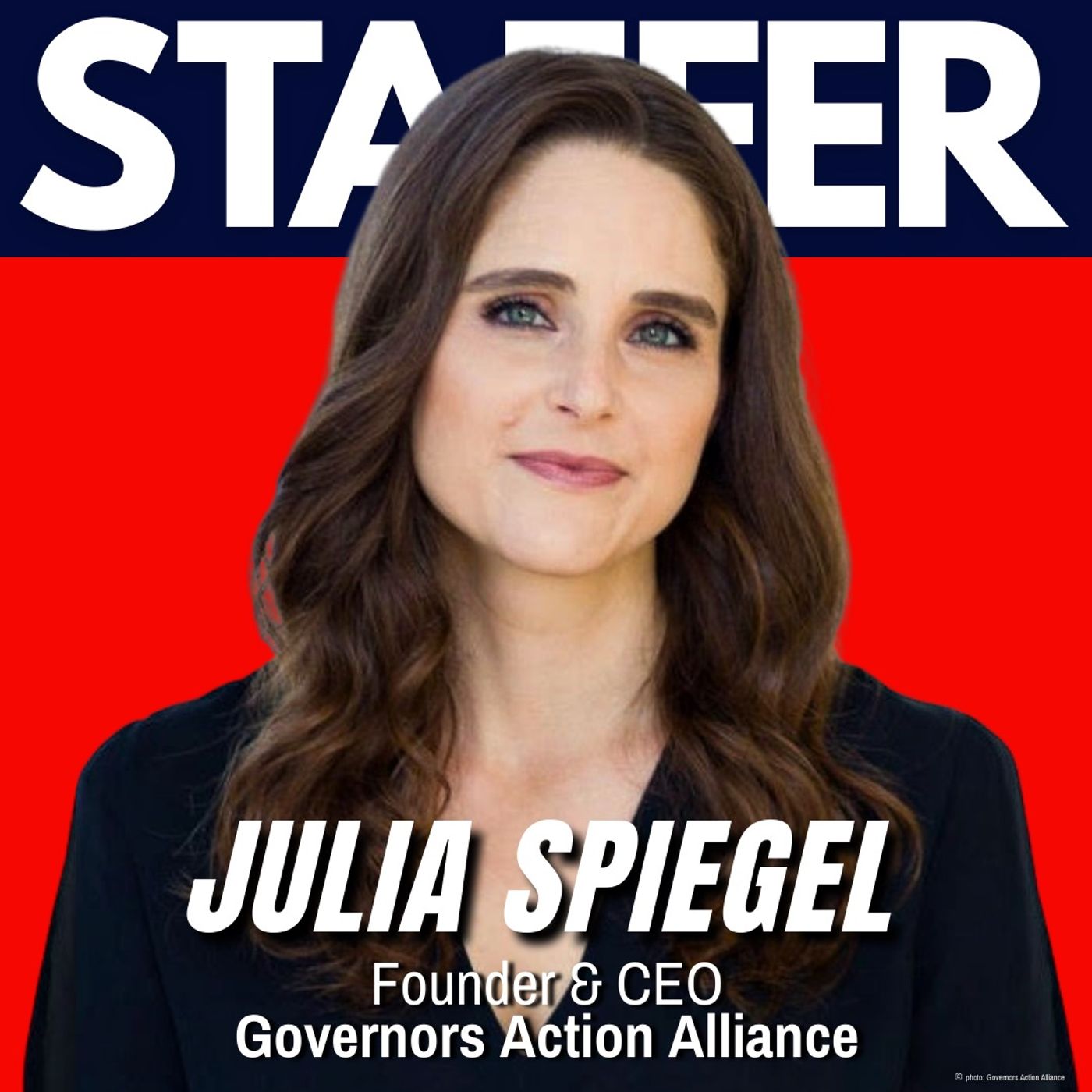
Julia Speagle, founder and CEO of GovAct, is an attorney and former legal counsel to California Governor Gavin Newsom. Her career is deeply influenced by her grandparents' Holocaust survival, instilling a belief in education as a permanent tool and a duty to safeguard democratic freedoms. While at Stanford, her activism against the Darfur genocide steered her toward policy and legal avenues for impact. Professionally, she worked as a field researcher in Central Africa with the International Crisis Group, an experience that exposed the limits of advocacy and motivated her to acquire legal and policy expertise through graduate studies. She later served as Senior Advisor to Ambassador Samantha Power and in California local government, engaging in both hyper-local issues and national impact litigation. Following the *Dobbs* decision, she played a key role in forming the Reproductive Freedom Alliance, uniting governors to protect abortion access. This led to the creation of GovAct, which mobilizes governors and their staffs to collectively defend fundamental freedoms against escalating national threats.
Hello, everyone, and welcome to Stafford, the show about people who work in government or politics at any level and what they take from the experience. I'm your host, Jim Papa, a partner at Global Strategy Group and a former staffer myself. Today, I'm excited to welcome Julia Speagle, founder and CEO of the Governor's Action Alliance or GovAct. Julia is an award-winning attorney who has championed fundamental freedoms at the highest levels of federal, state, and local government. As legal counsel to California Governor Gavin Newsom, when the U.S. Supreme Court overturned Grovy Wade, Julia launched the Reproductive Freedom Alliance, which brought together 23 governors to fight for reproductive freedom. Her innovative strategy for states to stockpile medication for abortion ahead of national threats to ban the drugs was profiled in a New York Times article on leaders at the forefront of the fight to protect democracy. Building on the alliance's successful model, Julia left government service in 2024 to launch GovAct, which marshals the collective strengths of governors and their senior staff to protect fundamental freedoms. Julia's career prior to joining the California Governor's Office is fascinating. She litigated high-impact cases on immigration, voting rights, and other social justice matters in the Santa Clara County Council's office. She served as Senior Advisor to then U.S. Ambassador to the United Nations Samantha Power. She clerked for Judge Margaret McEwan on the U.S. Court of Appeals for the Ninth Circuit. For her work protecting democracy and fundamental freedoms, Julia has won multiple awards and honors, including the California Lawyer of the Year Award and the Squire Pet and Boggs Foundation Distinguished Fellow Award. I am really excited to present my conversation with Julia to you. We recorded on Monday, January 26. Julia Speagle, welcome to Stafford. Thank you, Jim. It's such a pleasure to be with you. It is wonderful to have you here today. Thank you for making time for us. As you may know, with these interviews, I like to start at the very beginning. So can you tell our listeners a bit about where you grew up and what your family was like? You bet. I love the chance to go all the way back. So I am born and raised in the San Francisco Bay Area, surrounded by a family who's focused on science. My folks are professors at Stanford. My mom is a stem cell biologist. My dad is a psychiatrist. So as you can tell, the apple fell very far from the tree. Definitely let them down and did not enter the sciences. But the deeper, darker story behind the family origin is that on my mom's side, my grandparents are Holocaust survivors. And that narrative, that story, that history really animated much of my upbringing in ways big and small, where we would compare the price of butter to different grocery stores and my grandpa taught me, never miss the opportunity to use a clean bathroom because you never know when the next one will be. There are these, it was just ever-present, even in these very subtle ways as a little kid. And so in so many respects, I feel like that history, both of what can happen when a country turns against to people, but also what America represents as this land of opportunity and a place that took us in to give us refuge to build a life where my parents can be here and become faculty at Stanford. And I can have similar opportunities to build a career. We didn't take that for granted for one second. So that's just part of the fabric of this incredible opportunity and also the weight of understanding what the world can look like if it goes sideways. Yeah. Growing up with that background, and now you said you didn't pursue science. You obviously have lived a life in public service. How did you find that pathway for yourself? You know, as an evolution, I think for some folks they know from day one what the perfect magic plan was. That was never the case for me. I think I knew I wanted to contribute in help in some way. I originally really upset my parents by being pre-med and then no longer being pre-med when it didn't feel like my calling, my way of serving the community. But what I found, it was actually as I was a student at Stanford, the first genocide in the 21st century was taking place in the Darfur region of Sudan. And I became a student activist on it and I met some of my best friends on campus and we spent 90% of our days when we probably should have been focused on our studies, figuring out how we could mobilize around raising awareness. And for me around how to use the levers of American power to try and prevent and stop the genocide. So it was an interesting avenue for me as a student to see of all the ways I could engage in this issue, right? There's student activism, there's protesting, there's dions. I was gravitating towards writing the policy papers and looking at what are the actual legal and policy solutions. And that was really telling for me, I think, about here's where I'm finding my voice in this ecosystem, their issues I care about, especially given my family's history. How can I have the most impact? And it was the policy lane and how we can mobilize American power that really captivated me from an Earth age. Isn't it amazing how such an education within an education took place there? When you go off to college, most young people are thinking about what they're going to learn in the classroom or maybe about what they think they know about college. But then you find yourselves involved in something like fighting against a genocide and you learn so much, not just about yourself, but tools and tactics and pathways that you didn't know existed, but that are going to serve you throughout a lifetime. And it's where I found my voice and what I consider my people and ways that as just a student, I think, didn't feel like I took my academics very seriously, but I was not the student in the front row raising my hand first every time going to all the office hours. That's not where I felt the most confident expression of myself in that setting. And yet through this activism work, I got to know a wide range of incredible faculty very well. I found other ways to excel and develop those relationships that were maybe not what you consider the typical pathways. And I've actually, I've had the blessing of over the last several years, I taught it Sanford in a variety of capacities. And that's been one of the blessings I've tried to share with students that there's so many different ways to find what makes you tick when you're on this campus. And some of it is in the classroom and some of it is not, but the idea is to get to explore all of that and try things. You know, once we're older and out in the world gym, as you well know, it's not as easy to dip a toe in and then take it back out and say, you know, actually, that, yeah, I don't love that as much as I thought I did. Yeah. Well, an education has been a big part of your journey. You mentioned undergrad at Sanford. You got a lot of degree at Yale and masters in international relations at Princeton with that background, along with kind of what you were learning as we just said through experience. Tell me, how did you, you know, end up in your first job post education, post formal education? How did that come to be? So it actually was related to the student activism I was doing. We brought some speakers to campus to talk about the war and what different actors were doing. And I invited someone from international crisis group, John Prendergast. And we had this lively student debate. We got to present to the policy makers what we thought should have. And of course, you know, that when you're, you know, 18, you think you have all the answers and you quickly learn, you do not. But it was a great opportunity to test it. And stayed in touch and then said, I would love to work for the international crisis group when I graduate. How can I find a pathway for doing that? And it was through that panel, those connections that I developed that I was able to join crisis group after I graduated first in their headquarters in Brussels. Then I went to their Africa program in DC and then ultimately landed what felt to me, like this dream opportunity to be a field researcher in Uganda, Sassuyan and Congo on the Lord's Resistance Army rebellion that stemmed from Uganda but had become a regional conflagration. And the way that crisis group focused on these issues that I was so passionate about, you know, I had spent, I talked about student activism on campus. I spent all this time in my academic studying about, you know, study political science and economic studying about the drivers of war. Why does it persist? What actors can do? I did my student activism as best I could. But still felt so far removed from the people in places affected. And you can only read and listen to and learn so much before you, you know, you feel like you hit that wall and actually need to be on the ground to better understand. Just like if you're trying to understand another culture of place, you can read every book on China and then you land on the ground and you have a different sense of it. And so this was really a dream come true for me to be able to be on the ground and the aim was to get to know anyone with any stake in the war. So those are folks living in internally displaced camps. Those are rebel militia. Those are formal rebels who have left and are negotiating some sort of agreement with the government, government officials, the Ugandan military. So my job was to know all of them and start to piece together this past. You should why this rebellion and this war is persisting and what global actors could do to resolve it. And it was foundational in my life, absolutely changing my whole life trajectory and perspective. Yeah, searing. I mean, what an experience that just has to leave you changed. What are some of the things that you carry with you from that experience that inform what you do today? On the professional level, it's one of the reasons why I actually also went to grad school. I found it so deeply moving and incredibly impactful to what I was originally there to do is to attend peace talks. So we camped out on the border, Assassin and Congo, hoping that Joseph Coney
would show up for peace talks. He did not and it was unravelled. And then the result was that the job shifted from attending peace talks to going to massacre sites after failed military operations had gone awry and repilators had marauded through various areas of Northeastern Congo. It was a very intense experience, especially as a 22, 23 year old, out on my own, working for an organization, of course, that largely having operate independently on the ground. I think what Hickney professionally was that I was there witnessing what was the worst day of people's lives and having them recount to me their incredible traumas. And I felt like I couldn't promise in return. There was all that much I could do. And so I felt compelled to figure out what are the tools, what are the ways that I can get smarter and better and more effective, whether that's through the law or policy or something else. What can I, what can I marshal that will help in this situation so that I can actually give more back than what I was currently doing in those circumstances? And then personally, I met my husband, so, you know, (laughs) that's a definitely a positive repilator. He's a neighbor and a compound that I lived in in Uganda. And so, you know, he was there for one of the most monumental moments in my life and we've been together since. - Yeah, you know, you mentioned when you came back, how you viewed education. I read an interview where you said, you've always viewed education as a process of gathering the skills that you may need to, you know, utilize in your passion as you move forward. Where did you get that advice and is it something that you still tell young people to do today? - I do. I believe it really deeply. I do think some of it for me stems from that family origin story that I shared with you at the Holocaust, which is we were taught at a young age. You may not be able to count on living in the country you came from. You may not be able to count on having your citizenship, but you know what, no one can strip away from you is your education. No one can take that knowledge. No one can take those skills from you wherever in the world you are. So that was something that I felt very strongly deeply and then it was actually through a mentor of mine, Jeremy Weinstein, who was then faculty at Stanford. Now is the Dean of the Harper Kennedy School, an extraordinary policy maker, a concurrent mentor. And I remember I was trying to figure out that next step of how to be more effective. And he's the one who actually posed the question to me, well, Julie, if you're ever in a position, you've been advocating on how the US should resolve, respond to the genocide in Darfur, you care about mass atrocities. What if you're that person that you're advocating to? What if you're that person sitting in the federal government? What are the tools and skills you want to have available so that you're maximally effective? And that's what compelled me to think, okay, you know, I promise I'm not just a glutton for academic punishment. I wouldn't otherwise have probably done a dual degree, but it felt like, okay, if I have the law and the policy, maybe that will give me a framework, a set of tools that will enable me to be more effective. - So tell me, what was the pathway to that first job in government? - So after grad school, I did clerk for a year, so I clicked for Judge McEwen on the night circuit who's just an extraordinary judge and incredible academic person in her own right who cares deeply about human rights and other issues. That was my first put in, but obviously clerkships for those legal path, that's a one year gig, and then you find your next step. It was actually again, Jeremy Weinstein, who then was chief of staff to send me at the power when she was the US ambassador at the United Nations, who gave me a call. I remember I had just taken the bar exams, like, so what are you up to? I'm just recouping, actually. - I'm trying to take a breath. - Yeah, exactly. Trying to not think about the future too much. - And it was through again, that I had this wonderful opportunity, as soon as I finished my clerkship to go in and work for Samantha and I'll share, it was on a postgraduate fellowship initially, which I also encourage students and others thinking about their career. You know, it's a way to get a foot in the door, where you can say, I'm free, I'm ready to work so hard for you, and then once you're in a quantity, you know, and you've proven yourself, then there are other opportunities arise, where you pivot into political appointments, or other things. So that was my foot in the door and never looked back. - I know you, after you were at the US Mission Team, the United Nations, you eventually made your way back to California. Talk to us about what you did when you got there. - So California, you know, he's home, and I'd been away for over a decade. I think a couple of things hit for me. One is that while working for Ambassador Power, and with Jeremy was the dream of a lifetime, first of all, the administration was coming to an end, but even before that, I had started to feel the shift beneath my feet in a number of ways. One was that I had gone very far from being that field researcher on the ground, knowing everyone involved in the war to being 5,000 miles away from the peacekeeping missions. I was trying to help figure out how to reform. I just, I personally, in terms of my voice and feeling connected to the people and issues in place felt far away, and I felt harder for me to know that I was really acting and their best interests or acting and service of what was going to make a difference. And so I knew I wanted to go back into a more local immediate capacity. The other thing, though, more broadly, was feeling the shift beneath my feet that I had had this luxury of focusing globally my whole career. I had this luxury of saying, of course, things are so far from perfect here in America, but others are fighting that fight, and meanwhile, I can focus on mass atrocities and conflict prevention elsewhere. And I just suddenly no longer felt that I could do that, that I had been taking for granted, fundamental freedoms at home. And I couldn't afford it anymore. And so we decided to move back to Arizona from and to work hyper local in the county in Santa Clara where I could live and work in the community we are serving. And on things that are the bread and butter, what affect people's lives, you know, people talk about fixed-the-dame robes. They really care about fixed-the-dame roads. But in addition to that, you know, I had this opportunity to be the kind of lawyer that also sort of engaged in policy where on the one hand, I was able to represent the registrar voters during a presidential election with all the challenges they were facing with election observation and threats and violence. As the same time as I supported the fire districts in navigating massive fires all over the state and region and then needing to deploy endlessly, what does that do to a workforce? What are the risks for them? At the same time, is then able to do impact litigations. I worked for a unit called the Social and Justice Impact Litigation Team and they focus on nationwide impact cases. And so we filed the first ever lawsuit challenging then the Trump 1.0 Sanctuary Jurisdiction Executive Order, public charge litigation, a whole range of big impact cases. So it was this very exciting opportunity to go national and big and also hyper local and direct at the same time. Your work today is very much integrated with this, that national threats that affect people in specific geographies and in really deeply personal ways. Can you talk to us about the Governor's Action Alliance, GovAct, what is it and how did you form it? GovAct is an outgrowth actually of the work that I did for then Governor Newsom. So after I worked at the county, at the opportunity, we'll go work for Governor Newsom as Deputy Nigola Affairs Secretary. And I was there with the portfolio of issues focused on health and human services, immigration, consumer protection and more. And I'll tell you just a little bit of the origin story that then explains what GovAct is 'cause I think that the journey gets, it tells you much of it. - Great. - So we were there when the DOBS leak opinion came out. And overnight we saw that a fundamental freedom, that again, we had sort of taken for granted across the states would be stripped away. And we didn't have an apparatus ready. We like, we have, I have a colleague who used to say, you know, we expected the cavalry to come rolling in and then we realized the cavalry was us. You know, we as staffers, where they are having to pick up the pieces of fear of what do we do. So I started to throw myself at the problem, working on behalf of the Governor to look at all the ways we could protect providers and patients and abortion care access in the state. Even though that wasn't even technically part of my portfolio, just started jumping in to try and help. And the state did incredible things, advancing really creative laws to protect patients' providers. We passed the first constitutional amendment with thanks to California voters and trying the right to reproductive freedom in our state constitution, which I'd like to think helped light a wave across the country, a ballot initiative's doing the same thing. And what happened organically, Jim, is that I got incoming from other Governor's offices who tracked me down, they called five different people and said, hey, are you the person working on these issues for Governor Newsom? I've got questions for you. We're considering something similar, but I'm wondering about this language versus that. Why didn't you mean this group versus that? You know, the inside baseball, when you find someone who understands the constraints and the possibilities that you're facing and you can have a candid conversation with. And that just happened organically several times in the reproductive rights context. And we thought, this is wild. Why are we working in our state silos? Like sure, of course, every state has its unique politics and its unique constraints. And yet, we're facing common challenges. And we all want to row in the same direction. So why isn't there a vehicle to do that? So that is what gave rise to GovAct as a central platform that supports governors and their teams in protecting fundamental freedoms and it's mobilized, it's organized around a set of alliances. So the very first one is the reproductive freedom alliance that we then formed with Governor Newsom's incredible leadership with 23 governors.
And it created this connective tissue across governor's offices so that we could do things at scale. We could support each other. We could be faster, nimble, and it was so potent that we realized we needed it on other issues too. So currently, Gavak does that central platform, enabling this cross-state coordination. And now we also have an alliance in democracy called Governor's Secret and Democracy, and most recently, a governor's public health alliance, given all that's been happening with respect to federal policy on public health. You know, this this through line of this, you know, the the family experience that was imparted to you and then your time in East Africa and then coming home to find freedoms that were once assumed evaporated. What what lessons do you take about the importance of institutions? Institutions are paramount. I just I can't underscore I know we love to bash institutions, you know, like is like the institutions aren't perfect, just like people aren't perfect. Turns out institutions are largely made up of people and we're going to fail and not do everything right. But what I have witnessed what my what my family story imparted to me, what I witnessed on the ground of East Africa, what I see here in the US now is that when institutions falter, people suffer. And the the extent of that suffering can become so incredibly extreme, and it can take so long to come back when you see a true failing of those institutions. And so I I have just dedicated myself as as you name Jim's federal state local government and now a non-profit that supports state government because I just see how incredibly impactful and important those institutions are in meeting the needs of people and we're in this moment where it feels that if government doesn't meet daily needs, then what's it for? Right. If it doesn't actually improve people's daily lives, why do we have it? And so it just feels like we're in this this critical moment, but even outside of this current bubble and context that we're in, it's always mattered. It's just taking their different levels of awareness that are not, you know, maybe sometimes in governments at its best, you don't even notice it because it's just doing all the things that you need to have the roads cleared and schools open and everything else. But it just has really crystallized for me the incredible import of these institutions and then the people, you know, to speak to the namesake of your podcast, the staffers that are in there making things work and that, you know, in many ways, Galvat isn't owed to those staffers, I will say, just to tell you how much I love the focus of your podcast and so much of your work, Jim, because it is, it is those incredible staff that work day in and day out without the glamour, without the bright lights, without, you know, in many cases, like the extraordinary pay or whatever else to make those institutions work better for people. And we have so much to thank them for, and especially in moments like these. I couldn't agree with you more. And your experience just on what happened with dobs. I'm sure you were preparing in the lead up once the Supreme Court, you know, took the case. But what I love about that story from a staffer perspective is, you know, you had gained all of these skills that, you know, were in some ways far afield. But at a particular moment in time, you were the person who needed to become the expert to help the state navigate this incredibly shocking moment in public policy. And through your, you know, expertise, you then others, you know, came to draw on you as a resource. And that's what being a staffer sometimes is. You don't know what's going to come up, you know, tomorrow that in a month, you may have to become, you know, the country's expert on. And to also know when to martial expertise. So I think there are a couple of things for me that were really valuable. One is that I never quite accepted a binary of either your lawyer in government or your policy person in government. I always, every job I had, I made it both. And I do think that's a bit atypical. But the result was that you could see a problem like a fundamental freedom disappearing. And say, what are the sweetest solutions? Not just legal options, not just policy options, but the full range. Yeah. And I think that's very helpful and empowering because you can look at it more holistically and then figure out how to marshal it. The second thing though is that, you know, there are incredible reproductive rights advocates who sell the writing on the wall for a long time. They were canary in the coal mine. They've been experts working on these issues for decades. I did not pretend to be them. You know, I was very clear. I am newer to this issue. I know how much it matters though. And I'm here dedicated to try and learn and figure out creative solutions. And I do have a sense of how government works and what levers and tools governors possess. So how can we work collectively? How can I learn from you? How can we build something together? And so I was able to, I think at least attempt to enter that arena with some humility because otherwise it can be intimidating, right? You know, either these folks who've been experts in a specific issue area for decades. And here I am coming in saying this actually wasn't even in my portfolio. However, here I am really ready and willing eager to try and help. And, you know, ultimately it became the governor's first senior advisory reproductive rights. I don't think that's a position that's existing. Other governors offices before that it became this testament, I think, to the growth of the work and to the movement and the people serving in it. That it meant so much actually to the broader community that that role, like, regardless of me, that that role existed in the governor's office in that moment to show what a priority, because you know, staffing reflects priorities, right? Staffing reflects what matters. That's right. And so it was a signal to the whole community and across the country of how much protecting reproductive freedom mattered to governor Newsom. So today as you lead, Gov. Act, what, how would you describe your leadership style? You know, you've given us some clues about working with others, but I'm curious how you would describe it because it is a new endeavor to go from working within a structure and for a principle to founding and running a new organization. It is. I learn that every day, Jim, it is definitely different in all sorts of ways. And I, you know, I wish I could ask my colleagues what they think might be their ship style is because that might be more revealing than my own reflections, but I will save that for another time. I, you know, I'll share an anecdote, which is that we, we had an all-saffer treat and we engage in this thing called the leadership compass, which not sure if you're familiar, I know there are all sorts of different tests out there, but this is one that's fairly intuitive. And it helps every person figure out their leadership style. So there's Northeast Southwest. Each quadrant represents a different orientation to the work. And that I thought was so beautifully impactful because at the end, we had all the staff charted. We could see on a map where we all were in the different quadrants. And one of the beauties of it is that kind of depersonalized the differences. So to answer more directly a question, I was Northeast, which means I am very action oriented. And I like vision. Like I like figuring out what's what's the longer game of where that action gets us going. And it I saw on on that map, like that is that is a typical most people were more south southeast or southwest, which, you know, meant more analytical and more emotions based. And so that I thought was just so needing and helpful because it's you know, really isn't about personalities for say, but just to understand like we all have our different styles. And so and then how can we see as a collected as a team, how we make up a team of styles and work together on that. So that's been a really interesting illuminating tool. And I did not quite realize how action oriented I was until seeing myself on that chart. Yeah, those self assessments are handy, you know, because all we know is our own perspective. And it is as you say, helpful to also have it depersonalized. Yes. Just figure out what your styles, your likes are, etc. They can be quirky, but within an organization, they can really serve a purpose when an organization is balanced. Exactly. And also for us to all realize we all have our leadership styles, right? It's not just about the person that's out like we all are leaders within this organization and I'll have ownership over it. And so how how do we look at that collectively and work most effectively with each other. So now I know, for instance, there's some folks who are on the deeply analytical, like they want to have assessed every aspect of any issue before we make a decision, you know, I now know that and can figure out, okay, what are the questions they will want to have answered first before we have this conversation? It's just led to a much more productive way, I think of engaging because we can kind of understand that and they'll know, okay, Julia is actionary and she's going to want to make a decision. So let's figure out one needs to get done so that we feel comfortable being in a place to make a decision. Yeah. Is there anything that you had to learn to do less of now that you're leading an organization and relying on staff? I'm sure they would say yes. I'm still very much used to being the worker bee, you know, which I think is a hard, it's hard because obviously empowering staff who, you know, my team is just extraordinary in every way. They are far more effective at the best majority of things than I am and knowing that and getting out of my own way, I think is important. I guess the other thing I found hard, I will say as a shift, is that for so much of my life and career, I have been there to answer the call to anything others need and now I have to find time to protect myself to have space to set
agenda and be affirmative and not just be responsive to whatever and else is saying the need of me. And that's been hard. It's a hard shift that I'm not as used to. Yeah, and you're building. So it is not like you're stepping into an organization that has its own infrastructure from day one. You're building and leading and running and doing all the same time. That's exactly right. And yeah, and so we're setting, we're creating a whole new culture or a whole new apparatus. It's also just not a thing that had existed across state government before. So, you know, it's new in a lot of ways. And I think part of what I've really committed myself to is having fun along the way. You know, we crack jokes a lot that are all separate treat. We play with puppies for a while who needed practice socializing, which we're very happy to offer our services. You know, I think trying to find trying to find a moment to joy. You know, it's an intense time out there. There's a lot of hard work to do and how how we can build a fabric that is energizing and joyful even in the context of that is is really a big goal of mine. Yeah. So you've had so many different types of experiences in working with staffers. You've worked in the executive branch. You've worked in the judicial branch. You've worked at the federal and state. You've even worked overseas. So tell me having all this exposure to staffers, what do you think really good staffers learn early? Mm. Such a good question. One, there are few things that come to mind about the most effective staffers that I've seen or just so effective. One is a yes and mentality. You could ask to do something and it is yes and what else can I do like with this also be helpful. It's so easy to tear things down. It is so hard to build them up. And I think having that approach to say, you know, a principle is saying, here's a need and your response is yes, I can help do that and here's how else I can do it. It is like music to a principle's ears as I see it and have witnessed over a while. I think then second, then you actually have to deliver, right? So you have to have the work ethic and the consistency and be reliable, right? So that when they then call back the next day, you've actually dug into that thing and delivered, right? Because reliability, I just think is so when people are dealing with these incredible pressures in government and elsewhere, you know, you need to know you can count on your people. And so I think the combination of yes and and then making sure you know, if anything, you're under promising and overdelivering, that is really critical. And then the final thing I'll say that I think is maybe less, less common, but I think from my mind, it's so important is that folks who early on take feedback as a gift, they don't take feedback as an indictment or as a character assessment or as something deep about who they are as a person, but as a gift to get better. Because we all have to improve. We all are learning our whole careers and lives and to be able to take those moments of feedback and turn it into something productive, you just see people skyrocket in their careers, I think, as opposed to taking the hits and feeling and feeling hurt by it and not able to kind of internalize how to improve based on it. Yes. Whenever I get feedback like that, I like to tell myself, I'm a work in progress. It's because sometimes it feels frustrating and you can't help, but we're all we all strive to be A+ students, right? That's what we want to be. And when something isn't quite right and you hear it, you know, you get it back, there is sometimes a moment of resistance, but to your point, training yourself to welcome it is just an amplifier of talent. If you can teach yourself to get through that. Yes. And in fairness, you know, not all feedback is the same, right? And people can have good supervisors and bad supervisors and some feedback can be justified and some of it may not. And I think, you know, the question I tried to ask myself is what part of this feedback is worth keeping? So it's not to just wholesale say, like, of course, you must absorb whatever it is is imparted to you because it ain't always going to be fair or accurate or just or whatever else, but is there something in there that is worth taking? And if not, okay, like you've made that decision, you've looked at it, you've interrogated it and said, okay, none of this was actually valuable to me or you're able to say, well, part of this felt really unjustified and I don't think is accurate, but maybe there is this piece that I really should have worked on and done differently. And so I think for me, that's that's the frame, not wholesale take it in because it isn't all worth that. But what are the pieces that you can look at and say, is this useful to me or not? Yeah. Are there a couple of things you do each day that are important for your success? That others kind of adopt, is there anything you read? Is there anything you do? That's just part of your routine. Small but important to you. Yeah, I'm so envy as a people who are still reading books. I have those friends who post you end of here. I read 500 bucks and I think, oh my lord, so jealous. So that is unfortunately not part of my daily routine other than obviously all the work stuff that I have to read. I have two beautiful kids who I hold close and are really the grahamming factor in future in my life and addition obviously to my husband. So I always make sure to have some quality time with them no matter how short it is or even if I'm away, I record videos for them, we, you know, FaceTime, whatever else. I do try and take some time to exercise and or get outdoors. It just feels so important to show up the way that I would like to show up as a person is to have that that space in time. Sometimes it means it's very, very, very early in the morning, but it is still ultimately worth it, I think, to make that space in time. And then to stay in touch with my community, you know, I think having those, you know, maybe some people are blessed to have dozens, but even if it's just a few people that you feel you can really go to and either crack jokes and be totally silly and not have to think about the tough stuff for a moment or share the really big challenges of the day. I think remaining connected and not allowing the weight of it all to swallow you, that for me has been very grounding. And so that may mean short phone calls or short walks or even just texting so that I, you know, can get, you know, some of those we have to get out of our own heads and make space for for those other people in our lives who know us and can also say, hey, you don't sound like yourself today or, you know, you know, that sounds like a really challenging issue. Have you thought about it this way? Yeah. And that is, that is a discipline, right? Because work can consume you. It will always, it will always be incoming and being able to manage it so that you can still succeed and accomplish what it is you want your professional life to make a difference on. But also protect yourself and your family and all of the, those other things that are critically important to one's life. Yeah, it turns out the other things in your life require nurturing as well. You know, it's not like you can just nurture work and expect family and friends and physical well-being and mental well-being all just be there. You have to nurture those things too. And it's hard because they are the first things that fall by the wayside, you know, and really good. And so does take that intentionality, I think to say, I'm not, I'm not going to let that happen. Here's my priorities and here how I'm going to make sure to maintain it. You know, I have friends and actually my husband has a, every Sunday he does a set of phone calls to his closest friends every Sunday. He even did it in Uganda. I mean, for ages or friends giving tradition that we've now been for 17 years. You know, there's certain things that if you can put in place those traditions, the traditions hold you up in the end, you know, like it's no longer a question, oh, do we have space in time to do this thing? So tired Thanksgiving was a big to do. Oh, if you've done it for 17 years, you're doing friends giving. You know, it's coming. It's planned. You'll have it, you know, there's already a life force around it. Yes. And then you get to just be the beneficiary of it. So I think there's real value, also building those traditions. Yes. Such a good point. Okay. There are a couple of questions that I like to ask people at the end of our interviews. One of them is called in the vault. Can you tell us about a time when you made a mistake? What happened and what did you learn from it? I can. So I'll share I'll share one that you know, I first blush the non-noirers may say like this is such a silly example. But I will explain to you why it feels like a very serious example to me. So yes, that's here working in executive office, you know, executive actions are really potent and powerful and reflect the principle of that executive. And I was early on in working in that office and drafted an order that had to have the legal effective law, right? And I had 24 hours to do this. It was a mad dash scramble. And I used an outdated citation, which I'm a guarantee lawyers listening to this like, oh, no, because it's your worst nightmare, right? Like this is a legal document. And the thing that you're actually hired to do like the baseline of what you're supposed to be confident at is accurate legal research and citations like that is the floor, not the ceiling. And I just messed up that floor. And there are a couple of reasons for it. You know, one is that I was moving really fast. I did 24 hours and was scrambling to get it done. But that's not good enough. I should have done another review myself before pushing a forward to because I was newer. I was nervous about letting other people in. So I should have there were others on the team who could have also given it a read. And I didn't have
I felt this need to take it on myself and I can do it and I'll show what you know that they've been powered me to do this thing So therefore I should be able to do it as if getting another set of eyes on it Somehow would diminish the fact that I had drafted it and done it So I missed an opportunity to bring in the right people who could have had the right eyes on it and caught that But then three the thing that I I did do that I feel proud of is I immediately called my supervisor and said Mea Kulta I mess this thing up. I'm so very sorry. I Have a you know revised draft order that will rescind and replace does this work for you and the supervisor I actually think it bonded us the supervisor Was so grateful said don't worry. I'm so glad you called me and told me right away That sounds like a great solution and that was it and I think it built the trust You know to be able to say like and I wasn't I you know part of was part of me tempted like but I only had 24 hours and I was Scram, you know like there were all these things inside that I was feeling of course But to be able to own I need this mistake I'm really sorry about it. You're the first person to know I'm calling you right away Here's a proposed solution does that work. I think it built a level of trust and respect that I think so does really well going forward and My god, I did not make that mistake again. Yes. Yes Well, and then That moment of grace that you received you know one It does open the door to all of those lessons You know that you said you like you right you can onboard the lessons so much more Abely when the boss has said okay, we're gonna fix it Glad you handled it well and also what a good example for us You know when when we're dealing with anyone else who has made a mistake, you know inevitably made a mistake That's a good lesson for us on on how to handle somebody who's just you know doing everything they possibly can and is human just like we are Really true on both sides Yeah, I love that I'll also just note I have found that all the mistakes I've made that have been so painful those are the ones I really over index on I'm not repeating My make elder mistakes now I'll try to make fresh ones. Yes. Yes. I'll be crazy about the new ways that I messed up. Yes. Yeah, not that one again But it's but that shows that you know, we've deeply internalized it right and at least learned some lessons from it and And I think that's that's important and helpful to own totally totally Thank you for that. Okay last question for you if I Was able to raise the money and get the permitting to build a Hall of Fame to staffers on the national Mall who would you nominate for the national staffer Hall of Fame? Jim tell me you're already fundraising. Is this a thing? I was right. They're right. It's still imaginary unfortunately. I've asked this question a lot. I should get on the fund Yeah, yeah funders who are listening. This is an opportunity. It's a very important opportunity Especially I joke around but Man given how maligned public servants have have been in the last few years and what an importance in impactful career path like they they do deserve all So thank you for the the thoughtful question I will name a few that come to mind but I I could spend hours frankly to own this question One are the chiefs that staff to the governors especially folks like Ann Caprae are working for governor Pritzker Indeed, but often I'm working for governor pollists and then their chief lawyers like these are the folks fielding wildly challenging issues Every minute of every day in addition to just trying to help the trains of government run And so those are folks like Anspelayne whose chief counsel to governor Pritzker and to Dave Sap whose counsel to governor Newsom in California To Brian Mahana who is special counsel to governor Hocal like these are folks who their name should be like sung loud and proud across this country because they are Bed rocks of these administrations that are taking on so much to meet the needs of people and their jobs are hard and any ordinary circumstances And it's just grown astronomically and so I I could not You know shout their their praises and be more in awe them and and just grieve for the opportunity frankly to try and help serve You know to be a resource and ability to support the incredible they are driving day in and day out Yeah So well put They're all in first ballot. We'll get started on on the statues Julia, thank you so much for spending this time with us to talk through your journey and most importantly for what you do Because it really is so critically important and you've you've spent your life Working on behalf of others and you really typify what what this podcast is intended to lift up and praise and learn from So thank you. Oh, thank you Jim while your podcast is focused on the unsung heroes that That I think do so much for this country. So right back at you appreciate the opportunity and all that you're doing Okay, everyone. I hear the gavel pounding this meeting to a close which means this episode of staffer is adjourned I want to thank you all for listening to the only show created for and about the people who work in government and politics at any level I do have a quick favor to ask Please follow subscribe and like the show on all of your favorite podcast platforms Positive reviews are everything in this business. I'm told and make sure to sign up for episode alerts at staffershow.com and check out staffer show on Twitter Facebook Instagram and LinkedIn
Podcast Summary
Key Points:
Julia Speagle's career is driven by her family history as Holocaust survivors, emphasizing education as an unassailable asset and a commitment to protecting fundamental freedoms.
Her path into public service began with student activism at Stanford against the Darfur genocide, leading her to focus on policy and legal solutions over direct activism.
Early professional experiences included field research in conflict zones with the International Crisis Group, which highlighted the need for more effective tools, prompting her to pursue law and policy degrees.
She held significant roles such as Senior Advisor to U.S. Ambassador Samantha Power and legal counsel in California, where she helped establish the Reproductive Freedom Alliance after *Dobbs*.
Speagle founded GovAct to leverage collective gubernatorial power against national threats to democracy and freedoms, building on her state-level advocacy model.
Summary:
Julia Speagle, founder and CEO of GovAct, is an attorney and former legal counsel to California Governor Gavin Newsom. Her career is deeply influenced by her grandparents' Holocaust survival, instilling a belief in education as a permanent tool and a duty to safeguard democratic freedoms. While at Stanford, her activism against the Darfur genocide steered her toward policy and legal avenues for impact.
Professionally, she worked as a field researcher in Central Africa with the International Crisis Group, an experience that exposed the limits of advocacy and motivated her to acquire legal and policy expertise through graduate studies. She later served as Senior Advisor to Ambassador Samantha Power and in California local government, engaging in both hyper-local issues and national impact litigation. Following the *Dobbs* decision, she played a key role in forming the Reproductive Freedom Alliance, uniting governors to protect abortion access.
This led to the creation of GovAct, which mobilizes governors and their staffs to collectively defend fundamental freedoms against escalating national threats.
FAQs
GovAct, or the Governor's Action Alliance, is an organization founded by Julia Speagle that marshals the collective strengths of governors and their senior staff to protect fundamental freedoms, building on the successful model of the Reproductive Freedom Alliance.
Growing up with Holocaust survivor grandparents instilled in her a deep understanding of the consequences when a country turns against its people, as well as a profound appreciation for America as a land of opportunity, which motivated her career in public service and protecting freedoms.
As a student activist at Stanford during the genocide in Darfur, she discovered her passion for using policy and legal solutions to mobilize American power, which set her on a career focused on impactful advocacy and government work.
As legal counsel to California Governor Gavin Newsom, she launched the Reproductive Freedom Alliance after the overturning of Roe v. Wade, uniting 23 governors to fight for reproductive freedom and pioneering strategies like stockpiling abortion medication.
Working as a field researcher in conflict zones like Uganda and Congo exposed her to severe human suffering, compelling her to seek more effective tools through law and policy to create meaningful change and give back to affected communities.
She views education as a process of gathering skills needed for future passions, emphasizing that knowledge and skills are invaluable assets that cannot be taken away, and encourages exploring diverse pathways to find what truly motivates you.
Chat with AI
Loading...
Pro features
Go deeper with this episode
Unlock creator-grade tools that turn any transcript into show notes and subtitle files.
 PodcastTranscript AI