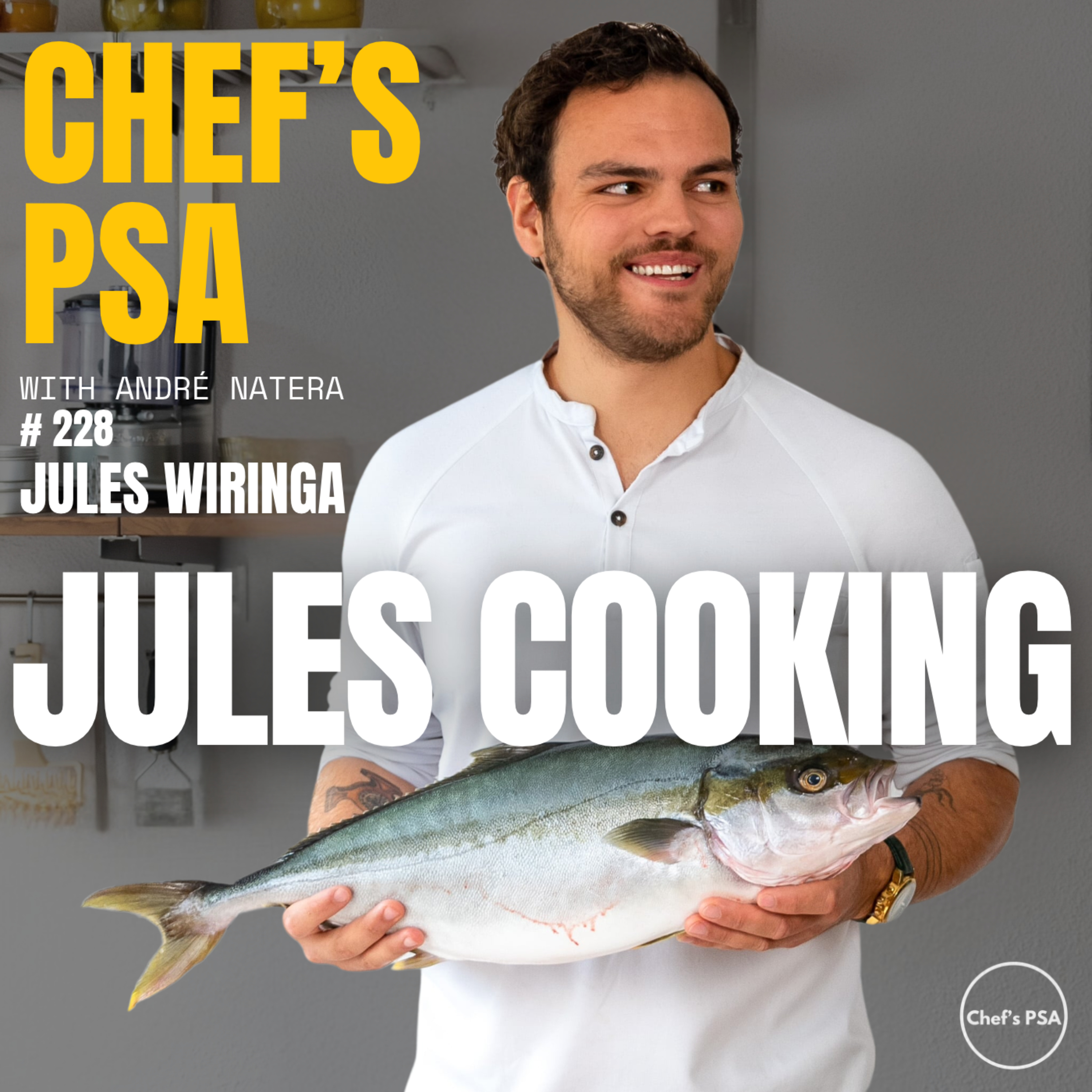
Jules Cooking: Michelin Kitchens, Gatekeeping, and Why Chefs Must Share Knowledge Ep. 228
from Chef's PSA Podcast
1h 2m 24s
Jules, a renowned chef and culinary educator, reflects on his journey from working in high-end kitchens to building an accessible, transparent platform that shares precise, tested recipes. He identifies a critical gap in traditional recipes—many omit key details or methods—leading him to manually revise and verify thousands of recipes to ensure accuracy, clarity, and educational value. His content is designed specifically for chefs, emphasizing practicality, scalability, and real-world application, with each recipe backed by video demonstrations and detailed notes. He strongly opposes gatekeeping in the culinary world, arguing that knowledge should be freely shared to empower the next generation of chefs. Drawing from his experience in Michelin-starred kitchens, he highlights key skills like efficiency, temperature control, and large-scale cooking that go beyond culinary school training. Jules advocates for balanced, well-paced dining experiences, criticizing overly long tasting menus and excessively strong flavors that overwhelm guests. He emphasizes the importance of humility, mentorship, and the profound impact chefs have on young professionals’ careers. Ultimately, he plans to open a fine-dining restaurant, where hands-on service and team engagement will remain central, reflecting his lifelong passion for the kitchen and its human element. His work bridges education and practice, making high-level techniques accessible and inspiring a culture of openness and continuous learning in the culinary industry.
And I think a lot of chefs need to understand the impact that they have on people.
All the sudden, it was like I wasn't broke, okay?
I had to come in and I'd like, set it.
Eight o'clock in the morning was still dark.
Here's some things that you need to prepare yourself for.
I was like, "What the fuck's going on?"
Well, they tasted it, and they always find so many things that that's wrong with food.
I have to say that he was at that level, one of the nicest chefs I've ever met.
Chefs are pretty cool.
That's fucked.
Hello, chefs. This is Chefs.
PSA, and I'm your host, Andre Natera.
Some chefs are so good, they only need one name.
Today, that's Jules.
He trained at Michelin Stardt Kitchens and became one of the biggest culinary creators on the Internet.
Teaching the techniques most kitchens still get keep.
We get into how he built it and why he gives the knowledge away.
Stay tuned.
But then, what I discovered, I've always had pastry chefs, they made it.
I knew they had a recipe, but I never verified it myself.
What I've discovered with pastry chefs is they always omitted one ingredient from the recipe.
I've read it.
Or they left the method, so they wrote everything out, but they didn't write in the method for the recipe.
These were things that I never checked back then.
I was just assuming it was all taken care of.
It's in this file, and then now that I got there, I was like, "Oh, so there was a way
that they were able to withhold knowledge while still satisfying my request to deliver the recipe."
Because now I found out there's knowledge gaps, and they're almost, let's say, 50% of the recipes
had knowledge gaps in them.
That's a lot.
Yeah.
Yeah, I didn't have that.
We just re-did the website last year, and I had to rewrite, I think, two and a half thousand recipes.
So I did it all by hand, checked everything, wanted to be sure, because I did a couple
tests with AI and everything, because it took me months and months to do that.
But still, the stuff I wrote, they left something out, they didn't do it the way I wanted it.
And I prefer, oh, I'm not against AI, but sometimes I like the human touch, and I definitely
think with recipes, and then you see recipes from a couple years ago, you're like, "Oh yeah,
there was someone, and you needed this little bit of more information, like if you put the
fan on tree for this one, and it's not in the recipe, but now it is in the recipe."
So that's why everything by hand, every double check, and every picture is the same, everything
is the same.
It's the same layout as well, which I really enjoy.
Yeah, my recipes don't gate-keep or anything, it's not that something is just for socials
or anything.
No, everything is tested, everything is with a picture, everything is with a video, and
nothing is being gate-kept.
I think that's super important in these days, you know, I'm sure you came up in a very
similar kitchen to the ones that I came up with, you know, like I said, some of the recipes
were not accurate.
Or the chef knew and always withheld a little bit, no, I'm the only one that makes us.
There was a lot of gate-keeping when it came to knowledge.
I think it's so difficult to do that today with the internet.
You can't.
All the information is out there, and I would want to make sure that since I have you on
the podcast, I think what you're doing is tremendous.
All the knowledge I know I've probably bingeed late at night, just a Jewel's video after
a Jewel's video, and you know, if I'm looking for a specific technique, that maybe it's
like I want to try this out.
Have I seen it before?
I might search your videos on YouTube to see if you've demonstrated it.
So what you're doing is incredible.
I would want to know, first and foremost, is what is your process for creating the recipes
are?
These recipes that you've done in the past, or a lot of them originals that, like, hey,
I got a creative thought.
I want to put this up.
Well, first of all, thank you.
It's different for every single one.
Of course, there's a foundation because I've been working in the industry for more than
20 years, 20 years, and it's just, there is a foundation because I have quite a lot
of knowledge.
I've caught a lot of experience, and I know how certain things go.
So I know that if you break something at 60 degrees Celsius, it needs that long.
If you raise it that 85, it needs that long, and that knowledge comes with experience.
So I think nowadays you can easily learn a lot online, but you still need the experience.
And my recipes always start with that foundation, and from there, I just develop.
So the things that I create now, they are so new, like I didn't do that 10 years ago.
But I just really enjoy developing.
I've been enjoying it for such a long time, and I really love putting things together,
trying new things, and most of the time I do it in my head.
So I think at the moment, I'm working on like 200 new recipes, but all in here.
And once it just sounds right, and I think it's going to work, then I start cooking, because
I don't have the luxury to test, and to test, and to test.
And if it's necessary, I will do it, but preferably not, because timing wise, we create
around 150 dishes a year, so I can't do testing, testing, because it's just not possible.
How much of those dishes wind up on YouTube, and I'm just curious, how many of them wind
up on the editing floor and never see the light of day?
I'd say 2% doesn't wind online, but the rest all does online.
Sometimes I'm just not happy, and I'll try again next year, if the season's back in quite
often.
I'm happy straight away, and sometimes I need to do a replaying, or I just need to adjust
a little thing.
But then still, when we film something, and I'm very happy with how it looks in the texture,
but flavor wise, it needs like, okay, let's put 10 more grams of vinegar, then I'll just
adjust it, test it, but we don't refill it, because it's going to look exactly the same.
So the recipe gets adjusted, but then I don't need to refill it, because the whole producing
is what takes most time.
Yeah, that makes perfect sense, and when you're doing the voiceover and writing the recipe
out, that's where the adjustment happens, because the video remains the same.
But that makes a ton of sense, 150 recipes, that's insane.
Yeah, 150 dishes, so times writing components.
Right.
And do you have a system, like if you had to say the foundations that you use, so they're
repeatable, you always make, I'm just making this up, do you always make the same chicken
stock, or do you change it up, depending on what you're making?
Yeah, definitely.
I mean, I have foundation recipes, so let's say I have around 100 foundation recipes,
one fries cream, one for soul bay, chicken stock, but then still, if I'm looking for something
that needs a little bit more body, I will toast the buns.
And if it needs to be a little bit more fresh, then I don't toast the buns and maybe add
a lot of herbs, but I always start with a base recipe and I go from there.
And it also depends on the season, plus I try to think of where people actually are, because
if you're here, you're not going to have access to the ingredients that I have access to.
Yeah, so that also is a big part of how I create, because I try to create for the world,
but sometimes it can be very difficult, but--
I didn't them, I'm assuming, with chefs in mind, or you're writing them with--
No, no, no, I created my recipes and my videos for chefs, because that's one of the
most asked question, like for how many people is this recipe, for how many dishes, and
then I tell them, yeah, I have no idea. If you put on 5 grams, it's for 20, if you put
on 10 grams, depending what you're like, yeah, but I'm cooking for two people.
Yeah, okay, yeah, then you're going to have a little gel, but put it in the freezer,
but I don't create my recipes for foodies, and I think, especially during the holidays,
a lot of foodies try my recipes, and I think it's incredible, and I have so much respect
for them, and I really love seeing the pictures and the stories.
But sometimes, like, making a sauce, you can't make a sauce for two people.
You can, but it's a waste of energy.
So I make my recipes for chefs, and I try to inspire chefs, and I try to educate chefs,
and especially the new generation, because I think that the whole hospitality industry
and chefs were like dinosaurs, we're about to go extinct if we don't act, and if we don't
do something.
And I think, if, and coming back to the gatekeeping, if we continue gatekeeping, and I know a lot
of people share a lot nowadays, but still, we can do a bit more, I think, especially the
guys who are online, they share a lot.
But in the restaurant, there is still being, or in the restaurant, there is so much stuff
that's still being gatecapped.
And I think it's just a waste.
You need to grab your comies, you need to grab your chefs to put these, and tell them,
like, hey guys, today we're going to create this.
I always challenged myself to come up with a dish, and then I pushed them, because in
the beginning, they're going to be, most of them are not going to be motivated.
to create, because they're busy, they have their own lives,
and you gotta inspire them, and you gotta take them by the hand
and show them how it's done.
I've had chefs who did the same to me,
and I'm really grateful for that,
because now it's my favorite thing to do in the kitchen,
and it really pushed my motivation to go further as well.
So that's why I just think it's so important.
I mean, example, I was working at a really nice place,
Michelin stars and everything.
There was a chef that would eat there,
and he worked there for two and a half years,
and he was pushing, and pushing, and pushing,
and he really gave it all.
When he left, the chef took his recipe book,
and he threw it away.
So this guy who gave it all for two and a half years,
and still the chef didn't allow him to take the recipes.
He just took the book through it away.
I mean, it's so crazy to me.
So this was respectful.
Yeah, that is.
But that is an absolutely insane story.
Just threw away his recipe book before he left.
Wow.
I mean, he never did it with me, fortunately,
but it was just, I couldn't believe my eyes,
and I said something about it as well,
and then we got in the big fight.
But from that moment on, I lost all the respect must gone,
because why would you do that?
I mean, my recipe books are sacred.
I came in to work an hour before every day.
And then once a week, I would sit down
and write all the recipes.
And if I made a spelling mistake or something,
I would rip the page out and start over,
because it had to be fucking perfect.
Nowadays, I do it online, obviously.
But still, I write everything down.
We have these papers on the wall.
I draw everything, then I start sketching
if I'm not happy with the result.
And we write all the recipes down.
And then, like I said, during production,
if I think it needs a little bit more disc,
I can just easily put it on.
And then later, we write all the recipes down on the website,
and then everyone can hopefully enjoy them.
But you started in restaurants.
Yeah.
So where do you see this going?
Does this lead to more media, more?
Obviously, you're a media company, right?
Does this lead to more media, to a larger brand, to brand deals?
Or is this leading you back to I want to get back in
and open up my own thing and have my own kitchen?
Well, open to the public, I should say.
Yeah, yeah.
I started 16 years ago making videos.
I think it was one of the first chefs on YouTube,
at least who tried to do phone dining.
Because back then, it was trying.
And I remember my first video.
I made a different story, but first video,
I made a pasta with a whisk.
Yeah.
Which part of this thing was it?
You look back, you're like a such an asshole.
But I think it's hard to say where things are going.
Things start to take off now.
I mean, things are good now.
I just hired a cameraman who was also great
at everything he does, and I hired him four months ago.
And now things are really starting to take off
and it allows me to do a lot of things as well.
But before that, I did everything myself,
sort of filming the editing, the website, the creating.
And now I noticed that we can really start to push.
So hopefully, within the upcoming two years,
I can create a brand that also runs without me.
So I would love to do more.
I would only need time.
And well, you probably know time is a bit.
So yeah, yeah, but it's just all it is.
But hopefully, I can do that within the coming two years.
And then afterwards, I can open up my own place.
I love my own restaurant.
Yeah, we're in the Netherlands.
Yeah, yeah, yeah.
You're always close to home.
Well, I mean, I'm curious what would you do?
Would it be the style of food that you're doing now currently?
Or would it be something that we're not going to see it coming?
No, no, no, I would love to open up fine dining.
Yeah, fine dining.
Let's say it's 20 guests.
We'll probably open three days a week, something like that.
But more or less, because I also want to focus on other things.
And I know that if you open up a restaurant
and you're not going to be there, yeah, you don't want that.
I would love to have a connection with the guests as well,
with the team, and try to be there for every service.
So it may not seem like a lot on your three days.
But with all the other stuff that's probably also going on,
I think it's perfect.
But how long does it kind of take?
Yeah, when you look at the current landscape of fine dining,
because it's so different.
I mean, you waited some restaurants in Austin
while you've been here.
You get a two one Michelin star restaurant, right?
Barbecue.
Yeah, yeah.
Right.
And Lee Roy and Lewis and Hasty, I believe.
And I'm sure you just did it there with Ron, right?
Plus all your travels in Europe.
And when you see the fine dining scene from Europe,
France, Spain, the UK, Italy, Netherlands, United States,
New York City is very different from Austin, Texas, Toronto.
Where do you see fine dining going for you?
Because all of them have a different perspective
on what fine dining is.
Is it the 20 course?
Is it the 30 courses?
Is it the smaller, like 11 Madison Park style?
You know, fewer than eight courses, I think, is it, are you
going the direction of what Albally was doing, you know,
back in the day?
What would be your, what would be your, and of course,
I'm not going to hold it to it.
Have you changed your mind?
I'm just going to put this clip up.
Nah, I think the thing I hate is having a dinner
longer than like two and a half hours.
Yeah.
Because then I started to lose my mind.
And I love eating eight, nine courses, but then still
needs to be in that two and a half hours.
And I love it when the plate is taking away.
They put the cap to read, they pour the pairing, whatever,
if you don't have a pairing fine as well, five minutes later,
next course.
And if someone needs a little bit more time, you can just
check with them.
You can just ask, hey, guys, how you feeling?
Do you need a little bit more time in between the courses?
But for me, I love it when there's a speed.
And at the end of the dinner, if I want to sit at a table,
enjoy another cocktail, have a fun talk.
That's fine as well.
For me, I just love speed.
And then still a couple courses, full experience.
But maybe it's a chest ring as well.
Sheffs always eat fast.
Yeah, I agree with you.
One of the dangers I think is that a lot of the fine dining
food starts to look repetitive.
Yeah, I'm sure you've come across this where,
if I put up a tart with caviar or truffles on it.
And I said, who made that?
You might not-- it could be one of--
Yeah, I thought anyone.
It could be 1,000 different chefs
or a sphere with whatever.
And I think some of the challenges are chefs with chefs
is that they're trying to find their own voice,
but they don't know their own voice yet.
Do you find that-- I hate to say--
because I'm not holding you responsible.
But a lot of people end up cooking like you,
which is a great honor and pleasure, like I said,
when I didn't know how to do something.
I was searching your videos and see how you did it.
But when I was doing that, I wasn't doing it to cook like you
was trying to add it to what I was already doing.
Do you find-- how do I ask this?
Do you find that that is complimentary
or are you giving them the tools, OK?
Make it your own, don't make it mine?
Yeah, I think that's exactly--
I try to get them the tools, I try to get them the foundation.
And from there on, it's your responsibility
to continue creating and create your own signature.
It's not that I came up with how to make a chicken stock.
I mean, I was taught that as well.
Great.
But I used that foundation to create something of my own.
And I totally agree that I think everyone's doing this.
Everyone's doing that.
And that's the danger we're in right now as well.
But as long as people just continue creating--
and that's why I say, as well, like, take your team,
tell them like, hey guys, let's create something together
and really try to push that.
Then you can create magic.
But otherwise, yeah, it's just one copy-based show, yeah.
I'm 100%.
When Thomas Keller put out the French laundry cookbook
before Instagram was the thing.
Every single chef in the United States
had a cone of sanitar tar or the annual audio
was made very similar to the way they did it
at the French laundry, because we were all cooking out
of books, and it was much slower.
Because you had to wait for the next cookbook to get ideas.
But with the internet, it's quick.
So you get the group chat that says, hey, check out
the new Jules video, right?
Did you see this?
He put this one out.
And there's a lot more velocity in the ideas,
which sometimes can be dangerous, too,
because I'm sure when you're putting something out,
you've made it a lot.
Second hand.
automatic knowledge right yeah more a lot of times they'll make it once and it's like okay
I got it moving on to the next thing I don't know stay here for a little bit and understand what's
happening no 100 percent yeah and I think that's why I tried to create so much first of all because
I really love it but second of all because if I repeat myself I'm not the world of it anymore
and then my competitors will catch up and I always try to be in the front and I try to create
new things it's something that I find very annoying what would you say like then that everyone's
just doing a thing because when I look at other creator sometimes it's sometimes sometimes I think
I'm looking at my own video yeah but it's with a different chef sometimes I feel like I'm listening
to my podcast yeah but it's a good thing right I mean it's a compliment and as long as you're
on top of your game and as long as you keep pushing then it doesn't matter but your console down
especially not nowadays what do you what do you see right now in culinary that you think a lot of
people do incorrectly like if you had the opportunity to educate people on a bad technique that you
constantly see online what what is that one how zesting zesting yeah yeah mine's from stupid but
zesting everyone's zesting like this they're like with their zest so they they have the citrus and
the zest like so but all the oils and the juices go all up in the air and not on the food so the zest
yeah the zest contains a lot of flavor but the oils and the the juices yeah and we've ordered
against a lot you see it going up so why why would you zest down I just don't get it yeah but
maybe a hot take because you see everyone doing it like so yeah yeah and it's so dumb I didn't think
you were gonna say zesting doesn't it that's what it's what it's what yeah um I want to go back a little
bit um for people that don't know your origin story um because for a lot of people their discovery
of your content might be like you said 10 years later and now they're discovering your food
as like oh who are you we're just such a great cook where did you learn all this um and why are you
doing it so can you take us back and tell us how you got started um going through kitchens and then
um at what point did you decide that you wanted to do content well I think um I have a story like
many chefs um I was inspired by by my surroundings so I love food and my parents had their own
vegetable garden and then back then I didn't appreciate it I thought everyone was stupid I thought
it was all very dumb but it did trigger something and it did trigger the appreciation for good ingredients
and um I remember my dad cooking in Italy um not professionally but just when we're in a holiday
and it took him fucking two three hours to make it tomato sauce and I was like come on dad I'm hungry
let's go and let's go and he was no good thing stay time yeah and nowadays I really appreciate
the big dad knife yeah I don't have a story um but it just triggered something in me and I was always
attracted by the kitchen by the the energy and by the the guys pushing I always say if I wouldn't
have been a chef I would go into like a minute area or something because I just like the this
trickiness and the directness and the pushing and the the camaraderie and but it just pulled me
into the kitchen um every time we went out for dinner I just I was focused on the kitchen I love
it so much so I started getting a job first as a dishwasher then slowly helping with the guys
with like plating and stuff like that um and then there was a restaurant it was a couple meters
from my home and it was really really good didn't have a Michelin star or anything but
for me it should have because it was incredible and the chef there he was so kind and he really
welcomed me into his kitchen family and he allowed me to start creating he allowed me to to just
be a chef or is it is it the chef or is it the cook it's both well he allowed me to be a cook
yeah yeah um so he allowed me to be a cook and then he taught me so much and he was so welcoming
and he he still is and I think to encounter someone like that and I've encountered almost all my
chefs were like that and it's just a blessing and that's why I think it's so important um but
then I went to to culinary school um moved to Amsterdam work there are a couple really incredible
Michelin star places um I did my my student years um at a two machine star restaurant then I
went to the highest level of culinary school in the Netherlands and I also stayed for two two and
half years at another place um because they they try to push you to uh see multiple places
so stay somewhere for a year and then move over but the the place where I worked um if you stayed
for two years you did all the sections so half a year on the cold side half a year on uh vegetables
then half a year pastry and then uh don't see so fish sauce meat and I learned so much that I
there how it really had like my entire foundation build um it was quite classical but in a really
really good way um then went to two machine star uh place became sushi of there uh pushed
for a couple of years and then um um I had the opportunity to uh go to restaurant in Amsterdam
to really take it a little bit higher in terms of quantity and in terms of quality
only then COVID hit like three months in COVID hit and then the investors were like yeah we don't
want to invest into uh their whole remodeling and everything so um they pull the plug on that
um I still stayed there to do the whole corona boxes and the lockdown boxes and stuff like that um
but while that was happening I just started to create more content
so you were creating content while you were in all these kitchens?
yeah yeah yeah yeah I was 15 when I would make my first video okay um and I had to do a video
for uh my English class so I had to do a video in English and um I was already working as a cook
and I was so intrigued by it so I just started making a cooking video and then I really loved
doing it and made a couple more and I sent my my first video so that's the one where I made pasta with
a whisk um I send it to a three missionist.chef and I was like I needed to do an internship to find out
what kind of career path you wanted to do and everyone went to like a garage or uh a florist or
something and I was like I I want to go to a restaurant and my parents were like okay which restaurant
the best internet and so I just wrote the chef's visit he was like okay cool come by
he's like oh jeez it's so we went there and it was incredible I did I did a trial day there
and um I had to come in at like seven eight o'clock in the morning was still dark yeah
and they put me on the on the station and I had to help someone and I don't think anyone knew
that I was 15 and no one knew that I was still in high school so it's just started to push me and
I was like what the fuck's going on I was clean pomegranate and I never I've never ever seen it
and it was just incredible and then the service happened and the chef he had control
of the entire kitchen he was pushing on the section himself he knew exactly what was going on
on every single table like service came uh to notify that guest had to use the restroom
and he already saw that so he was already like okay guys this one leaving let's wait five minutes
yeah and then the server came in like thirty seconds later like hey guys yeah we already know
yeah he was so in control and the skill and the knowledge and the leadership was just spectacular
and I was just in awe and I was seeing that and that really motivated me because I loved the cooking
part yeah but all the sudden it was like I wasn't correct cocaine it was incredible I had no
idea what was going on and that really motivated me to to go into find outing to push and to just
make the most out of every day it's it's so funny like a lot of people um there there's a difference
between uh loving cooking and loving working in kitchens yeah two very different things you
would love to cook but you might hate working in kitchens you may love working in kitchens but not
like cooking you'd like the so I know a lot of people that work in kitchens professionally that
they don't necessarily love to cook they just like the chaos and the showing up and the intensity that
comes with a professional kitchen um but if you love both if you love cooking and you also love
working in kitchens, I see like then you have almost unlimited potential.
Yeah, I think so as well, and like that moment, it was like my origin story, you know, it was pretty cool.
And then I would love to go back into the business as well. I miss running the servers and I miss pushing.
That's why once or twice a year I do these dinners, just like what I did with Run in Toronto.
It was really cool, really incredible to be back in the kitchen and just run a server.
And I mean, I think I still got it. It's not like doing it service every day, of course, but it's just what I really, really love.
Yeah, but I think if I start my restaurant now, the whole video thing is going to go to shit because for me it's all nothing.
And before COVID, I was also doing videos, but I did a video once a month, once every couple of weeks.
And then it never really took off. And then during COVID, I finally had to time to do more videos, people were at home, gained 100,000 followers within the first year.
And then I was like, okay, fuck it. Let's just give it a go. And then I really was able to take it to the level where I met right now.
There's not a lot of people that I think demonstrate the techniques at the level that you demonstrate them on.
You know, let's say 10, 15 years ago, probably now at this point, almost 20 years ago.
When Chef Steps had first started and they first came out, I remember they were groundbreaking because they were, you know, giving you a peek behind the curtain of some of these high level modernist techniques and how to work with hydrocolloids or whatever the case may be.
And they eventually went into a direction that was less, I feel geared towards fine dining shops and then more geared towards either the general population, let's call it.
And they left the void.
Yeah, yeah, it became a business.
Yeah, and I'm not knocking them for it. I understand like I get it.
Yeah, I get it. Like you got to pay bills and sometimes making hamburgers pays the bills and show people how to make a hamburger, right?
Definitely better than so. Right. But when I discovered your content, I was like, wow, someone else demonstrating these techniques at such a high level with such an ability to convey the precision in cooking.
I mean, I don't think I don't think many people can do what you do.
First of all, not many people can do what you do technically. Let's put that up there.
But also it's another skill to be able to teach it and video it and package it nicely, which it's like layers upon layers upon layers like maybe you can make the food, but you can't do all the other stuff, right?
You can make a good video, but you can't make the food, but you're able to cover all of that.
And I know when I tell people, like when people message me and say, who should I be looking at, go look at Jules, you'll learn a lot just from his, from his videos just sit there and watch and you'll learn a ton of technique or I'll direct them towards Ron, right?
Like you want to, you want to, I don't, I don't know, Ron is great.
Ron is, I'd put Ron up there. Like as one of my favorite cooks, because I see his food and everything he puts up is like, I want to eat that.
That looks delicious. I mean, he's an expert at cooking meat and everything that he does. Of course, you know, there's other shops out there like David Breedon and Matthew Peters that I look at it. I admire their skills tremendously, but I would definitely put you up there.
Like when I direct people, they're usually going to one of those places.
Yeah, I'm not very good with compliments. Hey, it's all right. I really appreciate you deserve it. I mean, you, you, you definitely deserve all the compliments wouldn't wouldn't say it otherwise.
And I think what you're doing is tremendous, but going back to going back to technique just a little bit.
When you, when you enter into these kitchens that you say is the most high level kitchen, you've been in the three stars, the two stars. And then there's the entry level when you go to culinary school and you're building your foundation.
What is it that you learned when you go into some of these higher end kitchens that culinary school didn't really prepare you for skill wise technique wise.
Like, what are some of the points of refinement that you've taken with you ever since it's like, okay, I can only work this way now because there's so much more efficient swanye however you want to call it.
Well, I think culinary school is very important, but you don't learn how to cook in culinary school.
I mean, I had to go to culinary school because my parents, they told me, okay, we understand that you want to be a chef, we understand you want to work in our specialty industry, but you need some kind of a paper.
Because maybe in like 10 years, you're not going to like it anymore and they have nothing. So I had to go to culinary school.
And I really quite enjoyed it. And after culinary school, I even went to another one, but that one I learned how to make connections and I learned more about pastry.
But in terms of cooking, I learned everything in hospitality industry itself. I would say that the most important thing is quantity versus doing it once.
Like in culinary school, you learn how to cook one steak, but in the industry, you learn how to cook 200 at the same time.
They never showed me how to cook steak in that big of a quantity, which makes sense as well. But now I know that, okay, let's say you cook 50 steaks all at once.
You need to open up the oven in between otherwise it starts steam and then you get the gray edge and everything. So every couple of minutes, just opening up steam goes out and then it's actually cooking instead of steaming.
It's one of those things that they don't teach you, which are on the stand as well, because you learn it in the industry itself.
But that's yeah, that's what I try to do with my videos, even if I'm just cooking one piece, I'm still or at least I still try to give that little note like, hey, if you do more, do this or do that or make it more efficient this way.
But I understand that with students, if you just cover them in so much knowledge that they get buried with it, then it can be overwhelming as well. So it's hard to be a teacher.
And especially in the beginning of culinary school, I remember more than half of the students there, they were there because they had to be they didn't know anything about cooking.
They were told to go to school and then I go, okay, I'll be there. But at the end of the of the first year, I'd say 20% already dropped out, not because being a chef is so hard, but because they just didn't had passion for it.
And some of the guys that I thought had an incredible passion, but one is working now in construction and the other guys are doing other stuff.
And I understand it as well, because once you have a family or once you get a bit older, being a chef can be quite challenging for your body and for your for your soul as well.
When when you start working with new cooks or new people that you're you're doing a dinner with, what do you notice immediately that makes this person stand out to you in your mind? This is this is a good cook versus this might be a little rough.
You know within the first second, what are you looking for specifically when they walk in and they walk in, not like full of confidence because they're like, oh, fuck now, leveling down because he's already way too intense, but when someone just walks in normally, he looks, okay, and he looks fresh, they already know like, okay, this is someone because I've had it so many times or someone comes in and they're like slandering and you're like, not another one.
But then still, I try to push them and I try to to light the fire because sometimes these guys also have it, but they've been kicked down too many times.
I mean, they're still there, so why not try and why not really go for it and it's just one of those things. I mean, I never did the omelet test or kadhanian or something like that.
I rather just have a proper talk with someone and if I feel the the motivation, then let's go for it.
The moment you became sous chef, the rules changed, you can't drink with the crew anymore, you can't look the other way anymore.
You can't be liked and respected at the same time.
Seizure's not above the law and either of you.
The sous chef blueprint, the manual that nobody handed you when you got promoted, get it at chef's PSA.com.
What do you, what do you notice in terms of skill set when you're looking at, it could be social media, but it could also be different restaurants that you go out and dine or you're cooking with individuals.
What are some of the the levels of technique that you say, okay, this, this is the difference between, you know, you know, how to cook versus, okay, this is elite cooking.
What are some of those details that take you those steps up?
I think the old school techniques, if you know how to make a proper balloting and it's properly cooked and everything and it's juicy, then incredible.
Or if someone is making a sashimi and I had a sashimi a couple of weeks ago and it was sashimi with a little bit of garnish and that's it.
Nothing really crispy, there was no seasoning, there was no, no broth or anything.
And the fish on its own can be incredible, but there was not a point there.
It had to be a dish and everything.
So then it was so disappointing because I was like, okay, a little bit of this and it would have been.
incredible. But now it's just not there. And maybe completely a different story. But I think
chefs should try their own food. Yeah. Taste it. Yeah. Well, they taste it. But then it's like
on the pasta. Okay. Quick, quick. Yes. Nice. Delicious. Let's go. Let's serve it for the next two
months. When I was working, I would always try to really sit down. And nowadays, I even think I
should have had more of my own food as a guest. So just go as a guest to your own restaurant.
Because chefs are critical as fuck. Yeah. And they always find so many things that that's wrong
with food. When I went, when I went down with chefs, nine times out of 10, I ate it because they're
always tasting every single component. Let's just enjoy the evening. Let's just have a good time,
guys. We're not here to criticize this other chef. But they never do it with their own
food. Yeah. So they always criticize everyone but themselves. But if you're dying at your own
restaurant, then I think you actually find the little details that can easily make such a difference.
Like, okay, guys, let's add something crispy here. Let's add something of a flavor there. Maybe
try to work on temperature or something. It's the little things that really go from basic to
incredible to greatness. But, yeah, you got to be strict to yourself as well.
What are some, what are some tools in the kitchen that you can't live without right now?
Like tools in terms of like specializing. It could be, it could be in terms of spatula or
something or it could be your combie oven. What are some tools that you think if someone wants to
cook very precisely at a high level, what are some tools that you think you have to have this
outside of. Everyone probably has a stove and a chef's knife. Of course.
I have a lot of tools. I've 120 square meters. I've no idea how many feet. Yeah, I've
no idea how many that. But it's a big studio and it's full with little tools and plates and stuff
like that. But I would say what I really love is my small blender. I've been using it for years
and years and it allows me to test small quantities because you can't make like a gel or an
emulsion or a powder in a big blender for such a small quantity. So I really love that one.
I think a good steel rod to sharpen your knives. You prefer like the diamond steel or do you prefer
the diamond? Yeah, I've had a knife and I've tested it with two of the same knives and then the
steel rod and the diamond rod and I've alternated it for the day. I couldn't find a difference.
Other than the diamond steel being sharper, I couldn't find a difference after testing it for a
year that there was really such a big difference and that the knife would really slim down.
I mean my butcher knife I've had it for 16 years and I'm brought it to the sharpening
glaze and then they take really big pieces off. But I don't do that anymore. I do it myself now
on the stones and everything and then it's fine. But having a proper diamond steel, it's awesome
because then you always have a sharp knife. And I remember working at Mission Star Places and
the guys coming to me like could you sharpen my knife also to chef. You should know how to sharpen
your knife. But it's just one of those things and I think it makes such a difference if you have a
proper one. Yeah, I think. What's your go to these days in terms of knife? Do you have like
do you typically work like with a petty knife or is there something that you use more often than
not? Chef's knives. Straight up chef's knife. Yeah, for me it's chef's knives. So
ghetto serrated knife, one of those super slices. Yeah, what's a super slicer? A super slicer. That's
it's like a serrated knife. It's long. It's round on the other side. And it's so sharp. Yeah,
we still have one. That's incredible. And I've been using it for years already. And it just goes
through everything. So if you want to push on bread, push it on back. But if you want to do like a
tomato or big pieces of meat, then you can just do that. But I also come bones with it. That's why
we call it the super slicer. Okay, yeah. You don't I've picked up recently that it's this little
serrated, you know, big to our knocks. Yeah, it's so sharp. Yeah, it's so sharp. And it's like, man,
it it I tell people like they look at this. Like, what do you have that? It's like trust me.
It looks cheap. It's so sharp. Yeah, it's incredible. Yeah. Plus, if you use it for a couple of
years, then then have it sharpen again. I mean, it just sticks with you for life. I have a couple
in the in the studio because every time I order a new knife, they deliver it with one of those
as a little gift. But it's super cool. What are you using for pepper these days?
Use a spice grinder. Do you have a pepper mill? Pepper mill. Which one do you use? Well, I've got
a couple. I got the the classic Peugeot because I think it still loops nice. But also I have the
the the metal special one. I think it's made here in the States. The pepper cannon. Yeah,
black one. Yeah, yeah. Because 10 times out of Peugeot or half a time out of that one. It's
crazy. Yeah. The I came across it recently. It showed up in the group chat. Someone said,
buy this one. And I was expensive. It was like 150 US. And then when I got it, I was like, oh, this
is like the metal that feels like a weapon. Yeah. And you know, like you said, one twist,
like 10 twists. Yeah. Yeah. It's like, oh, it's almost too good. Yeah. It's almost too great.
I could never go back. That's what I'm using. I have my Peugeot. Yeah, it looks nice on the shelf,
but yeah, go with the pepper cannon. No, I think it's great. Plus, I think you guys here in the States
have been using it for a long time, but those blow torches with the yellow canisters. I started
using it last year. And now more people on that lens and Europe started using it. Because for us,
it's cheaper. It burns harder. And it doesn't leave any taste. And the the propane ones, the
more chefs, at least with us use, you always taste it. You always taste it, or at least you also
smell it. And this one is just so awesome. I mean, you've been using it for a long time probably.
Yeah. But we haven't. And honestly, I've no idea why not. When you're looking to lift up
flavor, have you have you found your go Tuesdays? Like, okay, like a lot of chefs is like, oh, it needs
a little bit of the, you know, add some Daniel's vinegar, add some cherry vinegar, or add some
shiro dashi, or whatever the case may be. What are some things that you've discovered in your own
style when you're reaching for flavor that you find yourself grabbing often? Probably sushi vinegar
and ginger syrup. I love that. Yeah. Yeah, 100%. Ginger syrup. Yeah. Yeah. Yeah, because it brings a
little bit of balance, but not sweetness. So if you want to level out something, then I find just
a touch of ginger syrup is great. And this is just like a simple syrup. Yeah, a simple syrup
which ginger and sometimes I make it, but most of nine out of 10 not bite. There's an Australian
brand, which is great. And it's just really good. So I always have that in the fridge. Same as the
sushi seasoning. Which is or one that is like already the sushi seasoning. So it already has
everything in it. It's not just the vinegar. No, it's not a rice vinegar. It's more of a sweet rice
vinegar. Yeah. So sushi seasoning. And I think it's just very great. Yeah. Yeah. Right.
It was why I think it was called KD-30 Dine was the, I had a number. Yeah. Yeah. It was the
sushi. And it was also one of those, it needs some of this easy, easy to, easy to lift up the flavor.
Yeah, and I think it's just great. But I'm back at studio for around 30 different
finickers, like a shared vinegar or just a ponzu or stuff like that. But I think nine times out
of 10 when I add an ingredient like that, it's just for freshness. Because I love freshness.
I think maybe one of the things you see online now are the glossy, thick sauces. And they look great.
But they're probably way too strong. I'd rather have a really proper sauce and bind it with a
little bit of sentan gum or just a nut of butter. But now that it's a sea, at least online that a lot of
maybe more foodies and chefs, they overly reduce it. And then it becomes thick. But flavor-wise,
it's probably way too strong. Yeah. I love it when something is accessible. Because when you have
nine courses, after the fourth course, you're gonna be already done. And then I hate that if that
happens. Because then it's way too full. You're overstimulated in terms of flavor. And when they
build up and then also build down again, because you can't just build up and also finish with an
freaking strong dessert. I love it when they do a little bit of a reset after the main course,
where you can just have a very pleasant fresh dessert. And then maybe a chocolate dessert or
something. But I hate it when I go out to dinner and I'm walking to the car.
almost crawling, because I'm so cool, and the flavor was so heavy.
Or run into the bathroom.
Yeah, well that's the thing, and then you're in the car, and then you have a little
burp, and then you taste the granule.
Yeah, it ruins the experience, it ruins all the effort that the guys in the kitchen and
the servers in front, put into creating incredible evening.
Yeah, I think, from my personal opinion, for a lot of chefs out there that are doing
the very large tasting menu format, like you said earlier, try it.
But if you're going to serve 30 courses, you should sit down and experience what 30 courses,
what you're putting your guests through, and sit there without your phone, and see what
it's like, because like you said, I think two and a half hours, I feel as the sweet spot
for today's attention span also, where I could sit comfortably and enjoy the conversation
of the company I'm with, enjoy the food, and I could leave feeling like that was delicious,
I could remember some of the courses, because when you get 30 courses, I remember five of
them.
Yeah, you need to look at the pictures, because otherwise everyone's always like, what was
your favorite course?
Yeah, like, okay, it was off now, but I need to look at the pictures, because I forgot.
And sometimes there's a course, which is like mind-blowing, and that one you'll remember
for life, but yeah, it's difficult, 100%.
Yeah, I would err on the side of fewer courses, stronger dishes.
Give me ten things, very well, or eight things, whatever, just make them perfectly, versus
30 things, and some of them are good, some of them are okay.
Never had that.
Yeah.
Never had like, "Fruity course" somewhere.
It's a thing.
Yeah, I know, I know, I think a couple of years ago, I went to Salad de Carroca, and they
probably had a lot of courses, but never had "Fruity courses" or something like that.
Yeah, how was your experience there?
Yeah, it was good.
I worked in Spain for a little bit, and every time I was off, I would always go to Gerona,
and then I went to his ice cream place, and I was always so intrigued by it, by just
having a cone, and they used it to use it to put marshmallow, stuff like that on.
And now it's a little bit normal, and yeah, whatever, but back then, it was mind-blowing.
And of course, I was an intern, so I know I need to go to El Salvador, but I went a couple
of years ago.
But that was a really cool definition.
I did at dinner with Juan Roca, a collaboration dinner, when I say collaboration, he's cooking
and I'm just there, but we were hosting him, and I have to say that he was one of the
most nice, humble chefs that I've ever, at that level, like in general, he was one of
the nicest chefs I've ever met, but when you put at that, I think the year that we did
the dinner, yet, like, number one, World's 50, like the year before, it's like, this guy
is so humble.
So humble.
His whole team was great.
Yeah, but it's the best, right?
I love those people.
I think I tried to surround myself with people like that.
Yeah.
I don't like the cockiness and the lip of me look at me, but when you see a chef who deserves
all of that and still acts like, well, I'm not like that, then I think it's so nice.
No, the great thing about him was, and I think a lot of chefs need to understand the impact
that they have on people, after we were done with the event, he sat down with the entire
team, his team and our team, and we made dinner, you know, we were here in Austin, so we made,
I think we made, like, a big Mexican feast, so they could see something that they don't
see over there.
And we sat down and he sat, you know, with the cooks and just, of course, and I'm like,
this is a moment that they're going to remember for the rest of their lives that they got
to sit here with you on Roca, and I think a lot of chefs maybe don't realize the impact
that they have on a young colonarian's trajectory for the rest of their career, but that just sitting
down at the table may have changed someone's life and their career path forever.
No, 100%.
Yeah.
I think places like that are culinary institutes who ensure the survival of the chef's
race because otherwise, like I said before, we're dinosaurs and then we'll just go extinct.
Who do you see right now that inspires you that you're looking at like, wow, that's
a gangster.
I think there are a lot, a lot.
I think if you really want to know a gangster, we'll probably go to run.
Yeah.
Because he is a gangster in and outside the kitchen.
Yeah.
I think what he does is cool and the techniques that he shares, like the old school ones,
and he is knowledge for buttery, it's just awesome, but still, he still went to what's
called Kevin in Seattle, but they include in everything, and then they just jam and they
teach each other stuff as well.
So if someone's like that, I just love that.
Yeah.
Because there's always room for new knowledge, right?
Yeah.
So run 100% and there are a lot of chefs who are just really admire and I think they're
inspiring.
I think at the moment, the top of the list is Josh Nyland.
Yeah.
Yeah.
Incredible.
Yeah.
Incredible what he's doing, right?
I think it's just the sweet spot because he has his own places that he still does the
books and the video is in everything where he actually shares it, and I think there are
a lot of incredible chefs who are friends, who I admire, who I really respect, but he does
it on the knowledge side as well, the sharing side.
So I think that's just incredible.
I don't know.
Anyone that was dry in Fishbowl, I don't know if it was a thing or not, I'd never heard
of it in play.
Yeah.
His book came on, I started noticing what he was doing.
Yeah.
And now you see it.
Everywhere.
Yeah.
Yeah.
He impacted the way we cook now.
Yeah.
Right.
You look at certain chefs like Renee or Josh or Farhan or Thomas Keller, Mr. Bukus.
Yeah.
A lot of these chefs, they change cuisine.
Yeah.
Forward.
Yeah.
And he's definitely one of those people that I, yeah, he deserves all the respect.
That's incredible.
I would love to have a dinner there.
Downs high, this is whenever I have life.
Yeah.
Yeah.
We'll be amazing on a person.
For culinary students that are listening right now, if you had to give them some tips
as they're going into, and not just culinary students, but young cooks, let's just say,
young cooks, young colonarians, they're going for the first time into a very high end kitchen.
What would be some advice that you would tell them, hey, you, here's some things that
you need to prepare yourself for, so you could have a little bit of a competitive advantage
before you step foot into that kitchen.
Yeah.
I have a lot actually.
I think there are a lot of tips for chefs or for, for, for young cooks.
The top three, right, everything down is knowledge is key.
If I started before, like a couple years before with that, I would have had so many incredible
recipes.
So, right, everything down, don't be a dick, just ag normal, don't be cocky, you don't
be like, hey, I'm this guy, and look to other sections as well.
I always learn the most from other people's mistakes, so I always try to look like, okay,
he made a mistake, which is still fine because then that's how we learn, but then I already
tried to learn from his mistake, because then I didn't have to make the mistake myself.
That's probably top three, but there is a lot more.
Maybe the fourth one is just run, don't walk, but that's the thing more about life as
well.
Every day, I try to push, because I'm only here on this spot for a couple years, so time
flies.
COVID was six years ago.
I know.
It feels like yesterday, and that scares me, but it also motivates me to push every day,
just try to kick ass every day.
It's funny with COVID, I was thinking about this the other day, it's a definitely defining
line in my memories of how life was before COVID, and how life was right before COVID seems
like yesterday, right before COVID.
And then a lot of it's a blur in between.
Yeah, it scares me, but it also motivates me to run, don't walk, really push every day,
and then it's just a couple of years where you need to invest a lot, but then the rest
after.
It's so rewarding.
I don't think being a chef is just an incredible profession.
It's not a profession, it's a lifestyle, it's just amazing.
I'm going to give you some wrap-up questions, Chef.
These are going to be some new hard ones on the spot.
OK, cool, OK, so who's the greatest chef, between the two, but I'm going to give you two,
you have to pick one.
OK, that's better already.
Yeah, yeah, man.
So let's say, Alan Duques, Joel Rubachon.
I think the Rubachon probably, yeah, yeah, OK, I think I'll let it go, it's incredible as
well.
Oh, they're both incredible.
Yeah, yeah, that's just, yeah, yeah, yeah.
Faran or Renee, it's happy.
Probably Faran, but it's also a different timeline, right?
Yeah.
So probably both of them.
and I think they both really changed the industry
and they really are the top of their game.
Both now that is still.
- Yeah, okay, how about this one?
Do you know Thomas Keller?
(laughs)
- Okay, Thomas Keller?
- Yeah.
- Or grant packets here in the United States.
- I want to say both again.
I can't, I don't know.
Probably grown that comes from me.
- Yeah?
- Yeah, yeah.
But that's also because I don't know a lot about Thomas Keller.
I mean, I absolutely know he is.
And I respect him very, very much.
The grant tokens did more, or at least reach more
on our side of the world for me at least.
- Fair, last one.
Marco, pure white, or Gordon Ramsey.
- Yeah, that's Jesus.
- I knew you were, when he said,
"Marco is like, he's gonna say Gordon."
- Yeah, for me, Gordon, yeah, easy.
Marco in front of us as well, but Gordon is one of my heroes.
- Yeah.
- You always will be, yeah.
- Well chef, this has been really amazing.
Where can people follow along?
Where can people find you on YouTube, Instagram, everywhere else.
All on Jules Cooking website, julescooking.com, yeah.
If you have a question, feel free to hit me up.
I get quite a lot of messages,
but I try to take an hour out of my day,
each day just to go from the top to the bottom.
- Well, good for you.
I have none.
(laughing)
I don't have the bandwidth.
Congratulations.
- No, I appreciate it.
- Thank you for coming on.
Thank you for giving us your time and your wisdom,
and thank you, and congratulations on all the success.
- Really appreciate it.
- Thanks, Ian Vard.
It was great being here and here in the States as well.
- All right, that's the show.
If you liked it, make sure you leave five stars,
nothing less than five stars.
If you want more chefs, PSA, go to chefspsa.com,
get yourself some books, get yourself some merch,
including culinary leadership fundamentals,
and the line-cook survival manual.
If you want early access to episodes,
you need to get them on Spotify and Substack
by becoming a paid member.
The link is in the notes.
We'll see you next week.
Hit the Pornom music.
♪ No small drink in the kitchen ♪
♪ Mix it, drop it, chef dollars, no fiction ♪
♪ Stubber enough to beat the end of the session ♪
♪ Listen close, class is in session ♪
Podcast Summary
Key Points:
Jules shares his journey from restaurant kitchens to becoming a leading culinary educator, emphasizing transparency and accessibility in recipe creation.
He discovered widespread knowledge gaps in traditional recipes, leading him to manually verify and refine over 2,500 recipes to ensure accuracy and completeness.
His recipes are designed for chefs, not foodies, focusing on practicality, scalability, and real-world application with clear instructions, videos, and consistent formatting.
He advocates against gatekeeping in the culinary world, stressing that knowledge should be shared openly to empower new chefs and prevent the industry from becoming stagnant.
Jules highlights the importance of foundational skills, efficiency, and precision learned in professional kitchens—especially in high-volume cooking—over what is taught in culinary schools.
He promotes a balanced, well-paced dining experience, criticizing overlong tasting menus and overly strong flavors that overwhelm guests.
He values humility, mentorship, and the impact chefs have on young professionals’ career paths, citing personal experiences with chefs like Juan Roca as transformative.
Jules plans to expand his brand into a fine-dining restaurant, emphasizing hands-on service, team collaboration, and a return to the core values of the kitchen.
Summary:
Jules, a renowned chef and culinary educator, reflects on his journey from working in high-end kitchens to building an accessible, transparent platform that shares precise, tested recipes. He identifies a critical gap in traditional recipes—many omit key details or methods—leading him to manually revise and verify thousands of recipes to ensure accuracy, clarity, and educational value. His content is designed specifically for chefs, emphasizing practicality, scalability, and real-world application, with each recipe backed by video demonstrations and detailed notes.
He strongly opposes gatekeeping in the culinary world, arguing that knowledge should be freely shared to empower the next generation of chefs. Drawing from his experience in Michelin-starred kitchens, he highlights key skills like efficiency, temperature control, and large-scale cooking that go beyond culinary school training. Jules advocates for balanced, well-paced dining experiences, criticizing overly long tasting menus and excessively strong flavors that overwhelm guests.
He emphasizes the importance of humility, mentorship, and the profound impact chefs have on young professionals’ careers. Ultimately, he plans to open a fine-dining restaurant, where hands-on service and team engagement will remain central, reflecting his lifelong passion for the kitchen and its human element. His work bridges education and practice, making high-level techniques accessible and inspiring a culture of openness and continuous learning in the culinary industry.
FAQs
My recipes start with decades of culinary experience and foundational knowledge. I develop them in my head, testing only if necessary. I prioritize accuracy and clarity, often adjusting details during voiceover or video production to ensure the recipe works in real life.
I create recipes specifically for chefs, especially the new generation. I focus on practical, testable techniques and avoid gatekeeping. While foodies enjoy my content, I believe chefs need accessible, accurate knowledge to grow.
I personally write and double-check every recipe by hand. I’ve rewritten over 2,500 recipes to ensure accuracy, include detailed methods, and verify each step. I also test recipes in real kitchens and adjust them for clarity and consistency.
A frequent mistake is improper zesting—when citrus zest is grated with the oils and juices flying up, not onto the food. This wastes flavor. I also see overly thick sauces and heavy flavor buildups that overpower the palate and disrupt the dining experience.
Gatekeeping limits growth and innovation. I believe knowledge should be shared freely to empower chefs, especially new ones. Sharing is essential to prevent the hospitality industry from becoming stagnant and to ensure its survival.
I currently develop around 150 new recipes per year. While many are tested, not all make it to video—about 2% are never published due to not meeting quality standards or needing refinement.
Chat with AI
Loading...
Pro features
Go deeper with this episode
Unlock creator-grade tools that turn any transcript into show notes and subtitle files.
 PodcastTranscript AI