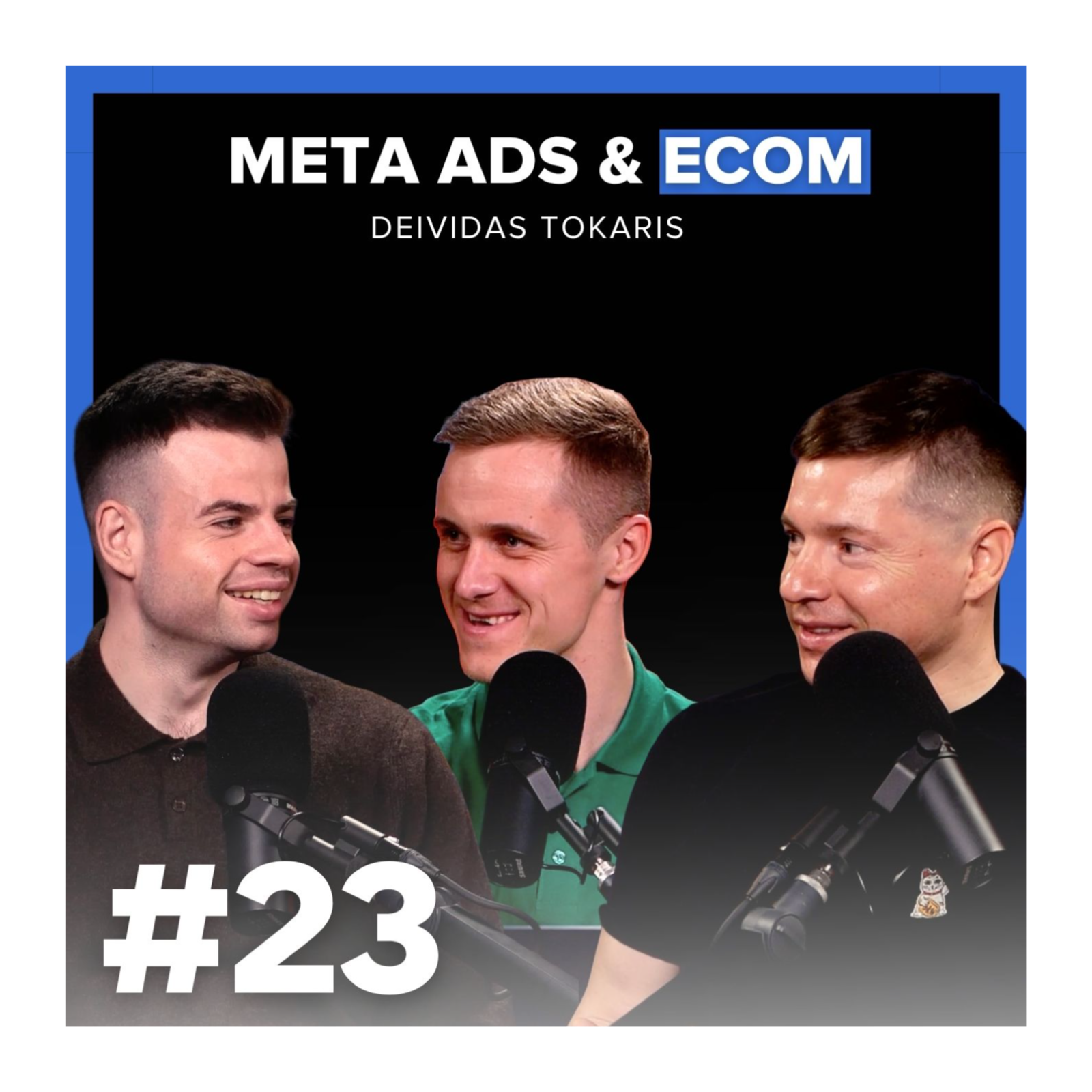
from Jau Tie Marketingistai - Skaitmeninės rinkodaros patarimai
65m 18s
David Astakaris, founder of a triple-scale Meta agency, explains how he transitioned from freelancing to running a 20-person team, driven by Meta’s sustained dominance in customer acquisition, especially for e-commerce. He notes that while Meta ads have become more expensive, the platform remains unmatched for reaching cold customers. His agency focuses on health and wellness brands, where high lifetime value and subscription models offset rising costs. The biggest challenge for e-commerce today is customer acquisition due to higher costs, economic uncertainty, and the need for better creative and funnel strategies. David advocates using advertorials and listicles to convert cold traffic by addressing pain points, rather than sending users directly to product pages. He emphasizes that funnel testing has become as important as creative testing, and recommends copying successful competitors initially before innovating. For creatives, scripts (hooks, pain points, urgency) are more critical than footage, and video ads should dominate (80%) over static ads (20%) for long-term growth. The key to success lies in holistic strategies: strong product, lifetime value, and problem-focused marketing.
And people are pushing the discounts to the limit 80 or 90% discount. Can you imagine? Just increase your price by 10% of your product every quarter. How do you find people? How do you hire them? How do you fire them? A lot of our team is actually from North Macedonia. A higher person and after a week it just disappears, you know. You like to hire people that you like that are similar to you. You really just know by looking at a person if that person is a good fit or not. Even you can be the best friends, you can have the best vibe in the world, but like if it's not a win-win deal, it's not going to work out and I know companies that straight up scam people, you know. Hello, this is Paulus from Laman Hook Agency and Simona's from Rocket Science Boggs. Together we create marketing podcasts, EOTM Marketing Gist, where we invite famous marketing specialists and business owners to share their earned expertise on topics that matter to us the most. If you like our podcast, subscribe to our YouTube channel to stay tuned to our latest episodes. Enjoy. Hello everyone. Today is our guest, David Astakaris. David Astakaris is a triple-scale agency founder and triple-scale is an official meta-partner and meta-performance agency. Hello, David Astakar. Hi Paulus. Hello guys. So David Astakar, how did you decide to open one more Facebook ads agency? There's so many of them. So how did you get to this decision? Yeah, I think as I'm going for my business journey, I kind of understand that you can do whatever and still make money. So I feel like it's the same thing here. A lot of people have been saying a lot that well, meta is becoming outdated, saturated, it's becoming really expensive. But when you look at the CPMs and you look at what's going on in the market, like in reality, it's a meta is continuously growing and in my opinion it's still the best customer acquisition platform, you know, for any e-commerce brand or any business in general. There have been competitors like TikTok at some point where we thought it's going to change the market, you know, it's going to change meta, but it didn't happen. So I feel that the market is so vast that any new agency can still take the market share. And while I have been working as a media buyer for meta for multiple years, and it was just a natural transition for me to just go into the channel that I really know, you know, and I can do so. That's just how it happened. And to be honest, it happened really naturally because I worked as a freelancer, then I started getting more clients and then I started outsourcing. And at one point, I was actually anti-agency. I told myself I don't want to have an agency, I don't want to run it, but then it just so happened that I'm here, you know, hiring a team at this point where 20-20 people, you know, growing quite fast. So what's your basic market or the customer type of e-commerce? Yeah. And which United States? Yeah, like we work with brands across the world to be honest, like when people ask me like, oh, what kind of brand do you work with? I'd say like generally, most of our brands are in health and wellness niche because this is the fastest growing e-commerce niche in general, you know, supplements. It has a subscription element. So it's really good for this day and age because meta, as I mentioned, is becoming more and more expensive nowadays. So if you only rely on customer acquisition constantly getting that new customer, you know, to be profitable and you don't have any back-end lifetime value, it's just going to be hell of a time for you. And at some point, like somebody better is going to come into the market. Somebody will start selling products for cheaper. So that's why we work with health and wellness, but we have different brands and we have brands in the US. We have brands in Canada, Australia, UK, even Lithuania, some of them, the European markets. But I feel those are like the biggest markets and most people advertise. Actually, we even have some clients that advertise in African countries. So it's also, you know, there's some market there as well. You're working a lot with e-commerce. What are the key challenges your agents face is working with e-commerce? Yeah, like we have most of our brands or e-commerce, but we still have some apps and info products if you can call them. Well, the difference between an app and an info product is info products is usually a course. You know, it's not an app. So, but we have those as well. And Lithuania is a really good app. It's killing them. You know, Kilo Health, as shown a great example. And there are so many companies here that do that. You know, small teams that are scaling, doing multiple millions out of that. And I think the biggest challenge right now for e-commerce brands is just, well, customer acquisition, you know, because it's the engine of any business. You have to get new, cold customers into the funnel if you want to scale the brand. You know, and I feel this is the, this is becoming problematic because it's not as easy as it was five years ago. It is becoming more operationally difficult. It is customer acquisition costs are rising, which means that you have to be better, more innovative, you know, have to do better creative, and you have to do good creative at scale. Then obviously, you know, problems in the economy right now, for example, the, you know, the crisis of all, it's increasing the, you know, the shipping costs, which naturally you have to increase the prices. And then, you know, the fear index uncertainty in the world is now the highest it ever has been, which means that people are not willing to pay that much. So we have all of these compounding problems. And, yeah, like it's a hell of a time for e-commerce. And I feel that generally, you know, it's, it's not even as much as, let's say, just simply test more and better creative. We are in a, in a third wave of performance marketing right now, where it's more about, you know, the product, the lifetime value, returning customers than, than anything else. So I think that's, you know, a lot of challenges that business are dealing right now. And how are agency faces that the rising of the cost per acquisition coming from meta ads do you support that with other marketing channels? Some in the channel or like other solutions that apply to that? So we as an agency, our primary focus is just meta ads. So we do other channels like for brands that, let's say, you know, are established with Meta and we see that it works. And, you know, we want to get that extra edge, for example, like app loving is a good new tool, you know, that can perform as well as meta. The scale, obviously, is not there, you know, maybe for some brands, you know, Google is great. TikTok can be a good channel as well. But like there's, there are no other channels as good as meta. Like for all the e-commerce brands that we work with, meta is usually 80% of the customer acquisition, you know, percentage, you know, so it's the main channel. And, well, the way we help them, I feel like on multiple fronts, so one is like the strategic front where we basically help them deal with the funnels. Because usually what happens is that, you know, you can test creative and like as an agency, we can get you there, you know, we can get a good CTR, a good CPC. But then like what happens after the post click experience, you know, like what are you running an advertorial, a listicle, a quiz funnel. So now you have to like, it's now it's becoming difficult to just simply run ads to your product page. You have to run ads to ad-virtorials, you know, we have to be VS cells. You have to find new funnels, new ways to do with new offers. And so we help on that front. But I feel like that the key at the end of the day is like still creative positioning offers, just like those those holistic things. You mentioned the adversarial, which is also interesting. And maybe in the Liffian, it's not that common practice of using it. Could you break for us down what's what's the difference between ad-virtuality, RSI, the usful? And also next to that the us of quizzes and what's the difference? Be sure. Yeah, sure. So like broader context, the reason why what people use adversarial system, like it's a it's a new thing in Lithuania and a lot of people use it. And actually we just started working with one Lithuanian e-commerce brand. You're quite small, but you know, they're selling, let's say cosmetics products. And you don't have an advertorial yet. And this is like literally the first thing I told him is like, hey, we need to do an advertorial. Because this is just pure customer psychology. Think about it this way. Your goal as a business is to get new users, you know, especially in the beginning. Your goal is that all the new purchases that are coming from Mata should be new users that have never bought from you before. You know, because you can get recurring sales and customers through email and email doesn't really cost you anything. So in order to be cost effective with Mata, you don't want to be retargeting that much, you know, because you can do that with cheaper ways, right? So you just want to make sure that, you know, all the new users that come and you're running ads and sending traffic to or pure called people. The problem with Mata is that Mata has made it easier to run ads and you are giving up control to the algorithm. But the problem is that the algorithm sometimes misses the goals that you want to achieve. Or maybe you miss the inputs that make sense. And what I mean by saying inputs is that, for example, a live example of our, you know, current customer. So, you know, we started testing or static ads. But the problem with static ads is that they're good for middle of the funnel people. So for one people, right? And what we notice is that our always has been going up. Oh, it's looking nice. But the problem is that in reality, we started diving deep and we see that we're just, you know, our new customer percentage is going lower. What happens? And this is like, I think this is the most common problem with e-commerce brands right now that are, you know, maybe a little bit out data that are not caught up with the times is that they run ads. They use their best performing creative. They don't find new winners. And
dates, you know, retargeting percentage increases. And at some point they hit a plateau where at the level of spend they used to be profitable. They're not anymore. They have to lower the budget center like what's happening? You know, we, you know, is it something, an algorithm change? But it has been happening for multiple months, even years potentially that led to that point. So this is where Advertorials comes in, right? Advertorial is used to convert pure cold users because think about it this way. You know, imagine you're selling a product that costs 200 USD, right? And you land a person, you know, he sees an ad on average, people watch ads for approximately 10 seconds. He sees 10 seconds of the ad. He loves the ad, presses, you know, he lands to the product page. He sees that, you know, it costs 200 USD. Most likely he's not going to buy it. You know, the life's, you know, the cycle of, of, you know, of purchase decision is much longer. And if you want to actually convert, you first have to, you know, raise the problem, you know, like what actual problem you're solving? What are the solutions? What are the pain points? And this is, this is where Advertorial comes in because it covers those mechanical points and elements because there are a couple of ways to do Advertorials. One is a, is a listicle. Listicle is, everybody probably knows seven reasons why, you know, seven reasons why why should, lose weight, seven reasons why, why should you use peptides, whatever, you know, this is like, this is a listicle. This is one way to do it. Another way is an Advertorial and usually an advertorial is a story. It can be a first person story. So like, you know, this Japanese doctor, you know, figured out the way to lose weight in seven days. Obviously it's more on the gray hats camiside. But this is another way. And you know, these advertorials you land there and it's like a bridge connecting your brand and the pain point. Because in reality, new customers that buy on meta, they don't care about your brand, they care about their problem, you know, and that is why problem focus brands are usually the ones that are winning. And this is the reason why Health and Wellness niche is right now, you know, the highest experiencing the highest growth is because it is very easy to pin, pinpoint, pain points for Health and Wellness brands because you can say, hey, lose weight or you will die, you know, well, pretty much like that. You know, I realized just one thing that it looks like this year is about listicles because all the S.J. people say is about listicles because LLM's takes data from listicles and you also work with listicles. So I think it means that it's the golden age of listicles. And of course, after I don't know one year or something like that, they will be, it would be not so easy like Google and Facebook will implement some some changes, some policies not to take them as seriously as they are, but as you say, now it's working very well. Yeah, and I think, you know, I don't think any funnel will ever go out of date, so to speak, because at the end of the day, it's just purely customer psychology. Like for example, you know, quiz funnels like Lithuanians are scaling quiz funnels massively. Like probably if we would add growth spend that was spent on quiz funnels simply by Lithuanians, it would probably go into, I would assume, you know, hundreds of millions, you know, and at that point, you would think that, hey, probably everybody seen a quiz funnel into US, but in reality, people still buy every day and brands are scaling with quiz funnels. So it's not about the funnel, but it's more about, you know, like the product placement and like the actual offer and the pain point. So I feel that listicles have been here around for a long time. Like we use listicles six years ago. So it's not like it's an innovation, but I feel that the reason why people started doing it more and more is because they understand that they cannot just simply line people into the product page and the cac is rising and they need to, you know, figure out how to convert new people in more aggressive ways, so to speak. So I feel that any any commerce brand that is not doing ad retorials or listicles, they should be doing it right now because there is a thing such as lining page or a funnel fatigue. Everybody knows creative fatigue, but let's say imagine you have a winner creative that's just stop performing over time. What you can do in easy way to to rework it, you can create a new funnel like an ad retorial and just tweak your ad to fit the ad retorial narrative because creative and lining page congruence is also very important and then you can revive your winner pretty much. So I think funnel testing is the new creative testing. Can you explain more about the process about selecting and finding a winning creative? Well, it's yeah, it's obviously a very broad topic, but I think there are two ways, you know, how you how you can do that. Let's say one way is just copying your competitors. It's it's very simple and I think like most brands really do that, you know, you have let's say an established competitor that you know that is performing well, they're scaling really hard. You always keep an eye on them and just take their best performing ads and just like tweak them and can copy. So that is one and this is the easiest way and to be honest for brands that are under 25 million in annual revenue, I would just recommend doing that. You know copy, first of all copy your first party competitors direct competitors and then what you can start doing is take parallel competitors. You know, so for example, you know, a brand that for example does 100 million and you feel that their creative style or let's say, you know, the pain points fit into into your brand. So what you can do is you can just, you know, take their creative from another niche. Let's say you're selling weight loss and then you can take something from, you know, peptide niche and just apply to yours. You know, this is a really easy way and I don't think like usually small brand should be reinventing the wheel. But at some point, of course, you hit a point where you have to create unique creatives and unique ads and unique scripts. But at this point, like from from what I see happening in the market, I feel that it's mostly about the script of the creative, you know, versus the, and I think it has been this way for, you know, as long as creative existed, it's mostly about the copying the script of the creative. This is where we have to be really focusing, you know, the hook, the pain points and then the editing is of course important. But I think it's like this secondary because we did this split test, you know, we tested what is more important like the footage or the script and usually like the, you know, script is really really goes a longer way, you know, and one of what I mean by saying a script is just basically those, those, you know, mechanical points that you're talking about, you know, the pain points, the solution, the USBs, why you need to buy this product, urgency elements, etc. So, so yeah. So how much of creatives, different formats do you test and which ones perform best, like AKS, Stapix, videos, etc. Yeah. So as I said, I feel that static, well, static ads are great, and I'm actually a fan of static ads and we have been scaling with Stapix. The problem is the static ads have limitations, you know, usually, well, it depends what kind of static ad because there are like different different types of static ads. If you just have like a product placement USBs and then buy now or like 50% off, this static ad will never be a good cold static ad. It will always primarily just retarget because think about it like purely from a customer perspective. Use call Facebook, you're not problem aware, maybe you don't, you're not even aware that you have a problem and then you just see your solution 50% off without really understanding how it solves your problem. So it just doesn't make sense. There's no congruency in the funnel, you know. So there are static ads that work for top of the funnel, but those static ads usually are ugly and more native style, you know, like the way native advertisers really, really, you know, push the ads, but those ads cannot land into product pages. Those ads must land into advertorials and listicles because it just doesn't work the other way around because it doesn't make sense. There's no congruency between those, you know, between the creative and the actual lining page. So I feel that static is a good way and an easy way to really test fast, but I just want to feel almost e-commerce brands should be focusing on video because video is the main asset that is going to help you grow and is the main asset that is going to help you get new customers. Static ads are usually just like complimentary and video is going to be a much more, we'll have much more longevity in terms of performance. Static ads will die much quicker and you will need to iterate the more, of course, it's easier to make a static than a video, but videos are more long term assets. So I feel that you should be focusing mostly on video and the way we do is we usually try to do 50/50 split between videos and statics, but now I'm seeing that I would, for most direct response companies e-commerce brands, I would focus probably 80 to 20%, like 80% videos and 20% statics and really just dial in on the scripts. And also another thing is a lot of people always ask me like, is it quantity or quality, which one is important? And a few years ago I would have said it's quantity, you know, with quantities of quality on its own, where it's just like blasts, static ads and tests as many as possible. Now from what they see, it's probably better to focus on quality. Scale quality first gets to a decent win rate and once you get to a decent win rate, you can start scaling the, you know, your quantity and a good win rate benchmark for anybody that wants to nail their creatives. I feel it's like 10%, like if you can get to a 10% of win rate with video, creative for e-commerce, you're in a good place. So what I would do, I would just go back into your ad account today, I would literally just. Look at what is your win rate, how many creatives or winners and if it's a 10% Scale your quantity if it's below 10% scale your quality, you know, that's what I would do And the way you figure out what is a win winner and what is not you have to just look at the benchmark of your Add account, you know, so for example Depends on how much you spend if you let's say spend one K a day then you look at let's say last 14 days of your add account performance and Look at your average row us right at your average row us for cold people, you know, because you have to distinguish you cannot look at Blended row us you have to look at cold net new user row us because there is a difference cold user We're always cost more than a middle of the funnel user So you just have to go into your audience segments or triple well depending on what you use and benchmark According to that so let's say your new customer Row is one right so it means that if you find a creative That spends that gets let's say 20 sales and has 1.2 new customer row us that Creative for you is a winner and then you just like see how many you test and how many winners you get and then according to that You adjust your you know your team you're hiring and the way you do creative You touch up on a little bit about offers Could you also break down a little bit for us what a great offer is and How do you come up with great offer because in the field like all brands is just like going full Hands on like discounts, you know, yeah, I mean this well discount is I guess it depends like what you say what you mean by seeing offer because I feel like It's also very broad because like an offer can be just purely I don't look a limited offer like a discount or something and you know discount or percentage of You know is very straightforward, you know everybody knows that like the higher the discount big chance You know you're gonna convert them better, but then obviously it can backfire because if you want to create some longevity For for your brand like consistently discounting can be a little bit of a problem But I will be honest, you know with with the most D2C brands that we work with for example Let's take fashion as an industry You know if you don't do discounts your brand is just not going to work you must do discounts and this is becoming a problem Ever like the cat is rising, you know the CPAs are rising and people are pushing the discounts to the limit We even worked with a brand at some point where they did like 80 or 90% discount. Can you imagine like you know It was it was crazy. Obviously was a bit more sketchy It wasn't like legitimately 90% but like just the positioning so we start pushing the limits to the point where it becomes a diminishing return And we saw that anything about 70 above 70% of a discount is You know has diminishing returns like people people don't take it seriously anymore because they understand that hey if something is being sold at a 70% discount it's you know It's just not legit or it's a scam, you know and well one brand that really comes to my mind like not specifically calling them out But like from my personal experience like my protein like probably everybody knows the company in Lithuania, right? I think it's a Polish company and I buy protein from from them, but the problem is that they always do discounts like they always like 60 70% discounts And if I go to their website and I see that the current discounter offers 30% I don't buy it because I know that in a few weeks I can get like a 60% off if that makes sense Which means that you create a pattern of people Expecting discounts so you don't want to do that but in terms of offer I feel that Again, like we need to split into middle of the funnel top of the funnel You know, I will be talking mostly about top of the funnel because Because that's what most one most brands want and you want new customers So I feel like it's just really important to you focus on two elements Conversion rate of the offer and the AOV What we do is we we have this what we call entry level offers So for example if you're running ads to a cold user You cannot expect that that cold user is going to be spending as much as middle of the funnel user You know like usually retargeting users AOV is 30 50% higher than cold Which means that your entry level offer or hero product, you know, you should be selling it for you know 50 30% cheaper than your retargeting is converting, you know, so that's that's one thing and Whenever you you have that offer usually what you want to what you want to do is focus more on on pain points and solutions rather than Then technical very very technical US piece, you know like hey, this is waterproof or or whatever you want to focus on You know on offering like a lifestyle change or or some sort of transformation and yeah, that's where you know A good offer comes comes in and then at that point it becomes just multiple elements like the price Price and if you're there at the right time so Creative is also important in the offer part because it creates the expectation for the person, you know Because like if you say on the ad, hey, it's 50 Dollars, but then the person lands in the in the landing page and it says $100 You know, it's it's in congruent So you have to like set an expectation and that is why for most cold ads and creatives that we do we don't even mention the pricing You know, we don't say it costs 200 you as a or 50% off. We don't usually mention it We just focus on pain points and then say it's limited stock by it now and then the person lands in you an Advertorial and only in the advertorial then that person wants he goes through that article. He sees Maybe the price or maybe like 50% off now by now and then only on the third step. He's the actual price How do you manage this process of creating an offer and creatives With the customer which your clients side because they have a Marketing department. Yeah, you have creatives and you need to be close aligned to make a good offer Yeah, I mean well at the end of the day where a meta, you know Ads agency and a partner for our brands and in reality we cannot do everything for them So that is that is the reason why we only work with let's say selected brands and we we really focus to work with founders that let's say our self-driven and Have this while self-industrying that well the offers the key the product is the key and You know a test the offer continuously and I think this is you know going back to the previous point just wanted to mention You should be continuously testing an offer and what I see for most e-commerce brands What they do is they find a winning offer and they never really question it is like oh, it's it's working It has been working last year. You should be working this year No, it's like you know e-commerce has cycles and usually every product has a five-year cycle in e-commerce Which means that you have to continuously Reinvent the offer and what you have to do and this is what it recommend from the CRO perspective Just increase your price by 10% of your product every quarter and just like do an AP test It's a very easy way and usually it has no impact on conversion rate And then you have to test different let's say maybe bundles potentially like different positionings You know different hero products. So so yeah, so that's that's very important and well the way we help is we just help more on a consultant basis So We as a meta partner, you know It's our incentive that the offer would be good because we can do the best job in the world in the pre-click experience But if the post click experience sucks is just not going to work out So we just help with strategy give them examples You know share data what's working for other clients because you know We work maybe with bigger brands than them and and I think that's that's the main point but like execution is on the client Obviously we try to help always possible Maybe get some people refers some people who's specialist that can help them but in reality like we cannot do so business needs to be prepared In a sense, yeah, if it wants to grow Yeah, of course, I mean It's just my belief that like I am a founder of my of my agency and I wouldn't expect that somebody else You know who's hired will do will solve all of my business problems me as a founder. I have to drive the business You know and I think this is the same thing with e-commerce, you know when you hire an agency Unless it's a full growth agency that does everything for you then maybe yeah, you can expect that But if you're higher higher a meta-ass partner You cannot expect that the meta-ass partner will solve your all of your problems logistics You know offer we work with brands and we help them and we actually funny thing we have a whenever we onboard a client we have this Big expectations document that In that document it contains what you can expect from us But it also contains what we expect from the from the founder and the brand because usually you know Brands expect results, but they don't provide everything we need and then it becomes you know There is misalignment and it's just impossible to make it work. So it has to win win That's that's one of the big issues We are also experiencing at our agency that you need the 100% involvement from the other side as well, and you like you can deliver a really good traffic converting traffic But like if the landing page experience isn't that great and the loading speed is slow or like it doesn't connect like the Check out process takes like 10 seconds or so, you know, so like a great example is like one click Amazon Buy out check out process, you know, so Could you maybe also share with us a little bit more what I like then?
key issues you are experiencing, like when you deliver great traffic on the other side where you don't have influence of. So I think maybe it's connected to the creative but I think there are main problems and what they call them choke points in the funnel. So the first choke point is the bounce rate. So bounce rate is the first one that we look at. So for example, you get, you see that you get good clicks. The CPC like in the US, you see that you get under one USD which means it's amazing. It's really good. But then you see that 95% of those clicks bounce. So then you have to understand like is it, is it that the ad and the lining pages not congruent or is it a technical problem, you know, like loading speed etc. So there are two sides of that there's that there's this philosophical marketing problem and there's a pure technical problem. So if it's a pure technical problem, I cannot really help in that sense. You know, we can recommend people maybe but like we don't work with that, you know, but if it's from the marketing side, we can potentially do different ads that are more congruent with the lining page, you know, and I feel general like maybe going a bit sideways from your question. But I feel that this is where marketing nowadays is going in media buying is going to that direction that it's no longer just, you know, launching campaigns and looking at access and ads. It's now thinking logically and connecting the dots, you know, like does this creative make sense for this lining page and not just launching it blindly just like, hey, this ad is, it has high row us. So I launched with this lining page, it should work. We have to actually understand the logic, you know, customer psychology and connect the dots there, you know. So yeah, answering your question. So like Boundstreet is the first check choke point. Another choke point is lining page to add to cart ratio. So let's say the person landed, but he didn't bounce. He's called the page. He went to the products didn't add to, didn't add to cart, you know. So then potentially there's a problem with price or maybe the, you know, the function of the website. Another choke point is add to cart to initiate checkout ratio. So people at, you know, to check to the car, but never go to the actual checkout, you know, what's happening there. And then check out to conversion to actual purchase choke point, you know, so like people go to the checkout, but, you know, maybe for some reason they're not buying. And again, there are two sides of this the way you can look at marketing side and technical side, you know. And for what I see most of the time for checkouts is more of a technical side, but you also have to look at the marketing side. Like for example, it does your checkout have, you know, upsells, does your checkout have order bump. Do you have downsides, you know, like all of these, all of these things do you have like a sticky bar that says, hey, you know, add to cart another product and it will be free shipping because those things like work. So those are more like marketing things than technical things. You mentioned a lot of also during our conversations about the funnels of creating a funnels. So like top of the final middle of the final bottom of the funnel, but what I'm hearing lately from the specialist working with a met ads channel, they just shoot broad like all the messages, you know, and like target all but convert none. Could you also like break this mid and also say how brands, how much brands should put emphasis on creating the entire funnel journey, you know. Yeah. So I think that's like what I mentioned in the beginning, like the the will funnel thing. So this is exactly you mentioned it. And this is what we see as well. Like most media buyers just launch broad and just what I call, let it rip, you know, just just, you know, let the algorithm do its thing. And in a way, it's a good thing because it like kind of freed up our time to like be actually more creative and focus on these things that we're talking about now funnels and marketing side. But but that is where it creates problems for people that don't really understand what you're doing is because again, like, like the example I gave you, you can launch a, I don't know, like a well sales campaign, you know, it's spending well, it's scaling, whatever, it has a good raw as. But like it's mainly run with static ads and you think it's going well and the founder thinks it's going well. But then you see your actual bottom line or, you know, store level shrinking. And they're like, what the hell is happening, you know, my meta is performing well, you know, but my business isn't growing. And then you have a look at the audience segments and the breakdowns and you see that 50% of that row us comes from middle of the funnel, you know, like for example, retargeting has free row us and your cold has one. So in reality, which what you have yourself there is you have a retargeting campaign while in reality, you might think you have a cold campaign. So what we started doing recently is we went back to the roots to the basics of media buying and we started doing hard exclusions, you know, we started exclude manually brutally telling meta don't target these, these, these, these, you know, like because I don't want. And it's very funny actually like I recently saw a real of Zuckerberg where he was in some sort of podcast or an interview and he was asked a question like should people manually do manual inputs in the meta. And it was funny because like Zuckerberg went a little bit of the script and the actual meta agenda and what he told is that if you feel if and if you're confident that by defining your audience, you're going to get more successful result like for example, you're advertising a product to women and it doesn't make sense to advertise to men. Then just put targeting into women and don't let meta pick it, you know, to send better signals to the algorithm. This is what Zuckerberg said. So I feel that to some degree, we still have to, you know, give hints to the algorithm and answering your question about this like funneling in the add account. So there's no more setup in the actual add account where you know, it's like cold, warm hot, there is no that anymore, but it's happening more on the creative side. Now media buyers cannot just like rely on on on simple funnel like add account structures. You have to actually look and you know from customer psychology realized like which ads are going to retarget and which not. So that is why I recommend using the tutorials for top of the funnel. This is why I recommend using more video because these ads big chance meta is automatically going to push those to cold users, you know, because meta like does it automatically like it's really weird and funny to see how algorithm things you can launch a static at. And you see like that it's just like 90% retargeting even though if you choose cold so it's now it's just meta is smart about it and you know the judge it be dependent on the ads. Earlier on our conversation you also emphasized that health and wealthness niche is one of the most lucrative and profitable. But like regarding USA market it's gaining more traction with the restrictions from the government and like all those pain pointings of the problems they're getting more and more restricted. Could you maybe like share with us more about like different niches and like how each of them like perform and which are the harder to work with you know like health segment. Well I mean like supplement I think is like the main the main niche you know something like it's a big category. Another one I guess is cosmetics but it's more like beauty not health and wellness I think in that sense so I think like when we say health and wellness there are a lot of different like products like for example we work with the you know body scales or like you know body watches that track like your body performance so it's still health and wellness but it's like health and wellness tech like another brand is pulsetto you know pulsetto is a health and wellness company with your health and wellness tech so that's another segment that they see popping really really well but I think it's like. It's more difficult to make it work there because like it's it's it's tech but I think like very ever green niche and the best niche that people do is like supplements you know because it's like so easy to sell it and have a recurring customer base it's CPG. It's easy to sell use that for your so you know more aggressive but of course matter is starting to you know basically restrict the mains that are primarily health and wellness you lose ability to track so matter is making it problematic for health and wellness businesses and it's becoming harder and harder but at the end of the day like if it's becoming harder it means that some competition is dropping which means that there's an opportunity there and I feel that you know supplement niche is going to continue growing. It's just that like it's really fast moving you know I think that average life cycle of an e-commerce product depending on where at what point of the trend you start is around like four or five years you know but for supplements is probably two years because like think about it now like you know peptides is the new hot thing right so like somebody sells peptides but in a year peptides might become relevant because one study comes out and says that peptides are you know harmful you know. And then we don't have a e-commerce but status why have to continuously be innovating you know and yeah so think the supplement is the main niche but it's also the most competitive niche because the CPMs can go as high as a hundred USD and it's becoming very hard to sell there. Let's speak a little bit about your agency management how do you find people how do you hire them how do you fire them and how do you keep them in your team yeah like now I'm been recently talking with a lot of founders and other agency founders and maybe more startup founders and I feel that
And like I didn't realize it before, but I feel like hiring and people is just like key for growth. It's just primary level, not marketing, not legion, like hiring because otherwise it's just not going to work out. You can hustle and get to a level, I don't know, like 1 million annual recurring revenue as an agency. With pure hard work, you as a founder pushing the agency. But then you're going to start dealing with some bottlenecks and pain points there if you don't do it right. So I feel that this is like, as well, challenges that we're dealing with, you know, finding good people. And well, the way we hire is pretty simple. You know, we have, we use LinkedIn primarily, you know, and job ads there and like we outreach to people. But I think like the main qualifier for a very good person is salary. So you know, you have to, I think nowadays as well, what I realized is that globalism and remote work has given opportunity to people from countries that wouldn't have had the opportunity. For example, we have a lot of our team is actually from North Macedonia, you know. So it's, it's, it's, it's, it might be a random country that not a lot of people consider there, but people there that, the lived there in Macedonia, it's not in European Union, they get the chance to earn more by arbitrage their skill to other markets, right? So, so I feel that salaries have started to equalize across the board, but obviously the US is still the most expensive. So yeah, so we hire from Europe, we are full remote agency and it helps us with the talent sourcing because we can give the benefit of over mode because if we would be in the office, it would be pretty hard to compete with brands such as Kilo because he just simply can, can pay more, you know. So yeah, I think, you know, that does the main challenge is finding the right people. And, and I think in any company, usually like core team of five, five people are the main revenue and growth drivers, you know, like the more people you have, you know, the less efficiency you'll have in the company. So I'm just right now trying to build and constantly rebuild and find those people that would, you know, would be like core key players and would let us, you know, grow past, past the point we are now. Is there a question or the skill that you value most in person? What, what you are asking them in the first interview? Yeah. I think, well, first of all, like when you hire, like because in the last few years, I hired probably like 40 people or so and I fired people, not maybe not 40, but some people. And what I realized is that gut feeling is very important. And when you hire and when you build a company from scratch, you really just know by looking at a person if that person is a good fit or not. And previously I used to like put, you know, really silence my, this inner intuition, but now I started really relying more and more on that. So yeah, I feel like it's just like gut feeling. Joy, feel like the question, the rhetorical question I asked myself is like, would I am I excited to have this person in my team? You know, if it's like, man, you know, he's going to be there, but I'm not excited, then probably it's a bad hire. But like if you're excited to have that person in your team, it's like imagine you have a basketball team and you get Michael Jordan in your team and you're like, damn, you know, I'm super excited to have him. You know, that's the feeling you want to get. So I feel like the gut feeling is important. And the questions we ask is usually like those more, more mindset related is like how the person views it, you know, how, how the person solves challenges and how he addresses problems, how he addresses feedback because we had like, you know, different cases there. And also since we were remote, we also had a lot of horror stories. Or for example, you know, hire a person and after a week, he just disappears, you know. So you just never know and this is what I realized when you hire people, like you really, really don't know. So you just have to trust your gut feeling and maybe even sometimes your gut feeling is going to, you know, mislead you. So what we do is like we try to fire fast, you know, if that's the case. And you know, recently, like we also hired like a creative team lead. And she was amazing, but like it just didn't work out. Like some things didn't work out for us. And we fired her like in a month or so, you know, because we saw that there's no point, you know, it's better to, it's better to have an empty seat than than a bad hire. But the gut feeling maybe it can work like this, that you like to hire people that you like, that are similar to you. True, yeah. That is true. Like in a sense, because one of the key hires and made early on, I had like a choice, you know, red pill, blue pill. And this is like there was one girl that I wanted to hire. She was like really, probably like she was like, you know, really communicative, you know, and she's a really liked her as a person. And there was just another person that maybe was a little bit challenging to me because she was like maybe more straight to the point straight forward, but she really knew her shit. You know, I just felt that because she asked the right questions. And I feel this is another thing, like in the interview, like does the person ask the right questions, you know, like is he asking you questions like, you know, about the company, about the problems. And if the person is asking the right questions and pinpointing the problems, that is already a good sign. So, yeah, you know, at that point, I chose, you know, discomfort and I hired the person that I felt a little bit discomfort and it was, it worked out really well. So I feel that I agree with you, you know, it can be a bias feeling. But then again, I feel like it's also important as a founder to trust that. We recently like dodged some bullets by me trusting, you know, my gut. So I'm going with it there, but it has to be, you know, a database gut feeling, you know, that is what it's most important for you than hiring a person. So it's a creativity, technical skills or communication skills. For an agency, I feel it's like, I think it's like 50% communication skills and 50% problem skills, problem solving skills, you know, I feel those are like the most important because if communication is good, it means that we will, you know, we'll get there, you know, it's basically, it's going to work out somewhere, you know, we're going to get feedback and you're going to give feedback. And the problem solving is just like the ability to basically jump into the problems and really solve them fast. So, and then the technical skill, I think, like it's of course important, you know, the hardcore technical skill. But in my opinion, it's something that's easiest to teach, you know, you cannot teach a problem solving skill and communication skills. So it's very important to have that. So when we hire media buyers or creatives, we look for, you know, for talent that is an A player hustler and can really solve problems for us, you know. So we need to place a problem solving in the kindergarten too. Yeah. Children must learn nearly, nearly stages. Yeah, creativity and problem solving. But isn't that like the way life works, right? You know, life is, life is problems, you know. You, everybody chooses their own problems, you know, what kind of problems are you going to be solving? And if you're good at problem solving, big chance you're going to be good at business as well, you know, because you're going to pinpoint problems as the right questions get to the core of the problem and then you're going to solve it. So, you know, if you want an A player, you have that person has to be a good problem solver, you know. Otherwise, if he's good technically, then he's a good specialist, you know, but A level players have to be problem solvers in my opinion. It means, you know that you cannot solve the problem without creativity. Yeah, there is part of the creativity, but if you have technical skills, you can just do it by the handbook now. So it depends on the agency model that you build, I think, you know, because like our agency model is more like custom in a way. It's not like very like, I don't know, like, like, for example, a plumber, you know, like, he knows he goes, you know, he has like this technical ability to fix a pipe, but like, out for example, hours as we sell growth and strategy, which is very custom and it cannot be templatized, which means that the only way to really deliver the service well is to have talented people that can be creative and strategize, you know. But if you do very simple delivery, that is like very, very clear from A to Z, then what you can do is you can templatize it. You can hire a technical junior AI agent, potentially, and you can, somebody can do it for you, you know. So how is AI changing your workflows? Yeah, a lot of people ask that, like, and well, I don't see myself as like the most AI savvy person to be honest. Like I see like people crushing with AI. I feel the, I think everybody feels like they're behind AI, you know, like it's impossible to be in touch, but as an agency, we mostly leverage AI for a couple of things. So one is reports and data analysis and data pulling, you know, for example, back in the day, you would have to have a sheet and fill it manually to have win, win rates and winners. Now you can deal with, you use Windsor to connect that to the ads manager. the data we plug it to Claude and you can create a major
win-rate reports. That's pretty easy. Another thing, for example, Manus AI, something that was purchased by Meta, and Meta is actually going to be really pushing Manus on everybody because Meta's high-level strategies that they want to increase their shareholder value, but the main problem of Meta is that they see that their main revenue source, 90% of revenue comes from ad revenue, but they see Google and Microsoft and Amazon that have 10 different revenue sources and they want to get there. That is why Meta is now going to be pushing AI, Manus AI, which they are acquired. They're going to be pushing more on WhatsApp advertising as well because they want to diversify the revenues there. So expect that. But yeah, so the way we leverage this is data and another thing is like creative, creative production. Like you can get you can easier, you can do research easier. So the research part is easier. The logic and reasoning and creativity part is easier, but I feel that we're not there like our creative strategy. Still do the work and you still have to, you know, you use AI, but you have to be the critical thinker to see like does this make sense or not because we know that AI hallucinates a lot and makes up facts. So and we also use AI for generative AI. For example, we use Hicksfield to generate statics. So one thing we did is we introduced this new workflow where previously our creative strategies would brief, you know, ideas and what creatives they wanted you to video editors for static editors and deal with you. Now we cut this chain short and our creative strategies are generating statics themselves now, you know, with Hicksfield. And you can do pretty good stuff with it, you know, when you teach the prompting. So I feel like it just cuts the chain shorter. You need less people, but it by no means it means that it just changed creative strategies completely. It's just, you know, not yet, especially for video for statics, maybe, but for video, we generate a lot of AI avatars. So I feel that it changed influencers, you know, influencers are probably suffering because you don't need as much UGC anymore, because you can generate decent UGC. But it hasn't changed video editors. I think video editors now are even more important than ever because like a good video editor can really, you know, is the key to make a good creative video. So let's go back to you as a person and a business owner. So what challenges do you have right now with Manning an Agency? So it's the sales, it's the process, the people, what you do in life when you don't work. Yeah. So the main challenge for me right now, I think, it's always probably going to be one of two challenges. It's either going to be sales or it's going to be operations. So, yeah, like operations and people, yeah, exactly. So it's like, you know, either in your one of those like Redville or Blueville, you know, depending on what stage you are. And so like if you have a good team and you don't have clients, then you have you either have a lead gen problem or you have a sales problem, you know, and it's very easy to identify which problem you have. Just look at your close rates. Like if your close rates are not at 30, 40%, then you have a sales problem. If they're at 30, 40%, for example, my close rates are 40%. If it's not at that level, then you have a lead, if it's at that level, then you need more leads simply, you know. So I think like we're constantly like juggling between those two. For now, I feel that we're in a stage where actually we have so many cool clients that we cannot really unbord more clients. And that is why we're dealing with some maybe operational things where we need to hire, but we need to hire high quality people and when you have to need to do it fast, it's just very difficult to do that. That is the reason why I'm actually right now stalling my agency's growth. We're now stabilizing our agency or not onboarding the many new clients just to make sure we catch up with the growth because in the last two years, we almost like doubled our revenue. So it's becoming hard to keep up with the growth. And yeah, and I'm trying to make it as less founder dependent as possible for our agency. And what I do for free time, I don't know, I tried to do well sports. I did my high rocks last week in Warsaw, so that was like a cool challenge. And what else I tried? Game sometimes, you know, this is something like a guilty pleasure, I guess. And yeah, I travel quite a lot as well, but I think mostly like my purpose and my mission is right now just just just primarily work. So I focus on that. What about the clients' acquisitions and what channels work best for you because like for our agency? Of course, there are other things which didn't work like maybe website doesn't work, but like ads not necessarily work for our business. That's funny because like we run ads for brands, you know? But you also like go a lot to like conferences and LinkedIn communication, so you try a lot of the different things, but you also like choose your bets probably somewhere where that mostly, you know? Yeah, yeah. I think like you just have to look at your last year's data and just like really figure out where did you get the most amount of leads and where was your biggest closely, you know, and then like you just know where to double down. And a lot of agency owners I think they didn't even e-commerce owners as well. They really overcomplicated because they think, hey, I do meta and now I need to do 10 other channels like no, just double down on one and you will get there. And I think for agency as well, it's like you don't need to do all channels, you just need to be really good at a couple of channels. So my best channel is LinkedIn inbound and outbound as well. We do called email as well, but called email, I think nowadays it's like struggling, it's quite difficult. But then yeah, like ironically, like we are a meta at agency. So I think like probably the best way to acquire customers would be meta ads. So we have run some ads here and there, but as I mentioned since our priority isn't growth right now, but more stabilize the situation. You know, I'm not running ads because I don't see a point, you know, to build a pipeline right now. And the highest quality leads for me, they come from multiple touch points, not just one touch point, you know, for example, we recently closed our biggest clients and that client saw me in a e-commerce conference here in Vilnius, then he saw one of my ads, then he saw that I'm going to be speaking at affiliate world. And then he was like, okay, it's maybe a time to book a call and then we book the call and we started working, you know, so this is a, as you can see, free touch points, you know, and that consideration cycle probably took six months, you know, three months, you know, so you cannot expect that to be like really direct response, you know, because it's B2B, it's relationship building. That is why like whenever people that are starting out their agencies, they ask me what to do, I just tell them just build relationships, talk with people, build relationships, help them for free and karma just walk, work its way in the universe and you will start getting clients and this is like how I started as well. Regarding relationships, I have one a rhetorical question for you. So, do you believe that great relationships with the clients can save you from the poor results from the campaigns and vice versa, you know? Oh, that's if good results can save you from a poor relationship. That's a that's a very philosophical question that that's actually good like and this I think comes to hiring as well and in my opinion, when we hire media buyers, we are always say 50% of client success is communication, 50% is performance. So I feel that you have to nail both to a degree. So like if you're let's say your performance is okay but not great and you have a good relationship with the client, I think it's going to be, you know, it's going to save it. But at the end of the day, like we also had cases where we have a great relationship with the client, he leaves us and we shake hands and like say, you know, sorry, he didn't work out but like all fair. So I feel that it's a good relationship is important because you know, if you part ways on a bad note, like it can really reflect on your business and like get bad reputation, I guess. So I always try to, you know, part ways in, you know, because sometimes we fail and like I'm just being transparent, it's like sometimes it doesn't work out and I take your ownership. So, you know, we done part ways on a good note. So I think that my priorities always have good client relationship and as best performance as possible, if performance is not good, then you just try to wiggle. But I feel like both are important to a degree because if performance is going to be terrible and it's not going to make sense financially, it's not going to, it's not going to change if you're if you're friends with the client, you know, there's a lot of logic in the RCA area. Yeah, but it's like very, you know, I think it's like very human, you know, because like at the end of the day when we work with clients, you know, it's you're always, you know, they work with you because it is it is a win-win deal, you know. So we have to, you know, make profit for them and then you make profit, profit as well, you know, it has to be a win-win deal. When it stops being a win-win deal, it stops, you know, relationship stops working, you know, and even you can be the best friends, you can why you have the best vibe in the world, but like if it's not not a win-win deal, it's not going to work out because people always look at their own interesting. You know, like you don't
you don't think like, oh, I'm not going to cancel the contract with an agency because I love David so much. Like, nobody thinks like that. I wish him. But it doesn't work that way. As we are nearly approaching to the end of our conversation, we have as the last section, Blitz questions for you questions you haven't here then you are not aware. So it might be from the top to bottom. Let's go. Yeah, just don't think the first thought will come to your head just spit it out. So a strong offer or creative and why? Strong offer because with strong offer and shitty creatives you can make it work but with great creative and shitty offer, you know, going to make it work. So offer all the way. Okay. Okay. Another one is also quite similar. Can you sell bad product with great marketing? Yes, you can. And I think that's how most direct response companies work. Marketing first product, you know, then then second because product is the back end, you know, like the person doesn't really know if product is good or not until it gets to him. That is the reason why, you know, most like apps or, you know, those like info products like the sell well because they sell the dream and the product might not deliver. So like with great marketing, you can sell whatever, you know, you can sell snake oil. Okay. But if that would be like a long lasting business, if that would go. Not really, but like usually it's going to be short term, but you're going to make more cash and then you can launch more and more and more and more. And there are, and I know companies in, for example, in the VSL space, you know, in this really great hat area that straight up scam people, you know, and they found ways to still run ads on meta and they're really running sketchy ways. For example, running those fake deep fakes of Trump promoting hair loss product, you know, and they sell well, you know, but but but it's a scam. So look at the pens, you know, what's what are your priorities? You want to be a moral? You want to scam people and there are all sorts of people in the world. Okay. If you were a start your agency from scratch tomorrow, what would you do with more courage and the more caution? Do you have to choose one of these or both? No, just what you would do with more courage and what will you would preserve your energy? With more courage, I guess what I would do is I would probably start with higher pricing straight off the bed and like it would not have undervalued myself because in the beginning I was like, you know, whoever pays and like the retainers were really low and we were really over delivering. And I feel that you know, even to this point, I feel like probably we're undervaluing ourselves. And I guess I'm just working my way up there to really, you know, just like self confidence, it's more like a personal thing. So I would have raised my pricing higher at that point. And then if with more caution, I would have probably said no more to bad clients. I feel that the biggest, well, the biggest pain point for companies that are growing fast and like the reason why most companies fail is not because of lack of growth is because of too much growth. You know, you chew more than you can eat. And that is especially a problem for agencies because you know what happens. You can really go out of hand really fast. You get too many clients or maybe you sell clients that you cannot deliver and then you have to deliver your team cannot do that and you have to be in the operation. So yeah, it's just too more and then, you know, everything falls apart. So we did probably maybe at some points, let's grow, you know, and more stabilization. That was David O'Stocker's from Triple Scale. Do you have anything to share with our listeners? How they can find you or? Sure. So you can find me on LinkedIn, I'm primarily active there. If you want to book a discovery call with me, you can do that on skilltriple.com and have a chat about strategy and see if we're potentially fit to work together. I'm also a speaker at affiliate world and potentially some other conferences. So yeah, I hope my goal is always to provide value here. That is why I'm, you know, trying to just really be practical. So yeah, just leave a comment and let us know if it was useful. You can message me as well personally if you have any questions I'll definitely answer you. Can we get some discount codes for affiliate world from you? Actually, I like, I have like a 25% off code. So if you need, if you need that, just, just send me out. Well, we can drop that in the description potentially. Yeah, we will drop probably that in the description. Thank you guys. It was a great conversation today. Thank you, bye bye. Thank you for listening another, you are the marketing used episode. I hope you found it useful, like, comment and share our latest episode with the rest. Also I invite you to join our YouTube subscribers list to stay most up to date with the digital marketing trends.
Podcast Summary
Key Points:
David Astakaris founded a third Meta-focused agency because Meta continues to grow and remains the best customer acquisition platform for e-commerce, despite competition from TikTok.
The agency primarily serves health and wellness brands in the US and global markets, emphasizing high lifetime value and subscription models due to rising Meta ad costs.
Key e-commerce challenges include rising customer acquisition costs, need for innovative funnels (advertorials, listicles, quizzes), and economic pressures like inflation and shipping costs.
Advertorials and listicles convert cold customers by focusing on pain points and problems, not just brand awareness; funnel testing is now as critical as creative testing.
Winning creative strategies involve copying competitors initially, then using parallel industries; scripts (hook, pain points, urgency) matter more than footage.
Video creatives are superior for long-term growth, with a recommended 80/20 split between videos and static ads for direct response e-commerce.
Summary:
David Astakaris, founder of a triple-scale Meta agency, explains how he transitioned from freelancing to running a 20-person team, driven by Meta’s sustained dominance in customer acquisition, especially for e-commerce. He notes that while Meta ads have become more expensive, the platform remains unmatched for reaching cold customers. His agency focuses on health and wellness brands, where high lifetime value and subscription models offset rising costs.
The biggest challenge for e-commerce today is customer acquisition due to higher costs, economic uncertainty, and the need for better creative and funnel strategies. David advocates using advertorials and listicles to convert cold traffic by addressing pain points, rather than sending users directly to product pages. He emphasizes that funnel testing has become as important as creative testing, and recommends copying successful competitors initially before innovating.
For creatives, scripts (hooks, pain points, urgency) are more critical than footage, and video ads should dominate (80%) over static ads (20%) for long-term growth. The key to success lies in holistic strategies: strong product, lifetime value, and problem-focused marketing.
FAQs
The market is vast, and Meta is still the best customer acquisition platform for e-commerce. I transitioned naturally from freelancing to outsourcing, eventually building a team of 20 people.
We work mostly with health and wellness e-commerce brands in the US, Canada, Australia, UK, and other markets. Health and wellness is the fastest-growing niche due to high lifetime value.
Rising customer acquisition costs, increased competition, and economic uncertainty make it harder to get new customers. Brands need better creative, funnels, and lifetime value strategies.
We focus on strategic funnels like advertorials and listicles, creative positioning, and offers. Meta remains the primary channel, but we also explore tools like App Lovin for extra edge.
An advertorial is a story-based landing page that bridges a brand and a customer's pain point. It helps convert cold customers by raising awareness before pushing a sale, unlike direct product pages.
Smaller brands can copy competitors' best ads and adapt them. Focus on scripts—hooks, pain points, and urgency—over footage. Video creatives are more effective long-term than static ads.
Chat with AI
Loading...
Pro features
Go deeper with this episode
Unlock creator-grade tools that turn any transcript into show notes and subtitle files.
 PodcastTranscript AI