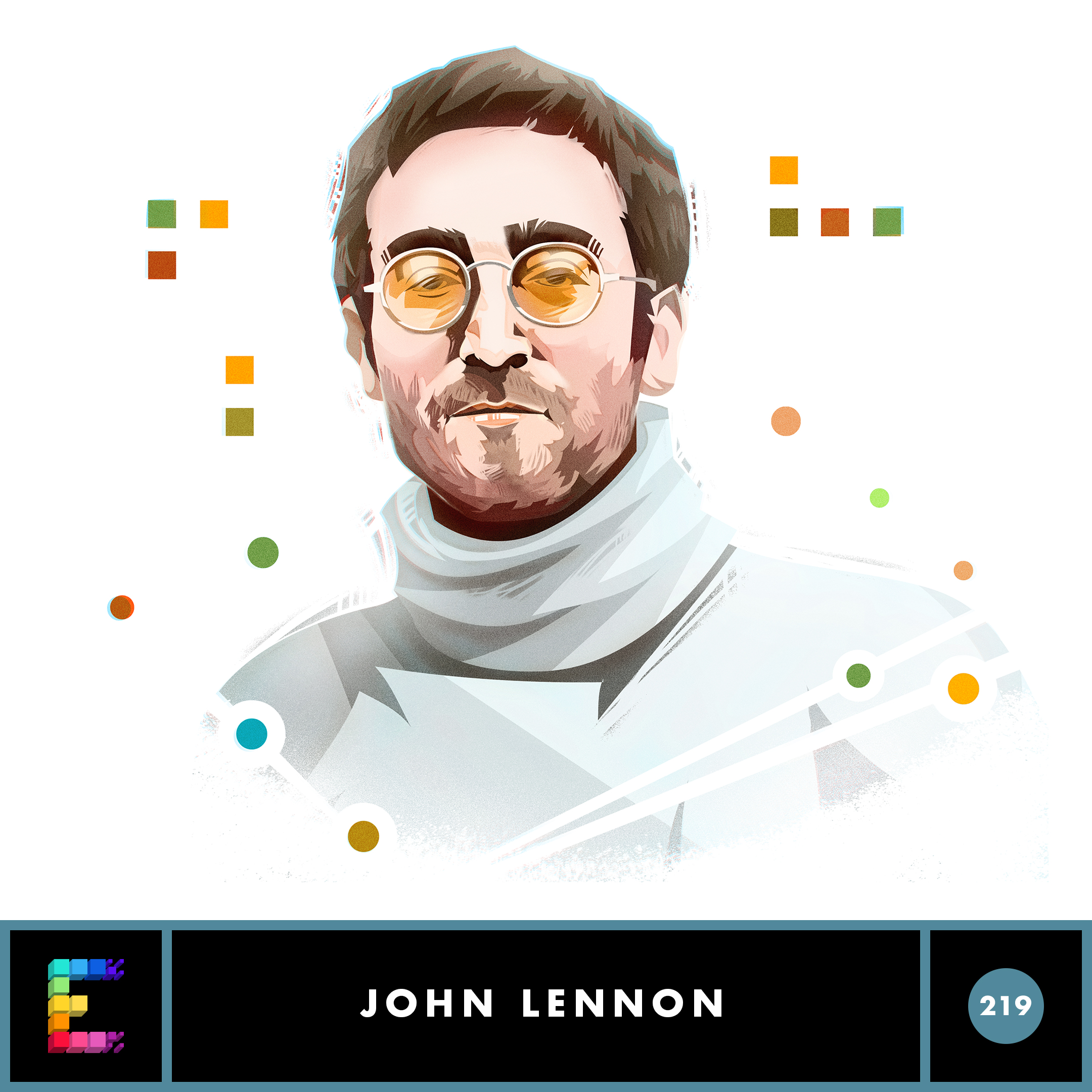
The Song Exploder podcast, hosted by Rishikesh Hirway, is in need of listener support as the podcast landscape evolves. A special episode delves into the making of John Lennon's song "God" from his first solo album, featuring insights from Klaus Foreman and archival interviews. The episode highlights Lennon's departure from the Beatles, his collaboration with musicians like Ringo Starr and Billy Preston, and the deep personal and creative themes explored in the song. The episode sheds light on Lennon's artistic process, the influence of primal therapy, and the significance of his relationship with Yoko Ono. Through interviews and behind-the-scenes details, the episode offers a unique glimpse into the creation of a significant musical piece by a legendary artist.
Transcription
3607 Words, 19338 Characters
You're listening to Song Exploder, where musicians take apart their songs and piece
by piece tell the story of how they were made.
I'm Rishikesh Hirwe.
Before we get into the episode, I want to say thanks so much for listening to Song Exploder.
This might be your first episode, or maybe it's your 300th.
It's crazy to me to think that the podcast has even been around this long.
But I will say that, unfortunately, over the last couple of years, it's been getting harder
and harder to see what the future might look like for the show, or if there even is a future.
And part of that is because while the number of podcasts out there in the world keeps growing,
the sort of middle class of podcasts where Song Exploder lives is getting hollowed out.
The one thing that can keep shows like this afloat these days is if enough people out
there are passionate enough about it that they're willing to put a few dollars every
month towards the work.
I've learned the hard way that ads come and go unpredictably, but the support of individual
listeners is real and much more dependable.
So I'm here asking if Song Exploder is a meaningful show for you, would you consider supporting
us and donating to the Radiotopia fundraiser that's happening right now?
We're looking for 1500 new donors who believe in the kind of podcasts that we make, intimate
stories made with careful production and sensitive editing.
It's a lot of work, but I really believe in making something that feels like every second
is worth paying attention to.
And I hope you believe in that too, and that's why you're listening right now.
If that's the case, please visit SongExploder.net/donate and know that whatever amount you're able to
chip in, it's making a huge difference over here.
It can kind of feel like a very lonely vacuum sometimes, and even just knowing that there
are people out there who care is huge.
The link again is SongExploder.net/donate and sincerely, thank you.
This episode contains explicit language.
Earlier this year, I got the most amazing email.
The estate of John Lennon said they have a treasure trove of audio material from his
life, and they were wondering if I would be interested in making an episode around the
song "God" from John Lennon's first solo album.
I've never tried making a posthumous episode before, because hearing directly from the
artist is at the heart of SongExploder.
But with all the interview archives that they have of him speaking, plus all the isolated
tracks from the recordings and the original demo, it actually seemed possible.
So this is a very different and special episode of the show.
In September 1969, John Lennon pulled the rest of the Beatles that he was leaving the
group.
Their breakup was announced publicly in April 1970, and that December, John Lennon released
his first solo album, John Lennon Plastic Ono Band.
The Plastic Ono Band was the name for a rotating group of musicians that John and his wife,
the artist Yoko Ono, had put together.
For the making of "God," the band included Ringo Starr on drums, Billy Preston on piano,
and Klaus Foreman on bass.
I got to interview Klaus Foreman about his experiences making this track.
And in this episode, you'll hear from him, along with archival interviews with John Lennon,
Ringo Starr, and Billy Preston.
You'll also hear the original demo for "God" and outtakes from the recording sessions at
Abbey Road Studios.
They recorded the final version of this song on October 9th, 1970, John Lennon's 30th
birthday.
But the story of "God" and what it was about and what it was inspired by really begins
with the breakup of the Beatles.
We were four guys that I met Paul and said, "Do you want to join me band?"
And then George joined, and then Ringo joined.
We were just a band who made it very, very big at all.
And we made it very, very big, but we sold out.
My own taste is different from that which I've played sometimes, which is called "copout,"
to make money, or whatever, or because I didn't know any better.
And didn't really enjoy writing third-person songs about people who lived in concrete flats
and things.
I like first-person music, but because of my hang-ups and many other things, I would
only now and then specifically write about me.
The only true songs I ever wrote were like "Help" and "Strawberry Fields."
They were the ones that I really wrote from experience and not projecting myself into
a situation and writing a nice story about it, which I always found phony.
And now I wrote all about me, and that's why I like it, it's me and nobody else.
In 1970, John Lennon and Yoko Ono started working with psychologist Arthur Janov, who
created primal therapy.
Primal therapy is based on the idea that we all carry around unprocessed trauma and internalized
pain from very, very early on in childhood.
But instead of processing that trauma, we find other ways to coexist with it.
In a nutshell, primal therapy allowed us to feel feelings continually, and those feelings
usually make you cry, because before I wasn't feeling things, that's all.
I can feel my own fear, I can feel my own pain, therefore I can handle it better than
I could before.
Here's an excerpt from an interview with psychologist Arthur Janov.
We had a talk, John, before he made that album, and he said, "Well, what about God?"
And I went into a long discourse about, you know, people have a lot of pain and they tend
to believe, and the less pain they have, the less they believe.
And he said, "Oh, something like, well, do you mean that God is a concept by which we
measure our pain?"
I said, "Yes, well, yes."
And so he wrote it.
This home recording was made in the summer of 1970, right around the time when John and
Yoko were attending Arthur Janov's primal therapy sessions.
I had the idea God is a concept by which we measure our pain, so when you have a word
like that, you just sit down and sing the first tune that comes into your head, and
the tune is the same, "God is a concept."
And then, like a lot of the words, they just came out my mouth.
I'll say it again, "God is a concept by which we measure our pain."
And then I just rolled into, "I don't believe in magic," and it was just going on in my
head.
And I don't know when I realized I was putting down all these things that I didn't believe
in.
Ai Qing and Bible in the first three or four just came out, whatever came out.
"I don't believe in magic, I don't believe in Ai Qing, I don't believe in Bible, I don't
believe in terror, I don't believe in Hitler."
I could have gone on, it was like a Christmas card list, you know, "Where do I end, Churchill
won?
Who have I missed?"
I got like that, and I thought, "I had to stop."
And then I was going to leave a gap and say, "Just fill in your own, for whoever you don't
believe in."
It was just going out of hand, you know.
But Beatles was the final thing, because it's like, "I no longer believe in myth, and
Beatles is another myth."
In September 1970, John Lennon started assembling musicians to record his new songs.
That included Klaus Vormann.
He was the bassist in Manfred Mann, and he was a longtime friend of the Beatles.
He made the cover art for their album Revolver.
Well, he asked me to be in the Plastic Owner Band, and I was knocked out.
And then it came to, "Now I'm going to do the Plastic Owner Band LP, and we're going
to play on the sessions."
And when I heard Ringo was there, I was so happy.
I mean, I always wanted to play with Ringo, and I never really had the chance up to then.
Here's Ringo Starr.
We would just sort of jam, and then we'd find out how they would sort of go when we did
them.
It was very loose, actually.
And it being a trio also was a lot of fun.
In spite of all the things, Beatles really could play music together when they weren't
uptight.
And if I get a thing going, Ringo knows where to go, you know, like that.
We played together so long that it fits.
So the three of them started recording at Abbey Road Studios in London.
Well, on this session, he always came in with the songs.
I think the first version he did was playing it on a guitar.
I mean, we were in the sitting in the studio, and he was playing it.
By which we measure our pain, yes, we do.
We never heard the songs before.
Ringo hasn't heard it.
I hadn't heard it.
We're completely fresh.
I don't believe in bubble, bubble.
I don't believe in the rubble, rubble.
I haven't got the word to say.
OK, so how about that?
God is a concept by which we measure our pain.
I'll say it again, God is a concept.
What key was that, Klaus?
D.
D?
Yeah.
We'll take one, and then let me listen.
See, I haven't got a concept in my head about this other than it's meant to be gospel,
and it doesn't sound anything like it, you know.
What? No, I don't like it like this at all.
In fact, I don't feel in the mood for any of this.
Have a night off.
No, we could do it.
It's just such a shame to come in all the way and sprout about for two hours,
and then go, you know.
Sprouting about for 12 hours, and still not feeling like doing it.
Yes, yes.
Maybe I should play it on piano, you know.
And then he went to the piano, and he played it very simple.
And he really liked it.
I can play the piano even worse than I play guitar.
So that's a limited palette, as they call it, you know.
I have to think in terms of go from C to A, you know, like that.
And I'm not quite sure where I am half the time.
So it's that kind of feel about it, you know.
That's reality.
Oh, sorry, I fucked the ending.
I liked all that beginning.
I always liked simple rock and nothing else, you know.
I was influenced by acid and got psychedelic, you know, like the whole generation.
But really, I like rock and roll, you know, and I express myself best in rock because
it's primitive enough and it has no bullshit.
When you just hear the piano, does it all for you?
Your mind can do the rest of it.
If you've got an ear, you can hear.
Any musician will tell you, just play a note on a piano, just call them harmonics in it.
So he got to that, you know.
What the hell, I didn't need anything else.
Hey, that sounded great to me.
Yeah, right, but it's very fast.
The playing was tremendous.
Is it too fast?
Well, let me just give you.
Oh, that's it, OK.
OK, OK.
Stop it now, Edel.
And then you went back to the guitar and asked me, "Klaus, you play the piano."
And I can't really play a rock and roll piano really well.
I mean, I learned classical piano, but I played a few little licks that sort of were a little gospel-like.
And I think that's the moment where they clicked with him.
Why don't we ask Billy Preston to come in and play?
Well, John Lennon, to me, was the boss beetle.
He was really a character.
He was witty and just a lot of fun.
He did whatever he wanted, and we felt like he was doing.
Yeah, John was the boss beetle.
Billy Preston was a Grammy-winning musician.
He played organ, piano, and other keyboards as a session player in the '60s,
with legends like Little Richard, Sam Cook, Ray Charles, and the Rolling Stones.
He recorded with the Beatles on their last two albums.
This last May, 15 years after his passing, he was inducted into the Rock and Roll Hall of Fame.
And this is him playing piano.
I met the Beatles in 1962 when I was on tour with Little Richard.
I was playing organ for Little Richard, and they were opening act on the show.
And we played one show in Liverpool, and then we went to Hamburg, Germany for two weeks.
And that's where we really became good friends.
We hung out there, and I used to get them free coax and steaks at the club,
because I was with Richard, so I can get things, you know.
And they would always hang around me and ask me things about America and different things.
So we became good partners.
Billy is fantastic.
I love the man so much.
And Ringo said that he never heard Billy play a wrong note in his whole life.
When he played, I feel that he's really holding back.
And he's not playing the gospel piano as crazy as he can.
He really knew I have to do something that really supports the song.
And as much as there is space for it, I'd do something, but he could have done much more,
which wouldn't have fitted the song so well.
And Ringo loves that to play as simple as you possibly can, and it's the same with me.
It was perfectly clear what we were going to play.
And at the moment, when John starts singing a song, and you hear his voice,
and you hear what he's saying, you automatically know what you have to play.
The simplicity of what Klaus and I played with him gave him a great opportunity
to actually, for the first time, really use his voice and his emotion how he could, you know.
I don't believe in tarot. I don't believe in Hitler. I don't believe in Jesus.
I don't believe in Kennedy. I don't believe in butter.
Ringo always said in interviews that he never plays the same fill again.
And he says, if you ask me to play that same fill again, he can't do it.
He can only do what he feels at the time.
We just clicked together, and it was just so much fun.
And you know, Ringo actually said the way we played, that's the best band he ever played.
I don't believe in Beatles. I just believe in me.
We went in the control room and listened to one take, and he said, I just believe in me.
And then he came up to me and said, Klaus, do you think I should say Yoko and me?
And then I told you, look, that's a question I cannot answer for you.
You know, that's something you have to know by yourself.
Not lots of people know Yoko, but she is very delicate and very fine feeling, and her presence was really good.
It was fantastic for John, and it was good for us too.
You know, lots of people were opposed to it, and they felt like John had gone nuts or something, being with Yoko and all this, you know.
It was terrible. It was a terrible situation.
I mean, the very, very first time when Yoko came in, and Ringo hadn't seen much of Yoko, he was very upset.
We all had our wives and our families, and then, you know, we'd go to work and come back.
Suddenly Yoko was living in the studio with us. It freaked us out, freaked me out anyway.
Because he had his John from the Beatles, and now he suddenly had John and Yoko.
He had a hard time to get used to this, but John was really good.
He went up to Ringo and said, "Look, Ringo, you know me, but now it's Yoko and me.
We both are together, and that's how it is."
And that made him feel much better, and then the next days everything was fine.
And I asked him, I said, "You know, what is going on?" He says, "Well, you know, we're going to spend every minute together."
So as soon as you knew that, you were cool, and that's what they did.
You could tell. It was a lovely companionship. They were always holding and, you know, kissing and dancing around.
They were always together.
There's nothing more important than our relationship. Nothing. Both of us could survive apart.
But what for? I'm not going to sacrifice real love for any friend or any business.
Because in the end, you're alone at night, and neither of us want to be.
And nothing works better than to have somebody you love hold you.
And that's reality.
John never liked his voice, and when he was with the Beatles, he always put lots of effects on his voice to cover up that.
And because he thought the voice didn't sound good, that's what he thought.
It used to get a bit embarrassing in front of Jordan Paul, because we know each other so well.
He's trying to be Elvis, always doing this now, you know. We're a bit super critical of each other, so we inhibited each other a lot.
But this time, it was my album, and now I had Yoko there, okay, so I can perform better. And I relaxed, you know.
The dream's over. You know, I'm not just talking about the Beatles, I'm talking about the generation thing.
You know, the dream's over, like, it's over, you know, and we've got to, well, I have, anyway, personally, got to get down to the so-called reality.
John, actually, he was really trying to say something with his "I don't believe."
He meant that sort of belief, where people, for example, are in despair, and the last thing they ask for is, "Oh, God, help me. I believe in you."
And that's what he doesn't believe in. He says the help, you only get out of yourself.
You can't ask for anybody to give it to you, and that's what you have to do.
And if you don't believe in yourself, you're fucked.
John was a very, very special guy, and he had a big heart, and he was very sincere in what he did and what he stood for.
He was always brave. He would put it out there, and the consequences sometimes were very harsh, but he would always put it out there.
And that's why you could not love him.
You're born in pain, you know, and pain is what we're in most of the time, and I think the bigger the pain, the more God's really in you.
Creating is a result of pain, too. I have to put it somewhere, and I write songs, you know, because that's the thing I chose to do, you know.
I can't help writing them. That's the fact.
And now, here's God, by John Lennon, in its entirety.
By which we measure all pain.
I'd say it again.
God is a concept by which we measure all pain, yeah, pain, yeah.
I don't believe in magic. I don't believe in itching. I don't believe in Bible.
I don't believe in touch. I don't believe in Hitler. I don't believe in Jesus.
I don't believe in Kennedy. I don't believe in butter. I don't believe in mantra.
I don't believe in Gita. I don't believe in yoga. I don't believe in kings.
I don't believe in Elvis. I don't believe in Zimmerman. I don't believe in Beatles.
I just believe in me. You're calling me. That's reality.
The dream is over. What can I say? The dream is over. Yesterday I was the dream river.
And now I'm reborn. I was the walrus. But now I'm John.
And so, dear friends, you just have to carry on. The dream is over.
You just have to carry on.
It's an award-winning, critically acclaimed show, and it's hugely influential in the podcast world.
In every episode, Jonathan sits down with a guest to revisit a defining regret or lost connection or an unsolved mystery from their life.
Maybe it's a friendship that ended without closure or a mistake that never received an apology.
Jonathan tries to help his guests make it right, and the stories are funny and heart-wrenching and will often make you laugh and cry in the same breath.
Listen to Heavyweight wherever you get your podcasts.
This episode was produced by me and Christian Koons. My interview with Klaus Vormann was engineered in Germany by Michael Bartlewski.
Editing help came from Craig Ealy and Casey Diehl, music clearance by Kathleen Smith, and the episode artwork was made by Carlos Lerma.
Song Exploder is a proud member of Radiotopia from PRX, a network of independent, listener-supported, artist-owned podcasts.
You can learn more about all our shows at radiotopia.fm.
You can follow me on Twitter and Instagram @rishihearway, and you can follow the show @songexploder.
You can also get a Song Exploder t-shirt at songexploder.net/shirt.
I'm Rishi Keishe Hearway. Thanks for listening.
Podcast Summary
Key Points:
Song Exploder podcast faces uncertainty due to the growing podcast landscape and the importance of listener support.
Special posthumous episode featuring John Lennon's song "God" from his first solo album.
Details on the making of "God," including insights from Klaus Foreman and archival interviews with John Lennon, Ringo Starr, and Billy Preston.
Summary:
The Song Exploder podcast, hosted by Rishikesh Hirway, is in need of listener support as the podcast landscape evolves. A special episode delves into the making of John Lennon's song "God" from his first solo album, featuring insights from Klaus Foreman and archival interviews. The episode highlights Lennon's departure from the Beatles, his collaboration with musicians like Ringo Starr and Billy Preston, and the deep personal and creative themes explored in the song.
The episode sheds light on Lennon's artistic process, the influence of primal therapy, and the significance of his relationship with Yoko Ono. Through interviews and behind-the-scenes details, the episode offers a unique glimpse into the creation of a significant musical piece by a legendary artist.
FAQs
Song Exploder is a show where musicians break down their songs and share the story of how they were made.
Listeners can support Song Exploder by donating to the Radiotopia fundraiser.
The Plastic Ono Band, including Ringo Starr, Billy Preston, and Klaus Foreman, were involved in making the song 'God' by John Lennon.
The breakup of the Beatles and John Lennon's personal beliefs inspired him to write 'God'.
Heavyweight revisits defining regrets, lost connections, or unsolved mysteries from guests' lives, aiming to help them make things right.
Rishikesh Hirway is the host of Song Exploder.
Chat with AI
Loading...
Pro features
Go deeper with this episode
Unlock creator-grade tools that turn any transcript into show notes and subtitle files.
 PodcastTranscript AI