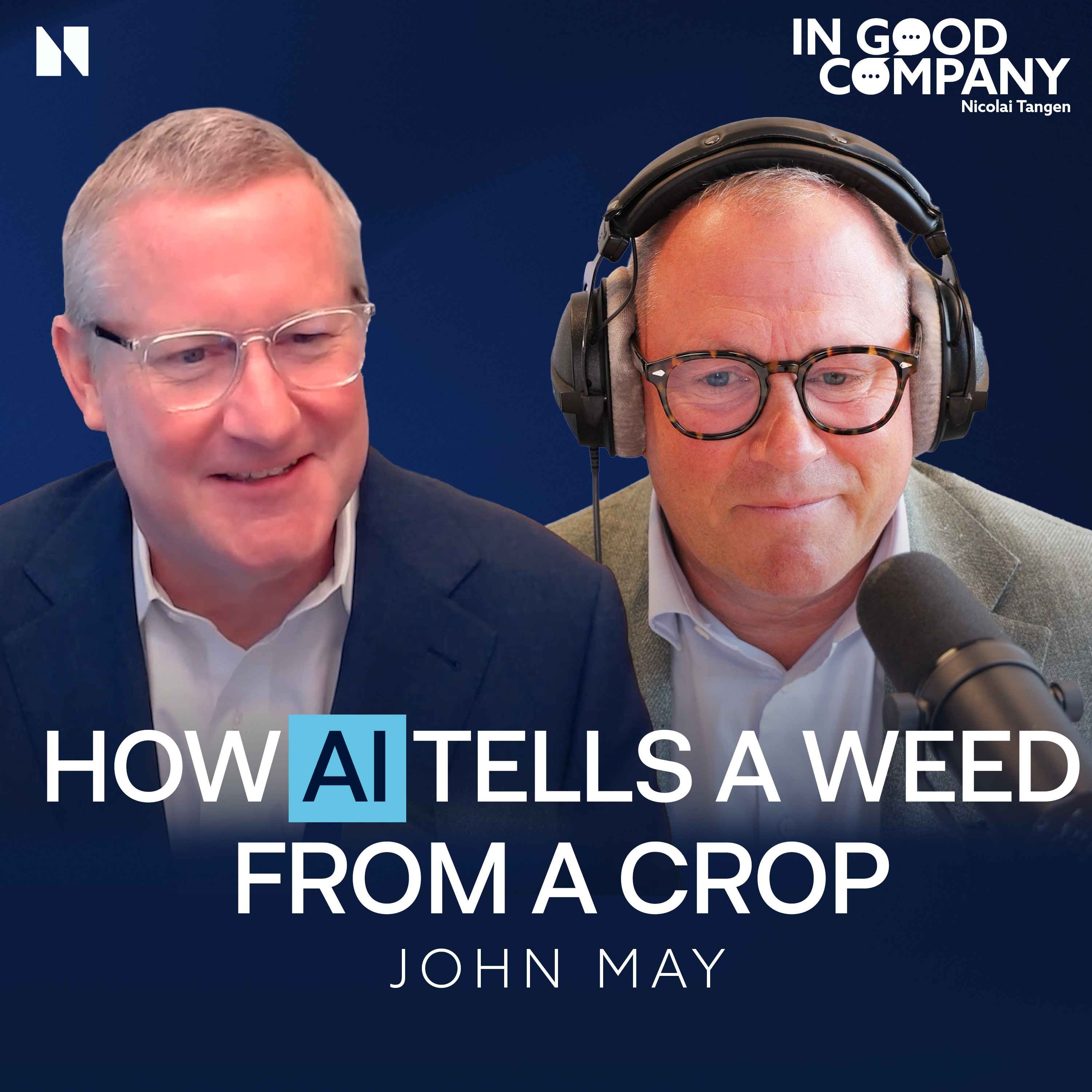
John Deere CEO: Farming's Future, Autonomous Tractors and AI in the Field
38m 7s
John Deere, under CEO John May, is undergoing a major transformation from a traditional agricultural machinery firm to a leading technology company in farming. The shift centers on understanding and addressing farmers’ biggest challenges—like seed placement, weed management, and input costs—using AI, computer vision, and autonomous systems. For example, AI now enables precise detection of weeds versus crops, reducing herbicide use by 60%, and targeted nitrogen application cuts fertilizer costs by two-thirds. These technologies are increasingly accessible through flexible subscription models, allowing small and mid-sized farms to adopt advanced solutions. Deere’s strategy emphasizes data use, with millions of connected machines generating agronomic data that farmers can analyze to make smarter decisions. The company aims to achieve fully autonomous corn production by 2030, reflecting a broader vision of intelligent, efficient, and sustainable farming. Despite challenges like climate variability, trade disruptions, and global supply issues, Deere maintains a strong customer-first culture, rooted in long-term employee commitment and deep industry knowledge. The company’s reorganization—de-layering structure and aligning around production systems—has accelerated innovation, while maintaining trust through transparent, accessible data and "right to repair" tools. Ultimately, the goal is to elevate farming through technology, enabling farmers to work smarter, not harder, while protecting the environment and improving profitability.
I have a farm myself and I bail hay.
And the quality of the bail that I can produce
is only as good as my experience set.
So when I think the hay is at a point where it can be harvested,
I get in the moco, I cut it,
and then I sit in the tractor and I'm bailing it,
I'm listening for things, I'm looking at the computer,
but the end product is going to be as good as I am.
(upbeat music)
(upbeat music)
- Hi everybody, I'm Nikolai Tangyan,
the CEO of the Norwegian so-and-well fund.
And today I'm joined by John May, the CEO of John Deere.
Now, when you think of John Deere,
you may think of green tractors.
And indeed, there is a green tractor
standing behind John here on the screen.
But a company has become one of the most advanced
technology companies in farming.
Tractors that drive themselves, AI that tells a weed from a crop,
and John is the man behind the shift.
He spent almost his entire career at Deere,
and now he is trying to turn the maker of farm machines
into a real technology company.
John, warm welcome.
- Thank you, it's great to be here.
And thanks for including me on your podcast.
Fantastic.
Now John, you became CEO in 2019,
and then very quickly after that,
you launched what you call smart industrial strategy.
What is that?
- Well, really what we wanted to do is get more focused
on the customer itself, and the jobs that our customer do.
You know, in the past, what we would do
is focus on building the best planter,
and we wanted to shift to helping our customers
plant better than they ever had
in the past by leveraging technology.
So we realigned the customer around production systems,
and then really invested heavily in technology
that would make our customers more productive,
more profitable, and more sustainable.
And how is it different from how Deere used to run?
- You know, in the past, we didn't focus on necessarily
the biggest challenges that our customer had.
So for example, when you're planting,
your biggest expense is actually the seed,
the cost of the seed.
So the importance of getting seed placed exactly
in the proper spot at the proper depth
ensures the highest yield
and helps our customers manage their costs.
So we really focused on understanding
what are our customers biggest pain points,
and what's the biggest cost to them,
and how can we help them reduce their costs?
- So you say that the goal is to help customers
to do more with less.
You rather help the farmer plant better
than to sell the best planter.
Why is that important?
- Yeah, let me give you an example, and I'll talk about spraying.
So everywhere around the world,
after the crop comes up and it's standing crop,
one of the biggest challenges
is managing weeds, managing pests.
And if you can't manage those weeds,
they take the valuable nutrients away from the healthy plant
and the healthy plant produces less.
So we invested heavily in a technology
that was not used in agriculture, computer vision,
and we created using artificial intelligence,
the ability to see the difference
between a healthy plant and a weed
and only spray the weed versus spraying the entire field.
That reduced herbicide application by 60%,
huge savings to our customer,
and they get a better outcome in the end.
- You say that you want more of the revenue
to be recurring and also have more subscriptions.
It's tough to change the business model of a 190-year-old company, right?
- Yeah, why is it so tough?
What is a tough part of it?
- Well, first of all, we have multiple business models
that it will offer to our customer.
And really what we saw as the opportunity
to shift and allow our customers,
if they want to, to pay by the acre,
or pay by the application,
allowed us to spread a very expensive technology
across more acres.
We have big, large farmers that can capitalize
their entire business by the latest and greatest technology,
but we have others that can't afford that.
And by coming up with a pay-as-you-go or a SaaS model,
it allows us to get this tech on more acres
and help more customers.
- But in a post, the farm was bought a tractor.
Now they have to pay a monthly fee.
Are they willing to do this?
- Yeah, and in some cases,
they might just buy the complete solution
and not necessarily the tech that has the pay-as-you-go.
They're very interested in it.
We're seeing right now take rates double
from last year on the use of the technology.
Really, you know, what makes the difference
is if you can demonstrate true value,
value that hits their income statement, their bottom line,
they're willing to invest in the technology.
And that's our strategy.
We want to make them more profitable and more productive.
What are some of the other areas
where you integrate technology and AI into machines?
- Another great example in a very expensive cost
to our growers is application of fertilizers,
like nitrogen as an example.
In the past, we didn't have the ability,
as we're planting the crop, planting corn,
to target the nitrogen application just to the seed.
Because that's the only part of the field
that needs the application.
Technology in the past allowed us just to free flow nitrogen
into the trench by using computer vision.
We can see exactly where that seed is
and only dose the seed with nitrogen.
And that allows our customers to save two thirds
of the nitrogen cost that they would have spent in the past.
And it has a sustainability impact
because it's putting the fertilizer
only where it needs to go.
How difficult is it to develop this technology?
- I mean, how difficult is it to tell a weed from a crop?
- Well, I tell our engineers, it can't be that hard.
Let's go fast and get it to the market,
but of course they disagree with me.
It's very difficult.
How we really got into this is we bought a company
that was focused on computer vision
and advanced algorithm and AI,
but not necessarily in the segments that we wanted to,
that were we compete, and we took that technology
and applied it to agriculture.
So if you think about self-driving cars and robotaxies,
that industry was developing this technology,
but we saw a use for it within our industry
and really for a totally different outcome
instead of just steering the vehicle,
it's all about having precise location of the plants,
precise location of where we need to put pesticides,
herbicides, et cetera.
So existing tech apply to our industry.
- One of the implications for like the land,
the soil, the water around the farm.
- Well, the more we can get precise,
the more we can leverage advanced sensors
like artificial intelligence, like computer vision,
we can reduce all of the inputs that are going into the field.
And the great news is it has a sustainability impact,
but the really positive news to our customer
is their expense.
Their total expense goes down for those inputs
and they're more profitable.
So it's a great win-win for sustainability
and for profitability for our growers.
- I believe you launched driverless tractors back in 2022
and this year, fully autonomous battery electric,
pretty incredible.
How do you approach this?
- So again, we leverage computer vision
as well as some other sensor technology.
And we believe it's the window for farming is so short
because of weather and because of rain, heat,
when does the soil get warm.
So farmers really need to move quickly
and leverage every hour that they have.
And we saw an opportunity to make equipment fully autonomous
and allow it to do the job better than the grower can
by themselves and run this equipment 24 hours a day
without having to have an operator in the cap.
So last year was the first year we launched
in a commercial fully autonomous tillage solution for sale.
And we've had great adoption and great results
as a result of it.
We plan to take that technology and roll it across
every production step that our growers do
because that tech stack that we developed
is portable across a tractor, a combine, a sprayer.
So it's gonna have, it's gonna lock a lot of value
for our customers.
- How much of farming do you think will be autonomous
in five years time?
- Well, our goal is our ambition period is by 2030.
We wanna have the corn production system growing corn
in the US fully autonomous.
That's our goal.
Everything from tillage, planting, spraying
and harvesting the crop without an operator engaging at all.
So we believe by 2030, if we can prove it out in corn,
we'll then roll it across all other crops.
So it's really exciting.
- It is incredible.
What's going to be the role of humans in farming them?
- You know, if you think about the role of a farmer,
they have tremendous amounts of knowledge.
they've been doing it for 30, 40 years.
I have a farm myself.
self and I bail hay. So, you know, when I think the hay is at a point where it can be harvested,
I get in the moco, I cut it, and then I sit in the tractor and I'm bailing it, I'm listening
for things, I'm looking at the computer, but the end product is going to be as good as
I am. So what we want to do is we want to get the farmer out of the cab and have them work
on higher value jobs, more planning, monitoring more machines, going to the field and looking at
the environment that the machines are operating in and then making small tweaks to optimize the
machine. That knowledge set of the farmer is better used outside of the cab, maybe in front of a
computer and doing planning and monitoring than sitting in the cab of the vehicle. John, what's
the coolest John Dare machine or you have on your farm? I would say the coolest machine that I have
is a planter, you know, because if you don't do that job right, if you don't get that crop
spaced right at the right depth and put it in the ground at the right time, you may not have a crop
but you sure won't have a high quality crop. And what's the cool about it when you see, when you go
and say hi to your machine, what's the cool, why is it so cool? So five, six years ago, it used to
be a machine that used hydraulics to control the seed all the way to the trench. We've gotten rid
of all the hydraulics, we use electric motors now. We can control every individual row unit
independently and adjust the actual planting of the crop based on the soil fertility
and put maybe in one row 30,000 seeds in the other 24,000 because of the differences, the micro
differences in the field. It's incredible the opportunity to shift from managing a field to
managing every individual plant that's out there. And that's how you'll get met the maximum yield
and that's how we'll feed the world going forward. I have to say when you talk about this machine
inside, well, I want to become a farmer, but farm income is down, right? And it's tough time
as for farmers. Why, why, why is that? Well, you know, we've had obviously a lot of disruption
on the trade side of grains. So when certain markets are no longer actually purchasing grains
from a country, then the overall trade flows get disrupted and it causes just anxiety.
Now, the great thing is supply and demand are pretty well matched. You know, the supply for
crop, what farmers produce and the demand from consumers, people that are eating, feeding families
around the world are well matched. But when we get disruption in trade flows, it really causes
a bit of anxiety and pause on where is my crop going to go. So this is a, you know, if you look
at other times when farm income is down, typically it's one specific country and it's related
normally to a big weather event like you have a drought in Australia. And all of a sudden now
the work short of crop and markets have to adjust to serve Australia. This is a global issue.
We're seeing all markets right now disrupted, whether you're talking about Australia,
Argentina, Europe, we're seeing disruption around the world. I mean, we have markets that have come
completely out of growing crops like Russia as an example. We had operations there. We were
focused on growing small grains with producers. We're no longer in that market. You have
markets like the Ukraine that are disrupted right now as well as the the war that we're seeing
in Iran and the effect that that's having on fertilizer, the flow of fertilizer as well as fuel.
So lots of uncertainty right now that's causing that. You called 2026 the bottom of this cycle.
How can you be so sure about that? Well, the reason we believe it's the bottom is all of the
stuff that we can control. We've control. So for example, what causes a slowdown in the purchase
of new equipment is when you start to see overall used volumes go up or you just came off a period
where there was lots of sales and that that inventory is now trading and you need to find a
second home for it. So we've worked really hard to get our used inventories in the appropriate
level that the markets need around the world and how we do that is we intentionally
underproduce retail demand. By underproducing retail demand, you allow customers to purchase
used equipment and then you get stability back in the market. We're at levels right now that we
believe are what we would see is at the bottom of the cycle as well as I know you mentioned commodity
prices are lower but they're actually higher than they were a year ago. So we're starting to see
markets stabilize in the overall revenue portion of our customers business become stronger.
So we believe 26 is the bottom and we'll start to see the overall industry start to cycle back
to more of a normal market cycle. You had an issue where farmers said that you stopped them from
fixing their own tractors and you settled this right to repair so-called right to repair
fight. How do you how do you win trust back after an episode like that?
You know our philosophy has always been and it's part of our values. It's part of
our purpose is to put the customer first and our intentions are to always serve the customer
and make sure that they have access to the parts and the tools that they need to fix their equipment.
So we were approached with some requests for example having our customers have the ability to
diagnose their equipment on their own. We created an amazing artificially backed tool now that's
available to the customers where they can just like a dealer technician plug into their equipment,
diagnose what the failure rate is, we'll tell them what parts you need, how you fix the machine
and then they can make the decision on whether they don't want to fix it themselves or they want to
involve a John Deere dealer or an external dealer. So our intent always is to make sure that
we're serving the customers in the best way and leveraging technology to do that better each year.
Can we move on to data? So you got a million connected machines 15 years of data.
Just how do you use that data? Well we use it in a couple different ways. So back in 2012
we made the decision to put a telematics gateway. Basically think of that as a cellular connection
that takes all the data whether it's machine data or agronomic data that used to be locked on
machines and send it to a cloud based system. We call that the operation center. So now our
customers if they choose to have all of their agronomic and their machine data in a location
where they can use it to make better decisions. We've tried to facilitate an ecosystem where we allow
any company to connect to that data set and if the farmer wants to share their data with say
an agronomic provider that writes prescriptions they can do that and then that agronomic provider
can create value and push it back to the customer or the machine to create more value for the
customer. So really we saw this opportunity where all this data that used to be locked on board
and was very hard for customers to use. If we could put in a safe secure location that's very
accessible to our customers we could allow them to make better decisions. What's the most valuable
data out of this all this incredible amount of data points? It's the agronomic data. It's knowing
what seed you planted, what type of seed, what hybrid you planted, how much rain you got during
the season when you applied fertilizers, when you applied pesticides and then when you actually
harvested the crop which fields perform the best based on those decisions that you made and then
you can compare those decisions and next year make different choices and in the past that was
very very hard to do. Now farmers have multiple years of data at their fingertips that are in the cloud
that we provide artificial intelligence tools for them to simply ask questions. You know I planted
this hybrid in this field. What if I would have planted this hybrid? What would I have likely
have seen as a result? So much more analytics right at the fingertips of the growers. I think that's
the most exciting thing right now that's going to change agriculture. How do you work with the
crop protection industry? I mean the buyer that's in Gentile the world. We do a couple different
things with them. Number one, they have products that they want to sell to the growers. Great
example would be they want to see what yield did a farmer get in a certain field. What are the
soil types? What's fertility? And then if they have that data they can write a better prescription
for the next
year's planting decisions. So we'll connect, if the customer wants to, we'll connect those
companies directly to that data. The economic, the input provider takes that data, writes
a prescription, and then sends it directly to the machine, directly to the planter, and
we plan it automatically, exactly how they want it planted. What hybrid goes in, what's
the seed volume, what's the spacing, and we can ensure the grower that that exact prescription
that was written by their seed company was exactly applied in the field the way it was
intended to, by using automation, by using autonomy, by using artificial intelligence.
That wasn't possible 10 years ago. How different is farming now in America compared to, let's
say, Africa, Asia, Brazil? Farming in America is definitely the most advanced, but when
I say that, there's pockets everywhere around the world. So in the United States, there
tends to be more precision tools available to the growers. Europe has the same sort of opportunity
that the US has. The next market that's really advancing at a rapid pace would be South America.
But we don't stop at these big markets. We provide lower cost, incremental steps into
precision agriculture, into markets all around the world, whether you're talking India and
offering a cell phone-based solution that allows them to connect to their tractor through
their cell phone and monitor productivity or Africa or Asia, we have similar tools. But it's
important to know that in those countries, in those regions, there are also very large
farms that are using the most advanced technology, but not across the entire countries or continents.
How big is the threat from Chinese equipment? You know, I think Chinese equipment, we're
going to see, we've had operations in China since the mid-70s, we still manufacture
product there. I ran the country for three years from 2004, 2007, and lived there, and ran
all of our facilities. What I think is going to happen with the Chinese in agriculture
is we're going to see them focus in more on a smaller agricultural side, maybe in production
systems like hate production or high-value crops. They'll eventually advance to larger production
crops like corn, soybeans, cotton, sugar, but I think there are ways away from that and
from developing those technologies. We still sell our most advanced agricultural equipment
into China for their large-state farms, but like every industry, we're watching. We're
absolutely watching. Another thing which is changing is climate. What are farmers seeing
now that they didn't see 10 years ago? You know, if you can look at any season and the
difference in weather patterns is by far probably the biggest challenge. If you look just
here where I am today, sitting in the Midwest, we have places in the Midwest that had 20 inches
of rain in the last week that didn't, that hasn't happened in 10 years. So the variability,
I would say variability in volatility in weather. I'm sure you see that in your markets
as well where we seem to have more extremes than we do more constant type of patterns. That
becomes a big challenge for growers to adjust to that. Also as regions change, you see different
crops going into those regions. You know, we're growing corn for example in northern parts
of the United States and we never did that 20 years ago. A lot of that has to do with
genetics, but a lot of it has to do with weather as well. When you see the impact on farms
and farmers, are you surprised that there is no more focus on climate or that the focus
has actually decreased over the last few years? You know, I think, not I think I know farmers
care probably more than anybody for their soil, for their water, because those are the critical
inputs for them to grow a crop. So when we come out with technologies that allow for
more precision placement of things like nitrogen, of things like herbicides, of things like
pesticides, they want to invest not just because they're saving money, but because they want
to be good stewards of their land. It is, you know, it's their factory. It's their factory
where they make all their money. So it's very important to farmers.
Let's move on to co-op of culture. An incredible stat. You are only the number 10 person to run
a company, which is 190 years old. Unbelievable. What is it that has made that possible?
Well, I'll tell you, I think it's the employees that we have in our company are committed
to our customers, they're committed to our industry, and the majority of our employees
are like me where, you know, they've had, you know, three decades with the company,
and their whole lives have been focused on agriculture. So I think our culture and
our purpose of we want life to leap forward. We want to invest in equipment, invest in technologies
that constantly and consistently advance the livelihood of people around the world.
And that purpose is passionate. And I think that's why we have people that have long tenure
with our customer and are fully invested in our industries and want to see our customers
succeed in advance.
What other part of co-op of culture that you would never change?
I would never do some of the kind of the funny ways that you do things.
You know, I would never change the fact that our customer is the most important person
that we focus on every day. And I'm telling you, if you walked around any one of our factories,
any one of our engineering centers, and if a customer happened to be there, they would
be swarmed by our people. And our people would be talking about their commitment to them,
their focus on innovation, their focus on quality, their focus on integrity, how important
it is to do things the right way. As well as humanity, we want to treat everybody the way
we want to be treated. And I would never change that because if you have to remember as a
business, you're not a business if you don't have a customer. If the customer is not
ringing the cash register, then you don't exist. So you have to have this incredible passion
to serve that customer and get better every single day.
What are the things that you would like to change, though?
Yeah, I think we're making a big shift right now as a company on the technology side.
And you know, we're going from a very mechanical engineering focused company to much more
software development. And that shift is difficult because you still need the strong mechanical
engineers, but you need this new high-tech, hard to recruit software engineers, but you
have to make sure everybody feels valued. Because without the hard iron, we can't deliver
the software that makes the machines better.
How do you do this? How do you get a hundred and ninety year old company to run fast?
You know, one of the things we did early on when we did Smart Industrial is we de-layered
the company. We had eleven layers and we went down to seven. Seven layers in the company.
You can't have this traditional industrial company that has so many levels of decision-making,
otherwise things are too slow. I mean, we first company we bought was an artificial intelligence
company when I was CEO called Blue River. They had two two layers. They had this guy
that was running it, the entrepreneur and everybody else. They moved fast. So we had to make
some big changes to accelerator speed.
What's the cleverest thing you've done since you took over as a CEO?
You know, I think the biggest change that we made that has been successful is we moved
away from a very traditional matrix organization where you had product lines and you had regions.
Very traditional looks like automotive companies, other traditional industrials. We aligned
around production systems. So you're on the corn team, you're on the soybean team, you're
on the wheat team, the cotton team, the sugar team, and all you're focused on is developing
equipment and technology for a person that grows corn. That's all you do all day long.
You get really deep, really close to the customer and it's hard to compete with that
or structure and I think that's been the most successful change we've made as a company.
Have you made changes which you need to reverse?
You know, I think the big challenge that every company has is, you know, you want to be
as efficient as possible. And to do that, you're always constantly trying to determine how
centralized should you be in order to leverage economies of scale versus how decentralized
should you be. And we have to balance that all the time. And we're doing that every
single year. Functions that maybe we've put too much focus on centralization like say
a supply band.
team that's sourcing all of our components for every industry we're in may not
that may have gone too far and we need to look at that so that's the biggest
balance that we're challenged with to slightly a deep dive questions here the
first one what is your biggest personal failure in life that is a deep
question you know I think I would say you know as you're coming up through the
company you know you see a lot of things that you would do differently not
I'm speaking of now that I'm sitting in this chair and then when you get in this
chair you realize the complexity of the company and the frustration I had as an
employee coming up that things were going too slow and we weren't making big
enough bets once you get in this chair you realize how complicated those
decisions are and I probably would have had more patience I think coming up
through the company you know I was fortunate to have some really good mentors
along the way that would help me you know slow down and and think more
broadly and then the last thing I'd say is I see the value as the CEO in
having a really strong team that can collaborate on every issue and when our
management team gets in the room there are no boundaries there are no
jurisdictions and I think if I could have made that culture exist all the way up
as I was a manager I would have produced a better product than any job that I'm
not many not many young people are able to to see that what what are the what are
the part of yourself you're trying to improve now you know I continue to you
know and you can appreciate this yourself as you come up and eventually become
CEO you've had almost all the roles in the company and the hardest thing to do
is to watch somebody make a decision that you know is not going to be
successful and I'm trying to do more of that step back and maybe ask probing
questions to maybe get people to think differently but it's okay to let people
have a failure because you learn so much from that so I try to ask 10 times as
many questions as I do give answers and and let people learn from their own
mistakes well what's something about you that most people don't know most people
don't know that I grew up in caribou main which is a little teeny town in
northern Maine where our school system shut down four weeks a year everybody
picked potatoes my dad owned the little teeny local furniture store and you
know I had to go to school on federal pell grants because my parents couldn't
pay for school I think when you get in this role I think people assume a lot of
stuff was handed to you and that's not the case you know I I've worked for my
college degrees I've had to get jobs on my own and and really work hard and and I
say that I should sell that more just to let people know that it is possible I
mean you don't have to be a family a member of the John Deere family to get in
this role you can be a kid from rural America that you know came from a real
small up growing in background and and if you have a passion for something you
can get there what do you think it has done to you as a person well I think it's
made me realize and I tell my kids this all the time I mean you can do anything
you want anything you want whatever you're passionate about if you're truly
truly passionate about something you can get there no matter how big it is or
how small it is and I think everybody has that opportunity what is a perfect
day for you perfect day for me would be out with our customers sitting in the
cab of a combine or or a sprayer or a tractor and telling them and listening to
them tell me what things I need to do better as the leader of John Deere and I
try to do that as much as I can and I always say hey listen you cannot hurt my
feelings so tell me everything that's on your mind that we can do better to
serve you as a customer how do you switch off yeah that's that's hard question I
I think you know when I'm back at home or on the weekends having the
opportunity to maybe go visit one of my kids they're relatively close to where I
live and just sit and talk with them about what did they do for their week and
maybe convince them to go to lunch with me you know you know how it gets against
the point where paying is not enough you have to convince them that maybe this
appointment is more valuable than the other appointment they have but I'd say
that's the big shut-off for me is spending time with family and just hearing
what's going on in their life do you cook I we do cook we do cook we use so for
most of my career we lived in rural America so we didn't have access to a lot of
restaurants so we cooked a lot as a family and what is your specialty what do
you what do you put on the barbecue I love to grill burgers and then the other
cool thing I just got my my girls bought this for me is one of these outdoor
pizza ovens you know that heat up to like 700 degrees Fahrenheit with a big stone
in it I love it fantastic I I I use mine all the time do you read I do read I do
read and I like you read I liked first of all if I'm on vacation I love to read
fiction you know I also try to look for books where I can learn something whether
it's an artificial intelligence book or a book that was given to me the first day
I became CEO that talked it's called the outsiders that talked about a small
group of CEOs that were extremely successful that weren't known because they
focused on the basic things and that's capital allocation and deploying human
resources to get the greatest return for the customer and the shareholder so I
look for things like that I love to read newspapers and I I get kitted for
this but I still read paper newspapers every day I just like a paper newspaper
yeah and I agree with you the book you mentioned is very very good lastly what is
your advice to young people I you know my my advice to young people is one of
the things that I've seen and I'm sure you see this as well people don't want to
move as much as we had to coming up through our careers there and I understand
that and can appreciate that but what do you learn from taking on new
responsibilities that are in different locations in the company or even
different divisions in the company or even more importantly outside of the US
outside the US makes you such a better leader and gives you visibility into
cultures in way the way business is done and even the customer how different
they are it just makes you a much better person and frankly it gets you to
that ultimate goal that I talked about around truly valuing everybody's
viewpoints my team I want everybody to be heard because they have a unique set
of experiences that I don't have don't this has been a great conversation I'll
tell you one thing a green tractor will never be the same thank you thank you
and thanks for thanks for inviting me I really appreciate it and thanks for
your time it's been wonderful thank you so much
Podcast Summary
Key Points:
John Deere has transformed from a machinery manufacturer into a technology-driven company by focusing on customer needs and deploying AI, computer vision, and automation to enhance farming productivity and sustainability.
Key innovations include precision planting, targeted herbicide and fertilizer application, and fully autonomous tractors, all designed to reduce input costs by up to 60% and improve yields through data-driven decisions.
The company is shifting toward recurring revenue models like pay-as-you-go and SaaS, enabling broader access to technology across different farm sizes and making advanced tools more affordable and scalable.
Summary:
John Deere, under CEO John May, is undergoing a major transformation from a traditional agricultural machinery firm to a leading technology company in farming. The shift centers on understanding and addressing farmers’ biggest challenges—like seed placement, weed management, and input costs—using AI, computer vision, and autonomous systems. For example, AI now enables precise detection of weeds versus crops, reducing herbicide use by 60%, and targeted nitrogen application cuts fertilizer costs by two-thirds.
These technologies are increasingly accessible through flexible subscription models, allowing small and mid-sized farms to adopt advanced solutions. Deere’s strategy emphasizes data use, with millions of connected machines generating agronomic data that farmers can analyze to make smarter decisions. The company aims to achieve fully autonomous corn production by 2030, reflecting a broader vision of intelligent, efficient, and sustainable farming.
Despite challenges like climate variability, trade disruptions, and global supply issues, Deere maintains a strong customer-first culture, rooted in long-term employee commitment and deep industry knowledge. The company’s reorganization—de-layering structure and aligning around production systems—has accelerated innovation, while maintaining trust through transparent, accessible data and "right to repair" tools. Ultimately, the goal is to elevate farming through technology, enabling farmers to work smarter, not harder, while protecting the environment and improving profitability.
FAQs
John Deere shifted from focusing on individual machines to helping farmers improve productivity by addressing their biggest cost and pain points using technology, such as precision planting and targeted pesticide application.
John Deere uses AI and computer vision to distinguish between crops and weeds, enabling precise spraying that reduces herbicide use by 60% and saves farmers money while improving crop health and sustainability.
John Deere is moving toward recurring revenue through subscription models like pay-per-acre or pay-per-application, allowing more farmers—especially small ones—to access advanced technology without large upfront costs.
By 2030, John Deere aims to have fully autonomous corn production systems that cover all steps—from tillage to harvesting—without any human operator, starting with corn in the U.S. and expanding to other crops.
Farmers will transition from operating equipment to higher-value tasks like planning, monitoring, and making decisions based on data, using their deep knowledge of agriculture to optimize machine operations remotely.
John Deere collects and analyzes data from millions of connected machines to provide farmers with insights on seed planting, fertilizer use, weather, and yields, enabling better decisions and long-term performance tracking.
Chat with AI
Loading...
Pro features
Go deeper with this episode
Unlock creator-grade tools that turn any transcript into show notes and subtitle files.
 PodcastTranscript AI